
Free Agent Stock Watch: Central Division
For the rest of the regular season and postseason, Hoops Rumors is taking a closer look at players who will be free agents or could become free agents during the 2023 offseason. We consider whether their stock is rising or falling due to their performance and other factors. Today, we’re focusing on a handful of Central players.
Brook Lopez, C, Bucks
- 2022/23: $13,906,976
- 2023/24: UFA
- Stock: Up
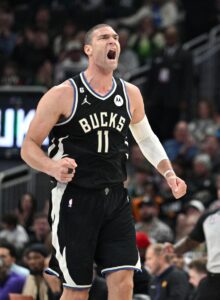 Lopez has been one of the NBA’s best stories this season, rebounding from a mostly lost season in 2021/22 after undergoing back surgery (he played just 13 regular season games and 12 playoff games). He’s having an outstanding year and has been a major factor in Milwaukee’s league-leading 44-17 record, averaging 14.7 PPG, 6.7 RPG and 2.4 BPG on .508/.370/.766 shooting through 60 games (30.3 MPG).
The veteran center, who is one of the leading candidates for Defensive Player of the Year, has said he hopes to remain with the Bucks, and the interest is reportedly mutual. Lopez has definitely earned a raise, but given his age (he turns 35 next month), I’d be a little surprised if he gets more than a two-year deal.
Khris Middleton, F, Bucks
- 2022/23: $37,948,276
- 2023/24: $40,396,552 (player option)
- Stock: Down
Middleton’s stock is down primarily due to injuries, which have limited him to 20 games to this point. The Bucks have been very cautious with the three-time All-Star, as he’s been coming off the bench lately and averaging his fewest minutes per game (21.5) since he was a rookie. However, despite the small sample size, it’s worth noting that the Bucks have been terrific with Middleton on the court – he has a plus-9.7 net rating, per NBA.com.
A career 38.9% three-point shooter, Middleton is making just 29.9% from deep this season, which has hurt his offensive efficiency (the rest of his shooting numbers are very close to career norms). That seems more like an aberration than a long-term concern.
The remaining 21 regular season games and how he fares in the postseason will likely determine whether or not the 31-year-old decides to pick up his player option for ’23/24. Let’s not forget that Middleton averaged 23.6 PPG, 7.6 RPG, 5.1 APG and 1.5 SPG during Milwaukee’s championship run a couple years ago — I would not be surprised at all if he bounces back from a disappointing season over the next few months.
Ayo Dosunmu, G, Bulls
- 2022/23: $1,563,518
- 2023/24: RFA
- Stock: Neutral
The 38th pick of the 2021 draft, Dosunmu had a strong rookie campaign, earning a spot on the All-Rookie Second Team after averaging 8.8 PPG, 2.8 RPG and 3.3 APG on .520/.376/.679 shooting in 77 games (40 starts, 27.4 MPG).
His numbers have been quite similar in year two, with the 23-year-old averaging 9.3 PPG, 3.2 RPG and 2.8 APG on .498/.316/.806 shooting in 60 games (49 starts, 28.1 MPG). Obviously the three-point percentage is down, which is unfortunate, and he hasn’t necessarily progressed from a statistical standpoint like some second-year players do.
Advanced stats aren’t very high on Dosunmu, and the Bulls have been better by a pretty significant margin when he’s not on the court. While Dosunmu may not have made a second-year leap, I still like his defensive potential and he reportedly has a strong work ethic and team-first attitude.
Dosunmu met the starter criteria, so the value of his qualifying offer increased to $5,216,324. It will be interesting to see how his restricted free agency plays out.
Hamidou Diallo, G/F, Pistons
- 2022/23: $5,200,000
- 2023/24: UFA
- Stock: Up
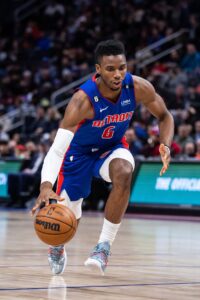 Diallo is challenging to evaluate because his strengths and weakness are more pronounced than most players. He is a non-shooting wing with pretty bad tunnel vision, which you would expect would make him ineffective in a league constantly looking for floor-spacers.
That isn’t the case. The 24-year-old is one of the most athletic players in the NBA and he plays with a tremendous amount of energy. He utilizes those strengths to play strong defense, crash the boards, drive, and catch lobs, and he’s been very effective at all of those things in ‘22/23.
The Pistons have an overall defensive rating of 117.6, which ranks 28th in the league. When Diallo is on the court, Detroit has the equivalent of the league’s fourth-best defense. He is shooting a career-high 58.1% from the field in large part because he is converting 71.8% of his attempts at the rim, per DunksAndThrees.com – a better mark than many centers.
Sometimes Diallo’s energy carries over into recklessness. He fouls too much and can be turnover-prone. Even if his game is polarizing, I think he deserves a raise, perhaps a deal in the range of $6-10MM per year.
Oshae Brissett, F, Pacers
- 2022/23: $1,846,738
- 2023/24: UFA
- Stock: Down
After averaging 9.6 PPG and 5.4 RPG on .428/.368/.716 shooting in 88 games (41 starts, 23.7 MPG) with Indiana from 2020-22, Brissett had an opportunity to establish himself as a reliable rotation player in a contract year. Unfortunately, that has not come to fruition.
The Pacers have been relatively weak at power forward all season. Brissett hasn’t helped much. He’s averaging 5.5 PPG and 3.4 RPG on .388/.333/.693 shooting in 49 games in ‘22/23, with his playing time cut back to 16.0 MPG. He has been a healthy scratch in seven of the last eight games.
Still just 24 years old, Brissett should land another (relatively small) deal in free agency — he’s a solid rebounder and defender. But those shooting numbers are a problem, and his stock is definitely down compared to the past couple seasons.
Wizards Waive Vernon Carey Jr.
The Wizards have officially waived big man Vernon Carey Jr., the team announced today in a press release.
Carey, who turned 22 on Saturday, has appeared in just 11 games this season for the Wizards and 14 overall since joining the team at the 2022 trade deadline in the Montrezl Harrell deal. The former Duke standout, who was drafted 32nd overall by the Hornets in 2020, has played in 37 total games for Charlotte and Washington, with career averages of 1.9 PPG and 1.4 RPG in 5.1 MPG.
Carey’s contract covered one additional season beyond this one, but the Wizards held a minimum-salary team option for 2023/24. By releasing him, Washington is essentially declining that option and will only be on the hook for the rest of this season’s $1.78MM salary, assuming Carey is not claimed on waivers.
The move will create an opening on the Wizards’ 15-man roster for another addition, and the club still has enough breathing room below the luxury tax line after signing Jordan Goodwin to fill that spot without becoming a taxpayer. Washington also still has an open two-way contract slot.
As for Carey, because he’s being waived on March 1, he’ll be playoff-eligible if he catches on with another NBA team. Given his lack of meaningful NBA experience though, it seems unlikely that he’ll be targeted by contenders.
Stephen Curry May Return During Warriors’ Upcoming Road Trip
2:29pm: The Warriors’ official update on Curry (via Twitter) states that he’s “making good progress” and has begun scrimmaging. The team doesn’t offer a specific timeline for his return, indicating that it will be based on how he responds to full practices and scrimmages.
1:04pm: There’s optimism that Warriors star Stephen Curry will be able to return to action sometime during the team’s upcoming road trip, reports ESPN’s Adrian Wojnarowski (via Twitter).
That three-game trip begins on Sunday afternoon in Los Angeles against the Lakers. The Warriors then travel to Oklahoma City to play the Thunder on Tuesday and to Memphis to face the Grizzlies next Thursday.
Curry has been unavailable since February 4 due to a left leg injury, and it sounds like he’ll miss at least two more games — Golden State hosts the Clippers this Thursday and the Pelicans on Friday.
The Warriors lost four of their first six games after Curry went down, but have perked up in the last week, winning consecutive home contests against Houston, Minnesota, and Portland. The Dubs have actually moved up to No. 5 in the West, though their record (32-30) is modest and there are only 3.5 games separating them from the No. 13 Thunder, so a couple losses could significantly affect the club’s place in the standings.
Curry was putting up his usual All-NBA numbers prior to his injury, averaging 29.4 points, 6.4 assists, and 6.3 rebounds in 38 appearances (34.6 MPG) and making 42.7% of 11.4 three-point attempts per night. It goes without saying that his return would provide a major boost for the Warriors, putting the team in a good position to secure a playoff spot in the final few weeks of the season.
Pacific Notes: Davis, Lakers, Fox, Clippers
With LeBron James expected to be sidelined for the foreseeable future, the Lakers need the version of Anthony Davis they got in the bubble in 2020, who can “single-handedly change games on the defensive end,” writes Chris Mannix of SI.com.
Although the Lakers lost in Memphis on Tuesday, they got Davis at his best in that game, according to Mannix, who points to the big man’s stat line (28 points, 19 rebounds, and five blocks) as one he’ll have to replicate a few more times if Los Angeles is going to move up the standings and clinch a play-in or playoff spot.
Unfortunately for the Lakers, Davis won’t be available in Oklahoma City on Wednesday night. As Mannix relays (via Twitter), the team announced today that Davis (right foot stress injury) will join James and D’Angelo Russell (right ankle sprain) on the sidelines, leaving L.A. shorthanded in a crucial game. The Thunder will be without Shai Gilgeous-Alexander, who entered the NBA’s health and safety protocols this week.
Here’s more from around the Pacific:
- The Lakers certainly aren’t throwing in the towel following James’ injury diagnosis. Head coach Darvin Ham said on Tuesday that the team remains focused on winning enough games to claim at least a play-in spot and ideally a top-six seed in the West. “The mission hasn’t changed for us, so the goal of securing a playoff spot is still very much alive,” Ham said, per Kyle Goon of The Southern California News Group. “It’s unfortunate that ‘Bron went down, but injuries are a real part of our sport and it’s next man up. You got to step up and hold down the fort until he returns.”
- The Kings got good news on Tuesday night, as the MRI on De’Aaron Fox‘s sore left wrist revealed no significant damage, according to Chris Biderman of The Sacramento Bee (Twitter link). Fox, who was out for Tuesday’s game, is day-to-day and Sacramento is optimistic that he won’t miss much – if any – more time.
- The Clippers have lost three consecutive games since the All-Star break and are still trying to figure out how to best use their recently added veterans, including point guard Russell Westbrook, writes Andrew Greif of The Los Angeles Times. As Greif outlines, Eric Gordon, Norman Powell, and Terance Mann are among the players whose roles still need to be sorted out, and head coach Tyronn Lue will have to determine whether to continue starting Marcus Morris, who has struggled as of late and played just 21 minutes in Tuesday’s loss. “We definitely do feel that we have the deepest team,” Gordon said, “but … the chemistry has to be there.”
Suns Notes: Crowder, Okogie, Warren, Payne, Bridges
A rift with head coach Monty Williams over the loss of his starting spot led to the end of Jae Crowder‘s time with the Suns, writes Jake Fischer of Yahoo Sports. Williams informed Crowder during the offseason that Cameron Johnson would be replacing him in the starting lineup, sources told Fischer. While Crowder didn’t go into detail, he confirmed that a strained relationship with Williams prompted him to ask for a trade.
“Yeah, we had differences,” Crowder said. “They asked me to keep it in-house, I’ll keep it in-house. I’m now gone, same thing I’ve told everybody else: I’ve moved on from the situation. I wish them the best, I’m leaving that behind.”
Crowder was initially on track to be shipped to the Nets as part of the Kevin Durant trade, but he ultimately wound up with the Bucks, who had been attempting to acquire him from the Suns. Phoenix gave permission to Milwaukee to meet with Crowder, and several trade scenarios had been discussed that included players such as Grayson Allen, Serge Ibaka, George Hill and Jordan Nwora.
“I landed where I wanted to land at the end of the day,” Crowder said. “I think I gained just knowing myself as a player and my mental. I never wavered. Never wavered on the process. From a month, to two months … I stayed with the plan of what it was and what I wanted to accomplish. So I give kudos to my mental and me staying sane throughout the entire process, because I did want the process to end fairly sooner than when it did.”
There’s more on the Suns:
- Phoenix will undergo a major lineup change tonight when Durant makes his debut with the team, and it appears Josh Okogie will be the fifth starter alongside Durant, Chris Paul, Devin Booker and Deandre Ayton, according to Duane Rankin of The Arizona Republic. Okogie has made five consecutive starts and is averaging 18.5 points and 5.8 rebounds over his last six games while shooting 53.4% from the field. “We’ve been looking forward to (Durant’s first game) since the trade, but we had to wait a little bit,” Okogie said. “We’re excited to finally get him in the mix of things, show him how we play. Show him the love that we play with, the passion and the unselfishness that we play with.”
- T.J. Warren hasn’t played in the two games since the All-Star break, Rankin notes in another Arizona Republic article. Warren was productive in Brooklyn, but Williams points out that he’s already using a 10-man rotation and someone else will be bumped now that Durant is active.
- Tania Ganguli of The New York Times looks at the long friendship between Cameron Payne and Mikal Bridges, who are no longer teammates since Bridges was sent to Brooklyn in the Durant deal.
Sixers Notes: Tucker, Butler, McDaniels, Embiid
P.J. Tucker seemed like a perfect fit during his lone season with the Heat, but he couldn’t turn down the three-year, $33MM offer he got from the Sixers last summer, writes Anthony Chiang of The Miami Herald. The 38-year-old forward said he expected to retire with Miami, but the realities of NBA business pushed him toward Philadelphia.
Multiple sources tell Chiang that the Heat wanted to re-sign Tucker, but they only offered $26.5MM over three seasons through their Non-Bird exception. Miami could have used its $10.5MM non-taxpayer mid-level exception to match the offer from Philadelphia, but passed on the opportunity because of Tucker’s age and the limits the deal would have placed on other potential moves.
“I wanted the full mid-level,” Tucker said. “I thought I deserved the full mid-level and that was something that I wanted. They knew that coming out of the gate. I expressed that I wanted that from the beginning. I feel like for what we did, for what we had, I feel like I deserved that and it just is what it is. But I don’t fault them at all. I understand they didn’t want to be hard-capped and wanted to be able to make moves later with whatever they thought the team may need.”
There’s more from Philadelphia:
- Jimmy Butler keeps reminding the Sixers why it was a mistake to trade him, observes Keith Pompey of The Philadelphia Inquirer. Butler knocked Philadelphia out of the playoffs last season, and he contributed several clutch plays on Monday as the Heat pulled out a narrow road win. Pompey notes that the Sixers haven’t advanced past the second round of the playoffs since sending Butler to Miami in 2019.
- Jalen McDaniels is learning to adjust after being traded to the Sixers at last month’s deadline, Pompey writes in another Inquirer story. Through six games, McDaniels is seeing less playing time and fewer scoring chances than he did with the Hornets. “I will say when I was in Charlotte, (there were) more opportunities with the ball in my hand more,” he said. “But here you have three guys (Joel Embiid, James Harden and Tyrese Maxey) that are going to take most of the shots. So just me playing off them is something I can do that’s probably part of my game as well. So I feel like it’s a plus, even though I’m not touching it as much as I was in Charlotte.”
- Joel Embiid has been through a series of demoralizing defeats during his time in Philadelphia, but he hasn’t demanded a trade or lost faith in the organization, as Ben Golliver of The Washington Post details.
Rockets Notes: Harden, Green, Porter, Kaminsky
The possibility that Sixers guard James Harden might return to Houston in free agency this summer remains as strong as ever, writes Kelly Iko of The Athletic. League sources expect the Rockets, who will have ample cap space, to aggressively pursue Harden once he turns down his $35.64MM player option. Sources close to Harden confirm to Iko that he’s considering the move.
Harden forced his way out of Houston two years ago after the loss of coach Mike D’Antoni and general manager Daryl Morey. His relationship with the organization appeared confrontational — he reported late and out of shape to training camp and having numerous clashes with coaches and teammates — but sources tell Iko that it never became acrimonious. Harden was disappointed that the Rockets were no longer contenders, and management was unhappy with how he handled the situation.
Harden still has a good relationship with team owner Tilman Fertitta and has maintained strong ties in the Houston area, Iko adds. Also, former Sixers minority owner Michael Rubin, a good friend of Harden’s who played a role in his desire to come to Philadelphia, sold his stake in the team last June.
Money will be an important factor in Harden’s decision, Iko notes, which gives the Sixers an advantage. Holding his Bird rights, they can offer up to a projected $272MM over five years, while Houston and any other potential suitor will be limited to four years at about $202MM. Iko states that if he stays in Philadelphia, Harden will expect to be compensated for taking a deal below his market value last summer to help the team sign several free agents.
There’s more from Houston:
- After returning Tuesday from a groin injury, Jalen Green is thankful that the damage wasn’t worse, writes Jonathan Feigen of The Houston Chronicle. The injury sidelined the second-year guard for two weeks and forced him to miss the Rising Stars event at All-Star Weekend. “I actually called Coach the other day and was just telling him, ‘The last 24 games, I’m with you,’” Green said. “’I’m ready to lock in. Whatever we’ve got to do, we’ve got to string together some wins.’”
- Coach Stephen Silas is optimistic that Kevin Porter Jr., Green’s backcourt partner, will be able to return Wednesday night, Feigen tweets. Porter has been out of action since January 11 with a foot contusion.
- Today is the last day that players can agree to a buyout and still be eligible for the postseason with their new team, which makes it significant for Frank Kaminsky, notes Ben DuBose of RocketsWire. Of the four veteran players the Rockets acquired at the trade deadline, Kaminsky is the only one left on the roster — John Wall, Danny Green, and Justin Holiday were all released.
Heat Notes: Lowry, Dragic, Jovic, Yurtseven
Kyle Lowry will miss his 10th straight game Wednesday due to knee soreness, but the Heat haven’t been aggressively pursuing another point guard in the buyout market, writes Barry Jackson of The Miami Herald. Lowry was flown to Philadelphia on Sunday and took part in a practice in hopes of playing Monday. He was briefly upgraded to questionable before being ruled out.
Jackson cites several factors for the team’s lack of urgency to find a replacement for Lowry, even with Russell Westbrook, Patrick Beverley and Reggie Jackson all receiving buyouts and John Wall still on the market. Heat officials remain confident that Lowry will eventually return and can still play at a high level, and they’re happy with how Gabe Vincent has performed in his absence.
Miami also believed it had greater needs in the frontcourt, Jackson notes, which is why Kevin Love and Cody Zeller were prioritized on the buyout market. The front office looked into Westbrook, a source tells Jackson, but decided not to pursue him due to deficiencies on defense and with three-point shooting, as well as a negative review from a league insider.
Jackson hears that the Heat also had interest in Kyrie Irving when he asked the Nets for a trade, but management wasn’t unanimous in believing he would be a good addition. Miami never aggressively pursued a deal with Brooklyn, according to Jackson’s sources.
There’s more from Miami:
- Longtime Heat point guard Goran Dragic may seem like an obvious target after being waived by the Bulls Tuesday, but Jackson doesn’t expect him to wind up in Miami. He and the team still have a good relationship, but sources tell Jackson there are more likely destinations, including the Mavericks, where he could team with fellow Slovenian Luka Doncic.
- After falling into seventh place during a recent losing streak, the Heat will open a crucial six-game home stand Wednesday as they try to avoid the play-in tournament, writes Anthony Chiang of The Miami Herald. It’s not a position the team expected to be in, but Udonis Haslem said players are focused on landing a top-six spot. “I don’t operate well in losing spaces. I’m tired of losing like Jimmy (Butler),” Haslem said. “We just got to keep fighting, though. We got a locker room full of fighters, we got a locker room full of guys who have built their reputation off hard work and they wouldn’t be here without that. So we got to go back to our roots and what got us here — busting our [butt] and working hard.”
- The Heat have assigned Nikola Jovic and Omer Yurtseven to their G League affiliate as they try to return from injuries, tweets Anthony Chiang of The Miami Herald. Jovic has been sidelined since late December with a back injury, while Yurtseven is rehabbing from ankle surgery that has kept him out all season.
Tyler Dorsey Signs With Fenerbahce
Former Mavericks guard Tyler Dorsey has officially signed with Fenerbahce, the Turkish team announced today in a press release.
According to the club, the deal will cover the next two seasons beyond this one, running through 2024/25. Sources tell Bugra Uzar of Eurohoops that the agreement isn’t expected to include NBA outs.
A former college standout for an Oregon team that made it to the Final Four in 2017, Dorsey thrived in the EuroLeague from 2019-22 while playing in Israel for Maccabi Tel Aviv and in Greece for Olympiacos. The 27-year-old’s success overseas led to a two-way deal with the Mavericks this past offseason, but he failed to crack Dallas’ rotation, appearing in just three games at the NBA level before being waived in late December.
Dorsey, who saw extensive action in the G League for the Texas Legends both before and after he was cut by the Mavs, performed at a high level during the Showcase Cup in the fall, averaging 24.3 points per game on .463/.470/.840 shooting in 17 appearances (32.5 MPG). His scoring efficiency slipped a little during the NBAGL regular season, as he averaged 18.9 PPG on .396/.370/.800 shooting in 12 contests (30.7 MPG).
The Legends granted Dorsey his release last week, allowing him to return overseas before the EuroLeague’s March 1 deadline to register new players. He’s joining a Fenerbahce team that features former NBA players Carsen Edwards, Johnathan Motley, and Nick Calathes, among others.
Trade Breakdown: Lakers/Jazz/Wolves Three-Team Blockbuster
This is the fourth entry in our series breaking down the significant trades of the 2022/23 season. As opposed to giving out grades, this series explores why the teams were motivated to make the moves. Let’s dive into a blockbuster deal between the Jazz, Lakers and Timberwolves.
On February 9, the Lakers acquired D’Angelo Russell, Malik Beasley and Jarred Vanderbilt; the Jazz acquired Russell Westbrook, Damian Jones, Juan Toscano-Anderson and the Lakers’ 2027 first-round pick (top-four protected); and the Timberwolves acquired Mike Conley, Nickeil Alexander-Walker, and three second-round picks (one from L.A., two from Utah).
Notes: Westbrook subsequently reached a buyout agreement with the Jazz and signed with the Clippers. All three teams involved in this deal generated traded player exceptions, which can be found right here.
The Jazz’s perspective:
The Jazz weren’t invested in continuing the season with their current roster, despite a surprisingly fun ride in a year that they were expected to be at the bottom of the standings.
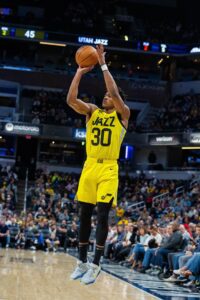 The move opened up playing time for Ochai Agbaji, Collin Sexton and Talen Horton-Tucker, three young players who had been in and out of the lineup (Sexton has been a rotation regular, but he’s dealt with injuries – this deal moved him into the starting lineup). Vanderbilt had already been moved to the bench due to the emergence of Walker Kessler, and the two were an awkward fit together offensively because neither is much of a threat to shoot (Vanderbilt compensates for his lack of shooting somewhat by being a good passer and ball-handler for a power forward).
Many fans think the Jazz “lost” this deal. That perception seems to stem from two things: the Lakers only giving up one first-rounder, when it was assumed they’d have to move off one just to trade Westbrook’s $47.1MM expiring salary, and the Jazz’s asking prices not being met.
The Jazz were reportedly looking for first-round picks for all three of Conley, Beasley and Vanderbilt. But that was never a realistic expectation.
Based on the structure of the deal, it’s pretty clear the Jazz were motivated to move off Conley’s contract for ‘23/24, which is partially guaranteed at $14.32MM ($24.36MM base salary), and didn’t at all mind adding Westbrook’s expiring deal to do it (it’s worth noting that the Jazz did add Jones’ $2.6MM player option for next season, which will almost certainly be exercised; Toscano-Anderson is on an expiring minimum-salary deal). I viewed Conley’s contract as having negative value leading up to the trade deadline, as he’ll turn 36 years old next season and has already declined on both ends of the court, particularly defensively.
Beasley provides something that every team wants: high volume 3-point shooting. However, he’s a very streaky shooter, and doesn’t offer a ton in other areas. He makes $15.56MM this season with a $16.52MM team option for ‘23/24. I thought Beasley had slightly positive value, but nothing special – maybe a heavily-protected first-round pick or a few seconds.
Vanderbilt was the player who had the most value of the three, in my opinion, due to his age (23), rate of improvement, versatility, strong defense, and team-friendly contract – he makes $4.37MM this season and $4.7MM in ‘23/24 (only partially guaranteed at $300K). I thought Utah could get a late first-rounder this season or a lottery-protected first in the future for him.
In aggregate, that’s one player with solid value, one with slightly positive value, and one with negative. Not a ton of overall value despite the three being rotation players for a decent team.
Obviously, the Jazz highly valued the lightly protected pick from the Lakers. Even in a scenario where the Lakers have the worst record in ’26/27 (they probably won’t, but you never know), there would still be a 47.9% chance the pick lands at fifth overall and goes to Utah. The major downside – and the upside for the Lakers – is if it does fall in the top four, the Jazz only receive the Lakers’ 2027 second-rounder.
Another factor in this trade from Utah’s side of things that I thought was interesting is also pretty cynical. If the Jazz believe Minnesota going from Russell to Conley is a downgrade — and it is at this point in their careers, which is why the Wolves got second-rounders back — then that increases the odds of the Wolves missing the playoffs. In that scenario, the Jazz would get a lottery pick in 2023 (they control Minnesota’s pick due to the Rudy Gobert trade).
They could also reasonably view the deal as a short-term upgrade for the Lakers, which would increase L.A.’s odds of passing Minnesota and Utah in the standings, and thus increase the odds of the Jazz controlling two lottery picks. For the rest of the season, the better the Lakers do and the worse the Wolves and Jazz do, the better it is for the Jazz as far as those first-rounders go.
The Jazz held out for a long time to get the best deal they could. This turned out to be it.
The Lakers’ perspective:
I think the Lakers made out well in this deal, but it did reduce their draft arsenal to go for a star in the future (that may or may not have been realistic). Still, they upgraded their roster, got younger, and the players make sense for what they need.
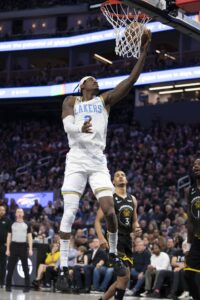 Los Angeles replaced one player who was a poor fit and two little-used reserves for three potential starters; at worst they’re rotation regulars. None of the outgoing players were shooters, and they picked up a couple pretty good ones.
Russell, 27, is having a strong year from an efficiency standpoint, shooting career highs from all over the court (54.3% on twos, 38.9% on threes, 85.0% from the line). However, he is not a great rebounder or defender, and his decision-making can be questionable as a lead ball-handler.
That’s less of a concern with the Lakers, as he can play alongside James and/or Dennis Schroder. That allows Russell to function both on and off the ball, which is ideal for his skill set. Unfortunately, he sprained his ankle in his fourth game back with Los Angeles, but the injury isn’t considered a long-term concern.
As I’ve mentioned previously, Beasley is a feast-or-famine type shooter who can go off at any given time. It’s a bit of roller coaster ride watching him from game-to-game because you never know if he’s going to be on that day or not, and he doesn’t stop shooting even if he’s off.
While he doesn’t provide a whole lot else, opponents treat the 26-year-old like a sharpshooter who has to be accounted for at all times, and that creates space for teammates. The Lakers didn’t have anyone like that on the roster before the deal, even if Beasley is more of a very willing good shooter than a great one.
Vanderbilt is the player I think fans will be most excited about of the three, despite being the least well known. He brings a much-needed infusion of speed, length, defensive versatility, hustle and rebounding the team has lacked all season.
Still just 23 years old, Vanderbilt instantly becomes the best wing defender the Lakers have had since they decided not to re-sign Alex Caruso in 2021 free agency. His energy is infectious and can swing the tide of games – he was absolutely instrumental in the team’s huge comeback victory over Dallas on Sunday.
The three players were teammates on the Wolves from 2020-22, so they already have some built-in chemistry (strangely, Beasley and Vanderbilt have now been packaged together in three separate trades). Only Vanderbilt has a small partial guarantee for next season, which gives the Lakers the flexibility to move on from any of them in the offseason, though I think that’s unlikely.
Another positive aspect of the deal is the Lakers added more desirable contracts. Almost their entire roster was on minimum- or maximum-salary deals before the deadline, but now they have more variety in that regard, assuming they retain all three players.
I don’t think this trade suddenly transformed the Lakers into title contenders this season, but I do think it made them much better than they were — now and going forward.
My biggest question mark from the Lakers’ side is, if this trade was available in February, could they have done it earlier in the season? Because they have to dig themselves out of a hole to climb up the standings, and there aren’t many games left in which to do it – a task made even more difficult by the foot injury to James.
The Wolves’ perspective:
One of the downsides of dealing away multiple starters at once — Patrick Beverley and Vanderbilt last year in the Gobert trade — is that it can erode a team’s chemistry. The Wolves clearly got on well last season. That matters for a young team, especially one that historically has been a bottom dweller in the standings.
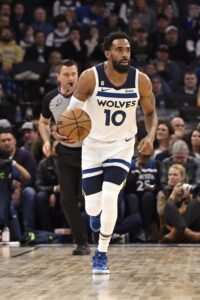 The Gobert trade upended that chemistry, transforming a fun up-and-coming team with low expectations into a win-now team with high expectations. It’s pretty clear some of the remaining players were less than thrilled with the deal, especially at the start of ‘22/23. Some moved on and slowly learned how to work with Gobert. Some did not.
Russell was in the latter group. He frequently had terrible body language this season, specifically anytime Gobert made a mistake (fumbled passes, etc.).
Perhaps more than anything else, this deal was a pretty clear vote of no confidence in Russell. Obviously, the Wolves did not value him at whatever he was asking for in contract extension negotiations.
The Wolves could not have easily cleared a significant amount of cap space in the offseason even if they had let Russell walk in free agency. Instead, they decided to push that decision a year down the line and replace his salary slot with Conley, a mature veteran who should be able to provide leadership for a team that, from the outside looking in, is lacking in that department.
Minnesota is trying to remedy some of the chemistry issues by adding a calming, professional locker-room presence in Conley. The fact that Conley played with Gobert for three seasons was obviously a motivating factor as well. They already have some built-in chemistry, which was clearly lacking with Russell.
He’s also a much better decision-maker than Russell on the court, with his assist-to-turnover ratio at 4.4-to-1, which ranks fifth in the NBA (Russell’s is 2.31-to-1, which ranks 112th). That’s important for a Wolves team that ranks 28th in the league in turnovers per game.
I have a lot of respect for how Conley carries himself, both on and off the court. He was one of the league’s most underrated players during his 12 years with Memphis, and his teams have consistently been better when he’s playing — that was true for Utah this year too (better on offense and worse on defense, but still plus overall). He has a high basketball IQ and generally doesn’t beat himself with careless mistakes.
Alexander-Walker was likely more of a throw-in for salary-matching purposes, but the Wolves will get a closer look at him for the rest of the season (he can be a RFA if they give him a qualifying offer). The former 17th overall pick is having a solid year from an efficiency standpoint and has impressed me in some late-game situations with his defense, even if he wasn’t consistently in Utah’s rotation.
While I understand the logic behind the move from Minnesota’s side of the deal, I also think the Wolves took on the most short- and long-term risk.
Make no mistake, the Wolves knew this was was a downgrade from a production standpoint — that’s why they got back three second-round picks in the deal. Considering his age, size (6’1″, 175 pounds) and contract, if Conley declines any further, it will be very difficult to move him next season.
Russell may have his flaws, but he was also clutch this season, having bailed them out on several occasions during second-half collapses (a season-long problem). He was the team’s second-leading scorer with Karl-Anthony Towns sidelined for most of the season, and removing him from the equation puts a lot of pressure on the rest of the roster to replace Russell’s scoring – the Wolves are just 21st in the league in offensive rating.
The early returns haven’t been promising. Minnesota has gone 1-4 since the deal was finalized, though in fairness some key rotation players have been in and out of the lineup.
The key takeaway from the Wolves’ end is that they preferred to get something back for Russell rather than losing him for nothing in free agency. Not wanting to make a significant investment in Russell makes sense to me if they didn’t view him as a long-term fit. Still, if they miss the playoffs and the Jazz get extremely lucky and that pick lands early, it would be an unmitigated disaster for Minnesota.