
Hoops Rumors Glossary: Tax Variance
The term “tax variance” doesn’t technically show up in the NBA’s Collective Bargaining Agreement, but it’s used colloquially to refer to instances in which a team’s salary for the purposes of calculating its end-of-season luxury tax bill diverges from its standard salary relative to the cap.
This can occur for a number of reasons, including player suspensions, incentives being met (or not), and certain free agent signings. Here’s a breakdown of how each of those occurrences affect a team’s salary for tax purposes:
Suspensions
When a player is suspended by the NBA, he forfeits a percentage of his salary. That percentage ranges from as low as 1/174th for a standard one-game suspension to as high as 1/91.6th for a suspension related to a failure to render services.
In each instance, a team receives a tax variance credit for 50% of the player’s forfeited salary. That means that if a player loses $1MM as a result of a suspension, his team receives a tax variance credit worth $500K.
That amount doesn’t come off the player’s cap hit or the standard team salary, which remain the same for the rest of the season. But for the purposes of calculating a team’s tax bill at the end of the season, the club’s total taxed salary is reduced by $500K as a result of the suspension.
The tax variance credit doesn’t apply to a suspension imposed by the player’s team, since it could open the door for clubs to try to reduce their tax bills or duck the tax entirely by suspending their players.
 A player still forfeits a portion of his salary when he’s suspended by his team (subject to appeal), but his team doesn’t generate any cap or tax savings.
For instance, when the Heat suspended Jimmy Butler for seven games, it cost him $2,355,798 (7/145ths of his $48,798,677 salary), but it didn’t change Miami’s cap or tax situation at all.
Unlikely incentives that are earned / Likely incentives that go unearned
When a player’s contract includes incentives, they’re considered either “likely” or “unlikely” to be earned. Likely incentives count toward a player’s cap hit for that season, while unlikely incentives don’t.
An incentive is deemed likely or unlikely based on whether or not the player and/or his team met the incentive criteria the previous season. So if a player’s contract calls for a bonus if his team wins the title, he’s considered “likely” to earn it if his team won the championship the year before — even if, in reality, his team isn’t literally likely to repeat.
Here’s a more detailed example. Let’s say a player has a $20MM annual base salary, plus a $1MM incentive if his team wins at least 40 games, another $1MM incentive if his team makes the playoffs, and a third $1MM incentive if he appears in at least 65 games.
If the player appeared in 70 games the prior season and his team finished 41-41, missing the playoffs, he would’ve earned two of those three $1MM bonuses. That means that for the subsequent season, his cap hit would be $22MM, with $2MM in likely incentives counting against the cap and $1MM in unlikely incentives not counting toward his cap charge.
That $22MM is the player’s cap hit for the rest of the season, but his team is subject to tax variance depending on whether or not he earns those incentives again. If the player appears in just 50 games and his team wins 35, missing the postseason, he’d miss out on all three bonuses and his team would receive a tax variance credit of $2MM for the two likely incentives he didn’t end up earning.
Conversely, if the player stays healthy, appears in 75 games, and leads his team to a 50-win season and a playoff berth, he’d earn all of his incentives, including the $1MM that had been considered unlikely. That tax variance would be taken into account for the team, with $1MM being added to its salary for the purposes of calculating its tax bill.
If we assume our hypothetical team entered the season with its player counting toward the cap for $22MM and its total salary at $180MM, tax variance could result in that total ending up as low as $178MM or as high as $181MM by the end of the season, which could significantly change the team’s final tax payment.
Signings of free agents with fewer than two years of NBA service
A rookie’s minimum salary is significantly less than that of a veteran player. But a team looking to duck the tax while filling out its back-end roster spots can’t simply sign a handful of rookie free agents to maximize its savings.
When a player with fewer than two years of NBA service signs a free agent contract worth less than a two-year veteran’s minimum salary, tax variance applies — for tax purposes, that player counts for the same amount that a two-year veteran on a minimum deal would.
The rookie minimum salary for 2024/25 is $1,157,153, whereas the minimum for a two-year veteran is $2,087,519. If a team signed a rookie free agent to a minimum-salary contract this season, that player’s salary and cap hit would be just $1,157,153, but he would count for $2,087,519 toward the tax.
If that player signed a two-year, minimum-salary contract, his salary and cap hit in 2025/26 would be $1,955,377, but he’d count for $2,191,897 toward the tax (those figures can be found in the second column of our minimum-salary chart).
Because this tax variance only applies to free agents, teams can avoid it by signing a rookie draft pick to a minimum-salary contract. That’s why we often see taxpaying clubs prioritize second-round picks — they can use those selections to draft a player who will sign a rookie minimum contract and actually have that modest rookie-minimum figure count for tax purposes. Tyler Smith of the Bucks and Oso Ighodaro of the Suns are a couple 2024 second-rounders on second-apron teams who fall into this category.
It’s worth noting that the same rule applies when a team is converting a player to a standard contract from a two-way deal. If the player was initially signed as a draft pick, tax variance won’t apply to him. If he signed as a free agent, it will.
This is why the Knicks, when they were looking to remain below their hard cap while filling out their roster back in the fall, had the option to convert Ariel Hukporti or Kevin McCullar (both 2024 second-rounders) from two-way deals to rookie-minimum contracts to stay below the hard cap, but couldn’t do so with Jacob Toppin, who signed initially as a free agent. Tax variance would’ve applied to Toppin, who would’ve counted for tax (and apron) purposes as if he were a veteran free agent, even though he only had one year of NBA service on his résumé.
New York ultimately converted Hukporti, whose prorated minimum deal is worth just $1,064,049 for cap, tax, and apron purposes.
Note: This is a Hoops Rumors Glossary entry. Our glossary posts will explain specific rules relating to trades, free agency, or other aspects of the NBA’s Collective Bargaining Agreement. Information from ESPN’s Bobby Marks was used in the creation of this post.
Knicks Notes: Bridges, Towns, Hart, Shamet, Robinson
Traded from Brooklyn to New York over the summer, Knicks forward Mikal Bridges has had to adjust to new roles on both sides of the ball this season, as Chris Herring writes for ESPN.com.
On offense, Bridges is handling the ball significantly less than he did with the Nets, with his touches down nearly 20% and his usage rate easily the lowest it’s been since his last full season in Phoenix. On the other end of the court, he has often served as the point-of-attack defender on guards rather than being assigned to bigger wings, which means he’s spending more time chasing smaller players around screens.
“Teams wanted to try attacking him, because it was a different spot for him; especially early on,” one Western Conference scout said to Herring. “If you got past him initially, you could force all sorts of aggressive rotations because the team was still getting used to having (Karl-Anthony) Towns at the rim. And the collective trust didn’t look like it was there.”
While Bridges’ transition remains a work in progress, his offensive numbers have rebounded following an up-and-down start. Since the start of December, he has averaged 20.0 points per game on .523/.385/.757 shooting. He’ll face his old team on Tuesday in the Knicks’ first visit to Brooklyn this season.
“It’ll be just good to be back,” Bridges said on Monday, per Stefan Bondy of The New York Post. “To see my teammates and the coaching staff that was there for a couple months before I got traded. See the staff and everybody. Good energy.”
Here’s more on the Knicks:
- Towns, who missed a pair of games due to a bone chip in his right thumb, was back in action on Monday against Atlanta. Josh Hart was also active after initially being listed as questionable due to a cervical compression that he said had been bothering him for a little while and was aggravated on Friday, according to Bondy. Towns’ injury appeared to be affecting his shot – his 27.8% mark from the field (5-of-18 shooting) was his worst of the season – but both players made it through the contest without setbacks. They’re listed as probable to play against Brooklyn on Tuesday, tweets Bondy.
- Head coach Tom Thibodeau expanded his rotation from eight players to nine on Monday, with Landry Shamet earning 10 minutes off the bench after a pair of DNP-CDs, writes Ian Begley of SNY.tv. Bridges was the biggest beneficiary of the move, logging just 27 minutes, well below his season average (a league-high 38.7 MPG). “It’s nice, man,” Bridges said, according to Bondy. “We got a lot of players, 1 through 15. So it’s good.”
- Mitchell Robinson, who said just a few days ago that he was down to 268 pounds, said on Monday that he’s now at 265, according to Bondy, who suggests the big man’s weight is notable due to his struggles with fitness and conditioning coming off injuries. According to Begley, he hasn’t heard anything to contradict the “internal hope/belief” that Robinson could return to action in early- to mid-February.
Minimum-Salary Players Who Can’t Be Acquired Using Minimum Salary Exception
As we explain in our glossary entry, the NBA’s minimum salary exception doesn’t just allow over-the-cap teams to sign players to minimum salary contracts. It also allows clubs to trade for players earning the minimum without having to send out any matching salary.
As long as the player’s salary doesn’t push a team’s salary above its hard cap, any club is permitted to use the minimum salary exception to acquire a player via trade, regardless of its proximity to the tax aprons.
However, not every player earning the minimum can be acquired using the minimum salary exception. Essentially, any contract that couldn’t have been signed using the minimum salary exception also can’t be acquired using the exception.
For instance, since the exception only allows teams to sign players to one- or two-year contracts, similar rules apply in trades. A team can’t use the minimum salary exception to acquire a player on a three- or four-year contract, even if he’s earning the minimum. If a player signs a two-year contract that exceeds the minimum in year one and is worth the minimum in year two, he’s ineligible to be acquired using the minimum salary exception.
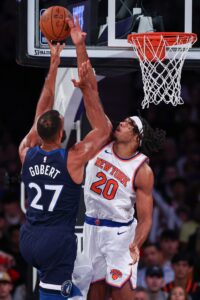 What does that mean in practical terms? Let’s use Knicks center Jericho Sims as an example, since his name has come up as a possible trade candidate.
Sims is earning $2,092,344 this season, which is his minimum salary based on the contract he signed in 2022. Since he’s currently in the third season of a three-year contract though, a team acquiring him can’t absorb his salary using the minimum salary exception.
That team, assuming it’s over the cap, would either have to send out a player to match Sims’ $2,092,344 salary or use an exception to take it on — it wouldn’t necessarily have to be a trade exception, since the non-taxpayer mid-level exception, bi-annual exception, or room exception could also work.
If Sims were on a one- or two-year minimum salary contract, he could be traded straight up for, say, a draft pick without his new team requiring a trade exception or an outgoing salary. That’s the case for a trade candidate like Pelicans wing Javonte Green, who is on a one-year minimum deal.
This rule shouldn’t be a major impediment for any transactions this season, since most teams have some form of exception available for a small trade, and those that don’t should have at least one expendable minimum-salary player to send out for matching purposes.
However, certain teams, including those operating above the second apron, will have far fewer pathways to acquire even this sort of low-cost player. So it’s worth keeping tabs on players like Sims who fit the bill, since it could affect how certain deals are constructed at this season’s deadline.
Here’s the list of players earning the minimum salary who can’t be acquired using the minimum salary exception in 2024/25:
Atlanta Hawks
Boston Celtics
Brooklyn Nets
Chicago Bulls
Cleveland Cavaliers
Dallas Mavericks
Denver Nuggets
Golden State Warriors
Indiana Pacers
Los Angeles Clippers
Los Angeles Lakers
Memphis Grizzlies
Miami Heat
Milwaukee Bucks
Minnesota Timberwolves
New Orleans Pelicans
New York Knicks
Oklahoma City Thunder
Orlando Magic
Philadelphia 76ers
Phoenix Suns
Portland Trail Blazers
Sacramento Kings
San Antonio Spurs
And-Ones: MVP Race, Maledon, Flagg, Dybantsa
The NBA’s Most Valuable Player race for this season already looks like it’ll be a two-man race, according to Zach Harper of The Athletic, who points to the current betting odds as evidence.
BetOnline.ag currently lists Thunder guard Shai Gilgeous-Alexander as the frontrunner at -400, followed relatively closely by Nuggets center Nikola Jokic at +250. After those two, Giannis Antetokounmpo of the Bucks is all the way down at +4000, with Celtics forward Jayson Tatum at +5000.
Last season’s MVP Jokic and Gilgeous-Alexander were among the three finalists for the award in 2024 alongside Mavericks guard Luka Doncic, who has already missed more than 17 games, taking him out of the running due to the 65-game rule. 2023 MVP Joel Embiid will also fall short of 65 games and has been eliminated from contention.
Here are a few more odds and ends from around the basketball world:
- Tony Parker, the president of ASVEL Basket in France, said during an interview with RMC Sport (YouTube link) that he believes current ASVEL standout Theo Maledon will receive NBA offers in the offseason, as Johnny Askounis of Eurohoops relays. Maledon, who previously played 177 regular season NBA games for three teams from 2020-24, has averaged 18.0 points and 4.5 assists per game in 22 EuroLeague outings this season, posting a shooting line of .457/.387/.889.
- Within the same interview, Parker expressed interest in getting ASVEL involved in the NBA’s rumored foray into European basketball, Askounis notes. “When you see what the NBA is doing, they are very strong. Whether it is marketing or the new TV rights contract that will start next year,” Parker said. “We need to be associated with that. I want there to be NBA Europe and for us to be part of it.”
- Duke standout Cooper Flagg has solidified his place atop the 2025 NBA draft class with his recent play, according to Sam Vecenie of The Athletic, who says Flagg’s performance over the past month – 23.4 PPG, 6.9 RPG, 4.6 APG, and a .561/.500/.881 shooting line – is arguably the best stretch for a college freshman since Zion Williamson was a Blue Devil.
- Meanwhile, Jared Weiss of The Athletic checks in on some of 2026’s best prospects, including A.J. Dybantsa and Cameron Boozer, who were taking part in the Hoophall Classic in Springfield, Mass. over the weekend. While Dybantsa wasn’t at his best during the event, Weiss says he spoke to multiple scouts who believe the 6’9″ wing could eventually become the NBA’s second-best player behind Victor Wembanyama.
Lakers Rumors: Trade Deadline Approach, Vanderbilt, Reaves
With the February 6 trade deadline approaching, the Lakers could take one of three general paths, according to Jovan Buha of The Athletic. They could use one or both of their tradable first-round picks to try to significantly upgrade the roster; stand pat or make a relatively minor trade, perhaps using their two remaining second-round picks; or launch a rebuild by tearing down the roster and trading LeBron James and Anthony Davis.
That last option is clearly the least likely, according to Buha, who suggests that trading away James and/or Davis if they haven’t asked to be moved would be against the organization’s “ethos.” And there’s no indication that either player will seek a deal out of Los Angeles within the next couple weeks.
As Buha said a few days ago in a YouTube video, his sense from talking to rival scouts and executives around the NBA is that the Lakers are more likely to do something small than to take a big swing at the deadline.
While that could change if certain players unexpectedly become available, the Lakers aren’t in a great position to address all three of their most glaring needs – a two-way wing, another play-maker and ball-handler, and a center who can protect the rim and rebound – using their remaining assets, given their limited trade chips and their lack of mid-sized expiring contracts, Buha writes.
Here’s more from Buha on the Lakers:
- Los Angeles is “cautiously optimistic” that the impending return of forward Jarred Vanderbilt will help give the team more clarity on which areas and positions represent its greatest need(s), per Buha. If Vanderbilt’s return goes well, the expectation around the league is that the Lakers will focus on adding either a big man or a ball-handler, especially since there likely won’t be impactful two-way wings available in their price range.
- The “all-in” approach, which would involve trading the Lakers’ 2029 and 2031 first-round picks, has long been the one favored by James and Davis, Buha notes, but acquiring another impact player would be difficult, in part due to their cap situation — the club can’t take back more salary than it sends out and can’t aggregate Dorian Finney-Smith‘s salary since he was recently acquired, so stacking contracts for a Jimmy Butler-type star earning the max would be challenging.
- As Buha observes, Austin Reaves‘ strong play since D’Angelo Russell was traded has also lessened the need for the club to acquire a high-level third option. In the nine games since Russell was moved, Reaves has averaged 20.4 points and 7.3 assists per game with a .450/.390/.915 shooting line.
Windhorst: Recent ‘Uptick’ In Jimmy Butler Trade Talks
Jimmy Butler has appeared in two games for the Heat since his team-imposed seven-game suspension ended last week, but the front office hasn’t slowed its efforts to find a trade involving the disgruntled star. In fact, ESPN’s Brian Windhorst suggested on the latest episode of his Hoop Collective podcast (YouTube link) that Miami has actually gotten more serious within the past few days about trying to get a deal done.
“Since Jimmy had his meeting with (team owner) Micky Arison on Thursday, there is no doubt an uptick in discussions around Jimmy Butler,” Windhorst said. “The Heat shifted into a new gear after that meeting.
“I even had a team on Friday call me and say… ‘Hey, we were just talking to a couple teams. We’re trying to dump a salary. And they all of the sudden had to end our phone calls to do something bigger, they said. What’s going on?’ And I go, ‘Well, I don’t know.’ But I speculate that it has to do with Butler. And not just a direct Butler trade, but three- and four-team trades. The point is, I do think the Heat are actually trying.”
The Heat still have over two weeks until the February 6 trade deadline to try to figure something out, and there’s reportedly no shortage of clubs expressing interest in potentially getting involved as facilitators in a three- or four-team scenario.
However, as has been well chronicled in recent weeks, moving Butler is a challenge due to his salary ($48.8MM), contract situation (he holds a $52.4MM player option for next season and reportedly wants an extension), and age (35). Many of the teams rumored to be most interested in the veteran forward, including the Suns, are most restricted in their ability to offer the sort of pieces Miami would want, including win-now players on short-term contracts.
Any Phoenix deal for Butler would almost certainly have to involve guard Bradley Beal, who has an even pricier cap hit than the Heat star and is under contract for two more seasons beyond this one, which isn’t appealing to Miami. That means the two sides would have to find a third team willing to take Beal, who in turn would have to sign off on the deal due to the no-trade clause in his contract.
According to Fred Katz of The Athletic, the Suns still haven’t asked Beal for his thoughts about any potential trade. A source familiar with Beal’s thinking confirms to Katz that the three-time All-Star would consider waiving the no-trade clause for the right situation, adding that winning would be his top priority in that scenario.
When Beal was traded from the Wizards to the Suns back in 2023, he was also open to the Heat, as well as West Coast teams like the Warriors, Kings, Lakers, and Clippers, says Katz, but none of those clubs appear to be likely suitors at this point.
Fenway Sports Group Not Expected To Bid For Celtics
Fenway Sports Group was identified last summer as a potential bidder for the Celtics, but with Boston’s ownership group expecting its first round of offers by this Thursday, FSG is not expected to be involved in the process, reports Chris Cotillo of MassLive.com.
Fenway Sports Group is the controlling owner of MLB’s Boston Red Sox, the NHL’s Pittsburgh Penguins, and Liverpool FC of the Premier League. The company also has NASCAR and golf properties in its portfolio and has expressed interest in investing in a basketball franchise.
However, FSG CEO Sam Kennedy said in September that a bid for the Celtics was “not on our radar,” and nothing has changed since then, according to Cotillo.
A recent report from The Boston Globe stated that the Celtics’ current controlling owners, led by Wyc Grousbeck, are expecting to receive bids from four or five groups by this Thursday. Current Celtics co-owner Steve Pagliuca is reportedly heading up one of those prospective ownership groups, but the identity of the other bidders isn’t yet known.
Lakers star LeBron James is involved in Fenway Sports Group as an investor and has repeatedly expressed interest over the years in the idea of owning a franchise in Las Vegas, so there has been speculation – as Cotillo details – that FSG is eyeing a potential Vegas expansion team in the coming years.
Draymond Green Out At Least One Week With Calf Strain
Warriors forward/center Draymond Green has been diagnosed with a mild left calf strain and is expected to be reevaluated in one week, reports Anthony Slater of The Athletic (Twitter link). The team has officially confirmed Slater’s reporting (Twitter link).
As Slater notes, that means Green will miss at least Golden State’s next four games, including Monday’s matchup with the defending champion Celtics. He’ll also be unavailable for games vs. Sacramento (on Wednesday), Chicago (Thursday), and the Lakers (Saturday) before being reexamined.
Green, who previously missed three consecutive games due to a back injury and an illness, made his return on Saturday vs. Washington, but was on the court for just three minutes before sustaining a first-quarter calf injury that sidelined him for the rest of the night.
Green has averaged 8.4 points, 6.0 rebounds, 5.5 assists, and 1.1 blocks per game through 34 contests this season for the Warriors. As usual, his impact goes beyond the box score — Golden State has a +3.9 net rating during his time on the court and a -3.0 mark when he’s not on the floor.
Buddy Hield and Gui Santos earned starts during Green’s absence, but it will be Gary Payton II elevated to the starting five on Monday vs. Boston, tweets Slater. Moses Moody has also played an increased role as of late and should continue to see regular minutes with Green on the shelf.
In more positive Warriors injury news, Stephen Curry will be active on Monday after spraining his left ankle in Saturday’s game.
Giannis Antetokounmpo, Jalen Green Named Players Of The Week
Bucks forward Giannis Antetokounmpo has been named the Player of the Week in the Eastern Conference, while Rockets guard Jalen Green has won the weekly award for the Western Conference, according to the NBA (Twitter link).
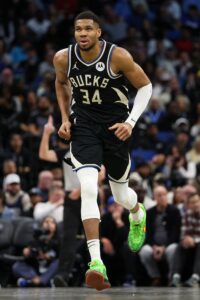 It’s the 25th time that Antetokounmpo has earned Player of the Week honors over the course of his decorated 12-year NBA career, including the second time this season.
In four games during the week of Jan. 13-19, the two-time MVP averaged 32.0 points, 12.5 rebounds, and 6.5 assists in 34.5 minutes per game, making 66.7% of his shots from the floor as the Bucks went 4-0. Milwaukee beat Sacramento, Orlando, Toronto, and Philadelphia by an average margin of 19 points per game in a dominant week.
Antetokounmpo beat out fellow nominees LaMelo Ball, Mark Williams, Pascal Siakam, Myles Turner, Darius Garland, Damian Lillard, and Onyeka Okongwu for the Eastern Conference award, per the NBA (Twitter link).
Green, meanwhile, was named Player of the Week for the first time this season and the second time in his four-year career. The former No. 2 overall pick has scored at least 26 points in eight consecutive games, including all four of Houston’s contests this past week.
Green led the Rockets to a 3-1 week by scoring 32.5 points per game on a scorching-hot shooting line of .606/.633/.962. He also chipped in 3.5 assists and 3.5 rebounds per night.
A trio of Clippers – James Harden, Norman Powell, and Ivica Zubac – headlined the Western Conference’s other Player of the Week nominees and were joined by Devin Booker, Shai Gilgeous-Alexander, Scoot Henderson, Trey Murphy, and Jamal Murray.
Raptors Rumors: Facilitation, Brown, Boucher, Mitchell, Olynyk
Doug Smith of The Toronto Star reported last week that the Raptors have signaled their interest in getting involved in a potential Jimmy Butler trade as a facilitator. According to Jake Fischer of The Stein Line (Substack link), it’s not just a Butler deal that Toronto is open to facilitating.
The Raptors have let it be known around the league that they’re willing to help grease the wheels on potential deadline deals, sources tell Fischer.
“They are as well positioned as anyone to facilitate a trade,” an Eastern Conference executive told Fischer. “If a team needs to send out four players to make the math work, do you send one to Toronto?”
The Raptors currently have more than $10MM in breathing room below the luxury tax line and are carrying just 14 players on full-season salaries (with Orlando Robinson on a 10-day deal), so they have both cap and roster flexibility. They also have a handful of players on expiring contracts, including Bruce Brown ($23MM), Chris Boucher ($10.81MM), and Davion Mitchell ($6.45MM).
Brown, Boucher, and center Kelly Olynyk are the Raptors most frequently cited as trade candidates, Fischer says, but Mitchell is another player who could make sense as a salary-matching piece in certain scenarios — he’d also hold some appeal to teams seeking another point-of-attack defender, though he offers little offensive punch.
Here’s more from Fischer on the Raptors:
- Toronto is “very motivated” to move Brown, sources tell Fischer. The veteran swingman, who won a title with Denver in 2023, was a popular target on the free agent market that summer and could draw interest ahead of the February 6 deadline from some of the same teams who pursued him at that time. Rival executives have been keeping an eye on Brown following his recovery from offseason knee surgery to see if he can recapture his previous form, Fischer writes.
- If the Raptors are unable to find a suitable trade for Brown, he could become an intriguing buyout candidate, Fischer writes. However, because he’s earning more than the non-taxpayer mid-level exception ($12.8MM), Brown would be ineligible to sign with any team operating above either tax apron if he were to reach free agency. That includes clubs like the Lakers and Nuggets, who are believed to have interest in the 28-year-old, sources tell Fischer. According to Fischer, Denver has considered whether trying to trade out of apron territory to gain more roster flexibility – including the ability to pursue players on the buyout market – would make sense.
- Boucher isn’t regarded as a viable buyout candidate if he’s not traded at the deadline. According to Fischer, the big man actually has some interest in a possible contract extension with the Raptors if he remains in Toronto through Feb. 6, which the team would be open to considering for its longest-tenured player.