
And-Ones: Dybantsa, Holiday, LeBron, Bronny, TNT, Carmelo
A.J. Dybantsa, who is widely considered the favorite to be the No. 1 pick in the 2026 NBA draft, was in Paris this week for the NBA’s Global Games and got a first-hand look at 2023’s top pick, Victor Wembanyama. According to Brian Windhorst of ESPN, Dybantsa expressed a desire to team up with Wembanyama with the Spurs when he reaches the NBA.
“I think Victor is just ridiculous; the things he does are just crazy,” said Dybantsa, who has committed to play his college ball next season at BYU. “I just think we would’ve been a crazy duo. Now the odds of that happening are very slim. But I mean, it was just a thought that came up in my mind when he got drafted. But you never know.”
As Dybantsa acknowledges, the odds are against him ending up in San Antonio. The Spurs control their own first-round pick in 2026 and have the right to swap first-rounders with the Hawks, so they technically have two shots at the No. 1 overall pick. But both San Antonio and Atlanta appear to be on an upward trajectory and seem unlikely to be among the NBA’s very worst teams in 2025/26.
Here are a few more odds and ends from around the basketball world:
- Veteran NBA wing Justin Holiday will audition for the Italian club Virtus Bologna over the next several days, head coach Duško Ivanović confirmed (story via Eurohoops). The expectation is that Virtus Bologna will decide next week whether or not to sign Holiday to a contract. The 35-year-old swingman, who has appeared in 680 career regular season games in the NBA, spend last season with the Nuggets but has been a free agent since July.
- LeBron James and Bronny James of the Lakers turned down an invitation from the NBA to take part in the skills challenge at All-Star weekend as a father/son duo, according to NBA insider Chris Haynes (Twitter video link). Haynes adds that Bronny also declined an opportunity to be among the G League players competing in the Rising Stars event.
- Alexander Sherman of CNBC checks in on the NBA’s media landscape, writing that Kenny Smith and Shaquille O’Neal are on the verge of signing new multiyear contracts with TNT Sports, while both Amazon and NBC have spoken to Carmelo Anthony about the possibility of having him join their studio shows for the 2025/26 season.
Suns Notes: Nurkic, Beal, Richards, Durant, Dunn
Two veteran Suns whose names have frequently come up in trade rumors in recent weeks appear on track to return to action on Saturday vs. Washington. Guard Bradley Beal, who has missed three of the team’s past four games due to a left ankle sprain, is listed as probable to play, while center Jusuf Nurkic isn’t on the injury report after being inactive for six consecutive games due to an illness and return-to-play reconditioning.
Of course, while Beal figures to play a prominent role as long as he’s active, Nurkic was a DNP-CD for two games prior to his illness and faces even more competition for playing time up front now that Nick Richards is a Sun, writes Duane Rankin of The Arizona Republic.
Asked about Nurkic’s role, head coach Mike Budenholzer suggested that all of the Suns’ centers, including Mason Plumlee and Oso Ighodaro, will have to show in games and practices that they deserve regular minutes.
“That’s the message to not just Nurk, but to Nick, to Mason, to Oso,” Budenholzer said. “All those guys have played for us and are capable. They’ve all got to earn their minutes.”
Here’s more on the Suns:
- Richards has averaged a double-double (11.0 PPG, 10.0 RPG) in his first three games as a Sun, serving as the team’s starting center on Monday and Wednesday. His 15 rebounds in Wednesday’s victory over Brooklyn were a personal season high. “Everybody has been telling me to just be myself and I’ve been telling myself (that) since I got here,” Richards said of adjusting to his new team, per Rankin. “I’m playing with some of the best guys in the world. Just trying to play through them. Trying to get to know everybody. Trying to build that chemistry with every single player on the team.”
- As a result of being named an All-Star starter, Kevin Durant locked in a $1.3MM bonus that’s part of his contract, according to ESPN’s Bobby Marks (Twitter link). That bonus had already been considered “likely” to be earned since Durant was an All-Star last season, so it doesn’t impact his cap hit or Phoenix’s projected tax bill, Marks adds.
- Ryan Dunn, the No. 28 pick in this year’s draft, has already started 23 games for the Suns, taking on an unexpectedly prominent role for a rookie on a veteran team with the league’s highest payroll. Speaking to Spencer Davies of RG.org, Dunn expressed gratitude for the confidence the Suns have shown in him. “It means a lot,” Dunn said. “I think they have a lot of trust in me, and I just try to come out and do my job every night. I’m not trying to be perfect in any aspect. I’m trying to just play hard and compete, and I think that’s gotten me a lot more minutes on the floor. I’m forever grateful for this staff and this team believing in me. I’m just trying to do the best to help our team win.”
- Dunn also spoke to Davies about several other topics, including how much he appreciates being able to learn from stars like Durant, Beal, and Devin Booker. “They have their own little regimens themselves, and I’ve been trying to watch that from afar,” Dunn said. “Just trying to pick up on stuff – how they watch film, how they workout, how they get up and down on the floor. Just taking that routine and taking other stuff into my game and trying to figure out ways to have a long career like that.”
Trade Rumors: Turner, Heat, Brown, Raptors, Clippers
Asked on a live stream on Friday whether the Pacers might be open to trading center Myles Turner, who is on an expiring contract, Jovan Buha of The Athletic (YouTube link) said he has heard a “little bit of chatter” about that possibility.
However, based on his wording, it sounds like Buha is just referring to speculation from rival executives who are curious about whether Indiana will be able to pay Turner in free agency this summer, rather than any concrete signs the club is considering making him available. The 28-year-old won’t become eligible for an extension before reaching unrestricted free agency in July, so if Indiana isn’t confident about its ability to re-sign him, hanging onto him would carry the risk of losing him for nothing in the summer.
I’d be very surprised if the Pacers entertain the idea of trading Turner by February 6, given that he’s the starting center on a team that has played its best basketball of the season in recent weeks (9-2 in January).
Still, it’s worth noting that Indiana’s front office showed a year ago that it’s willing to trade a regular contributor if the team doesn’t expect to be able to sign him beyond the current season. After he turned down an extension offer from the Pacers, Buddy Hield was shipped to Philadelphia at last season’s deadline, despite the fact that he was averaging 25.7 minutes per game and had started 28 of 52 contests for Indiana.
Here are a few more trade-related notes and rumors from around the NBA:
- Within his latest dispatch at The Stein Line (Substack link), Jake Fischer explores what the Heat are looking for in a Jimmy Butler trade, reiterating a few points that have been reported elsewhere, including the fact that Miami is prioritizing cap flexibility and short-term contracts, as well as players who can help the team make the playoffs this season.
- To that end, Fischer cites sources who say that the Heat have registered some interest in Raptors wing Bruce Brown, who is on a $23MM expiring contract, and confirms that Toronto is widely viewed as a team interested in facilitating a larger deal. “They want to get involved in any Jimmy Butler trade,” one rival general manager told Fischer. Wizards guard Malcolm Brogdon, who is on an expiring $22.5MM contract, is another example of the type of proven veteran on a favorable contract who might appeal to Miami, Fischer adds.
- After creating some cap flexibility last offseason when they let Paul George walk in free agency, the Clippers remain “keen on keeping their books clean,” according to Fischer, who says the team has conveyed to rivals that it’s not eager to take on long-term salary in pre-deadline trades.
- The Athletic’s NBA writers take a closer look at all 30 teams, considering whether the best approach to the deadline for each of those clubs is to buy, sell, or stand pat.
Stein: Optimism Mavs’ Doncic Will Return Before ASG
There’s optimism in Dallas that star Mavericks guard Luka Doncic will be able to return to action prior to next month’s All-Star Game, reports NBA insider Marc Stein (Twitter link).
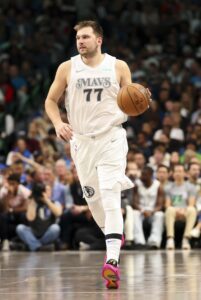 Doncic sustained a left calf strain on Christmas Day vs. Minnesota, with subsequent reports indicating that he was expected to miss at least a month. The Mavs confirmed that they intended to reevaluate the five-time All-Star in approximately one month, so a formal update from the team could be around the corner.
Beginning with Saturday’s NBA Finals rematch vs. the defending champion Celtics, the Mavericks have 11 more games before All-Star weekend (Feb. 14-16). Doncic has already missed the club’s past 15 games as a result of his calf strain. Dallas is 5-10 during that stretch, with a handful of key players battling injuries.
[RELATED: Dereck Lively Has Fracture In Ankle, Expected To Miss 2-3 Months]
While the Mavericks will obviously be inclined to play it safe with Doncic, who has dealt with multiple calf injuries over the course of his career, it would provide a huge lift if they can get him back on the court in the coming weeks.
The Mavs’ recent slump has dropped them into play-in territory in the Western Conference — the club currently holds the No. 7 seed, with a 24-21 record, and is just a single game ahead of the No. 10 Suns.
Prior to his injury, Doncic was averaging 28.1 points, 8.3 rebounds, 7.8 assists, and a career-high 2.0 steals in 35.7 minutes per game across 22 outings, with a shooting line of .464/.354/.767. As a result of this lengthy absence, he won’t be eligible for any end-of-season awards, since he’ll fall short of the 65-game requirement. He had made the All-NBA First Team five consecutive times entering 2024/25.
Grant Afseth of Dallas Hoops Journal previously reported that Doncic was on track to get healthy prior to the All-Star break.
How Pistons Could Use Cap Room At Trade Deadline
The Pistons are the only NBA team that currently has any cap room. While that has been true for the better part of six months, it will be more important than ever during the next 12 days, since that cap space will give Detroit significant flexibility to make deadline deals that could help the team in the present and/or future.
Entering the fall, it seemed likely that the Pistons, coming off a franchise-worst 14-68 season, would remain deep in rebuilding mode in 2024/25, but that hasn't been the case through the first half of the season. A resurgent Detroit team has gotten off to a 23-21 start and currently holds the No. 6 seed in the Eastern Conference. If the season ended today, the Pistons would control a guaranteed playoff spot.
If the Pistons were clearly lottery-bound again, it would make sense to use their cap room to take on teams' unwanted contracts with assets (draft picks, cash, and/or prospects) attached. But given their spot in the standings, there has been speculation that the front office will instead look to acquire a player (or players) who could help the team right away.
Since Jaden Ivey, the Pistons' starting shooting guard and primary backup point guard, went down on New Year's Day with a broken fibula, that speculation has centered around the idea of Detroit adding another ball-handler and play-maker. But many of the options linked to the team don't make a lot of sense to me.
Pricey veteran stars like Bradley Beal or Zach LaVine, for instance, would be more logical fits if they were on expiring contracts, but I can't imagine the Pistons want to take on their oversized deals for two seasons beyond this one, especially since they'd likely have to send out multiple rotation players to make the money work. Their $14MM in cap room can't accommodate a maximum-salary player without that outgoing salary.
Ivey hasn't even been ruled out for the rest of this season and certainly should be back on the court by the fall -- having a player like Beal or LaVine on next year's roster alongside Ivey and Cade Cunningham doesn't strike me as the best move for the duo's development together, which was trending in such a good direction prior to Ivey's injury.
A smaller deal to upgrade the backcourt might make sense. Bulls guard Coby White stands out to me as a better fit than those max-salary stars, given his cap hit ($12MM), his shorter-term deal (he's an unrestricted free agent in 2026), and the fact that he's gotten accustomed to playing both backcourt positions in Chicago.
But the Bulls would presumably seek at least a first-round pick for White, and the Pistons already owe their 2025 first-rounder to Minnesota. It's not like Detroit is one player away from legitimate contention, so it's still too early in the rebuilding process to be parting with another first-rounder unless it's in a deal that nets the team a star.
In my view, the logical path for the Pistons at this season's deadline is a more conservative approach that sees them continue to stockpile assets while also maintaining cap flexibility beyond this season and acquiring a player or two who could help fill the hole created by Ivey's injury for the rest of 2024/25.
Here's my suggestion for how the Pistons should use their cap room at the deadline:

Latest On Potential NBA-Run European League
Speaking this week to reporters in Paris, commissioner Adam Silver confirmed that the NBA continues to explore the idea of launching a league in Europe. Reporting in December indicated that the NBA and FIBA were discussing the concept, and Silver addressed those talks earlier this month in an appearance on Shaquille O’Neal’s podcast.
As Brian Windhorst of ESPN writes, Silver’s comments this week were his most expansive on the subject, as well as his most intriguing. The NBA commissioner suggested that he believes the EuroLeague – Europe’s current top basketball league – is leaving money on the table, Windhorst notes.
“While Europe continues to develop some of the very best players in the world — many of our most recent MVPs, of course, are European — we think that the commercial opportunity has not kept pace with the growth of the game,” Silver said. “And what we do at the NBA is we run leagues.
“We, of course, run the WNBA, we have the [Basketball Africa League], we have the G League, we have a 2K video league. So we operate five different leagues and we think it’s an expertise we have. And so we are looking very closely to see if there’s an opportunity to professionalize the game to another level here to create a larger commercial opportunity.”
According to Mike Vorkunov of The Athletic, the NBA is considering various models for its league — it could include new teams, existing clubs, or a combination of the two. Vorkunov says sources in Europe have continuously mentioned Real Madrid as a club that might be interested in leaving the EuroLeague for the NBA’s new venture.
While other EuroLeague teams could also be candidates to defect, the NBA has also reached out to some major European soccer clubs to see if they would have interest in creating new basketball teams, sources tell Windhorst. Both Windhorst and Vorkunov mention Manchester and Berlin as markets the NBA is looking at, with Vorkunov also listing London, Paris, and Munich as a few more possibilities.
The league may schedule NBA regular season games in one or more of those markets within the next couple seasons, per Windhorst and Vorkunov.
“Everything is on the table,” Silver responded when asked by BasketNews whether the NBA’s European league could feature EuroLeague teams. “So, [the] potential to include existing clubs? Absolutely there should be interest. The opportunity to create sustainable competition? Yes. Would we want to have a broad base of countries represented? Absolutely.
“I mean, that’s the benefit we have now by coming in and looking at this from a blank canvas. Incidentally, I recognize there’s enormous history and tradition here in European basketball, and we want to respect those traditions.”
Here’s more on the NBA’s potential foray into Europe:
- In order to move forward with a European league, the NBA would need to get the support of its Board of Governors. Windhorst, citing ownership sources, says there are still plenty of questions about the league’s plans, especially since some of the other leagues the NBA operates haven’t been consistently profitable. According to Windhorst, Silver suggested this week that a decision on whether or not to continue moving forward on a European league could be made following a Board of Governors meeting in a couple months. “We have an NBA board meeting in late March,” Silver said. “We’ll be giving an update to our bosses, in essence.”
- Of course, March’s meeting won’t be the first time that the league shares its plans with NBA team owners. As Windhorst writes, FIBA secretary general Andreas Zagklis made a presentation to team owners in New York in the fall about a potential European league, while George Aivazoglou, the NBA’s managing director of Europe and the Middle East, met with a committee of owners in November and spoke about which cities the league would target.
- League officials from the NBA and EuroLeague met last year as the NBA looked to partner with the established league on its new venture, says Vorkunov. The EuroLeague rejected the NBA’s proposal, since it didn’t want to give up control of its operations. “They wanted the heart and the head,” a EuroLeague executive told The Athletic.
- Vorkunov describes “dissent” among prominent European basketball figures about the impact of the NBA’s entry into the market. “I think the NBA walks into the European business and revenues go up a whole bunch,” one EuroLeague club owner said. “I don’t know how they do that, but they’re experts at it.” Others aren’t so sure, Vorkunov explains, noting that another club owner doesn’t believe there’s room for both the EuroLeague and an NBA league to succeed in Europe.
Warriors Notes: Kuminga, Podziemski, Anderson, Trades, Post
Jonathan Kuminga has been out since January 4 due to a right ankle sprain and the Warriors forward remains weeks away from returning to action, tweets Anthony Slater of The Athletic. According to Slater, Kuminga still has his ankle wrapped and hasn’t been able to do any real on-court work yet.
While Kuminga is around the team and is in “positive spirits,” he may not suit up for Golden State until after the All-Star break, says Slater.
Still, as Slater notes in another tweet, the Warriors’ injury situation on the whole is improving. Brandin Podziemski made his return on Thursday following a 12-game absence due to an abdominal issue and was effective in his first game back, scoring 10 points on 4-of-6 shooting as the Warriors outscored Chicago by 22 points during his 21 minutes. Kyle Anderson has been cleared to return on Saturday vs. the Lakers after missing the past five games due to what the club described as left gluteal bursitis.
Although Kuminga and Draymond Green (left calf strain) remain on the shelf for now, Golden State may have everyone else available on Saturday. Podziemski, Andrew Wiggins (back soreness), and Gary Payton II (illness) are the only other names on the injury report and they’re each listed as probable to play.
Here’s more on the Warriors:
- While the Warriors would love to acquire an impact player via trade, they’re unlikely to make a significant splash at this season’s deadline, according to Tim Bontemps and Brian Windhorst of ESPN (Insider link). ESPN’s duo anticipates Golden State will wait until a “true difference-maker” hits the trade market and expects any move the Dubs make by February 6 to be on the smaller side, like last month’s Dennis Schröder acquisition.
- Mark Medina of RG.org is also skeptical that a major in-season move is on tap for the Warriors.
- Meanwhile, Marcus Thompson II of The Athletic considers whether it makes sense for Golden State to do something bold at the deadline, focusing specifically on Bulls guard Zach LaVine as a potential target, which seems like a long shot to me.
- The Warriors’ staff has “gained increasing belief in recent weeks” that rookie center Quinten Post might be able to address the club’s need for a floor-spacer in the frontcourt, Slater writes for The Athletic. After making three brief appearances in the first 41 games of the season, Post has averaged 11.3 points in 16.0 minutes per night over Golden State’s past three games, making 7-of-18 (38.9%) three-pointers during that stretch. “He picks and pops,” head coach Steve Kerr said. “That means the other team’s big guy has to go with him. That means that defender’s not in the paint. Steph (Curry) was the happiest guy in the building tonight with all that room to work with. The game got a lot easier for all of our guys.”
Hoops Rumors Glossary: Tax Aprons
If an NBA team’s salary continues to rise after it surpasses both the salary cap and the luxury tax line, it may reach or exceed one or both tax “aprons.” The level of the first tax apron is several million dollars above the threshold at which a team becomes a taxpayer, while the second tax apron is another $10MM+ beyond the first apron.
A team whose salary exceeds the first apron is prohibited from making certain moves during that league year, while a team whose salary goes beyond the second apron faces even more restrictions. The goal is to encourage competitive balance by limiting the ability of the teams with the NBA’s highest payrolls to further upgrade their rosters.
Although the tax apron isn’t a new addition to the NBA’s Collective Bargaining Agreement, the 2023 CBA represents the first time that the league’s cap system features multiple aprons. The 2023 CBA also introduced several new rules that apply to teams whose salaries are above one or both aprons.
Let’s dive in and break down the tax aprons in greater detail…
How are the tax aprons calculated?
The formula that determined the level of the first tax apron in 2024/25 was as follows:
- Formula: $172,345,814 x ($140,588,000 / $136,021,000)
- Result: $178,132,000
- Note: The result was rounded to the nearest thousand.
These may just look on the surface like a collection of random numbers, but there’s a method to the madness. $172,345,814 was the result of last season’s first apron calculation (it was rounded to the nearest thousand, $172,346,000, for functional purposes); $140,588,000 is this season’s salary cap; and $136,021,000 was last season’s cap.
In other words, the first apron is simply rising by the same rate as the salary cap. That will continue to be the case going forward.
Like the first apron, the second apron will increase at the same rate as the cap each season, meaning the formula for 2024/25 was as follows:
- Formula: $182,793,814 x ($140,588,000 / $136,021,000)
- Result: $188,931,000
- Note: The result was rounded to the nearest thousand.
In future seasons, the current-year salary cap amount will be substituted into these two formulas in place of $140,588,000 to determine that season’s first and second tax aprons.
What restrictions does a team face if its salary is above the first tax apron but below the second apron?
When implementing its new CBA in 2023, the NBA gradually phased in the restrictions facing teams operating above the tax aprons over the course of two seasons. That gave those teams an opportunity to adjust their rosters to account for the new apron-related rules.
As of the 2024/24 season, all of the new restrictions are in effect.
Here are the moves that a team whose salary is above the first tax apron – but below the second apron – is prohibited from making in 2024/25 and beyond:
- Acquiring a player via sign-and-trade.
- Using any portion of the bi-annual exception for any transaction.
- Using any portion of the non-taxpayer mid-level exception to acquire a player via trade or waiver claim.
- Using more than the taxpayer portion of the mid-level exception to sign a player.
- Signing a player who was waived during the current season if his pre-waiver salary for that season exceeded the amount of the non-taxpayer mid-level exception.
- Using one or more outgoing players in a trade for matching purposes to take back more than 100% of the outgoing salary.
- Using a traded player exception generated during the prior year (ie. between the end of the previous regular season and the end of the most recent regular season).
It’s worth clarifying a few points related to these restrictions.
A team operating above the first apron doesn’t have access to the bi-annual exception or non-taxpayer mid-level exception, both of which can be used to sign a player or to acquire a player via trade or waiver claim. First-apron teams can use the taxpayer mid-level exception, but it can only be used to sign a player, not to acquire one via trade or waiver claim.
A team restricted to the taxpayer form of the mid-level can’t exceed its limits in dollars or years. For instance, in 2024/25, the taxpayer mid-level exception can be used to sign a player to a deal with a starting salary of up to $5,168,000 for up to two years. That means a team using its mid-level exception to sign a player to a three-year contract worth $3MM annually would have to use the non-taxpayer MLE to do so, since the deal would only fit within the taxpayer MLE in terms of money, not years.
The fifth item in the list above is important to remember after the trade deadline when certain veterans negotiate contract buyouts. If the player’s salary exceeds the full value of the non-taxpayer mid-level exception ($12,822,000 in 2024/25), he would be ineligible to sign with a team operating above the first apron once he clears waivers and reaches free agency — even if he negotiates a buyout that reduces his salary to below that non-taxpayer MLE amount.
The sixth item in the list only applies in instances where salary-matching is necessary. For example, a team operating above the first tax apron could send out a player earning $10MM in exchange for a player earning $9.5MM and a second player on a one-year, minimum-salary contract — even though the club would technically be taking back more total salary than it’s sending out, the minimum-salary player can be acquired using the minimum salary exception, so the $10MM player is only being used to match the $9.5MM player’s incoming salary.
In regard to the seventh item, let’s say a team operating above the first apron currently has one traded player exception worth $5MM, then generates another one worth $8MM at the 2025 trade deadline. Both of those exceptions would become unavailable once the team’s 2025 offseason begins.
That club could subsequently make a draft-night deal that generates a new $7MM trade exception and use it at any point between its creation and the end of the 2025/26 regular season. But if that team continues operating above the first apron, that $7MM TPE would once again become unavailable once the 2026 offseason begins, prior to its typical one-year expiration date.
What restrictions does a team face if its salary is above the second tax apron?
A team whose salary is above the second tax apron is prohibited from making any of the moves unavailable to teams above the first apron, as described above. That includes acquiring a player via sign-and-trade, using any portion of the bi-annual exception, and so on.
Additional restrictions also apply to teams operating above the second apron. Here are the moves that teams above the second tax apron are prohibited from making in 2024/25 and beyond:
- Using any portion of the mid-level exception.
- Aggregating two or more player salaries in a trade.
- Sending out cash as part of a trade.
- Acquiring a player via trade by using a signed-and-traded player for salary-matching purposes.
- Acquiring a player via trade using a traded player exception if that TPE was generated by sending out a player via sign-and-trade.
Teams above the second tax apron will face one more draft-related restriction beginning in the 2025 offseason. If the team’s salary exceeds the second apron at the end of a season, its first-round pick in the draft seven years away will be “frozen” — in other words, that pick would not be tradable.
If the team’s salary exceeds the second apron in at least two of the following four seasons (three of five in total), the frozen pick would move to the end of the first round for that draft. Conversely, if the team stays below the second apron for at least three of the subsequent four seasons, its pick becomes “unfrozen” and is once again tradable.
Let’s use the Suns as an example, since they’re a lock to finish the 2024/25 league year above the second tax apron. That would result in their 2032 first-round pick becoming frozen, ineligible to be traded once the ’25/26 league year begins. If their team salary remains above the second apron for at least two more seasons between ’25/26 and ’28/29, their frozen pick would move to the end of the 2032 first round and would remain ineligible to be dealt.
If multiple teams have a frozen pick moved to the end of the first round in a particular draft, they would make their selections in reverse order of their place in the NBA standings in the season prior to that draft. For example, if both the Suns and Celtics have their 2032 first-rounders moved to the end of the round and Boston finishes ahead of Phoenix in 2031/32, the Suns would pick ahead of the Celtics in that draft.
Can a team that begins a league year above the first or second tax apron gain the ability to make additional moves by reducing its salary and dipping below the apron(s)?
Yes. If a club were to open the 2025/26 league year carrying $200MM in salary, then engaged in a series of salary-dump trades that reduce its team salary to $150MM, it would no longer be subject to the restrictions facing an apron team.
The apron restrictions that apply to a team are determined by its salary position upon the conclusion of a given transaction. That means that if a second-apron club agrees to a trade that will move its team salary below the second apron, it could aggregate salaries and/or send out cash as part of that deal.
However, as long as the team’s salary remains above the first or second apron – or if the team is completing a transaction would push its salary above one apron or the other – that team is subject to the rules that apply to that apron level.
Critically, it’s worth noting that once a club engages in a roster move that is prohibited for a team above the first or second apron, that club will be hard-capped for the rest of the season at that apron level.
In 2024/25, for instance, teams like the Kings and Hornets acquired players via sign-and-trade, the Warriors and Mavericks used the non-taxpayer mid-level exception, and the Thunder and Pelicans took back more than 100% of their outgoing salary in trades. As a result, those teams are a few of the many that are hard-capped at the first apron ($178,132,000) and aren’t permitted to surpass that salary level for the rest of ’24/25.
The Nuggets, Pacers, and Knicks are the three teams currently hard-capped at the second apron ($188,931,000) this season. Denver used the taxpayer mid-level exception, Indiana sent out cash in a trade, and New York aggregated salaries in a trade.
Finally, there’s one more important point related to apron level restrictions and hard caps: A team that engages in any of the trade-related transactions prohibited for first or second apron teams between the end of the regular season and the end of that league year on June 30 will not be permitted to exceed that apron level during the following season.
If, for example, a team sends out cash in a trade in June of 2025, that team won’t be allowed to exceed the second tax apron during the 2025/26 league year. The inverse is also true — a team whose 2025/26 salary projects to be over the second apron won’t be able to trade cash in June 2025.
This rule only applies to trade-related transactions because the ones related to free agency don’t come into effect between the end of the regular season and the start of the next league year.
Anything else I should know about the tax aprons?
It’s worth pointing out that a club with a number of incentive bonuses on its books may find itself operating above the first or second apron even if its base team salary doesn’t exceed those levels.
For the purposes of calculating a team’s salary, a player’s likely incentives are included in his cap hit, but his unlikely incentives aren’t (an incentive is considered likely to be earned if it was achieved last season and unlikely to be earned if it wasn’t). However, for the purposes of determining a team’s apron level, all those incentives are counted.
That means a team with a $175MM base salary and an additional $5MM in unlikely incentives in 2024/25 would be considered a first apron team and would be unable to make certain roster moves, since there’s a chance those incentives could be earned, pushing the club’s salary above $178,132,000.
Note: This is a Hoops Rumors Glossary entry. Our glossary posts will explain specific rules relating to trades, free agency, or other aspects of the NBA’s Collective Bargaining Agreement.
An earlier version of this post was published in 2023.
Central Notes: Atkinson, Pistons, Vucevic, Ball
When Boston lost to the Lakers on Thursday, it guaranteed that the Cavaliers will hold the best record in the Eastern Conference through February 2. That, in turn, ensured that Cavs head coach Kenny Atkinson will coach one of the four All-Star teams on February 16 in San Francisco, while an assistant on his staff will coach another of those four squads, the NBA announced (Twitter links).
In past seasons, the head coaches for the teams with the best records in the East and West prior to the All-Star break would coach their respective conference in the All-Star Game. It’s a little more complicated this season due to the new four-team format, which is why both Atkinson and Thunder head coach Mark Daigneault will be bringing an assistant to All-Star weekend next month.
Here are a few more items of interest from around the Central:
- The Pistons traded their 2021 first-round pick during the 2020 offseason as part of a sign-and-trade deal that sent Christian Wood to Houston. However, that pick included heavy protections and has yet to convey while being traded three more times since then, from Houston to Oklahoma City to New York to Minnesota. As Jared Ramsey of The Detroit Free Press observes, 2025 may be the year that pick finally changes hands — the Timberwolves will receive it if it lands outside of the top 13 and the Pistons are very much in the hunt for a playoff spot in the East at 23-21.
- Prior to Thursday’s matchup with Golden State, Bulls center Nikola Vucevic said he didn’t view the game – against a team rumored to have interest in him – as an audition, per Joe Cowley of The Chicago Sun-Times. “There’s been many rumors in the past where I then played that certain team I’ve been linked to or not, and it doesn’t really affect me because I don’t think that way,” Vucevic said. If it was a tryout, the veteran big man didn’t exactly ace it, matching his season-low with nine points in a blowout loss to the Warriors, notes Julia Poe of The Chicago Tribune.
- In a separate story for the Tribune, Poe wonders if guard Lonzo Ball might end up being the Bulls‘ best trade chip at the February 6 deadline. His injury history is obviously a significant red flag, but Ball is the only one of the team’s highly-paid trade candidates who is on an expiring deal and Chicago has a +7.4 net rating during his minutes this season. In fact, it doesn’t seem as if the Bulls are especially eager to move on from the former No. 2 overall pick, who “quietly commands the locker room,” Poe writes.
Trade Rumors: Beal, Cavs, Pacers, Market Activity
Speaking this week to Duane Rankin of The Arizona Republic, Bradley Beal‘s agent Mark Bartelstein said that reports about specific teams his client would waive his no-trade clause for are “created out of thin air.”
Rumors this month have indicated that the Suns guard would be open to destinations like Miami, Denver, Milwaukee, and Los Angeles, but Bartelstein didn’t confirm Beal’s interest in those spots. He also suggested that he and Beal wouldn’t dismiss any possibilities without giving them some real thought.
“I never operate in terms of absolutes, meaning that we would never say there would never be a trade that you would not consider,” Bartelstein said. “You always keep an open mind like everyone does in all aspects of their life, and so if something was to come around that you were truly excited about, you always have to consider those things.”
Beal is considered a trade candidate because the Suns reportedly have serious interest in Jimmy Butler and Beal’s inclusion in an outgoing package would be the only realistic way to make a deal work. However, several recent reports have stated that Phoenix hasn’t come to Beal to discuss any trade scenarios, and Bartelstein has repeatedly said his client’s focus is on getting his ankle healthy and helping Phoenix win games.
Here are a few more trade-related notes and rumors from around the NBA:
- The Cavaliers have conveyed that they’re fine with the idea of paying the luxury tax, given how well the team is performing, but rival NBA executives are skeptical and are keeping an eye on Cleveland as a candidate to make a small salary-dump deal before the deadline, says Michael Scotto of HoopsHype. The Cavs are currently operating just $1.7MM above the luxury tax line.
- Within his look at potential suitors for Brooklyn forward Cameron Johnson, Scotto says the Pacers are getting inquiries from teams around the NBA on several of their young players, including Bennedict Mathurin, Aaron Nesmith, Jarace Walker, and Ben Sheppard. After a 9-14 start, the Pacers have been hitting their stride over the past couple months, winning 15 of their past 21 games, so it’s unclear if they’ll have the appetite for a deadline deal that shakes up their roster.
- According to Keith Smith of Spotrac (Twitter links), teams around the NBA believe that the Butler standoff in Miami could be delaying some trade activity. “We have a deal basically done, but the other team could be in a four- or five-team trade involving Butler,” one assistant GM told Smith. “So, they need to hold for now. So, yeah, that’s going to be such a big trade that we all just have to wait it out.” The expectation is that the dam will break in the final days leading up to the deadline if there’s no traction on a Butler deal by that point, Smith adds.
- Smith published his 2025 trade deadline primer for Spotrac this week, while Sam Vecenie of The Athletic has updated his 2024/25 trade board, with Butler, Zach LaVine, and Johnson at the top.