
Community Shootaround: Dell Demps
The Pelicans had the unfortunate distinction of finishing the 2015/16 campaign with their players missing a total of 351 games due to injury and illness, which was the most in the NBA in the past six years. “It’s been disappointing,” GM Dell Demps said of the seemingly never-ending string of physical maladies New Orleans endured this season. “We had a lot of high hopes coming into the season. And, obviously, not being at full strength has really … it’s been tough. It’s been tough on us. It’s been tough on the organization.“
New Orleans, which had been predicted by many to be a playoff contender this season, went just 30-52 on the campaign, which was a decrease of 15 wins from its 2014/15 showing. Demps is on the hot seat as a result and his position with the organization in doubt. The executive was originally scheduled to have his season-ending press conference on Monday, but it was abruptly rescheduled for an unspecified later date. The Pelicans have reportedly not made any final decision regarding Demps’ future with the team and evaluations of the rest of his staff are still ongoing, though current indications are that the executive will remain in his post for next season, according to Brett Dawson of The Advocate.
This brings me to the topic for today: Should the Pelicans retain Dell Demps as GM?
New Orleans has gone 203-273 while under Demps’ control, hardly an earth-shattering track record, but the Pelicans did appear to be a franchise on the rise before the season’s parade of injuries commenced. Do you believe the executive should be given another season to show results, considering how the team’s glut of injuries could not have been foreseen? Or have you viewed a large enough sample size of Demps to decide that he’s not the one to lead the Pelicans to the next level? Take to the comments section to share your thoughts and opinions on the subject, weigh in on what you believe Demps’ best and worst moves were as an executive, or simply to vent about New Orleans’ frustrating season. We look forward to what you have to say.
Offseason Salary Cap Digest: Brooklyn Nets
New Brookyn GM Sean Marks is poised to have maximum-level cap flexibility to work with in the offseason ahead, even if all three of the Nets who have player options decide to opt in, and even with multiple cap hits remaining from previous buyouts. Hoops Rumors is looking at each team’s cap situation for next season, starting with the Nets:
Guaranteed Salary
- Brook Lopez ($21,165,675)
- Thaddeus Young ($12,278,652)
- (Deron Williams $5,474,787) — Salary remaining from buyout via stretch provision
- Bojan Bogdanovic ($3,573,020)
- Rondae Hollis-Jefferson ($1,395,600)
- Chris McCullough ($1,191,480)
- Sean Kilpatrick ($980,431)
- Jarrett Jack ($500,000) — Partial guarantee; non-guaranteed portion listed below
- (Andrea Bargnani $323,599) — Salary remaining from buyout
- Total: $46,883,244
Player Options
- Wayne Ellington ($1,567,500)
- Shane Larkin ($1,500,000)
- Thomas Robinson ($1,050,961)
- Total: $4,118,461
Team Options
- None
Non-Guaranteed Salary
- Jarrett Jack ($5,800,000) — Partial guarantee; guaranteed portion listed above
Restricted Free Agents (Qualifying Offers/Cap Holds)
- Shane Larkin ($1,875,000/$1,875,000) — Pending player option
- Willie Reed ($1,215,696/$1,215,696)
- Markel Brown ($1,180,431/$1,180,431)
- Totals: ($4,271,127/$4,271,127)
Unrestricted Free Agents (Cap Holds)
- Sergey Karasev ($2,463,754)1
- Wayne Ellington ($1,800,000) — Pending player option
- Thomas Robinson ($980,431) — Pending player option
- Donald Sloan ($980,431)
- Henry Sims ($980,431)
- Total: $7,205,047
Other Cap Holds
- Andray Blatche ($1,788,285)
- Jason Collins ($980,431)
- Jerry Stackhouse ($980,431)
- Total: $3,749,147
Projected Salary Cap: $92,000,000
Footnotes:
- The Nets can’t re-sign Karasev to a contract with a starting salary worth more than the amount listed here because they declined their team option on his rookie scale contract.
The Basketball Insiders salary pages were used in the creation of this post.
Prospect Profile: Ben Simmons (Part Two)
PROJECTED DRAFT RANGE: Chad Ford of ESPN.com has Simmons ranked as the best prospect, while Jonathan Givony of Draft Express has him behind only Brandon Ingram. Givony has concerns about Simmons playing up to his full potential and believes the 19-year-old has the instincts and anticipation skills to be a terrific defender, but questions his effort on that end of the floor. Overall, Simmons’ approach to the game appears to be the reason he isn’t the DraftExpress choice for the No. 1 overall pick.
RISE/FALL: Simmons isn’t falling below No. 2 barring a serious injury between now and the June 23rd draft. It wasn’t until the end of the season, during a horrendous SEC tournament appearance, that chatter started to pick up about him not being the top selection. Ingram is the only challenger for the top spot and it may come down to who wins the lottery to determine the top overall selection. Make no mistake, the Rich Paul client is still likely to go No. 1.
FIT: The Sixers have the highest chance at landing the No.1 overall pick, as our Reverse Standings indicate. Philly has a 26.7% chance at the top spot, with a quarter of the pingpong balls for being the worst team, plus an additional 1.7% chance at the selection, since the team can swap picks with the Kings and would do so should Sacramento win the lottery. Picking Ingram instead of Simmons makes sense for the Sixers based on the team’s glut of big men. Having Jahlil Okafor, Nerlens Noel, Joel Embiid and Dario Saric all on the roster crowds the paint, but the Sixers could very well trade multiple members of the big man boy band they have assembled sometime this summer.
The Lakers have the second-best odds of landing the top pick, and they have no such roadblocks to playing time. Los Angeles would give Simmons a great situation to grow as a player. He and D’Angelo Russell attended the same high school, where they led their team to a national championship. The duo reportedly have spoken about playing together for the Lakers, according to Kevin Ding of Bleacher Report.
The Pelicans would be a fascinating fit for Simmons. They only have a 13.3% chance at a top-two selection, but they likely have the best frontcourt partner to offer Simmons in Anthony Davis.
The Kings would likely be the worst fit due to their ever-changing front office and recent history of inadequate player development. Sacramento won’t take home the No. 1 selection, as a result of its trade with Philadelphia, but it could get the No. 2 pick in one of two ways: the Sixers winning the lottery and the Kings landing No. 2 (0.5% chance of this occurring) or the Kings winning the lottery with the Sixers landing No. 2 and subsequently swapping picks (0.37%). In either of theses unlikely scenarios, it would take Philly selecting Ingram for Sacramento to land Simmons.
Every team could use a talent like Simmons and he would change the fortunes of any franchise. Ultimately, it will come down to the May 19th draft lottery to determine where he ends up.
FINAL TAKE: Pessimists may say the glass is half full and those people may look at Simmons as a nonshooting big man who doesn’t try hard enough. In reality, Simmons has enough in his glass to warrant being the top selection, and with the right coaching and tutelage, he could make any franchise’s cup runneth over.
(For Part One of Ben Simmons’ Prospect Profile, click here.)
Prospect Profile: Ben Simmons (Part One)
OVERVIEW: Ben Simmons was the No. 1 player in his high school class and he had his choice among any of the top collegiate programs in the nation. He chose to attend LSU, in part because David Patrick, Simmons’ godfather, was an associate coach for the school. As an Australian native, he had an opportunity to present an argument to the league claiming he should be eligible for the 2015 draft, akin to Thon Maker’s situation. Simmons was quick to shoot down talk about any sort of request, reiterating his dedication to the university. Even chatter about Adam Silver changing the one-and-done rule and altering it to a required two years for college players didn’t faze Simmons. “Then I’d stay two years [at LSU],” Simmons said prior to his senior high school season.
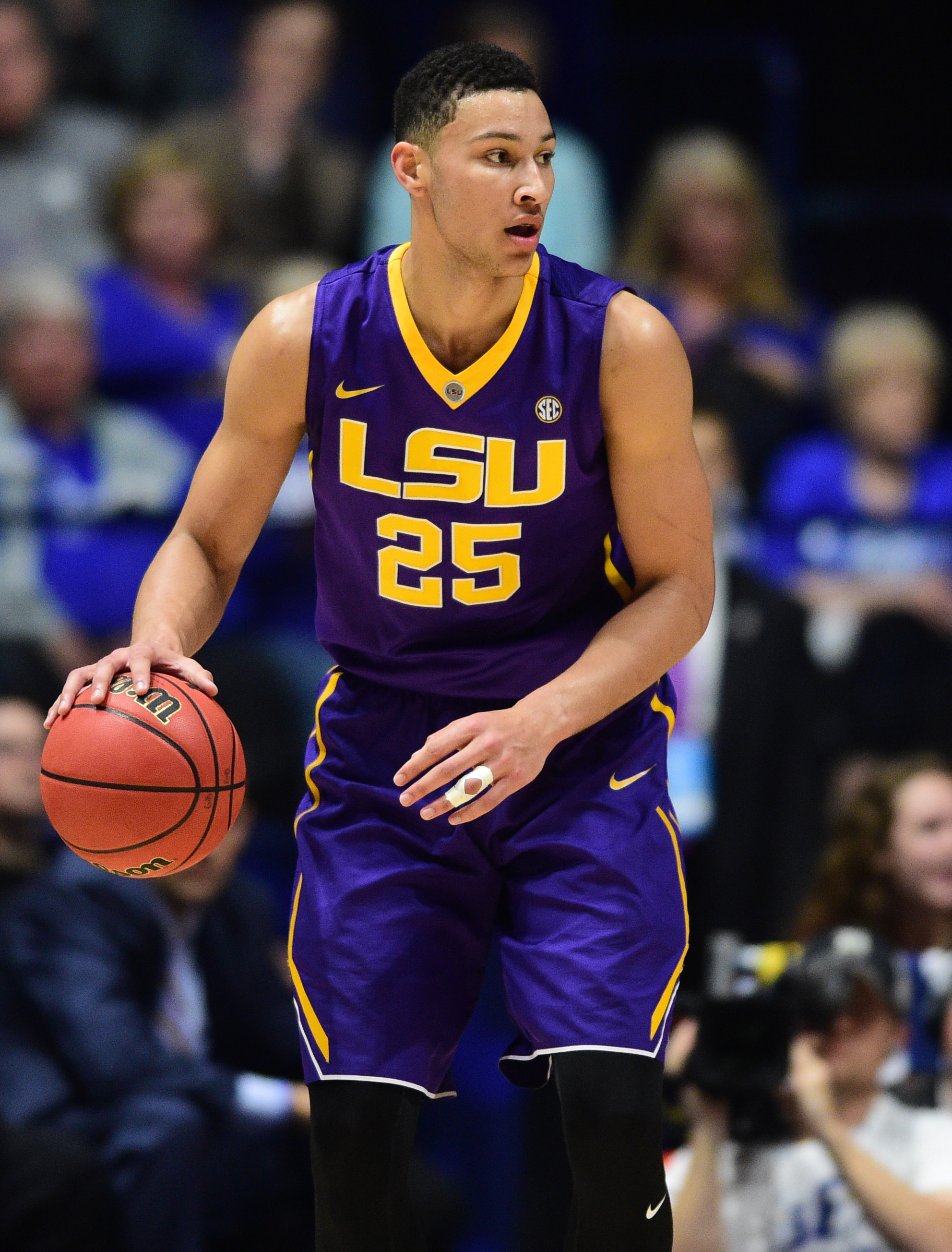
One disastrous regular season at the university proved to be enough. LSU finished the 2015/16 campaign with a record of 19-14, and the team was poised to miss the NCAA tournament. They were a lock to make the NIT, and Simmons had a chance to be one of the highest-profile players to ever play in it, but before the NCAA committee announced its selections, the school declined to participate in postseason play. Individually, Simmons dazzled as a Tiger, averaging 19.2 points, 11.9 rebounds, 4.8 assists, 2.0 steals per game. He is just one of five players over 6’9″ to average more than five assists per 40 minutes, according Jonathan Givony of DraftExpress. Still, he was not able to elevate the team to the level of a national title contender like he and many LSU fans had hoped.
STRENGTHS: Simmons is a special prospect. The awe in watching this sensational athlete comes from his natural ability on the hardwood. He runs the break masterfully, and his court vision and passing ability have drawn comparisons to LeBron James and Magic Johnson. He handles the ball extremely well for his size. You can envision him running a half-court offense, driving meticulously to the basket while drawing an additional defender near him just as he makes the crosscourt pass to an open teammate in the corner. This could be a regularity for the team that drafts him. He makes the right passes and plays a very Spursian-style game. He has excellent footwork and owns a few nice post moves. He creates contact and gets to the line often, as his 9.0 free-throw attempts per game authenticate. He’ll need to bulk up at the NBA level, but a 6’10”, nearly 240-pound frame puts him in a great position to contribute immediately. His 6’11” wingspan, coupled with his quickness and agility, will allow him to become a lock-down defender, one who can easily switch positions on pick-and-rolls, a task more and more teams are expecting their players to execute. Simmons gives you versatility on both end of the floor; he’s a true point forward. This isn’t DeMarcus Cousins bringing the ball up the court and stumbling into a set. That’s cute, but Simmons could be a big man who consistently makes plays at lighting speed on his way up the floor while evoking real fear in the transition defenders. Add in that he would be drawing an opposing big away from the basket and his value approaches tangibility.
WEAKNESSES: Outside shooting is an issue with Simmons. This was a concern heading into his freshman year, and he didn’t do much to prove the naysayers wrong in this area. Partway through the year, he essentially just stopped shooting from the outside. He attempted a total of three shots from behind the arc and it got to the point where defenders would play several feet off him and he still wouldn’t fire away. Another concern is his motor. At times, his demeanor appeared laissez-faire, lacking the passion that team leaders typically exhibit. He also played a very passive style for stretches. He wasn’t Rajon Rondo-esque selfishly unselfish, but it would have been beneficial for the way he’s perceived if he would have taken over games with his scoring more frequently.
(For Part Two of our Ben Simmons Prospect Profile, click here).
Community Shootaround: Warriors Sans Curry
Stephen Curry will miss, at minimum, the next two weeks as he recovers from a sprained right MCL, the team announced earlier today. Curry injured his knee in the Warriors’ Game 4 contest against the Rockets on Sunday afternoon. Last season’s MVP has already missed two games this postseason with an ankle injury, and the team is 1-1 in those contests.
If Curry only misses two weeks, that should bring him back during the Western Conference Semifinals against the winner of the Clippers-Blazers series. Two weeks is an optimistic outlook and there’s no guarantee that will be all the time Curry misses. In the meantime, his teammates are planning on picking up the slack. “One thing we’ve always talked about is our depth, and we’ve gotta use that to win games,” Draymond Green told ESPN after yesterday’s game.
That brings us to tonight’s topic: How far can the Warriors make it without Curry? Teams don’t win 73 games because of one player, although Curry’s presence on the floor is special for this squad. The Warriors should be able to win one more game against the Rockets to close out this series, but could the team make it to the Western Conference finals without him? How about the NBA finals? Could the Warriors win it all? Let us know what you think in the comment section below. We look forward to what you have to say!
Prospect Profile: Henry Ellenson (Part Two)
Community Shootaround: Mike Conley
The Mike Conley era in Memphis may have ended today. As the Grizzlies closed their season with a Game 4 loss to the Spurs, the clock officially began ticking toward Conley’s free agency on July 1st.
The nine-year veteran has spent his entire career in Memphis after being drafted fourth overall in 2007. Conley developed into one of the top point guards in the game, averaging 13.6 points and 5.6 assists over his career and turning the Grizzlies into a perennial playoff team. However, Conley’s season was cut short by Achilles tendinitis that kept him out of action since March 6th. He appeared in just 56 games, the fewest since his rookie season.
Conley is expected to be the most sought-after point guard on the free agent market this summer, and teams like the Knicks and Nets are already rumored to be suitors. The Bucks, Pacers and Rockets are three other franchises with point guard issues and likely enough cap room to offer a maximum deal.
Memphis has several advantages when it comes to keeping Conley at home. The Grizzlies own his Bird rights and can offer more money and more years than any competitor. There’s also the matter of loyalty, as Conley seems to have strong ties with the community and a good relationship with teammates Marc Gasol, Zach Randolph and Tony Allen, who have formed the heart of the “Grit ‘N’ Grind” era. “I’ve never seen anything different,” Conley recently told Ronald Tillery of The Commercial Appeal in response to a question about staying in Memphis.
However, Conley may have some concerns about the Grizzlies, who are rapidly becoming an old team. Gasol is 31. Randolph and Allen are both 34. Matt Barnes is 36, Chris Andersen is 37 and Vince Carter is 39. Age likely played a role in the physical breakdown that forced Memphis to use 28 players this season. Conley, who is just 28, has to decide if he wants to commit the rest of his prime to a team on which his best teammates are over 30.
That brings us to tonight’s question: Where do you think Conley will be playing next season? Will the combination of loyalty and dollars be enough to keep him in Memphis? Or will he opt for a fresh start with a younger, healthier team that has a better shot at an NBA title?
Take to the comments section below to share your thoughts and opinions on the topic. We look forward to what you have to say.
Prospect Profile: Henry Ellenson (Part One)

Seventeen years later, Ellenson can expect to hear his name called early on draft night. He posted 17 double-doubles at Marquette, ranked third in the Big East in scoring at 16.8 points per game and led the conference in rebounding with 9.8 boards per night. He was a first-team all-Big East selection and a finalist for the Wayman Tisdale national freshman of the year award.
Community Shootaround: Rookie Of The Year
The league will announce the winner of the 2016 Rookie of the Year award sometime this week and Karl-Anthony Towns is expected to pick up the hardware. Towns looked like a future star for the Wolves this season, averaging 18.3 points, 10.4 rebounds and 1.7 blocks per game. No other player won Rookie of the Month in the Western Conference, as Towns took home all six honors throughout the season.
Kristaps Porzingis won the honors for the Eastern Conference for the first three months of the season and through the first half of it, he appeared to be a challenger for the Rookie of the Year award. Porzingis, who averaged 14.3 points, 7.3 rebounds and 1.9 blocks per game this season, tailed off during the second half of the season, but he should come in at No.2 on most ballots once the results are announced.
Third place on this year’s ballot won’t be as unanimous, as there as many contenders for this spot. That brings us to tonight’s question: Who are you putting on your top three for Rookie of the Year? Towns and Porzingis may be firmly atop many ballots, but if they’re not at the top of yours, tell us who took their spot. If they are atop your list, let us know who the third place finisher is. There are slew of candidates for this spot.
Emmanuel Mudiay had a slow start to the season, but he started to find his form after returning from an ankle injury in January. The 2015 No. 7 overall pick averaged 12.8 points, 5.5 assists and 1.0 steals during 30.4 minutes per game this season.
Jahlil Okafor looked monstrous at times for the Sixers this season, averaging 17.5 points and 7.0 rebounds per game. He also added 1.2 blocks per game and sported a player efficiency rating of 17.1. He looked to be a lock for the third spot, but he missed 29 games as a result of injury and suspension, which could very well keep him off many ballots.
Myles Turner finished the year strong, but he missed 22 games earlier in the season with an injured thumb. The No. 11 overall pick in the 2015 draft didn’t rack up the minutes per game that the other contenders saw, but he did win the Eastern Conference’s Rookie of the Month award in February and averaged 16.3 points and 2.3 blocks per 36 minutes this year.
Devin Booker, who wasn’t as involved in the offense until late in the season, impressed once he received an opportunity. The 2015 13th overall pick averaged 13.3 points per game while shooting 34.3% from behind the arc.
Norman Powell, Josh Richardson and Justise Winslow all deserve consideration as well. Even though they don’t have the numbers to match some of the other contenders, all three are playing key roles for playoff teams.
Let us know who you think the top three rookies are in the comment section below. We look forward to what you have to say!
2015/16 D-League Usage Report: Bulls
The NBA’s relationship with the D-League continues to grow, and this season a total of 19 NBA teams have one-to-one affiliations with D-League clubs. Those NBA organizations without their own affiliates were required to assign players to D-League clubs associated with other NBA franchises. D-League teams could volunteer to take on the assigned players, and if no volunteers emerged, the players were assigned at random.
This significant change from the 2014/15 season came about after the Pacers purchased the Fort Wayne Mad Ants and turned them into their one-to-one partner for the 2015/16 campaign. Other NBA teams have interest in following suit in the years ahead, and the NBA’s ultimate goal for the D-League is for all 30 NBA franchises to have their own D-League squads. You can view the complete list of D-League affiliates here.
We at Hoops Rumors will be recapping the D-League-related activity for the 2015/16 campaign for each team and we’ll continue with the Chicago Bulls, one of the 11 NBA franchises without their own D-League affiliate:
The Bulls made four assignments for the 2015/16 campaign, sending three players to the D-League for a total of 32 days. Listed below are all the assignments and recalls made by Chicago for the 2015/16 campaign:
- November 21st: Assigned Cameron Bairstow (1st) [Austin Spurs] — Recalled December 7th
- December 31st: Assigned Cristiano Felicio (1st) [Canton Charge] — Recalled January 14th
- January 15th: Assigned Cristiano Felicio (2nd) [Canton Charge] — Recalled January 16th
- February 1st: Assigned Mike Dunleavy (1st) [Santa Cruz Warriors] — Recalled February 3rd
Here is how the Bulls players performed while on assignment to the D-League this season:
- Cameron Bairstow: In five D-League appearances, the forward averaged 14.0 points, 8.0 rebounds and 1.2 assists in 26.5 minutes per outing. Bairstow’s shooting line was .475/.000/.824.
- Cristiano Felicio: In four D-League appearances this season, the big man averaged 14.3 points, 5.5 rebounds and 1.5 blocks in 23.7 minutes per contest. His slash line was .641/.400/.750.
- Mike Dunleavy: The swingman was assigned to the D-League for practice/rehab purposes and didn’t appear in any games while with Santa Cruz.