
Hoops Rumors Glossary: Cap Holds
The Rockets have just over $131MM in guaranteed money committed to player salaries for 2025/26. However, even though next season’s salary cap is expected to come in above $154MM, Houston won’t begin the 2025 offseason with $24MM+ in cap room to spend.
In fact, the Rockets technically won’t open the new league year with any cap space at all. Each of Houston’s own free agents will be assigned a free agent amount – or “cap hold” – until the player signs a new contract or the Rockets renounce his rights.
The general purpose of a cap hold is to prevent teams from using room under the cap to sign free agents before using Bird rights to re-sign their own free agents. If a team wants to take advantage of its cap space, it can renounce the rights to its own free agents, eliminating those cap holds. However, doing so means the team will no longer hold any form of Bird rights for those players — if the team wants to re-sign those free agents, it would have to use its cap room or another kind of cap exception.
The following criteria are used for determining the amount of a free agent’s cap hold:
- First-round pick coming off rookie contract: 300% of the player’s previous salary if prior salary was below league average; 250% of previous salary if prior salary was above league average.
- Bird player: 190% of previous salary (if below league average) or 150% (if above average).
- Early Bird player: 130% of previous salary.
- Non-Bird player: 120% of previous salary.
- Minimum-salary player: Two-year veteran’s minimum salary, unless the free agent only has one year of experience, in which case it’s the one-year veteran’s minimum.
- Two-way player: One-year veteran’s minimum salary.
A cap hold for a restricted free agent can vary based on his contract status. A restricted free agent’s cap hold is either his free agent amount as determined by the criteria mentioned above or the amount of his qualifying offer, whichever is greater.
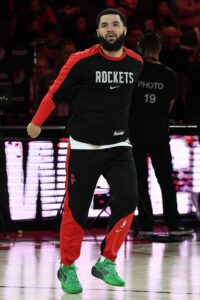 No cap hold can exceed the maximum salary for which a player can sign. For example, the cap hold for an Early Bird player with a salary above the league average is generally 130% of his previous salary, as noted above. But for an Early Bird player like Rockets guard Fred VanVleet, whose cap charge is $42,846,615 this season, 130% of his previous salary would be approximately $55.7MM, well beyond his projected maximum salary.
Instead, assuming VanVleet’s team option is declined by Houston, his cap hold would be equivalent to the maximum salary for a player with between seven and nine years of NBA experience. Based on a projected cap of $154,647,000, that figure works out to $46,394,100. If the Rockets turn down VanVleet’s option and intend to re-sign him, that cap hold would remain on their books until his new deal is official and his new cap hit replaces the hold.
One unusual case involves players on rookie contracts whose third- or fourth-year options are declined. The amount of their declined option becomes their cap hold, and if the player’s team wants to re-sign him, his starting salary can’t exceed that amount.
For instance, the Grizzlies declined Jake LaRavia‘s 2025/26 fourth-year option last fall, then traded him to the Kings in February. Because LaRavia’s rookie scale option was turned down, Sacramento won’t be able to offer him a starting salary this offseason worth more than $5,163,127, the amount of that option. That figure is also his cap hold.
That rule is in place so a team can’t circumvent the rookie scale and decline its option in an effort to give the player a higher salary. It applies even if the player is traded after his option is declined, but only to the club the player is part of at season’s end. In other words, because LaRavia finished the year with the Kings, Sacramento is prohibited from offering him a starting salary greater than $5,163,127 as a free agent, but any other team – including Memphis – could exceed that figure.
If a team holds the rights to fewer than 12 players, cap holds worth the rookie minimum salary are assigned to fill out the roster. So, even if a front office chooses to renounce its rights to all of its free agents and doesn’t have any players under contract, the team wouldn’t be able to fully clear its cap.
An incomplete roster charge in 2025/26 projects to be worth $1,272,870, meaning a team without any guaranteed salary or any other cap holds would have closer to $139MM in cap room than $154MM+ due to its 12 rookie minimum holds.
A player who has been selected in the draft but has not yet officially signed his rookie contract only has a cap hold if he was a first-round selection. A cap hold for a first-round pick is equivalent to 120% of his rookie scale amount, based on his draft position. An unsigned second-round pick doesn’t have a cap hold.
Cap holds aren’t removed from a team’s books until the player signs a new contract or has his rights renounced by the club. For example, the Warriors are still carrying cap holds on their books for retired players like Matt Barnes and David West, who never signed new contracts since playing for Golden State nearly a decade ago.
Keeping those cap holds gives teams some degree of cushion to help them remain above the cap and take advantage of the mid-level exception and trade exceptions, among other advantages afforded capped-out teams. If and when the Warriors want to maximize their cap room, they’ll renounce Barnes and West, but they’ve remained over the cap – and haven’t needed to remove those holds – since those players became free agents in 2017 and 2018, respectively.
Note: This is a Hoops Rumors Glossary entry. Our glossary posts will explain specific rules relating to trades, free agency, or other aspects of the NBA’s Collective Bargaining Agreement. Larry Coon’s Salary Cap FAQ was used in the creation of this post.
Earlier versions of this post were published in previous years by Luke Adams and Chuck Myron.
Al Horford Would Like To Re-Sign With Celtics
As Brian Windorst of ESPN.com writes, the defending-champion Celtics were always going to be faced with difficult financial decisions this offseason no matter how they fared in the playoffs. But if they’re unable to dig themselves out of the 0-2 hole they find themselves in after unexpectedly blowing a pair of 20-point second-half leads, then there will be new questions about the viability of the current roster.
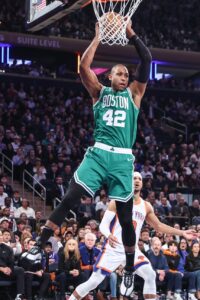 Nearly all of Boston’s core is under contract for multiple seasons beyond 2024/25. Veteran forward/center Al Horford is the team’s biggest free agent, and he will be 39 years old next month.
Horford does not plan to retire after ’24/25 and would like to re-sign with the Celtics, sources tell Windhorst. Whether Boston is amenable to that idea may depend on the type of contract Horford is willing to accept, since the team’s payroll (including luxury tax penalties) is projected to exceed $500MM in ’25/26, per ESPN’s Bobby Marks.
Horford remained productive this season, averaging 9.0 points, 6.2 rebounds and 2.1 assists in 60 games, including 42 starts (27.7 minutes per contest). While Horford was a mid-range maestro early in his career, he has extended his range over the years — 68.1% of his field goal attempts came behind the three-point line this season, and he converted 36.3% of those long-range looks.
According to Windhorst, president of basketball operations Brad Stevens and his staff have successfully been able to keep the players’ minds off the impending ownership change. The team also hasn’t discussed potential roster changes with player agents, Windhorst reports, though that obviously doesn’t mean that future moves won’t be in the cards.
Boston will face the Knicks in New York for Saturday’s pivotal Game 3.
Cavs’ Garland, Mobley Discuss Injuries After Game 3 Win
After missing a little more than two weeks due to a left great toe sprain, All-Star point Darius Garland returned to action for the Cavaliers on Friday night in Indiana, playing an important role in a decisive Game 3 victory.
As Chris Fedor of Cleveland.com writes, Garland was clearly playing through pain and wasn’t at his best, registering 10 points on 3-of-11 shooting, three assists, four turnovers and four fouls in 25 minutes. However, his contributions went beyond the box score, as he handled the Pacers’ full-court defense well and took ball-handling and play-making pressure off Donovan Mitchell and Cleveland’s other guards.
After the game, Garland told Fedor the return timeline for his toe injury is typically closer to four weeks than two, but he was eager to suit up with the Cavs facing an 0-2 deficit.
“I just want to be out there for my guys,” Garland said. “Everybody put their bodies and their injuries on the line. We fought through it. Just going out there to win this series.”
Head coach Kenny Atkinson told Garland not to rush back from the injury, which sidelined him for past the four playoff games leading up to Friday’s contest. But he was thrilled the 25-year-old was able to play, even if it’s not a given he’ll be ready for Sunday’s Game 4.
“(Garland) is just playing through a lot of pain, quite honestly,” Atkinson said. “To get him to play this game, let’s just say there’s a lot that goes into it and he’s kind of taking one for the team here. I think he had to push through a lot. Hopefully, he recovers. Even if we get 15, 20 minutes from him, we need it. We need another ball-handler. He can create separation. He can create advantages, even if it’s not going to be perfect with the way his health is right now.”
The Cavs also had Defensive Player of the Year Evan Mobley (left ankle sprain) and forward De’Andre Hunter (dislocated right thumb) back for Game 3 after they both missed Game 2. Hunter continues to deal with pain and swelling on his palm, particularly when catching passes, Fedor writes.
As for Mobley, he looked the closest to 100% during the victory, finishing with 18 points, 13 rebounds, four assists, three steals and three blocks in 35 minutes. That wasn’t the case earlier this week though, as Mobley said he was wearing a walking boot and was unable to put weight on his ankle prior to Game 2, when he was listed as questionable before being ruled out.
“I really wanted to play (Game 2), but definitely couldn’t,” Mobley said, according to Jamal Collier of ESPN. “But after that loss, I wanted to get back as soon as possible and get out there. So I was just basically day to day seeing how it felt, how quickly I heal. Normally heal pretty quick, and from there just played it by ear.”
While the Cavaliers were pleased to win the game, they recognize they still have to dig themselves out of a hole to win the series.
“We haven’t done anything,” Garland said, per Fedor. “We’re still down a game, so we’ve got to come in here Sunday with the same attitude, same mindset, and same physicality that we played with today. Just bring it again on another level.”
Hawks Interested In CAA’s Austin Brown For Front Office Job
Marc Stein and Jake Fischer of The Stein Line reported on Friday that the Hawks owner Tony Ressler was highly intrigued by the possibility of adding an “established” player agent to run Atlanta’s front office.
With that in mind, CAA’s Austin Brown has emerged as a candidate for a “top executive role” with the Hawks, sources tell Grant Afseth of RG.org.
Brown, the co-head of CAA’s basketball division, is one of the most powerful agents in the NBA. The Evanston, Illinois native played college basketball at DePauw in Indiana before becoming an investment banker with J.P Morgan and then attending law school, he said in an interview in 2022 (YouTube link).
As Afseth writes, Brown’s client list includes Hawks guards Trae Young and Caris LeVert. He also represents Donovan Mitchell, Jaren Jackson Jr., OG Anunoby, and Myles Turner in addition to several other noteworthy current and former players, per RealGM.
Brown’s name has popped up in the past when teams have made front office changes — he was previously linked to the Knicks and Bulls back in 2020. Fischer also reported a couple years ago that Brown remained an agent to keep an eye on for future front office openings.
The Hawks are looking for a new president of basketball operations after firing former general manager Landry Fields. Assistant GM Onsi Saleh was promoted to interim GM and is currently running Atlanta’s day-to-day basketball operations, but is expected to work under the new hire.
Eastern Notes: Anunoby, Pistons, Raptors, Giannis
After the Knicks‘ swarming defense, led by wings OG Anunoby and Mikal Bridges, limited Boston to 90 points on 36.2% shooting in a Game 2 victory, veteran forward P.J. Tucker told reporters, including Stefan Bondy of The New York Post, that Anunoby was overlooked in a major way by Defensive Player of the Year voters this spring.
“OG’s been off the charts. I don’t know how he didn’t win Defensive Player of the Year,” Tucker said of his Knicks teammate. “I don’t think it’s even close. I think he’s the best two-way player in the league. He’s always played defense, but this year offensively he’s taken it up another notch. I don’t think we ran one play for him (in Game 1) and he had 30 points. I’m telling you, it’s incredible. He’s amazed me this year and he’s the Defensive Player of the Year, no doubt.”
This year’s voters weren’t aligned with Tucker — while 13 players showed up on at least one Defensive Player of the Year ballot, Anunoby wasn’t among those 13. Neither he nor any other Knick received a single DPOY vote.
The Knicks only finished 13th overall in defensive rating during the regular season, but they’ve taken their play up a notch in recent weeks and rank fourth in that category in the postseason.
Here’s more from around the Eastern Conference:
- Which of the Pistons‘ top four veteran unrestricted free agents are most and least likely to re-sign with the team this summer? Omari Sankofa II of The Detroit Free Press (subscription required) considers that question, identifying Malik Beasley as the most likely to be back, followed by – in order – Dennis Schröder, Tim Hardaway Jr., and Paul Reed. Sankofa wouldn’t be surprised if there’s mutual interest in each case, but thinks it makes sense for Hardaway to test the open market and suggests Detroit might need more size in the frontcourt than Reed provides.
- Ahead of Monday’s draft lottery, Eric Koreen of The Athletic examines four hypothetical outcomes for the Raptors, including one where they remain at No. 7 and three where they move into the top four (but not to No. 1). Koreen likes Maryland’s Derik Queen as a potential target at No. 7 and notes that Baylor’s V.J. Edgecombe could be the “cleanest fit for the Raptors in the lottery” if they move up to No. 3 or 4.
- Asked during an appearance on FanDuel’s Run it Back show (Twitter video link) for his thoughts on Giannis Antetokounmpo‘s future, veteran big man Bobby Portis said his longtime Bucks teammate “bleeds green,” adding that he believes the two-time MVP would like to spend his entire career with one team. Portis also pointed out that any team trading for Antetokounmpo would have to give up so many assets to land him that his new club may not end up in a better position than the Bucks to contend.
Warriors Notes: Kuminga, Jackson-Davis, Butler, Rotations
As the Warriors navigate the loss of Stephen Curry to a “tricky” hamstring strain, head coach Steve Kerr is going to have to reshape the game plan on the fly. That includes opening up minutes to players who might not have gotten as many opportunities otherwise.
“There’s no Steph. It’s a completely different team,” Kerr said, per The Athletic’s Anthony Slater (via Twitter). He pointed at two players in particular who will play a part in the team’s Game 3 approach: Jonathan Kuminga and Trayce Jackson-Davis.
“Everything has to be about finding a new formula and [Kuminga] is absolutely a part of that formula,” he said.
Kuminga only played 50 total minutes in the Warriors’ seven-game series against the Rockets, but with Curry down, he logged 26 minutes in Game 2 against the Timberwolves, scoring 18 points on 11 shots. With few offensive options outside of Jimmy Butler and Brandin Podziemski, Kuminga’s ability to score and pressure the rim will be important to keeping the offense running.
When it comes to Jackson-Davis, Kerr said, “[He] showed he can be effective against this team,” referencing the second-year center’s 15-point, six-rebound performance in just 19 minutes in Game 2. Jackson-Davis has only played more than six minutes twice in this postseason, but Curry’s injury means the team is leaning more into its defensive personnel.
Here are more Warriors notes:
- The Warriors have spent years trying to mold Kuminga into the team-first player they want him to be, with mixed results, but now they’ll have to rely on him playing like the star-in-the-making he considers himself, writes The Athletic’s Marcus Thompson II. As long as Curry is out, Kuminga has a runway to prove himself both now and for the future, with restricted free agency around the corner. “This has not been an easy stretch for (him),” Kerr said after Game 2. “He really came out there and did a great job today and showed what he’s made of. Obviously, he’ll be back out there in Game 3. We’re gonna need him.”
- Jimmy Butler admitted after Game 2 that he’s still feeling the effects of the hard fall he took in the first round against Houston, which resulted in him being diagnosed with a pelvic contusion (Twitter video link via Slater). Butler has shot 39.4% from the field through two games against the Wolves, though in typical fashion, his contributions extend across the box score — he has averaged nine rebounds and six assists per night.
- The Warriors are the first team in NBA history to use 14 players in the first half of a playoff game, Slater writes for The Athletic. This was part of a broader push from Kerr and the coaching staff to throw different things at the wall to see what sticks while not overtaxing their remaining stars. “We went into the game thinking we’d play a lot of people short-burst minutes, try to protect Jimmy and Draymond,” Kerr said. “They’ve been playing huge minutes every other day, flying all over the country. We had to weigh that.” That approach included going away from the struggling Quinten Post and Moses Moody, whom the team had turned to in the previous series, in favor of Kuminga and Jackson-Davis. Expect Kerr to continue searching for combinations and riding hot hands as the team looks to manufacture offense and stay alive until Curry can return.
Wolves Notes: Edwards, Conley, Gobert, Fan Ejection, Dillingham
After being upset by the Warriors at home in Game 1, Anthony Edwards and the Timberwolves won Game 2 by a margin of 117-93. For the Wolves, who led the game from start to finish, the biggest scare of the night came when Edwards had to leave the game in the second quarter after re-injuring the left ankle that he had previously hurt in Game 4 of the first round.
The injury occurred when Warriors big man Trayce Jackson-Davis stepped on Edwards’ ankle after meeting him at the rim for a block. Head coach Chris Finch immediately feared the worst.
“This one, I was really planning on not seeing him the rest of the game, to be honest with you,” Finch said, according to ESPN’s Dave McMenamin.
The Wolves managed to hold off the Warriors, who were missing their own star in Stephen Curry after he left Game 1 with a Grade 1 hamstring strain, for the rest of the half while Edwards got worked on in the locker room.
“Once we got to like the third movement in my ankle, I’m like, ‘All right, it’s starting to feel good. If we tape it, I’ll see how it feels,'” Edwards said. “[Wolves VP of medical operations and performance David Hines] does a great job of making sure I’m good before I get out there, so big shoutout to David.”
Edwards was able to return to the game in the second half and lead the Wolves to their commanding victory in a game he called “the biggest game of our career.” Afterward, he told reporters he planned on being good to go for the crucial Game 3 in Golden State — he’s not listed on the injury report for Saturday’s contest.
Here’s more on the Wolves:
- Mike Conley is known for his stoic floor generalship, but in Game 2 of the series against the Warriors, he made a point to set a tone, both in terms of defense and demonstrativeness. “I just wanted to really show the guys I’m going to do whatever I can for the team, sacrifice,” Conley said, per The Athletic’s Jon Krawczynski. “That’s all I was focused on for the majority of the game. I know our guys kind of fed off the energy I was bringing.” The Wolves, led by Edwards and Julius Randle, are a team built on defense, trash talk, and a chip that never leaves their shoulder. With Minnesota 1-0 heading into the game, Conley focused on channeling that energy to bring out the best in the team. For at least one game, the strategy worked.
- Timberwolves coach Chris Finch took umbrage with the level of physicality in Game 1 of Minnesota’s second-round series with the Warriors, particularly when it came to the contact Golden State was able to inflict on star big man Rudy Gobert. Despite a relatively similar number of overall fouls called (Minnesota had 21 to Golden State’s 18), Finch wasn’t satisfied. “We sent a bunch of those clips into the league. In fact, I’m not sure I know another player in the league with Rudy’s pedigree that is allowed to be physically beaten on the way he is. And so, we’ve got to address that one way or another,” Finch said, according to McMenamin. He wasn’t the only one frustrated, as Warriors coach Steve Kerr had his own litany of complaints, especially in regards to how Curry was guarded before getting injured. If Game 2 of the series is any indication, the clips sent in didn’t have much of an impact, as the Wolves were called for 22 fouls that led to 25 Warriors free throws, while the Warriors were called for 16 fouls that led to 20 Wolves free throws.
- Game 2 also saw a Minnesota fan ejected from the game, and another one leave voluntarily before they could be ejected. In a press release (via Twitter), the Timberwolves cited the fan “… Violating the NBA Fan Code of Conduct in an incident involving Draymond Green.” The second fan was alleged to have made racially charged comments at Green, though Wolves reporter Chris Hine reported (via Twitter) that the first fan may have been the one to use that language. Kerr thanked the Wolves organization for how they dealt with the unfortunate situation. “The Wolves handled that beautifully and Draymond is handling it well,” he said.
- Rookie point guard Rob Dillingham has been upgraded to questionable for Game 3, per Timberwolves PR (via Twitter). Dillingham has missed the previous eight games with a right ankle sprain. The 20-year-old scoring guard was only averaging 3.8 minutes from the beginning of March onward, so he may not play even if he’s active.
Heat’s Pat Riley Discusses Butler, Roster, Tax, Herro, More
At his end-of-season press conference on Friday, longtime president Pat Riley admitted the falling out with Jimmy Butler affected the Heat‘s season in a major way, per Anthony Chiang and Barry Jackson of The Miami Herald.
“There’s no doubt what happened with Jimmy had a tremendous impact on our team,” Riley said. “The buck stops with me. I’ll take that hit if you want it. What happened in the regular season, I don’t want to discuss.”
That doesn’t mean Riley regrets his comments about Butler last offseason — he made a number of pointed remarks during that spring media session, including telling reporters that the star forward wouldn’t get the extension he was looking for due to concerns about his availability.
“I’m not going to apologize for saying no on the contract extension,” Riley said on Friday. “We didn’t have to I don’t think I should… It’s over. It’s done. I wish him well. Good luck to him. And I hope in his heart somewhere he wishes us well too.”
As for the underwhelming return package the Heat received in return for trading Butler to Golden State, Riley said the team was somewhat hamstrung by the situation.
“We were pretty much locked in with one team (Phoenix), the team of his choice. It didn’t happen there. We took the deal we felt was best for us now and also in the future. We have young players. We have medium age players in their prime. Our draft picks are in better order than what they were. We have a lot of flexibility. That’s where the blueprint is going to come from this summer.”
Here’s more from Riley’s presser, with quotes courtesy of The Herald, Tim Reynolds of The Associated Press, and Ira Winderman of The South Florida Sun Sentinel:
- While Riley isn’t sure that the Heat need to make major roster changes this offseason, he acknowledged there’s “no doubt” that changes of some sort will be necessary and said the team “probably won’t run it back.” Still, he doesn’t think the ugly losses to Cleveland in the postseason reflect Miami’s true talent level and suggested he’ll try to avoid tanking at all costs. “(That playoff series) might have put the final nail in thinking we got to tear everything apart and rebuild. We’ve never done that,” Riley said. “Thirteen times, we’ve always found a way to rebuild (into) a team that was respected, that was a contender.”
- Riley admitted that the Heat, who have been in the luxury tax for each of the past two seasons, would like to stop surpassing that threshold every year, especially with harsher repeater penalties about to take effect. “We have to make an adjustment,” he said. “It gets punitive financially. It’s not a priority, but it is in order to manage the financial part of the team. We will try to get out and then back in and reset it.”
- Riley isn’t permitted to talk about players on other rosters, and reporters didn’t ask him specifically about Kevin Durant, but the Heat president faced questions about whether the team needs to acquire an “alpha” and whether he’d be willing to trade for an “aging” star. Riley didn’t rule out either scenario. “For us, if that player is the right name and the contract is the right length, I still think an aging player can play,” Riley said. Regarding the idea of adding an alpha, he stated: “If that talent can help and he’s humble, that’s fine. If it translates to winning, that’s all that counts.”
- According to Riley, the Heat are “moving forward” with Bam Adebayo and Tyler Herro. Regarding a possible extension for Herro, Riley said the front office wants the veteran guard to remain in Miami for the rest of his career and indicated that a new deal this summer is a possibility, but not a given. “We’ve already talked about it. I’ve talked about it with Tyler. You’ll see what happens as we plan,” Riley said “… Definitely Tyler is deserving of the thought of an extension. But are we going to do it? We haven’t committed to it. But we’re going to discuss it. I’ve already talked to him about it. He’s cool (with whatever happens).”
- Asked about critics of “Heat culture” and whether that reputation has taken a hit in the last year or two, Riley pushed back, referring to that criticism as a “narrative” created by people who aren’t familiar with the organization. “I’m proud of the culture and what we’ve created,” Riley said. “For people who don’t really know, but it’s fashionable to comment on it and criticize it, the hell with them. We have a great culture that hasn’t been crushed. Just because there were some issues this year that were not culture-oriented, they were player-oriented — talking about the Butler situation — our culture is the same.”
Luke Adams contributed to this story.
Cavs’ Mobley, Garland, Hunter Available On Friday
5:59 pm: All three injured Cavaliers will be active for Friday’s Game 3, reports Shams Charania of ESPN (Twitter link).
Head coach Kenny Atkinson said during his pregame media session that there wouldn’t be a set minutes limit for Garland, Mobley, or Hunter, but that the team would make that decision over the course of the night based on “feel” and “communication” (Twitter link via Dustin Dopirak of The Indianapolis Star).
8:28 am: The Cavaliers played without three of their best players in Tuesday’s Game 2, in which Cleveland blew a seven-point lead with under a minute remaining to fall in a 0-2 hole in its second-round series vs. Indiana. Darius Garland has missed the past four games with a left great toe sprain, while both Evan Mobley (left ankle sprain) and De’Andre Hunter (dislocated/sprained right thumb) were injured in the fourth quarter of Game 1.
All three of the injured Cavaliers are officially listed as questionable for Friday’s Game 3 in Indianapolis, just like they were for Game 2 prior to being ruled out. However, two league sources tell Joe Vardon of The Athletic that the Cavs are optimistic the trio will attempt to suit up tonight.
“They participated in the walk-through and we’re hoping for the best,” head coach Kenny Atkinson said Thursday. “I think it’s frustrating for all of us, right? It’s no indictment on anybody, it’s just, injuries are a tough thing and you don’t really know unless you experience it yourself.”
As Vardon observes, even if the three players are able to play, it remains to be seen how effective they’ll be. A source tells Vardon that the swelling on Hunter’s thumb has decreased, but Mobley and Garland appeared to be hobbled during Thursday’s walk-through.
Sources tell Chris Fedor of Cleveland.com that Garland continues to deal with pain and swelling in his toe, which he aggravated in the team’s first-round series against Miami. The injury has made it “incredibly difficult” for the All-Star point guard to make any “sharp movements,” Fedor writes.
“He desperately wants to get on the court,” Atkinson said of Garland. “It’s just kind of in these situations I just kind of, I step back. I support him 100%, whichever way it goes. I think he’s probably like, ‘I’ve got to get to a certain point where I can compete at a high-intensity playoff level.’ That type of intensity is tough to simulate. I guess at some point hopefully he will get out there and try it. But obviously couldn’t run or anything.”
LeBron James Opens Up About Knee Injury
After going down in the middle of the fourth quarter of Game 5 against the Timberwolves with a knee injury, LeBron James was able to return to the court and finish the game. But in the wake of the Lakers‘ loss, which ended their season, it was revealed that he had suffered a Grade 2 MCL sprain.
In an episode of James’ “Mind The Game” podcast with Steve Nash, the Lakers star shed more light on that injury and his path forward.
“I knew as soon as when the impact happened with me and [Donte] DiVincenzo, I felt it right away,” James said. “My knee locked up, and that’s why I kind of stayed on the ground for quite a minute to see if the knee will kind of release a little bit. But I knew right then and there was a pain that I hadn’t felt before.”
James reflected on the latter point, discussing how this was a unique experience in his 22-year career: “I’ve had the regular tendonitis and the patella, all that stuff, but this is the first time I’ve ever had a sustained knee injury where I had to, like, okay, you got to get off your feet.”
James told Nash that he had initially planned on waiting and assessing his pain level before getting his MRI, but when he woke up the next day, he knew it was dire enough to get the situation checked out immediately.
“Well, when I woke up Thursday morning and tried to get out of bed, I was like, holy s–t,” he said. “And I called Doc right away. I said, ‘I can’t wait till Friday. I need to go today.'”
James confirmed that if the Lakers had won Game 5, he likely would’ve been unavailable for the rest of the series “and even further.”
If there’s a silver lining to the injury – other than the fact that thanks to the Wolves taking care of business in five games, James’ record of playing in 292 straight playoff games without missing time to injury remains intact – it’s that his recovery process won’t involve surgery. With the season behind James and the Lakers, he has plenty of time to complete the four-to-six week rehab period and still get the rest of his conditioning in before next season starts.
While James has been noncommittal about his future, both in the NBA and with the Lakers in light of his looming player option for the 2025/26 season, his comments seemed to indicate his plans on playing next season.
“I have some time to get it right and get back to full strength as far as I need,” he told Nash.