
The minimum salary exception is something of a last resort for capped-out teams looking to add players, as well as for players seeking NBA contracts, but it’s one of the most commonly used cap exceptions.
As its name suggests, the minimum salary exception allows an over-the-cap team to sign a player to a minimum-salary deal. A contract signed using the minimum salary exception can be a one- or two-year deal, but can’t cover more than two seasons.
Teams can use the exception multiple times in a league year, giving clubs that have used all of their cap room and other exceptions an avenue to fill out their rosters. The exception also accommodates teams’ acquisitions of minimum-salary players via trade, as players signed via the minimum salary exception don’t count as incoming salary for salary-matching purposes.
Players are entitled to varying minimum salaries based on how long they’ve been in the NBA. In 2025/26, a player with no prior NBA experience was eligible for a $1,272,870 minimum salary, while a player with 10 or more years of experience was eligible for $3,634,153.
[RELATED: NBA Minimum Salaries For 2025/26]
Under the NBA’s current Collective Bargaining Agreement, the minimum salary is adjusted each season to reflect the year-to-year salary cap change. If the cap increases by 5%, so will minimum salaries. If the cap doesn’t change from one season to the next, neither will minimum salaries.
 Our minimum-salary estimates for 2026/27, based on a projected salary cap of $166MM, can be found right here.
There’s a wide disparity between the minimum salary for rookies and for long-tenured players, with a minimum-salary veteran of 10+ seasons earning nearly three times as much as a rookie making the minimum next season. The NBA doesn’t want those pricier deals to discourage clubs from signing veterans, however, so the league reimburses teams for a portion of a minimum-salary player’s cost if he has three or more years of experience, as long as the contract is a one-year deal.
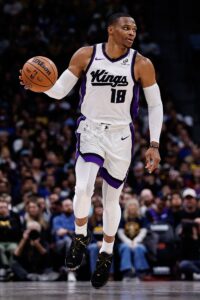
For example, when the Kings signed 17-year veteran Russell Westbrook to a one-year pact ahead of the 2025/26 season using the minimum salary exception, he locked in a salary of $3,634,153, but the team’s cap hit was just $2,296,274, equivalent to the minimum salary for a player with two years of NBA experience. The league will reimburse the Kings for the difference between Westbrook’s salary and cap hit ($1,337,879).
Many salary cap exceptions can only be used once each season. When a team uses its full mid-level exception to sign one or more players, the club can no longer use that exception until the following league year. Unlike the mid-level and other cap exceptions though, the minimum salary exception can be used any number of times in a single season.
The Bucks, for instance, used the minimum salary exception to sign Gary Harris, Taurean Prince, Jericho Sims, Thanasis Antetokounmpo, Cole Anthony, and Chris Livingston last offseason. They also used it during the season to add Cam Thomas on a rest-of-season contract.
While many exceptions begin to prorate midway through the regular season, the minimum salary exception prorates beginning after opening night. If a season is 174 days long and a player signs a minimum-salary deal after 25 days have passed, he would only be paid for 149 days.
An example of a prorated minimum salary occurred when the Kings signed Killian Hayes on March 15. Hayes has five years of NBA experience, so he would’ve been eligible for a full-season minimum salary of $2,667,947. But because he signed on the 146th day of the regular season, he received just 29/174ths of that amount: $444,658.
In cases where a veteran player signs a one-year contract using the minimum salary exception midway through a season, his cap hit is prorated in the same way that his salary is.
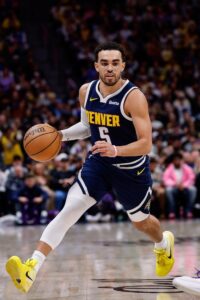 For example, when Tyus Jones joined the Nuggets on March 5, there were 39 days left in the ’25/26 season. He earned a rest-of-season salary of $814,552 (39/174ths of his full-season minimum of $3,634,153), while his cap hit was $514,682 (39/174ths of $2,296,274, the minimum salary for a player with two years of experience).
When a player signs a two-year contract using the minimum salary exception, his second-year salary is locked in as part of that agreement. Depending on the amount of the second-year cap increase, he may end up making more or less than the amount he would have earned if he’d instead signed two consecutive one-year minimum contracts.
On a two-year, minimum-salary deal, the player’s second-year salary is worth 105% of the first-year minimum for a player with the same years of NBA experience.
For instance, a rookie signing a two-year minimum-salary deal in 2025/26 would be assured of $2,150,917 in ’26/27, once he has one year of NBA experience under his belt — that’s 5% more than the minimum for a player with one year of NBA experience in ’25/26 ($2,048,494).
Finally, it’s worth noting that the minimum salary exception can be used to claim a player off waivers in the same way that it can be used to trade for a player. However, in the case of both trades and waiver claims, a minimum-salary player can’t be acquired using the minimum salary exception if his contract is for more than two years or if his salary exceeded the minimum in any previous year of the contract.
When the Jazz waived Vince Williams Jr. earlier this month, he was earning a $2,301,587 salary, which was his minimum for this season at the time he signed. But Williams was in the third year of his contract and had earned more than the minimum in his first season of that deal back in 2023/24 — both of those factors made him ineligible to be claimed using the minimum salary exception, so if a team had wanted to claim him, it would have needed to use cap room or another exception, such as the mid-level or bi-annual.
Here are a few more notes on the minimum salary exception:
- Players signed using the minimum salary exception are eligible for trade bonuses, but not incentive bonuses. A minimum-salary player with a trade bonus cannot be acquired in a trade using the minimum salary exception unless he waives that bonus.
- When a minimum-salary player is traded during the season, any reimbursement from the NBA is split between his two teams. It’s prorated based on the number of days he spends with each club.
- If a minimum-salary player with a non-guaranteed salary is waived before he exceeds the minimum for a two-year veteran, his team won’t be reimbursed for any portion of his salary.
- Every 10-day contract is worth a prorated minimum salary. The NBA also reimburses teams for a portion of the 10-day minimum salary for veterans with three or more years of experience.
- A team isn’t permitted to sign a player using the minimum salary exception if the deal would push that club’s salary beyond its hard cap. The only exception to this rule is when a team is using the exception to sign a player to an Exhibit 9 or Exhibit 10 contract prior to the regular season, since those deals don’t count against the cap until the season begins.
Note: This is a Hoops Rumors Glossary entry. Our glossary posts will explain specific rules relating to trades, free agency, or other aspects of the NBA’s Collective Bargaining Agreement. Larry Coon’s Salary Cap FAQ and the Basketball Insiders salary pages were used in the creation of this post.
Earlier versions of this post were published in previous years by Luke Adams and Chuck Myron.