
After finishing with a disappointing 36-46 record in 2024/25 despite having the most expensive payroll in the NBA, the Suns quickly fired head coach Mike Budenholzer, who was given a five-year, $50MM+ contract two years ago.
Budenholzer was hired one day after the team fired Frank Vogel, who led the Suns to a playoff berth after going 49-33 in his lone season (2023/24). Phoenix was swept in the first round by Minnesota though, and Vogel was dismissed 11 months after reportedly signing a five-year, $31MM deal.
Vogel was hired to replace Monty Williams, whom new owner Mat Ishbia wanted out after the Suns went 45-37 and were eliminated in the second round of the playoffs in 2022/23. That came a year after the top-seeded Suns infamously blew a 3-2 lead against the Mavericks in the second round of the 2022 postseason.
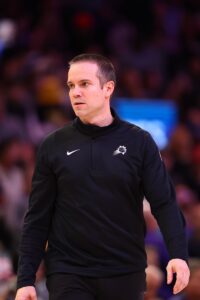 Looking for a new head coach every offseason while paying each of your recently fired coaches long-term money is never a recipe for success, so hiring the right candidate was critical for the Suns in 2025. They went with a first-time head coach in Jordan Ott, and the move paid off -- he did an admirable job leading a scrappy roster that finished with the league's ninth-ranked defense.
The main reason the roster looked different -- and younger -- this season is because the Suns finally pulled the plug on the ill-fated Kevin Durant and Bradley Beal experiments, both of which were completely disastrous for the long-term future of the team. Phoenix didn't get a clean break from Beal's contract either. We'll circle back to that shortly.
Out went veterans like Durant, Beal, Tyus Jones, Jusuf Nurkic, Mason Plumlee, Damion Lee and Monte Morris, and in came Jalen Green, Dillon Brooks, Khaman Maluach, Rasheer Fleming, Jordan Goodwin and Mark Williams.
The Suns exceeded expectations in 2025/26, going 45-37 and entering the play-in tournament as the No. 7 seed in the Western Conference. Phoenix lost its first play-in game to Portland, but won its second against Golden State and advanced to the playoffs as the No. 8 seed.
Phoenix was overmatched in the first-round series against Oklahoma City and was swept by the defending champions in four games. That series laid bare the limitations of the current roster against a top contender.
There were certainly positive developments in '25/26, starting with Ott and the buy-in he got from a hard-playing roster that arguably punched above its weight in the regular season. Impending free agent Collin Gillespie had a breakout season; Goodwin was another bargain in his second stint with the team; Brooks brought an edge and toughness to the group that was sorely lacking; Fleming (and to a lesser extent Maluach) showed flashes near the end of the season; and Oso Ighodaro took positive strides in year two. All of those factors made Phoenix much more fun to watch than the most recent iterations of the team.
It's odd that the Suns were something of a plucky underdog in '25/26, because they were the total opposite the previous few seasons, with a bloated payroll banked by an owner so desperate to win immediately that he neglected the club's long-term outlook. Still, while the roster, coach, narrative, and (lower) expectations might have been different, Phoenix's modest success this season didn't really move the team any closer to title contention.
The Suns' Offseason Plans
If you only look at their active player salaries for next season, it would appear as though the Suns would be in a decent spot to try to re-sign all of their own free agents -- most notably Gillespie, Goodwin and Williams -- on top of making other upgrades. It's not a specific salary that will limit Phoenix's financial flexibility this offseason though -- it's the $23.2MM in dead money the team is carrying on its books, most of which came from using the stretch provision on Beal's contract after he agreed to give up some of the money he was owed in a buyout last summer.
