
International Notes: Mexico City Game, James, Teodosic, Harper
The NBA’s Mexico City Game in 2024 will feature a pair of Southeast rivals, as the Heat and Wizards will match up in the contest on Saturday, November 2, the league announced today in a press release. It will be the NBA’s 14th regular season contest and 33rd game overall in Mexico.
The game will be the fourth in Mexico for the Wizards, who last played there in 2019, and the third for the Heat. Since Miami’s last visit in 2022, the team has added Mexican-American forward Jaime Jaquez, which likely factored into the NBA’s decision to have the team return just two years later.
Here are a few more updates from around the international basketball world:
- Reigning EuroLeague MVP Mike James has a new three-year deal in place with AS Monaco Basket, the team officially announced on Friday (via Twitter). The former NBA guard was initially said to be nearing an agreement a week ago before Donatas Urbonas of BasketNews.com reported that James was considering testing the open market. According to Urbonas (Twitter link), Monaco improved its offer to ensure that a deal got done. James previously appeared in 49 NBA games from 2017-21 with the Suns, Pelicans, and Nets.
- Former NBA guard Milos Teodosic, who played for the Clippers from 2017-19, will spend another season with Crvena Zvezda in Serbia. The team announced (via Twitter) that it has signed the 37-year-old to a new one-year contract (hat tip to Sportando).
- Valencia Basket and Jared Harper, who suited up for the Suns, Knicks, and Pelicans from 2019-22, have parted ways, the Spanish club announced in a press release. A former All-NBAGL first-teamer, Harper spent the past two seasons with Valencia but will be a free agent this summer.
New Free Agency Rules Will Go Into Effect After Finals End
It’s possible that Friday’s contest between the Celtics and Mavericks will be the final game of the 2023/24 NBA season, with Boston holding a 3-0 lead and looking to complete the sweep. If the Celtics do finish off the series tonight, we’ll get our first look at the new rules related to free agency negotiations that the NBA and players’ union implemented in their most recent Collective Bargaining Agreement.
In past years, teams have been prohibited from negotiating new contracts with free agents prior to June 30 at 6:00 pm Eastern time. That timeline will still apply to teams who wish to speak to other clubs’ free agents, but for the first time, teams will be permitted to negotiate contracts with their own free agents beginning one day after the NBA Finals end. So if the Celtics win on Friday, those negotiations could begin for players around the league on Saturday.
The rule change should put teams in a better position to retain their own free agents. A year ago, for instance, one reason cited for the split between the Sixers and James Harden was Philadelphia’s insistence on waiting until June 30 to negotiate potential contract terms after being docked two second-round picks for jumping the gun on free agency in 2022. Harden reportedly felt as if he was being ignored by management and wasn’t confident the team would make him a lucrative contract offer, prompting him to pick up his player option and ask for a trade.
That type of situation should be easier to avoid now that teams will have an exclusive window between the end of the NBA Finals and the start of free agency on June 30 to talk to their own free agents.
Of course, it’s been considered an open secret over the years that teams and player agents are in contact before they’re legally permitted to be, which is why so many contract agreements (including some complex sign-and-trade deals) are reported in the hours – or even minutes – after free agency opens at 6:00 pm ET on June 30. It will be interesting to see whether that same pattern of reporting occurs the day after the Finals end — in other words, if the Celtics win tonight, will we get a flurry of new deals reported this weekend for free-agents-to-be who are returning to their own clubs? Or will those updates take a little longer to materialize?
Free agent contracts still can’t be officially finalized until after the July moratorium lifts on July 6, so a player who verbally agrees to re-sign with his current team on June 22 could change his mind during the next couple weeks before he officially puts pen to paper. We’ve seen that occur on occasion in the past with free agents who reach tentative deals between June 30 and July 6, then renege on them, but it’s pretty rare and will probably continue to happen infrequently going forward.
Players who won’t be free agents this offseason but who will become eligible to sign contract extensions on July 6 will also be permitted to talk to their current teams about new deals a day after the Finals end, ESPN’s Bobby Marks confirmed to Hoops Rumors.
Like this year’s free agents, those extension-eligible players would also have to wait until after the moratorium ends to formally complete a new contract, unless they’re already extension-eligible, in which case they’re allowed to talk to their respective teams even before the Finals end and can continue to negotiate up until June 30.
Players who will become extension-eligible sometime after July 6 won’t be able to open negotiations during that post-Finals window and will have to wait until the new league year to explore new deals with their clubs.
Pistons To Hire Fred Vinson As Assistant Coach
Longtime Pelicans assistant Fred Vinson is leaving New Orleans after 14 years with the organization, according to Adrian Wojnarowski of ESPN, who reports (via Twitter) that Vinson will be joining Monty Williams‘ coaching staff with the Pistons.
A professional player in the NBA and several other leagues around the world from 1994-2007, Vinson transitioned into coaching in 2008, spending two years with the Clippers before joining the Pelicans (the Hornets at the time). He worked under Williams from 2011-15, then remained with the team under three more head coaches (Alvin Gentry, Stan Van Gundy, and Willie Green).
As Wojnarowski notes, Vinson is highly regarded for his expertise as a shooting instructor. Kevin O’Connor of The Ringer (Twitter link) refers to the veteran assistant as one of the NBA’s top “shot doctors,” pointing to improvements made by Lonzo Ball and Herbert Jones, among others. New Orleans ranked fourth in the NBA this past season with a .383 3PT%.
While the hiring of Vinson looks like a strong signal that Williams will be coaching the Pistons next season, James L. Edwards III of The Athletic (Twitter links) cautions not to read too much into it. As Edwards points out, new Pistons president of basketball operations Trajan Langdon is close with Vinson from their time together in New Orleans, and Detroit was in need of a shooting specialist.
Langdon has reportedly been given the green light to make a head coaching change if he decides it’s in the best interests of the franchise, despite the five seasons remaining on Williams’ six-year, $78MM deal. However, the deeper we get into the team’s offseason without a move being made, the less likely it appears that a change will occur before the 2024/25 season.
Suns’ G League Team Selects 14 Players In Expansion Draft
The Valley Suns, Phoenix’s new G League affiliate, were awarded the returning rights to 14 players as part of the 2024 expansion draft, the league announced in a press release.
Each existing G League team was permitted to protect up to 12 players and had until June 5 to provide that list of protected players to the league. The Valley Suns received the full list of unprotected players on June 6 and had until June 13 at 3:00 pm Eastern time to select up to 14 of those players, drafting no more than two per team.
Crucially, while Phoenix’s affiliate now controls these players NBAGL returning rights, that does not mean all of them – or any of them, for that matter – will suit up for the Valley Suns in 2024/25, since they’re not obligated to play in the G League.
Many could end up playing for teams in non-NBA leagues around the world or even getting another shot in the NBA, in which case the Suns’ rights wouldn’t amount to much. But if any of these players sign G League contracts for next season, the Valley Suns will get first dibs at bringing them to training camp.
Here are the 14 players selected by the Valley Suns in the expansion draft:
- Garrison Brooks (Westchester Knicks)
- Chaundee Brown Jr. (South Bay Lakers)
- Gary Clark (Salt Lake City Stars)
- Matt Lewis (Westchester Knicks)
- Didi Louzada (Cleveland Charge)
- Theo Maledon (Sioux Falls Skyforce)
- Emmanuel Mudiay (Iowa Wolves)
- Mychal Mulder (Capital City Go-Go)
- Jahlil Okafor (Delaware Blue Coats)
- Justin Smith (Delaware Blue Coats)
- Denzel Valentine (Raptors 905)
- Quinndary Weatherspoon (South Bay Lakers)
- Lindell Wigginton (Cleveland Charge)
- Trevion Williams (Sioux Falls Skyforce)
Of those names, Mudiay, Okafor, and Valentine are the most notable. All three are former NBA lottery picks who spent several seasons in the league and are still no older than 30 years old. Brown, Clark, Louzada, Maledon, Mulder, Weatherspoon, and Wigginton have also seen NBA regular season action in recent years.
Returning rights players are just one group of the many that make up a G League team, so if only a small handful of the players listed above sign NBAGL contracts, the Suns will have plenty of other paths to fill out their roster. Those paths are as follows:
- Affiliate players: Players who are signed (generally to Exhibit 10 contracts) and then cut by the parent NBA club, as detailed here.
- G League draft rights: Players who are selected in the G League draft in the fall.
- NBA draft rights: Players who are drafted by an NBA team and sign a G League contract instead of an NBA contract.
- Local tryout: Players who earn a shot via a local tryout.
- G League player pool: Players who sign G League contracts and go undrafted (or sign their contracts after the draft). Newly signed players go through a waiver process and enter the league’s free agent pool if they go unclaimed.
- Two-way contract: Players who are on a two-way contract with an NBA team and are transferred to the G League.
- NBA assignment: Players who are on a standard contract with an NBA team and are assigned to the G League.
Celtics Notes: Tatum, Tillman, Brown, Game 4
Celtics forward Jayson Tatum has made just 35.9% of his shots from the floor in the NBA Finals, including 29.6% of his three-pointers. While he has contributed in many other ways, including on the boards (8.7 RPG) and as a play-maker (7.3 APG), those poor shooting numbers have made teammate Jaylen Brown the odds-on favorite to be named Finals MVP, assuming Boston finishes off the Mavericks. That’s just fine with Tatum, as he tells Chris Haynes of Bleacher Report.
“Man, I want everybody to be at their best. I want everybody to contribute. Winning will take care of everything,” Tatum said. “Finals MVP or whatever, a champion is a champion. That’s the goal. I want for my teammates what I want for myself. I want everybody to shine. There’s enough attention for all of us. And so, I want everybody to give us theirs.”
Tatum has earned no shortage of individual accolades over the course of his seven-year career, including five All-Star berths, four All-NBA nods (including three as part of the First Team), an Eastern Conference Finals MVP (in 2022), and an All-Star Game MVP (2023). The one thing he feels as if his résumé is missing is a championship.
“I’ve been here before, and I know what it felt like to lose [in the Finals] and that was the worst feeling ever,” Tatum told Haynes. “That was the worst summer I ever had. I made the All-Star team five times. I’m All-NBA first team year after year. The only thing they said I haven’t done is win. I just vowed to myself that if I ever got back to the Finals, then I would literally do whatever I needed to do to ensure that we have a different outcome.”
Here’s more on the Celtics ahead of a potential close-out game on Friday:
- Backup center Xavier Tillman averaged just 13.7 minutes per game after being sent to the Celtics at the trade deadline and hasn’t been a regular part of the postseason rotation, appearing in just six of the club’s first 16 playoff games. However, he came up big in Game 3 with Kristaps Porzingis unavailable, hitting a three-pointer, grabbing four rebounds, and blocking a pair of shots. Boston outscored Dallas by nine points in his 11 minutes of action. Al Horford said Tillman was “ready for the moment,” while Derrick White said the big man gave the team “big-time minutes,” per Jake Fischer of Yahoo Sports. “Obviously we’d love to have KP out there,” Brown said, according to Jay King of The Athletic. “We are different when he is. But X stepped in that role, and I thought he was great.”
- Within his story on Tillman, Fischer says that more than a dozen teams had legitimate interest in the big man prior to the trade deadline. Tillman had heard the Suns were another “strong possibility” if he didn’t end up in Boston, Fischer adds.
- After nearly letting a 21-point fourth quarter lead slip away in Game 3, the Celtics credited their past experiences on this stage as the reason they were able to buckle down and hang on for the victory, writes Tim Bontemps of ESPN. “All year long we’ve been hearing about the Celtics are the past, for the last six to eight months, that’s all we’ve been hearing is all the different shortcomings we’ve had in the past,” Brown said. “This is a new team, you know what I mean. We’ve learned from those experiences. And in these moments, you can see that we learned from it. We stepped up to the plate, and we found a way to win.”
- Both Brown and Tatum also pointed to last year’s postseason experience – which ended with a home loss to the No. 8 Heat – as a source of motivation this time around. “I mean, last year, just falling short on your home floor, it definitely hurt,” Brown said, per Bontemps. “It was embarrassing, in my opinion. I felt like the team was relying on me. JT got hurt in Game 7 and I dropped the ball. To me, it was embarrassing. It drove me all summer. Drove me crazy.”
- Bontemps, Chris Herring, and Brian Windhorst of ESPN shared their biggest takeaways from Game 3 and weighed in on what to expect in Game 4.
2024 NBA Offseason Preview: Milwaukee Bucks
Several of the core contributors who played key roles during the Bucks‘ championship run in 2021 – including Giannis Antetokounmpo, Khris Middleton, Brook Lopez, Bobby Portis, and Pat Connaughton – have remained on the roster since then, but the team has struggled to replicate the success of that season.
After being bounced in the second round of the 2022 playoffs, the top-seeded Bucks were upset by the No. 8 Heat in the first round in 2023. Determined not to get complacent following that disappointing outcome, Milwaukee made two major changes last offseason, firing head coach Mike Budenholzer and replacing him with first-time head coach Adrian Griffin in the spring, then packaging Jrue Holiday, Grayson Allen, a future first-round pick, and a pair of first-round swaps for seven-time All-Star Damian Lillard just before training camp got underway.
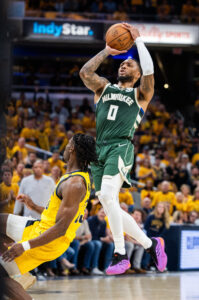
To say the results were mixed would be generous. Griffin opened the season with a strong 30-13 (.698) record, but Milwaukee never seemed to be firing on all cylinders during that stretch, and the Bucks’ veteran players were reportedly questioning the new coach’s schemes, especially on defense. Griffin was replaced just halfway through his first season by Doc Rivers, with Bucks general manager Jon Horst citing Rivers’ championship experience and leadership as a better fit for the veteran roster.
Lillard, meanwhile, earned his eighth All-Star nod and led the Bucks with 7.0 assists per game, but his scoring average (24.3), field goal percentage (42.4%), and three-point percentage (35.4%) were all below his career rates and he didn’t mesh with Antetokounmpo quite as seamlessly as the club had hoped.
The addition of a gifted scorer and play-maker like Lillard to the roster helped Milwaukee improve its offensive rating from 15th in 2022/23 to sixth in ’23/24, but the loss of talented defenders like Holiday and Allen hurt. The Bucks’ defensive rating plummeted from fourth to 19th, bumping the club’s overall net rating from fifth down to 11th.
For a second straight year, the Bucks lost in the first round of the playoffs as the higher seed while Antetokounmpo dealt with an injury. After missing two-and-a-half games in the 2023 series vs. the Heat, Giannis was unavailable for the entire Eastern Conference quarterfinal vs. Indiana this spring. Without the two-time MVP – plus Lillard, who missed Games 4 and 5 – Milwaukee couldn’t keep up with the Pacers.
While there’s optimism that a full offseason with Rivers and Lillard will create more cohesion heading into the 2024/25 season, it’s hard to feel all that bullish about the Bucks’ championship potential with the current roster, based on how the last two years have played out. But barring cost-cutting moves, the club once again projects to operate over the second tax apron, limiting the front office’s options for pursuing upgrades, so better chemistry and better health luck may be Milwaukee’s best hopes for another deep playoff run.
The Bucks’ Offseason Plan
With a roster this expensive, it’s logical to wonder if any of the Bucks’ four highest-paid players could be on the move this summer. However, it seems safe to assume the team won’t be looking to move Antetokounmpo or Lillard.
Middleton, meanwhile, has been affected by injuries over the past two years, but he looked like his old self in the playoffs this spring, averaging 24.7 points, 9.2 rebounds, and 4.7 assists per game on .482/.355/.900 shooting vs. the Pacers despite receiving more defensive attention with Giannis out. If the Bucks are relatively confident they’ll get that version of Middleton going forward, as he enters his age-33 season, it doesn’t make sense to trade him.
That leaves Lopez, who will earn $23MM in his age-36 season. Those two numbers look a little scary alongside one another, but Lopez is only a year removed from finishing second in Defensive Player of the Year voting and remains the kind of center every team is seeking — one who can space the floor on offense (he has a .369 3PT% over the past three seasons) and protect the rim on defense (2.3 BPG during that same three-year stretch). He’d certainly have positive trade value on his expiring contract, but it’s hard to see how moving him would make Milwaukee better.
The average age of the four-man core is somewhat concerning (only Antetokounmpo will be younger than 33 next season), but I’d be surprised if the Bucks don’t roll with that group for at least one more season. A year from now, with Lopez’s contract expired and Middleton facing a player option decision for 2025/26, the team will be in a better position to reassess its options.
Portis is one of the league’s best sixth men and is a relative bargain at $12.6MM, so he’ll almost certainly stay put too, leaving the Bucks to fill out the rest of the roster with players who can complement that strong top five.
That collection of complementary players could start with Connaughton, though his production has taken a hit since he enjoyed a career year in 2021/22 — he has averaged just 6.5 points per game on .411/.341/.717 shooting over the past two seasons. I expect the Bucks to explore the trade market to see if there’s a way to turn his $9.4MM contract into one or two more reliable role players (or one lesser-paid player and cap/tax relief), but they don’t have many draft assets left to attach to him to sweeten their offers.
Every single one of Milwaukee’s draft picks from 2025-30 has either been traded or is tied up in a swap. The team’s 2031 picks can be traded beginning in July, so either the first- or second-rounder (or both) could be packaged with Connaughton in an effort to find an upgrade. Under normal circumstances, I’d suggest the Bucks may prefer to preserve the 2031 first-rounder for a more significant move, but they’re so all-in on this team in the short term that they probably shouldn’t hang onto that pick too tightly if there’s a deal out there that clearly makes them better.
In order to fill out the rest of the rotation beyond their top six or seven players, there are only two real paths available to the Bucks: Signing veteran free agents and continuing to add and develop young talent. Let’s start with free agency.
Assuming they’re not able to shed salary, the Bucks will generally be limited to minimum-salary signings as a second-apron team (they’ll be able to offer most of their own free agents 20% above the minimum). Players unable to do better than that on the open market will certainly have interest in Milwaukee, since the team is a potential contender and will likely have rotation spots available.
Still, the minimum-salary pool is a limited one. Malik Beasley was a nice addition for the minimum last summer and I’m sure the Bucks would love to have him back, but he may draw interest at a higher price point than what Milwaukee can offer. The rest of the club’s free agents are probably once again in line for minimum deals, at best, so they’re candidates to be brought back, though there are red flags in each case.
Patrick Beverley‘s year came to an ugly end due to an incident with Indiana fans that resulted in a four-game suspension to open the 2024/25 season; Jae Crowder and Danilo Gallinari are in their mid-30s and aren’t the players they once were; Thanasis Antetokounmpo has a torn Achilles that will likely cost him most – if not all – of ’24/25. Of those four, Beverley would be the most useful on-court fit, if the Bucks are willing to give him another chance following his end-of-season meltdown.
As the Bucks explore the market for outside free agents, they could use another point guard, wing, and center. Jordan McLaughlin and Aaron Holiday are potential under-the-radar targets at the point; Justin Holiday and Cedi Osman would be intriguing options on the wing if they’re available for the minimum; Daniel Theis and Xavier Tillman are a couple options I like at center.
Milwaukee also has a handful of young players on team-friendly contracts and will have to determine whether they remain committed to MarJon Beauchamp, A.J. Green, Andre Jackson, and Chris Livingston. None of those four players logged more than 614 minutes last season, but they showed some promise, with Beauchamp, Green, and Jackson all shooting the ball well. Rivers isn’t exactly known as a player-development specialist, but if those youngsters continue to make strides, there should be room in the rotation for at least one or two of them.
If the Bucks are concerned about their luxury tax bill and their proximity to the aprons, Beauchamp would be the most logical trade candidate of that quartet, since his fully guaranteed salary of $2.73MM is the only one above the minimum — the team could save some money by swapping him out for a minimum-salary replacement.
The Bucks will also enter this year’s draft armed with the 23rd and 33rd overall picks, putting them in a good position to nab at least one player who could contribute immediately. This draft class isn’t top-heavy, but it has no shortage of seasoned college players who spent three, four, or five seasons at school and who should be able to transition to the NBA more smoothly than the average one-and-done prospect. That could work just fine for Milwaukee.
It wouldn’t shock me if the Bucks look to move down from No. 23 unless there’s a specific player they love at that spot. Trading that pick for a 2024 second-rounder and maybe a couple future second-rounders would help them begin to restock a bare cupboard of future draft assets and would be financially advantageous — a second-round pick would likely only count toward the cap and tax for approximately $1.16MM, whereas the 23rd pick would have a starting salary of about $2.95MM.
Marquette’s Tyler Kolek, Creighton’s Baylor Scheierman, Dayton’s DaRon Holmes II, Cal’s Jaylon Tyson, and Kansas’ Kevin McCullar are a few of the prospects who spent at least three years at college and who should be available late in the first round or early in the second for the Bucks.
Salary Cap Situation
Guaranteed Salary
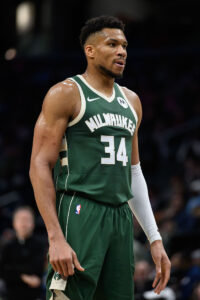 Giannis Antetokounmpo ($48,787,676)
- Damian Lillard ($48,787,676)
- Khris Middleton ($31,666,667)
- Middleton’s cap hit includes a $31,000,000 base salary and $666,667 in likely incentives.
- Brook Lopez ($23,000,000)
- Bobby Portis ($12,578,286)
- Pat Connaughton ($9,423,869)
- MarJon Beauchamp ($2,733,720)
- Chris Livingston ($1,891,857)
- Andre Jackson ($945,929)
- Partial guarantee. Rest of salary noted below.
- Total: $179,815,680
Non-Guaranteed Salary
- A.J. Green ($2,120,693)
- Green’s salary will become guaranteed if he remains under contract through July 8.
- Andre Jackson ($945,928)
- Partial guarantee. Rest of salary noted above.
- Jaylin Galloway (two-way)
- Ryan Rollins (two-way)
- Total: $3,066,621
Dead/Retained Salary
- None
Player Options
- None
Team Options
- None
Restricted Free Agents
- None
Two-Way Free Agents
Note: Because he’s a former first-round pick who had his third- and/or fourth-year option declined, Washington will be an unrestricted free agent.
Draft Picks
- No. 23 overall pick ($2,951,760 cap hold)
- No. 33 overall pick (no cap hold)
- Total (cap holds): $2,951,760
Extension-Eligible Players
- Pat Connaughton (veteran)
- Bobby Portis (veteran)
Note: Unless otherwise indicated, these players are eligible for extensions beginning in July.
Unrestricted Free Agents
- Thanasis Antetokounmpo ($2,093,637 cap hold): Bird rights
- Malik Beasley ($2,093,637 cap hold): Non-Bird rights
- Patrick Beverley ($2,093,637 cap hold): Non-Bird rights
- Jae Crowder ($2,093,637 cap hold): Bird rights
- Danilo Gallinari ($2,093,637 cap hold): Non-Bird rights
- Total (cap holds): $10,468,185
Other Cap Holds
- Goran Dragic ($2,093,637 cap hold)
- Meyers Leonard ($2,093,637 cap hold)
- Jeff Teague ($2,093,637 cap hold)
- Total (cap holds): $3,961,359
Note: The cap holds for these players are on the Bucks’ books from prior seasons because they haven’t been renounced. They can’t be used in a sign-and-trade deal.
Cap Exceptions Available
Note: The Bucks project to operate over the cap and over the second tax apron. That means they won’t have access to the mid-level exception, the bi-annual exception, or either of their two existing trade exceptions. If they dip below the second apron, they would gain access to the taxpayer mid-level exception ($5,183,000).
- None
And-Ones: Luwawu-Cabarrot, 2024 FAs, M. Thomas, ESPN
Former NBA forward Timothe Luwawu-Cabarrot has reached an agreement on a two-year contract with Baskonia, the Spanish club announced today in a press release.
Luwawu-Cabarrot played in the NBA from 2016-22 after being selected 24th overall in the 2016 draft. He saw rotation minutes for several seasons but never developed into a high-level contributor in the NBA, averaging 5.9 points, 2.0 rebounds, and 0.9 assists in 16.0 minutes per game across 328 regular season appearances (60 starts) for the Sixers, Thunder, Bulls, Nets, and Hawks.
The French forward has played a more significant role in Europe over the past two seasons for Olimpia Milano in 2022/23 and ASVEL in 2023/24. As he makes the move to Spain, Luwawu-Cabarrot will be looking to help boost a Baskonia team that missed the Spanish League (ACB) postseason in 2024 and was swept out of the first round of the EuroLeague playoffs by Real Madrid.
Here are more odds and ends from around the basketball world:
- Keith Smith of Spotrac has concluded his deep dive into the NBA’s 2024 free agent class by taking a closer look at the power forwards and centers on the market this summer. Smith also ranked the overall top 50 free agents, with LeBron James, Paul George, Tyrese Maxey, and Pascal Siakam leading the way.
- As first reported by Jonathan Givony of ESPN, Meleek Thomas, one of the top prospects in the recruiting class of 2025, has signed a deal to play with Overtime Elite for the 2024/25 season. A 6’4″ combo guard, Thomas is preserving his college eligibility and will take visits to UConn and Arkansas later this month, according to Givony.
- With ESPN poised to renew its broadcast rights deal with the NBA, Andrew Marchand of The Athletic argues that the network should pursue bigger-name broadcasters to elevate its coverage, including perhaps pitching LeBron James on a Tom Brady-esque deal once the Lakers star retires as a player.
2024 NBA Offseason Preview: New Orleans Pelicans
After acquiring CJ McCollum at the 2022 trade deadline, the Pelicans had long hoped for an extended period to evaluate what their roster looked like when fully healthy. They didn’t get it during the 2021/22 season, with Zion Williamson unavailable all year, including for the team’s first-round playoff loss to Phoenix. And they didn’t get it in ’22/23, when injuries limited Williamson to 29 games and Brandon Ingram to 45.
 The Pelicans didn’t entirely avoid health issues in ’23/24, but they came about as close as they could realistically expect, with Williamson, Ingram, and McCollum each playing between 64 and 70 regular season games. A late-season knee injury limited Ingram’s effectiveness in the playoffs, and Williamson hurt his hamstring in the play-in tournament, sidelining him for the first-round series vs. the Thunder, but by that point, the Pelicans had gotten the extended evaluation period they’d hoped for, giving them a better idea of what they had.
So what was the verdict? Here’s what head of basketball operations David Griffin had to say in April at the end of New Orleans’ season:
“In the past, we’ve always erred on the side of continuity, and our takeaway has always been, ‘Let’s see this group healthy.’ I think we’ve seen it enough. I think we had a really, really good opportunity to see Zion play a career high in games. I think we saw it for segments of time well enough to understand that we’ve got a lot of work to do. Because it is a historically good Western Conference, there are teams that didn’t make the playoffs that are going to get radically better this offseason. We need to do the same. I think you’ll see a real sense of urgency from all of us to do that.
“… I want to be really, really clear. This is not going to be a summer of complacency. It’s time to get better.”
It’s an encouraging stance from Griffin, who could’ve lauded the Pelicans for their 49-33 regular season record, which was a seven-game improvement over the prior season and tied for the second-best record in franchise history. He could’ve used Ingram’s and Williamson’s late-season injuries as excuses for the lack of playoff success. But he (rightly) recognized that the current roster isn’t good enough to beat the very best teams in the West and that some changes are needed.
Fortunately for the Pelicans, they’re in a pretty good position to make those changes. The roster is chock full of tradable contracts and the club has an excess of future first-round draft picks — in addition to holding all their own future first-rounders, the Pels control the Lakers’ unprotected pick in 2025 and Milwaukee’s unprotected pick in 2027, as well as the right to swap first-rounders with the Bucks in 2026.
That’s not to say that the right moves are obvious or that upgrades will be easy, but the Pelicans are better positioned than some of their conference rivals to further bolster an already-strong roster this summer.
The Pelicans’ Offseason Plan
The Pelicans don’t necessarily have to make a move involving one of their three highest-paid players this summer, but there’s reason to believe they’ll seriously consider it. Williamson isn’t going anywhere and McCollum is probably more valuable to New Orleans than he would be on the trade market, but Ingram’s future with the franchise is far from certain.
The 2024/25 season will be the last of Ingram’s five-year, maximum-salary contract with the Pelicans, and reports have indicated the front office isn’t comfortable with the idea of offering the star forward a max extension that would start at 30% of the cap (rather than 25%, like his previous deal).
Ingram has had five good seasons in New Orleans, but his game has plateaued to some extent since he made the All-Star team and earned Most Improved Player honors in 2020, and his three-point shooting has taken a step back. After making 38.6% of 6.2 three-pointers per game in his first two seasons with the Pelicans, the 26-year-old has knocked down just 35.4% of 3.9 tries per night in the past three seasons.
Those numbers are important, because with multiple non-shooters on the floor – Williamson and a center such as Jonas Valanciunas or Larry Nance – the team needs its other players to regularly take and make those outside shots to properly space the floor. If Ingram can’t reliably do that, the Pelicans will be hesitant to make another huge financial commitment to him, so he could find himself on the trade block in the coming weeks.
While there are a number of teams around the NBA who could benefit from Ingram’s skill set, it’s hard to envision a more ideal trade partner than Griffin’s former club, the Cavaliers, who will have to consider this offseason whether to move forward with overlapping pieces in both their backcourt (Donovan Mitchell and Darius Garland) and frontcourt (Jarrett Allen and Evan Mobley). Conveniently, Cleveland could use a big scoring wing, while two of the Pelicans’ biggest needs are a true point guard and a rim-protecting center.
The Pelicans have long had interest in Allen, having been linked to him during multiple previous transaction windows, and I think Garland would be a pretty good fit in New Orleans too. McCollum has been the team’s de facto point guard in recent years, but he’s not a natural distributor — both Williamson and Ingram averaged more assists per game than he did last season.
It remains to be seen just how open the Cavaliers will be to negotiating a deal with New Orleans. While the two teams look like an obvious match to me, Cleveland’s head of basketball operations Koby Altman has resisted the idea that a shake-up is necessary, telling reporters last month that he doesn’t anticipate “sweeping changes” to his roster this summer. We’ll see if he sticks to that stance.
As logical as a trade centered around Ingram and Allen would be from the Pelicans’ perspective, they’ll need to consider alternatives at the five if the Cavs aren’t open to a deal. Center is a greater priority than a point guard, where Williamson and McCollum can share ball-handling duties if need be. Williamson is an effective small-ball center in certain lineups, as is Nance, but rim protection isn’t either player’s specialty and New Orleans needs a bigger body to match up with the top centers in the Western Conference.
Valanciunas, who is headed to free agency, has his strengths – he’s an excellent interior scorer and rebounder – but those strengths don’t necessarily match up with the Pelicans’ needs, which means it’s very possible he won’t be back in New Orleans next season. Still, it will be tricky for the club to land a capable replacement, given its lack of cap room and a relative dearth of quality of big men on the free agent market.
Nic Claxton or Isaiah Hartenstein would be great, but the Pelicans have no feasible path to acquiring either of them. Goga Bitadze, Andre Drummond, and Mason Plumlee are among the other possible free agent fits, but they don’t inspire a whole lot of excitement. The club may have to rely on the trade market to acquire a starting-caliber five. While Allen will once again be at the top of New Orleans’ wish list, the club figures to kick the tires on several other veteran centers who might be available, including perhaps Clint Capela, Mitchell Robinson, Wendell Carter, and Robert Williams.
Ingram wouldn’t be the most logical centerpiece in a deal for some of those non-Allen centers, so the Pelicans will likely have to consider sending out Nance in certain scenarios. He’s a solid contributor, but he’ll be on an expiring $11.2MM contract and will be the only Pelican besides Williamson, Ingram, McCollumn, and Herbert Jones ($13MM) making more than about $6MM next season.
Jones – who made the All-Defensive First Team, improved his three-point percentage to 41.8%, and is under contract for three more seasons – is a long-term keeper, leaving Nance as the most logical salary-matching piece in a mid-sized deal that doesn’t involve Ingram.
Whether or not Ingram is traded, the Pelicans will want to find a way to get young sharpshooters Trey Murphy and Jordan Hawkins more playing time. Murphy, who averaged a career-high 14.8 points per game and is a career 39.2% three-point shooter, appears on the verge of a true breakout and is an ideal complement to Williamson, given his ability to space the floor. Moving Ingram could clear a path for the fourth-year sharpshooter to move into the starting lineup on a permanent basis (he started 23 of 57 games last season) while also creating the cap flexibility to comfortably lock him up long-term.
Murphy will be eligible for a rookie scale extension this offseason and I expect the Pelicans will be motivated to work out a deal sooner rather than later, since his value will likely only to continue to rise as he takes on a greater role. I wouldn’t necessarily expect Murphy to match or exceed the five-year, $135MM extension Devin Vassell signed last fall, but a payday in the range of $20-25MM per year is realistic. A new deal for Murphy would begin in 2025/26, just as Ingram’s current contract expires.
As for Hawkins, last year’s 14th overall pick didn’t have a significant role as a rookie but acquitted himself reasonably well when he played, converting 36.6% of his three-pointers. He’ll need to become more of a threat inside the arc and work on his defense, but Hawkins looks like a rotation piece going forward and will be on a team-friendly contract for three more seasons.
Naji Marshall is an underrated three-and-D wing who has been a bargain on a minimum-salary contract for the Pelicans since the 2020/21 season and offered a reminder of his value this spring when he averaged more minutes per game in the play-win over Sacramento and the first-round series vs. Oklahoma City than he did during the regular season. He’s due for a raise as an unrestricted free agent though, and with New Orleans starting to face a cap crunch and looking to find more minutes for Murphy and Hawkins, Marshall could be the odd man out. The Pels would certainly welcome him back if the price is right, but I expect the 26-year-old to draw mid-level interest in free agency.
Jose Alvarado‘s contract situation will also be worth keeping an eye on this summer. The Pelicans hold an affordable $2MM team option on Alvarado for next season, but picking it up isn’t a no-brainer, since doing so would put the guard on track for unrestricted free agency in 2025. Turning down the option would allow New Orleans to control Alvarado’s restricted free agency, ensuring that he doesn’t go anywhere, even if it would mean paying him more in 2024/25.
This decision could go either way, but my guess is that the team will simply exercise Alvarado’s option, locking in his $2MM salary. That will put the Pelicans in better position to navigate the cap in ’24/25, and they could still negotiate a possible extension with Alvarado during the season. While it would increase the risk of him getting away a year from now, he’s not such a crucial part of the long-term plans that New Orleans can’t take that risk, especially if former lottery pick Dyson Daniels continues to develop into a more consistent two-way threat in the backcourt.
Salary Cap Situation
Guaranteed Salary
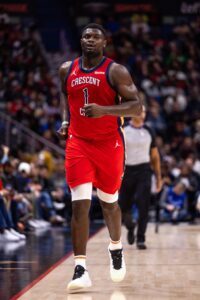 Zion Williamson ($36,725,670)
- Brandon Ingram ($36,016,200)
- CJ McCollum ($33,333,333)
- Herbert Jones ($12,976,362)
- Larry Nance Jr. ($11,205,000)
- Dyson Daniels ($6,059,520)
- Trey Murphy ($5,159,854)
- Jordan Hawkins ($4,525,680)
- E.J. Liddell ($2,120,693)
- Total: $148,122,312
Non-Guaranteed Salary
- Matt Ryan ($2,196,970)
- Malcolm Hill (two-way)
- Total: $2,196,970
Dead/Retained Salary
- None
Player Options
- None
Team Options
- Jeremiah Robinson-Earl ($2,196,970): Non-Bird rights
- Jose Alvarado ($1,988,598): Bird rights
- Alvarado’s salary would remain non-guaranteed if his option is exercised.
- Total: $4,185,568
Restricted Free Agents
- None
Two-Way Free Agents
Note: Because he has finished each of the past two seasons on a two-way contract with the Pelicans, Seabron’s qualifying offer would be worth his minimum salary (projected to be $2,093,637). That offer would include a small partial guarantee.
Draft Picks
- No. 21 overall pick ($3,202,560 cap hold)
- Total (cap holds): $3,202,560
Extension-Eligible Players
- Jose Alvarado (veteran)
- Extension-eligible until June 30 (or beyond, if his team option is exercised).
- Brandon Ingram (veteran)
- Naji Marshall (veteran)
- Extension-eligible until June 30.
- CJ McCollum (veteran)
- Extension-eligible as of September 26.
- Trey Murphy (rookie scale)
- Larry Nance Jr. (veteran)
- Extension-eligible as of October 1.
- Jonas Valanciunas (veteran)
- Extension-eligible until June 30.
Note: Unless otherwise indicated, these players are eligible for extensions beginning in July.
Unrestricted Free Agents
- Jonas Valanciunas ($23,152,500 cap hold): Bird rights
- Naji Marshall ($2,093,637 cap hold): Bird rights
- Cody Zeller ($2,093,637 cap hold): Non-Bird rights
- Total (cap holds): $27,339,774
Other Cap Holds
- Willy Hernangomez ($4,642,804 cap hold)
- Tony Snell ($2,093,637 cap hold)
- Gary Clark ($1,867,722 cap hold)
- Jared Harper ($1,867,722 cap hold)
- James Nunnally ($1,867,722 cap hold)
- Total (cap holds): $12,339,607
Note: The cap holds for these players are on the Pelicans’ books from prior seasons because they haven’t been renounced. They can’t be used in a sign-and-trade deal.
Cap Exceptions Available
Note: The Pelicans project to operate over the cap and under the first tax apron.
- Non-taxpayer mid-level exception: $12,859,000
- Bi-annual exception: $4,681,000
- Trade exception: $5,722,116
Note: Unless otherwise indicated, trade exceptions don’t expire before the regular season begins.
Draft Notes: Fit Vs. Value, International Prospects, Top PGs, More
In their latest mock draft for ESPN.com (Insider link), Jonathan Givony and Jeremy Woo provide two paths — Givony makes each pick based on the team’s biggest need, while Woo chooses the player who would be the best value at that spot.
For example, at No. 1, Givony has the Hawks taking Donovan Clingan, arguing that one of the league’s worst defenses would benefit from adding the draft’s best rim protector, while Woo views Zaccharie Risacher as the choice for Atlanta, since both he and Givony have the French forward ranked as the best prospect in this year’s draft class.
There are several spots where the best fit and best value overlap, including at No. 2 (Alexandre Sarr to the Wizards), No. 4 (Reed Sheppard to the Spurs), No. 5 (Matas Buzelis to the Pistons), No. 6 (Stephon Castle to the Hornets), and No. 12 (Nikola Topic to the Thunder).
Here’s more on the 2024 NBA draft:
- In another Insider-only story for ESPN.com, Givony and Woo highlight 20 draft prospects who excel in specific areas. For instance, while Givony and Woo consider Kentucky’s Sheppard to be the best spot-up shooter in the 2024 draft class, ESPN’s duo names UConn’s Cam Spencer as the best pull-up shooter and Tennessee’s Dalton Knecht as the best movement shooter. On the other side of the ball, Virginia’s Ryan Dunn is viewed as the best defensive play-maker, UConn’s Castle is recognized as the best on-ball defender, and Risacher is identified as the best off-ball defender.
- While top prospects Risacher and Sarr and potential lottery picks Tidjane Salaun and Topic have gotten plenty of attention leading up to the draft, there are several other international prospects worth getting familiar with, according to Givony, who provides a primer on a handful of others who could hear their names called on June 26 or 27, including French wing Pacome Dadiet, Spanish point guard Juan Nunez, and Serbian forward Nikola Djurisic.
- In an interview with Cyro Asseo de Choch of HoopsHype, Djurisic said he has been told his game is similar to that of seven-time All-Star Joe Johnson and likened himself to a “less athletic, taller Anthony Edwards.”
- Referring to UConn’s Castle as one of the biggest risers in the pre-draft process, Krysten Peek of Yahoo Sports ranks the reigning national champion No. 1 among point guards in this year’s draft class, followed by Topic at No. 2. Kentucky’s Rob Dillingham, Providence’s Devin Carter, and Pitt’s Carlton Carrington round out Peek’s top five point guard prospects.
Hoops Rumors Glossary: Waivers
When an NBA team cuts a player, he doesn’t immediately become a free agent. Instead, the player is placed on waivers, which serves as a sort of temporary holding ground as the other 29 teams decide if they want to try to add him to their roster.
A player remains on waivers for at least 48 hours after he is officially cut by his team. During that time, a team can place a waiver claim in an attempt to acquire the player. If two or more clubs place a claim, the team with the worst record takes priority (during the offseason and up until December 1, records from the previous season determine waiver order).
If a team claims a player off waivers, it assumes his current contract and is on the hook for the remainder of his salary. The claiming team also pays a $1,000 fee to the NBA office. If no claims are placed on the player, he clears waivers at 4:00 pm Central time two days after his release (or three days later, if he was cut after 4:00 pm CT) and becomes an unrestricted free agent.
While the waiver format is simple enough, not every team will have the salary cap flexibility to make a claim for any waived player it wants. There are only a handful of instances in which a club is able to claim a player off waivers:
- The team has enough cap room to accommodate the player’s entire current-season salary.
- The team has a traded player exception worth at least the player’s salary.
- The team has a disabled player exception worth at least the player’s salary, and he’s in the last year of his contract.
- The player’s contract is for one or two seasons and he’s paid the minimum salary.
- The player is on a two-way contract.
Since most NBA teams go over the cap and sizable TPEs and DPEs are somewhat rare, the majority of players who are claimed off waivers are either on minimum-salary contracts or two-way deals. Claiming those players simply requires an open roster slot.
More often than not though, waived players go unclaimed. In that case, the player’s original team remains on the hook for the rest of his salary.
Unless the player is in the final year of his contract and is waived after August 31, his club has the option of “stretching” his remaining cap hit(s) over multiple years using the stretch provision, which we explain in a separate glossary entry. A team that waives a player and uses the stretch provision on him cannot reacquire that player until after his contract would have originally expired.
In the case of any player without a fully guaranteed contract, the non-guaranteed portion of a player’s salary is removed from a club’s cap immediately once the player is waived.
When a player is “bought out” by his club, he’s placed on waivers as part of the agreement. He and his team agree to adjust the guaranteed portion of his contract, reducing the amount owed to the player by the team, assuming he clears waivers. If he’s claimed by a new team, that buyout agreement is voided, since his new club would take on his full remaining salary.
Here are several more notes related to waiver rules:
- Players can be waived and claimed off waivers during the July moratorium.
- A player waived after March 1 is ineligible for the postseason if he signs with a new team.
- A player on an expiring contract (or a contract that could become expiring as a result of an option decision) can’t be waived between the end of the regular season and the start of the next league year. He also can’t be waived at the end of the regular season if he won’t clear waivers before the date of each team’s final regular season game.
- A player claimed off waivers can’t be traded for 30 days. If he’s claimed during the offseason, he can’t be traded until the 30th day of the regular season.
- A player on a 10-day contract who is cut before the end of that 10-day period does not have to pass through waivers.
- If a player is traded and then is waived by his new team, he can’t re-sign with his former club until one year after the trade or until the July 1 after his original contract would have expired, whichever is earlier.
- Note: If a player is traded twice before being waived, he’s allowed to re-sign with the team that first traded him.
- A player who has Early Bird or full Bird rights retains Early Bird rights if he’s claimed off waivers.
- If a team makes a successful waiver claim, it doesn’t lose its spot in the waiver order — the 30th-ranked team at the end of a season remains atop the waiver priority list until December 1 of that year, even if that team makes multiple offseason claims.
- A team with a full roster can submit a waiver claim and wouldn’t have to clear a spot on its roster for a claimed player until it’s determined that the claim is successful.
Note: This is a Hoops Rumors Glossary entry. Our glossary posts will explain specific rules relating to trades, free agency, or other aspects of the NBA’s Collective Bargaining Agreement. Larry Coon’s Salary Cap FAQ was used in the creation of this post.
Earlier versions of this post were published in past years.