
Community Shootaround: Cavaliers’ Offseason
This year’s Cavaliers became the first Cavs team in over three decades to make the second round of the playoffs without LeBron James on its roster. But as successful as the season was in Cleveland, there’s a sense that major changes could be around the corner.
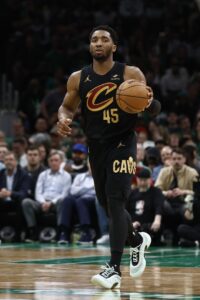 The Cavs will have to make a decision on head coach J.B. Bickerstaff, whose future with the club is said to be in “serious jeopardy.”
They’ll have to figure out whether or not Donovan Mitchell will sign a long-term extension as he enters a contract year.
If Mitchell is unwilling to extend, he could very well end up in the trade block, whereas if he does re-up with the Cavs, it may be Darius Garland who becomes the offseason trade candidate.
Cleveland will also have to decide on whether Jarrett Allen and Evan Mobley can coexist in the frontcourt going forward as Mobley becomes eligible for a rookie scale extension.
There has been speculation for months – or even years – that Mitchell won’t want to commit to a long-term future in Cleveland and will ultimately have to be traded, but that’s far from a sure thing. In fact, one report following the Cavs’ elimination from the postseason this week suggested there’s a “growing sentiment” Mitchell will sign an extension.
Still, in the latest episode ESPN’s Hoop Collective podcast (YouTube link), Brian Windhorst advised listeners not to assume Mitchell has finalized a decision one way or the other yet.
“I hope to be very careful to not make too much into what the secondary chatter is about what Donovan’s going to do,” Windhorst said. “Because I have heard stuff – from what I would consider reliable sources – all over the board, which leads me to believe that the accurate answer or real answer may not be out there, and that Donovan is doing a great job of keeping everybody in a happy place.
“I will say this, the Cavs organization feels very optimistic he’s going to sign, and maybe that’s the way it’s going to go — I’m not here saying that it won’t. But there’s other people out there saying the opposite.”
Regardless of what happens with Mitchell, Windhorst and his ESPN colleagues Tim MacMahon and Tim Bontemps agreed during their discussion of the Cavs’ offseason that it probably doesn’t make sense to move forward with the team’s four core players, given the overlap between Mitchell’s and Garland’s skill sets, as well as Allen’s and Mobley’s.
While Mitchell will be the focus of the summer in Cleveland for many fans, the frontcourt issue looms large. Mobley had a solid series vs. Boston in the second round of the playoffs with Allen sidelined, and Allen was at his best earlier in the season when Mobley was on the shelf recovering from knee surgery. If the Cavs have to choose one of the two, it seems likely to be Mobley, who is younger, probably has a higher ceiling, and will be under team control for longer if he signs an extension this offseason.
“I would just say that while there’s extreme interest and excitement probably from certain fanbases to go to the trade machine and work out Donovan Mitchell trades, and maybe those will be needed in a month, we’ll see,” Windhorst said. “I would think the Cavs are going to be spending more time in this next month looking at possible Jarrett Allen trades, and what that could bring.”
As Bontemps observed in the Hoop Collective podcast, the Cavs seem unlikely to completely tear things down this offseason. Even if Mitchell doesn’t agree to an extension and ends up being traded, there’s still too much talent on the roster to bottom out, so in any trade discussions, the team would likely seek players who could step in and make an impact right away — or draft assets that could be flipped to acquire those sorts of players.
If the Cavs end up looking to move Allen and/or Garland, one obvious potential trade partner would be the Pelicans, who have been linked to Allen several times in the past and also have a need at point guard. A deal involving rumored trade candidate Brandon Ingram could be the sort of move that would better balance both rosters.
We want to know what you think. Does Bickerstaff need to go or has he earned another year at the helm in Cleveland? Will Mitchell sign an extension? If he doesn’t, what kind of trade should Cleveland be seeking? If he does, will Garland have to go? And what about the frontcourt? Should Allen be on the trade block this summer?
Head to the comment section to weigh in with your thoughts and predictions!
Olympic Notes: France, Australia, Germany, Brazil
Ahead of the 2024 Olympics in Paris, the host nation has announced its preliminary 19-man roster (Twitter link). As Eurohoops relays, the headliners on France’s squad are big men Victor Wembanyama and Rudy Gobert, the top two finishers in this year’s Defensive Player of the Year vote.
However, there are several more notable NBA names on the list, including Nicolas Batum, Evan Fournier, Bilal Coulibaly, and Ousmane Dieng. Other recent NBAers who didn’t finish the 2023/24 season on a roster include Killian Hayes, Frank Ntilikina, and Theo Maledon.
One player not on France’s roster is veteran guard Mike James. The 2023/24 EuroLeague MVP is an American, but according to a report from L’Equipe (hat tip to BasketNews.com), the French Basketball Federation explored the possibility of getting a French passport for James, who has played for AS Monaco in France’s LNB Pro A since 2021. That effort didn’t make any real headway, however.
“We do not have the culture of other nations which use naturalized players in a systematic way,” an unnamed executive told L’Equipe. “But we have a duty to explore all possibilities. In this case, we were asked, we looked at it and quickly established that it was not a question.”
The French national team will have to make seven cuts and set a 12-man roster for this July’s event.
Here are a few more updates related to the 2024 Olympics:
- The Australian national team has trimmed its preliminary Olympic roster from 22 players to 17, the Boomers announced in a press release. None of the NBA players on the roster – including Josh Giddey, Joe Ingles, Patty Mills, Dante Exum, Matisse Thybulle, and Dyson Daniels, among others – were among the cuts, but potential 2024 first-round pick Johnny Furphy was. The plan is for those 17 Australian players to attend training camp this summer before setting the final 12-man roster.
- The German national team announced this week that head coach Gordon Herbert won’t continue on in that role after the conclusion of the Paris Olympics (hat tip to Sportando). The two sides are going their separate ways after a fruitful partnership that included a gold medal at the 2023 FIBA World Cup.
- The Brazilian national team has announced its preliminary roster for this summer’s Olympic qualifying tournament in Latvia. The notable names include veteran point guard Raul Neto, former first-round pick Bruno Caboclo, Warriors rookie Gui Santos, and former NBA guard Didi Louzada. The Brazilians will need to win the six-team qualifier to earn a spot in the Olympic men’s basketball tournament.
Thunder Notes: Giddey, Offense, SGA, Williams, Holmgren
The Thunder‘s decision to move Josh Giddey to the bench came at an odd time, in the view of Joe Mussatto of The Oklahoman, who notes that the guard’s fit in the starting lineup has been a concern for much of the season, and certainly for the entire series vs. Dallas. Head coach Mark Daigneault explained on Wednesday why he decided to wait until after Oklahoma City’s Game 4 win to make a change.
“Considering all the information before every single game and treating every game as its own life, I just wasn’t comfortable doing it up until now,” Daigneault said. “At the end of the day I’m making a lot of different decisions. They’re not all gonna be right or wrong.”
Benching Giddey didn’t do a whole lot for the Thunder’s offense, which was limited to 92 points in a Game 5 loss, Mussatto writes. Still, as Anthony Slater of The Athletic relays, Daigneault came away from Wednesday’s loss feeling good about the way the offense functioned, even if the results weren’t there. The NBA’s best three-point shooting team during the regular season (38.9%) made just 10-of-40 attempts from beyond the arc in Game 5.
“I’m careful to say I loved a 92-point night,” Daigneault said. “But I did feel like we were bumping up against some hurdles on the offensive end of the floor the (previous) three games. I did feel like (in Game 5) we were able to find some cracks. We made them a little bit more uncomfortable. We had them in rotation a little bit more.”
Here’s more on the Thunder ahead of a must-win Game 6 on Saturday:
- Regardless of what happens in Game 6, Shai Gilgeous-Alexander passed an important test this spring, Mussatto writes for The Oklahoman. After having established himself as a No. 1 option, a multi-time All-Star, and a true MVP candidate, Gilgeous-Alexander has shown during this postseason that he’s capable of maintaining his level in the playoffs and being the best player on a legitimate contender. That bodes well going forward for a Thunder team still on the rise, Mussatto observes.
- After scoring 19 or more points in each of the Thunder’s four games vs. New Orleans in round one, Jalen Williams has only topped 18 points once in five games vs. Dallas. The second-year forward, who is playing in the postseason for the first time, is still working out just how aggressive he should – or needs to – be on offense, tweets Joel Lorenzi of The Oklahoman. “I think sometimes I should probably force a little more. But I’m big on playing within the team, like we’ve been doing all year,” Williams said. “I think (I’m) sometimes getting caught up in trying to create for others the whole game. It’s a balance that I’m still trying to figure out.”
- In a series of feature stories, Slater of The Athletic takes a look at Gilgeous-Alexander’s evolution as a team leader in Oklahoma City, Marc J. Spears of Andscape examines how Williams’ self-confidence permeates through a young OKC roster, and Ramona Shelburne of ESPN explores Chet Holmgren‘s perfect fit in the Thunder’s frontcourt.
Hoops Rumors Glossary: Ted Stepien Rule
While a rule like the Gilbert Arenas provision can flatter its namesake, the late Ted Stepien, former owner of the Cavaliers, may have preferred not to go down in history as the reference point for the Ted Stepien rule.
Stepien, who owned the Cavs in the early 1980s, made a series of trades that left the franchise without first-round picks for several years. To avoid having its teams end up in similar situations going forward, the NBA eventually instituted a rule that prohibited a club from trading out of the first round for consecutive future seasons. It’s now informally known as the “Stepien rule,” even though the Cavs owner isn’t explicitly mentioned in the league’s Collective Bargaining Agreement.
Because the Stepien rule applies only to future draft picks, teams are still permitted to trade their first-rounders every year if they so choose, but they can’t trade out of the first round for back-to-back future drafts.
For instance, since the Mavericks have traded their 2024 first-round pick to New York, they aren’t currently permitted to trade their 2025 first-rounder. Following the 2024 draft, Dallas would regain the right to trade that 2025 first-round pick, since the ’24 first-rounder will no longer be considered a future pick.
The Stepien rule does allow a team to trade consecutive future first-round picks if the team has acquired a separate first-rounder from another team for either of those years. So if Dallas were to trade for another team’s 2025 first-rounder next week, that would give the Mavericks the flexibility to move their own 2025 pick immediately, without having to wait until after the 2024 draft.
Teams are permitted to include protection on draft picks. This can create complications related to the Stepien rule, which prevents teams from trading a first-round pick if there’s any chance at all that it will leave a team without a first-rounder for two straight years.
For example, the Trail Blazers owe their lottery-protected 2025 first-round pick to Chicago — it will only convey if it falls outside of the top 14. That traded 2025 pick is protected through 2028, and as long as there’s still a chance it won’t convey immediately, the Blazers are prevented from unconditionally trading any of their next few first-round picks.
Portland could trade a conditional 2027 first-round pick, but a team acquiring that pick would have to be OK with the fact that it would be pushed back by one year every time the protected pick Portland has traded to Chicago doesn’t convey.
There are a handful of ways for teams to work around the Stepien rule. Phoenix is one team that has taken advantage of those workarounds in recent years. When the Suns acquired Kevin Durant at the 2023 deadline, they gave up first-round picks in 2023, 2025, 2027, and 2029. The Stepien rule prevented them from surrendering their 2024, 2026, or 2028 picks at that time, but remember, a team just needs to control one first-round pick in every other future draft — not necessarily its own pick.
That means the Suns were also able to include “swap rights” to their 2028 first-rounder in the deal for Durant and swap rights for their 2024, 2026, and 2030 first-rounders in a subsequent trade for Bradley Beal. Phoenix has actually traded swap rights twice on a couple of those future picks, putting them in line to receive the least favorable of three separate first-rounders. Giving up swap rights is a way for teams to extract value from a future first-round pick without moving out of that year’s first round.
The Suns will be able to work around the Stepien rule again this summer if they so choose by trading their 2024 first-rounder after a selection has been made. As noted above, once a pick has been used to draft a player, it’s no longer subject to the Stepien rule. Phoenix could agree to move its 2024 first-rounder prior to the draft, select a player on behalf of its trade partner, then officially finalize the deal after the draft.
Here are a few more rules related to trading draft picks:
- The “Seven Year Rule” prohibits teams from trading draft picks more than seven years in advance. Once the 2024/25 league year begins on July 1, a 2031 draft pick can be traded, but a 2032 pick cannot be dealt.
- The Seven Year Rule applies to protections on picks as well. If a team wants to trade a lottery-protected 2031 first-rounder this July, it can’t roll those protections over to 2032. That’s why, typically, the further into the future a traded pick is, the less likely it is to be heavily protected.
- A team can add protection to a pick it has acquired as long as there wasn’t already protection on the pick. For instance, Brooklyn currently controls Phoenix’s unprotected 2025 first-round pick. If the Nets want to include that selection in a trade, they would be permitted to put, say, top-four protection on it.
- Beginning in 2024/25, a team that finishes the season with a team salary above the second tax apron will lose the right to freely trade its first-round pick seven years out — that pick would become “frozen.” For example, if the Suns finish next season above the second apron, their 2032 first-rounder can’t be traded. If the team stays below the second apron for at least three of the subsequent four seasons, its pick becomes “unfrozen” and is once again tradable; if not, it remains frozen and is moved to the end of the first round for that draft.
- For salary-matching purposes, a traded draft pick counts as $0 until the player signs a contract.
Note: This is a Hoops Rumors Glossary entry. Our glossary posts will explain specific rules relating to trades, free agency, or other aspects of the NBA’s Collective Bargaining Agreement. Larry Coon’s Salary Cap FAQ was used in the creation of this post.
Earlier version of this post were published in previous years.
Wolves Notes: Conley, Edwards, Towns, McDaniels
Facing elimination on Thursday, the Timberwolves turned in arguably the most dominant performance of any team this postseason, holding the Nuggets to 70 points on the night and going on separate 20-0, 13-0, and 24-0 runs en route to a 45-point victory. What was the difference for Minnesota? According to Anthony Edwards, the answer was simple, writes Dave McMenamin of ESPN.
“We got Mike Conley back,” Edwards said of his backcourt mate, who missed Game 5 due to a right soleus strain. “That was it.”
It’s a little reductive to give Conley full credit for the Wolves’ incredible performance. After all, he was also on the floor for the team’s home losses in Games 3 and 4. But Minnesota’s players and coaches have spoken all season about the outsized impact the veteran point guard – who was the team’s fifth-leading scorer during the season – has on the Wolves.
“Mike means everything for us,” head coach Chris Finch said after Game 6. “Unbelievable next to Anthony in terms of being able to set him up, play off of him, be in his ear all of the time. Smart defender. Just everything you want in an experienced, veteran point guard and just the very fact that Ant doesn’t have to handle it every single time, that alone helps us. … We desperately missed him the other night.”
Here’s more out of Minnesota:
- As Sam Amick of The Athletic details, several Timberwolves players credited a video the coaching staff showed prior to Game 6 for helping the club regain its swagger and get in the right head space heading into Thursday’s contest. “Normally we have a (film) edit, just with certain offensive possessions This edit was more of a production, one of those that show all the big dunks and highlights and the ball movement and with music behind it,” Conley said. “It was a surprise. We’ll usually see the defensive stuff and offensive stuff, but this time they plugged it up to the big speaker. We normally don’t have anything plugged into the big speakers, just the (film) and coach will be talking over it. But this was more of a change-our-mentality sort of thing.” Edwards told reporters that the team’s “energy shifted” after watching the hype video, while Karl-Anthony Towns said it reminded the Wolves of the “discipline, the execution, (and) the tenacity” that they’d been lacking in their losses.
- Edwards – who said on Thursday that he wants to be “the best player on both sides of the ball in the NBA,” per McMenamin – was the primary defender on Jamal Murray in Game 6. It was a miserable night for the Nuggets guard, who scored just 10 points on 4-of-18 shooting, though Murray suggested after the loss that a right elbow injury he suffered early in the game was more to blame for his off night. “I put some numbing cream on it just so I didn’t have to feel it every time it extended,” Murray said, according to Ohm Youngmisuk of ESPN. “… We got two days off. I just got to get ready and be able to be better for Sunday. Yeah, (it’s got) to be better for Sunday, man.”
- Towns scored a playoff-low 10 points on Thursday, but his fingerprints were “all over” Minnesota’s Game 6 win, Jon Krawczynski of The Athletic contends. Towns grabbed 13 rebounds, handed out five assists, only turned the ball over once, and – perhaps most crucially – stayed out of foul trouble while defending Nikola Jokic. “I told him today, ‘We’re thankful that you didn’t foul because if you foul we lose,'” Edwards said. “Because you are the best matchup we’ve got for Jokic. Like, you do the best job on him.”
- After making just 2-of-12 three-pointers and scoring a total of 35 points in the first five games of the series, Jaden McDaniels hit 3-of-5 threes and scored 21 points on Thursday. Chip Scoggins of The Star Tribune takes a closer look at the impact that the Wolves’ “X-factor” had in the victory.
Eastern Notes: Thibodeau, DeRozan, Carter, Nets, Bucks
The Knicks and head coach Tom Thibodeau will discuss an extension this offseason ahead of his contract year in 2024/25, confirms Shams Charania of The Athletic (Twitter video link).
In an appearance on FanDuel’s Run it Back show, Charania said the Knicks “very much want to lock (him) in long-term,” adding that Thibodeau is expected to get a raise on his current deal, which is worth about $7MM per year. Both Charania and Jake Fischer of Yahoo Sports suggest that an eight-figure annual salary for Thibodeau is a realistic outcome in those negotiations.
Thibodeau has compiled a 175-143 (.550) regular season record since taking over as the Knicks’ head coach in 2020. The team won a playoff series last spring and is on the brink of a conference finals appearance this year, with a 3-2 lead over the Pacers in the Eastern semifinals.
Here’s more from around the Eastern Conference:
- Asked during another Run it Back segment this week whether he can envision himself playing in the NBA for five more seasons, 15-year veteran DeMar DeRozan admitted that sticking around that long isn’t a priority for him. “I don’t want play 20 years, I’ll be honest,” DeRozan said (Twitter video link). “Just from the standpoint of missing my kids, and I kind of love being normal at times. Twenty years is a lot.” The Bulls forward also reiterated (Twitter video link) that he hopes to re-sign with Chicago this summer, a stance that he made clear at season’s end.
- The Nets announced this week that they intend to retire Vince Carter‘s No. 15 jersey next season (Twitter link). Carter, who began his career in Toronto, was traded to New Jersey in 2004 and averaged 23.6 points, 5.8 rebounds, and 4.7 assists per game with the Nets across 374 regular season contests in four-and-a-half seasons, earning a pair of All-Star berths with the franchise.
- Could the Bucks‘ G League team be looking for a new home sometime soon? Justin Marville of The Oshkosh Northwestern details how a dispute between the Wisconsin Herd and Oshkosh Arena owner Fox Valley Pro Basketball Inc. over their lease agreement could result in the Herd leaving Oshkosh. As Marville notes, the Oshkosh Arena is currently for sale, so a new owner could help smooth things over with the Herd, though it’s unclear how long the sale process might take.
2024 NBA Offseason Preview: Charlotte Hornets
The Hornets had postseason aspirations entering training camp in 2023, but their season never really got off the ground, due in large part to a series of injuries that affected nearly every one of their starters and rotation players.
Among those injuries: LaMelo Ball, Charlotte’s star point guard, appeared in only 22 games due to a right ankle ailment that required surgery; back issues limited promising young starting center Mark Williams to just 19 contests all season; and three-and-D wing Cody Martin, a key connecting player, ended up playing only 28 times after missing the first two months of the season while recovering from a procedure on his left knee.
The Hornets’ roster wasn’t exactly loaded with star-level talent to begin with, so without much room for error, the team was unable to overcome a constantly full injury report to stay in the hunt in the Eastern Conference. But that was probably a blessing in disguise. Falling out of contention early made it an easy decision to sell off talent – including veterans like Terry Rozier, P.J. Washington, and Gordon Hayward – for young players, draft picks, and expiring contracts prior to February’s trade deadline.
It also served as a good time for the new ownership group, headed by Rick Schnall and Gabe Plotkin, to overhaul the front office — they hired promising young executive Jeff Peterson away from the Nets to replace Mitch Kupchak as the club’s head of basketball operations. A season of change was capped by head coach Steve Clifford stepping down from his role at season’s end to transition to a position in the front office.
Charlotte’s short-term outlook might not look much different than it did 12 months ago, but with a new general manager (Peterson), a new head coach (Charles Lee), and a new young cornerstone player (2023’s No. 2 overall pick Brandon Miller) in place, there’s more reason for optimism in the long term.
The Hornets’ Offseason Plan
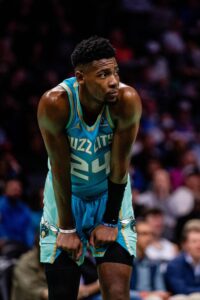 When a new management group takes over a rebuilding team, the first order of business is to establish which of the incumbent players are part of the long-term plan. In the Hornets’ case, there’s one obvious sure thing: Miller, whose impressive rookie season was largely overlooked while Victor Wembanyama was doing things we’ve never seen before in San Antonio and Chet Holmgren was anchoring the defense for the West’s No. 1 seed in Oklahoma City.
But Miller, a versatile wing defender with size, averaged 17.3 points per game and made 37.3% of his three-pointers in his first NBA season. He’s just 21 years old and has legitimate star upside, so the fact that Charlotte will have him on a rookie scale contract for three more years is a huge boon for the franchise.
We can probably add Ball to that list of core building blocks too. He’ll need to be healthier going forward for the Hornets to count on him, but Ball – who is only 15 months older than Miller – has an All-Star berth under his belt and appeared to be on the verge of leveling up early in the 2023/24 season, averaging 25.9 points and 8.6 assists in his first 14 games before getting hurt in the 15th. His five-year, maximum-salary rookie scale extension will begin this summer, so barring an unexpected pivot from the new front office, it’s safe to assume the plan will be to continue adding pieces around Ball and Miller.
Assuming his back issue doesn’t linger, Williams looks like one solid piece to complement those two rising stars. The big man showed in 2023 – both at the end of his rookie season and the start of his sophomore year – that he has the potential to develop into a solid starting center. He has one more year before he becomes extension-eligible, so the Hornets won’t have to make any decisions on him in the short term — they’ll just hope he’s healthy enough to get a longer look at him as the starting five in 2024/25.
While there’s no obvious fourth long-term keeper under contract at this point, there are a couple more candidates who could join that group. The first is whichever prospect Charlotte drafts with the No. 6 pick.
Assuming the franchise remains fully committed to Ball, selecting another ball-dominant player in that spot might not make sense, but pretty much any other position is a possibility, given the relatively wide-open nature of the roster. That includes a sharpshooter (Reed Sheppard or Dalton Knecht), a three-and-D forward (Zaccharie Risacher), a secondary ball-handler and play-maker (Matas Buzelis), a wing scorer (Ron Holland), or even a rim-protecting big man (Donovan Clingan). Some, but not all, of those players will be off the board by the time Charlotte is on the clock at No. 6, and Peterson will have a chance to put his stamp on the roster with his choice in that spot.
The other player whom the Hornets could make part of their core is unrestricted free agent Miles Bridges, who returned after a year out of the league and showed no signs of rust, averaging 21.0 points, 7.3 rebounds, and 3.3 assists in a team-high 37.4 minutes per game. However, Bridges’ free agency is more complicated than most.
The reason Bridges was out of the league for a year is because he was facing credible domestic assault charges. His case was resolved when he accepted a plea deal and was sentenced to three years of probation, at which point he re-signed for one year with the Hornets, served an NBA suspension, and then reclaimed his spot in the team’s starting lineup. However, he later faced new allegations of domestic violence following the resolution of the initial case.
Those newer charges were eventually dismissed due to insufficient evidence for a trial, but they won’t exactly work in Bridges’ favor as he seeks a lucrative, long-term deal. The Hornets have a series of questions to answer before investing in Bridges long-term. Are they confident his legal issues are fully behind him? Are they comfortable making a major financial investment in him from a moral – and public relations – perspective? Do they want him to be one of the faces of their franchise? If they do try to re-sign him, will the off-court baggage bring his value down, both in contract talks and in potential future trade negotiations? And beyond all that, exactly how much value does he provide on the court, where he has only made 35.0% of his three-pointers in one of five NBA seasons?
It’s obviously not in a rebuilding team’s best interest to let a talented 26-year-old player go for nothing, but giving Bridges a big payday and then having him show up in the headlines again for the wrong reasons would be a black eye on the organization. The Hornets have a lot to consider as they weigh Bridges’ future — if they have reservations, it could make sense to explore another short-term contract, a deal with protections for the team, or sign-and-trade scenarios.
There are no true potential impact players on the rest of the roster, but Grant Williams, Martin, Nick Richards, Vasilije Micic, and Tre Mann are solid enough depth pieces who could either be trade chips this offseason or could return to fill out next season’s roster.
Of those players, I’d consider Micic the most likely trade candidate. A salary-matching piece in the Hayward deal, the Serbian play-maker was given a chance to play real minutes down the stretch and showed he’s capable of playing a backup point guard role at the NBA level. Micic will be on a pseudo-expiring contract (he has a team option for 2025/26) and the 30-year-old rookie would likely prefer to play for a contender. His poor three-point shooting (27.9% on the season, including 29.4% in Charlotte) will hurt his value a little, but he could at least net a second-round pick if the Hornets take back an unwanted contract.
After taking into account the cap hold for Bridges and the No. 6 pick, along with the partial guarantee on Davis Bertans‘ option year, the Hornets won’t have significant cap room this summer, especially if they decide to retain some of their players with non-guaranteed contracts, including Seth Curry, Aleksej Pokusevski, Bryce McGowens, and JT Thor.
Still, they could easily have at least $15MM+ to work with (or $30MM+ if Bridges walks), plus the $8MM room exception. That space might be best spent on accommodating salary-dump trades with teams looking to shed salary.
Having taken a step backward last season by trading a series of veterans, the Hornets presumably aren’t giving Peterson a mandate to get the team back to the playoffs as soon as possible, so he can afford to take things slow and continue to stockpile draft assets — that patient, deliberate approach to the rebuild may line up the team to land another top-six pick in the 2025 draft, which is considered stronger at the top than this year’s.
Salary Cap Situation
Guaranteed Salary
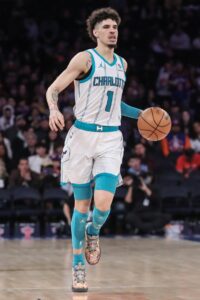 LaMelo Ball ($35,250,000)
- Ball’s cap hit is a tentative figure based on 25% of a projected $141MM cap.
- Grant Williams ($13,025,250)
- Brandon Miller ($11,424,600)
- Cody Martin ($8,120,000)
- Vasilije Micic ($7,723,000)
- Nick Richards ($5,000,000)
- Tre Mann ($4,908,373)
- Mark Williams ($4,094,280)
- Nick Smith Jr. ($2,587,200)
- Total: $92,132,703
Non-Guaranteed Salary
- Seth Curry ($4,000,000)
- Curry’s salary will become guaranteed if he remains under contract through June 28.
- Aleksej Pokusevski ($2,273,252)
- Pokusevski’s salary will become guaranteed if he remains under contract through July 8.
- Bryce McGowens ($2,019,699)
- McGowens’ salary will become guaranteed if he remains under contract through July 18.
- Leaky Black (two-way)
- Marques Bolden (two-way)
- Total: $8,292,951
Dead/Retained Salary
- None
Player Options
- Davis Bertans ($16,000,000): Bird rights
- Bertans technically holds an early termination option. If he opts in, his salary will be partially guaranteed for $5,250,000.
- Total: $16,000,000
Team Options
- JT Thor ($1,988,598): Bird rights
- Thor’s salary would remain non-guaranteed if his option is exercised.
- Total: $1,988,598
Restricted Free Agents
- None
Two-Way Free Agents
Draft Picks
- No. 6 overall pick ($7,510,680)
- No. 42 overall pick (no cap hold)
- Total (cap holds): $7,510,680
Extension-Eligible Players
- Tre Mann (rookie scale)
- Cody Martin (veteran)
- JT Thor (veteran)
- Extension-eligible until June 30 (or beyond, if his team option is exercised).
Note: Unless otherwise indicated, these players are eligible for extensions beginning in July.
Unrestricted Free Agents
- Miles Bridges ($15,050,470 cap hold): Bird rights
- Total (cap holds): $15,050,470
Other Cap Holds
- Arnoldas Kulboka ($1,867,722 cap hold)
- Scottie Lewis ($1,867,722 cap hold)
- Total (cap holds): $3,735,444
Note: The cap holds for these players are on the Hornets’ books from prior seasons because they haven’t been renounced. They can’t be used in a sign-and-trade deal.
Cap Exceptions Available
Note: The Hornets project to operate under the cap. They would have to renounce two trade exceptions – worth $3,585,600 and $442,826 – in order to use cap room. If they were to operate over the cap, they’d lose the room exception and would have access to the mid-level exception ($12,859,000) and bi-annual exception ($4,681,000).
- Room exception: $8,006,000
Cavs’ Donovan Mitchell To Miss Game 5
5:25pm: Mitchell is out for Game 5, the team announced (Twitter link via Cavs sideline reporter Serena Winters). As we relayed in a separate story, LeVert and Allen are out as well.
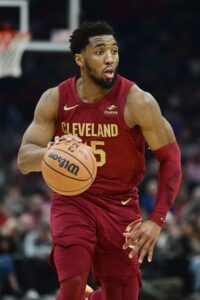 10:51am: Cavaliers star Donovan Mitchell is expected to miss Game 5 of the Eastern Conference semifinals on Wednesday in Boston, sources tell Shams Charania and Joe Vardon of The Athletic (Twitter link).
Mitchell, who was unavailable for Game 4 due to a left calf strain, had been listed as questionable for Wednesday’s contest, which is a do-or-die game for a Cavs team trailing the Celtics 3-1 in the series. The All-Star guard admitted on Monday that his availability for Game 5 was very much up in the air.
Two other key Cleveland players are also listed as questionable: starting center Jarrett Allen (right rib contusion) and sixth man turned starter Caris LeVert (left knee bone bruise). None of the three players were on the floor when reporters were let into the Cavs’ shootaround on Wednesday morning, though Mitchell and LeVert did later come onto the court, notes Tim Bontemps of ESPN (Twitter links).
Allen has missed seven straight playoff games as a result of his rib injury, while LeVert reportedly aggravated his knee issue in Game 4, which he started in Mitchell’s place.
Barring some last-minute good news on Mitchell’s status – or a big-time upset on Wednesday by a Cleveland team listed as a 16-point underdog – there’s a chance the 27-year-old has played his last game as a Cavalier. He’ll enter a potential contract year this offseason and if he doesn’t sign an extension, the Cavs will have a major decision to make on his future, with rival teams already said to be preparing their trade offers.
Nuggets Notes: Jokic, Gordon, Watson, Holiday
Nikola Jokic was awarded the Michael Jordan trophy as this season’s Most Valuable Player prior to the tip-off of Game 5 of the Western Conference semifinals on Tuesday. Then the Nuggets star went and showed why he won the award for a third time, dismantling the Timberwolves and Defensive Player of the Year Rudy Gobert with 40 points and 13 assists in a victory that gave Denver a 3-2 edge in the series.
As Ohm Youngmisuk of ESPN writes, Jokic made 15-of-22 shots from the floor, including 8-of-9 when Gobert was his primary defender, en route to a performance that teammate Aaron Gordon referred to as “incredible,” “astounding,” and “ridiculous.” Even Jokic’s opponents couldn’t help but be in awe of the way the big man played on Tuesday.
“I just laugh,” Timberwolves guard Anthony Edwards said. “That’s all I can do. I can’t be mad, because he’s good, man. I think I said that after Game 1, when we won, and Game 2. He’s the MVP. He’s the best player in the NBA; he showed it the last three games, three games in a row. .. He was special tonight. I got to give him his flowers. I don’t know what we were supposed to do.”
Head coach Michael Malone, who lauded Jokic for his basketball smarts and said he “probably belongs to Mensa,” pointed out that the timing of the superstar center receiving his latest Most Valuable Player trophy was more appropriate than the timing of the initial MVP announcement.
“Nikola was named MVP after that (106-80) Game 2 loss,” Malone said. “And I think the last three games he has shown everybody why he is arguably one of the best players to play this game.”
Here’s more on the Nuggets:
- Gordon, who had 18 points and 10 rebounds in the Game 5 win, has been a crucial X-factor for Denver in the series, writes Ryan McFadden of The Denver Post (subscription required). In an in-depth feature published prior to Tuesday’s contest, Rob Mahoney of The Ringer explored how Gordon has “found his basketball destiny” with the Nuggets, adding a component to the roster that helped the team reach its ceiling.
- In an entertaining story for The Athletic, Sam Amick details how Gordon has been left out of recent team dinners since he was the only Nuggets player who didn’t make it to last Thursday’s dinner in Minneapolis before the Nuggets won their first game of the series following two straight losses. Denver hasn’t want to risk messing with what’s working by changing its routine since then. Reggie Jackson said that dinner ahead of Game 3 helped the team stop being so tense: “We needed to be around each other. We knew what we had to do, and we knew we had something to accomplish. But it was time between the games to breathe and relax and talk about life. That really helped.”
- In the first round of the playoffs, Peyton Watson averaged 12.0 minutes per game off the bench, while veteran Justin Holiday played just 7.1 MPG. In the second round, Holiday has seen his minutes jump to 18.3 per contest while Watson has essentially fallen out of the rotation. Bennett Durando of The Denver Post explores the thinking behind the rotation tweak, explaining that the Nuggets are prioritizing Holiday’s offense over Watson’s defense. “Just trying to find a lineup that can give us the best chance to have success,” Malone said last week. “With the way (the Timberwolves) guard and how effective they are defensively, sometimes you have to put your best offensive lineup out there to give yourself a chance to score and stay in the game.”
- Now that the Nuggets have regained the upper hand in their series vs. Minnesota and are just one win away from advancing to the Western Conference Finals, Dan Wolken of USA Today argues that Denver is the clear favorite to win its second consecutive championship.
Mavericks Notes: Jones, Doncic, Irving, Lively
Four years after nearly being dealt to the Mavericks in a trade that fell apart over a miscommunication, veteran forward Derrick Jones chose Dallas last summer over a handful of rival suitors, including the Bulls and Suns, reports Tim Cato of The Athletic. According to Cato, Jones ultimately narrowed his options to the Mavs and Celtics before deciding to sign with Dallas.
Speaking to Cato, Jones’ agent Aaron Turner said he encouraged his client to sign with the Mavericks because it was the situation where the forward would get the best opportunity to display his full skill set and claim a major role if he impressed the coaching staff.
“You’ve got to go somewhere not where you’re wanted, but you’re needed,” Turner said in describing the advice he gave to Jones. “Whether (the Mavericks) know they need you yet, it doesn’t matter. They need you.”
Jones ended up starting 66 of 76 games for the Mavs, serving as the team’s primary defensive stopper while establishing new career highs in points (8.6) and minutes (23.5) per game, as well as three-point percentage (34.3%). Head coach Jason Kidd calls Jones a player “we count on” on both ends of the court, and Turner says the 27-year-old would like to be back in Dallas next season.
The Mavericks will only hold Jones’ Non-Bird rights, which allow for a raise of just 20% above his minimum, so they may have to dip into their mid-level exception to make him a competitive offer. Turner expects his client to test the market, but the hope is that the Mavs will be able to put an offer on the table that makes sense for both sides. For his part, Kidd doesn’t want to let Jones get away.
“We understand the business (and that) there’s other teams that can maybe pay him more,” Kidd said. “But we definitely want him back.”
Here’s more on the Mavs:
- It’s hard to blame Luka Doncic, who’s playing through multiple injuries and may not even be active if this were the regular season, but the Mavericks will need more from him if they hope to advance past the Thunder, Cato says in another article for The Athletic. As Cato notes, Dallas built its roster around defense and relies heavily on Doncic and Kyrie Irving for scoring, so those two stars will likely have to be operating at the peak of their powers to get the team two more wins over Oklahoma City.
- How a resilient Mavs team responds in Game 5 after a meltdown in Monday’s Game 4 loss will be a defining moment for this group, as Irving said following that defeat. “This is the telltale sign of whether or not we’re going to be that group that gets over the hump,” Irving said, per Brad Townsend of The Dallas Morning News (subscription required). “Or we’re going to be one of those groups that looks back and sees OKC (advance) and kind of living with some of the woulda, coulda, shoulda.”
- Of the 12 active NBA players who have made at least seven All-Star teams, only Irving advanced past the first round of the playoffs. The veteran guard spoke to Tim MacMahon of ESPN about being the last star standing from the “older” generation this spring, as well as his impressions of the league’s rising young stars. “It’s been pretty much our generation running the Finals, the Eastern Conference Finals, Western Conference Finals,” Irving said. “(The shift has) just been quick. I don’t want to say I know that those guys are looking at the light in the tunnel. I can’t speak for them. But to see this newer generation come in and to see how it’s played out, I’m excited. It keeps me motivated and inspired to continue to lead my generation, because I was the youngest of that generation watching them.”
- Mavericks center Dereck Lively and Thunder guard Cason Wallace have both played key roles as rookies for their respective teams in the playoffs. The fact that they’ve each fit in so well and adapted so quickly to playoff basketball makes last year’s draft-day trade involving the two players a win-win, writes Joe Mussatto of The Oklahoman. Oklahoma City moved up two spots to nab Wallace with the No. 10 pick, with Dallas drafting Lively after sliding down to No. 12.