
Hoops Rumors Glossary: Non-Bird Rights
Players and teams have to meet certain criteria to earn Bird rights and Early Bird rights, but Non-Bird rights are practically a given.
They apply to a player who has spent a single season or less with his team, as long as he finishes the season on an NBA roster and is on a standard contract (rather than a hardship or 10-day deal). Even a player who signs a rest-of-season contract right before the regular season finale and spends just a single day with his club would have Non-Bird rights in the offseason.
Teams can also claim Non-Bird rights on Early Bird free agents if they renounce them. The primary motivator to do so would be to allow the team to sign the free agent to a one-year contract, a move that’s not permitted via Early Bird rights.
Teams are eligible to sign their own free agents using the Non-Bird exception for a salary starting at 120% of the player’s previous salary, 120% of the minimum salary, or the amount of a qualifying offer (if the player is a restricted free agent), whichever is greatest. Contracts can be for up to four years, with 5% annual raises.
The cap hold for a Non-Bird player is 120% of his previous salary, unless his previous salary was the minimum. In that case, the cap hold is equivalent to the two-year veteran’s minimum salary. If a Non-Bird free agent only has one year of NBA experience, his cap hold is equivalent to the one-year veteran’s minimum salary.
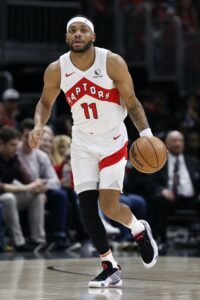 The salary limitations that apply to Non-Bird rights are more severe than those pertaining to Bird rights or Early Bird rights, so in many cases, the Non-Bird exception may not be enough to retain a well-regarded free agent. For instance, the Nuggets held Bruce Brown‘s Non-Bird rights last summer, but couldn’t have used them to match or exceed the offer the veteran wing received from the Pacers.
Because Brown had earned a relatively modest $6,479,000 salary in 2022/23, Denver’s ability to offer a raise using the Non-Bird exception was extremely limited — the Nuggets would have only been able to offer 120% of Brown’s previous salary using his Non-Bird rights, which worked out to $7,774,800. Indiana used its cap room to give Brown a $22MM starting salary, easily topping Denver’s maximum offer.
The Bucks may end up in a similar situation this offseason with Malik Beasley, who will only have Non-Bird rights after playing out a one-year, minimum-salary contract. Milwaukee almost certainly won’t have cap room, and the mid-level exception won’t be an option either as long as the team’s salary remains above the second tax apron. If they want to re-sign Beasley, the Bucks may have to hope he’ll accept an offer in the $3.6MM range via the Non-Bird exception.
Holding Non-Bird rights on a free agent didn’t help the Nuggets with Brown and may not be enough for the Bucks with Beasley, but there are cases in which the exception proves useful.
The Clippers, for instance, only had Non-Bird rights on Russell Westbrook last offseason, but that gave them the ability to offer a starting salary worth 20% more than the veteran’s minimum that another team might have offered. Since Westbrook wanted to remain in Los Angeles, the Non-Bird exception – which allowed for a starting salary of $3,835,738 – was enough to re-sign him. His minimum salary would have been $3,196,448.
After being traded from the Pacers to the Raptors earlier this season, Brown will have Non-Bird rights again this summer if Toronto opts to turn down his $23MM team option for 2024/25. However, in that scenario, the Raptors would have significantly more flexibility than Denver did to offer Brown a new contract, since he’ll be coming off a much higher salary this time around. Toronto could offer Brown a starting salary of up to $26.4MM (120% of $22MM) using the Non-Bird exception.
Finally, it’s worth noting that a player who re-signs with his previous team on a one-year deal (or a two-year deal that includes a second-year option) and will have Early Bird or Bird rights at the end of that contract would surrender those rights if he consents to a trade. In that scenario, he’d only finish the season with Non-Bird rights.
No players in this position consented to a trade this year, but it was a factor in Miles Bridges‘ decision to tell the Hornets he wouldn’t approve a deal.
If Charlotte had traded him to a new team, Bridges would have only had Non-Bird rights, meaning his new team wouldn’t have been able to offer him a starting salary higher than $9,505,560 (120% of his $7,921,300 salary for 2023/24) without using cap room or another exception. By remaining with the Hornets, Bridges hung onto his Bird rights, giving him more pathways to a significant payday, either by re-signing in Charlotte or via a sign-and-trade.
Note: This is a Hoops Rumors Glossary entry. Our glossary posts will explain specific rules relating to trades, free agency, or other aspects of the NBA’s Collective Bargaining Agreement. Larry Coon’s Salary Cap FAQ was used in the creation of this post.
Earlier versions of this post were published in previous years by Luke Adams and Chuck Myron.
Latest On Stephen Curry
After announcing on Saturday that Stephen Curry would miss at least two games due to his sprained right ankle, the Warriors provided an update on their two-time MVP on Tuesday, issuing a press release (via Twitter) stating that he has been cleared for on-court workouts.
Curry, who injured his ankle last Thursday vs. Chicago, was unavailable for a pair of games vs. the Spurs on Saturday and Monday and has been ruled out for Wednesday’s matchup with the Mavericks. According to Golden State, he’s expected to join the team in Los Angeles for practice on Friday and will be reevaluated again following that practice.
After Wednesday’s contest in Dallas, Golden State will be in action on Saturday vs. the Lakers, and it sounds as if Curry might be able to return for that game, tweets Anthony Slater of The Athletic. If that’s the case, it would be great news for the Warriors, who are battling for play-in positioning and currently trail L.A. by one game for the No. 9 seed in the West.
Curry hasn’t been at his best in recent weeks, making just 37.0% of his shots from the field, including 32.8% of his threes, over his past 10 games. However, his season-long numbers remain strong — he has averaged 26.9 points, 4.9 assists, and 4.4 rebounds in 32.8 minutes per game across 59 starts, with a .449/.407/.920 shooting line.
The 15-year veteran, who will turn 36 this Thursday, needs to play in six more games to be eligible for end-of-season awards, including All-NBA. If he doesn’t return on Saturday in Los Angeles, his next opportunity to play would be in the Bay Area next Monday as the Warriors open a three-game home stand by hosting the Knicks.
Lakers Notes: Vincent, Vanderbilt, Bronny, Russell
Lakers guard Gabe Vincent, who underwent arthroscopic surgery on his left knee in late December, has been cleared for non-contact on-court work, head coach Darvin Ham told reporters today (Twitter link via Khobi Price of The Southern California News Group).
Shams Charania of Stadium and The Athletic reported on Monday during an appearance on FanDuel’s Run It Back (Twitter video link) that Vincent had progressed to “conditioning and ramping up,” adding that he could return to action as soon as next week. While that remains possible, Ham’s update on Tuesday suggests that the veteran still isn’t taking contact, so he has a little more work to do before he’s ready to suit up.
Vincent, who received a three-year deal worth most of the Lakers’ mid-level exception this season, has been limited to just five appearances due to health issues after having been an important part of Miami’s rotation during the team’s NBA Finals run last spring. He’s owed guaranteed salaries of $11MM in 2024/25 and $11.5MM in ’25/26.
Here’s more on the Lakers:
- Lakers forward Jarred Vanderbilt, sidelined since February 1 due to a left foot sprain, doesn’t appear to be quite as far along as Vincent in his rehab process. Ham said today that Vanderbilt is making progress but hasn’t yet been cleared for on-court work (Twitter link via Price).
- With USC’s season nearing its end, Bronny James has yet to establish himself as “any kind of draftable player for 2024,” according to John Hollinger of The Athletic, who writes that the idea of LeBron James teaming up with his son next season in Los Angeles looks increasingly unlikely. The optimal developmental path for Bronny probably involves him remaining in college for at least another year, Hollinger adds.
- Within the same Athletic story, Hollinger notes that D’Angelo Russell‘s expiring contract has long been viewed as a logical trade asset for the Lakers this offseason, but wonders whether it’s a lock that the point guard will pick up his $18.7MM player option for 2024/25, given how well he has played as of late (22.5 PPG and 6.4 APG on .477/.457/.848 shooting in his past 26 games). If Russell opts out, it could complicate Los Angeles’ plans on the trade market, Hollinger observes, since the team won’t have any other sizable expiring deals.
- It’s impossible to predict how this Lakers’ season will end, Bill Plaschke writes in a column for The Los Angeles Times. As Plaschke details, a recent stretch that included impressive wins over Oklahoma City, Milwaukee, and Minnesota also featured disappointing losses to potential playoff opponents like Denver and Sacramento. Ham said on Sunday that he believes the team is “trending in the right direction,” but stressed that L.A. must bear down to continue that trend: “Just take things one day at a time, one game at a time.”
Community Shootaround: 2024 Buyout Market Impact
As our tracker shows, eight notable veteran players were waived at some point after last month’s trade deadline and subsequently landed with teams that have playoff or championship aspirations. Those players are as follows:
 Danilo Gallinari: Signed with Bucks
- Delon Wright: Signed with Heat
- Patty Mills: Signed with Heat
- Shake Milton: Signed with Knicks
- Spencer Dinwiddie: Signed with Lakers
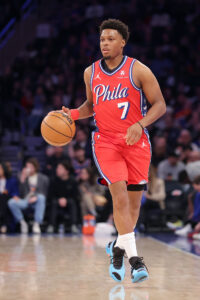
- Kyle Lowry: Signed with Sixers
- Thaddeus Young: Signed with Suns
- Mike Muscala: Signed with Thunder
Unlike last year, when Russell Westbrook joined the Clippers after being let go by Utah, there are no former MVPs in this year’s group of buyout-market additions. But Lowry is a six-time All-Star; he and Mills have won titles; Gallinari, Dinwiddie, and Young have strong career résumés; and guys like Wright and Muscala have been consistent, reliable contributors for years.
Of course, it’s rare for any buyout market acquisitions to play important roles for championship-caliber clubs, and several of these players likely won’t be part of their respective teams’ playoff rotations. Still, Lowry is starting for the Sixers, while Gallinari is playing semi-regular minutes for a Bucks team that appears capable of making a deep postseason run. Others could emerge as key contributors, especially in the event of injuries.
This was also the first season that a new rule was in place prohibiting players who were earning more than the non-taxpayer mid-level exception ($12.4MM) before they were waived from joining teams whose salaries are above either tax apron.
That rule applied to Lowry and Dinwiddie, who weren’t eligible to sign with the Celtics, Nuggets, Warriors, Clippers, Heat, Bucks, or Suns. Those seven teams are also prohibited from signing a couple of veterans still available in free agency: Marcus Morris and Joe Harris.
Those tax-apron teams were still able to be players on the buyout market, but they were only able to target free agents whose pre-waiver salaries had been below $12.4MM, such as Gallinari, Wright, Mills, and Young.
Now that the NBA’s buyout season is just about over, we want to know what you think about this year’s moves. Which buyout market addition has the potential to make the biggest postseason impact? Will any of the players still on the free agent market play rotation roles for playoff teams? Did you appreciate the new restrictions placed on apron teams in the buyout market or find that rule unnecessary?
Head to the comment section below to weigh in with your two cents!
Southeast Notes: Wizards, Wright, Peterson, Mosley
Ted Leonsis‘ plan to move the Wizards from Washington, D.C. to Alexandria, Virginia appears to be on life support, according to David Aldridge of The Athletic.
As Aldridge details, Virginia senator Louise Lucas, who is the chair of the state senate’s Finance and Appropriations Committee, removed the proposal to build a new arena and “entertainment district” from the state’s 2024 budget, and that budget was approved on Saturday by Virginia’s General Assembly.
While it’s possible that proposal will be revived and regain momentum as a result of various political maneuvering, Aldridge believes the setback gives Leonsis a chance to return to the bargaining table with D.C. mayor Muriel Bowser to figure out a deal that would keep the Wizards in Washington going forward. Reaching a compromise to keep the Wizards in the nation’s capital would allow everyone to save face, Aldridge contends.
Here’s more from around the Southeast:
- Heat guard Delon Wright, who signed with Miami last month after being waived by Washington, has been a DNP-CD for five straight games, including a surprising loss to his former team on Sunday. However, he’s not complaining about his role, writes Anthony Chiang of The Miami Herald. “I’m just trying to stay as ready as I can,” Wright said. “I can’t complain too much because I’m coming into a different situation with a team that just went to the Finals. I’m just trying to fit in. I’m not in a position to be moping around. So I just have to stay ready whenever I’m called upon and do the best I can with whatever role they give me.”
- Nets guard Dennis Schröder, who knew Jeff Peterson in Atlanta before reuniting with him briefly in Brooklyn, said the Hornets‘ new head of basketball operations is a “great human being” who is honest, straightforward, and holds people accountable, per Roderick Boone of The Charlotte Observer. Peterson is already making a positive impression on Hornets players, Boone adds. “Yeah, he’s engaged,” Miles Bridges said. “He’s coming to every practice, every game. And just to have a GM who cares and shows up all the time means a lot.”
- Jamahl Mosley‘s new four-year extension with the Magic doesn’t include a team option for the 2027/28 season, a league source tells Josh Robbins of The Athletic. That reporting suggests the deal is fully guaranteed.
And-Ones: NBA Media Rights, Bell, 2024 Draft, Sheppard
The exclusive media rights negotiating window between the NBA and current partners Disney and Turner is open until April 22, and sources recently told Tom Friend of Sports Business Journal they believe the parties entered those negotiations roughly three-quarters of the way toward an agreement based on their preliminary talks in recent months.
According to Friend, those sources also expect the in-season tournament – now known as the Emirates NBA Cup – to be part of the Disney and Turner packages rather than going to a streaming service such as Apple or Netflix.
Once the current exclusive negotiating window closes on April 22, Amazon and Apple are expected to talk to the NBA, with Amazon considered the favorite for the league’s national streaming rights and Apple viewed as likelier to pursue a smaller “singular” event, such as perhaps the play-in tournament, says Friend. The SBJ report also suggests that NBC is a candidate to regain some broadcast rights.
NBA team executives think the overall media rights deal will end up being worth about $60-72 billion, with negotiations potentially concluding in June or July, Friend reports. The league’s previous media rights deal was worth $24 billion over nine years.
- Former NBA big man Jordan Bell is leaving the Indiana Mad Ants – the Pacers‘ G League affiliate – with a few weeks remaining in the NBAGL season. According to Scott Agness of Fieldhouse Files, Bell agreed to a buyout with the Mad Ants and is pursuing an international opportunity. Bell’s destination isn’t yet known, but Agness believes he’s likely headed back to the Chinese Basketball Association, where he played in 2022/23.
- In an Insider-only story for ESPN.com, Jonathan Givony and Jeremy Woo preview this week’s NCAA conference tournaments, posing 15 burning questions to be answered, including what version of UConn’s Stephon Castle will show up in the Big East tournament and whether Isaiah Collier‘s stock, which has bounced back since he returned from a hand injury in February, will continue to rise in the Pac-12 tourney.
- Kentucky freshman Reed Sheppard ranks second overall on the newest 2024 big board from Kevin O’Connor of The Ringer and is the No. 1 pick in O’Connor’s mock draft (to San Antonio).
- Law Murray of The Athletic takes a look at how all 30 NBA teams have adjusted their rotations and depth charts since the start of the season.
Magic, Jamahl Mosley Agree To Four-Year Extension
8:35am: The Magic have officially announced Mosley’s contract extension, confirming in a press release that it runs through 2027/28.
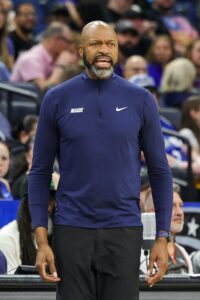 “Jamahl and his staff have done a tremendous job not only this season, but since we hired him back in 2021,” president of basketball operations Jeff Weltman said in a statement. “His preparation, work ethic, ability to connect with the players, and passion he brings to the job every day brings positive results, both on the court and off. We are very happy to have Jamahl lead the Magic for years to come.”
8:14am: The Magic have agreed to a new long-term contract with Jamahl Mosley, according to Adrian Wojnarowski of ESPN, who reports that Orlando’s head coach is set to sign a four-year extension that will take him through the 2027/28 season.
Mosley, who was hired by the Magic to replace Steve Clifford in 2021, got off to a slow start with a rebuilding Orlando club, leading the team to a 22-60 record in ’21/22. However, he has improved upon that mark in each of the two subsequent seasons.
The Magic went 34-48 last season and are 37-28 so far in ’23/24. Overall, Mosley has a modest 93-136 (.406) record, but he has Orlando on pace to post its highest winning percentage since 2010/11 and well positioned to earn its first playoff berth since 2020.
As Wojnarowski notes, the Magic’s defensive turnaround under Mosley has been impressive. After ranking 26th in defensive rating during Clifford’s final season, the team improved each year under Mosley and is currently fifth in the NBA with a 111.3 defensive rating this season.
Prior to being hired by the Magic, Mosley spent seven years as a Mavericks assistant under Rick Carlisle. He transitioned from playing to coaching in 2005 and began his coaching career with stints in Denver (2005-10) and Cleveland (2010-14).
Mosley’s initial contract with the Magic was reported at the time to be a four-year deal, but it’s possible that fourth year (2024/25) was a team option. Based on Wojnarowski’s reporting, it sounds like the new four-year extension will begin in ’24/25, perhaps replacing that option year.
Donovan Mitchell Now Ineligible For End-Of-Season Awards
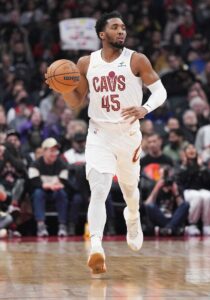
Cavaliers guard Donovan Mitchell missed his 18th game of the season on Monday, meaning he has joined a growing list of star players who are ineligible for end-of-season awards in 2023/24, tweets ESPN’s Bobby Marks.
 The NBA introduced a rule this season requiring players to appear in at least 65 games in order to be eligible to receive votes for a Most Valuable Player, Defensive Player of the Year, or Most Improved Player award, as well as for an All-NBA or All-Defensive spot.
Mitchell missed his seventh consecutive game on Monday due to a left knee bone bruise and has now appeared in just 47 of Cleveland’s 65 contests. Even if he were to return on Wednesday and play in every game for the rest of the regular season, he’d max out at 64 appearances.
As Marks notes (via Twitter), other notable players who are no longer eligible for end-of-season awards include Joel Embiid, Jimmy Butler, Julius Randle, Kyrie Irving, Draymond Green, Ja Morant, OG Anunoby, LaMelo Ball, Jamal Murray, Kristaps Porzingis, and Mitchell’s teammates Darius Garland and Evan Mobley.
Several of those players likely wouldn’t have made All-NBA or All-Defensive teams even if they had reached the 65-game threshold, but Mitchell was a strong All-NBA candidate, having averaged 28.0 points, 6.2 assists, and 5.4 rebounds in 35.7 minutes per game so far this season, with a shooting line of .472/.371/.861. Those numbers aren’t far off the ones he posted in 2022/23, when he finished sixth in MVP voting and made the All-NBA Second Team.
While Mitchell won’t earn an All-NBA spot this season, that won’t have any impact on his next contract, since he’s no longer eligible for a super-max deal after being traded from Utah to Cleveland in 2022. He will be extension-eligible as of this July, however.
The Cavaliers could offer Mitchell a new contract that is worth 30% of the 2025/26 cap and covers up to four seasons (through ’28/29), with 8% annual raises. As Marks observes, based on the latest cap projections, that four-year max extension would be worth an estimated $199MM.
Raptors Notes: Boucher, Olynyk, Poeltl, Quickley, Banton
Entering Thursday’s contest in Phoenix, Raptors big man Chris Boucher hadn’t played more than 12 minutes in a game since January. However, he scored 11 points in nearly 24 minutes of action vs. the Suns, and after Toronto quickly fell behind by double-digits in the opening minutes in Portland on Saturday, another opportunity emerged for Boucher, who helped lead a fourth-quarter comeback that sent the game to overtime
Although the Raptors ultimately lost the game, Boucher finished with 16 points, eight rebounds, and three blocked shots in a season-high 31 minutes. Speaking to reporters later in the night, Boucher said that head coach Darko Rajavkoic has been open with him as his minutes have fluctuated this season, adding that he understands why his role hasn’t been consistent.
“We talk. He knows me and knows what I can bring and all,” Boucher said, per Michael Grange of Sportsnet.ca. “Sometimes things don’t go the way you want. The team’s had a lot of changes and I got caught in the middle. I know they know what I’m able to do, and everyone knows that I can change the game and all. I don’t think anyone thinks I can’t play, it’s about more than me.”
Boucher is under contract with the Raptors for one more season beyond this one, with a $10.81MM guaranteed salary for 2024/25. However, it’s possible – especially following last month’s acquisition of Kelly Olynyk – that he’ll emerge as a trade candidate this summer.
Here’s more on the Raptors:
- From a team-building perspective, the Raptors might prefer that their top two centers – Jakob Poeltl and Olynyk – were a little younger, but having those two veterans under contract for at least the next two seasons gives the club some certainty and stability at the position, according to Eric Koreen of The Athletic, who notes that the team will be able to focus its efforts and resources on upgrading other positions.
- In a separate story for The Athletic, Koreen highlights Immanuel Quickley‘s recent strong play, writing that the guard is increasing his price tag ahead of restricted free agency. In nine games since the All-Star break, Quickley is averaging 21.8 points, 8.1 assists, and 6.1 rebounds per contest while making 43.0% of his three-point attempts.
- Former Raptor Dalano Banton helped lead the Blazers to a victory on Saturday, racking up 25 points in 42 minutes against his old team. As Josh Lewenberg of TSN.ca tweets, one of Masai Ujiri‘s gripes about the previous coaching staff was that it didn’t do enough to develop its young players, including Banton. With that in mind, it was a little surprising that Toronto didn’t do more last summer to retain Banton – who could have been a restricted free agent if the Raptors had given him a qualifying offer – in order to see how he might’ve developed under Rajakovic, Lewenberg observes.
Hoops Rumors Glossary: Early Bird Rights
Bird rights offer teams the chance to sign their own free agents without regard to the salary cap, but they don’t apply to every player. Other salary cap exceptions are available for teams to keep players who don’t qualify for Bird rights. One such exception is the Early Bird, which applies to players formally known as Early Qualifying Veteran Free Agents.
While the Bird exception is for players who have spent three seasons with one club without changing teams as a free agent, Early Bird rights are earned after just two such seasons. Virtually all of the same rules that apply to Bird rights apply to Early Bird rights, with the requirements condensed to two years rather than three.
Players still see their Bird clocks restart by changing teams via free agency, being claimed in an expansion draft, or having their rights renounced. A player who is traded can also have his Bird clock reset if he approves a move after having re-signed with his previous team on a one-year contract (or a one-year contract with a second-year option) earlier in the league year.
 As is the case with Bird rights, a player’s clock stops when he’s released by a team and clears waivers, but it would pick up where it left off if he re-signs with that same team down the road without joining another club in the interim. For instance, James Johnson will have Early Bird rights this offseason because – even though he was waived in January – he’s on track to finish a second consecutive season with the Pacers and didn’t join another team between his stints in Indiana.
The crucial difference between Bird rights and Early Bird rights involves the limitations on contract offers. Bird players can receive maximum-salary deals for up to five years, while the most a team can offer an Early Bird free agent without using cap space is 175% of his previous salary (up to the max) or 105% of the league-average salary in the previous season, whichever is greater.
These offers are also capped at four years rather than five, and the new contracts must run for at least two years — the second season can be non-guaranteed, but can’t be a team or player option. Raises are maxed out at 8% per season.
Besides Johnson, some of the more notable free agents who will have Early Bird rights during the 2024 offseason include Malik Monk (Kings), Isaiah Hartenstein (Knicks), Kyle Anderson (Timberwolves), and Andre Drummond (Bulls).
In some instances, teams can benefit from having Early Bird rights instead of full Bird rights if they’re trying to preserve cap space. The cap hold for an Early Bird player is 130% of his previous salary, significantly less than most Bird players, whose cap holds range from 150-300% of their previous salaries.
However, having a player’s Early Bird rights instead of his full Bird rights puts a team at a disadvantage in other cases. For example, when Christian Wood reached free agency in 2020, his Early Bird rights only allowed the Pistons to offer a starting salary of up to about $10.05MM, a figure the Rockets topped in their three-year, $41MM offer.
In order to match or exceed that number, Detroit would have had to use cap room — having Wood’s full Bird rights would’ve allowed the Pistons to make a far more substantial offer without requiring cap space.
Meanwhile, some players with limited NBA experience are subject to a special wrinkle involving Early Bird rights, called the Gilbert Arenas Provision, which applies to players who have only been in the league for one or two years. We cover the Arenas Provision in a separate glossary entry, so you can read up on the details there.
Essentially, the Arenas Provision protects teams from a situation like the ones the Pistons found themselves in with Wood, allowing them to match offer sheets on their restricted free agents without necessarily using Bird rights or cap room to do so. Last offseason, Lakers guard Austin Reaves and Pelicans forward Herbert Jones were both Arenas free agents. The provision would apply this coming offseason to a player like Pistons wing Simone Fontecchio.
Finally, one more distinction between Bird rights and Early Bird rights applies to waivers. Players who are claimed off waivers retain their Early Bird rights, just as they would if they were traded. Those who had Bird rights instead see those reduced to Early Bird rights if they’re claimed off waivers.
This rule stems from a 2012 settlement between the league and the union in which J.J. Hickson was given a special exception and retained his full Bird rights for the summer of 2012 even though he had been claimed off waivers that March.
Note: This is a Hoops Rumors Glossary entry. Our glossary posts will explain specific rules relating to trades, free agency, or other aspects of the NBA’s Collective Bargaining Agreement. Larry Coon’s Salary Cap FAQ was used in the creation of this post.
Earlier versions of this post were published in previous years by Luke Adams and Chuck Myron.