
Checking In On Top Remaining Free Agents
Jonathan Kuminga, Josh Giddey, Quentin Grimes and Cam Thomas have generated most of the free agency headlines this offseason. While Giddey (four years, $100MM) and Cam Thomas (one year, $6MM) re-signed with their respective teams earlier this month, Kuminga and Grimes remain restricted free agents ahead of the October 1 deadline to accept their qualifying offers.
There haven’t been many updates on Grimes’ situation with the Sixers of late, but there has been movement on the Kuminga front. The Warriors reportedly made a new three-year offer to the young forward, but his agent said signing the $8MM QO remains a viable option unless the team’s offers improve.
The prolonged Kuminga stalemate has prevented the Warriors from completing other roster moves, with unrestricted free agents Al Horford, De’Anthony Melton and Gary Payton II among the veterans expected to sign with Golden State. The team has been linked to Seth Curry and Cody Martin as well.
The Warriors also have the NBA’s two remaining unsigned 2025 draft picks (Alex Toohey and Will Richard) as well as the lone two-way RFA (Taran Armstrong). As of now, Golden State technically only has 10 players under contract — five fewer than any other team.
Russell Westbrook is the most accomplished UFA left on the board. However, he has really only been linked to the Kings, who reportedly covet Kuminga and have been wary of making other trades until his restricted free agency is resolved. Sacramento would likely need to open a spot in the backcourt to make room for Westbrook.
Precious Achiuwa is another player who surprisingly remains unsigned ahead of training camp. He was added to our list of 2025’s top 50 free agents in late June after spending the past year-plus in New York.
Achiuwa, who recently turned 26 years old, reportedly drew EuroLeague interest from Panathinaikos in early August before the Greek team decided to sign Richaun Holmes. He has since been linked to the Heat, though Miami isn’t in position to sign him to a veteran’s minimum deal without crossing the luxury tax line.
Ben Simmons (who has reportedly mulled retirement), Monte Morris, Cameron Payne, Malik Beasley (who remains a subject in a federal gambling probe), Alec Burks, Mo Bamba and Thomas Bryant are among the other noteworthy names who have yet to find new teams with training camps set to begin within the next two weeks.
NBA 2025 Offseason Check-In: Dallas Mavericks
Hoops Rumors is checking in on the 2025 offseason for all 30 NBA teams, recapping the summer’s free agent signings, trades, draft picks, departures, and more. We’ll take a look at each team’s offseason moves and consider what might still be coming before the regular season begins. Today, we’re focusing on the Dallas Mavericks.
Free agent signings
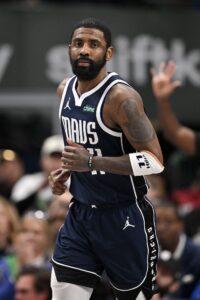 Kyrie Irving: Three years, $118,473,846. Third-year player option. Trade kicker (15%). Re-signed using Bird rights.
- D’Angelo Russell: Two years, $11,654,250. Second-year player option. Signed using taxpayer mid-level exception.
- Dante Exum: One year, minimum salary. Re-signed using minimum salary exception. Waived right to veto trade.
- Moussa Cisse: One year, minimum salary. Non-guaranteed (Exhibit 10). Signed using minimum salary exception.
- Matthew Cleveland: One year, minimum salary. Non-guaranteed (Exhibit 10). Signed using minimum salary exception.
Trades
- None
Draft picks
- 1-1: Cooper Flagg
- Signed to rookie scale contract (four years, $62,730,225).
Two-way signings
- Miles Kelly
- One year, $85,300 partial guarantee.
- Ryan Nembhard
- One year, $85,300 partial guarantee.
Departed/unsigned free agents
- Spencer Dinwiddie (Hornets)
- Kessler Edwards (Nuggets)
- Kai Jones (Anadolu Efes)
Other roster moves
- Signed P.J. Washington to a four-year, $88,762,440 veteran contract extension that begins in 2026/27.
- Signed Daniel Gafford to a three-year, $54,380,289 veteran contract extension that begins in 2026/27.
- Waived and stretched Olivier-Maxence Prosper (guaranteed $3,007,080 salary).
Salary cap situation
- Operating over the cap ($154.6MM) and above the luxury tax line ($187.9MM).
- Carrying approximately $204.7MM in salary.
- Hard-capped at $207,824,000.
- Three traded player exceptions frozen (largest worth $11,000,000).
The offseason so far
It’s almost hard to fathom a non-playoff NBA team experiencing the same sort of highs and lows that the Mavericks – and their fan base – did during the five-month stretch this year from the start of February to the end of June.
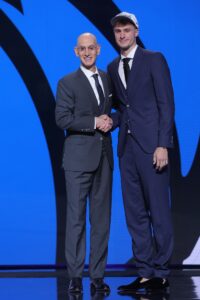 A not-insignificant number of Mavs supporters appeared ready to give up on the team after the front office traded perennial MVP candidate Luka Doncic to the Lakers in a February blockbuster that could be charitably described as “controversial.” But many of those same fans had a “just when I thought I was out, they pull me back in” moment on May 12 when Dallas – having entered the night with the 11th-best odds (1.8%) – improbably won the 2025 draft lottery, putting the club in position to draft a new franchise player: Cooper Flagg.
With Doncic no longer part of the Mavericks’ future, Kyrie Irving recovering from an ACL tear he sustained in March, and Anthony Davis (eye) and Dereck Lively II (foot) both undergoing offseason surgeries, it looked like it would be a miserable summer in Dallas on the heels of a disappointing spring in which the injury-plagued team missed the playoffs entirely after making the Western Conference Finals in 2024.
Winning the draft lottery and the right to select Flagg didn’t just salvage the offseason — it reinvigorated the organization, providing the Mavericks with legitimate optimism for the long-term future after the Doncic/Davis swap had shortened their probable window for contention.
Describing Flagg’s arrival in those terms makes it sound as if the pressure on him will be enormous, but it’s not as if he’ll immediately be asked to carry the franchise like he would have been if he’d landed somewhere like Utah or Washington. The Mavs, even without Doncic, have a pretty talented roster when Irving and Davis are healthy, with Lively, P.J. Washington, Klay Thompson, Daniel Gafford, Naji Marshall, Max Christie, and Caleb Martin among the most likely candidates to play major roles in 2025/26. Flagg will certainly see regular playing time, but the club won’t ask too much of him in his rookie year.
With a couple important exceptions, most of the Mavs’ key players were already under contract for 2025/26 when the offseason began, so after drafting Flagg, the team had two clear priorities: addressing the point guard spot and locking up some of those players already under contract to longer-term extensions.
Although there have been some rumblings this summer about the possibility of the Mavs experimenting with Flagg as a point guard, the hole at that position was one crucial leftover problem from the Doncic trade that winning the draft lottery didn’t solve. Not only was Irving a free agent this summer, but he almost certainly won’t be ready to return from his ACL tear until sometime in the second half of 2025/26 at the earliest. Even if they were to re-sign Irving, the Mavs were going to need more reinforcements.
Despite turning 33 this year, Irving remains the Mavs’ point guard of the future — their belief in him was part of the reason that president of basketball operations Nico Harrison was willing to trade Doncic at all. So it came as no real surprise when the two sides quickly agreed to terms on a new three-year, $118.5MM deal several years before free agency began.
It’s almost the exact same contract Irving signed with the club in 2023, with the same two guaranteed seasons, third-year player option, and trade kicker. While Irving is two years older now and is coming off a major injury, he has been excellent on the court – and hasn’t created any off-court drama – since arriving in Dallas. Salaries have also risen a little since 2023, and the Doncic trade gave him some additional leverage in those contract negotiations.
The Mavs also agreed to bring back Dante Exum on a one-year, minimum-salary contract. A solid defender who has improved his three-point shot since a multiyear stint in Europe from 2021-23, Exum has battled injuries during his two years in Dallas and has been limited to just 75 regular season outings, but he has been very productive when he’s available.
Still, with Irving out, the Mavs weren’t about to hand over ball-handling duties to the trio of Exum, Brandon Williams, and Jaden Hardy, so adding an outside point guard was the front office’s number one goal entering free agency. With only the taxpayer mid-level exception available to spend, Dallas didn’t realistically have a shot at any of the top players on the market, but the club did well to land D’Angelo Russell, a former No. 2 overall pick and 2019 All-Star who is still just 29 years old.
Russell isn’t a strong defender and his three-point percentage dropped off significantly last season to a career-low 31.4%. But based on his career trajectory, last season’s shooting numbers look like an anomaly. Russell is still a solid scorer and play-maker who spent multiple seasons in Los Angeles developing chemistry with Davis. Dallas probably isn’t a legitimate contender in the postseason if Russell is the starting point guard, but for a stop-gap option who will transition to a backup role if and when Irving returns, the team could’ve done much worse.
The Mavs didn’t complete any trades this summer, so drafting Flagg, adding Russell, and waiving 2023 first-round pick Olivier-Maxence Prosper (a necessary move to create room under a second-apron hard cap to re-sign Exum) were the only moves the club made involving its standard roster. But Dallas also completed a pair of veteran contract extensions, agreeing to terms with both Washington (four years, $88.8MM) and Gafford (three years, $54.4MM).
Those prices are reasonable for what that duo brings to the court, though it’s fair to question whether the Mavs really needed to invest long-term in Washington and Gafford at this point. They’ll be part of a crowded frontcourt that already features Davis, Lively, and Flagg, three players who would likely rank ahead of Washington and Gafford if you were to list the team’s most valuable long-term assets.
For what it’s worth, the terms of Gafford’s deal fell within the extend-and-trade limits, meaning he could be moved at any time this season, whereas Washington’s extension makes him ineligible to be dealt until at least the 2026 offseason.
Up next
 With little room to maneuver below their hard cap, the Mavericks will likely enter the regular season with their current 15-man standard roster. Outside of making a trade, the only option they would have to create some additional flexibility would be to waive Williams, whose minimum-salary contract is only partially guaranteed for $200K for now.
However, Williams was an effective role player for Dallas down the stretch last season, earning a call-up from his two-way contract when the team could’ve opted to promote Kessler Edwards or Kai Jones instead. If the Mavs didn’t plan to hang onto Williams through opening night, they likely would’ve made a move with him in June or July, before his $200K partial guarantee was locked in.
While Dallas’ 15-man roster looks pretty set, the club does have one two-way slot available alongside Miles Kelly and Ryan Nembhard. That opening may be up for grabs in training camp and the preseason — Moussa Cisse and Matthew Cleveland have already signed Exhibit 10 contracts with the Mavs and Jamarion Sharp is reportedly expected to do the same, so they could be among the players who get a chance to compete for a two-way deal.
Having already finalized new deals with Washington and Gafford, the Mavericks likely won’t complete any more contract extensions before the season begins. Dwight Powell, who is on a $4MM expiring contract, is the only Mav who is still extension-eligible, but a new deal for the 34-year-old reserve probably isn’t at the top of the front office’s to-do list.
2025/26 NBA Over/Unders: Atlantic Division
With the 2025/26 NBA regular season set to tip off next month, we’re getting serious about predictions for the upcoming campaign and continuing an annual Hoops Rumors tradition.
With the help of the lines from a series of sports betting sites – including BetMGM and BetOnline – we’re running through the predicted win totals for each of the NBA’s 30 teams, by division. In a series of team-by-team polls, you’ll get the chance to weigh in on whether you think those forecasts are too optimistic or too pessimistic.
In 2024/25, our voters went 13-17 on their over/under picks. Can we top that in ’25/26?
We’ll begin our series today with the Atlantic Division…
New York Knicks
- 2024/25 record: 51-31
- Over/under for 2025/26: 53.5 wins
- Major offseason moves:
How many games will the Knicks win in 2025/26?
-
Over 53.5 63% (263)
-
Under 53.5 38% (160)
Total votes: 418
Boston Celtics
- 2024/25 record: 61-21
- Over/under for 2025/26: 42.5 wins
- Major offseason moves:
- Added: Anfernee Simons, Chris Boucher, Luka Garza, Josh Minott, Hugo Gonzalez
- Lost: Jrue Holiday, Kristaps Porzingis, Al Horford, Luke Kornet, Torrey Craig, JD Davison
- Note: Jayson Tatum is expected to spend most or all of the season recovering from a torn Achilles.
How many games will the Celtics win in 2025/26?
-
Over 42.5 54% (230)
-
Under 42.5 48% (204)
Total votes: 428
Philadelphia 76ers
- 2024/25 record: 24-58
- Over/under for 2025/26: 42.5 wins
- Major offseason moves:
- Added: VJ Edgecombe, Trendon Watford, Johni Broome
- Lost: Guerschon Yabusele, Jared Butler, Ricky Council IV, Lonnie Walker IV
- Note: Quentin Grimes is still a restricted free agent but is considered likely to re-sign.
How many games will the Sixers win in 2025/26?
-
Under 42.5 58% (232)
-
Over 42.5 43% (169)
Total votes: 397
Toronto Raptors
- 2024/25 record: 30-52
- Over/under for 2025/26: 37.5 wins
- Major offseason moves:
- Added: Collin Murray-Boyles, Sandro Mamukelashvili
- Lost: Chris Boucher, Colin Castleton
How many games will the Raptors win in 2025/26?
-
Under 37.5 55% (203)
-
Over 37.5 47% (174)
Total votes: 372
Brooklyn Nets
- 2024/25 record: 26-56
- Over/under for 2025/26: 20.5 wins
- Major offseason moves:
- Added: Michael Porter Jr., Terance Mann, Egor Demin, Nolan Traore, Drake Powell, Ben Saraf, Danny Wolf, Haywood Highsmith, Kobe Bufkin
- Lost: Cameron Johnson, D’Angelo Russell, Trendon Watford, De’Anthony Melton, Keon Johnson, Maxwell Lewis
- Note: The Nets may still trade or waive multiple players from last season’s team in order to set their regular season roster.
How many games will the Nets win in 2025/26?
-
Over 20.5 56% (199)
-
Under 20.5 45% (162)
Total votes: 357
NBA 2025 Offseason Check-In: Washington Wizards
Hoops Rumors is checking in on the 2025 offseason for all 30 NBA teams, recapping the summer’s free agent signings, trades, draft picks, departures, and more. We’ll take a look at each team’s offseason moves and consider what might still be coming before the regular season begins. Today, we’re focusing on the Washington Wizards.
Free agent signings
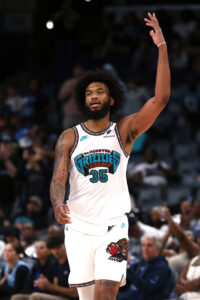 Marvin Bagley III: One year, minimum salary. Signed using minimum salary exception.
- Anthony Gill: One year, minimum salary. Re-signed using minimum salary exception. Waived right to veto trade.
Trades
- Acquired the draft rights to Will Riley (No. 21 pick), the No. 43 pick in the 2025 draft, either the Heat’s or Pacers’ 2031 second-round pick (whichever is most favorable), and the Jazz’s 2032 second-round pick from the Jazz in exchange for the draft rights to Walter Clayton (No. 18 pick).
- Acquired Dillon Jones and the Rockets’ 2029 second-round pick from the Thunder in exchange for Colby Jones.
- Acquired CJ McCollum (from Pelicans), Kelly Olynyk (from Pelicans), Cam Whitmore (from Rockets), and the Bulls’ 2027 second-round pick (from Pelicans) in a three-team trade in exchange for Jordan Poole (to Pelicans), Saddiq Bey (to Pelicans), the draft rights to Micah Peavy (No. 40 pick; to Pelicans), the Bulls’ 2026 second-round pick (to Rockets), and the Kings’ 2029 second-round pick (to Rockets).
- Note: The Wizards already controlled the Bulls’ 2027 second-round pick if it landed between 31-50. Now they’ll receive it no matter where it ends up.
- Acquired Malaki Branham, Blake Wesley, and either the Mavericks’, Thunder’s, or Sixers’ 2026 second-round pick (whichever is least favorable) from the Spurs in exchange for Kelly Olynyk.
- Note: Wesley was subsequently bought out by the Wizards.
Draft picks
- 1-6: Tre Johnson
- Signed to rookie scale contract (four years, $37,439,130).
- 1-21: Will Riley
- Signed to rookie scale contract (four years, $17,220,192).
- 2-43: Jamir Watkins
- Signed to two-way contract.
Two-way signings
- Tristan Vukcevic
- One year, $85,300 partial guarantee (will increase to $318,218 at start of regular season).
- Jamir Watkins
- One year, $85,300 partial guarantee (will increase to $318,218 at start of regular season).
Departed/unsigned free agents
- Malcolm Brogdon (Knicks)
- JT Thor (unsigned)
Other roster moves
- Bought out Marcus Smart (gave up $6,800,001 of $21,586,856 salary).
- Bought out Blake Wesley (gave up $1,378,870 of $4,726,328 salary).
- Waived Richaun Holmes (partially guaranteed for $250,000).
- Waived Jaylen Martin (two-way contract).
Salary cap situation
- Operating over the cap ($154.6MM) and below the luxury tax line ($187.9MM).
- Carrying approximately $156.1MM in salary.
- Hard-capped at $195,945,000.
- Full non-taxpayer mid-level exception ($14,104,000) available.
- Portion of bi-annual exception ($407,672) available.
- Three traded player exceptions available (largest worth $13,445,122).
The offseason so far
After winning 15 games in 2023/24 and 18 last season, the Wizards are in no hurry to take a significant step forward in ’25/26. In fact, a major improvement in the standings might work against the best interests of the organization in the long term, since Washington will owe its 2026 first-round pick to New York if it lands outside the top eight. Assuming that pick is inside the top eight, the Wizards will keep it and would no longer be required to give up a future first-rounder — instead, they’d send the Knicks their second-rounders in 2026 and 2027.
That first-round pick, which has landed in its protected range for each of the past three years, was originally sent to Houston as part of the John Wall/Russell Westbrook swap during the 2020 offseason before being rerouted to Oklahoma City and then to New York.
 While that Wall/Westbrook trade may feel like ancient history, the traded pick involved in the deal continues to loom large over the franchise. It’s a big reason why the majority of the Wizards’ moves this summer weren’t about adding win-now help, but were instead about creating financial flexibility, taking fliers on former first-round picks, or continuing to accumulate future draft assets. Washington made four trades this offseason and each of them falls into one or more of those three categories.
For instance, the Wizards added three second-round picks to their stockpile by trading back from No. 18 to No. 21 on draft night. They picked up another second-rounder and took a shot on a recent first-round selection when they sent Colby Jones‘ non-guaranteed deal to Oklahoma City in exchange for 2024’s No. 26 overall pick Dillon Jones. And when they dealt Kelly Olynyk to San Antonio, they acquired a future second-round pick and reduced their 2025/26 team salary in the process.
The biggest trade of Washington’s summer was the one initially sending Olynyk to D.C. alongside veteran guard CJ McCollum. The agreement, which saw Jordan Poole and Saddiq Bey head to New Orleans as the Wizards and Pelicans swapped second-round picks, looked a little curious on the surface, but made a ton of sense on the cap sheet — while Poole and Bey have two guaranteed years left on their contracts, McCollum and Olynyk (as well as the players whom the Wizards eventually acquired when they flipped Olynyk to the Spurs) are on expiring deals.
That means the Wizards are now in position to create a huge chunk of cap room during the 2026 offseason. Even if they retain all their players with team options and/or non-guaranteed salaries for the 2026/27 season, they’d still only have about $70MM in salary on their books entering next year’s draft. Of course, Washington doesn’t need that cap room to pursue free agents, but the team’s relative lack of multiyear financial commitments gives the front office a ton of flexibility to take on salary in trades, during either the coming season or the summer of 2026.
That trade with the Pelicans turned into a three-team deal when the Wizards folded in a separate agreement with the Rockets — Washington sent a pair of second-round picks to Houston in exchange for 2023 first-rounder Cam Whitmore.
It was the only deal the Wizards made this summer in which they gave up more draft assets than they got back, but the price tag to take a shot on a young scorer who has some untapped potential was relatively modest. Whitmore just turned 21 in July and has averaged 22.3 points per 36 minutes during his first two NBA seasons, but there was no place for him on an increasingly deep Rockets roster. We’ll see if he can find a more permanent home in D.C.
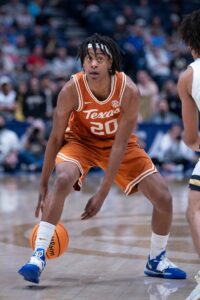
The Wizards added two more notable youngsters to their roster in this year’s draft, using the sixth overall pick on Texas guard Tre Johnson and the 21st pick on Illinois forward Will Riley, a pair of one-and-done college players.
Washington has now made six first-round picks in the past three years, including three top-seven selections, and doesn’t yet have a clear-cut franchise player to show for it. The franchise presumably hoped to address that issue this year with the second-best lottery odds in a class headlined by Cooper Flagg and Dylan Harper, but ended up with a worst-case outcome, leapfrogged by four teams and dropping to No. 6.
As disappointing a result as that was, there’s still optimism about Johnson’s ability to become a long-term fixture in the Wizards’ backcourt. He was excellent in two Summer League games, scoring 38 points on 14-of-24 shooting in 55 minutes of action, which was a promising first impression.
As the Wizards continue to lean into their youth movement, there are fewer veterans than ever left on the roster. The club brought back Marvin Bagley III and Anthony Gill on minimum-salary contracts, and it looks like McCollum and Khris Middleton will at least start the season in Washington. But Marcus Smart was bought out, Richaun Holmes was waived, Malcolm Brogdon departed in free agency, and it’s likely just a matter of time until McCollum and Middleton (both eligible for free agency in 2026) move on as well. The Wizards’ young core should get plenty of opportunities to sink or swim in 2025/26.
Up next
The Wizards have a minor roster crunch to address for the regular season, with 15 players on guaranteed contracts and Justin Champagnie on a non-guaranteed deal. Champagnie was a pretty effective role player last season and doesn’t deserve to be the odd man out, so Washington will likely have to trade or release someone with a guaranteed salary, which shouldn’t be an issue for a team operating way below the luxury tax line.
Malaki Branham, acquired from the Spurs in the Olynyk deal, is one candidate to be waived — he averaged a career-low 9.1 minutes per game in his third NBA season in 2024/25.
 It’s also not clear if Jones, who was acquired in that aforementioned trade with the Thunder, is someone Washington actually likes or if the front office just made the deal for the second-round pick that was attached to him. He looks like another potential release candidate.
The Wizards have one open two-way slot alongside second-round pick Jamir Watkins and big man Tristan Vukcevic. After undrafted rookie Kadary Richmond agreed to sign with Washington in June, St. John’s coach Rick Pitino published a social media post congratulating Richmond for his “two-way” deal, but no reporters ever confirmed that the guard was getting a two-way contract and he has yet to officially sign at all, so Pitino may have misspoke. It’s possible Richmond will be one of a few players who have a chance to compete for that two-way slot in training camp.
Setting the 15-man standard roster and filling the final two-way opening will be the main items on the Wizards’ to-do list this fall, since there are no real extension candidates on the roster — Branham is the only player eligible for a rookie scale extension, and extension-eligible veterans like McCollum and Middleton aren’t legitimate candidates for new deals.
Still, the Wizards are worth keeping an eye on as a trade facilitator. The preseason doesn’t typically feature a ton of trade activity, but there are usually at least a couple deals made, and the Wizards’ cap situation makes them a logical partner for teams looking to shed a contract or two. Washington is operating more than $30MM below the luxury tax line and still has the full non-taxpayer mid-level exception and a pair of mid-sized trade exceptions at its disposal to take on salary.
NBA 2025 Offseason Check-In: Minnesota Timberwolves
Hoops Rumors is checking in on the 2025 offseason for all 30 NBA teams, recapping the summer’s free agent signings, trades, draft picks, departures, and more. We’ll take a look at each team’s offseason moves and consider what might still be coming before the regular season begins. Today, we’re focusing on the Minnesota Timberwolves.
Free agent signings
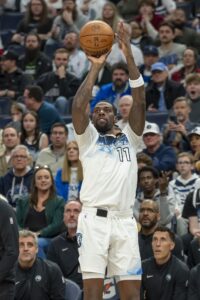 Naz Reid: Five years, $125,000,000. Fifth-year player option. Re-signed using Bird rights.
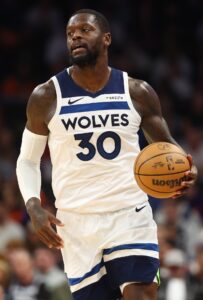
- Julius Randle: Three years, $100,000,000. Third-year player option. Re-signed using Bird rights.
- Joe Ingles: One year, minimum salary. Re-signed using minimum salary exception.
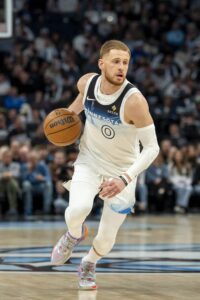
- Bones Hyland: Exact details TBD.
Trades
- Acquired the draft rights to Rocco Zikarsky (No. 45 pick; from Lakers), either the Warriors’ or Nuggets’ 2026 second-round pick (whichever is least favorable; from Suns), either the Suns’ or Rockets’ 2032 second-round pick (whichever is most favorable; from Suns/Rockets), and cash ($3.25MM; from Lakers) in a seven-team trade in exchange for the draft rights to Rasheer Fleming (No. 31 pick; to Suns).
- Acquired the Cavaliers’ 2027 second-round pick and cash ($1.5MM) from the Hawks in exchange for Nickeil Alexander-Walker (sign-and-trade).
Draft picks
- 1-17: Joan Beringer
- Signed to rookie scale contract (four years, $20,331,643).
- 2-45: Rocco Zikarsky
- Signed to two-way contract.
Two-way signings
- Enrique Freeman
- One year, $85,300 partial guarantee (will increase to $318,218 at start of regular season).
- Rocco Zikarsky
- Two years, $85,300 partial guarantee (will increase to $318,218 at start of regular season); second year partially guaranteed for maximum two-way protection amount (will increase to 50% at start of regular season).
Departed/unsigned free agents
- Nickeil Alexander-Walker (Hawks)
- Jesse Edwards (Melbourne United)
- Luka Garza (Celtics)
- Bones Hyland (unsigned)
- Josh Minott (Celtics)
- Tristen Newton (unsigned)
Other roster moves
- Re-signed Jesse Edwards to a two-way contract ($85,300 partial guarantee), then waived him.
Salary cap situation
- Operating over the cap ($154.6MM) and above the luxury tax line ($187.9MM).
- Carrying approximately $200.3MM in salary.
- No hard cap.
- Full taxpayer mid-level exception ($5,685,000) available.
- One traded player exception available ($7,580,900); one traded player exception frozen ($4,686,880).
The offseason so far
Given that the Timberwolves have only advanced beyond the first round of the playoffs three times in franchise history, it’s not an exaggeration to call the last two seasons – which saw them appear in back-to-back Western Conference Finals – the most successful stretch in team history. However, entering the 2025 offseason, financial concerns threatened to put a dent in a roster that had won four postseason series in the past two years.
 Marc Lore, Alex Rodriguez, and their “deep-pocketed” ownership group finally assumed majority control of the Timberwolves in June, while defensive anchor Rudy Gobert took a pay cut of nearly $9MM on a new deal that began in 2025/26. But after operating above the second tax apron in ’24/25, the Wolves weren’t eager to surpass that threshold for a second consecutive year. That meant the club likely wouldn’t be able to re-sign all three of its top free agents, Naz Reid, Julius Randle, and Nickeil Alexander-Walker.
The Wolves chose to prioritize Reid and Randle, reaching a five-year, $125MM agreement with the former and a three-year, $100MM deal with the latter. Since both Reid and Randle are power forwards, there was an argument for letting one of them walk, but Minnesota was a much better team when both players were available, since it allowed Reid – the Sixth Man of the Year in 2023/24 – to go to work against second units and created more frontcourt optionality. The Wolves had a 44-25 record in games Randle played, compared to a 5-8 mark when he was sidelined.
Reid’s $125MM contract, which is fully guaranteed with a fifth-year player option, was actually the most lucrative deal signed by any free agent this summer. That may seem like an aggressive investment in a player who doesn’t project to be a starter, but the 26-year-old has been one of the league’s most effective reserves in recent years and would be fully capable of stepping into a starting role in the event that Randle is traded at some point in the next couple seasons.
Reid’s new contract will also cover his prime years and isn’t an anomaly when compared to deals around the league. DeMar DeRozan, Miles Bridges, Tobias Harris, John Collins, RJ Barrett, Jerami Grant, and Khris Middleton are among the forwards who will earn between $3-12MM more than Reid in 2025/26.
Randle, meanwhile, turned down a $30.9MM player option in favor of a multiyear deal that starts at the same price. The three-time All-Star has taken some flak for his inconsistent three-point shot and mediocre defense, but he’s a talented, scorer, play-maker, and rebounder who had an excellent postseason (21.7 PPG, 5.9 RPG, and 4.9 APG on .502/.385/.880 shooting), and he should be more comfortable in his second year in Minnesota following his first full offseason as a Timberwolf. He had little time to adjust to new his home last fall when the Knicks traded him to the Wolves at the start of training camp.
With Reid and Randle back in the fold, the Wolves didn’t have enough room below the second apron for Alexander-Walker, who received a four-year, $60MM+ contract from the Hawks.
Minnesota got a future second-round pick and cash as part of that sign-and-trade transaction, but lacked the resources to acquire a direct replacement for Alexander-Walker, a three-and-D guard, in free agency or on the trade market. The Wolves will be betting on increased contributions from a trio of in-house backcourt youngsters, with Rob Dillingham, Terrence Shannon Jr., and Jaylen Clark each likely getting the opportunity to compete for an increased role in 2025/26.
Although the Wolves also used a first-round pick on Joan Beringer and re-signed Joe Ingles to another minimum-salary contract, Beringer is an 18-year-old who will be playing stateside for the first time and Ingles shifted into the “locker room leader” phase of his career last season by logging 114 total minutes in 19 outings. It’s probably not realistic to expect major contributions from either player this season.
Up next
The Timberwolves entered the day on Monday with just 13 players on standard contracts and a team salary roughly $5.86MM below the second tax apron. Bones Hyland has since signed a contract – presumably worth the minimum – that could line him up to be Minnesota’s 14th man.
It’s possible Hyland will simply get that 14th roster spot and the Timberwolves will carry a 14-man standard roster into the regular season, but it’s not quite that simple.
For one, we don’t know yet how much (if any) of Hyland’s salary is guaranteed. Is he being handed a roster spot or will he have to compete for one? If it’s the latter, he could be the first of a handful of veteran free agents to reach deals with the Wolves, similar to how the Knicks agreed to terms with Landry Shamet, Garrison Mathews, and Malcolm Brogdon in a 24-hour span last week.
 Minnesota also has enough wiggle room below the second apron to add a 15th man on a minimum deal or even using a modest portion of the taxpayer mid-level exception. But the Wolves are far enough into the tax that they’d be paying a penalty of $3.50 per dollar on that 15th man’s salary, so it would have to be someone they really like.
For what it’s worth, I’ve long thought that it would be in the Wolves’ best interest to add another veteran point guard to provide depth behind Mike Conley, who will be entering his age-38 season. Donte DiVincenzo and Hyland aren’t really true point guards, and it’s unclear if Dillingham will be ready to take on that role in his second NBA season. Brogdon would’ve been a nice fit, but there are other options still out there, including Cameron Payne and another one of Connelly’s former Nuggets, Monte Morris.
The Wolves have an open two-way slot available alongside Enrique Freeman and second-round pick Rocco Zikarsky, but the expectation is that Tristen Newton will fill it. The 2024 second-rounder reportedly agreed a month-and-a-half ago to sign his two-way qualifying offer, but that move still hasn’t been officially confirmed by either the team or the league. Assuming it gets done as expected, Minnesota’s two-way players should be set for the season.
As for potential extension-eligible players, most of the Wolves’ core players are already on longer-term deals. The only players eligible for extensions this fall are DiVincenzo and Leonard Miller.
A DiVincenzo extension isn’t out of the question, but he has two guaranteed years left on his current contract, so I doubt the Wolves will be in a hurry to get something done with him at this point unless he’s willing to give them a pretty team-friendly rate.
Miller, meanwhile, has barely seen the floor in his first two NBA seasons, playing just 84 total minutes in 30 appearances. At this point, extending his current deal is probably less of a priority than simply making sure he shows enough to finish out that expiring contract without being waived.
NBA 2025 Offseason Check-In: Miami Heat
Hoops Rumors is checking in on the 2025 offseason for all 30 NBA teams, recapping the summer’s free agent signings, trades, draft picks, departures, and more. We’ll take a look at each team’s offseason moves and consider what might still be coming before the regular season begins. Today, we’re focusing on the Miami Heat.
Free agent signings
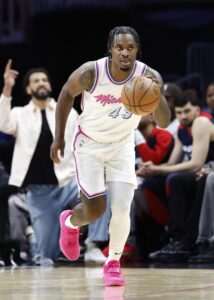 Davion Mitchell: Two years, $24,000,000. Re-signed using Bird rights.
- Dru Smith: Three years, $7,898,151. Second year non-guaranteed. Third-year team option. Re-signed using Early Bird rights.
- Dain Dainja: One year, minimum salary. Non-guaranteed (Exhibit 9). Signed using minimum salary exception.
- Trevor Keels: One year, minimum salary. Non-guaranteed (Exhibit 9). Signed using minimum salary exception.
- Gabe Madsen: One year, minimum salary. Non-guaranteed (Exhibit 9). Signed using minimum salary exception.
- Ethan Thompson: One year, minimum salary. Non-guaranteed (Exhibit 9). Signed using minimum salary exception.
- Jahmir Young: One year, minimum salary. Non-guaranteed (Exhibit 9). Signed using minimum salary exception.
Trades
- Acquired Simone Fontecchio from the Pistons in exchange for Duncan Robinson (sign-and-trade).
- Acquired Norman Powell (from Clippers) in a three-team trade in exchange for Kyle Anderson (to Jazz) and Kevin Love (to Jazz).
- Acquired the Nets’ 2026 second-round pick (top-55 protected) from the Nets in exchange for Haywood Highsmith and the Heat’s 2032 second-round pick.
Draft picks
- 1-20: Kasparas Jakucionis
- Signed to rookie scale contract (four years, $17,730,606).
Two-way signings
- Myron Gardner
- Two years, $85,300 partial guarantee; second year non-guaranteed.
- Vladislav Goldin
- One year, $85,300 partial guarantee.
Departed/unsigned free agents
- Alec Burks (unsigned)
- Josh Christopher (unsigned)
- Duncan Robinson (Pistons)
- Isaiah Stevens (Kings)
Other roster moves
- Exercised team option on Keshad Johnson ($1,955,377).
Salary cap situation
- Operating over the cap ($154.6MM) and below the luxury tax line ($187.9MM).
- Carrying approximately $186.1MM in salary.
- Hard-capped at $195,945,000.
- Full non-taxpayer mid-level exception ($14,104,000) available.
- Full bi-annual exception ($5,134,000) available.
- Five traded player exceptions available (largest worth $16,834,692).
The offseason so far
It was a forgettable season in 2024/25 for the Heat, who engaged in a lengthy standoff with disgruntled star Jimmy Butler that culminated in a deadline trade sending him to Golden State, then wrapped up the year with an underwhelming 12-21 post-deadline performance that dropped the team to the No. 10 spot in the Eastern Conference standings.
The club showed some signs of life in the play-in tournament by becoming the first No. 10 seed to win consecutive play-in games to make the playoffs, but once they got there, the Heat were on the wrong end of a historic beat-down by the top-seeded Cavaliers, who outscored Miami by a whopping 122 points in a four-game sweep.
As ugly as both the second half of the season and that first-round playoff series were, there were at least a couple positive takeaways that stemmed from the Heat’s trade deadline activity. The most obvious one was the play of Davion Mitchell, who was sent from Toronto to Miami as part of the five-team Butler blockbuster.
A defensive specialist who struggled offensively for most of his first three-and-a-half NBA seasons, Mitchell emerged as a starter and averaged 10.3 points and 5.3 assists per game with a .504/.447/.702 shooting line in 30 regular season games for the Heat. He was even better in the postseason, making 59.3% of his field goal attempts and 52.0% of his three-pointers with averages of 15.2 PPG and 6.5 APG in six play-in and playoff outings.
Mitchell’s excellent second half earned him a fully guaranteed two-year, $24MM commitment from the Heat. It was easily the most lucrative contract Miami handed out this offseason – the team’s other free agent signings will all earn the minimum in 2025/26 – and it should be a pretty safe investment as long as the offensive strides made last season by the former lottery pick weren’t a one-off.
At $12MM per year, Mitchell doesn’t necessarily need to replicate those strong second-half numbers in order to return positive value — as long as he produces enough to make opposing teams take him seriously as an offensive threat, his play on defense will keep him in the rotation on a consistent basis.
 The other notable offseason move the Heat made as a result of their Butler trade was using the No. 20 overall pick in the draft on Kasparas Jakucionis. Having won both of their play-in games, the Heat were forced to sent their own lottery-protected pick (No. 15 overall) to Oklahoma City, but they received the Warriors’ first-rounder as part of the return for Butler, then used it to draft a one-and-done point guard out of Illinois.
Jakucionis didn’t get off to a great start at the California Classic Summer League, where he made just 1-of-15 field goals and had as many turnovers and personal fouls as points (12) in three games. But he was better in Las Vegas, and – as Jared McCain can attest – there’s certainly no guarantee a poor Summer League showing will carry over to the regular season. The Heat are optimistic about the long-term potential of Jakucionis within their developmental system.
Outside of the Mitchell signing and the Jakucionis pick, all of the Heat’s major offseason moves occurred on the trade market, including a sign-and-trade sending Duncan Robinson to Detroit in exchange for Simone Fontecchio and a three-team deal that saw Norman Powell land in Miami in exchange for Kyle Anderson and Kevin Love.
The Robinson transaction was an interesting one. It came as a bit of a surprise in June when the veteran sharpshooter opted out of $19.9MM contract that would have been partially guaranteed for $9.9MM. After all, if he had opted in, Robinson would have been guaranteed at least $9.9MM, with the opportunity to either reach the free agent market anyway (if Miami had waived him) or to make another $10MM (if Miami had kept him).
But the decision to opt out seemingly came with an understanding that the Heat would help Robinson get to a preferred destination. It ended up working out for both sides — Robinson got roughly $18.8MM in guaranteed money on his deal with the Pistons, right around what he would’ve gotten on his full Heat deal, while Miami acquired Fontecchio, whose $8.3MM cap hit will fit into the team’s budget much better than Robinson’s $19.9MM would have.
With the help of savings created by swapping out Robinson for Fontecchio, the Heat were able to take in Powell and his $20.5MM expiring deal in exchange for Anderson and Love, who will earn a combined $13.4MM in 2025/26. While Anderson is a solid role player and Love is a respected locker-room leader, neither player is as valuable as Powell, who is coming off a career year in which he scored 21.8 points per game and made 41.8% of his three-point tries.
The Heat were still operating below the first apron after their trade for Powell, but it left them about $1.6MM above the luxury tax line with 14 players under contract. To address the issue, they attached a 2032 second-round pick to Haywood Highsmith in a trade to Brooklyn, then replaced him by re-signing Dru Smith to a standard multiyear contract that includes one guaranteed season.
Highsmith is in the process of recovering from knee surgery and wasn’t an integral part of the Heat’s roster, but he’s a pretty dependable rotation player who could easily rebuild positive value by the trade deadline if he plays well in Brooklyn. Still, getting out of the tax was an important consideration for a Heat team that had been a taxpayer for the past two seasons and was wary of facing repeater penalties in future seasons.
Up next
The Heat don’t have enough room to add a 15th man to their standard roster without surpassing the luxury tax line. However, the tax line isn’t a hard cap — the team could go into the tax if it wants to, then make an effort to duck below it again later in the season.
The other option for the Heat if they want to bring in one more free agent would be to waive Terry Rozier, whose $26.6MM salary is only partially guaranteed for $24.9MM. Waiving Rozier and signing a newcomer on a minimum-salary deal would keep Miami out of tax territory, though the team still wouldn’t have enough room to add a 15th man while surpassing that threshold. Taking that route would also mean giving up a big expiring contract that could be used in a mid-season trade.
If the Heat do decide to bring in one more player for their regular season roster, it will likely be someone in the frontcourt, since the team is a little thin in the middle — especially if Bam Adebayo resists spending much time at the five. Precious Achiuwa is among the free agents who have been linked to the Heat, while former Miami center Thomas Bryant also remains unsigned for now.
The Heat have one two-way contract slot open alongside Vladislav Goldin and Myron Gardner, and it sounds like that spot will be up for grabs in training camp. Trevor Keels, Jahmir Young, Ethan Thompson, Gabe Madsen, and Dain Dainja are all on Exhibit 10 contracts that can be converted into two-way deals, so they all could be involved in that competition.
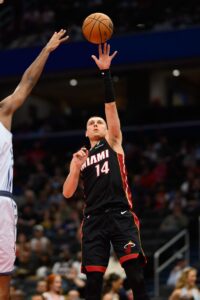 The front office will have a major decision to make next month on Tyler Herro, who becomes extension-eligible as of October 1. Owed $64MM over the next two seasons, Herro could sign for as much as $149.7MM over three seasons (beginning in 2027/28). He certainly made a case for a lucrative new deal with his performance last season — he set career highs in points (23.9) and assists (5.5) per game, as well as field goal percentage (47.2%), and made an All-Star team for the first time.
Still, Herro isn’t really a true point guard, has repeatedly battled injuries, and is hardly a lock-down defender. The Heat will be wary of making a massive investment in the 25-year-old, especially since he still has two guaranteed years left on his current contract and doesn’t necessarily have to be extended quite this early. If the two sides don’t agree to terms before the coming season, they could revisit talks next summer.
The Heat have no shortage of additional extension candidates, with Powell, Andrew Wiggins, and Nikola Jovic also eligible to sign new contracts. Of the three, only Jovic has a preseason deadline, meaning those negotiations may be prioritized. But Jovic’s role and availability have been inconsistent through three NBA seasons, so unless Miami can get a pretty team-friendly rate (ie. no more than $10-12MM per year), I’d be somewhat surprised if the two sides work something out this fall.
Powell and Wiggins, meanwhile, will remain extension-eligible into the season, and it sounds like the Heat will wait on Powell to get a better sense of his fit on the roster. It might make sense to take the same path with Wiggins, whose first couple months with the Heat last season were frequently interrupted by health issues, which prevented him really getting into a rhythm with his new team.
Free Agents Who Sign After Monday Won’t Be Trade-Eligible On December 15
Unless he’s part of a sign-and-trade deal, an NBA free agent who signs a new contract can’t be traded immediately. The Collective Bargaining Agreement states that a newly signed free agent is ineligible to be traded until December 15 or until he’s been under contract for three months, whichever comes later.
Based on that rule, the majority of the free agents who signed new contracts in July, August, and the first half of September will become trade-eligible on December 15 (a smaller group of free agents who met certain specific criteria won’t become trade-eligible until January 15).
By our count, at least 81 players are currently on track to become eligible to be moved on December 15. That doesn’t take into account any players signed to Exhibit 9 or Exhibit 10 contracts who might earn regular season roster spots, since they’re not included on our list (they’ll be added if they haven’t been waived by opening night).
However, with the exception of camp invitees who unexpectedly stick around for the regular season, that list won’t continue to expand to include any additional names after Monday, which will be exactly three months away from December 15. A free agent who signs a new contract after September 15 will remain trade-eligible for a full three months rather than becoming trade-eligible on December 15.
For instance, a player who signs on September 22 would become eligible to be dealt on December 22; one who signs on October 4 would become trade-eligible on January 4, and so on.
For most players, there will be no meaningful difference between becoming trade-eligible on December 15 or a few weeks later, since the majority of deals get done in the days leading up to February’s deadline anyway. But a pair of trades were completed on December 15 last season, as soon as certain players’ restrictions lifted. That sort of Dec. 15 trade won’t be possible this season for any free agent who signs after Monday.
It’s also worth noting that a player who is traded after December 16 can’t have his salary aggregated with another player’s salary in a separate deal prior to the trade deadline. That rule will further limit teams’ flexibility to make moves this winter involving late-September or October signees.
Finally, we should mention that November 5 is an important date in this discussion, since this season’s trade deadline will land on February 5. A player who signs a free agent contract on November 6 or later will be ineligible to be dealt during the 2025/26 season.
Once the season begins next month and we have a better sense of which players signed after Sept. 15 have earned spots on regular season rosters, we’ll publish a new list of those players’ trade eligibility dates to complement our December 15 and January 15 round-ups.
Early Look At Hornets’ Potential Roster Crunch
Barring a trade (or two), Charlotte will be facing a roster crunch this fall.
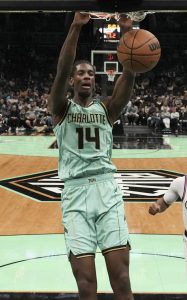 As our tracker shows, the Hornets currently have a full offseason roster, with 18 players on standard contracts (16 guaranteed) and all three two-way spots filled. They need to trim their standard roster down to 15 players before the regular season begins.
None of the players on standard deals are signed to training camp contracts, and until the Hornets free up roster spots, they will be unable to finalize Exhibit 10 deals with players who will be headed to their G League affiliate, the Greensboro Swarm, to open the 2025/26 season. That likely won’t play a factor in the roster battle, but it’s worth mentioning nonetheless.
Here’s the list of players currently on standard contracts, sorted by how much money they make:
- LaMelo Ball
- Miles Bridges
- Collin Sexton
- Josh Green
- Grant Williams
- Brandon Miller
- Kon Knueppel
- Pat Connaughton
- Tre Mann
- Tidjane Salaun
- Liam McNeeley
- DaQuan Jeffries *
- Nick Smith Jr.
- Sion James
- Ryan Kalkbrenner
- Spencer Dinwiddie
- Mason Plumlee
- Moussa Diabate *
* Denotes non-guaranteed contract.
Outside of maybe Miller and Knueppel, it wouldn’t totally surprise me if Charlotte decided to eventually trade virtually anyone on the roster. But for the sake of this exercise, we’ll assume that Ball, Bridges, Sexton, Green, Williams, Salaun, McNeeley, James and Kalkbrenner won’t be on the move in the next five-plus weeks.
The Hornets re-signed Mann to a guaranteed three-year, $24MM contract in free agency and he can’t be traded until January 15. It’s safe to say he won’t be waived before the season begins.
Dinwiddie and Plumlee were also free agent additions and neither can be dealt until Dec. 15. Although they both received guaranteed contracts, they’re only earning the veteran’s minimum in 2025/26.
Either Dinwiddie or Plumlee could theoretically be cut this fall, but it would be a little strange to sign a player to a guaranteed deal only to release him before he suits up for a regular season contest. It’s certainly an option, especially if one gets hurt, but it seems fairly unlikely right now.
By process of elimination, that likely leaves four players — Connaughton, Smith, Jeffries and Diabate — essentially vying for the 15th and final roster spot.
Of the four, Jeffries seems like the most obvious candidate to be waived. He was sent to Charlotte last October as part of the Karl-Anthony Towns trade, and while he appeared in 47 games last season, he wasn’t a major contributor. The five-year veteran is on a fully non-guaranteed contract, so the Hornets won’t incur a cap hit if they release him.
Despite earning $9.42MM in 2025/26, Connaughton also seems pretty likely to be cut. Perhaps I’m wrong and Charlotte will keep his expiring contract to use for salary-matching purposes in a future trade, but he has negative value on that deal after his career was derailed by injuries the past few years. When they sent Vasilije Micic to the Bucks for Connaughton in July, the Hornets acquired two second-round picks in the deal — it seems safe to assume they made the trade for the draft assets, not for Connaughton himself.
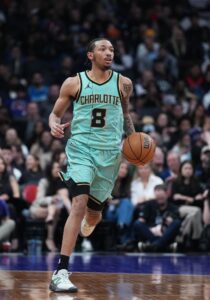 That leaves Smith and Diabate. Smith is just two years removed from being selected in the first round of the 2023 draft, but he hasn’t taken a major step forward since entering the NBA, having made exactly 39.1% of his field goal attempts in both of his professional seasons. He played a more significant role last season, but the Hornets were outscored by 14.3 points per 100 possessions when he was on the court, compared to 6.3 points per 100 possessions when he wasn’t playing.
Smith also has a backcourt logjam working against him, while Diabate should benefit from the fact that the Hornets don’t have many viable options in the middle — Plumlee and Kalkbrenner are the only other centers on the roster, so Diabate could actually play rotation minutes this fall, as he did last season, whereas the path to regular playing time for Smith would be more crowded with Miller and Mann back from injuries and Dinwiddie and Sexton now in the mix as well.
It’s worth reiterating that Smith’s salary for 2025/26 is guaranteed, but neither he nor Diabate is owed any guaranteed money beyond the coming season and Charlotte is operating way below the luxury tax line this season. In other words, eating some guaranteed money shouldn’t really affect the team’s flexibility.
Still, even if Jeffries, Connaughton, and Smith look like the most logical odd men out, it’s possible this situation won’t end up being quite that straightforward, so it’ll be worth keeping an eye on this fall.
Luke Adams contributed to this story.
NBA 2025 Offseason Check-In: Houston Rockets
Hoops Rumors is checking in on the 2025 offseason for all 30 NBA teams, recapping the summer’s free agent signings, trades, draft picks, departures, and more. We’ll take a look at each team’s offseason moves and consider what might still be coming before the regular season begins. Today, we’re focusing on the Houston Rockets.
Free agent signings
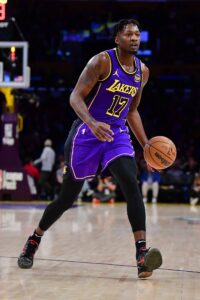 Dorian Finney-Smith: Four years, $52,705,000. Third year non-guaranteed. Fourth-year player option (non-guaranteed if exercised). Trade kicker (3.232%). Signed using non-taxpayer mid-level exception.
- Fred VanVleet: Two years, $50,000,000. Second-year player option. Re-signed using Early Bird rights.
- Clint Capela: Three years, $21,105,000. Trade kicker (5%). Signed using Bird rights and acquired via sign-and-trade from Hawks.
- Jeff Green: One year, minimum salary. Re-signed using minimum salary exception. Waived right to veto trade.
- Aaron Holiday: One year, minimum salary. Re-signed using minimum salary exception.
- Josh Okogie: One year, minimum salary. Signed using minimum salary exception.
- Jae’Sean Tate: One year, minimum salary. Re-signed using minimum salary exception.
- Cameron Matthews: One year, minimum salary. Non-guaranteed (Exhibit 10). Signed using minimum salary exception.
Trades
- Acquired the draft rights to Mojave King (from Pelicans), the Bulls’ 2026 second-round pick (from Wizards) and the Kings’ 2029 second-round pick (from Wizards) in a three-team trade in exchange for Cam Whitmore (to Wizards).
- Acquired Kevin Durant (from Suns) and Clint Capela (sign-and-trade; from Hawks) in a seven-team trade in exchange for Jalen Green (to Suns), Dillon Brooks (to Suns), David Roddy (two-way; to Hawks), the draft rights to Khaman Maluach (No. 10 pick; to Suns), the draft rights to Jahmai Mashack (No. 59 pick; to Warriors), either the Thunder’s, Mavericks’, or Sixers’ 2026 second-round pick (whichever is second-most favorable; to Suns), either the Clippers’ 2026 second-round pick or the most favorable of the Celtics’, Pacers’, and Heat’s 2026 second-round picks (whichever is least favorable; to Nets), the Celtics’ 2030 second-round pick; to Nets), the right to swap 2031 second-round picks (56-60 protected; to Hawks), and cash ($85,300; to Hawks).
Draft picks
- None
Two-way signings
- Isaiah Crawford
- One year, $85,300 partial guarantee (will increase to $318,218 at start of regular season).
- JD Davison
- One year, $85,300 partial guarantee (will increase to $318,218 at start of regular season).
- Kevon Harris
- One year, $25,000 partial guarantee.
Departed/unsigned free agents
- N’Faly Dante (Hawks)
- Jack McVeigh (Cairns Taipans)
Other roster moves
- Signed Jabari Smith Jr. to a five-year, $122,000,000 rookie scale contract extension that begins in 2026/27.
- Signed Steven Adams to a three-year, $39,000,000 veteran contract extension that begins in 2025/26.
- Waived Jock Landale (non-guaranteed contract).
- Waived Jeenathan Williams (non-guaranteed contract).
Salary cap situation
- Operating over the cap ($154.6MM) and above the luxury tax line ($187.9MM).
- Carrying approximately $194.7MM in salary.
- Hard-capped at $195,945,000.
- Portion of non-taxpayer mid-level exception ($1,404,000) available.
- One traded player exception available ($3,539,760).
The offseason so far
While some blockbuster NBA trades come out of nowhere, there are also plenty that finally get done after weeks – or even months – of rumors and speculation linking a player to a specific team. Anthony Davis being traded to the Lakers falls into the latter category; the deal that eventually sent Davis out of Los Angeles obviously falls into the former group.
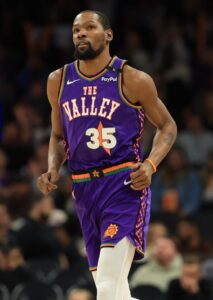 The trade that sent Kevin Durant from Phoenix to Houston is another example of one of those long-running rumors that eventually came to fruition. When word broke that Durant was being dealt to Houston, it didn’t come as a shock like February’s Davis/Luka Doncic mega-deal did, because it just made so much sense.
Durant, who was said to be caught off-guard when the Suns discussed him in trade talks at the deadline, was long expected to seek an offseason trade, while the Rockets, armed with the young players and draft picks necessary to get a deal done, had just shown in their postseason loss to Golden State that they badly needed an infusion of offensive firepower.
Durant, even as he enters his age-37 season, is capable of providing just that, having continued to produce at an All-NBA level last season (26.6 points per game on .527/.430/.839 shooting). While he’s no longer the defensive force he was during his prime years, the Rockets will be happy if the 15-time All-Star continues to put up his typical scoring numbers and gives head coach Ime Udoka a reliable bucket-getter who can create his own shot in clutch situations.
The Durant deal between the Suns and Rockets eventually turned into a seven-team monstrosity that folded several separate trade agreements into a single transaction, but there were essentially three crucial outgoing pieces from Houston’s perspective in the Durant portion of the trade: Jalen Green, Dillon Brooks, and this year’s No. 10 overall pick.
Green’s three-year extension, which begins this year, was practically designed to make him a trade chip. And when he struggled in his first playoff series, scoring no more than 12 points in six of seven games, it sealed his fate. Green will be given an opportunity in Phoenix to make another leap, but the Rockets – eager to take a step toward title contention right now – couldn’t afford to wait to see whether or not that would happen.
Giving up this year’s No. 10 pick also wasn’t a major sacrifice for the Rockets, who had the No. 3 pick a year earlier and ended up barely utilizing the player they selected with it (Reed Sheppard). If Houston had kept its 2025 first-rounder, it would’ve been a tall order for the team’s latest lottery selection to crack the rotation anytime soon.
Of those outgoing pieces, Brooks actually might be the one the Rockets miss the most in the short term. A locker-room leader and a tenacious defender, the forward played an important role in Houston, and the club is unlikely to ask Durant to take on the same defensive assignments that Brooks handled. As a result, going out in free agency and landing another defensive-minded wing capable of guarding high-level perimeter scorers was a priority for the front office.
That search eventually landed with a four-year, $52.7MM commitment to Dorian Finney-Smith that is more team-friendly than it initially looked. Only the first two years of Finney-Smith’s new contract are guaranteed, giving Houston some flexibility to get out of the deal in a year or two if things don’t work out. Still, based on how Finney-Smith helped transform the Lakers’ defense last winter after a mid-season trade sent him from Brooklyn to Los Angeles, there’s no reason to think the wing won’t be an asset for the Rockets.
Houston also used the minimum salary exception to add Josh Okogie, another versatile wing who will give the team energy and defense off the bench.
Having brought back several players from last season’s roster on more team-friendly deals – Fred VanVleet took a pay cut to $25MM, while Aaron Holiday and Jae’Sean Tate re-signed for the minimum – the Rockets still had a little financial flexibility below a first-apron hard cap after agreeing to trade for Durant and striking a deal with Finney-Smith.
Interestingly, Houston used that remaining flexibility below the first apron to acquire Clint Capela via sign-and-trade, incorporating that agreement with Atlanta into the super-sized Durant deal so as not to send out any additional salary.
It was a curious move for a team that already has Alperen Sengun and newly extended backup center Steven Adams in the middle, but after having success with lineups that featured both Sengun and Adams down the stretch last season, the team seems prepared to continue leaning into those bigger looks going forward. Having Capela in the mix as well will give the Rockets more reliable depth up front and more flexibility to mix and match those two-big units.
The Rockets’ other two major transactions of the summer featured first-round picks from 2022 and 2023: the team doubled down on its investment in 2022’s No. 3 overall pick, Jabari Smith Jr., by signing him to a five-year, $122MM extension, but decided to move on from 2023 first-rounder Cam Whitmore, trading him to Washington for a pair of second-round picks.
Whitmore showed off some intriguing scoring upside during his first two NBA seasons, but Smith’s all-around game – including his stout defense – is a better fit for Houston’s roster and for Udoka’s philosophy. Smith’s numbers dipped a little in an injury-shortened 2024/25 season, but there’s reason to believe his game still has more room to grow — he just turned 22 years old in May.
Up next
The Rockets have an opening on their projected 15-man roster, but they don’t have enough room below their hard cap to actually sign a 15th man until January, so their standard roster looks set. Their three two-way contract slots have also been filled, which means their preseason signings and cuts figure to be about securing G League rights and lining up bonuses for Rio Grande Valley Vipers players.
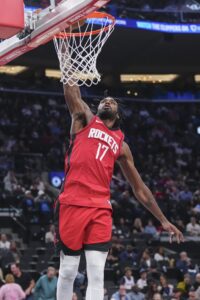 Still, it won’t be a quiet October in Houston. The team has two big contract decisions to make, as both Durant (veteran) and Tari Eason (rookie scale) are eligible to sign extensions.
Since Durant is on an expiring contract, he’ll remain extension-eligible all season long, so there’s not necessarily an urgency to get something done with him before opening night, but it’s frankly a little surprising that the two sides don’t already have an agreement in place. When Durant was on the trade block, Houston was said to be one of the teams he’d be willing to sign an extension with, but the team has seemingly been in no rush to finalize a new contract.
Reports in August indicated that the two sides are still expected to work something out, but that the Rockets may be reluctant to give Durant a maximum-salary deal (roughly $119MM over two years). That would explain the delay and is an understandable position to take, given that a two-year extension would cover KD’s age-38 and -39 seasons.
I’d still expect Houston to put a lucrative offer on the table, but it will be interesting to see whether the team will be willing to guarantee more than one additional season beyond 2025/26. For the sake of comparison, when the Clippers re-signed James Harden in July, they gave him one guaranteed year (for age 36), with a partially guaranteed player option ($13.3MM of $42.3MM) on the second year.
Negotiations with Eason won’t be simple either, especially since the two sides face an October 20 deadline. If no deal is reached by that point, the fourth-year forward will head to restricted free agency in 2026.
Having lost Brooks, the Rockets will probably be relying on Eason to step up and play an increased role in 2025/26, and the 24-year-old has shown real promise as a three-and-D wing. But Houston’s roster is getting increasingly expensive and the team will also have to make a substantial investment in Amen Thompson when he becomes extension-eligible next summer.
The front office will have to be careful about how much it’s prepared to commit to Eason, a solid contributor with untapped potential who still probably isn’t one of the club’s five or six most important players.
Why So Many Players Will Be Signed-And-Waived Before Season
The Raptors have signed three free agents to their offseason roster this week. They’ve also waived those same three players, with Quincy Guerrier, Tyreke Key, and Jarkel Joiner each spending no more than a single day under contract with the team, despite the fact that training camp is still weeks away.
There will be dozens of this sort of “sign-and-waive” transaction completed in the next five-plus weeks before opening night — many of them will involve players who don’t have a realistic path to make their team’s regular season roster and won’t be under contract for more than a day or two.
While they may look pointless on the surface, these moves are meaningful to teams and players for a couple reasons. Here are the two reasons why you can count on seeing many more sign-and-trade moves in the coming weeks:
1. In order to secure a player’s G League rights
Up to four players waived by a team prior to the start of the NBA regular season can be designated as “affiliate players.” As we explain in more detail in our glossary entry on the subject, if a player designated as an affiliate player signs a G League contract, he’s automatically assigned to that team’s NBAGL squad.
A player can only be made an affiliate player if his returning rights aren’t already controlled by a G League team. That’s why our annual list of affiliate players around the league consists mostly of undrafted rookies and a few veterans who have never played in the NBAGL before.
If a player has only ever been assigned to the G League while on a standard or two-way contract with an NBA team, his returning rights aren’t controlled by that club. For example, if a team were to sign Emoni Bates to a training camp deal this fall, it could designate him as an affiliate player, since he has only played in the G League while on a two-way contract with the Cavaliers — that means the Cleveland Charge don’t control his returning rights.
Sign-and-waive transactions involving players meant to be designated as affiliate players often don’t occur until training camps begin, since a player is typically require to participate in at least one day of team activities in order to qualify as an affiliate player.
2. In order to award a player a bonus
Many of the players who are signed and immediately waived by an NBA team can’t be designated as affiliate players because their G League rights are already controlled by a specific club.
This applies to the three players signed-and-waived by the Raptors this week — Guerrier and Key played for the Raptors 905 last season, while Toronto’s affiliate made a trade last month to acquire Joiner’s returning rights. That means if Guerrier, Key, and Joiner sign G League contracts this fall, the 905 would control them as “returning rights” players and wouldn’t have to use one of their four “affiliate player” slots to retain them.
The Raptors didn’t need to sign Guerrier, Key, and Joiner to contracts to acquire their G League rights, but giving them non-guaranteed Exhibit 10 deals will allow Toronto to award those players some bonus money on top of their standard G League base salaries.
A player who signs an Exhibit 10 contract and then is waived before the season will earn his Exhibit 10 bonus if he spends at least 60 days with his team’s G League affiliate. This season, the maximum Exhibit 10 bonus amount is $85,300. Since those bonuses don’t count against the cap, they serve as a way for teams to reward or incentivize a player who joins their G League affiliates instead of seeking another opportunity, perhaps overseas.
The majority of players who sign Exhibit 10 contracts are awarded the maximum allowable bonus ($85,300), but some G League role players will agree to receive bonuses that come in below that max. For example, Key – who averaged just 17.3 minutes per game during the NBAGL regular season in 2024/25 – agreed to a bonus worth just $35K, Hoops Rumors has learned.
Still, even a modest Exhibit 10 bonus represents a significant raise for a player who signs a G League contract. Shams Charania of ESPN reported in the fall of 2022 that the base NBAGL salary at that time was $40,500. It’s possible that figure has increased slightly since then, but it’s still just a small fraction of what a player would earn on a standard – or even a two-way – NBA contract. An Exhibit 10 bonus could double or even triple a G League player’s earnings for that season.
It’s worth noting that if the Raptors hadn’t acquired Joiner’s returning rights from the Hawks’ G League affiliate, they wouldn’t be in position to carry him on the 905’s roster or give him an Exhibit 10 bonus. If an NBA team signs and waives a player whose NBAGL rights are held by another organization, it’s generally a safe bet that a G League trade to acquire that player’s returning rights is in the works.
While only some of the many sign-and-waive transactions that occur between now and the start of the regular season are about acquiring a player’s NBAGL rights, nearly all of them will involve lining up some bonus money for a player ticketed for the G League.