
Celtics Trade Georges Niang, Two Picks To Jazz
August 6: The move is now official, per the Celtics (via Twitter).
The second-rounders headed to the Jazz in the deal are either the Celtics’ or Magic’s 2027 pick (whichever is most favorable) and either the Celtics’ or Cavaliers’ 2031 pick (whichever is most favorable), per Jake Fischer (Twitter link).
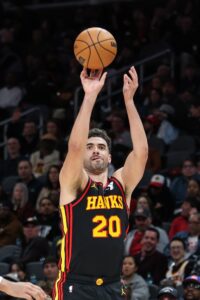 August 5: The Celtics are trading Georges Niang and two future second-round picks to the Jazz for rookie RJ Luis Jr., ESPN’s Shams Charania tweets.
Utah is utilizing part of the $26.6MM trade exception created in last month’s three-team trade in which Utah dealt John Collins to the Clippers, Bobby Marks of ESPN tweets.
It’s another salary dump for the Celtics, allowing them to move well below the second tax apron.
Niang was acquired by Boston from the Hawks in the three-team Kristaps Porzingis blockbuster this offseason. The 6’7″ forward has an expiring $8.2MM contract for next season.
Niang has been on the move quite a bit this year. He began last season with Cleveland and played 51 games for the Cavaliers, all but one off the bench, before getting dealt to Atlanta in February. Niang appeared in 28 games with the Hawks, including two starts. Overall, he averaged 9.9 points, 3.4 rebounds and 1.4 assists in 21.5 minutes per night last season.
Niang will provide Utah with another floor-stretching big off the bench. He’s a career 39.9% shooter on three-point tries.
It will be his second stint with the Jazz, whom he played with from 2017-21. They’re looking at him as someone who can play a rotation role and bring veteran leadership to their young core, Tony Jones of The Athletic tweets. The two sides have spoken, according to Jones, and Niang is happy and excited to be back in Utah.
Luis, an undrafted rookie out of St. John’s, was signed to a two-way contract, so he’ll fill the Celtics’ open two-way slot. Boston reached an agreement with free agent forward Chris Boucher to take Niang’s spot on the 15-man roster.
According to cap expert Yossi Gozlan (Twitter link), the Celtics shed approximately $5oMM off their luxury tax bill with the Niang trade. They’re now just $1.7MM above the first apron and $9.4MM above the luxury tax line. They also created a $8.2MM trade exception.
Nuggets’ G League Affiliate Makes Several Leadership Changes
Former NBA forward Ryan Bowen, who has been an assistant coach with the Nuggets for the past decade (and 12 seasons overall), will be the new head coach of the Grand Rapids Gold, Denver’s NBA G League affiliate announced in a press release.
“Ryan brings a championship mindset, years of experience, and a deep connection to the Nuggets system,” said Gold president Steve Jbara. “We’re thrilled to welcome him to Grand Rapids and can’t wait to see the impact he’ll make on our players and our community.”
Bennett Durando of The Denver Post reported last month that Bowen would be transitioning to the new job. He will replace another former NBA veteran, Andre Miller, who coached the Gold for the past three seasons. According to Durando’s source, Miller is “leaving on his own terms to pursue other coaching opportunities.”
The press release also announced three additional changes to Denver’s organization:
- Longtime scout and assistant coach Chad Iske has been named the Gold’s general manager, as first reported by Durando. Iske will also be the Nuggets’ vice president of pro personnel.
- Nihal Kolur, who has been a basketball operations associate with the Nuggets since 2022, will be the Gold’s assistant GM and the Nuggets’ director of strategy. Kolur specializes in the CBA, salary cap and roster building.
- Matthew Tynes has been named the Gold’s director of operations and scouting. Tynes has been a basketball operations assistant for the past two years.
Lakers Notes: LeBron, Luka, Extension, Reaves, More
Lakers forward LeBron James has been “supportive and understanding” of the team’s commitment to building around fellow star Luka Doncic, ESPN’s Shams Charania said Monday on First Take (YouTube link). Doncic signed a three-year max extension on Saturday, the first day he became eligible to re-up with the Los Angeles.
James is nearing the end of his record-setting career — he turns 41 years old at the end of December — but Doncic is theoretically just entering his prime, as the Slovenian guard is 26. James exercised his $52.6MM player option in June, which will make him an unrestricted free agent in 2026.
While James was not physically present at the press conference to announce Doncic’s extension, he FaceTimed Doncic to congratulate him on the new deal, as first reported by Marc Stein of The Stein Line (Substack link) and subsequently confirmed by ESPN’s Dave McMenamin.
“I hope, obviously, [he stays long term],” James told ESPN on April 30. “Laker fans f—ing love him here. L.A. has accepted him. We love him as a teammate, as a brother. But ultimately, he’s got to make a decision for him. S—, I ain’t going to be around much longer.”
Here’s more on the Lakers:
- Dan Woike of The Athletic details Doncic’s decision to extend with the Lakers and the subsequent celebration in Las Vegas that was attended by new owner Mark Walter, governor Jeanie Buss, head coach JJ Redick and several teammates. “He’s only looking forward. And he’s here. He wants to get the best players here. He wants to win, and he knows it starts with him,” said Lara Beth Seager, Doncic’s manager. “And I think that’s what he proved this offseason. ‘OK, everyone wants to say or people think that they know me or I’m not a leader or I’m this way, or I’m that way, I don’t care. They can think and say whatever they want. “I’m gonna show them who I am.’“
- ESPN insiders McMenamin, Zach Kram, Tim Bontemps and Bobby Marks examine how the Lakers should build around Doncic both now and in the future, including what types of players they should try to add (rim-running centers and three-and-D wings), what tools they have to use in trades, and their salary cap situation moving forward. Marks points out that just because L.A. could have a significant amount of cap room in 2027 doesn’t mean the team must solely rely on that to try to build out the roster.
- In that same ESPN story, Bontemps writes that while much of the offseason speculation about the Lakers has been centered on James’ future, what they should do with Austin Reaves might be the trickier question. Reaves, who is widely expected to decline his 2026/27 player option (worth $14.9MM) in order to hit free agency next summer, reportedly declined a four-year, $89MM extension in June — the maximum he was eligible to receive — in the hope of landing a bigger payday. “I think he will get $30 [million] plus [annually],” one executive told ESPN, echoing multiple front office sources who were asked about the next deal Reaves could command.
- According to Bontemps, there’s an expectation around the league that Reaves will re-sign with the Lakers, but to reach that $30MM-per-year figure, the 27-year-old guard may have to shine on the biggest stage after struggling in the first-round playoff loss to Minnesota. “This is a big season for him,” one Western Conference assistant coach said. “He’d better bring it in the playoffs, because he’s got to be good enough [to pair with Doncic].”
Spurs Re-Sign Harrison Ingram To Two-Way Contract
The Spurs have officially re-signed forward Harrison Ingram to a two-way contract, the team announced today (via Twitter). The club also confirmed its previously reported two-way deal with Riley Minix.
Ingram, the 48th overall pick in the 2024 draft out of North Carolina, appeared in just five games for San Antonio as a rookie on a two-way contract last season. He spent most of the year with the Austin Spurs in the G League, making 48 total appearances in the Tip-Off Tournament and the NBAGL regular season.
Ingram averaged 12.3 points, 9.0 rebounds, 4.0 assists, and 1.4 steals in 32.6 minutes per game for Austin. Although his shooting line was an underwhelming .407/.289/.581, the Spurs liked what they saw enough to tender him a two-way qualifying offer in June, making him a restricted free agent like.
With Ingram and Minix back on two-way deals, San Antonio has filled all three of its two-way contract slots. Summer League standout David Jones-Garcia occupies the other spot.
The Spurs now have 17 players under contract in total, including 13 on fully guaranteed salaries and Lindy Waters on a partially guaranteed deal.
2026 NBA Trade Deadline Set For February 5
The NBA’s trade deadline for the 2025/26 season will be on Thursday, February 5 at 3:00 pm Eastern time, according to the league’s official list of key dates for the upcoming season.
That date for the 2026 trade deadline had been expected based on a previously confirmed regular season start date of October 21, but it hadn’t been officially listed on NBA.com until now.
That deadline is worth highlighting today due to how it will affect players who sign veteran contract extensions for the rest of the 2025/26 league year. When a player signs a veteran extension, he may become ineligible to be traded for six months if his new deal meets certain criteria. Six months from today would be February 6, one day after the trade deadline.
That means a player who signs a veteran extension between now and the Feb. 5 deadline will be ineligible to be traded this season if his new deal meets any of the following criteria:
- His current contract and new extension exceed four years in total.
- His starting salary on the extension is worth more than 120% of the final-year salary on his current deal (or 120% of the NBA’s estimated average salary, for a player earning below the average)
- He receives a raise greater than 5% between the first and second years of the extension (or in any subsequent seasons).
- His current contract is renegotiated as part of the extension.
Knicks forward Mikal Bridges is one example of a recently extended player who meets one or more of these criteria. He’s now under contract for five years in total, received a 2026/27 salary exceeding 120% of his ’25/26 cap hit, and will get 8% annual raises. That means Bridges is ineligible to be traded for six months, but because his deal was finalized on August 1, his trade restrictions will lift on February 1, a few days before this season’s deadline.
This rule doesn’t apply to players who sign rookie scale extensions. They can be traded immediately, though the poison pill provision might make it difficult to do so.
Players who sign veteran extensions that don’t meet any of the criteria above are also eligible to be traded immediately. Mavericks big man Daniel Gafford is an example of a player who falls into this category. The three-year extension he signed last month resulted in him being under contract for four years in total, and his new deal starts at 120% of his previous salary and features 5% annual raises. As a result, no trade restrictions currently apply to Gafford.
November 5 is another date worth keeping in mind now that the trade deadline for 2026 is officially set. A free agent who signs with an NBA team after Nov. 5 won’t become trade-eligible this season.
Atlantic Notes: Pritchard, Bridges, Knicks, Nets
The Celtics‘ biggest transactions this offseason – including trades that sent Jrue Holiday to Portland and Kristaps Porzingis to Atlanta – have been more about reducing the team’s payroll as opposed to upgrading the roster. Still, despite those summer moves and the fact that Jayson Tatum will be sidelined with a torn Achilles, reigning Sixth Man of the Year Payton Pritchard remains confident in the team’s ability to compete.
“We’re definitely trying to be a playoff team. We’re trying to win a championship,” Pritchard said on the Celtics Talk Podcast with Chris Forsberg (story via Logan Reardon of NBC Sports Boston). “It’s not even about playoffs, we have one standard in Boston and it’s to win a championship. Everybody in that locker room will have the goal of competing for a championship. And we will do everything in our power necessary to go for that. That’s what (the fans) should know.”
Pritchard went on to acknowledge that it “definitely sucks” to lose players like Holiday, Porzingis, and Luke Kornet, adding that he’ll especially miss Holiday, who was “like a big brother.” Still, the Celtics guard is optimistic that other players will step up and play well in increased roles — Pritchard himself, who averaged a career-high 28.4 minutes per game last season, is among the players who will likely take on more responsibilities in 2025/26.
“I feel like everybody should be excited,” Pritchard said. “There’s a lot of opportunities across the board. For me, personally, I’m excited every year. Because it’s an opportunity to prove myself again, to show that I can take another step. And that’s my goal every year. I’m definitely hungry and motivated this year, been working really hard. So I’m excited.”
Here’s more from around the Atlantic:
- Despite the fact that Mikal Bridges accepted a little less than he could have received on his four-year, $150MM contract extension, the Knicks project to be a second-apron team next season if they re-sign Mitchell Robinson, Yossi Gozlan writes for The Third Apron (Substack link). Within his look at the Knicks’ cap situation, Gozlan notes that Bridges’ unusual 5.69% trade kicker would put him in line to receive a bonus of about $6.17MM if he’s traded during the 2026 offseason — it would be almost the exact amount he gave up as part of his extension agreement (his max extension would have been worth roughly $156.17MM).
- In a mailbag for The Athletic, James L. Edwards III explores Robinson’s contract situation and the timing of Bridges’ extension, among other topics. Edwards also explains why he wouldn’t be a fan of even a minimum-salary investment in free agent guard Ben Simmons and confirms that the Knicks – along with many other teams around the league – have been monitoring Giannis Antetokounmpo‘s situation in Milwaukee throughout the offseason.
- After ending up at No. 8 in this year’s draft lottery, the Nets appear likely to tank again in 2025/26 in the hopes of landing a higher first-round pick. Brian Lewis of The New York Post (subscriber link) discusses the potential pitfalls of that approach, noting that teams who prioritize draft positioning for multiple years risk creating culture issues. “A lot of these teams that try to bottom out by tanking like Brooklyn is doing, they think there’s no consequences,” one agent told Lewis. “You risk eroding the environment you’re trying to create. That’s what happened in Philadelphia.”
Key Dates, Deadlines For Restricted Free Agents
While it’s not uncommon for restricted free agency to play out slowly for certain NBA players, it’s rare for so many high-level RFAs to remain unsigned a month after the July moratorium lifted. Jonathan Kuminga (Warriors), Josh Giddey (Bulls), Quentin Grimes (Sixers), and Cam Thomas (Nets) continue to negotiate with their respective teams after wrapping up their rookie scale contracts earlier this summer.
 While we wait for resolution on those top four RFAs, it’s worth taking a closer look at the important dates and deadlines that apply during the restricted free agency process, including both the ones that have already passed and the ones still to come.
Here’s the breakdown:
June 29: Last day to tender a qualifying offer to a player eligible for restricted free agency
A player is eligible for restricted free agency if he’s a former first-round pick who is wrapping up the fourth year of his rookie scale contract or if he’s a former second-round pick or undrafted free agent who has been in the NBA for no more than three years.
If a player meets that criteria, a team must issue a qualifying offer to make him a restricted free agent. The qualifying offer is a one-year contract offer whose exact value is determined by an existing formula. While the player has the option of signing that qualifying offer, it can also serve as a placeholder that gives the player’s team the right of first refusal in the event he signs an offer sheet with another club.
We go into far more detail on how qualifying offers and how they’re calculated in our glossary entry on the subject. The headline here is that June 29 is the last day they can be issued — a player who doesn’t receive a qualifying offer on or before that date will instead become an unrestricted free agent.
Teams typically don’t issue qualifying offers far in advance of this deadline even if their decisions are relatively straightforward ones. In 2025, for instance, 30 of the 37 players who received QOs got them on either June 28 or June 29, per RealGM.
July 13: Last day for a team to unilaterally withdraw a qualifying offer
While a player can accept his qualifying offer as soon as he receives it, most QOs remain unsigned at the start of free agency, opening the door for a team to rescind its qualifying offer without the player’s approval.
For instance, on July 1 of this year, the Bucks withdrew their qualifying offer to Ryan Rollins, who began the league year as a restricted free agent. Rescinding that QO made Rollins an unrestricted free agent and meant he no longer had the option of accepting the one-year, $2.6MM offer.
In that case, the Bucks’ decision was about maximizing their cap room — withdrawing Rollins’ qualifying offer slightly reduced his cap hit, creating a little extra spending flexibility for the team to sign Myles Turner. Milwaukee retained Rollins’ Early Bird rights when he became an unrestricted free agent and was able to eventually re-sign him to a starting salary ($4MM) that exceeded his QO. So that scenario was a win-win for the player and team, but that isn’t always the case when a qualifying offer is pulled.
After July 13, a team can no longer unilaterally withdraw a player’s qualifying offer, which means that any rescinded QO on July 14 is a result of a mutual decision between the team and player.
This situation played out with multiple two-way restricted free agents this summer — Enrique Freeman (Pacers) and Isaiah Crawford (Kings) agreed to have their QOs withdrawn after July 13, which made them unrestricted free agents and allowed them to sign two-way deals with new clubs (the Timberwolves and Rockets, respectively).
October 1: Deadline for a restricted free agent to accept his qualifying offer
Between July 13 and October 1, a restricted free agent has the security of having his qualifying offer as a fallback plan, knowing that his team can’t take it off the table without his approval.
That doesn’t necessarily mean an RFA who remains unsigned on July 14 won’t get a deal done until that Oct. 1 deadline gets close, but the lack of any other deadlines before October results in little immediate urgency during late July and August. That’s one reason why we’ve seen little movement on Kuminga, Giddey, Grimes, and Thomas in recent weeks.
If the October 1 deadline passes without a player signing his qualifying offer, he remains a restricted free agent but would no longer have the option of accepting his one-year QO, which would significantly reduce his leverage.
It’s important to note that the October 1 deadline isn’t necessarily a hard and fast one — it can be pushed back as long as the team and player agree, and that can be done multiple times. For example, the two sides may initially agree to delay the deadline back to Oct. 15, then two weeks later decide to push it back again to November 1. However, that date can’t be postponed indefinitely…
March 1: Very last day for a restricted free agent to accept his qualifying offer; deadline for an RFA to sign an offer sheet
A team and a restricted free agent aren’t permitted to push the deadline to accept a qualifying offer beyond March 1. If an RFA still doesn’t have resolution on his contract situation by that date, his QO would go away, meaning he wouldn’t be able to accept it on March 2.
A restricted free agent also isn’t eligible to sign an offer sheet with a rival team after March 1. That means that if he hopes to play in the NBA during that season, his options between March 2 and the end of the season would essentially be down to one: Work out a new agreement with his current team.
If a restricted free agent goes the entire season without signing any sort of contract, he doesn’t become unrestricted the following year. His current team has the ability to once again tender him a qualifying offer by June 29 with the same terms as the previous QO, and if the club issues that offer, the process would begin all over again for a second year.
Essentially, a restricted free agent’s options only get worse once October 1 (or the newly agreed-upon QO decision deadline) passes, which is why we should probably count on resolution for this year’s top RFAs well before the regular season gets underway.
Pacers’ Mike Weinar Withdraws From Knicks Search For Top Assistant
Pacers assistant Mike Weinar has removed his name from consideration for the Knicks‘ top assistant position, Stefan Bondy of the New York Post tweets.
Ian Begley of SNY (Twitter link) confirms Weinar has removed withdrawn from consideration to be Mike Brown‘s offensive coordinator and lead assistant, adding that Hornets assistant Chris Jent remains a candidate for the job. New York’s interest in Jent was reported over the weekend.
Jent guided Charlotte to the Summer League title last month. Prior to arriving in Charlotte, he spent five years on the Hawks’ bench (2017-22) and two seasons with the Lakers (2022-24).
Jent served as the interim head coach for the Magic for the final 18 games of the 2004/05 season.
Weinar has spent the bulk of his NBA career working with head coach Rick Carlisle in Dallas and Indiana. Prior to his time with the Pacers, he served as an assistant for the Mavericks, having transitioned from a basketball operations role to join the coaching staff. His tenure in Dallas included the club’s 2011 title run.
According to Bondy, there were family considerations involved in Weinar’s decision.
Former Heat Employee Accused Of Stealing Team Items, Selling Them For Profit
A former Heat employee has been accused of stealing more than 400 game-worn jerseys and other items and selling at least 100 of those items for profit, according to reports from The Athletic’s Brooks Peck and the Miami Herald’s Anthony Chiang and Charles Rabin.
According to a Department of Justice press release, Marcos Thomas Perez faced federal charges of transporting and transferring stolen goods in interstate commerce on Tuesday. Among the items Perez alleged stole was LeBron James’ jersey from Game 7 of the 2013 NBA Finals, which he sold for approximately $100K. The jersey was later sold in 2023 at a Sotheby’s auction for $3.68MM.
The federal investigation was launched in early 2024 after game-worn jerseys from James, Shaquille O’Neal and Dwyane Wade — among many other items — went missing from the Heat’s arena, the Kaseya Center.
Perez worked the City of Miami Police Department in November 1992 until he retired in April 2016. He was employed by the Heat as a security officer from 2016-21, then worked for the NBA as a security employee from 2022 until this year.
“During his tenure, Perez worked on the game-day security detail at the Kaseya Center, where he was among a limited number of trusted individuals with access to a secured equipment room,” the DOJ’s press release reads. “This equipment room stored hundreds of game-worn jerseys and other memorabilia that the organization intended to display in a future Miami Heat museum.
“During his employment, Perez accessed the equipment room multiple times to steal over 400 game-worn jerseys and other items, which he then sold to various online marketplaces. Over a three-year period, Perez sold over 100 stolen items for approximately $2 million and shipped them across state lines, often for prices well below their market value.”
Law enforcement executed a search warrant at Perez’s home in April and seized almost 300 items that the Heat confirmed had been stolen from their arena.
Meadowlark Media’s Amin Elhassan first reported the news of the investigation on “The Dan Le Batard Show with Stugotz” last week, according to the Herald. The Heat organization and the league have declined to comment during the ongoing investigation.
Spurs Re-Sign Riley Minix On Two-Way Contract
10:00 pm: The signing is official, according to NBA.com’s transaction log.
7:35 pm: The Spurs are re-signing Riley Minix on a two-way deal, ESPN’s Shams Charania tweets. San Antonio had a pair of open two-way slots, so no corresponding move will be necessary.
Minix, 24, appeared in one game with San Antonio last season. The 6’7″ forward was a restricted free agent after receiving a two-way qualifying offer from the Spurs in June.
Minix underwent season-ending surgery in January to repair a torn labrum in his left shoulder. He sustained the injury during a G League game vs. Iowa on January 1.
The former Morehead State standout was healthy enough to play for the Spurs’ Summer League team last month and saw action in five games. He averaged 10.6 points, 4.6 rebounds and 1.4 assists while shooting 48.6 percent from the field in 23.9 minutes per game.
San Antonio signed Minix to an Exhibit 10 deal in July 2024 after he went undrafted. He had his Exhibit 10 deal converted to a two-way contract ahead of the regular season.
The 24-year-old averaged 19.3 PPG, 6.6 RPG, 2.1 APG, 1.2 SPG, and 1.2 BPG with an impressive .524/.414/.853 shooting line in 19 total contests (31.6 MPG) for the G League Austin Spurs last season.