
Draft Notes: Thunder, Kings, Wolves, Warriors
The Thunder‘s offseason checklist to shore up the team around two-time MVP Shai Gilgeous-Alexander will likely revolve mostly around moves around the margin, but they do have three picks in the 2026 NBA draft: Nos. 12, 17, and 37.
With the 12th pick, it could behoove the Thunder to go after some size. Nate Ament (Tennessee), the Michigan trio of Aday Mara, Yaxel Lendeborg, and Morez Johnson Jr., or Hannes Steinbach (Washington) could all help the team add size and skill in different ways, Justin Martinez writes for The Oklahoman.
At No. 17, Martinez looks at a more wing-heavy group, including Cameron Carr (Baylor), Dailyn Swain (Texas), and Bennett Stirtz (Iowa), alongside versatile defenders Allen Graves (Santa Clara) and Jayden Quaintance (Kentucky).
It’s likely that the team will end up not using all three selections, Martinez writes, but with the 37th pick, Joshua Jefferson (Iowa State), Alex Karaban (UCONN), and Emanuel Sharp (Houston) are three of the names Martinez points to as being interesting players that could fit the Thunder’s ethos.
We have more news and notes related to the 2026 draft:
- The Kings announced a new pre-draft workout group for Monday, according to Sean Cunningham of KCRA News (Twitter link). Baba Miller (Cincinnati) will participate after having to reschedule a previous visit due to illness. He will be joined by Bruce Thornton (Ohio State), B.J. Edwards (SMU), Fletcher Loyer (Purdue), Kobe Knox (South Carolina), and Tucker DeVries (Indiana).
- The Timberwolves worked out Aaron Nkrumah earlier this month, Darren Wolfson of KSTP reports (via Twitter). The 6’6″ forward started out playing Division III basketball before transferring to Tennessee State for his junior and senior seasons. He averaged 17.7 points, 5.5 rebounds, 3.0 assists, and 2.8 steals while shooting 35.1% from three and being named Ohio Valley Conference Player of the Year.
- The future of the Warriors depends on hitting on the 11th pick in the draft, ESPN’s Anthony Slater tells Michael Wallace of Grind City Media (YouTube link). Their two starting wings, Jimmy Butler and Moses Moody, are expected to miss at least the start of the year with injuries, leaving a large hole in the rotation. The Warriors are unlikely to trade the pick in a deal that doesn’t involve a high-level player returning to Golden State, according to Slater. Golden State does need to get younger, but the team doesn’t need to try to find its next Stephen Curry at No. 11, Slater says, noting that Arizona’s Brayden Burries is an off-ball guard who has drawn interest from the Warriors’ decision-makers and could complement the current core while growing into a player with more offensive responsibility.
Stein’s Latest: Reaves, Pistons, Bulls, Raptors, Mavs
The Lakers are still trying to find the right balance of players to put around star Luka Doncic, and they have an important offseason ahead of them, with Austin Reaves and LeBron James both on track unrestricted free agency.
Signs seem to be pointing to the Lakers retaining Reaves, according to Marc Stein of the Stein Line (subscriber link). Stein highlights the developing partnership between the 28-year-old guard and Doncic, writing that the Lakers appear to view the duo as the cornerstone combination they’ll build the team around.
While one report indicated that the Nets could offer Reaves a max contract and that the Pistons may have interest in him as a shooter and ball-handler next to Cade Cunningham, Stein notes that there is a sense the Nets would rather give out short-term deals if they decide to be aggressive in free agency. As for the Pistons, they seem more likely to look to fill the holes in their roster via trade than via free agency, Stein writes, so as not to risk complicating their cap situation ahead of Jalen Duren‘s restricted free agency and Ausar Thompson‘s next contract.
We have more news from around the NBA:
- There are still three teams without a head coach, but that is expected to change soon. Stein reports that the Bulls could choose their next head coach as soon as Monday. As Stein and Jake Fischer reported earlier this week, Micah Nori (Wolves), Tiago Splitter (Blazers), Ryan Schmidt (Hawks), and Wes Unseld Jr. (Bulls) are considered the four finalists for the position.
- The Raptors quietly interviewed former Mavericks president Donnie Nelson as well as Toronto’s former Coach of the Year Dwane Casey last year during their front office search that eventually led to the hiring of Bobby Webster, who was recently extended, Stein reveals, while confirming previous rumors that head coach Darko Rajakovic is expected to be extended sooner rather than later. Stein also notes that Patrick Engelbrecht, Toronto’s director of global scouting and international affairs, could end up reuniting with Mavs president Masai Ujiri as Ujiri continues to build out Dallas’ new-look front office.
- The Mavericks are moving forward with their search for a head coach and reportedly held interviews throughout this weekend. As has previously been reported, the list of Mavs candidates includes Nori, Royal Ivey (Rockets), Jama Mahlalela (Raptors), Tony Dobbins (Celtics), and former Blazers coach Terry Stotts.
Nuggets’ Aaron Gordon Receiving Trade Interest
The Nuggets could emerge as one of the more important teams on the trade landscape this summer once Giannis Antetokounmpo‘s situation is resolved, Marc Stein writes in his latest Substack article for The Stein Line. Denver has the unenviable task of trying to continue putting the best supporting cast possible around star Nikola Jokic while navigating a difficult financial situation that will likely cause the team to lose at least one of its core players.
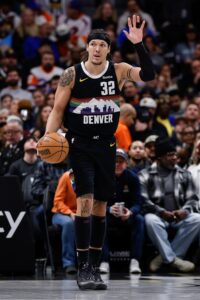 Veteran forward Aaron Gordon has emerged as the most sought-after trade target on the roster, Stein writes, despite the injuries that have limited him to just 87 games over the last two regular seasons.
Gordon’s combination of versatile, hard-nosed defense, strong off-ball offensive play, and reliably solid outside shooting makes him an ideal fit for most contenders, but those same traits are exactly why the Nuggets would prefer to retain him.
Gordon has developed a strong two-man game with Jokic over the years and has become one of the big man’s favorite passing targets due to his great instincts as a cutter. The veteran forward is starting the first season of a three-year, $103.6MM extension, which has a player option in year three.
The Nuggets would also like to hold onto Jamal Murray, who is coming off the strongest season of his career, and instead would prefer to send out 25-year-old wing Christian Braun in any trade involving a starter, Stein notes.
Braun took a step back after signing a five-year, $125MM extension last summer, as health issues – including a significant ankle sprain – limited him to 44 games in 2025/26. He made just 30.1% of his three-pointers this season after shooting 38.4% over his previous three years, and his scoring average dipped to 12.0 PPG. However, he’s a solid defender and transition threat and is young enough that there is still interesting upside for a team that needs a reliable performer on the wing.
Knicks Notes: Brown, Brunson, Jent, Robinson
It was less than two years ago that Mike Brown was fired by the Kings after Sacramento got off to a poor start in 2024/25. Now he is the coach who brought the Larry O’Brien trophy back to New York.
“He understands what it is to be a champion,” Knicks star and Finals MVP Jalen Brunson said of his head coach, per Jason Anderson of the Sacramento Bee. “He understands how to build a team, how to build habits that will put you in this position. And we’re so grateful, so thankful to have him at the top. He kept us even so many times. He’s brought the best out of us as people first, and, man, I’m so happy for him. He’s the reason why we’re (champions).”
In addition to being a two-time Coach of the Year, Brown can now boast five championship rings, four of which came as an assistant. He made the right decisions and pressed the right buttons throughout the Knicks’ miraculous 16-3 playoff run.
“He’s done a great job of adjusting our team to give us the best chance to win,” said Karl-Anthony Towns after Game 4. “The spot we’re in now is because of his courage and trust to change what we were doing and put us in a better position.”
Brown’s performance as the Knicks’ coach is particularly noteworthy, given that he didn’t appear to be the team’s first choice after firing Tom Thibodeau last summer, Tim Reynolds writes for The Associated Press. Whether or not he was the preferred candidate, he showed that he was the best option with his poise, personality, and commitment to excellence.
One of Brown’s notable decisions was to meet with his five starters before the playoffs began, both individually and then as a group, and let them air any grievances they might have with how the season had gone, Justin Tasch writes for the New York Post. Brunson’s father, Rick Brunson, said that the meetings “were pivotal to New York’s playoff success.”
We have more Knicks news and notes:
- Brunson is shorter than 95% of the NBA, Stefan Bondy writes for the New York Post, but his heart and his fight ensured he’ll go down as a Knicks legend. His Game 5 performance, in which he scored 45 of the team’s 94 points, was a masterpiece in which every point was crucial to closing out the series without any possibility of a Spurs comeback. “It’s everything I dreamed of,” Brunson said after the game. “It’s why I came to New York.” Brunson bet on himself when he left the Mavericks and Luka Doncic to run his own team, but he also bet on the Knicks when he took a substantial pay cut to give president Leon Rose the necessary flexibility to fill out the roster as Rose saw fit, Reynolds writes. Rose rewarded that faith by bringing in players Brunson trusted and who could complement his skill set in the right ways.
- Brown made sure his coaching staff earned its share of credit for the championship run, shouting out one specific assistant as being an indispensable part of his team. “There are a lot of jobs open out there. Chris Jent, my associate head coach, I’m surprised has not gotten an interview,” Brown said after Game 5, per Michael Scotto of HoopsHype (Twitter video link). “He won the Summer League championship this past summer, he’s our offensive coordinator, associate head coach. He’s been around for a long time. Someone needs to give him an interview because he will help your team win at the highest level.”
- The longest-tenured Knick made perhaps the biggest play of his career in fitting fashion at the end of Game 5, Zach Braziller writes for the Post. Mitchell Robinson, playing 20 minutes while Towns dealt with foul trouble, grabbed an offensive rebound off a missed free throw with 22 seconds to go and kicked it out to OG Anunoby, who hit one of two free throws to make it a two-possession game. It was the exact type of play that made him such a critical part of the Knicks’ identity throughout the season. Robinson grinded out extra possessions and found teammates on kick-outs, supercharging the team’s offense when it started to bog down. Robinson, the longest-tenured Knick, is the only player left from his 17-win rookie season, and despite playing with a broken hand, he came up clutch when it mattered the most, battling Victor Wembanyama for rebounds and hauling in the biggest one of the night. He responded to the accomplishment in his typical lighthearted fashion. “Yesterday, at the hotel, I caught a snake. Again,” he said. “You know I caught a snake in the beginning of the playoffs when we played Atlanta. We won, and I caught one last night and we won today. I think it’s something about snakes.”
Southwest Notes: Spurs, Johnson, Grizzlies, Rockets
After losing Game 5 of the NBA Finals, the Spurs had to conduct their final media obligations of the season with their opponents celebrating nearby. It’s a feeling they’re not likely to forget, Jeff McDonald writes for the San Antonio Express-News.
“It hurts a lot. Hearing that right now, seeing them storming the court on our home court, it’s tough,” Devin Vassell said. “We know we’ll do everything we can — scratch, fight — to get back into this position and have a different outcome.”
The way the series played out – the Spurs let double-digit leads slip away in all four losses – is sure to leave a lasting impression on the second-youngest Finals team in league history. Victor Wembanyama is confident that it also provided valuable lessons about how he and his teammates need to prepare, emotionally and physically, to win a championship.
“All five games in the series had the same scenario,” Wembanyama said. “How relentless we were in our mistakes and (how relentless) they were in punishing them.”
Head coach Mitch Johnson is hoping that the experience only makes them hungrier to get back to the Finals and avenge this loss, a sentiment echoed by the team’s young star center.
We have more from around the Southwest Division:
- Keldon Johnson had a strong season for the Spurs, winning Sixth Man of the Year while averaging 13.2 points per game. However, he was unable to get going in the Finals, as his scoring dropped to just 4.4 points per game. He’s trying his best to learn from the disappointment and come back a better, more prepared player. “When you get in the playoffs, every game is different,” Johnson said after Game 5. “Every possession matters. You can’t look forward through things. You got to be locked in every possession, every detail, and take that in. Every game is different. Every game may need something different. And that’s what I feel like my biggest takeaway is from playoffs.”
- The Grizzlies are in the early stages of their rebuild, coming into the offseason with an interesting young core highlighted by breakout rookie Cedric Coward and the number three pick in the 2026 draft. Despite modest salary commitments, they likely won’t operate as a cap space team this summer, Yossi Gozlan notes in his offseason preview for The Third Apron (Substack link). That will allow them to take in more money in a trade than they send out, give them the freedom to pursue sign-and-trades, and give them access to both their $15MM non-taxpayer mid-level exception and their $5.5MM biannual exception. Finding an end to the Ja Morant trade saga will also be key to laying the foundation for whatever comes next.
- After a first-round loss in the 2026 playoffs, the Rockets enter the offseason facing real questions on how to elevate the team into a more legitimate contender. They will have to be somewhat careful in terms of negotiations with restricted free agent Tari Eason, Keith Smith writes in an offseason preview for Spotrac, but retaining the fourth-year wing should still be a priority, as should figuring out what happens with Fred VanVleet‘s contract — he holds a player option that could be declined to negotiate a new deal. The veteran point guard’s importance was clear in how much Houston struggled to form a cohesive offensive identity. Any real changes would likely have to come through the trade market, with players like Jabari Smith Jr., Reed Sheppard, and Steven Adams potential additions to any star package. Smith speculates that a five-year, $185MM extension makes sense for Amen Thompson, an elite defender who should be able to play a more natural role when VanVleet returns.
Sixers Notes: Offseason, Graves, Okorie, Johnson, Lendeborg
The Sixers made their first major offseason move when they fired former president of basketball operations Daryl Morey and replaced him with Mike Gansey, a longtime Cavaliers executive. Now they’ll be turning their attention to roster transactions — they can begin negotiating with their own free agents on Sunday, while the draft takes place on June 23 and 24.
There are also a few more subtle offseason questions for the franchise, writes Gina Mizell of The Philadelphia Inquirer, including what Elton Brand‘s new role will be with the team. The 76ers’ longtime general manager is no longer in the front office after Jameer Nelson was promoted, but he reportedly agreed to a new position with the Sixers’ parent company.
Among the other offseason questions posed by Mizell is whether the Sixers will make further changes to their front office or adjust Nick Nurse‘s coaching staff.
We have more on the 76ers:
- Philadelphia controls the 22nd pick in the 2026 draft. In a conversation with Adam Aaronson of PhillyVoice, draft evaluator Logan Adams made the case for the 76ers selecting Santa Clara forward Allen Graves, assuming he’s still available at that spot.
- In a similar story for PhillyVoice, Aaronson spoke to Brian Geisinger about Ebuka Okorie‘s strengths and weaknesses and his potential fit with the 76ers. For what it’s worth, Graves is ranked 17th on ESPN’s big board, while ex-Stanford guard Okorie is at No. 27.
- Appearing on the PHLY Sixers podcast (YouTube link), Michigan assistant coach Mike Boynton discussed the 2025/26 seasons of Morez Johnson and Yaxel Lendeborg and how the championship-winning big men could fit with Philadelphia if they’re available at No. 22 (or if the Sixers trade up).
Knicks Notes: Brunsons, Hart, Bridges, Championship
Captain Jalen Brunson was the Knicks‘ hero once again in Saturday’s championship-clinching Game 5 victory, scoring 45 of New York’s 94 points en route to being unanimously named the Finals MVP. Brunson said the pressure of intense playoff moments is nothing compared to what his father, assistant coach Rick Brunson, faced during his journeyman NBA career, as Marcus Thompson II of The Athletic details.
“No pressure. No pressure whatsoever,” Jalen said. “My dad being on eight or nine unguaranteed contracts throughout his career and not knowing when you’re going to get cut, when a team is going to move on from you, while your family is on the East Coast and you are wherever you are in the country. That’s pressure.
“Working out three times a day in the summertime and watching him push himself just to get a training camp deal, that’s pressure. I’m very fortunate to be in the position I am and I definitely think I worked pretty hard. So when the opportunity presented itself like it did today, I just trusted my work. … I’m just never afraid to fail.”
Rick Brunson called it “surreal” watching his son lead the Knicks to their first title in 53 years, according to Thompson.
“I can’t imagine,” Rick said, shaking his head. “I never thought he’d get to this level. I’d be lying to you if I said I thought he would be this good. I just wanted someone to come to New York, run a team, and hopefully have a chance to win a championship. And for him to be the guy to help me help the team, this is surreal.”
Here’s more on the new NBA champions:
- Brunson’s decision to sign an extension in the 2024 offseason rather than waiting for a more lucrative contract in 2025 free agency played a key role in helping the front office built out the roster around him, writes James L. Edwards III of The Athletic. “He understands what winning is about,” head coach Mike Brown said. “He took a pay cut that I wouldn’t take. Every time they would throw that number in front of me, I would say no, and I feel like I’m a great guy. He set the bar. That set the standard.”
- CJ Moore of The Athletic recently spoke to several people associated with Villanova about Brunson, Josh Hart and Mikal Bridges, the trio of Knicks who played college ball together with the Wildcats. “When things are going against them, they don’t show too much body language,” said Matt Kennedy, a former Villanova walk-on, several days before New York’s historic Game 4 comeback. “The big thing at Villanova was attitude, and don’t show your emotion. I think that’s what’s allowed them to come back in a lot of games, that mindset and attitude; you can’t really break them. They’re just gonna keep coming and coming and coming at you.”
- Hart said after Game 5 that his bond with Brunson and Bridges will last a lifetime, per Howie Kussoy of The New York Post. “Those are my brothers for life,” Hart said. “We have a bond that’ll never be broken. We won a championship together in college, but this one obviously takes the cake. We’ve been built for this moment. We’ve all been forged in the fire … Coach [Jay] Wright helped us be cut from a different cloth. No matter the moment, it’s never too big for us.”
- ESPN’s Vincent Goodwill takes a look at the Knicks’ path to the championship, noting that the team’s dominant playoff run was unexpected even though New York was one of the preseason favorites in the Eastern Conference. Tim Bontemps of ESPN says OG Anunoby‘s game-winning tip-in in Game 4 was the team’s defining moment while taking a deeper dive at the Knicks’ lengthy title drought.
- Kristian Winfield of The New York Daily News and Fred Katz of The Athletic take behind-the-scenes looks at the Knicks’ celebration in San Antonio.
International Notes: EuroLeague FAs, Fournier, Ferrell, Washington
While several EuroLeague players have already reached contract agreements for next season (and beyond), there are still some top players on the open market, writes Stefan Acevski of Eurohoops.
Longtime NBA power forward Trey Lyles, who starred for Real Madrid last season, is the top-ranked player on Acevski’s list, which also features recent NBA veterans like Daniel Theis (AS Monaco), Cory Joseph (Olympiacos) and Braxton Key (Valencia).
Here are a few more notes from overseas:
- French wing Evan Fournier recently helped Olympiacos win both the EuroLeague Final four and the Greek league finals, winning MVP on both occasions, per Mike Gkioulenoglou of Eurohoops. Fournier, a 12-year NBA veteran who last played for Detroit in 2023/24, talked about the incredible fan support he’s received since he joined Olympiacos, his fluctuating role throughout the season, and a desire to see the playoffs occur in a different order in the future. “Panathinaikos is a really good team. They play extremely hard, but to be honest, Europe has to think of a better way to end the season,” Fournier said. “To go from the EuroLeague to domestic Finals is very hard. You kind of check out, win or lose. And especially us, I think we have the hardest Finals in Europe, so you go from winning to jumping into another war. I wish we could have ended the season with the EuroLeague and not the Greek Finals.”
- Veteran guard Yogi Ferrell has officially re-signed with Buducnost in Montenegro, relays Johnny Askounis of Eurohoops. The 33-year-old, who played five seasons in the NBA, had a strong season during both EuroCup and ABA League action in 2025/26.
- Partizan has parted ways with Duane Washington, who had spent the past two years with the Serbian club (Twitter link via the team). A 26-year-old guard who played two years in the NBA, Washington led the ABA League in points per game this season and put up solid numbers in the EuroLeague (14.9 points on .450/.377/.800 shooting splits in 21.9 minutes per game) as well.
And-Ones: TIME List, Flight Risks, Option Dates, Power Rankings
Lakers superstar LeBron James tops TIME’s 2026 list of the 100 Most Influential People in Sports. The four-time MVP isn’t the only person affiliated with the NBA on the list, as Victor Wembanyama, Shai Gilgeous-Alexander, Jalen Brunson, Cooper Flagg, Stephen Curry, Mavericks president Masai Ujiri and Shams Charania of ESPN are also present.
Here are a few more odds and ends from around the basketball world:
- Eric Pincus of Bleacher Report lists his 10 biggest “flight risks” — the players most likely to change teams — in free agency. Four Lakers — Austin Reaves, Rui Hachimura, Deandre Ayton and James — are on Pincus’ list, as are Heat forward Andrew Wiggins and Sixers guard Quentin Grimes. Wiggins ($30.2MM) and Ayton ($8.1MM) both hold player options for 2026/27.
- While most player and team option decisions for next season are due by June 29, in some cases the deadlines are a little sooner, notes Brett Siegel of ClutchPoints (Twitter link). Trae Young (Wizards) and Kentavious Caldwell-Pope (Grizzlies), for example, have until June 23 to decide whether they want to pick up their lucrative player options, while the Clippers have until June 26 to determine what to do with their $16MM option on Bogdan Bogdanovic.
- Ten ESPN insiders have voted on their power rankings for 2026/27, with the Thunder, Spurs, Knicks, Celtics and Pistons comprising the top five. The Kings, Nets and Wizards are at the bottom end of the rankings.
Spurs Notes: Wembanyama, Vassell, Harper, Fox, Castle, Barnes
The Spurs‘ inexperience and inability to close out games turned out to be their undoing in the NBA Finals, writes Michael C. Wright of ESPN.com. The team built double-digit leads in all five games of a series it lost 4-1, Wright notes, including a 16-point lead in Saturday’s Game 5, when San Antonio was eliminated.
Finals MVP Jalen Brunson led the Knicks to a 21-7 run to end Game 5, a consistent theme throughout the series. New York won its four games by 16 combined points, a slim yet triumphant margin.
“The margin for error is very thin,” said Wembanyama, who averaged 7.8 points in fourth quarters during the series but shot just 34.0% from the field. “Our domination stints are absolute. We absolutely dominated for most of the series. But our errors, our mistakes are punished so hard that we can’t have ups and downs like this so much, you know? The ups are OK. The downs are the reason we lost.”
Saturday’s loss started well for the Spurs, who limited the Knicks to just 37 points in the first half, their lowest total of 2025/26 (regular season or playoffs). But the Spurs only managed 42 first-half points of their own, and – more importantly – scored just 18 in the fourth quarter, when New York put up 29 (Brunson alone had 15 points on 4-of-6 shooting) and wound up winning by four.
“There’s a lot that goes into it,” Spurs coach Mitch Johnson said. “We didn’t deserve to win the games. There’s a lot of levels of execution. There can be rebounding. There can be end-of-game details. There can be starting the game where you get the lead and then you don’t sustain that. We weren’t ready to win an NBA championship. The better team won. We did a lot of good things, and we didn’t finish the job.”
Wembanyama and the Spurs are determined to use the bitter taste of disappointment as a learning lesson, according to Wright.
“What I’m pissed about is, there’s probably a hundred games before we can be back in the Finals,” Wembanyama said. “I don’t know how to say it in English. But I’m going to have to hold that inside of me, slow down, wait and execute for a hundred games. It’s going to be all of it [shaping my mentality in the future]; who we are, what we’re made of, our experiences.
“This has been a hell of a year in terms of experience. I don’t think we could have learned more and gained more experience in one playoff run and in one season, and personally in 18 months. This is the biggest lesson of my life, the biggest learning moment. I can’t tell you exactly what the lesson is. But we’re learning from that. I’m learning more than any other time in my life.”
Here’s more on the Spurs:
- Devin Vassell was among the players who lamented the team’s late-game miscues in the series, per Jared Weiss of The Athletic. He also acknowledged the pain of hearing the Knicks celebrate on the Spurs’ home floor. “Obviously, in the finals, with everything being amplified, one mistake can cost you a game. I think we had a couple that cost us multiple,” Vassell said.,
- Standout rookie Dylan Harper led San Antonio with a team-high 25 points (on 10-of-19 shooting) to go along with five rebounds and four assists in Game 5, observes Tom Orsborn of The San Antonio Express-News (subscriber link), though he missed three layups and a free throw late in the loss when he was running on fumes. “There was some good, some bad,” Harper said. “There were a lot of possessions I want to take back and do differently. But that’s now how the ball bounced. Just got to keep moving on.”
- While Harper was a bright spot, fellow guards De’Aaron Fox (seven points on 3-of-15 shooting) and Stephon Castle (six points on 1-of-10 shooting) struggled mightily in Game 5, Orsborn adds. “I got shots I’ve made in the past and sometimes you just don’t make them,” Fox said. “Some felt good. Back rim, in and out. It is what it is. Obviously, I wish I made those shots, but that team is physical. They force you into taking jump shots and try to keep you out of the paint. But shots just didn’t go down for me.”
- Vassell praised Harper after the game, referring to him as a “star in the making,” though he raised some eyebrows when he suggested last year’s second overall pick was upset with his playing time and role throughout 2025/26 (Twitter video link via Sam Vecenie of The Athletic).
- While San Antonio certainly seems to be on an upward trajectory, there’s no guarantee the team will be back in the NBA Finals next season, notes Kelly Iko of Yahoo Sports. “I think you have to look at it for the season it’s been,” veteran forward Harrison Barnes told Yahoo Sports. “The pain of losing in the Finals, and ultimately you have to accept that. There’s no guarantee that this group will ever have the opportunity to achieve that. Some players in this room may be able to get back to the Finals, some players in this room may be able to win a championship. I think accepting what this moment has been, where we come to as a team, and hopefully as guys continue on in their careers — whether it’s five, 10, 15 years — they’ll use this as a reference point.”