
Bird rights offer teams the chance to sign their own free agents without regard to the salary cap, but they don’t apply to every player. Other salary cap exceptions are available for teams to keep players who don’t qualify for Bird rights. One such exception is the Early Bird, which applies to players formally known as Early Qualifying Veteran Free Agents.
While the Bird exception is for players who have spent three seasons with one club without changing teams as a free agent, Early Bird rights are earned after just two such seasons. Virtually all of the same rules that apply to Bird rights apply to Early Bird rights, with the requirements condensed to two years rather than three.
Players still see their Bird clocks restart by changing teams via free agency, being claimed in an expansion draft, or having their rights renounced. A player who is traded can also have his Bird clock reset if he approves a move after having re-signed with his previous team on a one-year contract (or a one-year contract with a second-year option) earlier in the league year.
As is the case with Bird rights, a player’s clock stops when he’s released by a team and clears waivers, but it would pick up where it left off if he re-signs with that same team down the road without joining another club in the interim.
For instance, if the Pacers were to re-sign Tony Bradley to a rest-of-season contract, he would have Early Bird rights this offseason because – even though he was waived earlier this season – he would be on track to finish a second consecutive year with Indiana and didn’t join another team in the interim.
The crucial difference between Bird rights and Early Bird rights involves the limitations on contract offers. Bird players can receive maximum-salary deals for up to five years, whereas the most a team can offer an Early Bird free agent without using cap space is 175% of his previous salary (up to the max) or 105% of the league-average salary in the previous season, whichever is greater.
These offers are also capped at four years rather than five, and the new contracts must run for at least two years — the second season can be non-guaranteed, but can’t be a team or player option. Raises are maxed out at 8% per season.
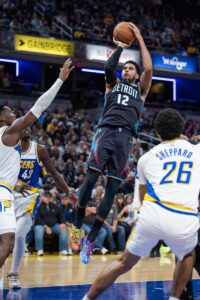 Tobias Harris (Pistons), Quinten Post (Warriors), Spencer Jones (Nuggets), and Andre Drummond (Sixers) are among the free agents who will have Early Bird rights during the 2026 offseason. Isaiah Hartenstein (Thunder) is another notable player who would join that group if his team option is declined.
In some instances, teams can benefit from having Early Bird rights instead of full Bird rights if they’re trying to preserve cap space. The cap hold for an Early Bird player is 130% of his previous salary, significantly less than most Bird players, whose cap holds range from 150-300% of their previous salaries.
However, having a player’s Early Bird rights instead of his full Bird rights puts a team at a disadvantage in other cases. For example, when Hartenstein reached free agency in 2024, his Early Bird rights limited the Knicks to a maximum four-year offer of $64.2MM ($72.5MM after incentives), a figure the Thunder had no problem topping using cap room when they signed Hartenstein to a three-year, $87MM deal.
In order to match or exceed Oklahoma City’s offer, New York would have had to use cap room of its own, which the team didn’t have available — having Hartenstein’s full Bird rights would’ve allowed the Knicks to give him a far more substantial contract without requiring cap space.
Meanwhile, some players with limited NBA experience are subject to a special wrinkle involving Early Bird rights, known as the Gilbert Arenas provision, which applies to players who have only been in the league for one or two years. We cover the Arenas provision in a separate glossary entry, so you can read up on the details there.
Essentially, the Arenas provision protects teams from a situation like the ones the Knicks found themselves in with Hartenstein, allowing them to match offer sheets on their restricted free agents without necessarily using Bird rights or cap room to do so.
Post, Jones, and Knicks center Ariel Hukporti are among the restricted free agents on track to be subject to the Arenas provision in 2026, though it’s unclear whether any of them will command a significant enough offer to bring that rule into play.
Finally, one more distinction between Bird rights and Early Bird rights applies to waivers. Players who are claimed off waivers retain their Early Bird rights, just as they would if they were traded. Those who had full Bird rights instead see those reduced to Early Bird rights for their next free agency period if they’re claimed off waivers.
This rule stems from a 2012 settlement between the league and the union in which J.J. Hickson was given a special exception and retained his full Bird rights for the summer of 2012 even though he had been claimed off waivers that March.
Here’s an example from last season that combines a pair of Early Bird rules: former Sixers big man Paul Reed had full Bird rights with Philadelphia before being waived by the team in July of 2024. Reed was claimed off waivers by the Pistons at the time, was waived again several months later, then was re-signed by Detroit, ultimately finishing the 2024/25 season with the Pistons.
As a result of being claimed off waivers, Reed lost his Bird rights but retained Early Bird rights. He was able to hang onto those Early Bird rights when he was subsequently waived and re-signed by Detroit, since he didn’t join another team in between those transactions, which would have reset his Bird clock. The Pistons eventually used the Early Bird exception to re-sign Reed during the 2025 offseason.
Note: This is a Hoops Rumors Glossary entry. Our glossary posts will explain specific rules relating to trades, free agency, or other aspects of the NBA’s Collective Bargaining Agreement. Larry Coon’s Salary Cap FAQ was used in the creation of this post.
Earlier versions of this post were published in previous years by Luke Adams and Chuck Myron.