
Bulls Acquire Nick Richards In Three-Team Trade Involving Suns, Bucks
9:48 pm: The three-team trade is official, the Bulls announced (via Twitter).
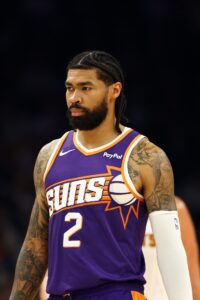 1:58 pm: The Bucks and Suns have expanded the trade, adding the Bulls to the mix, Charania tweets. Richards will head to Chicago instead of Milwaukee with Ousmane Dieng going to Milwaukee.
Richards could see more playing time with the Bulls, considering they dealt Nikola Vucevic this week. Dieng wound up in Chicago earlier this week when the Thunder traded him to Charlotte, which then re-routed him to the Windy City in the Coby White deal.
Dieng appeared in 27 games off the bench for Oklahoma City. He’s making $6.67MM this season and will be a restricted free agent this summer.
11:08 am: The Bucks and Suns have reached an agreement on a trade that will send guard Cole Anthony and wing Amir Coffey to Phoenix in exchange for center Nick Richards and forward Nigel Hayes-Davis, sources tell Shams Charania of ESPN (Twitter link).
The news of the deal comes right on the heels of Charania’s report that the Bucks were informing Giannis Antetokounmpo suitors that the star forward will stay put and that they’re moving onto other trade opportunities.
This deal will probably have a minimal impact in terms of on-court performance but it does impact salary cap sheets for this season.
For the Suns, it’s a major financial boon. Phoenix drops under the luxury tax line by roughly $2.5MM and also creates a $5MM trade exception by shipping out Richards, cap expert Yossi Gozlan tweets. Richards has an expiring contract, as does Hayes-Davis, who is making just over $2MM with no future obligations.
Anthony is making just under $2.67MM this season, while Coffey has a $2.87MM salary. Both are also on expiring deals with matching cap hits of $2,296,274.
According to Phoenix radio host John Gambadoro of Arizona Sports 98.7 (Twitter link), the trade creates a pathway for the Suns to promote two-way player Jamaree Bouyea to their standard roster. Bouyea is averaging 7.0 points in 15.3 minutes per game through 25 appearances.
Phoenix was already carrying 14 players on standard contracts, one less than the maximum, but the trade will give the team more financial flexibility to promote Bouyea and remain below the tax. It remains to be seen whether the Suns will retain both Anthony and Coffey, but they could create another roster opening if they waive one of them.
Anthony has appeared in 35 games off the bench this season, averaging 6.7 points and 3.5 assists in 15.1 minutes per game. Coffey has seen action in 30 games, averaging 2.4 points in 8.8 minutes per contest. Anthony might be the more valuable piece, as he could fill a role as a backup point.
Richards started 34 of 36 games for the Suns last season after being acquired from Phoenix but his role has diminished this season. He’s appeared in 28 games, averaging 3.2 points and 3.3 rebounds in 9.1 minutes. Hayes-Davis has seen even less court time, averaging 1.3 points in 7.2 minutes over 27 games.
While Hayes-Davis seems unlikely to play a major role in Milwaukee and is probably a candidate to be released, Richards could see rotation minutes in the team’s frontcourt.
Giannis Antetokounmpo Rumors: Bucks, Heat, Wolves, Lakers
Although they entertained trade offers for the superstar forward, the Bucks ultimately decided to keep Giannis Antetokounmpo past Thursday’s deadline, pushing a decision on his future into the offseason.
The two-time MVP made an interesting social media post on Thursday afternoon (Twitter link). He wrote, “Legends don’t chase. They attract ” alongside a video clip from “The Wolf of Wall Street” in which Leonardo DiCaprio’s character repeatedly says, “I’m not leaving,” among other obscenities.
Sources close to Antetokounmpo reiterated to Chris Haynes of NBA on Prime (Twitter video link) that the 31-year-old “never requested a trade.”
“Obviously (Antetokounmpo) has been applying pressure over the last couple of years in hopes that the Bucks would turn this roster into a championship (contender),” Haynes said. “He wants to contend for a title for years and years in his prime.
“But right now he’s happy. I was told that he’s committed and focused on getting back healthy from that calf injury. He’s progressing really well, to the point where he might even play in the All-Star game on February 15.”
Here are some more Giannis-related rumors:
- A source tells Barry Jackson of The Miami Herald that the Heat were informed “very late” Wednesday night that Milwaukee would likely be retaining Antetokounmpo beyond the deadline (Twitter links). According to Jackson, Milwaukee considered the Heat’s offer and Miami was willing to “do what it took” to acquire the nine-time All-NBA member, but the Bucks preferred to wait and see what types of packages they could get in the summer. While the Warriors reportedly got the impression earlier this week the Bucks didn’t plan to trade Giannis, that was not was not how the Heat viewed the situation until late Wednesday, Jackson adds.
- One team that was in pursuit of Giannis told Ramona Shelburne of ESPN that Milwaukee never gave a threshold it wanted met in a deal, leaving the unnamed club skeptical that the Bucks ever intended to trade Giannis this week (Twitter video link).
- Antetokounmpo recently made it known he was interested in teaming up with Anthony Edwards on the Timberwolves, team and league sources tell Jon Krawczynski of The Athletic. According to Krawczynski, the Wolves canvassed the league to see what they could get for multiple key rotation players, but talks with the Bucks never reached an advanced stage. Krawczysnki hears that while new owners Marc Lore and Alex Rodriguez were intrigued by the possibility of a Giannis trade, they also weren’t convinced that dealing away Jaden McDaniels, Naz Reid and Joan Beringer would have been a “prudent” decision, given Antetokounmpo’s age and injury history.
- The Lakers intend to make a “hard push” for Antetokounmpo in the summer, sources tell Broderick Turner of The Los Angeles Times. The Lakers will have three first-round picks to trade in the offseason, as opposed to the one they had access to prior to the deadline. Turner hears New York and Miami are Giannis’ preferred landing spots, but the 13-year veteran hasn’t ruled out the Lakers as a possibility.
Pelicans Trade Jose Alvarado To Knicks
9:02 pm: The trade is official, according to the Knicks (Twitter link). New York also acquired the draft rights to Latavious Williams, a 36-year-old forward who is currently playing in Saudi Arabia, tweets Steve Popper of Newsday.
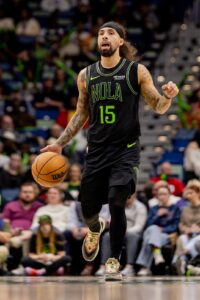 11:33 am: New York native Jose Alvarado is heading home, according to Shams Charania of ESPN, who reports (via Twitter) that the Pelicans have agreed to a deal that will send the fifth-year guard to the Knicks.
According to Ian Begley of SNY.tv (Twitter link), New York will send a pair of second-round picks along with Dalen Terry to New Orleans in exchange for Alvarado. The Pelicans will also receive cash, per Charania (Twitter link).
The two second-rounders headed to New Orleans are 2026 and 2027 selections, adds James L. Edwards of The Athletic (Twitter link). Jake Fischer of The Stein Line (Twitter link) has the full details on those selections — the 2026 pick figures to be Detroit’s second-rounder, while the 2027 pick will be the second-most favorable of four teams’ picks.
Alvarado had been connected to the Knicks in rumors for much of the season leading up to the trade deadline. New York was in the market for backcourt help and the 27-year-old was viewed as a logical fit due in part to his affordable $4.5MM cap hit, which the Knicks could accommodate by sending out Guerschon Yabusele ($5.5MM).
The Pelicans reportedly weren’t interested in taking back Yabusele, whose contract includes a 2026/27 player option, so the Knicks found another taker, making a deal with Chicago for Terry, and will flip the newly acquired forward to New Orleans in this deal — it’s also possible the two moves will be officially completed as a single transaction.
Considered a tenacious defender who brings energy off the bench, Alvarado has averaged 7.9 points, 3.1 assists, and 2.8 rebounds in 21.9 minutes per game across 41 appearances for the Pelicans this season. His shooting line is .418/.363/.833.
Alvarado’s contract features a $4.5MM player option for next season. If he opts out of his deal, the Knicks would have the ability to re-sign him using his Bird rights, but they may prefer for him to opt in and negotiate an extension that begins the following season, since it would help keep the team’s payroll in check for 2026/27.
The Knicks’ need for backcourt depth was heightened on Thursday as the team got word that Miles McBride will require core muscle surgery that could sideline him until the postseason, so Alvarado is well positioned to take on a significant role upon joining his new team.
New York will now have enough breathing room below its second-apron hard cap to sign a 15th man to a minimum-salary contract rather than having to wait until late in the season to do so.
As for the Pelicans, while they were widely viewed as one of the biggest potential sellers at this year’s deadline, they’ve been quiet to this point, having reportedly told teams they wouldn’t be moving prime trade chips like Zion Williamson, Trey Murphy III, and Herbert Jones. While potential suitors believed that stance might change if the offers were strong enough, New Orleans hasn’t been convinced to move anyone besides Alvarado so far.
Warriors Trade Trayce Jackson-Davis To Raptors
February 5: The trade is official, the Warriors confirmed (via Twitter).
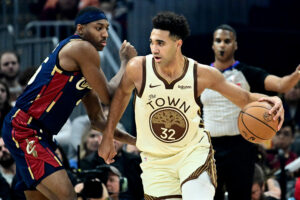 February 4: The Warriors will send backup center Trayce Jackson-Davis to the Raptors in exchange for a 2026 second-round pick that originally belonged to the Lakers, according to ESPN’s Shams Charania (Twitter link).
Jackson-Davis, 25, saw rotation minutes during his first two seasons, but his role has been reduced this year. He has appeared in just 36 games and is averaging 4.2 points and 3.1 rebounds in 11.4 minutes per night.
He makes $2.2MM this season and his contract includes a $2.4MM team option for 2026/27.
Charania notes that Toronto adds some size to its frontcourt by using the space created by trading Ochai Agbaji earlier in the day while managing to stay out of tax territory.
The Raptors explored several options for another big man, including the Pelicans‘ Yves Missi, the Nets‘ Day’Ron Sharpe and the Magic’s Goga Bitadze, tweets Josh Lewenberg of TSN Sports. However, it would have taken a first-round pick to land any of them and the Raptors were comfortable picking up Jackson-Davis while parting with the second-rounder they acquired when they sent Davion Mitchell to Miami a year ago.
The Jackson-Davis trade, coupled with the deal that sends Jonathan Kuminga and Buddy Hield to Atlanta, gives the Warriors enough roster flexibility to convert two-way guard Pat Spencer to a standard deal, notes Jake Fischer of The Stein Line (Twitter link). Spencer is just one game away from reaching his limit of 50 active games.
Clippers Trade Ivica Zubac To Pacers
8:26 pm: The deal is official, the Clippers confirmed in a press release.
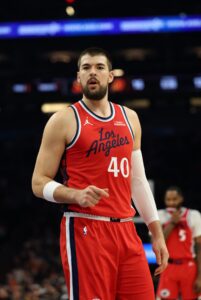 1:13 pm: The Pacers have their new starting center, according to ESPN’s Shams Charania, who reports (via Twitter) that Indiana has reached an agreement to acquire Ivica Zubac from the Clippers.
The full trade, according to reports from Charania (Twitter links), Jake Fischer of The Stein Line (all Twitter links), and Brett Siegel of ClutchPoints (Twitter links), is as follows:
- Pacers to acquire Zubac and Kobe Brown.
- Clippers to acquire Bennedict Mathurin, Isaiah Jackson, the Pacers’ 2026 first-round pick (top-four protected and 10-30 protected), the Pacers’ 2029 first-round pick (unprotected), and the Mavericks’ 2028 second-round pick.
If that 2026 Pacers pick doesn’t land between No. 5 and No. 9, the Clippers will instead get Indiana’s unprotected 2031 first-rounder, according to Fischer.
Ever since losing Myles Turner to the division-rival Bucks in free agency last summer, the Pacers have been in the market for a new starting center, having attempted to temporarily address the position this season with a combination of Jackson, Jay Huff, Micah Potter, Tony Bradley, and James Wiseman.
Indiana was linked to several starting-caliber centers on the trade market, with a focus on players with modest or mid-sized contracts, such as Daniel Gafford, Nic Claxton, Walker Kessler, and Yves Missi. According to NBA insider Chris Haynes (Twitter link), the Pacers made a recent push to acquire Kessler, offering a package that included two unprotected first-round picks, but were rebuffed by the Jazz.
Zubac was the one name continually being linked to the Pacers for much of the season, but it was unclear if the Clippers intended to entertain offers for him after fighting their way back into the postseason picture with a 16-3 stretch. In the wake of the Clippers’ deal sending James Harden to Cleveland earlier this week, Zubac rumors once again began percolating as it became clearer that the organization had an eye toward its future, and Indiana pivoted its attention to the 28-year-old big man.
Zubac is coming off a career year in which he averaged 16.8 points and 12.6 rebounds per game, finished as the Most Improved Player runner-up, made the All-Defensive second team, and placed sixth in Defensive Player of the Year voting.
While he may not receive the same kind of award consideration this season as a member of sub-.500 teams, Zubac has once again been a valuable anchor at the five, averaging 14.4 PPG and 11.0 RPG on 61.3% shooting through 43 games. He also has a team-friendly contract that includes an $18.1MM salary this season, with guaranteed salaries of $19.6MM and $21MM to follow.
Those cap hits will increase slightly as a result of the 5% trade kicker included in Zubac’s contract, adding nearly $800K per year, notes Yossi Gozlan of The Third Apron (Twitter link). Still, his contract should provide strong value to the Pacers over the next two-and-a-half seasons as the team looks to return to contention after a disappointing 2025/26 showing.
Speaking of the Pacers’ ’25/26 performance, they currently have the third-worst record in the NBA at 13-38. They’re narrowly ahead of the Pelicans and Kings in the standings and just one game back of the Nets and Wizards, so their place in the lottery standings could change between now and the end of the season, but right now, there’s a 52.1% chance they’ll land a top-four pick and a 47.9% chance they’ll be between No. 5 and No. 7, per Tankathon.
In other words, the Clippers will have roughly a 50/50 chance – or slightly better, depending where the Pacers finish – of securing a lottery pick in the 5-9 range of what is considered a very strong draft.
That pick could be the crown jewel of the Clippers’ return for Zubac, but even if it ends up in the top four and Indiana keeps it, L.A. will be on track to receive two unprotected Pacers first-rounders down the road and is adding two young players to its roster in Mathurin (23 years old) and Jackson (24 years old).
Mathurin, the sixth overall pick in 2022, has battled thumb and toe issues this season that have limited him to 28 games, but he’s still averaging career highs in points (17.8), rebounds (5.4), and assists (2.3) per contest while shooting 37.2% from beyond the three-point line. The Canadian guard will be eligible for restricted free agency this summer.
Jackson, meanwhile, has started 14 of his 38 games for the Pacers this season, coming off an Achilles tear that limited him to five outings in 2024/25. He has averaged 6.4 PPG and 5.6 RPG in 16.8 MPG.
The fifth-year center has a $7MM salary for next season and a $6.4MM salary for ’27/28. There’s some injury protection language in his deal, notes ESPN’s Bobby Marks (Twitter link), but unless he injures his Achilles again, those salaries will remain guaranteed.
Sixers Promote Dominick Barlow To Standard Contract
The Sixers have promoted forward Dominick Barlow from his two-way deal to a standard contract ahead of their game against the Lakers in Los Angeles on Thursday night, according to Adam Aaronson of PhillyVoice (Twitter link). The team has formally announced the move in a press release.
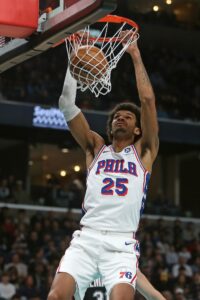 Tony Jones of The Athletic (Twitter links) first reported that the Sixers and Barlow were headed toward an agreement on a multiyear deal, and Aaronson confirms it’s a two-year contract with a team option for 2026/27.
Barlow, 22, signed a two-way contract with Philadelphia last summer after appearing in 96 games across three seasons for San Antonio and Atlanta. He quickly emerged as a key part of the Sixers’ rotation and has since become the team’s starting power forward.
In 40 games (33 starts) for the 76ers so far this season, Barlow has averaged 8.4 points, 5.1 rebounds, 1.3 assists, and 1.0 steal in 24.0 minutes per contest. He’s shooting a career-high 55.0% from the floor and 80.0% from the free throw line.
Barlow was still eligible to appear in up to 10 more games while on his two-way contract, but he wouldn’t have been permitted to play if the Sixers were carrying fewer than 15 players on their standard roster. Even after signing Charles Bassey and Patrick Baldwin Jr. to 10-day deals on Thursday, Philadelphia was still at 14 players, so Barlow will fill the final spot on the roster and will no longer face an active game limit.
That means there’s no room on the roster at this point for another two-way standout, forward Jabari Walker. He has reached his 50-game limit and won’t be eligible to suit up for the Sixers unless he’s converted to a standard deal. However, the team can activate its other two-way player, MarJon Beauchamp, and will do so for Thursday’s game, tweets Kyle Neubeck of PHLY Sports.
According to Derek Bodner of PHLY Sports (Twitter link), Barlow’s team option for next season is worth $3.4MM, which suggests the team is using its mid-level exception to go above the veteran’s minimum in order to sign the forward.
Bulls Trade Ayo Dosunmu To Timberwolves
The Bulls have officially traded guard Ayo Dosunmu to the Timberwolves, the Wolves and Bulls have confirmed in a pair of press releases.
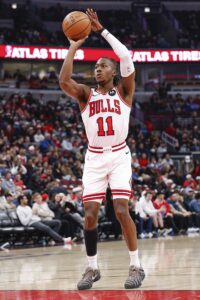 Third-year forward Julian Phillips heads to Minnesota in the deal along with Dosunmu, with the Bulls acquiring 2024 first-round pick Rob Dillingham, third-year forward Leonard Miller, and four second-round picks.
Jon Krawczynski of The Athletic (Twitter link) first reported that the two teams were finalizing a deal involving Dosunmu, while ESPN’s Shams Charania (Twitter links) confirmed that an agreement was in place and provided the full details.
According to Michael Scotto of HoopsHype (Twitter link), the four second-rounders are as follows:
- Either the Nuggets’ or Warriors’ 2026 pick (whichever is least favorable).
- The Cavaliers’ 2027 pick.
- Either the Timberwolves’ or Warriors’ 2031 pick (whichever is most favorable).
- Either the Suns’ or Rockets’ 2032 pick (whichever is most favorable).
The Timberwolves have been on the lookout for a way to upgrade their backcourt for much of the season. Veteran Mike Conley, the starting point guard for most of last season, saw his production fall off significantly, while youngsters like Dillingham and Terrence Shannon Jr. didn’t take the sort of steps forward the team hoped they would. That resulted in Anthony Edwards and Donte DiVincenzo taking on more ball-handling responsibilities.
Although Dosunmu isn’t a true point guard, he’ll give Minnesota another player capable of handling the ball, initiating the offense, and making outside shots. The Chicago native is in the midst of a career year, with averages of 15.0 points, 3.6 assists, and 3.0 rebounds in 26.4 minutes per game and an excellent shooting line of .514/.451/.857 through 45 outings (10 starts).
It’s a disappointing end to Dillingham’s tenure with the Wolves — the club gave up an unprotected 2031 first-round pick and a 2030 pick swap in order to draft him eighth overall in 2024, but he didn’t develop into a reliable rotation player, averaging just 4.0 PPG and 1.9 APG on .398/.346/.657 shooting in 84 regular season appearances (10.0 MPG).
While Dillingham may benefit from a change of scenery, Dosunmu could become a fixture in Minnesota’s backcourt if the team can find a way to lock him up beyond this season. The 26-year-old is on an expiring $7.5MM contract and is eligible until June 30 for an extension worth up to about $52.4MM over three years. If he and the Wolves don’t reach an agreement by then, he’ll reach unrestricted free agency, with Minnesota holding his Bird rights.
It’s worth noting that this move shouldn’t take the Wolves out of the running for Giannis Antetokounmpo, their top trade target, but there’s widespread skepticism that the Bucks star will be moved before the deadline.
As for the Bulls, besides taking a shot on Dillingham, they continue to add to their collection of future draft assets. They’ve now completed or agreed to six separate trades this week and have acquired nine second-rounders in those deals, increasing their total count to 14, tweets ESPN’s Bobby Marks.
Although Dosunmu and Coby White are headed to new NBA homes, Chicago still has a backcourt logjam. Josh Giddey and Tre Jones remain on the roster, with newcomers Jaden Ivey, Collin Sexton, Anfernee Simons, and now Dillingham joining the mix. Still, an unbalanced roster may not be an issue for the Bulls in the short term, given that they appear to be focused on building for the future rather than maximizing their playoff chances this season.
According to K.C. Johnson of the Chicago Sports Network (Twitter link), the Bulls expressed interest in rookie big man Joan Beringer during their conversations with the Wolves, but Minnesota is high on the 19-year-old Frenchman and was unwilling to include him in its offer for Dosunmu.
Chicago will cut into its projected 2026 cap room a little as a result of this deal. While Miller has a $2.4MM team option for 2026/27, Dillingham’s $6.9MM salary is fully guaranteed. The Bulls will have until October 31 to decide whether or not to exercise Dillingham’s $8.8MM team option for the ’27/28 season.
Lakers Trade Vincent, Second-Round Pick To Hawks For Kennard
8:03 pm: The trade is official, the Lakers and Hawks confirmed.
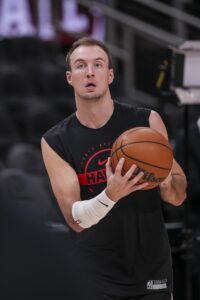 9:40 am: The Lakers and Hawks have agreed to a trade, according to Shams Charania of ESPN (Twitter link), who hears from sources that Atlanta is acquiring guard Gabe Vincent and the Lakers’ 2032 second-round pick from Los Angeles in exchange for sharpshooter Luke Kennard.
Dan Woike of The Athletic first reported (Twitter link) that the Lakers were closing in on a deal sending Vincent to the Hawks.
Finding another shooter was among the Lakers’ priorities heading into the deadline, and they’re able to fill that role with Kennard, who’s connecting at 49.7% from beyond the arc in 46 games this season. Kennard, 29, is also a Duke alum, just like head coach JJ Reddick.
Vincent, 29, wasn’t able to provide the value the Lakers were hoping when they signed him as a free agent in the summer of 2023. Injuries played a role as he was limited to 11 games in his first season in L.A. and has appeared in just 29 this year. He’ll get a fresh start in Atlanta before becoming an unrestricted free agent this summer.
The two players have similar expiring contracts with Kennard at $11MM and Vincent at $11.5MM, so the trade won’t carry any major financial implications, either this season or beyond.
The Lakers parted with their last available second-round pick in the trade, notes Yossi Gozlan of The Third Apron (Twitter link). However, he points out that the $500K they save in the exchange could be useful on the buyout market, since they didn’t have a ton of breathing room below their first-apron hard cap.
The Hawks will create an $11MM traded player exception in the deal, Charania adds (Twitter link). That means they figure to absorb Vincent’s contract into the TPE from last year’s Bogdan Bogdanovic trade — that $13.1MM exception would have expired on Friday, so Atlanta is essentially rolling it over for another year.
The Hawks also agreed to a deal on Wednesday to acquire Buddy Hield from Golden State, and Jake Fischer of The Stein Line hears that they plan to keep both Hield and Vincent on their roster (Twitter link).
Mavericks Send Anthony Davis To Wizards In Three-Team Deal
February 5: The trade has been finalized, the Mavericks and Wizards announced. It was officially completed as a three-team deal, with the Hornets receiving Malaki Branham and the Mavs receiving Tyus Jones. Charlotte confirmed its part of the trade in a press release.
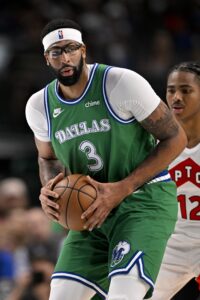 “Anthony Davis is one of the most accomplished players of his generation, and we are thrilled to have him in Washington,” said Wizards general manager Will Dawkins. “Anthony’s championship experience and defensive pedigree bring a new level of opportunity and excitement to this franchise.”
February 4: The Mavericks are trading big man Anthony Davis to the Wizards, according to ESPN’s Shams Charania, who reports (via Twitter) that Jaden Hardy, D’Angelo Russell, and Dante Exum will also head to Washington in the deal.
In return, the Mavericks will receive Khris Middleton, AJ Johnson, Malaki Branham, Marvin Bagley III, two first-round picks, and three second-rounders, sources tell Charania.
Those first-rounders will be a “least favorable” 2026 pick that will almost certainly be the Thunder’s, plus the Warriors’ top-20 protected 2030 pick, per Charania. The second-rounders are Phoenix’s 2026 pick, Chicago’s 2027 pick, and Houston’s 2029 selection.
Davis had been on the trade block in Dallas for much of the season, but there was some doubt about whether a deal would materialize after he suffered a hand injury expected to sideline him for at least most of February, if not beyond that. Rumored suitors like Atlanta and Toronto appeared to back off to some extent, opening the door for a surprise team like the Wizards to make a deal.
While Washington is an unlikely landing spot for a veteran star like Davis, the 13-36 Wizards are clearly pivoting toward being competitive next season, having acquired four-time All-Star Trae Young from Atlanta last month and now pairing him with a 10-time All-Star in Davis.
According to Jake Fischer of The Stein Line, the Wizards would ideally like to use second-year big man Alex Sarr as a “super-sized” and “switchable” power forward and had been seeking another impact frontcourt player to use alongside him. Washington explored a possible deal for Kings center Domantas Sabonis and had considered making a run at Jazz center Walker Kessler in restricted free agency before pulling the trigger on a trade for Davis, Fischer says.
As they did with Young, the Wizards are buying low on Davis amid an injury-plagued season in which he has dealt with several separate health issues and has been limited to 20 appearances. Although the draft-pick haul they’re giving up for AD looks substantial at first glance, the 2026 first-rounder will likely end up at No. 30, while the 2030 selection will turn into a ’30 second-rounder if it lands in the top 20.
Like Young, who has yet to make his Wizards debut as he rests a knee injury, Davis appears unlikely to play much – if at all – during the second half of this season. Washington will owe its 2026 first-round pick to New York if it lands outside the top eight, so the club will likely do all it can to avoid that scenario. Resting its veteran stars should help that cause.
Despite the modest value of the first-round picks changing hands, the Wizards’ package likely appealed to Dallas due to the financial flexibility it will afford the team going forward. Besides moving off Davis’ maximum-salary contract, which will pay him $58.5MM in 2026/27, with a $62.8MM player option for ’27/28, the Mavs will remove Hardy’s $6MM guaranteed salary and Russell’s $6MM player option for ’26/27 from their books.
Besides giving the Mavericks more cap flexibility going forward, the deal will also generate considerable short-term savings, with the Wizards taking advantage of their significant breathing room below the luxury tax line to take on more than $24MM in 2025/26 salary. Dallas had been operating right up against the second tax apron but will move all the way out of apron and tax territory with this move, resulting in $57MM in savings, tweets cap expert Yossi Gozlan.
Most importantly, the trade lines up the Mavs to begin building around star rookie Cooper Flagg. Dallas will have a pair of first-round picks in a strong 2026 draft, including their own selection which is on track to be a lottery pick. And the team has a much cleaner cap sheet to work with moving forward, even with long-term deals for role players like P.J. Washington and Daniel Gafford still on the books.
Still, the return for Davis stands in stark contrast to what they gave up to get him just one year ago. Under former head of basketball operations Nico Harrison, the 32-year-old was the centerpiece of the package the Mavs received for franchise player Luka Doncic. Since making that deal, the franchise has parted ways with Harrison and now done the same with Davis, conceding that it made a major mistake at the 2025 deadline.
Kings Convert Dylan Cardwell To Four-Year Standard Deal
6:24 pm: Ham provides the details of Cardwell’s new contract (Twitter link): $871K for the remainder of 2025/26, $2.15MM (guaranteed) in ’26/27, $2.53MM in ’27/28, and $2.74MM in ’28/29. The final two years are non-guaranteed, Ham confirms, and ’28/29 is a team option.
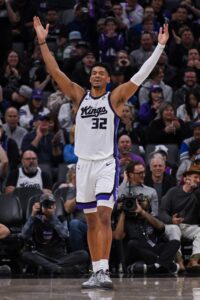 5:43 pm: The Kings have officially promoted Dylan Cardwell from his two-way contract to a multiyear standard deal, the team announced in a press release (Twitter link via James Ham of The Kings Beat).
Cardwell’s new deal covers four seasons and the first two are fully guaranteed, agent Corey Marcum tells Shams Charania of ESPN (Twitter link).
A Georgia native, Cardwell played a fairly limited role in five college seasons at Auburn. The 24-year-old big man went undrafted last June, but quickly agreed to a two-way contract with the Kings.
Despite his modest stats with the Tigers, Cardwell has quickly become a fan favorite in Sacramento, providing a much-needed infusion of energy, enthusiasm, rebounding, and interior defense. He has made 25 appearances as a rookie, averaging 4.7 points, 7.1 rebounds and 1.7 blocks in 20.0 minutes per game.
The Kings opened up two spots on their standard roster when they sent out three players for one in the De’Andre Hunter trade. Charania suggested at the time that Cardwell might be promoted, which Ham later confirmed.
Sacramento technically was under no obligation to convert Cardwell’s contract right after the trade deadline — he has only been active for 31 games, 19 shy of his 50-game limit. Instead of waiting, the Kings decided to reward him early. Cardwell earned praise from GM Scott Perry at the start of the new year.
The Kings now have one standard roster opening and one two-way vacancy in the wake of Cardwell’s promotion.