
Four 2025 NBA Draft Picks Remain Unsigned
As our tracker shows, 55 of the 59 players selected in June’s 2025 draft have either signed their first NBA contracts or are confirmed to be playing overseas for the upcoming season. John Tonje (Jazz) and Amari Williams (Celtics) recently became the latest 2025 draftees to sign with their respective teams, having finalized two-way deals.
That leaves four players – all second-round picks – who remain unsigned. Those players are as follows:
- Mohamed Diawara (Knicks)
- Alex Toohey (Warriors)
- Will Richard (Warriors)
- Jahmai Mashack (Grizzlies)
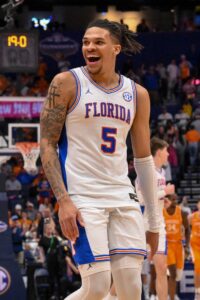 NBA insider Jake Fischer provided an update on Richard today, writing that the former Florida wing is expected to sign with Golden State once Jonathan Kuminga‘s restricted free agency is resolved. Fischer didn’t say whether Richard would be signing a standard contract or a two-way deal, but his wording suggested the former Florida guard is a candidate for a 15-man roster spot.
Signing Richard to a contract that begins at the rookie minimum could help the Warriors manage their cap/tax/apron situation, since he’d only count for about $1.27MM (compared to roughly $2.3MM for a veteran minimum deal).
Fischer didn’t mention Toohey, who was selected four picks ahead of Richard. That doesn’t necessarily mean Toohey isn’t a candidate for a 15-man roster spot — in certain hard-cap scenarios, it could make sense for the Warriors to carry two rookie-minimum players. But it might be a signal that Richard is the better bet for a standard deal, while Toohey could end up on a two-way contract or as a draft-and-stash prospect.
Diawara is in a similar boat to Richard and Toohey, seemingly stuck in limbo while the Knicks mull their options with their remaining roster spots. It looks like the Knicks will have to carry at least one draft-rights player on a rookie minimum contract in order to navigate their own hard cap, and Diawara is one of two leading candidates to fill that spot — 2023 second-rounder James Nnaji is the other.
If Nnaji signs a standard contract or if the Knicks find a way to create enough cap flexibility to fill out their roster with veteran minimum signings, Diawara is probably ticketed for a two-way deal. As a European-born player who was playing overseas prior to be drafted, the 20-year-old forward would typically be a strong draft-and-stash candidate, but his French team, Cholet Basket, announced last month that Diawara was headed to the NBA.
That leaves Mashack, whose next step remains unclear. It’s not uncommon for one or two players selected near the end of an NBA draft to end up as domestic draft-and-stash prospects, signing directly with their teams’ G League affiliates. But Mashack probably deserves better than that after a strong five-game Summer League showing in which he filled up the box score by averaging 9.0 points, 4.4 assists, 4.0 rebounds, 2.0 steals, and 1.2 blocks in 23.7 minutes per contest while making 41.7% of his three-point attempts.
The Grizzlies have a two-way contract slot open alongside PJ Hall and Javon Small, so signing Mashack to fill that opening would make the most sense to me — if that’s the plan, I’m not sure why it hasn’t happened yet.
Heat Notes: Jovic, Larsson, Fontecchio, Dragic
Heat forward Nikola Jovic got off to an excellent start at the EuroBasket tournament in Latvia on Wednesday, as Ira Winderman of The South Florida Sun Sentinel writes. Jovic was Serbia’s leading scorer – with 18 points on 6-of-8 shooting – and was an eye-popping plus-36 in just 16 minutes of action in a blowout victory over Estonia.
As impressive as Jovic was a scorer and shooter (3-of-4 on three-pointers), his passing was perhaps even more noteworthy — he racked up six assists while committing just one turnover. The 22-year-old has averaged 2.2 assists per game in 107 regular season outings through three NBA seasons.
A pair of Jovic’s Heat teammates who are also competing at EuroBasket weren’t as productive in their respective 2025 debuts. Pelle Larsson battled foul trouble and scored just 10 points while missing all four of his three-point tries in Sweden’s loss to Finland on Wednesday. On Thursday, Simone Fontecchio made just 1-of-11 shots from the field and was a minus-11 across 34 minutes in Italy’s nine-point loss to Greece.
We have more on the Heat:
- In a mailbag for The Sun Sentinel, Winderman explores the Heat’s expectations and projected roles for Jovic and Larsson in 2025/26, suggesting that Jovic will likely be a top frontcourt reserve while Larsson would be doing well to show he can be a “quality ninth man.”
- Although former Heat point guard Goran Dragic may one day take on a more formal role with the club, there’s no indication that he’s joining Erik Spoelstra‘s coaching staff at this point, despite social media posts that showed him in attendance at practice, Winderman writes for The Sun Sentinel. For now, it appears Dragic is just informally “looking to pass on knowledge to the next generation,” including rookie point guard Kasparas Jakucionis, Winderman explains.
- With the deadline for teams to use the stretch provision on 2025/26 salaries now less than 24 hours away, Anthony Chiang of the Miami Herald hears from a league source that the Heat are “leaning against” stretching anyone’s salary on Thursday or Friday. A waive-and-stretch move likely would’ve received more serious consideration if Miami hadn’t moved under the luxury tax line by trading Haywood Highsmith to Brooklyn earlier this month.
NBA 2025 Offseason Check-In: New Orleans Pelicans
Hoops Rumors is checking in on the 2025 offseason for all 30 NBA teams, recapping the summer’s free agent signings, trades, draft picks, departures, and more. We’ll take a look at each team’s offseason moves and consider what might still be coming before the regular season begins. Today, we’re focusing on the New Orleans Pelicans.
Free agent signings
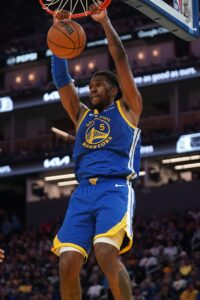 Kevon Looney: Two years, $16,000,000. Second-year team option. Signed using non-taxpayer mid-level exception.
- Jaden Springer: One year, minimum salary. Non-guaranteed (Exhibit 9). Signed using minimum salary exception.
Trades
- Acquired the No. 23 pick in the 2025 draft and the draft rights to Mojave King from the Pacers in exchange for the Pacers’ 2026 first-round pick.
- Note: The Pelicans had acquired the Pacers’ 2026 first-round pick (with top-four protection) in a previous trade; the Pacers got it back in this deal.
- Acquired the draft rights to Derik Queen (No. 13 pick) from the Hawks in exchange for the draft rights to Asa Newell (No. 23 pick) and either the Pelicans’ or Bucks’ 2026 first-round pick (whichever is more favorable).
- Acquired Jordan Poole, Saddiq Bey, and the draft rights to Micah Peavy (No. 40 pick) from the Wizards in a three-team trade in exchange for CJ McCollum (to Wizards), Kelly Olynyk (to Wizards), the Bulls’ 2027 second-round pick (to Wizards), and the draft rights to Mojave King (to Rockets).
Draft picks
- 1-7: Jeremiah Fears
- Signed to rookie scale contract (four years, $34,193,629).
- 1-13: Derik Queen
- Signed to rookie scale contract (four years, $24,355,797).
- 2-40: Micah Peavy
- Signed to four-year, $8,685,386 contract. First two years guaranteed. Third year non-guaranteed. Fourth-year team option.
Two-way signings
- Trey Alexander
- One year, $85,300 partial guarantee (will increase to $318,218 at start of regular season).
- Hunter Dickinson
- One year, $85,300 partial guarantee (will increase to $318,218 at start of regular season).
- Bryce McGowens
- One year, $85,300 partial guarantee (will increase to $318,218 at start of regular season).
Departed/unsigned free agents
- Brandon Boston Jr. (Fenerbahce)
- Keion Brooks Jr. (unsigned)
- Bruce Brown (Nuggets)
- Jamal Cain (Magic)
- Elfrid Payton (unsigned)
- Jeremiah Robinson-Earl (unsigned)
Other roster moves
- Signed Herbert Jones to a three-year, $67,580,892 veteran contract extension that begins in 2027/28. Includes third-year player option.
- Waived Antonio Reeves (non-guaranteed contract).
- Waived Lester Quinones (two-way contract).
Salary cap situation
- Operating over the cap ($154.6MM) and below the luxury tax line ($187.9MM).
- Carrying approximately $183.7MM in salary.
- Hard-capped at $195,945,000.
- Portion of non-taxpayer mid-level exception ($6,104,000) available.
- Full bi-annual exception ($5,134,000) available.
- Three traded player exceptions available (largest worth $13,445,122).
The offseason so far
The future in New Orleans looked bright during David Griffin‘s first year as head of basketball operations in 2019/20. The Pelicans had just acquired a haul of players and draft picks headlined by Brandon Ingram from the Lakers in exchange for Anthony Davis and had lucked into No. 1 overall pick Zion Williamson, who looked like a natural successor to Davis as the club’s franchise player.
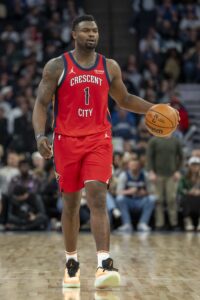 However, injuries to Williamson, Ingram, and a handful of other key Pelicans players consistently derailed the team’s forward momentum. During Griffin’s six seasons on the job, New Orleans posted a winning record just twice and compiled a total of two playoff victories in a pair of brief postseason appearances.
The organization still hasn’t given up on Williamson, who has missed more regular season games (258) during his first six NBA seasons than he has played (214) and faced a lawsuit this spring accusing him of rape and abuse. But Ingram was traded in February, and Griffin was subsequently replaced this spring by former Pistons general manager Joe Dumars.
The decision to hire Dumars raised some eyebrows. The longtime executive was the architect of a Detroit team that advanced to at least the Eastern Conference Finals for six straight years during the 2000s, but the second half of his tenure with the Pistons produced underwhelming results, and it has been a while since he has even been involved in personnel decisions for an NBA team — he worked in the league office for the past three years.
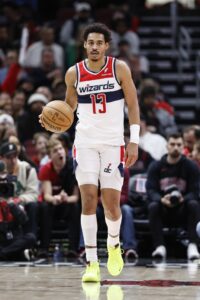
Dumars’ first summer in New Orleans has been a fascinating one. On the surface, many of the moves he has made point toward a soft reset for the Pelicans. The club added a pair of rookies in the draft lottery – Jeremiah Fears at No. 7 and Derik Queen at No. 13 – and got younger in a trade that sent CJ McCollum and Kelly Olynyk to the Wizards in exchange for Jordan Poole, Saddiq Bey, and second-round pick Micah Peavy.
With Dejounte Murray still recovering from a torn Achilles that figures to keep him on the shelf for the start of the season, Herbert Jones and Trey Murphy III coming off shoulder surgeries, and even Bey still making his way back from an ACL tear, there’s a world in which the Pelicans take a patient approach to the 2025/26 campaign, wait for all their key players to get healthy, and evaluate their core players and rookies to see how they all fit together before pushing forward in ’26/27.
But it doesn’t seem like that approach is the one Dumars and the Pelicans have in mind. The price to trade up from No. 23 to No. 13 for Queen was New Orleans’ 2026 first-round pick, which will be the most favorable of the Pelicans’ own first-rounder and the Bucks’ first-rounder — that unprotected pick was sent to Atlanta for the right to draft Queen, leaving New Orleans without a first-round selection for 2026 and strongly suggesting that tanking won’t be a consideration.
If Queen turns into an impact player and that “most favorable” 2026 pick ends up in the mid- to late-teens, the trade would be a coup for Dumars. But it carries remarkable risk, given that New Orleans is coming off a 21-win season and probably won’t have its starting point guard available when the 2025/26 season tips off. In a competitive Western Conference, they’re far from a lock to make the playoffs. And while it doesn’t look like Giannis Antetokounmpo is going anywhere at this point, the Bucks’ pick has real lottery upside too in the event of an Antetokounmpo injury or trade.
Even if the Pelicans are relatively confident another 21-win season isn’t on tap, the 39-win Mavericks just provided a reminder that the flattened lottery odds open the door for a middle-of-the-pack team to claim a top pick — the Pelicans know this first-hand, having jumped from No. 7 in the pre-lottery order to get Williamson in 2019.
The pressure will be on head coach Willie Green to turn things around after a disappointing 2024/25 season. Dumars, who has long been fond of Green and nearly drafted him for the Pistons in 2003, opted not to make a head coaching change immediately after taking the reins. However, if the Pelicans underachieve again in ’25/26, it’s not to hard to imagine Green being the next NBA head coach who finds himself on the hot seat.
In addition to Fears, Queen, Poole, and Bey, the Pelicans’ other notable newcomer this offseason was longtime Warriors center Kevon Looney. While I have some reservations about the Queen and Poole/Bey trades, I liked the Looney signing — he has long been an underrated defender and rebounder, he’s still just 29 years old, and his new two-year, $16MM contract is only guaranteed for one season. He should bring some added stability to the center position after the Pelicans had to rely on rookie Yves Missi as their starter in ’24/25.
Up next
The Pelicans are carrying 14 players on guaranteed contracts for the 2025/26 season, with Jaden Springer signed to a non-guaranteed Exhibit 9 contract. Their three two-way slots have been filled.
 New Orleans has about $4.2MM in breathing room below the luxury tax line, which is more than enough for a 15th man on a minimum-salary contract. While it’s possible the team will leave that spot open to start the season for the sake of flexibility, it probably makes sense for depth purposes to fill it, given that Murray likely won’t be ready to play and a few other players will be managed carefully as they return from major injuries.
Springer may be the leading 15th-man candidate for now, but the Pelicans could bring in a couple more vets on training camp deals to compete for that spot. And since whoever makes the team will likely be on a non-guaranteed contract, New Orleans will have the flexibility to waive that player a month or two into the regular season without paying his full-season salary.
The Pelicans already took care of their top extension candidate this offseason by signing Jones to a three-year, $67.6MM deal. That was a logical move that should pay off, especially if Jones – already one of the NBA’s best defenders – can continue developing and expanding his offensive game.
But that will likely be the last extension the Pelicans sign before the regular season begins. Williamson and Poole will both be eligible to sign new deals, but the club seems extremely unlikely to further invest in the duo at this point, given that they both still have multiple years left on their contracts. Poole has yet to even play a game as a Pelican, while Williamson will, at the very least, need an extended run of good health to warrant another significant commitment from New Orleans.
Deadline Looms For Teams To Stretch 2025/26 Salaries
Friday, August 29 is the last day that an NBA team will be able to waive a player who has a fully or partially guaranteed salary for 2025/26 and stretch that player’s ’25/26 salary across multiple seasons.
[RELATED: Hoops Rumors Glossary: Stretch Provision]
The stretch provision deadline has historically been August 31, and while that’s technically still the case, the current Collective Bargaining Agreement tweaked the wording of the rule. In order to apply the stretch provision to a player’s current-season salary, a team must now ensure the player clears waivers on or before August 31 rather than simply requesting waivers on him by August 31.
The adjusted wording is similar to the CBA language related to the league-wide salary guarantee date in January. In that case, a team must place a player on waivers on or before January 7 in order to have him clear waivers ahead of the league-wide Jan. 10 guarantee date. In the case of the stretch provision rule, a player whose salary is being stretched now must be waived by August 29 at 4:00 pm Central time to ensure he has cleared waivers prior to September 1.
A player who clears waivers between September 1 and the end of the 2025/26 season can still have his cap hit(s) for 2026/27 and subsequent seasons stretched across multiple years, assuming he’s owed guaranteed money beyond this season. But his ’25/26 cap charge would remain unchanged in that scenario, unless he reaches a buyout agreement with his team.
The stretch provision allows teams to gain some short-term relief at the cost of reduced long-term flexibility. It’s used most frequently by teams in the luxury tax who want to lower their projected tax bill (or duck out of tax territory entirely) or by teams who want to create extra cap room to accommodate a specific roster move.
While the stretch provision typically isn’t used all this frequently, it has been deployed this offseason in two very noteworthy instances. The Bucks stretched the two years and $112,583,016 remaining on Damian Lillard‘s contract, while the Suns stretched the two years and $96,915,050 left on Bradley Beal‘s deal after he agreed to a buyout.
Like Beal, Cole Anthony (Grizzlies) and Vasilije Micic (Bucks) agreed to buyouts with their respective clubs and then had the stretch provision applied to their leftover salaries — $11.1MM for Anthony and $2MM for Micic. Both players had just one season of guaranteed salary remaining.
Since the stretch provision allows a team to spread the player’s remaining salary across twice the remaining years on his contract, plus one additional year, the new cap hits for those four players are as follows:
- Lillard (Bucks): $22,516,603 for five seasons (through 2029/30)
- Beal (Suns): $19,383,010 for five seasons (through 2029/30)
- Anthony (Grizzlies): $3,700,000 for three seasons (through 2027/28)
- Micic (Bucks): $666,667 for three seasons (through 2027/28)
The Suns’ moves significantly reduced their projected luxury tax payment and moved them well below the second tax apron, while the Bucks’ and Grizzlies’ moves helped create the cap room necessary for other transactions.
We likely won’t see a flurry of cuts today and tomorrow in order to take advantage of this rule, but the deadline is still worth keeping in mind for the possibilities it will take off the table. Any player on a guaranteed expiring contract who is waived after August 29 without a buyout agreement or a waiver claim will have his remaining salary count entirely against his team’s ’25/26 books.
Decisions On 2026/27 Rookie Scale Team Options
While decisions on player and team options for veteran NBA contracts are typically due in June, the deadline to exercise third- and fourth-year team options for players on rookie scale contracts arrives each fall. This year’s deadline for teams to pick up rookie scale options is October 31, 2025.
All the players whose options will be exercised or declined by Oct. 31 are already under contract for the 2025/26 season. Their teams will have to make a decision on whether they want to lock in those players’ contracts beyond the coming season, picking up or turning down team options for the 2026/27 campaign.
For players who signed their rookie scale contracts in 2023 and have already been in the NBA for two years, teams must decide on fourth-year options for 2026/27. For players who just signed their rookie deals last year and only have one season of NBA experience under their belts, teams will already be faced with a decision on third-year options for ’26/27.
In many cases, these decisions aren’t difficult ones. Rookie scale salaries are affordable enough that it usually makes sense to exercise these team options, even if a player isn’t a key cog on the roster. And for those players who do have a significant role on a team’s roster, the decision is even easier — it’s not as if the Spurs will consider turning down their option on Stephon Castle, for instance.
Still, we’ll wait for a trusted reporter, the NBA, a player (or his agent), or a team itself to confirm that an option is indeed being exercised or declined, and we’ll track that news in this space.
Listed below are all the rookie scale decisions for 2026/27 team options that clubs must make by Oct. 31. This list will be updated through the deadline as teams’ decisions are reported and announced. The salary figures listed here reflect the cap hits for each team.
Here are the NBA’s rookie scale team option decisions for 2026/27 salaries:
Atlanta Hawks
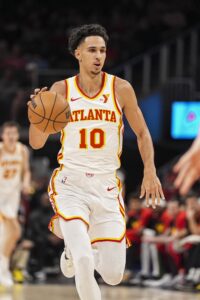
- Zaccharie Risacher (third year, $13,826,040): Exercised
Boston Celtics
- Baylor Scheierman (third year, $2,744,040): Exercised
Brooklyn Nets
- Kobe Bufkin (fourth year, $6,904,203): Waived
- Noah Clowney (fourth year, $5,414,034): Exercised
- Dariq Whitehead (fourth year, $5,366,911): Waived
Charlotte Hornets
- Brandon Miller (fourth year, $15,104,626): Exercised
- Tidjane Salaun (third year, $8,237,880): Exercised
- Nick Smith Jr. (fourth year, $4,890,067): Waived
Chicago Bulls
- Matas Buzelis (third year, $5,715,360): Exercised
Cleveland Cavaliers
- Jaylon Tyson (third year, $3,658,560): Exercised
Dallas Mavericks
- Dereck Lively II (fourth year, $7,239,130): Exercised
- Olivier-Maxence Prosper (fourth year, $5,259,383): Waived
Denver Nuggets
- Julian Strawther (fourth year, $4,826,931): Exercised
- DaRon Holmes (third year, $3,372,120): Exercised
Detroit Pistons
- Ausar Thompson (fourth year, $11,117,925): Exercised
- Ron Holland (third year, $9,069,600): Exercised
- Marcus Sasser (fourth year, $5,198,983): Exercised
Golden State Warriors
- Brandin Podziemski (fourth year, $5,679,458): Exercised
Houston Rockets
- Amen Thompson (fourth year, $12,258,609): Exercised

- Reed Sheppard (third year, $11,108,880): Exercised
Indiana Pacers
- Jarace Walker (fourth year, $8,478,541): Exercised
- Ben Sheppard (fourth year, $5,031,668): Exercised
Los Angeles Clippers
- Kobe Brown (fourth year, $4,792,058): Declined
Los Angeles Lakers
- Dalton Knecht (third year, $4,201,080): Exercised
Memphis Grizzlies
Miami Heat
- Jaime Jaquez Jr. (fourth year, $5,939,141): Exercised
- Kel’el Ware (third year, $4,654,920): Exercised
Milwaukee Bucks
- None
Minnesota Timberwolves
- Rob Dillingham (third year, $6,889,320): Exercised
- Terrence Shannon Jr. (third year, $2,801,640): Exercised
New Orleans Pelicans
- Jordan Hawkins (fourth year, $7,021,895): Exercised
- Yves Missi (third year, $3,512,760): Exercised
New York Knicks
- Pacome Dadiet (third year, $2,983,680): Exercised
Oklahoma City Thunder
- Cason Wallace (fourth year, $7,420,806): Exercised
- Nikola Topic (third year, $5,429,760): Exercised
Orlando Magic
- Anthony Black (fourth year, $10,106,315): Exercised
- Jett Howard (fourth year, $7,337,938): Declined
- Tristan Da Silva (third year, $3,991,200): Exercised
Philadelphia 76ers
- Jared McCain (third year, $4,422,600): Exercised
Phoenix Suns
Portland Trail Blazers
- Scoot Henderson (fourth year, $13,585,523): Exercised
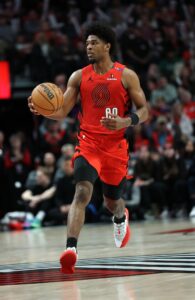
- Donovan Clingan (third year, $7,519,920): Exercised
- Kris Murray (fourth year, $5,315,004): Exercised
Sacramento Kings
- Devin Carter (third year, $5,158,080): Exercised
San Antonio Spurs
- Victor Wembanyama (fourth year, $16,868,246): Exercised
- Stephon Castle (third year, $10,015,920): Exercised
Toronto Raptors
- Gradey Dick (fourth year, $7,131,510): Exercised
- Ja’Kobe Walter (third year, $3,811,800): Exercised
Utah Jazz
- Taylor Hendricks (fourth year, $7,805,900): Exercised
- Keyonte George (fourth year, $6,563,925): Exercised
- Cody Williams (third year, $6,015,600): Exercised
- Brice Sensabaugh (fourth year, $4,862,237): Exercised
- Isaiah Collier (third year, $2,763,960): Exercised
Washington Wizards
- Alex Sarr (third year, $12,370,680): Exercised
- Bilal Coulibaly (fourth year, $9,240,012): Exercised
- Cam Whitmore (fourth year, $5,458,310): Exercised
- Bub Carrington (third year, $4,900,560): Exercised
- AJ Johnson (third year, $3,237,120): Exercised
- Kyshawn George (third year, $3,108,000): Exercised
- Dillon Jones (third year, $2,884,440): Waived
Mavs’ Kyrie Irving On ACL Recovery: ‘I’m Healing Up Great’
Mavericks guard Kyrie Irving, who tore his left ACL in early March, provided a minor update on his recovery process during a live Twitch stream earlier this week, as Grant Afseth of Dallas Hoops Journal relays.
“I was in the gym doing a little bit more,” Irving said (Twitter video link via All Things Mavs). “I won’t tell you exactly what I was doing because it’s all about incremental growth, but I can share with y’all (that) it was some good days in the gym. I’m healing up great. To this date (August 26), this will be five months post-surgery.”
Irving, 33, had taken on increased ball-handling and play-making responsibilities in the wake of the Mavericks’ Luka Doncic trade last season and was averaging 24.7 points, 4.8 rebounds, and 4.6 assists per game on .473/.401/.916 shooting through 50 outings when he went down with the season-ending injury.
Irving became eligible for free agency this offseason when he declined his $43MM option, but he didn’t seriously test the market, opting to sign a new three-year, $118.5MM deal to remain in Dallas.
Reporting back in April indicated that the Mavericks were optimistic about Irving’s chances of returning to the court sometime early in 2026, and president of basketball operations Nico Harrison suggested in July that the star guard is “ahead of schedule” in his rehab process.
However, Harrison has also made it clear that the team won’t rush Irving back to the court, and the nine-time All-Star has preached patience as well, cautioning in July that there’s no guarantee he’ll be 100% healthy before the end of the 2025/26 regular season.
“That doesn’t mean I won’t be back,” Irving said at the time. “It’s just — I don’t want to make any predictions on when I’m going to be back. I just want to be back 150,000% better.”
With Irving sidelined, the Mavs are expected to lean on guards D’Angelo Russell, Brandon Williams, Dante Exum, and Jaden Hardy, while frontcourt players like Anthony Davis and Cooper Flagg likely initiate the offense more frequently too.
Dawn Staley Says She Would’ve Accepted Knicks’ HC Job If Offered
Appearing on the Post Moves podcast with Candace Parker and Aliyah Boston on Wednesday, South Carolina women’s basketball head coach Dawn Staley confirmed she had a formal interview earlier this offseason for the Knicks‘ head coaching job.
“I interviewed for the Knicks,” Staley said (Twitter video link; hat tip to James L. Edwards III of The Athletic). “It was the same interview that everybody else that was in their candidate pool (got). Same thing. … I thought I did pretty well. I was well prepared.”
The Knicks, who also spoke to former Grizzlies coach Taylor Jenkins, Timberwolves assistant Micah Nori, and Pelicans assistant James Borrego about their coaching vacancy after being denied permission to speak to several NBA head coaches already under contract, ultimately hired Mike Brown. But if the team had decided they wanted Staley, she would’ve taken the job, she told Parker and Boston.
“If the Knicks would’ve offered me the job, I would’ve had to do it,” Staley said. “Not just for me, it’s for women. … To break open that. And it’s the New York Knicks, and I’m from Philly, but it’s the freakin’ New York Knicks.”
Staley went on to say that she felt as if she may have hurt her chances by asking too many pointed questions during her interview.
“(One of my questions was) if you hired me as the first female (head) coach in the NBA, how would it impact your daily job?” she said. “Because it would. It would. Because you’re going to be asked questions that you don’t have to be asked if you hire a male coach. There’s going to be the media, there’s going to be all this stuff that you’ll have to deal with that you didn’t have to deal with and don’t have to deal with when you hire a male.
“That got them to thinking. That really got them to thinking about ‘maybe she’s right.’ I felt the energy change after that. So I shot myself in the foot by being…inquisitive, asking all those darn questions.”
Staley, a six-time WNBA All-Star as a player, was the women’s basketball head coach at Temple from 2000-08 and has coached South Carolina since ’08, leading the Gamecocks to three national titles during that time. She was named the Naismith Coach of the Year four times in five seasons from 2020-24.
League sources tell The Athletic that Staley impressed Knicks staffers during her interview but wasn’t considered a finalist for the team’s head coaching opening.
“Would I take any NBA job? No,” Staley added. “I will say this: The NBA has to be ready for a female head coach. You can’t just interview somebody and say, ‘We’re going to hire her.’ I probably lost the job by asking this question.”
Nuggets Notes: Jokic, Kroenke, Newcomers, Akinjo
Nuggets vice chairman and president Josh Kroenke was sitting courtside on Wednesday for Serbia’s first game of EuroBasket 2025 against Estonia, per Edvinas Jablonskis of BasketNews.com. Kroenke is the latest Nuggets executive to visit Nikola Jokic in Riga, Latvia this week, joining vice president of basketball operations Ben Tenzer and executive VP of player personnel Jon Wallace (story via BasketNews.com).
The three-time MVP treated the Nuggets’ contingent to a show, leading the way as Serbia rolled to a 98-64 blowout victory over the Estonians.
Jokic scored just 11 points, but was a +39 in 23 minutes of action and also contributed 10 rebounds and seven assists. He and the Serbians will be back in action on Friday when they face Portugal in the second matchup of the group-play stage of EuroBasket.
Here’s more on the Nuggets:
- John Schuhmann of NBA.com expects Cameron Johnson and Bruce Brown to be defensive upgrades on Michael Porter Jr. and Russell Westbrook for the Nuggets and takes a closer look at some film to explore what sort of impact the newcomers could have. As Schuhmann notes, Denver ranked just 21st in defensive rating last season after placing eighth in 2023/24.
- The Nuggets’ G League affiliate, the Grand Rapids Gold, completed a trade with the Wisconsin Herd, acquiring James Akinjo‘s returning rights in exchange for the rights to Will Richardson and a 2026 first-round pick (Twitter link). The deal suggests that Akinjo, a former Baylor point guard who has played in the G League since going undrafted in 2022, is a good candidate to sign an Exhibit 10 contract with Denver at some point before the season begins.
- In case you missed it, we published our list of 2026 free agents by team on Tuesday. The Nuggets have nine players – six on the standard roster and three two-ways – who could reach free agency next summer.
NBA 2025 Offseason Check-In: Indiana Pacers
Hoops Rumors is checking in on the 2025 offseason for all 30 NBA teams, recapping the summer’s free agent signings, trades, draft picks, departures, and more. We’ll take a look at each team’s offseason moves and consider what might still be coming before the regular season begins. Today, we’re focusing on the Indiana Pacers.
Free agent signings
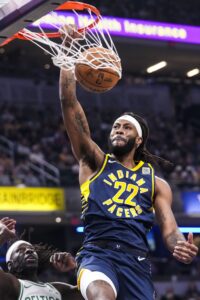 Isaiah Jackson: Three years, $21,000,000. Includes Achilles-related injury protection. Re-signed using Bird rights.
- James Wiseman: Two years, minimum salary. First year partially guaranteed ($1MM). Second-year team option. Signed using minimum salary exception.
Trades
- Acquired their own 2026 first-round pick from the Pelicans in exchange for the No. 23 pick in the 2025 draft and the draft rights to Mojave King.
- Note: The Pelicans had acquired the Pacers’ 2026 first-round pick (with top-four protection) in a previous trade; the Pacers got it back in this deal.
- Acquired the draft rights to Kam Jones (No. 38 pick) from the Spurs in exchange for the Kings’ 2030 second-round pick and cash ($2.5MM).
- Acquired Jay Huff from the Grizzlies in exchange for the Trail Blazers’ 2029 second-round pick and the right to swap their 2031 second-round pick for either the Pacers’ or Heat’s 2031 second-round pick (whichever is least favorable).
Draft picks
- 2-38: Kam Jones
- Signed to four-year, $8,685,386 contract. First year guaranteed. Second year partially guaranteed ($1,075,459). Third year non-guaranteed. Fourth-year team option.
- 2-54: Taelon Peter
- Signed to two-way contract.
Two-way signings
- Quenton Jackson
- One year, $85,300 partial guarantee (will increase to $318,218 at start of regular season).
- Taelon Peter
- Two years, $85,300 partial guarantee (will increase to $318,218 at start of regular season); second year non-guaranteed.
Note: The Pacers carried over RayJ Dennis on a two-way contract from 2024/25.
Departed/unsigned free agents
- Thomas Bryant (unsigned)
- Enrique Freeman (Timberwolves)
- James Johnson (unsigned)
- Myles Turner (Bucks)
Other roster moves
- Exercised team option on Tony Bradley ($2,940,876).
Salary cap situation
- Operating over the cap ($154.6MM) and below the luxury tax line ($187.9MM).
- Carrying approximately $181.8MM in salary.
- Hard-capped at $195,945,000.
- Full non-taxpayer mid-level exception ($14,104,000) available.
- Full bi-annual exception ($5,134,000) available.
The offseason so far
Through 82 regular season contests and 22 of 23 total playoff games, 2024/25 was a dream season for the Pacers, who improbably overcame a 10-15 start to win three playoff series and then went toe-to-toe with the 68-win Thunder in the NBA Finals. But with Indiana looking to seize control of Game 7, star point guard Tyrese Haliburton – who was coming off a calf injury – tore his right Achilles tendon, ending his night, his season, and ultimately the team’s championship hopes.
Haliburton’s injury didn’t invalidate all the memorable performances, comebacks, and series victories that came before it, but it put a serious damper on one of the greatest years in team history — and it will have a lasting impact beyond the spring of 2025.
Even if the Pacers hadn’t won Game 7 in Oklahoma City, getting through that night without any serious injuries likely would’ve given the front office confidence to heavily invest in the roster going forward. Team owner Herb Simon hardly ever pays the luxury tax, but for a team that came within one win of a title and was in position to bring back its entire core, I think he would’ve been comfortable doing so.
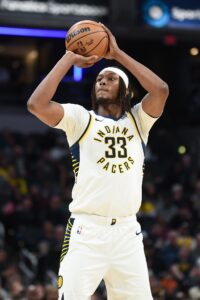 However, with Haliburton ruled out for the entire 2025/26 season, Indiana’s outlook for the coming year isn’t nearly as promising. Without their star player available, the Pacers almost certainly won’t be a serious championship contender next spring. That likely made Simon much more reluctant to become a taxpayer, which – in turn – resulted in the loss of longtime center Myles Turner in free agency to the division-rival Bucks.
To be clear, the Pacers and Turner were very much engaged in contract talks when free agency started, and president of basketball operations Kevin Pritchard later insisted that ownership was willing to go “deep into the tax” to bring back the 29-year-old. Still, I have to think Indiana’s front office wasn’t quite as aggressive as it would have been if Haliburton were healthy.
While there were conflicting reports on exactly what the Pacers’ final offer to Turner was, most of those reports suggested the team hadn’t gone beyond a three-year bid worth about $22-23MM per year. That’s comfortably below what rival Eastern Conference centers like Jarrett Allen ($30MM per year), Jakob Poeltl ($28MM per year), and even Nic Claxton ($24.3MM per year) received on their most recent long-term contracts.
It seemed as if the Pacers were playing hardball with Turner to some extent, recognizing that no rival suitor had $20MM+ in cap room available and perhaps hoping that his price would come in low enough that they could duck under the tax line with a cost-cutting move elsewhere on the roster. Public remarks from Pritchard and general manager Chad Buchanan in the wake of Turner’s departure certainly suggested they weren’t expecting Milwaukee to find a way to open up the cap space necessary to give the big man a four-year contract worth in excess of $27MM annually. Turner reportedly accepted that offer without giving the Pacers a chance to match it.
With the rest of their starters and top reserves already under contract for the 2025/26 season, the Pacers dedicated much of their summer to finding a way to fill the new Turner-shaped hole in their frontcourt. They picked up Tony Bradley‘s non-guaranteed minimum-salary option and re-signed the centers who opened last season second and third on the depth chart behind Turner: Isaiah Jackson and James Wiseman.
Both Jackson and Wiseman suffered early-season Achilles tears of their own last fall, but Indiana clearly still believes both players are capable of providing positive minutes and is confident about how their recoveries are progressing.
I was pretty convinced that Jackson wouldn’t even get a qualifying offer, but the Pacers not only made him a restricted free agent, they re-signed him to a three-year, $21MM contract that will be fully guaranteed as long as he doesn’t have any recurring Achilles issues. As for Wiseman, he got a deal similar to the one he signed last year, a two-year, minimum-salary pact with a partially guaranteed first-year salary and a second-year team option.
Relying on a pair of big men coming off Achilles tears and a veteran journeyman would be risky, so the Pacers were also active on the trade market addressing the center position, acquiring Jay Huff from the Grizzlies in exchange for a future second-round pick and a second-round swap.
Huff is an intriguing pickup. He has put up monster numbers in the G League in recent years, and that production began to translate to the NBA level in 2024/25, as he averaged 6.9 points, 2.0 rebounds, and 0.9 blocks in 11.7 minutes per game across 64 outings for Memphis, with a .515/.405/.786 shooting line. I get the sense that the Pacers have high hopes for Huff, having brought in an assistant coach who worked closely with him at Virginia and reportedly helped convince the Grizzlies to take a shot on him a year ago.
Huff and Jackson will likely be fighting for the top spot on the Pacers’ depth chart at the five, with Wiseman and Bradley possibly vying for a spot on the 15-man regular season roster — neither player has a fully guaranteed deal, so if Jackson and Wiseman look healthy and effective, Bradley could be the odd man out.
Up next
With 15 players on standard contracts and three on two-way deals, the Pacers’ roster looks ready for the regular season, but there’s a little wiggle room there. As noted above, neither Wiseman nor Bradley has a guaranteed contract, so Indiana could waive one of them this fall in order to open up its 15th roster slot. In that scenario, Bradley would be the more likely release candidate, since he’s not owed any guaranteed money, whereas Wiseman has a $1MM partial guarantee.
If the Pacers do open up a roster spot, they wouldn’t be obligated to fill it right away and could create some additional roster and financial flexibility by leaving it open at the start of the season. But it’s also worth keeping an eye on veteran forward James Johnson, who remains unsigned. Buchanan said last month that Johnson hopes to continue his playing career, and Indiana has found room for him on its roster after the start of the season in the past.
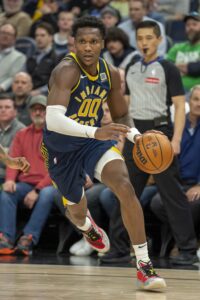 The more pressing items on the Pacers’ to-do list this fall will be a pair of potential contract extensions — Bennedict Mathurin is eligible for a rookie scale extension, while Aaron Nesmith is up for a veteran extension.
Both players will face an October 20 deadline, though Nesmith has two years left on his current deal and would become extension-eligible again starting in July 2026 if he doesn’t sign a new contract at this point. Mathurin, conversely, would be headed for restricted free agency next summer if he enters the season without an extension in place.
Nesmith has a more clearly defined role and more clearly defined extension parameters — the Pacers are limited to offering him up to three years and approximately $63MM on top of the $22MM he’s still owed over the next two seasons. That price seems reasonable for a player who has emerged as one of the club’s most reliable wings — Nesmith has averaged 12.1 points per game and made 42.3% of his three-point attempts over the past two seasons while admirably handling tough defensive assignments.
Mathurin has more upside than Nesmith as a scorer and an all-around offensive weapon, but his fit in Indiana’s Haliburton-led offense hasn’t exactly been seamless, so it’s unclear exactly how hard the team will push to get something done.
On one hand, it may make sense to extend Mathurin now before he takes on a larger role with Haliburton out and potentially has a career year in 2025/26. On the other hand, the Pacers simply may not be convinced he’s part of their long-term plans, especially if he’s seeking a deal north of $20MM per year — they avoided the tax this year, but a lucrative new contract for Mathurin would put them in danger of surpassing that threshold in 2026/27.
Suns Sued By Two Minority Shareholders
A pair of Suns minority shareholders – Andy Kohlberg of Kisco WC Sports and Scott Seldin of Kent Circle Investments – have sued the team in a Delaware Chancery Court, reports Michael McCann of Sportico. The minority owners say in their complaint that they’re “dissatisfied” with the way Suns Capital Group LLC (Mat Ishbia‘s group) has managed the team.
As McCann details, Kisco and Kent Circle claim they haven’t been allowed to view records and financial information that would help them understand how the franchise is being run and how much their shares are worth. They’re demanding a court order that would allow them to look into alleged “potential breaches of a limited liability company agreement, mismanagement of the team and conflicts of interest,” McCainn writes.
According to Gerald Bourguet of PHNX Sports, when Ishbia took over as the Suns’ controlling owner in 2023, he gave the team’s 16 limited partners the opportunity to sell their stakes in the team at the same $4 billion valuation that applied to his majority stake. Fourteen of the 16 partners took that buyout offer, with Kisco and Kent Circle representing the only two holdouts.
Kisco has since sought a buyout from Ishbia’s group; there are conflicting reports on whether Kent Circle has done the same. Bourguet’s report suggests both minority stakeholders have looked to be bought out, while McCann says Kent Circle hasn’t done so but has expressed “growing concerns” about management.
The price that Kisco and Kent Circle are demanding from Suns Capital Group LLC to buy them out is based on a valuation in excess of $6 billion, according to Bourguet. The complaint, per McCann, alleges that Ishbia’s LLC didn’t respond in good faith to Kisco’s efforts to divest its shares by June 1 and instead issued a capital call for June 2 with “no advance notice.” The per-unit valuation conveyed on that call was “strikingly low and bears no relationship to the actual value of the company which is worth billions,” according to the plaintiffs.
In a letter to Kisco and Kent Circle, Suns Capital Group LLC indicated it has no objections to the minority partners finding another buyer for their shares, per Bourguet. However, the majority ownership groups insists that the minority stakeholders have no right to demand Ishbia’s LLC be the one to buy them out at a significantly higher valuation than the 2023 price.
Kisco and Kent Circle, meanwhile, argue in their complaint that the majority ownership group has been putting pressure on and diluting the team’s minority owners, citing “mismanagement and lack of transparency.”
According to Bourguet, the plaintiffs suspect Ishbia’s group of entering into undisclosed side deals and also raised questions about the funding of a practice facility for the WNBA’s Phoenix Mercury. As McCann writes, the complaint states that facility was “seemingly paid for using” team funds but that the minority stakeholders were “provided virtually no information” about how it was funded or the process used to determine its funding.
Attorneys for Suns Capital Group LLC will have the opportunity to respond to the complaint, McCann notes.