
Hoops Rumors Glossary: Exhibit 9 Contract
When NBA teams are in the process of filling out their training camp rosters, the most common form of deal signed by players around the league is the Exhibit 10 contract. An Exhibit 10 contract can be converted into a two-way deal or puts a player in line to earn a bonus if he’s waived and then joins his team’s G League affiliate.
Many of those non-guaranteed training camps also include an Exhibit 9 clause in addition to – or in place of – Exhibit 10 language.
An Exhibit 9 clause protects an NBA team in the event that a player suffers a significant injury in training camp.
If a player on a standard non-guaranteed contract without an Exhibit 9 clause suffered such an injury, his club would be required to pay him his salary until he’s healthy enough to play or until the end of that season, whichever comes first. For example, a player on a non-guaranteed rookie minimum deal who sustained a season-ending ACL tear would be owed his full $1,272,870 salary.
If the injured player’s contract includes Exhibit 9 language, however, his team could waive him and only be on the hook for a one-time payment of $15K. That amount increased from $6K when the NBA completed its latest Collective Bargaining Agreement.
An Exhibit 9 deal, which is non-guaranteed and doesn’t count against the salary cap until the start of the regular season, can only be a one-year, minimum-salary contract. A team can carry up to six players on Exhibit 9 deals, but can’t sign a player to such a contract unless it has at least 14 players already under contract (not including two-way deals).
In most cases, if a team plans to have a player on a non-guaranteed contract participate in training camp and/or the preseason, his contract will include an Exhibit 9 clause in order to limit the club’s liability.
If a player signs a contract that includes Exhibit 10 language but not an Exhibit 9 clause, it’s usually a signal that he’s just being added for G League rights/bonus purposes and won’t actually be participating in training camp with his team. Conversely, an Exhibit 9 contract that doesn’t include Exhibit 10 language suggests the player will probably be taking part in camp but may not be a candidate to join his team’s G League affiliate if he’s waived.
So far this offseason, we’ve confirmed the contract details on a dozen Exhibit 10 contracts that have been officially signed and all 12 of them also include an Exhibit 9 clause. At least one contract – the Suns‘ deal with Jared Butler – is an Exhibit 9, but not an Exhibit 10.
An Exhibit 9 contract that also includes Exhibit 10 language can be converted into a two-way deal. In that scenario, the Exhibit 9 clause would become null and void, so the team would no longer have injury protection.
In the event that a player with Exhibit 9 language in his contract makes his team’s regular season roster, his deal would be converted to a standard non-guaranteed contract. The Exhibit 9 protection wouldn’t carry over into the regular season.
Note: This is a Hoops Rumors Glossary entry. Our glossary posts will explain specific rules relating to trades, free agency, or other aspects of the NBA’s Collective Bargaining Agreement. Larry Coon’s Salary Cap FAQ was used in the creation of this post.
Earlier version of this article were published in 2014 and 2023.
Pelicans Sign Jaden Springer
2:47 pm: Springer’s contract is a non-guaranteed Exhibit 9 deal, according to Michael Scotto of HoopsHype, who tweets that the guard will compete for a roster spot in training camp.
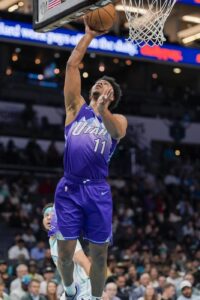 7:22 am: The Pelicans have signed free agent guard Jaden Springer, the team announced in a press release.
The No. 28 pick in the 2021 draft, Springer played a limited role in Philadelphia across two-and-a-half seasons before being sent to Boston at the 2024 trade deadline. He spent roughly a full calendar year with the Celtics, then was rerouted to Houston in a salary-dump deal in February 2025.
After being cut by Houston, Springer signed a 10-day deal with the Jazz in February and agreed to a two-year contract with the team in March following that initial 10-day audition. However, he was waived by Utah last week before his minimum salary for the 2025/26 season could become partially guaranteed.
Springer, who is known more for his perimeter defense than his offensive game, has career averages of 2.9 points and 1.4 rebounds in 8.8 minutes per contest across 110 regular season outings. He played a significant role at the G League level during his first two years with the 76ers, but has only made two appearances in the NBAGL since the start of the 2023/24 season.
Details of the Pelicans’ deal with Springer aren’t yet known — it’s a pretty safe bet that it will be a minimum-salary contract, but it’s unclear whether or not it will include guaranteed money.
For what it’s worth, New Orleans has 14 players on standard guaranteed contracts and has enough breathing room below the luxury tax line to carry a 15th man into the regular season, so there could be a path for Springer to make the team this fall. Because he has four years of NBA experience, he’s no longer eligible for a two-way deal.
Jonathan Kuminga Rumors: Warriors, QO, Suns, Kings
Jonathan Kuminga has been unwilling to accept a two-year, $45MM offer from the Warriors that includes a second-year team option, Sam Amick of The Athletic writes, confirming reporting from ESPN. Amick also confirms that the restricted free agent forward has signaled an increased willingness to accept his one-year, $8MM qualifying offer.
Recognizing that it wouldn’t make a ton of financial sense for Kuminga to take the qualifying offer, Golden State is likely hoping that stance is a bluff, according to Amick, who says the Warriors’ “Plan A” is to convince the 22-year-old to re-sign on a short-term deal and then revisit trade options prior to February’s deadline, when it would be easier to move him.
[RELATED: Hoops Rumors Glossary: Base Year Compensation]
The Suns are reportedly willing to offer Kuminga $90MM over four years, but sources tell Amick that sign-and-trade talks between Phoenix and Golden State haven’t “progressed in any serious manner,” with the Warriors not showing any real interest in the sort of package the Suns is offering. Marc J. Spears of ESPN previously mentioned Royce O’Neale, Nick Richards, and second-round picks as the primary assets Phoenix is willing to put on the table.
While the Kings have reportedly offered a package that includes Dario Saric, Devin Carter, and draft capital (reportedly multiple second-round picks or a protected first-rounder), they’ve also proposed a deal that would involve Malik Monk and a 2030 first-round pick, with Kuminga getting a three-year, $63MM contract, Amick reports. In that scenario, Amick explains, the 2030 pick would be lottery-protected and would turn into the least favorable of the Kings’ and Spurs’ 2031 first-rounders if it doesn’t convey in ’30.
The Warriors have insisted the first-round pick be unprotected, per Amick, which has been a sticking point. Additionally, other reports – including one from Matt George of Locked on Kings (YouTube link) – have indicated that Golden State doesn’t have much real interest in Monk either. Acquiring Monk without sending out any additional salary beyond Kuminga would hard-cap the Warriors at the first tax apron without the flexibility to fill out the rest of their roster, barring cost-cutting moves.
Here are a few more items of interest related to the Kuminga situation:
- The Kings like the fact that Kuminga could be slotted in at the power forward position, allowing Keegan Murray to move to his preferred small forward spot, Amick writes, adding that Sacramento’s three-year, $63MM offer is designed to ensure the team avoids surpassing the luxury tax line this season.
- Noting that possible Warriors free agent additions like Al Horford and De’Anthony Melton are in limbo while the team seeks resolution on Kuminga, Amick adds Gary Payton II to that list, suggesting a return to Golden State remains in play for the veteran guard.
- While there has been speculation that the Kings would trade DeMar DeRozan if they acquire Kuminga, Matt George of Locked on Kings (YouTube link) says everything he’s heard suggests the front office isn’t eager to move DeRozan and would want to hang onto him even if Kuminga ends up in Sacramento. “Every single time I’ve inquired about the Kings moving on from DeMar DeRozan, I’ve been met with a pretty definitive ‘no, the Kings aren’t looking to trade him,'” George said. “But if they were to go out and get Jonathan Kuminga – which I still believe is unlikely at this point – they would ask DeRozan to come off the bench.”
- Grant Afseth of FastbreakJournal.com hears from sources that a two-year, $48MM deal that includes a player option is one framework that has been floated in talks between Kuminga and the Warriors. The report doesn’t make it clear which side has “floated” that idea (presumably it’s coming from Kuminga’s camp) or whether the forward would insist on retaining his implicit no-trade clause in that scenario.
JaVale McGee Signs With Illawarra Hawks
Veteran NBA center JaVale McGee has reached an agreement on a one-year deal with the Illawara Hawks of Australia’s National Basketball League, sources tell Olgun Uluc of ESPN.com. The team has officially confirmed the deal (Twitter link).
McGee, 37, appeared in 909 NBA regular season games from 2008-24, spending time with nine different teams across 16 seasons in the league. He’s a three-time NBA champion, having won titles with the Warriors in 2017 and 2018 and the Lakers in 2020, and also won gold with Team USA at the Tokyo Olympics in 2021.
McGee last played in the NBA during the 2023/24 season, when he averaged 4.0 points and 2.7 rebounds in 7.4 minutes per game across 46 appearances off the bench for the Kings. The big man didn’t catch on with another NBA team for ’24/25 and eventually signed joined Vaqueros de Bayamón. He averaged 17.1 points and 9.2 rebounds per game for the Puerto Rican club, Uluc notes.
According to Uluc, longtime Illawara center Sam Froling is in the process of recovering from an Achilles injury, so the Hawks were in need of frontcourt depth for the coming season. Illawara is Australia’s reigning champion, having defeated Melbourne United in the 2025 NBL Finals.
Timberwolves Expected To Waive Jesse Edwards
After reaching an agreement to sign forward Enrique Freeman to a two-way contract, the Timberwolves are expected to waive center Jesse Edwards from his own two-way deal, per Jon Krawczynski of The Athletic (Twitter link).
The Wolves don’t need to cut Edwards in order to make room on the roster for Freeman, so it’s not clear if the move will happen right away or later in the offseason. But after Minnesota added a pair of rookie big men in Joan Beringer and Rocco Zikarsky in this year’s draft, Edwards no longer appears to be in the team’s plans going forward, as Krawczynski explains.
Waiving Edwards would also create a two-way opening for Tristen Newton, a 2024 second-round pick who still has a qualifying offer on the table from the Wolves. Zikarsky and Freeman will occupy the club’s other two-way slots.
A Dutch-born seven-footer who played his college ball at Syracuse and West Virginia, Edwards joined the Timberwolves on a two-way deal last July after going undrafted. The 25-year-old appeared in just two NBA games, but played a major role for the Iowa Wolves in the G League, averaging 11.9 points, 7.6 rebounds, and 1.9 blocks in 25.1 minutes per game across 34 total outings.
Edwards was tendered a two-way qualifying offer in June and accepted it almost immediately. By signing that QO, he secured a partial guarantee worth $85,300, which won’t count against Minnesota’s cap.
Nets, Ricky Council Agree To One-Year Deal
After being waived last week by the Sixers, Ricky Council IV is heading to another Atlantic team, according to Shams Charania of ESPN (Twitter link), who hears from agent Adie von Gontard that the free agent swingman has a one-year agreement in place with the Nets.
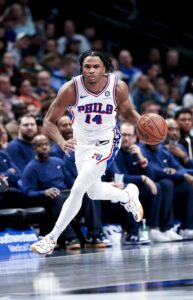 An undrafted free agent out of Arkansas in 2023, Council spent his first two professional seasons with the Sixers, appearing in 105 games during that time, including a team-high 73 in 2024/25.
While the 6’6″ wing showed promise as a rookie, his production dropped off as he took an increased role in his second year. Council averaged 7.3 points, 2.9 rebounds, and 1.3 assists in 17.1 minutes per game last season, with an underwhelming shooting line of just .382/.258/.804.
The rebuilding Nets are in a better position to take a shot on Council, who will turn 24 on Sunday, than the win-now Sixers, who leaned on him so heavily last season due in large part to a series of injuries affecting starters and rotation players.
While the details of Council’s contract agreement aren’t yet known, it figures to be a minimum-salary deal, so it could be completed later in the offseason without cutting into Brooklyn’s cap room. I also wouldn’t expect it to be guaranteed, though that hasn’t been confirmed.
Hoops Rumors Chat Transcript: RFA Edition
Hoops Rumors hosted a live chat today at 1:00 pm Central time (2:00 pm Eastern), focusing on restricted free agency and the fate of players like Jonathan Kuminga, Josh Giddey, Quentin Grimes, and Cam Thomas.
Hoops Rumors Glossary: Minimum Salary Floor
The NBA’s salary cap primarily serves as a way to restrict the amount a team can invest in player salaries in a given year. However, because the league has a soft cap rather than a hard cap, there’s technically no specific figure that clubs are prohibited from exceeding once they go over the cap to re-sign players. As long as a team doesn’t use certain exceptions or acquire a player via sign-and-trade, that team doesn’t face a hard cap.
There is, however, a specific threshold on the lower end that teams must meet in each NBA season. The league’s minimum salary floor requires a club to spend at least 90% of the salary cap on player salaries. For instance, with the 2025/26 cap set at $154,647,000, the salary floor for this season is $139,182,000.
For the purposes of calculating whether a team has reached the minimum salary threshold, cap holds and international buyouts aren’t considered, but players who suffered career-ending injuries or illnesses are included in the count, even if they’ve since been removed from the club’s cap.
Under the NBA’s previous Collective Bargaining Agreement, the penalties levied against a team whose salary was below the minimum floor at the end of the season weren’t very harsh — the franchise was simply required to make up the shortfall by paying the difference to its players.
However, the current Collective Bargaining Agreement has made those penalties for teams below the minimum salary floor significantly more punitive.
A team is now required to reach the minimum salary floor by the start of the regular season, rather than the end of the regular season. A team whose salary is below the minimum floor at the start of the regular season won’t receive a share of the end-of-season luxury tax payouts.
Additionally, a team whose salary is below the minimum floor at the start of the season will have a cap hold added to its salary in order to reach the minimum floor. For instance, a team with a $134,182,000 salary on opening night in 2025/26 would have a $5MM cap hold added to its salary to reach the $139,182,000 floor and would be unable to immediately access that $5MM of cap room (that “frozen” room could eventually be unfrozen if the team increases its salary above the minimum floor).
At the start of the regular season, a team is assigned an “MTS threshold” figure, which is the lesser of the minimum salary floor or the team’s salary as of opening night. A team that dips below its “MTS threshold” at any time during the regular season would have until the end of the next day to get back above that threshold.
This happened to the Pistons during the 2024/25 season — they briefly dropped below the minimum salary floor when they waived Paul Reed‘s partially guaranteed $8MM contract in December and were required to get back above the floor by the end of the next day. They did so by signing Javante McCoy to a contract worth well above his minimum a little over 24 hours later.
A team that begins the season below the floor cannot reduce the shortfall amount it pays the NBA by spending on player salaries during the season. For example, a team that starts the season $5MM below the floor would pay the league $5MM at that time and wouldn’t recoup that money even if it moves above the floor during the season.
However, if that team’s salary ends up more than $5MM below the floor by the end of the season (ie. as a result of likely incentives not being earned), the club would owe the league an additional payment on top of that initial $5MM.
While the previous CBA called for a team that finished the season below the floor to pay the shortfall to its own players, the shortfall money is now sent to the NBA, which then redirects it to all players. That shortfall money will generally be disbursed to each player in the league in proportion to his salary for that season.
Based on the changes in the current CBA, it’s unlikely that we’ll see any team open a regular season below the minimum salary floor anytime soon — all of the incentives that teams had to remain below the floor into the season have been eliminated. A team operating below the floor on opening night wouldn’t be able to access all of its cap room, would forfeit an end-of-season tax payment, and wouldn’t even be able to award its shortfall amount exclusively to its own players.
The Nets are currently the only NBA team operating below the minimum salary floor for 2025/26 — it’s a safe bet they’ll rectify that sometime before the start of the season this October.
Note: This is a Hoops Rumors Glossary entry. Our glossary posts will explain specific rules relating to trades, free agency, or other aspects of the NBA’s Collective Bargaining Agreement. Information from ESPN’s Bobby Marks and Larry Coon’s Salary Cap FAQ was used in the creation of this post.
Earlier versions of this post were published in past years.
Signed Second-Round Picks Now Count Against Cap
Between July 1 and July 30 of each NBA league year, a player signed using the second-round pick exception doesn’t count toward his team’s cap, but that changes as of July 31. Beginning on Thursday, each of the second-rounders signed using that exception will begin carrying 2025/26 cap hits.
[RELATED: 2025 NBA Draft Pick Signings]
The effect this will have on teams around the league is negligible. The only club still operating below the cap is Brooklyn, but the Nets didn’t make any second-round picks in this year’s draft and haven’t signed any second-rounders that were stashed from previous drafts, so this change won’t reduce their cap room at all.
The Nets are far from the only NBA team that hasn’t signed a second-round pick to a standard contract this offseason. In fact, only 11 of the league’s 30 clubs have done so.
The Suns, Magic, Hornets (two picks), Sixers, Lakers, Pistons, and Pacers made the top eight selections of the 2025 second round and have signed those players to standard deals, while the Pelicans (No. 40 pick Micah Peavy), Kings (No. 42 pick Maxime Raynaud), Cavaliers (No. 49 pick Tyrese Proctor), and Hawks (2024’s No. 43 pick Nikola Djurisic) have joined them. The rest of this year’s second-rounders are either still unsigned, will play overseas, or agreed to two-way contracts.
None of those 11 teams surpassed an apron threshold as a result of their second-rounders’ new cap hits. For example, the Cavs would be well over the second apron with or without Proctor on their books.
Since none of those teams will see their ability to make other roster moves affected by the new cap charges, this is really more of a housekeeping note than anything.
And-Ones: Hollis-Jefferson, LeBron, Sophomores, G. Arenas
After recently going viral on NBA Twitter for a tweet in which he made his case for an NBA roster spot, veteran forward Rondae Hollis-Jefferson spoke to Cyro Asseo of HoopsHype about his quest to get back into the league.
“I feel like, given the time I was in the NBA, I think it was very important for me to self-reflect and think about all the things that I could have done differently that kind of shaped me into the person I am today,” Hollis-Jefferson said. “I was just sitting there the other day thinking about it. I was thinking about it all, man. Just where I’m at, how far I’ve come, the growth, the experiences, everything that I’ve been through.
“… It was one of those days where your wheels are turning. And I said, man, I should be in the NBA, dude. I know everyone knows how hard I work, how much I care about basketball, but that’s really where it stemmed from.”
A first-round pick in 2015, Hollis-Jefferson appeared in 305 regular season games for three teams from 2015-21. While he has been out of the NBA for four years, he has continued to compete in professional leagues around the world, spending time in Turkey, Puerto Rico, South Korea, the Philippines, and Lebanon.
Still just 30 years old, Hollis-Jefferson says a desire to be closer to home is a big part of the reason why he’d love to make it back to the NBA.
“Just wanting to be on that big stage and really, really wanting to be closer to home, to be closest to my kids,” he said. “It’s one thing for them to take a max five-hour flight to, say, California, versus a 20-hour travel day to Asia or somewhere else.”
Here are more odds and ends from around the basketball world:
- Despite some speculation that a recent meeting between LeBron James, his business partner Maverick Carter, and Nikola Jokic‘s agent Misko Raznatovic was a recruiting trip, they were actually discussing plans for an international basketball league that is being spearheaded by Carter, multiple sources tell Ben Horney, Daniel Roberts, and Alex Schiffer of Front Office Sports.
- Jeremy Woo of ESPN.com identifies the 10 most interesting second-year NBA players he’ll be watching in 2025/26. Woo’s list includes first-year standouts, like reigning Rookie of the Year Stephon Castle, players recovering from major injuries, such as Thunder guard Nikola Topic and Sixers guard Jared McCain, and youngsters who will be in line for major role increases as sophomores, including Rockets guard Reed Sheppard.
- Former NBA All-Star Gilbert Arenas was among six people arrested on Wednesday on suspicion of hosting illegal high-stakes poker games at a mansion in Los Angeles owned by Arenas, according to a report from The Associated Press. The press release from the U.S. Attorney’s Office detailing the specifics of the case can be found right here.
- A man has been found guilty for second-degree murder in the killing of former NBA forward Adreian Payne, per Silas Morgan and Cristobal Reyes of The Orlando Sentinel (susbcription required). Lawrence Alexander Dority, who shot and killed Payne in May 2022, claimed that he thought the 31-year-old was reaching for a gun and cited self-defense, but Orange County Sheriff’s Office investigators concluded Payne didn’t have a weapon on him and that he didn’t pose a threat to Dority, who is scheduled to be sentenced on August 29.