
Wizards Sign Kira Lewis, Jaylen Nowell, Leaky Black
SEPTEMBER 30: Over a month after agreeing to terms with them, the Wizards have officially signed Lewis, Nowell, and Black, having listed all three players as part of their 21-man training camp roster.
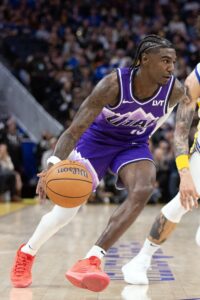 AUGUST 28: The Wizards have reached contract agreements with free agents Kira Lewis, Jaylen Nowell, and Leaky Black, league sources tell Josh Robbins and Shams Charania of The Athletic (Twitter link).
According to Robbins and Charania, all three players will sign Exhibit 10 contracts with Washington and will be given an opportunity to compete in training camp for regular season roster spots.
Lewis, 23, was the 13th overall pick in the 2020 draft, but only appeared in 131 games across his first four NBA seasons due in large part to injuries, including a torn ACL he suffered during the 2021/22 season. The 6’1″ guard has averaged 5.2 points and 1.8 assists in 13.3 minutes per game for the Pelicans, Raptors, and Jazz. Last season, he was traded three times – from New Orleans to Indiana to Toronto to Utah – before reaching unrestricted free agency when the Jazz declined to issue a qualifying offer.
Nowell, a 6’4″ shooting guard, spent his first four NBA seasons in Minnesota from 2019-23, averaging 9.1 points per game on .447/.322/.798 shooting in 184 appearances for the Timberwolves. Despite showing promise as a scorer, Nowell was unable to find a regular NBA job last season — he was waived by Sacramento ahead of opening night, then signed two 10-day contracts apiece with the Grizzlies and Pistons during the season. The 25-year-old spend most of the 2023/24 campaign with the Stockton Kings in the G League.
Black, 25, spent his rookie season with the Hornets after going undrafted out of UNC in 2023. The 6’6″ forward saw limited action in 26 NBA games while on a two-way contract with Charlotte. He played a larger role for the Greensboro Swarm in the NBAGL, posting averages of 7.1 PPG, 6.2 RPG, and 2.1 APG in 24.8 MPG across 25 total Showcase Cup and regular season outings. His two-way deal covered two seasons, but he was waived by the Hornets about four weeks ago.
Exhibit 10 contracts allow players to earn bonuses worth up to $77.5K if they’re waived by their NBA teams and then spend at least 60 days with the club’s G League affiliate, so it’s possible Lewis, Nowell, and/or Black will end up playing for the Capital City Go-Go. Exhibit 10 deals can also be converted to two-way contracts prior to opening night, but Lewis and Nowell have more than three years of NBA service and are therefore ineligible to be two-way players.
The Wizards currently have 16 players on standard contracts (15 guaranteed), with a pair on two-way deals. While Black figures to be in the mix for the team’s open two-way slot, it will be an uphill battle for Lewis or Nowell to make the standard regular season roster unless Washington intends to trade or waive a player with a guaranteed contract.
Amir Johnson Reportedly Joining Clippers’ Staff
Former NBA big man Amir Johnson is joining the Clippers‘ coaching staff under head coach Tyronn Lue in a player development role, according to Law Murray of The Athletic (Twitter link).
A 14-year veteran, Johnson appeared in a total of 870 NBA regular season games for the Pistons, Raptors, Celtics, and Sixers from 2005-19. The 37-year-old averaged 7.0 points, 5.4 rebounds, and 1.0 block in 21.1 minutes per night over the course of his career
When his NBA opportunities dried up, Johnson caught on with the G League Ignite, first as a player and veteran mentor for the team’s young prospects, then as an assistant coach in 2023/24.
As Murray observes, current Clippers assistant Jay Larranaga was a member of the Celtics’ staff during Johnson’s two seasons in Boston from 2015-17. Larranaga has worked with the Clippers’ big men since 2021.
Johnson, who was with the Clippers in Las Vegas at Summer League last month, figures to supplement Larranaga’s work with the bigs in his new role with the organization.
Longest-Tenured NBA GMs/Presidents
NBA teams don’t replace their top front office decision-makers as often as they swap out their head coaches, but it’s still an achievement to spend more than five seasons as a team’s head of basketball operations. Currently, only a third of the league’s top executives (10 of 30) can make that claim, with another four set to enter their sixth season in 2024/25.
Although only one person holds a team’s head coaching job, that same team might carry a variety of front office executives with titles like general manager, president of basketball operations, or executive VP of basketball operations. In some cases, it’s not always which clear which executive should be considered the club’s head of basketball operations, or which one has the ultimate final say on roster decisions. That distinction becomes even more nebulous when taking into account team ownership.
For our list of the longest-tenured GMs/presidents in the NBA, we’ve done our best to identify the top exec in each front office, but if a situation isn’t entirely clear-cut, we’ve made a note below.
One team whose exact hierarchy is unclear is the Spurs. Head coach Gregg Popovich has long held the title of president of basketball operations, though it’s a safe bet he isn’t overly involved in day-to-day front office operations. While general manager Brian Wright and CEO RC Buford are also believed to have significant voices in personnel decisions, we’re considering Popovich to be the head of basketball operations in San Antonio based on his title, meaning he tops the list, narrowly edging out Heat president Pat Riley.
Here’s the list of the NBA’s longest-tenured heads of basketball operations, along with their respective titles and the dates they were hired or promoted:
- Gregg Popovich, Spurs (president): May 31, 1994
- Brian Wright has been the Spurs’ general manager since July 2019 and is believed to lead most front office business, but Popovich’s title indicates he’s above Wright in the basketball operations hierarchy.
- Brian Wright has been the Spurs’ general manager since July 2019 and is believed to lead most front office business, but Popovich’s title indicates he’s above Wright in the basketball operations hierarchy.
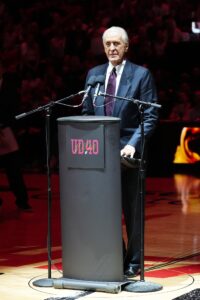
- Pat Riley, Heat (president): September 2, 1995
- Sam Presti, Thunder (GM/executive VP): June 7, 2007
- Masai Ujiri, Raptors (president): May 31, 2013
- Sean Marks, Nets (GM): February 18, 2016
- Kevin Pritchard, Pacers (president): May 1, 2017
- Jeff Weltman, Magic (president): May 22, 2017
- Jon Horst, Bucks (GM): June 16, 2017
- Koby Altman, Cavaliers (president): June 19, 2017
- Lawrence Frank, Clippers (president): August 4, 2017
- Rob Pelinka, Lakers (GM/VP): April 9, 2019
- Pelinka has been the Lakers’ GM since February 2017, but was below Magic Johnson in the front office hierarchy until Johnson resigned on April 9, 2019.
- James Jones, Suns (president): April 11, 2019
- Jones began serving as the Suns’ co-interim GM alongside Trevor Bukstein in October 2018, but was named the lone, permanent head of basketball operations on April 11, 2019.
- Zach Kleiman, Grizzlies (executive VP): April 11, 2019
- David Griffin, Pelicans (executive VP): April 17, 2019
- Leon Rose, Knicks (president): March 2, 2020
- Arturas Karnisovas, Bulls (executive VP): April 13, 2020
- Monte McNair, Kings (GM): September 17, 2020
- Rafael Stone, Rockets (GM): October 15, 2020
- Daryl Morey, Sixers (president): November 2, 2020
- Brad Stevens, Celtics (president): June 2, 2021
- Nico Harrison, Mavericks (GM/president): June 28, 2021
- Joe Cronin, Trail Blazers (GM): December 3, 2021
- Cronin assumed the job on an interim basis on December 3, 2021. He was named the permanent GM on May 10, 2022.
- Danny Ainge, Jazz (CEO/alternate governor): December 15, 2021
- Tim Connelly, Timberwolves (president): May 23, 2022
- Calvin Booth, Nuggets (GM): May 23, 2022
- Landry Fields, Hawks (GM): December 21, 2022
- Michael Winger, Wizards (president): May 25, 2023
- Mike Dunleavy Jr., Warriors (GM): June 16, 2023
- Jeff Peterson, Hornets (executive VP): March 5, 2024
- Trajan Langdon, Pistons (president): May 31, 2024
Information from Basketball-Reference was used in the creation of this post.
NBA 2024 Offseason Check-In: New Orleans Pelicans
Hoops Rumors is checking in on the 2024 offseason for all 30 NBA teams, recapping the summer’s free agent signings, trades, draft picks, departures, and more. We’ll take a look at each team’s offseason moves and consider what might still be coming before the regular season begins. Today, we’re focusing on the New Orleans Pelicans.
Free agent signings
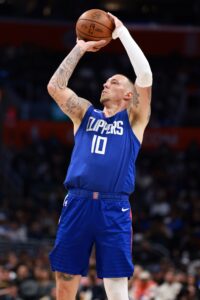 Javonte Green: One year, minimum salary. Signed using minimum salary exception.
- Daniel Theis: One year, minimum salary. Signed using minimum salary exception.
- Matt Ryan: One year, minimum salary. Non-guaranteed. Signed using minimum salary exception.
Trades
- Acquired the draft rights to Antonio Reeves (No. 47 pick) from the Magic in exchange for the right to swap second-round picks in 2030 and 2031.
- Acquired the Bulls’ 2027 second-round pick (top-50 protected) from the Wizards in exchange for Jonas Valanciunas (sign-and-trade).
- Acquired Dejounte Murray from the Hawks in exchange for Larry Nance Jr., Dyson Daniels, E.J. Liddell, Cody Zeller (sign-and-trade), the Lakers’ 2025 first-round pick, and either the Pelicans’ or Bucks’ 2027 first-round pick (whichever is least favorable; top-four protected).
Draft picks
- 1-21: Yves Missi
- Signed to rookie scale contract (four years, $15,654,827).
- 2-47: Antonio Reeves
- Signed to three-year, minimum-salary contract ($5,408,801). First year guaranteed. Second year non-guaranteed. Third year non-guaranteed team option.
Two-way signings
Departed/unsigned free agents
- Naji Marshall (Mavericks)
- Dereon Seabron (unsigned)
- Cody Zeller (Hawks)
Other moves
- Exercised Jeremiah Robinson-Earl‘s 2024/25 team option ($2,196,970).
- Exercised Jose Alvarado‘s 2024/25 team option ($1,988,598).
- Signed draft-and-stash prospect Karlo Matkovic to a three-year, $5,658,801 contract. First two years guaranteed. Third-year team option.
- Claimed Trey Jemison (two-way) off waivers.
Salary cap situation
- Operating over the cap ($140.6MM), over the luxury tax line ($170.8MM), and below the first tax apron ($178.1MM).
- Carrying approximately $172.4MM in salary.
- Hard-capped at $178,132,000.
- Full mid-level, bi-annual exceptions available.
- Two traded player exceptions available (largest worth $9,900,000).
The offseason so far
The Pelicans entered the summer with three key items on their to-do list — upgrading at point guard, finding a starting center, and resolving the Brandon Ingram situation.
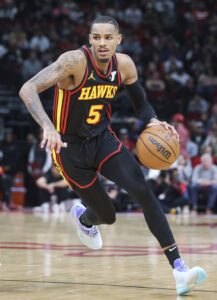 Of those three goals, the Pelicans clearly achieved one of them, striking a deal with the Hawks to acquire Dejounte Murray to fortify their backcourt. The cost – including a rotation big man (Larry Nance Jr.), a former lottery pick with untapped potential (Dyson Daniels), and two future first-round picks – wasn’t cheap, but Murray should bring an intriguing new element to a Pelicans team that has relied on CJ McCollum to run the point in recent years.
While McCollum did OK in that role, Murray is more of a natural play-maker whose presence will allow McCollum to operate more off the ball, or perhaps even to run the second unit. And while Murray’s defensive numbers dropped off in Atlanta, he has an All-Defensive nod on his résumé and has the tools to bounce back on that side of the ball, upgrading the Pelicans’ perimeter defense.
The other two top items on the Pelicans’ offseason checklist remain a work in progress.
New Orleans is unwilling to offer Ingram a long-term, maximum-salary extension as he enters a contract year, and has rising sharpshooter Trey Murphy in the wings waiting to step into Ingram’s starting role. The team also lost its top two centers – Nance and Jonas Valanciunas – this offseason, with Valanciunas leaving for Washington in free agency.
The two-in-one solution to those issues would be to trade Ingram for a starting-caliber center, but New Orleans has explored that path with no success so far, as targets like Jarrett Allen, Nic Claxton, and Wendell Carter remained with their respective teams this summer. As a result, the cap-strapped Pelicans had to turn to free agency for a temporary solution at the five, bringing in veteran big man Daniel Theis on a minimum-salary deal.
Theis is better suited to be a backup, but he’s the best option the Pelicans have at center in the short term, with newly added rookies Yves Missi and Karlo Matkovic unlikely to play major roles right away and Jeremiah Robinson-Earl seemingly lacking starter upside. In a perfect world, Missi would enjoy a Dereck Lively-esque debut season and pair with Theis to form a reliable platoon in the middle. But it’s more likely that center will remain an area of need for New Orleans into the season.
As for Ingram, the Pelicans are said to be open to discussing an extension below the maximum, but with Zion Williamson occupying one forward spot and Murphy and Herbert Jones having earned significant roles, investing heavily in Ingram may not be the preferred path for the organization. As talented a scorer as he is, the former No. 2 overall pick isn’t an elite three-point shooter or defender, making him a somewhat awkward fit next to Williamson, who shares those traits.
Of course, those are the same reasons why another team might be reluctant to trade for Ingram and commit to paying his next contract, which hurts the Pelicans’ ability to extract a ton of value for him on the trade market. Ingram’s presence also gives New Orleans some high-level insurance in the event of a Williamson injury, which hasn’t exactly been a rare occurrence in recent years. It’ll be fascinating to see whether a trade or a new contract with New Orleans is the next step for the 2020 All-Star.
Up next
As detailed above, Ingram’s future with the franchise remains up in the air, but it’s possible no resolution comes before opening night. The forward will remain extension-eligible throughout the season, all the way up until June 30, 2025, and the Pelicans could trade him at anytime up until February’s deadline — or even in a sign-and-trade deal next summer. So while it would be nice to have an answer sooner rather than later, the two sides can afford to enter the regular season without an extension or trade.
The Pelicans have two more extension candidates with whom they’ll likely explore new deals before the season begins. Like Ingram, Jose Alvarado will be extension-eligible all year, but the team faces an October 21 deadline in its talks with Murphy. If Murphy hasn’t signed a rookie scale extension by that time, he’ll become a restricted free agent next July.
Murphy, 24, hasn’t made fewer than 38.0% of his three-point attempts in any of his three NBA seasons and has increased his shot volume every year, from 3.0 attempts per game as a rookie to 7.8 last season.
A player who can shoot like that and hold his own on defense is an extremely valuable asset and that will be reflected in his next contract. RJ Barrett, Jordan Poole, Tyler Herro, Jaden McDaniels, and Devin Vassell all received four- or five-year rookie scale extensions ranging from $107-135MM during the 2022 and 2023 offseasons. I expect Murphy to seek a deal at least in that neighborhood.
The cost for Alvarado shouldn’t be as high, but he’ll certainly be due a raise on his current minimum-salary contract after having established himself as a reliable rotation player for the Pelicans. The 26-year-old would be an unrestricted free agent next summer, so I expect New Orleans will make an effort to stop him from reaching the open market, but it remains to be seen how high the front office will be comfortable going for a reserve like Alvarado.
The Pelicans are currently carrying 15 players on standard contracts on three on two-way deals, so barring a preseason trade involving Ingram and/or a center, the roster looks pretty close to being set for the regular season.
We’ll see whether 15th man Matt Ryan opens the season on the roster or is waived for financial reasons. It’s also possible New Orleans will make a change or two to its two-way players — Malcolm Hill, whose two-way deal carried over from 2023/24, didn’t appear in a single game for the Pelicans last season, so it’s unclear whether he’s in their plans going forward. For what it’s worth, he had a strong year in the G League.
26 NBA Teams Have Made At Least One Offseason Trade
Since the NBA’s 2024 offseason began, 29 trades have been completed, as our tracker shows. A total of 26 teams have been involved in those 29 deals, with 20 clubs (two-thirds of the league) making multiple trades.
The defending champion Celtics are one of the four teams not to have made a trade this offseason, having been content to essentially run it back with the same group that went 16-3 in the postseason this past spring. The Bucks, Cavaliers, and Lakers also haven’t completed any deals since the season ended.
On the other end of the spectrum, the Knicks have been the most active team on the trade market, completing an eye-popping seven deals, two more than any other team.
Most of those trades were minor moves made during the draft — New York entered day one holding the 24th, 25th, and 38th overall picks, but ended up trading down in (or out of) the draft multiple times using the Nos. 24 and 38 selections, then acquired the No. 34 pick in a separate deal. Of course, the Knicks’ one non-draft trade was a big one, as they acquired Mikal Bridges from their cross-town rivals in Brooklyn.
Besides the Knicks, the Thunder were the most active team on the trade market this summer. They kicked off trade season by completing the first of this offseason’s 29 deals (acquiring Alex Caruso from Chicago) and then made four more, for a total of five. The Spurs and Trail Blazers made four trades apiece.
Here are some more details on this offseason’s deals:
- The Nets, Hawks, Wizards, Mavericks, Pelicans, Timberwolves, Suns, and Warriors have each made three offseason trades, while the Raptors, Bulls, Pistons, Hornets, Grizzlies, Rockets, Nuggets, and Kings completed two apiece. That leaves the Sixers, Pacers, Heat, Magic, Jazz, and Clippers as the teams that have made just one trade.
- A total of six 2024 first-round picks were traded this offseason, with one of those picks (No. 26) changing hands twice. The highest 2024 picks traded this summer were No. 8 (Rob Dillingham; Spurs to Timberwolves) and No. 14 (Carlton Carrington; Trail Blazers to Wizards).
- Predictably, this year’s second-rounders were involved in far more trades than the first-rounders. Sixteen of the 28 second-round picks in the draft changed hands at least once since the offseason began, with four of those selections having been included in multiple deals — the No. 40 (Oso Ighodaro) and No. 52 (Quinten Post) picks were dealt three times, while Nos. 51 (Melvin Ajinca) and 56 (Kevin McCullar) were each moved twice.
- A total of 12 future first-round picks and 30 future second-round picks changed hands in trades this offseason, along with six future first-round pick swaps and four future second-round swaps.
- While some of those future traded picks included most/least favorable language, nearly all of them should convey as planned — only two traded first-rounders (and one swap) included any form of protection, and that protection was light (no more than top-four protected). Additionally, just three of the 30 traded second-rounders were protected.
- Of the 29 trades made this offseason, 25 were straightforward two-team agreements. A pair of deals were three-teamers, one involved four teams, and one was the first six-team trade in NBA history.
- A total of 29 veteran players on existing NBA contracts were traded this offseason, with two of those 29 players – Mamadi Diakite and E.J. Liddell – on the move twice and one of them – RaiQuan Gray – on a two-way deal. Another eight players were signed-and-traded, while an additional four players who were selected in a draft prior to 2024 draft had their NBA rights sent to new teams.
Real Madrid, Guerschon Yabusele Officially Part Ways
Real Madrid and forward/center Guerschon Yabusele have reached an agreement to end his contract with the Spanish club, the team officially announced today in a press release. The move helps clear the way for Yabusele to finalize his reported deal with the Sixers.
Yabusele’s contract with Real Madrid included an NBA-opt out clause with a buyout reportedly worth $2.5MM. NBA rules allow the 76ers to contribute up to $850K of that amount without it counting toward their cap, but that left $1.65MM still to cover.
A team with more cap flexibility could’ve accommodated that remaining amount within Yabusele’s cap hit (e.g. paying him a $3MM salary and taking on a $4.65MM cap charge). However, because Yabusele is signing a veteran’s minimum contract with Philadelphia, his salary will be just $2,087,519, so taking the $1.65MM from that amount would essentially wipe out his NBA earnings for 2024/25.
Yabusele and Madrid were said to be negotiating the terms of his buyout. No details have been reported yet, so it’s unclear if the Spanish team may have agreed to reduce the $2.5MM total or worked out some sort of payment plan. Either way, the situation has been resolved, putting Yabusele on track to officially sign with Philadelphia once he receives FIBA clearance.
Yabusele didn’t emerge as a regular rotation player during his previous NBA stint from 2017-19 in Boston, but has thrived overseas in recent years, winning a EuroLeague title (2023) and two Spanish League (Liga ACB) titles (2022, 2024) with Real Madrid after claiming a French League (LNB Pro A) championship with ASVEL in 2021. He was also one of the key contributors to the French national team that won a silver medal at the Paris Olympics this summer.
NBA 2024 Offseason Check-In: Miami Heat
Hoops Rumors is checking in on the 2024 offseason for all 30 NBA teams, recapping the summer’s free agent signings, trades, draft picks, departures, and more. We’ll take a look at each team’s offseason moves and consider what might still be coming before the regular season begins. Today, we’re focusing on the Miami Heat.
Free agent signings
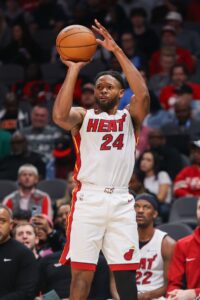 Haywood Highsmith: Two years, $10,816,000. Re-signed using Bird rights.
- Kevin Love: Two years, $8,000,000. Re-signed using Early Bird rights.
- Thomas Bryant: One year, minimum salary. Re-signed using minimum salary exception. Waived right to veto trade.
- Alec Burks: One year, minimum salary. Signed using minimum salary exception.
- Zyon Pullin: One year, minimum salary. Non-guaranteed (Exhibit 10). Signed using minimum salary exception.
- Isaiah Stevens: One year, minimum salary. Non-guaranteed (Exhibit 10). Signed using minimum salary exception.
Trades
- Acquired the draft rights to Pelle Larsson (No. 44 pick; from Rockets) and cash (from Hawks) in a three-team trade in exchange for the draft rights to Nikola Djurisic (No. 43 pick; to Hawks).
Draft picks
- 1-15: Kel’el Ware
- Signed to rookie scale contract (four years, $20,466,072).
- 2-44: Pelle Larsson
- Signed to three-year, minimum-salary contract ($5,408,801). First year guaranteed. Second year partially guaranteed. Third-year team option.
Two-way signings
- Josh Christopher
- Keshad Johnson
- Zyon Pullin
- Note: Pullin was subsequently waived and re-signed to an Exhibit 10 contract.
- Dru Smith
Departed/unsigned free agents
- Caleb Martin (Sixers)
- Patty Mills (Jazz)
- Cole Swider (Pacers)
- Alondes Williams (unsigned)
- Delon Wright (Bucks)
Other moves
- Signed Bam Adebayo to a three-year, maximum-salary veteran extension that begins in 2026/27. Projected value of $165,348,864. Includes third-year player option.
- Waived Orlando Robinson.
Salary cap situation
- Operating over the cap ($140.6MM), over the luxury tax line ($170.8MM), and between the first tax apron ($178.1MM) and second tax apron ($188.9MM).
- Carrying approximately $184.8MM in salary.
- No hard cap.
- Taxpayer mid-level exception ($5.2MM) available, but can’t be used due to proximity to second apron.
- One traded player exception frozen/unavailable (worth $6,477,319).
The offseason so far
For a second consecutive summer, the Heat entered the offseason facing the possibility of losing two key rotation players. After watching Gabe Vincent sign with the Lakers and Max Strus head to Cleveland in 2023, Miami saw Caleb Martin and Haywood Highsmith reach unrestricted free agency last month.
Technically, there were no cap restrictions preventing Miami from making aggressive bids to retain both players, but the Heat’s front office made it clear – based on its actions and via media reports – that it had no intention of hamstringing itself by surpassing the second tax apron, which would significantly limit the team’s ability to make moves on the trade market. As a result, the club had to hope that the market for Martin and Highsmith wasn’t robust and that the two wings might be inclined to return at a team-friendly price.
While neither Martin nor Highsmith landed as lucrative a contract as we might’ve expected at the start of the summer, Martin still exited Miami, signing with the conference rival Sixers. But the Heat were able to bring Highsmith back into the fold, agreeing to a two-year contract worth a little more than the taxpayer mid-level exception. It’s a good price for a talented defender whose offensive game has grown in the past couple years as he earned a spot in the team’s regular rotation.
After accounting for Highsmith’s deal, a new two-year, $8MM agreement with Kevin Love, and a rookie scale contract for No. 15 overall pick Kel’el Ware, the Heat had little flexibility to fill out the rest of their roster while operating under the second apron.
Using the taxpayer mid-level exception would’ve pushed Miami’s salary over the second apron, so the club had to settle for filling its remaining openings with minimum-salary signings. That included a new deal for returning big man Thomas Bryant, plus minimum-salary commitments to veteran guard Alec Burks and second-round pick Pelle Larsson. The team is currently carrying 14 players on standard contracts and is unable to add a 15th man without surpassing the second apron.
Burks is a solid value on a minimum deal, and based on the Heat’s recent track record in the draft, it wouldn’t be a surprise if Ware and/or Larrson develop into reliable contributors sooner or later. I wasn’t as high on the deals with Love and Bryant, however.
Love’s first-year salary is $3.85MM, whereas if he had signed a one-year, minimum-salary contract, he would’ve earned about $3.3MM with a cap hit of $2.1MM. Clearly, the Heat felt they needed to go above the minimum and add a second year to bring one of their veteran leaders back in the fold, but it’s a bit of a tough pill to swallow when they have so little financial flexibility — a one-year minimum deal for Love would’ve provided more room to operate below the second apron, allowing for the addition of a 15th man.
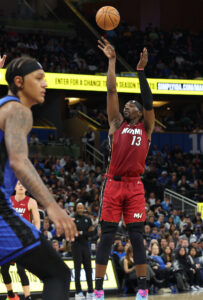 Bryant, meanwhile, was in and out of the Heat’s rotation last season and looked like a player whose days in Miami were numbered. When he declined his minimum-salary player option in order to test the market, it appeared the Heat had lucked out, but perhaps he knew he’d have an offer from his former team waiting for him as a fallback option if he didn’t find a more favorable opportunity elsewhere. I was surprised the Heat re-signed Bryant, but it’s possible they expect to get more from the veteran center now that he has a year with the organization under his belt.
The one big-money move the Heat made this summer was to lock up defensive anchor Bam Adebayo to a three-year, maximum-salary extension. The deal doesn’t go into effect until 2026/27, so Adebayo is now under contract for at least the next four seasons, with a player option for 2028/29.
It’s not out of the question that Adebayo, who has finished in the top five of Defensive Player of the Year voting for five seasons in a row, could win the award in 2025. If he did – or if he made an All-NBA team – he would’ve become super-max eligible, so it made sense for the Heat to extend one of the league’s best big men sooner rather than later in order to eliminate the possibility of Adebayo increasing his maximum salary.
Up next
Things didn’t go as smoothly with the Heat’s other extension-eligible star this offseason as they did with Adebayo. Reports in the spring indicated that Jimmy Butler would be seeking a new maximum-salary deal; asked about those reports, Heat president Pat Riley expressed reluctance to put such an offer on the table for the 34-year-old, who has battled injuries in recent years.
Despite some trade speculation involving Butler, the situation didn’t come to a head this summer. The six-time All-Star remains committed to the Heat, but has indicated he’ll wait until next offseason – when he could become a free agent by turning down his 2025/26 player option – to sign a new contract. There’s nothing to resolve before the season begins, in other words, but this is a situation worth monitoring into the season in case things take a turn for the worse.
The Heat’s other extension-eligible veteran, Terry Rozier, seems unlikely to sign a new contract before the season begins. He’s still under contract for two more years and has only played 31 games with Miami since being acquired from Charlotte in a mid-season trade. The team will probably want to take a longer look at Rozier’s fit with the rest of the roster in before deciding whether to make a longer-term commitment to him.
The Heat’s 14-man standard roster looks good to go for the regular season, but it’s possible more changes will come to their two-way slots before opening night. Miami already made one offseason swap, signing Zyon Pullin to a two-way deal, then waiving him in favor of Summer League standout Josh Christopher. Christopher, Dru Smith, and Keshad Johnson currently occupy those two-way slots, but a strong preseason from Pullin, Isaiah Stevens, or another camp invitee could lead to another change.
Cavaliers Sign Luke Travers To Two-Way Deal
4:30pm: The signing is official, according to the Cavaliers.
3:39pm: Draft-and-stash prospect Luke Travers has agreed to sign a two-way contract with the Cavaliers, agent Daniel Moldovan tells Adrian Wojnarowski of ESPN (Twitter link).
Travers, who will turn 23 next Tuesday, was the 56th overall pick in the 2022 draft. Rather than signing an NBA contract at that time, however, he continued to play professionally in his home country of Australia, suiting up for the Perth Wildcats in 2022/23 and Melbourne United in ’23/24.
A 6’7″ wing, Travers enjoyed a strong season in Melbourne this past year, averaging 12.0 points, 7.6 rebounds, and 1.9 assists in 26.3 minutes per game, with a shooting line of .516/.327/.671, across 25 appearances. He has also suited up for Cleveland’s Summer League team in each of the past three offseasons, averaging 7.4 PPG, 5.3 RPG, 1.9 APG, and 1.4 BPG in 15 outings (24.7 MPG) in Las Vegas.
Word broke earlier this month that Travers had left Melbourne United to pursue NBA opportunities, and while a two-way deal with Cleveland always appeared to be the most likely outcome, that wasn’t considered a certainty until now. The Cavs could’ve traded his NBA rights to another team or used a 15-man roster spot to sign him.
Instead, Travers will begin his NBA career in Cleveland on a two-way contract that will pay him $578,577, half of the rookie minimum. He’s eligible to appear in a maximum of 50 NBA games while on that deal, though if the Cavs hold an open spot on their standard 15-man roster, they’ll be limited to 90 total NBA games for their three two-way players (Travers, Emoni Bates, and JT Thor). As a result, the Australian wing will likely spend plenty of time in the G League with the Cleveland Charge.
Once their reported deals with Travers and Thor are official, the Cavs will have 15 players under contract — 12 on standard deals and three on two-ways, with Isaac Okoro still a restricted free agent.
NBA Teams With Fewest Players On Guaranteed Contracts
As of Wednesday, eight of the NBA’s 30 teams are carrying at least 15 players on guaranteed contracts and are unlikely to have many additional offseason acquisitions in store. Another 17 teams are carrying either 13 or 14 players on guaranteed deals.
As our roster counts page shows, that leaves five clubs carrying 12 or fewer players on fully guaranteed deals. That doesn’t necessarily mean all five of those teams will sign free agents to guaranteed contracts before the regular season begins, but it’s worth checking in on them to take a closer look at their roster situations.
[RELATED: 2024/25 Non-Guaranteed Contracts By Team]
Cleveland Cavaliers
No NBA team has fewer players on fully guaranteed salaries than the Cavaliers, who are carrying just 10 of them. However, we can probably pencil in two more players for their standard regular season roster — Craig Porter played rotation minutes last season and has a $1MM partial guarantee, while Sam Merrill proved to be a bargain on his non-guaranteed minimum-salary deal.
If we assume those 12 players will be on the Cavs’ opening night roster, that leaves three openings. Cleveland reportedly plans to leave one open, and one may be earmarked for restricted free agent Isaac Okoro, but even if Okoro returns, the club will still need to add one more player to its roster as a 14th man. It will be interesting to see if the Cavs target a specific free agent and offer him a guaranteed contract or if they’ll bring multiple non-guaranteed players to camp to compete for that 14th spot.
Golden State Warriors
The Warriors have 12 players on fully guaranteed salaries, with Lindy Waters and Gui Santos also in the mix on non-guaranteed salaries. Golden State doesn’t currently have the flexibility to sign a veteran free agent as a 15th man due to the team’s close proximity to its hard cap of $178.1MM, but either Waters or Santos could be waived to make room for a replacement.
The Warriors gave up a second-round pick in June to acquire Waters, so I doubt the plan is to waive him. Santos’ future is less certain. He barely played in the NBA last season as a rookie, and his G League numbers (including a .437 FG% and 3.1 turnovers per game) weren’t exceptional. If the Dubs want to bring in another player to fill out their regular season roster (they’re reportedly working out Bruno Caboclo this week), Santos looks like the best bet to be the odd man out.
Indiana Pacers
Although the Pacers have just 12 players on fully guaranteed contracts, they have at least four players in the mix for the final three spots on their roster, including two with partial guarantees (James Johnson and James Wiseman) and two on non-guaranteed deals (Kendall Brown and Cole Swider).
I expect Johnson and Wiseman to have the upper hand for spots on the 15-man roster, with Brown and Swider potentially fighting for the 15th spot — assuming Indiana even carries a full 15-man squad to open the regular season.
For what it’s worth, the Pacers have shown a willingness in the past to move Johnson on and off their roster. Last season, he signed four separate contracts with the club, including two 10-day deals. But the fact that Indiana gave him a $750K guarantee on his newest contract is an indication the team doesn’t plan on cutting the veteran forward before opening night.
Philadelphia 76ers
While the Sixers technically only have 12 players on guaranteed salaries for the time being, that number will increase to 13 once Guerschon Yabusele officially signs with the team. He’s likely still working out the logistics of the move, including his buyout with Real Madrid and clearance from FIBA.
Once Yabusele has signed, Philadelphia will have 13 players on guaranteed contracts, plus Ricky Council on a non-guaranteed deal. I can’t imagine Council is going anywhere after his promising rookie season, so the only question for the Sixers will be whether or not they want to carry a 15th man to open the year. They’re well into tax territory already, so they may hold that spot open unless there’s a specific player they like and don’t want to get away.
Sacramento Kings
The Kings currently have 14 players on standard contracts — 12 on guaranteed deals, plus Orlando Robinson with a partial guarantee ($500K) and Keon Ellis on a non-guaranteed salary.
Ellis was a rotation player for much of last season and should be a lock for the regular season roster. On the surface, Robinson may not look like a sure thing, but the Kings’ cap situation works in his favor. The club is currently only below the tax line by about $1MM, so eating Robinson’s $500K partial guarantee in order to replace him with a newcomer before the season starts wouldn’t be the most financially prudent move.
I’d expect the Kings to keep their 15th roster spot open to start the season. If they carry someone in that spot, it might be another player on a non-guaranteed deal for the sake of flexibility.
Deadline Looms For Teams To Stretch 2024/25 Salaries
Thursday, August 29 is the last day that an NBA team will be able to waive a player who has a fully or partially guaranteed salary for 2024/25 and stretch that player’s ’24/25 salary across multiple seasons.
[RELATED: Hoops Rumors Glossary: Stretch Provision]
The stretch provision deadline has historically been August 31, and while that’s technically still the case, the current Collective Bargaining Agreement tweaked the wording of the rule. As Bobby Marks of ESPN notes (via Twitter), in order to apply the stretch provision to a player’s current-season salary, a team must now ensure the player clears waivers on or before August 31 rather than simply requesting waivers on him by August 31.
The adjusted wording is similar to the CBA language related to the league-wide salary guarantee date in January. In that case, a team must place a player on waivers on or before January 7 in order to have him clear waivers ahead of the league-wide Jan. 10 guarantee date. In the case of the stretch provision rule, a player whose salary is being stretched now must be waived by August 29 at 4:00 pm Central time to ensure he has cleared waivers prior to September 1.
A player who clears waivers between September 1 and the end of the 2024/25 season can still have his cap hit(s) for 2025/26 and future seasons stretched across multiple years, assuming he’s owed guaranteed money beyond this season. But his ’24/25 cap charge would remain unchanged in that scenario, unless he reaches a buyout agreement with his team.
The stretch provision allows teams to gain some short-term relief at the cost of reduced long-term flexibility. It’s used most frequently by teams in the luxury tax who want to lower their projected tax bill (or duck out of tax territory entirely) or by teams who want to create a little extra cap room to accommodate a specific roster move.
Teams haven’t employed the stretch provision all that frequently in recent years, but three players waived this week will have their guaranteed money stretched across multiple seasons. The Suns are stretching the $21.75MM owed to Nassir Little for the next three years, as well as the $2,120,693 owed to E.J. Liddell for 2024/25, while the Grizzlies are stretching Mamadi Diakite‘s $1,392,150 partial guarantee for ’24/25.
Since the stretch provision allows a team to spread the player’s remaining salary across twice the remaining years on his contract, plus one additional year, the new cap hits for those players will be as follows:
- Little (Suns): $3,107,143 for seven seasons (through 2030/31)
- Liddell (Suns): $706,898 for three seasons (through 2026/27)
- Diakite (Grizzlies): $464,050 for three seasons (through 2026/27)
The Suns’ moves reduce their projected tax bill, while the Grizzlies’ move creates a little additional breathing room below the tax line.
We likely won’t see a flurry of cuts today and tomorrow in order to take advantage of this rule, but the deadline is still worth keeping in mind for the possibilities it will take off the table. Any player on a guaranteed expiring contract who is waived after August 29 will have his remaining salary count entirely against his team’s ’24/25 books.