
Northwest Notes: Thunder, Holmgren, Nnaji, Scoot, Grant
The significance of the Thunder‘s victory in Denver on Saturday night can’t be ignored, according to Tony Jones of The Athletic, who points out that it’s extremely rare for any team to steal a win at Ball Arena. The Nuggets lost just seven times in Denver during the 2022/23 regular season and had won 10 of 11 home games so far this season before Saturday’s defeat.
“It showed that we can play with anybody when we are playing well,” Thunder forward Jalen Williams said of the thrilling 118-117 win. “Obviously, we have a ton of respect for Denver. In regards to that, they did a lot to win this game as well. But we feel that we can compete with anybody, and I think this solidifies those thoughts that we have.
“Honestly, I don’t think that we’ve ever not thought that way. But this just gives us more and more confidence as we head into the rest of the season. We know that we have a lot of work ahead of us and a long way to go. But we know that we can play with anyone when we are on our game.”
With the victory, the Thunder moved ahead of the Nuggets in the standings and once again hold the No. 2 seed in the Western Conference. As Jones writes, Shai Gilgeous-Alexander also continued to strengthen his Most Valuable Player case on Saturday, outplaying two-time MVP Nikola Jokic and hitting the game-winning shot in the final second of the fourth quarter.
Here’s more from around the Northwest:
- Jokic had high praise for Thunder big man Chet Holmgren, who had an incredible nine blocked shots on Saturday. As Bennett Durando of The Denver Post relays, the Nuggets’ star center thinks Holmgren is capable of being much more than just a Rookie of the Year winner. “I think that’s not supposed to be his goal,” Jokic said. “I think he can be much better than that.”
- Zeke Nnaji has been a DNP-CD in six of the Nuggets‘ past eight games, as head coach Michael Malone has leaned on DeAndre Jordan as the team’s primary backup center. However, Malone is unwilling to classify Nnaji as “out of the rotation,” referring to him as “an effective player for us,” tweets Harrison Wind of DNVR Sports. Nnaji signed a four-year, $32MM rookie scale extension prior to the season; it will begin in ’24/25.
- Trail Blazers rookie Scoot Henderson has been showing his explosiveness more often as of late, which the team views as another sign that he’s getting more comfortable after a slow start to his NBA career, writes Jason Quick of The Athletic. “I think Scoot is getting better every day, to be honest with you,” Billups said of the No. 3 overall pick, who has averaged 18.3 points on .468/.500/1.000 shooting in his past three games. “You can actually see the progress in the games. In the early part of the season he really struggled, and I thought most of his struggles came from him just wanting so badly to play well. So, he could never slow down.”
- Trail Blazers forward Jerami Grant returned to action on Saturday after spending four games in the concussion protocol and didn’t miss a beat, scoring 27 points on 12-of-20 shooting in 38 minutes of action. Grant is one of several players around the NBA who won’t become trade-eligible until January 15.
Cavs Notes: Injuries, New Lineup, Mitchell, Roster
Less than an hour after it was reported on Friday that Darius Garland is expected to miss at least a month due to a fractured jaw, word broke that Evan Mobley would undergo knee surgery, which will sideline him for roughly six-to-eight weeks.
It was a crushing one-two blow for the Cavaliers, as Chris Fedor of Cleveland.com (subscription required) writes. Head coach J.B. Bickerstaff said that the team “felt like s–t,” while Dean Wade said it “sucks” to see two key starters go down with injuries. However, the club is determined to remain competitive without Garland and Mobley in its lineup.
“Injury is a part of the game. But you hate to see it. Hate to see with two guys who continuously put the work in to get better and those guys have been working their butts off,” Donovan Mitchell said. “On the flip side, and I think these two will feel the same way, no one’s going to care outside of this locker room. You know what I mean? If anything, teams are going to want to try to come at us even more. I think that’s what kind of brings us together. We have to go out there and hold it down for these two. They’re our rocks. They’re part of what we built.”
“I knew that our team could do it,” Jarrett Allen said of overcoming the two injuries. “We always rely on the next guy to be ready to come in and make an impact.”
The Cavaliers got off to a good start on Saturday in their first game without Garland and Mobley, defeating the Hawks by a score of 127-119.
“I think we just came together,” Wade said. “Everyone likes each other. When things like this happen, adversity comes and hits us, I think we get closer. We still got a lot of weapons, a lot of talent in this room. Even with those guys out, we can still get the job done. What D.G. and Evan bring to the floor, we just had to do a little extra.”
Here’s more out of Cleveland:
- In deciding on a new lineup, the Cavaliers opted to slide Mitchell to point guard and Max Strus to shooting guard, with Isaac Okoro and Wade entering the starting five at small forward and power forward, respectively. As Fedor explains, undrafted rookie Craig Porter Jr. isn’t considered quite ready for a starting job and the Cavs seem committed to keeping Caris LeVert in a sixth man role.
- When Joe Vardon of The Athletic tried to ask Mitchell on Saturday about his contract situation and his long-term future in Cleveland in light of the Garland and Mobley injuries (and the Cavs’ up-and-down play this season), the star guard cut him off. “My job is to focus on this,” Mitchell said. “We have two guys that are out, so I’m not answering anything. And no disrespect. I appreciate that you have to ask the question, but I’m not going there with any of those questions. My focus is on these guys being out, us trying to find a way to get wins.”
- Mitchell thrived in his first game in place of Garland at point guard, handing out a career-high 13 assists. Mitchell also scored a career-high 71 points last season in a game Garland missed, but the former Jazz star said it’s “damn sure not easier” to play without his usual backcourt mate. “I have to pick up the slack that’s there,” Mitchell said. “When he’s not there, it’s my job to go out there and fill that void. He’s an All-Star guard. We came here and made this for us to be together. It’s definitely not an, ‘Oh, it’s me versus him.’ That’s my brother. That’s my dog. … The only way we make this push is as a group. I can’t do everything. It doesn’t happen with just one of us.”
- Keith Smith of Spotrac takes a look at some options out there for the Cavaliers if the team decides it wants to add roster reinforcements via free agency or trade. As Smith notes, adding a free agent would push Cleveland’s team salary over the luxury tax line, but if that player receives a non-guaranteed contract and is waived on or before January 7, the club could sneak back out of the tax.
Hoops Rumors Glossary: Hard Cap
The NBA’s salary cap is a “soft” cap, which is why most teams’ salaries have surpassed the $136,021,000 threshold for the 2023/24 season. Once a team uses up all of its cap room, it can use a series of “exceptions” – including the mid-level, bi-annual, and various forms of Bird rights – to exceed the cap.
Since the NBA’s Collective Bargaining Agreement doesn’t feature a “hard” cap by default, teams can construct rosters that not only exceed the cap but also blow past the luxury tax line ($165,294,000 in ’23/24). While it would be nearly impossible in practical terms, there’s technically no rule restricting a club from having a team salary worth double or triple the salary cap.
However, there are certain scenarios in 2023/24 in which a team can become hard-capped at one of two thresholds, known as the “tax aprons.” Those scenarios are as follows:
A team becomes hard-capped at the first tax apron if:
- The team uses its bi-annual exception to sign a player.
- The team uses more than the taxpayer portion of the mid-level exception to sign a player (or multiple players).
- Note: In 2023/24, the taxpayer MLE is worth $5,000,000, compared to $12,405,000 for the full non-taxpayer MLE. The taxpayer MLE can be used to complete deals up to two years, while the non-taxpayer MLE can be used to complete deals up to four years.
- Note: In 2023/24, the taxpayer MLE is worth $5,000,000, compared to $12,405,000 for the full non-taxpayer MLE. The taxpayer MLE can be used to complete deals up to two years, while the non-taxpayer MLE can be used to complete deals up to four years.
- The team uses any portion of its mid-level exception to acquire a player via trade or waiver claim.
- The team acquires a player via sign-and-trade.
- The team signs a player who was waived during the current regular season, if his pre-waiver salary for 2023/24 exceeded the amount of the non-taxpayer mid-level exception ($12,405,000).
- The team takes back more than 110% of the salary it sends out in a trade (using salary-matching rather than cap room).
A team making any of those six roster moves must ensure that its team salary is below the first tax apron when it finalizes the transaction and remains below the apron for the rest of the league year.
For the 2023/24 league year, the first apron is set at $172,346,000, which is $7,052,000 above the tax line. A team that completes one of the six moves listed above can’t surpass that line under any circumstances.
A team becomes hard-capped at the second tax apron if:
- The team uses any portion of the mid-level exception to sign a player.
Under the previous Collective Bargaining Agreement, every team was permitted to use at least some portion of the mid-level exception, but it’s no longer available to teams above the second tax apron, so a club that uses any part of the MLE is hard-capped at that second apron.
As noted above, a team that uses more than the taxpayer portion ($5MM) is hard-capped at the first apron, which means teams between the first and second apron are allowed to spend up to $5MM in MLE money.
For the 2023/24 league year, the second apron is set at $182,794,000, which is $17.5MM above the tax line.
So far in ’23/24, a total of 11 teams have hard-capped themselves at the first tax apron by acquiring a player via sign-and-trade, using the non-taxpayer mid-level exception, using the bi-annual exception, or taking back more than 110% of the outgoing salary in a trade. Two more teams have hard-capped themselves at the second apron by using $5MM in mid-level money.
For many of those teams, the restriction is barely noticeable — they remain far below their hard cap and haven’t had to worry about whether a roster move might put them over it. However, a handful of clubs will have to be wary of that hard cap as they approach the trade deadline.
It’s worth noting that even if a team starts a new league year above the tax apron, that doesn’t mean they can’t become hard-capped at some point later in the season. For example, the Warriors are currently well above the second apron, but in the unlikely event that they dump a couple big contracts and then use $5MM of their mid-level exception to sign a free agent, a hard cap would be imposed and they’d be ineligible to surpass the $182.8MM second apron for the rest of the league year.
In other words, the hard cap applies from the moment a team completes one of the transactions listed above, but isn’t applied retroactively.
The list of roster moves that will impose a hard cap on a team will expand beginning in the 2024 offseason. After the last day of the 2023/24 regular season, the following restrictions will apply:
A team becomes hard-capped at the first tax apron if:
- The team takes back more than 100% of the salary it sends out in a trade (when over the cap).
- Note: This will replace the fifth rule listed above, reducing the salary-matching limit from 110% to 100% for teams over the first apron.
- The team uses a traded player exception generated during the prior year (ie. between the end of the previous regular season and the end of the most recent regular season).
A team becomes hard-capped at the second tax apron if:
- The team aggregates two or more player salaries in a trade.
- The team sends out cash as part of a trade.
- The team acquires a player using a traded player exception that was created by sending out a player via sign-and-trade.
- Note: This applies whether the traded player exception is generated as part of a simultaneous trade (ie. using an outgoing signed-and-traded player for matching purposes) or non-simultaneous trade (ie. in a subsequent trade, using a TPE previously generated by sending out a player via sign-and-trade).
- Note: This applies whether the traded player exception is generated as part of a simultaneous trade (ie. using an outgoing signed-and-traded player for matching purposes) or non-simultaneous trade (ie. in a subsequent trade, using a TPE previously generated by sending out a player via sign-and-trade).
Typically, a team’s hard cap expires on June 30 when the current league year comes to an end, with the team getting a clean slate on July 1. However, beginning in the 2024 offseason, if a team engages in any of the trade-related transactions prohibited for first or second apron teams between the end of the regular season and June 30, the team will not be permitted to exceed that apron level during the following season.
If, for example, a team sends out cash in a trade in June of 2024, that team won’t be allowed to exceed the second tax apron during the 2024/25 league year. The inverse is also true — a team whose 2024/25 salary projects to be over the second apron won’t be able to trade cash in June.
This rule only applies to trade-related transactions because the ones related to free agency don’t come into effect between the end of the regular season and the start of the next league year.
Note: This is a Hoops Rumors Glossary entry. Our glossary posts will explain specific rules relating to trades, free agency, or other aspects of the NBA’s Collective Bargaining Agreement. Larry Coon’s Salary Cap FAQ was used in the creation of this post.
Previous versions of this post was published in 2020 and 2021.
Atlantic Notes: White, Thybulle, Sixers, Knicks
Does Derrick White deserve All-Star consideration? Chris Forsberg of NBC Sports Boston argues that the Celtics guard has a legitimate case, noting that the team has a +13.6 net rating when White is on the court compared to a +1.5 mark when he sits. That’s the widest on/off difference for any player on the roster.
White is also averaging 15.6 points and 5.1 assists per game while shooting 48.2% from the field and 42.7% on three-pointers. All of those numbers would be career bests for the seventh-year guard (with the exception of his rookie season, when he shot 48.5% from the floor and 61.5% on threes in just 139 total minutes).
Still, while the 19-5 Celtics certainly have a case to send multiple players to this season’s All-Star Game in Indianapolis, it’s unclear whether White will make the cut. As Forsberg observes, Jayson Tatum is a lock to be an All-Star, while teammates Jaylen Brown and Kristaps Porzingis will also warrant consideration.
Here’s more from around the Atlantic:
- Since being traded from Philadelphia to Portland at last season’s trade deadline, Matisse Thybulle has made 39.9% of his three-point attempts, well above the 32.5% mark he put up across three-and-a-half seasons with the Sixers. Keith Pompey of The Philadelphia Inquirer wonders if the 76ers gave up on Thybulle too early and whether he might’ve been rejuvenated under a new head coach in Nick Nurse.
- In a separate story for The Philadelphia Inquirer, Gina Mizell previews trade season for the Sixers, identifying some potential big-name trade targets while also considering what sort of role players might fit in Philadelphia. A prototypical point guard, a more traditional center, and a “straight-up gunner” are among the pieces the club could keep an eye out for, Mizell suggests.
- With Mitchell Robinson out for a couple months and Taj Gibson now a part of the roster, Tom Thibodeau‘s rotation at center for the Knicks looks pretty clear, writes Stefan Bondy of The New York Post. Jericho Sims will start, Isaiah Hartenstein will get the majority of the minutes, and Gibson will be available for insurance purposes. That’s how it worked out on Friday and Saturday, with Hartenstein averaging 30.5 minutes, Sims averaging 17.5, and Gibson logging a total of seven minutes in garbage time.
Hoops Rumors Glossary: Salary Aggregation
When an NBA team is over the salary cap and wants to make a trade, certain rules in the Collective Bargaining Agreement dictate how much salary the team is permitted to take back. These salary-matching rules are evolving – they changed prior to this season and will change again in 2024 – but in most cases, an over-the-cap team must send out nearly as much salary as it acquires for the trade to be legal.
In some scenarios, salary aggregation is required in order to legally match the incoming player’s cap hit. Aggregation is the act of combining multiple players’ salaries in order to reach that legal outgoing limit.
For example, let’s say Team A has a team salary above the first tax apron and wants to acquire a player earning $30MM from Team B. Sending out a player earning $27MM would fall short of the minimum requirement, since Team A can only bring back up to 100% of the outgoing amount. Trading a $27MM player would allow the team to acquire up to $27MM in salary.
However, by adding a second player earning $3MM to its package, Team A would reach the minimum outgoing threshold by “aggregating” its two traded players, resulting in a total of $30MM in outgoing salary — that’s enough to bring back a $30MM player.
Only player salaries can be aggregated. Trade exceptions cannot be aggregated with one another or with players. That means a team with a $10MM trade exception can’t aggregate that exception with a $20MM player (or a separate $20MM trade exception) to acquire a $30MM player.
Crucially, sending out two players together in a trade doesn’t necessarily mean they have to be aggregated.
For instance, if Team A sends out one player earning $30MM and another earning $4MM in exchange for its incoming $30MM player, there’s no need to aggregate the two outgoing salaries. Since $30MM is an amount sufficient to take back $30MM, the $4MM player can essentially be traded for “nothing,” creating a $4MM trade exception that could be used at a later date.
Because trade exceptions can only be created in “non-simultaneous” trades and salary aggregation can only be completed in a “simultaneous” trade, trade exceptions can’t be generated in scenarios in which salaries are aggregated. In the hypothetical trade above, swapping the $30MM player for the $30MM player represents a simultaneous trade, while sending out the $4MM player represents a non-simultaneous trade, resulting in the trade exception.
Here’s another example to illustrate that point, using the same $30MM incoming player: If Team A decides to salary-match by sending out one player earning $20MM and a second earning $15MM, that team can’t generate a trade exception worth the excess amount ($5MM), because the two outgoing salaries must be aggregated, resulting in a simultaneous trade.
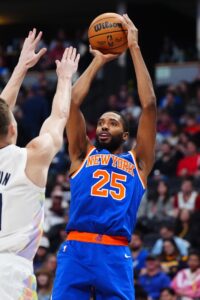 One good recent example of salary aggregation came when the Knicks acquired Mikal Bridges from the Nets. Bridges had a cap hit of $23,300,000, so the Knicks – whose team salary was going to be above the first tax apron, had to send out at least $23.3MM to match the incoming amount.
The Knicks were going to use Bojan Bogdanovic ($19,032,850) as part of their outgoing package, but needed to add another $4,267,150 to make the deal legal. In order to reach that amount, they signed-and-traded Shake Milton to a deal with a first-year salary of $2,875,000 and partially guaranteed Mamadi Diakite‘s salary for $1,392,150, getting them exactly to $23.3MM. If Bridges had been earning a dollar more, New York would have needed to adjust either Milton’s first-year salary or Diakite’s partial guarantee to make it work.
The NBA’s trade rules state that when a team acquires a player using salary-matching or a trade exception (rather than cap room), it cannot aggregate that player’s salary in a second trade for two months.
The one exception to that rule occurs if a player is traded on or before December 16, but less than two months until that season’s trade deadline. In that case, the player is permitted to be aggregated again either on the day before the deadline or the day of the deadline.
Any player traded after December 16 can’t have his salary aggregated with another player’s before the trade deadline. But, as outlined above, that doesn’t mean that a player acquired after today can’t be traded again before the deadline along with other players — it simply means his salary can’t be aggregated as part of the deal.
Here are a couple more notes related to salary aggregation:
- Beginning in the 2024 offseason, a team whose total salary is above the second tax apron will not be permitted to aggregate salaries as part of a trade. A team that does aggregate salaries in a trade will become hard-capped at the second apron for the rest of that league year (or for the following league year, if the trade is made between the end of the regular season and June 30).
- If a team is aggregating three (or more) player salaries in a trade for matching purposes in order to take back fewer players than that, no more than one of the aggregated players can be earning the minimum salary. This rule doesn’t apply between December 15 and the trade deadline, but is in effect the rest of the year.
Note: This is a Hoops Rumors Glossary entry. Our glossary posts will explain specific rules relating to trades, free agency, or other aspects of the NBA’s Collective Bargaining Agreement. Larry Coon’s Salary Cap FAQ was used in the creation of this post.
A previous version of this post was published in 2022. This post was updated in 2025 to reflect new salary-matching rules.
Southeast Notes: Fultz, Ball, Mensah, Wizards
After being upgraded to questionable for Friday’s game in Boston, Magic guard Markelle Fultz (left knee tendinitis) was ultimately ruled out for a 16th consecutive contest. As Jason Beede of The Orlando Sentinel tweets, Fultz has only gone through portions of practice this week, so the club wasn’t quite ready to clear him for game action.
Asked what went into the decision to rule out Fultz on Friday, head coach Jamahl Mosley explained: “Just being able to check to make sure he’s fully back to what we need him to do and getting full practices in with full contact. That’s going to be very important.”
Although his return didn’t happen on Friday and he didn’t take contact in Saturday’s practice, Fultz told reporters on Thursday that he thinks he’ll be back sooner rather than later, per Beede (subscription required). The former No. 1 overall pick said that he’s been “progressing great,” though he’s also on board with the team’s cautious approach to the injury.
“I’m thinking the long game here,” Fultz said. “I don’t want to come back in, play a few games and have to sit back out. When I’m back, I want to stay back for the long run.”
Here’s more from around the Southeast:
- After announcing on December 8 that they’d reevaluate LaMelo Ball (right ankle sprain) in a week, the Hornets offered a very minor update on Friday, tweeting that the star guard has “continued progressing” in his conditioning and individual activities. Updates on his status will be provided “as appropriate,” the Hornets added. It doesn’t sound as if Ball has resumed practicing with the team or that his return is imminent.
- After signing a two-way contract with the Hornets on Thursday, center Nathan Mensah was immediately thrust into a rotation role for the injury-plagued club, backing up Nick Richards at the five in Friday’s loss to New Orleans. Mensah fouled out in just 13 minutes of action but he grabbed seven rebounds and made a solid first impression, per Shane Connuck of The Charlotte Observer. “He did a great job,” Brandon Miller said. “His presence down there, I felt like he did a great job on the defensive side, just getting boards, some blocks. He’s gonna be great for us.”
- Following this week’s announcement stating that the Wizards plan to move from the District of Columbia to Virginia, David Aldridge of The Athletic and Candace Buckner of The Washington Post published columns criticizing team owner Ted Leonsis for his handling of the situation and his treatment of the franchise’s long-time D.C. market.
- In a pair of stories focusing on the Wizards‘ rebuilding process, Aldridge and Josh Robbins of The Athletic take a look at how the new front office is emphasizing “small wins” as part of its culture-building efforts and explore how the organization is attempting to improve its off-court infrastructure.
Bulls Sign Henri Drell, Waive Justin Lewis
5:00pm: The moves are official, per NBA.com’s transaction log.
2:22pm: The Bulls have agreed to sign forward Henri Drell to a two-way contract, his agent Matt Bollero tells Shams Charania of The Athletic (Twitter link).
In order to open up a two-way slot for Drell, Chicago is waiving forward Justin Lewis, according to Charania (Twitter link).
Drell, 23, is a 6’9″ Estonian wing who joined the Windy City Bulls in January 2022 and has now spent parts of three seasons with Chicago’s G League affiliate. In 11 Showcase Cup games for Windy City this fall, he has averaged 12.4 points, 6.8 rebounds, 2.5 assists, and 2.0 steals in 28.6 minutes per night, posting a shooting line of .433/.306/.800.
Lewis signed a two-way contract with Chicago in the summer of 2022 after going undrafted out of Marquette, but tore his ACL last August, prompting the team to waive him last fall. He rejoined the Bulls on a new two-year, two-way deal in March and made his debut for Windy City last month.
However, Lewis hasn’t been particularly effective so far this season, averaging just 5.7 PPG and 5.0 RPG on .333/.135/.500 shooting in 12 games (25.2 MPG) for Chicago’s NBAGL squad. He hasn’t played at all for the NBA team.
Once the moves are official, Drell will join Adama Sanogo and Onuralp Bitim as the Bulls’ two-way players.
Pistons Among Teams Eyeing OG Anunoby
The Pistons are expected to be active in the trade market prior to this season’s deadline and have interest in acquiring a forward, according to James L. Edwards III of The Athletic, who identifies Raptors forward OG Anunoby as one of the players Detroit has its eye on.
Of course, as Edwards acknowledges, Anunoby is a trade target who will appeal to most teams across the NBA, given his three-and-D skill set and his seamless fit on virtually any roster. There’s also no guarantee that Toronto will make him available on or before February 8.
Even if Anunoby ends up on the trade block, it’s possible Detroit won’t aggressively pursue him during the season in the hopes that he could be signed in free agency next summer, Edwards adds. The 26-year-old has a player option for 2024/25 that he’s extremely likely to decline, while the Pistons are well positioned to create a significant amount of cap space in July.
Edwards identifies Sixers forward Tobias Harris as another veteran on an expiring contract who would be of interest to the Pistons, though Harris has played an important role in Philadelphia this season following James Harden‘s exit and seems unlikely to be traded unless it’s for an upgrade.
Losers of 22 consecutive games, the Pistons obviously aren’t looking to make a win-now move that will propel them to playoff contention this season. With that in mind, it may seem counterintuitive that they’d be interested in trading for players like Anunoby and Harris, who can become free agents in 2024.
However, if the Pistons were to acquire Anunoby, Harris, or someone else with a similar contract situation, the player’s Bird rights would be traded along with him, putting the Pistons in a strong position to extend or re-sign him.
Still, I’d be surprised if a lottery-bound team like Detroit is prepared to give up the sort of assets it would take to acquire an established impact player — the Pistons may be better off selling off some of their own veterans at this season’s deadline and taking the same approach next summer that Houston did this past offseason, adding vets in free agency instead of via trade.
Central Notes: Cavs, Mitchell, DeRozan, Pacers, Johnson, Bucks
After the Cavaliers‘ 51-win 2022/23 season came to a disappointing end with an unceremonious exit in the first round of the playoffs, that momentum appears to have carried over to this fall, with the team off to a 13-12 start. However, speaking to Steve Bulpett of Heavy.com, star guard Donovan Mitchell rejects the idea that the postseason letdown in the spring left a lasting mark on the team.
“I think we came back motivated,” he said. “We’ve got guys who came back ready to go. I think it motivated us, but, you know, it’s not showing it. That’s the tough part. But I’m not deflated. We’ve got to figure this thing out. That’s it. That’s all you can really do. Find ways. That’s it. It’s tough obviously, you know, winning a few, losing a few, but we’re not going to quit. We’re going to keep going.”
Mitchell also said that he believes the Cavaliers have the pieces to be a contender and that it’s just a matter of getting everyone on the same page. But Mitchell’s conversation with Bulpett occurred on Thursday, and the challenge facing the team got a lot tougher on Friday, when word broke that both Darius Garland and Evan Mobley will be sidelined until well into the new year due to injuries.
Earlier today, Jake Fischer of Yahoo Sports reported that the Cavaliers had shown no inclination to make Mitchell available via trade despite the “mounting interest” of rival teams. It’s unlikely that stance has changed in the past few hours, in spite of the Garland and Mobley news, but it’ll certainly be worth keeping a close eye on how the situation in Cleveland plays out in the coming weeks to see how the club responds.
Here’s more from around the Central:
- Bulls forward DeMar DeRozan is “deeply valued internally,” according to K.C. Johnson of NBC Sports Chicago, who says the organization appreciates the veteran not just for his skills on the court but for his leadership off of it. The team has similar feelings about Alex Caruso, Johnson adds.
- A recent report indicated that the Bulls and DeRozan are far apart in extension talks and suggested that the forward is a trade candidate in the final year of his contract. For what it’s worth though, DeRozan has expressed a desire to stay where he is. “Chicago is Chicago to me,” he told Julia Poe of The Chicago Tribune. “I love it here. Obviously it’s a place I want to be in my career. None of that has changed. I don’t have no other type of doubts or feelings or suggestions to be elsewhere. That don’t cross my mind.”
- Following a run to the play-in tournament final, Tyrese Haliburton spoke about his hope that seeing how the Pacers play will make impact players want to join him in Indiana. With that in mind, Dustin Dopirak of The Indianapolis Star considers what sort of moves the Pacers could make by February’s deadline and what their best trade assets might be.
- James Johnson‘s new one-year, minimum-salary deal with the Pacers is non-guaranteed, Hoops Rumors has confirmed. Johnson will receive his full salary ($2,241,188) if he remains under contract beyond January 7.
- The chippy, hard-fought nature of Wednesday’s victory over the division-rival Pacers, which culminated in an argument over the game ball, may have helped the Bucks build a stronger bond, as Eric Nehm of The Athletic writes. “When stuff happens, whether it’s extremely serious or it’s small, any time you can get into something and you can look over and see people got your back and they’re with you, it changes things,” Damian Lillard said. “… I think (Wednesday), for our team, it was just a step in that direction where we kind of — we were with each other, so I’m not saying that’s going to make us the world’s greatest, but it was a step in the right direction.”
Southwest Notes: Morant, Luka, Pelicans, Wemby
Speaking today to reporters for the first time this season, Grizzlies guard Ja Morant admitted he made “a lot” of mistakes in the past and said he had “some horrible days” this year as he focused on his behavior away from basketball, according to reports from Damichael Cole of The Memphis Commercial Appeal and Teresa M. Walker of The Associated Press. However, he’s hopeful that he’ll ultimately benefit from his 25-game suspension and the requirements that came with it, including therapy.
“In the end, I feel like it made me better,” Morant said. “I feel like I learned some stuff about myself that I did during that process. Very eye-opening. It kind of gave me a new look on life. How I go about my days. How I carry myself.”
Morant, who acknowledged that his actions will speak louder than his words when it comes to being a better leader on and off the court for the Grizzlies, also said he felt guilty about the fact that the team has struggled without him while he has served his 25-game suspension. After winning 107 regular season games over the last two seasons, Memphis is off to a 6-17 start this fall.
“Yes, it’s definitely some guilt in that,” he said. “Obviously I’m not on the floor. Nobody like losing. … I take full responsibility of that. Even though I’m not on the floor, decisions I’ve made didn’t allow me to be out there to go to battle with my team.”
Morant remains on track to make his return on Tuesday against New Orleans. His teammates, who have been seeing what he’s doing in practice, are excited about how he’s looked and the impact his return will have on the club, as Cole writes for The Commercial Appeal. Jaren Jackson Jr. said Morant has the “same quick-trigger bounce” as he always has, while Vince Williams referred to the star guard as an “energy guy” in practices.
“I feel like he’s putting in a lot more effort on the defensive end in practice,” Williams said. “If he’s doing it in practice, I know he’s going to do it in the games for us.”
Here’s more from around the Southwest:
- Appearing on Headliners with Rachel Nichols (Twitter video link), Mavericks star Luka Doncic was asked if he’d seek an exit from Dallas if he didn’t feel like the team was moving toward title contention. Doncic suggested that’s not something he’s considered. “I feel great here,” he said. “They drafted me. I’ve felt at home since day one. I’m really happy where I’m at. I think we made some great moves this offseason. Yeah, I’m happy here.”
- The Pelicans have the pieces to be an effective small-ball team and have been leaning more on those lineups as of late, William Guillory writes for The Athletic. In Guillory’s view, embracing a small-ball identity could take the team to new heights, so he thinks it’s important to see what a lineup consisting of Zion Williamson, Brandon Ingram, CJ McCollum, Trey Murphy, and Herbert Jones looks like once they’re all healthy — those five players have shared the court for just one minute so far this season.
- Former No. 1 overall picks Anthony Davis and LeBron James are sympathetic to the expectations that Spurs big man Victor Wembanyama is facing in San Antonio, according to Jeff McDonald of The San Antonio Express-News (subscriber link), who notes that neither Davis nor James made the playoffs during their first two NBA seasons. “You’ve just got to go in and just play, find your way,” Davis said of Wembanyama this week. “You’re going to have ups and downs in the season. Obviously, he’s an exceptional talent. But don’t stress yourself out over the pressure from everyone else. You’ve got to know what your team wants from you. And don’t think that you have to turn the franchise around in one year.”