
Bradley Beal On Track To Return Tuesday
Suns guard Bradley Beal practiced in full again on Sunday and is on track to return to action this Tuesday vs. Golden State, barring a setback, sources tell Duane Rankin of The Arizona Republic (Twitter link).
Beal’s Suns debut was delayed this fall due to back issues. He appeared in just three games for Phoenix in early November before those back problems flared up again, forcing the team to rule him out for at least three weeks.
Head coach Frank Vogel stated in mid-November and again this week that the Suns’ goal is to make sure Beal is 100% healthy before he’s cleared, so that he doesn’t have to be in and out of the lineup due to his back ailment. After the three-time All-Star began practicing in full earlier in the week, Vogel indicated that they wanted him to “stack together a few practices” to make sure his body was responding well to the increased work.
The Suns’ star trio of Beal, Kevin Durant, and Devin Booker has yet to suit up in the same game so far this season, as all three players have missed time due to injuries.
Booker was unavailable during Beal’s three-game cameo last month and there’s no guarantee Durant will be able to play on Tuesday if and when Beal returns. Durant missed Friday’s game due to a sprained left ankle and wasn’t a full participant in Sunday’s practice, per Gerald Bourguet of PHNX Sports (Twitter link).
Phoenix has held its own with its big three banged up during the first quarter of the season. The team has a 12-10 record and sits at No. 7 in the Western Conference standings, just 1.5 games behind the No. 3 Mavericks.
And-Ones: Bronny, I. Thomas, Las Vegas, Livingston
After practicing with his Trojans teammates multiple times this week, Bronny James has been cleared to make his collegiate debut and will be available on Sunday for USC vs. Long Beach State, writes Ohm Youngmisuk of ESPN.
A freshman guard, Bronny is the son of Lakers superstar LeBron James and had been considered a possible lottery pick in the 2024 NBA draft before suffering cardiac arrest in July. Less than five months after that health incident, he’s poised to return to the court.
According to USC head coach Andy Enfield, Bronny will come off the bench and will be on a minutes limit.
“It’s just going to be a feel for how the game’s going, how he’s playing, how he feels physically,” Enfield said last week. “[Sunday will] be very emotional for him as well as his teammates. But as the game progresses, I think he’ll settle in, and we’ll just play it half by half and see where he is.”
Here are more odds and ends from around the basketball world:
- Within a larger conversation about his induction into the University of Washington’s Husky Hall of Fame, veteran guard Isaiah Thomas tells Mat Issa of Forbes that he’s still hoping to make an NBA comeback. “I’m still trying to play the game of basketball. I want to get back to the NBA,” Thomas said. “So, I’m still working out and staying ready.”
- With the NBA considering potential tweaks to the in-season tournament for 2024, Sam Amick of The Athletic reports that the league only had a one-year agreement with Las Vegas, so there’s no guarantee the final four will be played at T-Mobile Arena again next year. That said, the NBA is obviously fond of the market and players seemed enthusiastic about the idea of traveling to Vegas for the IST semifinals and final.
- On the subject of Las Vegas, Chris Mannix of SI.com argues that NBA expansion to Sin City is inevitable, writing that it’s a matter of “when” rather than “if.”
- Former NBA guard Shaun Livingston has joined the National Basketball Players Association in a player engagement role, according to Amick (Twitter link). Livingston and Andre Iguodala, the NBPA’s new acting executive director, were teammates for several years in Golden State.
Hoops Rumors Glossary: Tax Aprons
If an NBA team’s salary continues to rise after it surpasses both the salary cap and the luxury tax line, it may reach or exceed a pair of tax “aprons.” The level of the first tax apron is several million dollars above the threshold at which a team becomes a taxpayer, while the second tax apron is another $10MM+ beyond the first apron.
A team whose salary exceeds the first apron is prohibited from making certain moves during that league year, while a team whose salary goes beyond the second apron faces even more restrictions. The goal is to limit the ability of the teams with the NBA’s highest payrolls to further upgrade their rosters and to encourage competitive balance.
Although the tax apron isn’t a new addition to the NBA’s Collective Bargaining Agreement, the 2023 CBA represents the first time that the league’s cap system features multiple aprons. The 2023 CBA also introduced several new rules that apply to teams whose salaries are above one or both aprons.
Let’s dive in and break down the tax aprons in greater detail…
How are the tax aprons calculated?
The formula that determined the level of the first tax apron in 2023/24 was as follows:
- Formula: $165,294,000 + ($6,716,000 x $129,838,000 / $123,655,000)
- Result: $172,346,000
- Note: The result was rounded to the nearest thousand.
These may just look on the surface like a collection of random numbers, but there’s a method to the madness. $165,294,000 is this season’s luxury tax line, while $6,716,000 was the gap between the tax line and the apron in 2022/23. $129,838,000 is the average of this season’s and last season’s salary caps, while $123,655,000 was the amount of last season’s salary cap.
More simply put: The gap between the tax level and the apron was calculated by taking last season’s gap and increasing it by a percentage representing half of this season’s cap increase. The cap rose by 10% this past summer; this year’s difference of $7,052,000 between the tax threshold and the first apron is 5% more than last year’s difference of $6,716,000.
Going forward, the first tax apron will increase at the same rate as the salary cap, making the calculation a little simpler. The formula will be as follows:
- $172,346,000 x (salary cap for that season / $136,021,000)
For instance, if the salary cap for 2024/25 comes in at $145,000,000, the first tax apron would be $183,723,000.
The calculation of the second tax apron, newly created for the 2023/24 season, was much more straightforward — it was simply a matter of adding $17.5MM to this season’s tax line, so the second apron came in at $182,794,000.
Like the first apron, the second apron will rise at the same rate of the cap in future seasons, meaning the formula will be as follows:
- $182,794,000 x (salary cap for that season / $136,021,000)
If we use that same example as above of a $145,000,000 cap for 2024/25, the second apron would come in at $194,861,000 next season.
What restrictions does a team face if its salary is above the first tax apron but below the second apron?
The restrictions facing teams above the first tax apron are different in 2023/24 than they will be in future seasons, since the NBA wanted to phase in those rules gradually rather than implementing them all at once. Rolling out the changes over a couple seasons gives teams the opportunity to adjust their rosters to account for the new apron-related rules.
Here are the moves that a team whose salary is above the first tax apron – but below the second apron – is prohibited from making in 2023/24:
- Acquiring a player via sign-and-trade.
- Using any portion of the bi-annual exception.
- Using more than the taxpayer portion (up to two years, with a starting salary of $5MM) of the mid-level exception.
- Signing a player who was waived during the current season if his pre-waiver salary for 2023/24 exceeded the amount of the non-taxpayer mid-level exception ($12,405,000).
- Taking back more than 110% of the salary it sends out in a trade (when over the cap).
The first four limitations on this list will remain in place in future seasons. The fifth will be modified to become even more restrictive.
Here are the additional moves that teams above the first apron – but below the second apron – will be ineligible to make beginning after the last day of the 2023/24 regular season:
- Taking back more than 100% of the salary it sends out in a trade (when over the cap).
- Using a traded player exception generated during the prior year (ie. between the end of the previous regular season and the end of the most recent regular season).
To clarify that second point, let’s say a team above the first apron currently has one trade exception worth $5MM, then generates another one worth $8MM at the 2024 trade deadline in February. Both of those exceptions would become unavailable once the team’s 2024 offseason begins.
That club could subsequently make a draft-night deal that generates a new $7MM TPE and use that exception at any point between its creation and the end of the 2024/25 regular season. But that TPE would once again become unavailable once the team’s 2025 offseason begins, prior to the typical one year expiration date.
What restrictions does a team face if its salary is above the second tax apron?
A team whose salary is above the second tax apron is prohibited from making any of the moves outlined above that are unavailable to teams above the first apron. That includes acquiring a player via sign-and-trade, using any portion of the bi-annual exception, and so on.
In 2023/24, a team above the second apron is also forbidden from using any portion of the mid-level exception.
Additional restrictions will be implemented beginning in 2024. Here are the moves that teams above the second tax apron won’t be permitted to make beginning after the last day of the 2023/24 regular season:
- Using any portion of the mid-level exception.
- Aggregating two or more player salaries in a trade.
- Sending out cash as part of a trade.
- Acquiring a player using a traded player exception if that TPE was created by sending out a player via sign-and-trade.
- Note: This includes taking back salary in the same transaction in which a player is sent out via sign-and-trade.
Teams above the second tax apron will face one more draft-related restriction beginning in the 2024/25 league year. If the team’s salary exceeds the second apron, its first-round pick in the draft seven years away will be frozen, making it ineligible to be traded.
If the team’s salary exceeds the second apron in at least two of the following four seasons (three of five in total), the frozen pick would move to the end of the first round for that draft. Conversely, if the team stays below the second apron for at least three of the subsequent four seasons, its pick becomes “unfrozen” and is once again tradable.
For instance, let’s say the Clippers finish the 2024/25 league year above the second tax apron. That would result in their 2032 first-round pick becoming frozen. If their team salary remains above the second apron for at least two more seasons between ’25/26 and ’28/29, their frozen pick would move to the end of the 2032 first round and would remain ineligible to be traded.
If multiple teams have a frozen pick moved to the end of the first round in a particular draft, they would make their selections in reverse order of their spot in the standings in the season prior to that draft. For example, if both the Clippers and Warriors have their 2032 first-rounders moved to the end of the round and Golden State finishes ahead of L.A. in 2031/32, the Clippers would pick ahead of the Warriors in that draft.
Can a team that begins a league year above the first or second tax apron gain the ability to make additional moves by reducing its salary and dipping below the apron(s)?
Yes. If a clubs opens the 2024/25 league year carrying $200MM in salary, then engages in a series of salary-dump trades that reduce its team salary to $125MM, it would no longer be subject to the restrictions facing a an apron team.
However, as long as the team’s salary remains above the first or second apron – or if the team is completing a transaction would push its salary above one apron or the other – that team is subject to the rules that apply to that apron level.
Critically, it’s worth noting that once a club engages in a roster move that is prohibited for a team above the first or second apron, that club will be hard-capped for the rest of the season at that apron level.
In 2023/24, for instance, teams like the Cavaliers and Rockets acquired players via sign-and-trade, the Lakers and Knicks used the non-taxpayer mid-level exception, and the Thunder and Trail Blazers took back more than 110% of their outgoing salary in trades. As a result, those teams are among several that are hard-capped at the first apron ($172,346,000) and aren’t permitted to surpass that salary level for the rest of ’23/24.
The Nuggets and Grizzlies are the only teams hard-capped at the second apron this season, since they used a piece of the mid-level exception that doesn’t exceed the taxpayer portion ($5MM) allotted to teams above the first apron.
Finally, there’s one more important point related to apron level restrictions and hard caps: A team that engages in any of the trade-related transactions prohibited for first or second apron teams between the end of the regular season and the end of that league year on June 30 will not be permitted to exceed that apron level during the following season.
If, for example, a team sends out cash in a trade in June of 2024, that team won’t be allowed to exceed the second tax apron during the 2024/25 league year. The inverse is also true — a team whose 2024/25 salary projects to be over the second apron won’t be able to trade cash in June.
This rule only applies to trade-related transactions because the ones related to free agency don’t come into effect between the end of the regular season and the start of the next league year.
Anything else I should know about the tax aprons?
It’s worth pointing out that a club with a number of incentive bonuses on its books may find itself operating above the first or second apron even if its base team salary doesn’t exceed those levels.
For the purposes of calculating a team’s salary, a player’s likely incentives are included in his cap hit, but his unlikely incentives aren’t (an incentive is considered likely to be earned if it was achieved last season and unlikely to be earned if it wasn’t). However, for the purposes of determining a team’s apron level, all those incentives are counted.
That means a team with a $170MM base salary in 2023/24 and an additional $5MM in unlikely incentives would be considered a first apron team and would be unable to make certain roster moves, since there’s a chance those incentives could be earned, pushing the club’s salary above $172,346,000.
Note: This is a Hoops Rumors Glossary entry. Our glossary posts will explain specific rules relating to trades, free agency, or other aspects of the NBA’s Collective Bargaining Agreement.
The Lakers Players Who Benefited Most From IST Prize Money
The Lakers‘ team salary this season is just above the $165.3MM luxury tax line, far exceeding the $126MM or so on the Pacers‘ books.
However, not a single player on Indiana’s roster is on a minimum-salary contract and only four Pacers players on standard deals are earning less than $5MM this season. By comparison, Los Angeles has eight players with cap hits below that $5MM threshold, including five earning the minimum.
While the $500K bonus for winning the NBA’s in-season tournament (IST) may be a drop in the bucket for maximum-salary stars like LeBron James and Anthony Davis, it serves as a significant pay raise for the players on the lower half of the Lakers’ cap sheet, as well as the players on two-way contracts who will receive bonuses worth $250K.
Here are the Lakers players for whom the NBA Cup prize money represents more than a 10% raise on their 2023/24 base salary, which is noted in parentheses:
Players receiving a $500K bonus:
- Jarred Vanderbilt ($4,640,000)
- Note: Vanderbilt’s contract also includes $58K in likely incentives and $145K in unlikely incentives.
- Taurean Prince ($4,516,000)
- Jalen Hood-Schifino ($3,695,040)
- Christian Wood ($2,709,849)
- Jaxson Hayes ($2,165,000)
- Cam Reddish ($2,165,000)
- Max Christie ($1,719,864)
- Maxwell Lewis ($1,119,563)
Players receiving a $250K bonus:
- Colin Castleton ($559,872)
- Alex Fudge ($559,872)
- D’Moi Hodge ($559,872)
The bonuses for Lewis and the Lakers’ two-way players represent a raise of roughly 44.7% on their respective base salaries.
The Lakers’ coaching staff also benefited financially from their in-season tournament success. Head coach Darvin Ham earned the same $500K bonus that his players did, while his assistant coaches divvied up $375K in bonus money.
The Pacers’ players and head coach Rick Carlisle went home with bonuses worth $200K (or $100K for two-way players).
None of this prize money will count against the salary cap, so the Lakers’ team salary for cap purposes remains unchanged, as do the team salaries for Indiana and the other six clubs who made the knockout round of the IST.
Gorgui Dieng Working For Spurs As Basketball Operations Representative
Veteran big man Gorgui Dieng never formally announced his retirement as a player, but it sounds as if he has moved onto the next stage of his career. As Jeff McDonald details for The San Antonio Express-News (subscription required), Dieng is working with the Spurs as a basketball operations representative, a title the team created for him.
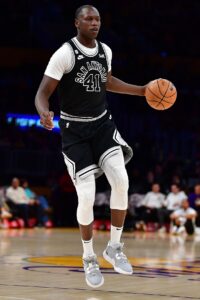 According to McDonald, Dieng splits his time between the front office and coaching staff, working with general manager Brian Wright in addition to mentoring young big men like Victor Wembanyama and Charles Bassey.
“I’m very free on what I’m doing,” Dieng said. “I’m in the front office learning and doing stuff. When they start practice, I come here and help the team. I’m here just to be around them and help.”
Dieng, who will turn 34 in January, appeared in a total of 628 regular season NBA games from 2013-23, averaging 7.3 points and 5.6 rebounds in 20.1 minutes per night for the Timberwolves, Grizzlies, Spurs, and Hawks. In 2022/23, he played in 31 games for San Antonio, providing some veteran frontcourt depth and serving as a leader in the locker room.
“Everyone around me knew I wanted to play 10 years and that was it,” Dieng said. “I always said that. When I reached 10, I said I’ve reached my goal. It was time to stop and try different stuff.”
Despite his stated desire to play just 10 years, Dieng was open to contract offers this past offseason, but didn’t generate much interest on the free agent market, McDonald reports.
The Senegalese forward/center, who has a house in San Antonio and spent some time at the team’s practice facility during the summer, approached Wright about joining the organization as an intern, according to McDonald, who says the team insisted on giving Dieng a formal position and a salary. Head coach Gregg Popovich and the Spurs’ players are happy to have him around.
“He’s a wonderful human being,” Popovich said. “He’s one of the all-time favorite teammates of everybody. He’s a great source of experience in the league, and anybody can talk to him.”
“He’s someone you can always talk to at any time,” Spurs guard Tre Jones agreed. “He is always open. I think just having that personal connection to everybody and having such good relationships with people, that’s what makes him who he is.”
For his part, Dieng says he’s “learning a lot of stuff” in his new role and that he’s especially enjoyed the work he’s doing in the Spurs’ front office. According to McDonald, Dieng said he can imagine himself one day becoming a team’s top basketball operations executive, but for now he’s happy to play a far more modest role in San Antonio and perhaps work his way up the ladder.
“The front office, it takes talent,” Dieng said. “It takes hard work. Us (players), we just play and go home. They put everything together.”
Northwest Notes: Watson, Edwards, Milton, Jazz
A rotation player this season after logging limited minutes as a rookie, second-year Nuggets guard Peyton Watson has Deion Sanders’ portrait in his locker to remind of the type of defender he wants to be, writes Vinny Benedetto of The Denver Gazette. Watson, who has earned praise from teammates Nikola Jokic and Kentavious Caldwell-Pope for his defensive play and his energy, explained his thinking.
“I just thought it was the most admirable thing that teams would literally throw away from his side (first) through (third) downs. Then, on fourth down, (they) punt out of bounds so he couldn’t return it. Like, you can’t even let this guy get involved in the game,” Watson said. “I admire the mentality and how he approached the game.”
While minutes have fluctuated this fall for some of the Nuggets’ reserves, Watson has remained a part of head coach Michael Malone‘s regular second unit, averaging more than 21 minutes per night in his past six games.
“He can guard bigs. He can guard smalls. I like how he’s playing right now,” Malone said. “He’s helping impact the game in a positive manner right now, and it’s great to see for a young player, taking advantage of the opportunities that’s being given to him.”
Here’s more from around the Northwest:
- Timberwolves guard Anthony Edwards, who recently missed two games with a hip pointer and appeared to be favoring that hip in his return on Wednesday, exited Friday’s game after just three minutes (Twitter link). He’s undergoing further examination on Saturday and it remains unclear whether he’ll miss any additional time, per Jon Krawczynski of The Athletic.
- The Shake Milton that scored 17 points on 6-of-9 shooting in Friday’s win over Memphis was the player the Timberwolves thought they were getting when they signed him in free agency this summer, according to Krawczynski, who suggests Minnesota will become an even more dangerous team if the guard’s Friday performance wasn’t a one-off. Head coach Chris Finch has been pushing the struggling Milton to be more confident and assertive, which was reflected in his play in Memphis, Krawczynski adds.
- While Salt Lake City officials are working hard to keep the Jazz in the downtown area, the franchise has explored the possibility of building a new arena outside the city, including perhaps at the south end of Salt Lake County, according to Andy Larsen of The Salt Lake Tribune (subscription required). Larsen takes a deep dive into the story, examining the factors at play and clarifying that the team won’t be moving out of the Delta Center anytime soon.
Warriors Notes: Starting Five, CP3, Kuminga, Klay, Haliburton
There was an expectation heading into the Warriors‘ game on Friday in Oklahoma City that head coach Steve Kerr might make a change to a starting lineup that has struggled this season after being one of the NBA’s best in 2022/23. Entering Friday’s action, the five-man group of Stephen Curry, Klay Thompson, Andrew Wiggins, Draymond Green, and Kevon Looney had posted a minus-13.0 net rating in 113 minutes.
However, as Kendra Andrews of ESPN tweets, Kerr stuck with that lineup on Friday and it was relatively effective, outscoring the Thunder by three points in nearly 16 minutes of action. Still, it wasn’t enough. After taking a 14-point lead in the first half, the Warriors watched it slip away and eventually lost in overtime in OKC.
“It’s a pattern right now,” Kerr said after the game, per Anthony Slater of The Athletic. “I watched this same group win a championship a year and a half ago. They’re champions. But they’re not playing like it. I’m not coaching like it. We have to figure this out.”
Here’s more on the Warriors:
- Veteran point guard Chris Paul was a late scratch on Friday due to an illness, tweets Slater. The Warriors announced their starters before ruling out Paul, so the starting five presumably would have been the same even if he had been available.
- Golden State committed 29 turnovers in Friday’s loss, which is the most in any game in the Kerr era and the most by any Warriors team since 2002, writes Slater. Kerr referred to it as an “obscene” amount of turnovers and said he plans to hold a film session to try to address the issue. “You want me to go through them?” Kerr said when asked if there were any in particular they needed to eliminate. “We will watch all 29 as a team. I can tell you that. We will watch all 29 turnovers.”
- Klay Thompson praised Jonathan Kuminga for his recent play, referring to him as “the future,” according to Slater. Thompson also said he’ll “never, ever lose faith in this group” and shrugged off Charles Barkley likening the 10-12 Warriors to the Titanic on TNT’s Thursday broadcast.“The only frustration with that is will this guy ever give us any credit?” Thompson said when informed of Barkley’s comments. “You know how hard this is to do? Annually? You’d think Charles would understand how hard it is to win a championship. To do that annually? And we’re still here. What are we — 10 and 12? There’s 60 freaking regular season games left. But he’s been hating on us since 2015. So this is no surprise.”
- During that same TNT broadcast, former Warriors president of basketball operations Bob Myers spoke about bringing Tyrese Haliburton in for a workout prior to the 2020 draft and ultimately passing on him (Twitter video link). “What bothers me more than anything was — his workout was good (but) when we met with him after, I should have known then because of who he is as a person and a leader,” Myers said. “… That conversation left a mark because of how smart he is and how confident. It’s not fake, it’s not arrogant, it’s confidence. When you talk about players wanting to play with him, that’s real. … There’s a lot of great players in the NBA that people do not want to play with. (If) you are a great player and a great person, then people want to play with you.” Haliburton said at the time that he thought he’d be a “really good fit” in Golden State — he wasn’t really in the conversation for the No. 2 overall pick, but there was a sense that he could be one of the Warriors’ targets if they traded down.
Raptors Notes: Lineup, Schröder, Trent, Siakam, Gueye
Prior to Friday’s game against Charlotte, Eric Koreen of The Athletic and Blake Murphy of Sportsnet.ca both made the case that the Raptors should make a lineup change. Koreen advocated for Gary Trent Jr. to replace Dennis Schröder in the starting five, with Murphy acknowledging that’s the “most obvious immediate move.”
The logic, as Murphy explains, is that the trio of Pascal Siakam, OG Anunoby, and Scottie Barnes would benefit from playing with at least one outside shooter, if not two. Instead, the three forwards have spent most of the season alongside Schröder, an inconsistent marksman (he’s at 33.3% on threes this season) and Jakob Poeltl, a non-shooter. The five-man unit had a minus-3.1 net rating entering Friday, which isn’t acceptable for the team’s top lineup, writes Murphy.
However, head coach Darko Rajakovic stuck with his usual group against the Hornets. The starting five spent 17 minutes on the floor together and was outscored by three points during that time while making just 2-of-11 outside shots. The rest of the Raptors’ lineups played Charlotte to a draw, but the starters’ three-point deficit was ultimately reflected in the final score: Toronto lost 119-116 to fall to 9-13 on the season.
Here’s more on the Raptors:
- The Raptors are at a familiar crossroads, according to Michael Grange of Sportsnet.ca, who says the team has failed to properly judge the level of its roster and where it stands relative to its competition in recent years. The franchise can’t afford to make that mistake again and will need to be prepared to make difficult personnel decisions at this season’s trade deadline, Grange writes.
- Josh Lewenberg of TSN.ca explores the same subject as Grange, suggesting that time is running out for the current roster to prove it deserves to be kept intact. Within his story, Lewenberg cites league sources who say the Raptors still haven’t opened extension negotiations with Siakam but also haven’t discussed him in trade talks since the summer. Siakam will be an unrestricted free agent in 2024.
- Mouhamadou Gueye has gotten off to a strong start for the Raptors 905 this season, averaging 15.6 points, 8.3 rebounds, and 3.0 blocks in 32.4 minutes per game through his first nine contests with Toronto’s G League affiliate. Gueye would’ve been the most logical in-house candidate to fill the two-way contract slot that opened when the Raptors waived Ron Harper Jr., according to Murphy, but he’s currently dealing with a neck injury. Using that two-way spot to sign Jontay Porter away from another organization will provide the banged-up 905 with some additional depth.
Bulls Notes: LaVine, Caruso, Young Players, White
Speaking on Thursday to reporters, including K.C. Johnson of NBC Sports Chicago, Bulls guard Zach LaVine said he had originally hoped to return to action on Wednesday or Friday, but his injured foot didn’t respond well when he attempted to ramp up his work, so he and the team decided to take a more cautious approach. The Bulls ruled out LaVine for an additional three or four weeks and he received a PRP (platelet-rich plasma) injection.
“I’ve been trying to train and do active rehab to get back out there. That didn’t work,” LaVine said. “It had a little bit of a—I don’t want to say setback—but it got more sore to where it didn’t make sense to try to play on it continuously. Rest for a little bit. Get some PRP. Hopefully that will do some good things for it. Continue to promote that healing and check back in a week or two and see where you’re at.”
LaVine added that his absence has “nothing to do” with the trade speculation swirling around him and that he’s been happy to see the team string together some wins without him. He’s hoping that success continues and that he’s able to contribute to it once he returns.
“Am I still a part of this team and very committed? Yeah. I got a Bulls jersey on. I committed here. And for as long as I’ll be here, I’ll still support and love Chicago and go out there and play my heart out for those guys. That’s never going to change,” he said. “There’s going to be different stories and narratives. And there’s going to be off-the-court stuff that’s going to be dealt with. For me, as long as I’m here with a Bulls jersey on, I’m going to play as hard as I can for my teammates and continue to be the best player and teammate I can be. Simple as that.”
Here’s more on the suddenly surging Bulls:
- The Bulls won a fourth consecutive game on Friday night, defeating the Spurs in San Antonio, but Alex Caruso left the game in the fourth quarter due to a left ankle injury and didn’t return, Johnson notes for NBC Sports Chicago. The severity of that injury is to be determined, but Caruso had to be helped to the locker room by the team’s training staff.
- Darnell Mayberry of The Athletic takes a look at some of the young players who are getting more opportunities with LaVine sidelined, including guards Coby White and Ayo Dosunmu.
- Despite the Bulls’ four-game winning streak since LaVine went down, no one in the locker room is suggesting the team is better without the two-time All-Star, writes Joe Cowley of The Chicago Sun-Times. “It’s hard to replace the talent that Zach has out there on the court with one person,” Caruso said. “We’ve done a good job of playing-by-committee. It’s also a different look when (LaVine’s) not out there compared to when he is, but I’ve played in plenty of games with him now, nearly two-and-a-half years, and when he’s locked in and playing good we’re a really good basketball team.”
- In a separate story for the Chicago Sun-Times, Cowley examines how White has responded to outside criticism – including from Cowley himself – and has continued to make major strides, proving those critics wrong. “I know what you said, others have said,” White told the Sun-Times. “I feel like I’ve got thick skin, but the main thing for me is I wanted to pay attention to it just so I can feel it. Feel it for me, and then to get through it. … You know what, sometimes people on the internet or the media, you guys, you speak the truth. There were times I would look at it and say, ‘I got to get better at this, he’s right. I’ve got to fix this.’ I never tried to shy away from any of it because that’s not my personality. You have to look at it all head on, take it for what it is, not let it define you, but use it.”
Poll: Which Team Will Win NBA Cup?
The NBA’s first-ever in-season tournament final will take place on Saturday at T-Mobile Arena in Las Vegas, as the veteran Lakers take on the upstart Pacers for the right to hold the NBA Cup — and to earn championship bonuses worth $500K per player.
The Lakers may have the home-court advantage, given Los Angeles’ proximity to Vegas and the franchise’s huge fan base, but the Pacers have earned plenty of fans of their own in recent weeks with their fast-paced, high-scoring style of play. And they’ll enter the game as the lovable underdogs looking to knock off another highly star-studded opponent after defeating Boston in the quarterfinal and Milwaukee in the semifinal.
The Pacers’ 123.5 offensive rating is easily the NBA’s best mark, as is their pace (104.13 possessions per game). Tyrese Haliburton, who is submitting an MVP-caliber season thus far, leads the attack with 26.9 points and an NBA-best 12.1 assists per game, but the Pacers have no shortage of offensive options, with six other players averaging double-digit points per night (a seventh, Jalen Smith, won’t be available on Saturday).
They’ll be going up against one of the NBA’s stoutest defenses — the Lakers’ 110.3 defensive rating is tied for sixth-best in the league. Los Angeles also holds a significant edge in big-game experience. While Haliburton and several other Pacers have never played in the postseason, LeBron James alone has 282 playoff games on his résumé.
Of course, Saturday’s game isn’t a playoff contest, and Haliburton and the Pacers certainly haven’t shied away from the spotlight so far in the in-season tournament, having talked repeatedly about how they’re embracing the rare opportunity to play for a national audience.
Both teams have taken the tournament seriously so far and that doesn’t figure to change on Saturday, with $300K on the line (the runners-up will go home with bonuses worth $200K rather than $500K).
We want to know what you think. Are you taking the Pacers or the Lakers to win the first NBA Cup?
Place your vote below, then head to the comment section below to share your predictions.
Who will win the 2023 NBA Cup?
-
Indiana Pacers 51% (425)
-
Los Angeles Lakers 49% (402)
Total votes: 827