
Hoops Rumors Chat Transcript: 7/27/2023
Hoops Rumors hosted a live chat today at 10:30 am Central time (11:30 am Eastern).
Click here to view the transcript, and join us on Tuesday for our next live chat, hosted by Dana Gauruder.
2023/24 Non-Guaranteed Contracts By Team
As the NBA regular season approaches and teams reduce their rosters from the 21-player offseason limit to the 15-man regular season max, the best way to determine which players will survive preseason cuts is to consider their contracts. Players with guaranteed salaries for 2023/24 are far more likely to earn spots on 15-man rosters than players whose contracts aren’t fully guaranteed.
Keeping that in mind, we’re using the space below to keep tabs on the players on each NBA team who don’t have fully guaranteed contracts. The players listed here have non-guaranteed salaries, partially guaranteed salaries, or Exhibit 9 or Exhibit 10 contracts, which essentially function like non-guaranteed deals.
Unless otherwise noted, these players are on minimum-salary contracts. Some players on this list have partial guarantees, which we’ve also mentioned below.
Not all of these players will be waived before the regular season begins, so we’ll maintain this list for the next several months, up until January 10, 2024. That’s the day that all players still under contract will have their salaries fully guaranteed for the rest of the 2023/24 season.
[RELATED: Early NBA Salary Guarantee Dates For 2023/24]
Only players who have formally signed contracts are listed below, so if a player has reportedly reached an agreement with a team on a non-guaranteed deal, we’ll add him to our list when that deal becomes official and we confirm the details.
Without further ado, here’s the full list of players without fully guaranteed salaries for 2023/24, broken down by team:
Updated 1-10-24 (5:42am CT)
Atlanta Hawks
- None
Boston Celtics
- None
Brooklyn Nets
- None
Charlotte Hornets
- None
Chicago Bulls
- None
Cleveland Cavaliers
- None
Dallas Mavericks
- None
Denver Nuggets
- None
Detroit Pistons
- None
Golden State Warriors
- None
Houston Rockets
- None
Indiana Pacers
- None
Los Angeles Clippers
- None
Los Angeles Lakers
- None
Memphis Grizzlies
- None
Miami Heat
- None
Milwaukee Bucks
- None
Minnesota Timberwolves
- None
New Orleans Pelicans
- None
New York Knicks
- None
Oklahoma City Thunder
- None
Orlando Magic
- None
Philadelphia 76ers
- None
Phoenix Suns
- None
Portland Trail Blazers
- None
Sacramento Kings
- None
San Antonio Spurs
- None
Toronto Raptors
- None
Utah Jazz
- None
Washington Wizards
- None
Jaylen Brown Extension Notes, Reactions
While it’s possible the Celtics will eventually regret giving Jaylen Brown a five-year super-max extension that projects to be the richest deal in NBA history, it was the only real option available to them, says Kevin O’Connor of The Ringer.
As O’Connor outlines, Boston has title aspirations in 2023/24 and there was likely no viable trade involving Brown that would have raised the team’s ceiling in the short term. The Celtics could have tried to pay Brown less than his maximum, but would’ve risked alienating him and compromising their chemistry heading into an important season — not to mention potentially losing him in unrestricted free agency a year from now.
Executives around the league who spoke to Sean Deveney of Heavy.com agreed that giving Brown a super-max extension was the most logical path for the Celtics.
“It is a good deal because he is a star player and that is what they had to pay him,” an Eastern Conference executive said. “I love the people who say they should not have given him that contract. Like, OK, then what should they have done? Traded him? Let him go to free agency? The same people who are beating them up for signing him would be beating them up if they did not sign him. It’s crazy.”
With Jayson Tatum due for a super-max extension of his own in 2024, the Celtics may face financial challenges down the road, but having two young stars on big contracts is a “champagne problem,” O’Connor writes, suggesting that it’s not something the team needs to worry about right away. If Boston ultimately decides that it can’t win a title with a roster built around Tatum and Brown, the club is now better positioned to eventually make a trade rather than having to undergo a full reset.
Here’s more on Brown’s new deal:
- The extension signals that the Celtics intend to move forward with their plan to build around the trio of Brown, Tatum, and Kristaps Porzingis, all of whom are between 25 and 27 years old, writes Jay King of The Athletic. While they’ll likely miss Marcus Smart and Grant Williams, the C’s are optimistic that Porzingis’ presence will put them in a better position to attack certain defenses that have given them trouble in recent years, King explains.
- Chris Forsberg of NBC Sports Boston takes a look at the short- and long-term implications of Brown’s new contract, observing that there may be a financial squeeze on the Celtics’ supporting cast in future seasons.
- While Brown’s extension is the new richest contract in NBA history, it won’t hold that title for long, notes Zach Kram of The Ringer. Given the rate at which the league’s salary cap is climbing, some massive contracts signed in the early 2020s already look like bargains, Kram writes. Brown’s deal may never qualify as team-friendly, but the super-max contracts being signed during the later years of his extension will be significantly more lucrative.
Celtics Sign Jaylen Brown To Super-Max Extension
JULY 26: Brown has officially signed his super-max extension, the Celtics announced today (via Twitter).
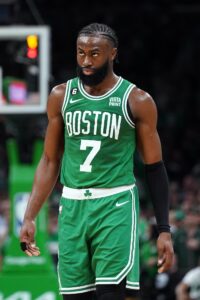 JULY 25: The Celtics and star wing Jaylen Brown are in agreement on a five-year, super-max contract extension, agent Jason Glushon tells Marc J. Spears of Andscape (Twitter link).
The deal, which is worth a projected $304MM, is fully guaranteed and includes a trade kicker, but doesn’t feature a fifth-year player option, tweets Shams Charania of The Athletic.
It’s the most lucrative deal in NBA history, and a massive investment by the Celtics in Brown, who became eligible for a super-max extension – with a starting salary worth 35% of the cap instead of 30% – by making the All-NBA Second Team this spring.
The 26-year-old averaged a career-best 26.6 points per game on .491/.335/.765 shooting while also contributing 6.9 rebounds, 3.5 assists, and 1.1 steals per night across 67 appearances (35.9 MPG). He earned his second All-Star nod and helped the Celtics get to within one game of the NBA Finals.
Brown had been entering a contract year in 2023/24 and there was a belief that it would be difficult for the Celtics to extend him if he hadn’t become super-max eligible, due to the NBA’s limitations on veteran extensions. Once Brown made an All-NBA team, it opened the door for the two sides to reach an agreement on a deal that will tack on five years to his current contract and ensure he’s under team control through 2028/29, keeping him off next summer’s free agent market.
While it took a few weeks for the two sides to come to terms, reports throughout July consistently maintained that there was optimism it would eventually get done — now it has.
The projected $304MM figure is based on an assumption that the NBA’s salary cap will increase by 10% again in 2024/25, as it has in each of the last two seasons. Assuming that’s the case, Brown will earn approximately $52.4MM in the first year of his new contract; that number would jump all the way up to $69.1MM by year five, resulting in a total of about $303.7MM.
Before his new extension takes effect, Brown will earn a base salary of $28.5MM in 2023/24, with an additional $3.3MM available in incentives.
Brown will become the 12th player to sign a designated veteran contract since the NBA introduced it in 2017. Even if the cap doesn’t increase by a full 10% next offseason, the value of Brown’s extension will comfortably surpass Nikola Jokic‘s five-year, $276.1MM contract with Denver — Jokic’s deal was previously the most lucrative in NBA history.
Brown’s teammate Jayson Tatum also achieved the super-max performance criteria this spring, but won’t have the service time necessary to sign a designated veteran extension of his own until the 2024 offseason. Assuming the Celtics also ink Tatum to a super-max deal, which could become the new richest contract in league history, they’ll have to figure out a way to build and maintain a competitive roster around two massive contracts in the coming years.
As Bobby Marks of ESPN notes (via Twitter), once Brown officially signs his extension, he’ll be ineligible to be traded for a full calendar year.
Contract Details: Noel, Dowtin, White, Jordan, Matthews, More
The one-year, minimum-salary contract that Nerlens Noel signed with the Kings is currently only partially guaranteed for $300K, Hoops Rumors has learned. Noel would see his partial guarantee increase to $600K if he hasn’t been waived by the first game of the regular season this fall. In order to receive his full salary, he’d need to remain under contract through at least January 7.
Here are more details on a few recently signed NBA contracts:
- Jeff Dowtin‘s one-year, minimum-salary contract with the Raptors is fully non-guaranteed for the time being. However, the guard would receive a partial guarantee worth $900K if he’s not waived on or before October 21, reports Blake Murphy of Sportsnet.ca (Twitter link).
- The Thunder signed Jack White to a two-year, minimum-salary contract that includes a $600K partial guarantee in year one and a team option for 2024/25, Hoops Rumors has learned.
- The one-year, minimum-salary deals signed by DeAndre Jordan (Nuggets) and Wesley Matthews (Hawks) are fully guaranteed, Hoops Rumors has learned.
- The two-way contracts signed by Omari Moore (Bucks) and Leaky Black (Hornets) cover two years rather than just one, Hoops Rumors has learned.
- Sixers center Montrezl Harrell and Nuggets guard Reggie Jackson waived their right to veto trades during their 2023/24 season, Hoops Rumors has learned. As we detailed earlier today, players who re-sign with their previous teams on one-year deals (or two-year deals with a second-year option) get trade veto rights by default, but can choose to give up those rights.
Lauri Markkanen A Candidate For Renegotiation In 2024
Jazz forward Lauri Markkanen is a player to keep an eye on as a strong candidate for a contract renegotiation and extension in 2024, according to Michael Scotto of HoopsHype. Scotto made his comments on Markkanen during a podcast with HoopsHype colleague Yossi Gozlan, who said he’d be surprised if the 26-year-old’s contract isn’t renegotiated and extended next offseason.
An NBA team can’t renegotiate a player’s salary downward, but is allowed to use cap room to give him a raise for the current season, as the Jazz did with Jordan Clarkson earlier this month. The club can then negotiate an extension based on that newly renegotiated cap hit, giving him a first-year salary worth as much as 140% of that amount (up to the player’s maximum salary).
Markkanen will earn approximately $17.26MM in 2023/24 and $18.04MM in ’24/25. Under the NBA’s veteran extension rules, he’d be eligible next offseason for a four-year extension worth approximately $113MM, including a 40% raise to $25.26MM for ’25/26.
Renegotiating Markkanen’s contract using cap room to give him a raise in 2024/25 would allow the Jazz to increase their extension offer well beyond $113MM, putting them in a better position to lock up the Finnish star for the long term. Utah currently only projects to have about $99MM in salaries on its cap for ’24/25, and not all of that money is guaranteed, so the team would have plenty of flexibility to operate under the cap and give Markkanen a raise.
After being traded from the Cavaliers to the Jazz in the Donovan Mitchell blockbuster, Markkanen enjoyed a breakout season in Utah, earning his first All-Star nod and blowing away his previous career high by averaging 25.6 points per game in 66 contests (34.4 MPG). He posted an impressive shooting line of .499/.391/.875 and also grabbed 8.6 rebounds per night.
Markkanen will technically become extension-eligible this offseason, but the Jazz aren’t in position to renegotiate his contract yet, since they’ve used up their 2023/24 cap room. That means the most he could get on an extension prior to next offseason is $81.9MM over three years.
NBA contract renegotiations have typically been pretty rare, but they’ve enjoyed a renaissance within the last year. Clarkson, Domantas Sabonis (Kings), and Myles Turner (Pacers) have all renegotiated their contracts with their respective teams since January. Before that, no player had agreed to a renegotiation since Robert Covington in 2017.
Hoops Rumors Glossary: No-Trade Clause
It’s not uncommon in many major professional sports for a player to negotiate a contract that includes a no-trade clause, which prohibits him from being traded – either at all or to certain specific teams – without his consent. However, no-trade clauses are extremely rare in the NBA.
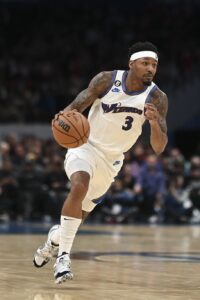 When the Wizards signed Bradley Beal to a new contract in 2022 that included a no-trade clause, Beal became just the 10th player in NBA history to receive that perk.
In order to qualify for a no-trade clause, a player must meet the following criteria:
- He must be signing a free agent contract, not an extension.
- He must have at least eight seasons of NBA experience.
- He must have spent at least four seasons with the team he’s signing with.
This last point is the most malleable of the three. In order to qualify for a no-trade clause, a player doesn’t necessary need to have spent the past four consecutive seasons with his team — he just needs to have spent at least four seasons with that team at some point.
For example, if LeBron James were to become a free agent next summer and decided to sign with the Heat, he could negotiate a no-trade clause into his new contract, since he spent four years in Miami from 2010-14.
Additionally, a partial season can be counted as one of those four seasons a player needs to spend with a team in order to qualify for a no-trade clause. For instance, if Jordan Clarkson had become a free agent this offseason, he would’ve been eligible to negotiate a no-trade clause with the Jazz, who traded for him during the 2019/20 season. Clarkson has only been in Utah for three full years and part of a fourth season, but that’s enough to meet the criteria.
Still, those three requirements are enough to eliminate a no-trade clause as an option for many players. One prominent recent example is Jaylen Brown. Although Brown has spent more than four years with the Celtics, he has only been in the NBA for seven seasons and is signing an extension rather than a free agent contract, so a no-trade clause wasn’t available to him.
A player who has a no-trade clause in his contract and consents to a trade retains the right to veto a trade when he joins his new team. So Beal’s no-trade clause remains in effect now that he’s a member of the Suns.
Although explicit no-trade clauses are rare, there are a couple other scenarios in which a player can receive an implicit no-trade clause, meaning his consent is still required in order to trade him.
First, a player who re-signs with his previous team on a one-year contract, or a two-year deal with an option year, is given no-trade protection for the rest of that league year — or until his second-year option is exercised.
Heat forward Kevin Love and Suns wing Josh Okogie are among the players who will fall into this group in 2023/24.
Here are a few more notes related to these criteria:
- A player who meets these criteria and still decides to consent to a trade will lose his Bird or Early Bird rights at the end of the season and will instead be deemed to have Non-Bird rights.
- Although those criteria don’t apply to players on two-way contracts, they do apply to players who accept standard (ie. non two-way) one-year qualifying offers as restricted free agents. So Hornets forward Miles Bridges will have the right to veto a trade in ’23/24.
- The NBA’s new Collective Bargaining Agreement allows a player who re-signs with his former team on a one-year contract (or two-year deal with an option) to waive his ability to veto a trade. A handful of players have done so this offseason, including Lakers guard D’Angelo Russell and Nuggets guard Reggie Jackson. They’re eligible to be traded without their approval in 2023/24.
Second, a player who signs an offer sheet as a restricted free agent and has that offer matched by his previous team has the ability to veto a trade for a full calendar year. That means Trail Blazers swingman Matisse Thybulle and Sixers big man Paul Reed will have de facto no-trade protection until next July.
While explicit no-trade clauses in the NBA are rare, these criteria that give players veto rights for a year at a time aren’t uncommon at all, and often end up applying to non-stars, giving them a little control over their own professional futures.
Note: This is a Hoops Rumors Glossary entry. Our glossary posts will explain specific rules relating to trades, free agency, or other aspects of the NBA’s Collective Bargaining Agreement. Larry Coon’s Salary Cap FAQ was used in the creation of this post.
Spurs Considered Lucrative Offer Sheet For Austin Reaves
Lakers guard Austin Reaves revealed in a recent interview that the Spurs and Rockets were among his potential options in free agency before he reached a deal to remain in Los Angeles.
Michael Scotto of HoopsHype has since provided more details on those what-if scenarios, citing league sources who say San Antonio considered an offer sheet for Reaves that would have been worth $21MM per season.
However, according to Scotto, the Spurs were concerned that the Lakers would simply match their offer sheet and that they might miss out on other opportunities to use their cap room while they awaited L.A.’s decision. The Lakers wouldn’t have had to officially match an offer sheet for Reaves until the end of the day on July 7 and could have tied up San Antonio’s space in the meantime.
As for the Rockets, they were “closely monitoring” Reaves and were prepared to put together a lucrative offer sheet if they had failed to land top target Fred VanVleet, sources tell Scotto. When VanVleet agreed to a three-year, maximum-salary deal with Houston, the team didn’t see the need to spend big on another backcourt player.
Reaves’ restricted free agency was an uncommon case, since he had accumulated just two years of NBA experience and was therefore subject to the Gilbert Arenas provision.
Although the Lakers could only offer Reaves about $53.8MM over four years using his Early Bird rights, the Arenas provision allowed a rival team with cap room to give him a bigger, back-loaded offer sheet worth up to nearly $102MM over four years — the Lakers would have had the right to match any offer sheet despite not being able to offer Reaves that much money directly.
Ultimately, no rival suitors decided to aggressively pursue Reaves, allowing the Lakers to bring him back on his maximum Early Bird deal, worth $53.8MM across four seasons. Following a breakout season in which he averaged 13.0 points, 3.4 assists, and 3.0 rebounds in 28.8 minutes per game with an excellent .529/.398/.864 shooting line, the 25-year-old may turn out to be a bargain at that price.
Hawks, Magic To Play Regular Season Game In Mexico City
The Hawks and Magic will face one another in the NBA’s 2023 Mexico City Game, the league announced today in a press release. The regular season contest will take place on Thursday, November 9 at the Arena CDMX.
According to the NBA’s announcement, it will be the league’s 32nd game played in Mexico since 1992, including both the regular season and preseason. Outside of the U.S. and Canada, no country has hosted more NBA games during that time.
The Magic have competed a few times in Mexico City, including twice during the 2018/19 season, but it will be the Hawks’ first visit to the city.
Mexico City has been a frequent destination for NBA regular season games in recent years. The league held a pair of regular season contests in the city each year for four consecutive seasons from 2016-19. Following a COVID-related hiatus, the NBA returned to Mexico last December, when Miami faced San Antonio.
The Spurs participated in each of the two most recent games in Mexico City, but it appears that fans south of the border won’t get the opportunity to see No. 1 overall pick Victor Wembanyama in person during his rookie year, assuming the league doesn’t have plans to separately announce a second Mexico City game.
The NBA will play at least two regular season contests outside of the U.S. and Canada in 2023/24 — the league announced a week ago that Brooklyn and Cleveland would square off in Paris.
NBA Teams Facing Potential Fall Roster Crunches
With two months to go until NBA teams report to training camps, there’s no need for a club to have its 21-man offseason roster – let alone its 15-man standard roster for the regular season – set in stone at this point.
Still, many rosters around the league are clearly taking shape, with several teams carrying 14 or 15 players on standard guaranteed contracts and seemingly unlikely to make any more major changes this offseason.
There are also a handful of teams carrying more than 15 standard contracts who will have to trade or waive at least one or two of those players before the regular season begins in order to adhere to the NBA’s regular season roster limit.
Here are some of the teams who will be facing possible roster crunches in the coming months:
Oklahoma City Thunder
(20 standard contracts)
The Thunder have been a willing trade partner for teams looking to dump unwanted contracts this offseason, and it has resulted in Oklahoma City becoming the first club to reach its full 21-man roster limit (its 21st player, Keyontae Johnson, is on a two-way contract).
Of the Thunder’s 20 players on standard deals, at least 17 have guaranteed salaries for 2023/24. That group doesn’t include Jack White, whose full contract details have yet to be reported, or Isaiah Joe and Aaron Wiggins, both of whom are on non-guaranteed contracts after playing well in rotation roles in ’22/23.
If the Thunder intend to keep White, Joe, and Wiggins into the regular season, they’ll have to trade or waive five players on guaranteed salaries. The players recently acquired in those salary-dump deals – including Victor Oladipo, Davis Bertans, TyTy Washington, and Usman Garuba – would probably be most at risk. Of the Thunder’s returning players, Tre Mann and Jeremiah Robinson-Earl are among those whose roster spots may not be fully secure.
Memphis Grizzlies
(17 standard contracts)
Like the Thunder, the Grizzlies took on some unwanted contracts in offseason trades in order to acquire other assets.
The two players Memphis received in those deals – Josh Christopher and Isaiah Todd – are the most likely odd men out for the 15-man regular season roster, since none of Memphis’ other 15 players are obvious trade or release candidates.
San Antonio Spurs
(17 standard contracts)
The Spurs actually only have 16 players on standard contracts for the time being, but are reportedly bringing back Sandro Mamukelashvili on a one-year deal. He has yet to officially re-sign and the exact details of his contract are unclear.
Assuming San Antonio plans to have Mamukelashvili on its 15-man regular season roster, the team will need to trade or waive two other players before opening night. That number could grow if the Spurs want to sign Dominick Barlow or Sidy Cissoko to a standard contract, but they do have two-way slots available for both.
Cameron Payne, Cedi Osman, Reggie Bullock, Devonte’ Graham, and Khem Birch are a few of the veterans on expiring or pseusdo-expiring contracts who probably aren’t in the Spurs’ long-term plans. But some of those guys would be useful contributors on the court this season and might have a little trade value, so San Antonio might not be done dealing.
Washington Wizards
(16 standard contracts)
The Wizards have a new front office in place for this season, so some of the reserves on expiring contracts who were brought in by the old regime could be candidates to be traded or waived. That group includes Delon Wright, whose name has come up in trade rumors this summer, Xavier Cooks, whose multiyear deal is only guaranteed for 2023/24, and Anthony Gill.
The new regime has also acquired a few players this offseason who may have been traded for financial or salary-matching reasons more than for how they fit into the Wizards’ plans going forward. Of those players, Danilo Gallinari and Mike Muscala are on expiring contracts, while Patrick Baldwin and Landry Shamet aren’t currently owed guaranteed money beyond 2023/24 (Ryan Rollins has a $600K partial guarantee in ’24/25).
It wouldn’t shock me if the Wizards end up moving off multiple players on the current roster and making another addition or two before the regular season begins.
Others to watch
The Hawks are currently carrying 16 players on standard contracts, but only 15 are guaranteed, making Vit Krejci and his non-guaranteed salary the probable odd man out. Atlanta also reportedly remains active in trade talks, which could further shake up the roster.
The Hornets only have 12 players on guaranteed salaries, but they also have a pair (JT Thor and Kobi Simmons) on non-guaranteed deals, plus a pair of restricted free agents (P.J. Washington and Theo Maledon) and a No. 31 overall pick (James Nnaji) who remain unsigned. Charlotte can comfortably manage the 15-man limit, especially if Nnaji spends the season overseas, but may have to deal with a minor roster crunch if Washington and Maledon both return.
The Clippers, like the Hawks, have 15 players on guaranteed salaries and a 16th (Jason Preston) on a non-guaranteed deal. Los Angeles pushed back Preston’s guarantee date, which suggests the team may be open to hanging onto him if a roster spot becomes available (perhaps in multi-player James Harden trade?).
The Trail Blazers and Sixers are worth monitoring, since they would likely take back more players than they send out in any trade involving Damian Lillard or Harden. For now though, both teams have plenty of roster space — Portland has 13 players on standard contracts (12 fully guaranteed), while Philadelphia has 14 (13 fully guaranteed).