
Remaining Mid-Level, Bi-Annual Exceptions Begin To Decline In Value
Besides being the day when non-guaranteed salaries officially become fully guaranteed, January 10 represents an important date on the NBA calendar for a second reason. It’s also the day when several cap exceptions begin to prorate downward for the rest of the season.
[RELATED: Key In-Season NBA Dates Deadlines For 2022/23]
The non-taxpayer mid-level exception, taxpayer mid-level exception, room exception, and bi-annual exception will all decline in value by 1/174th each day for the rest of the season, beginning today. Trade exceptions and disabled player exceptions will be unaffected.
Each team will be impacted slightly differently by the proration calculations. For instance, the Bulls had $7,290,000 left on their mid-level exception entering Tuesday. Their MLE value will decline by $41,897 per day (1/174th of $7,290,000) for each of the season’s remaining 90 days. By the last day of the season, even if they don’t use it to sign another player, the Bulls’ MLE would be only be worth in the neighborhood of $3.5MM.
A team like the Hornets, with their full $10,490,000 mid-level exception available, will see that exception’s value decline by over $60K per day, while the $691,731 left on the Timberwolves‘ MLE will dip by just $3,975 per day.
Teams’ mid-level and/or bi-annual exceptions will prorate downward daily by 1/174th of the amount left as of January 10, even if that club uses a portion of its exception between now and the end of the season. So if a team has $5MM left on its MLE today and uses $3MM to sign a player tomorrow, that team would still lose 1/174th of $5MM per day the rest of the way, not 1/174th of $2MM.
[RELATED: Hoops Rumors Glossary: Proration]
These prorating exceptions shouldn’t have a major league-wide impact. However, if a team wants to offer a free agent more than the minimum salary or sign a player to a three- or four-year contract during the second half of the season, they’ll need to use some form of the MLE or BAE. As a result, teams will have to keep tabs on the ever-changing values of those exceptions.
For details on the portions of their mid-level and/or bi-annual exceptions teams have used so far this season, you can check out our trackers here and here.
Suns Among Teams Interested In Jalen McDaniels
Hornets forward Jalen McDaniels has drawn “increasing interest” around the NBA as a potential trade candidate, Shams Charania of The Athletic said during an appearance on The Rally (Twitter video link). The Suns are among the clubs monitoring McDaniels as the February 9 trade deadline nears, according to Charania.
McDaniels, who will turn 25 later this month, is enjoying a breakout season in Charlotte, averaging career highs in points (10.9), rebounds (4.9), assists (2.1), and steals (1.1) per game, among other categories.
A fourth-year forward, McDaniels saw his playing time dip to a career-low 16.3 minutes per game under James Borrego last season, but has become a key rotation contributor for new head coach Steve Clifford in 2022/23, logging a career-high 26.5 MPG. He’s also one of just two Hornets to have appeared in all 41 games so far this season, along with Mason Plumlee.
McDaniels’ length, defensive versatility, and ability to make threes (.352 career 3PT%) will make him a popular trade target if the Hornets are willing to move him. Charania notes that the former second-round pick would make sense for Phoenix in a potential Jae Crowder deal, though a third team would almost certainly need to be involved, since Charlotte wouldn’t be a logical fit for Crowder.
Because McDaniels wasn’t a first-round pick, he’ll be an unrestricted free agent – rather than restricted – at the end of his fourth season this summer, and Charania suggests he’ll be “sought after” on the open market. That could make the Suns and other teams hesitant to give up too much for him — McDaniels’ club would have his Bird rights, but wouldn’t be able to control his free agency by unilaterally matching any offer he receives.
Scotto’s Latest: Burks, Reddish, Quickley, Cavs, Hardaway
Pistons guard Alec Burks is receiving interest from a number of playoff-caliber clubs, league sources tell Michael Scotto of HoopsHype.
Burks is having one of his best seasons as a pro off the bench for the Pistons, averaging 14.0 PPG, 3.0 RPG, and 2.2 APG in just 22.0 minutes per contest (30 games). His 44.7% three-point rate is a career high, as is his 46.4% mark on shots from the floor.
Burks is earning approximately $10MM this season and has a $10.49MM team option on his contract for 2023/24. According to Scotto, the Pistons are a pretty safe bet to exercise that option if Burks remains with the team for the rest of the season, since it’s a team-friendly price based on his production and his veteran presence. With that in mind, Detroit could always trade Burks in the offseason or even at the 2024 trade deadline, so the club won’t have to simply settle for the best offer in the coming weeks.
Here’s more from Scotto:
- The Knicks‘ asking price for Cam Reddish is a pair of second-round picks, league sources tell Scotto. The Lakers and Bucks are among the teams who have inquired on the fourth-year forward, Scotto adds.
- The Bucks are also one of the clubs to inquire on Knicks guard Immanuel Quickley, along with the Mavericks, Wizards, and others, says Scotto. However, Quickley has been playing some of his best basketball as of late and New York’s asking price is significant (at least a first-round pick), reducing the odds that he’s moved.
- Addressing the possibility of a Caris LeVert/Tim Hardaway Jr. swap between the Mavericks and Cavaliers, Scotto confirms a couple of concerns from Cleveland’s side first voiced by Chris Fedor of Cleveland.com. The Cavs would be hesitant to take on Hardaway’s contract, which has two years left beyond this season, according to Scotto, and may be seeking extra compensation in any deal due to a belief that LeVert is a better overall player.
Hoops Rumors’ 2023 NBA 10-Day Contract Tracker
On January 5, NBA teams became eligible to sign players to 10-day contracts, and many of the signings that take place between now and April will be of the 10-day variety. Hoops Rumors has created a database that allows you to keep on top of those deals, tracking every 10-day signing all season long.
Besides featuring all of this year’s 10-day deals, our 10-Day Contract Tracker includes information on all 10-day contracts signed since the 2006/07 season. The search filters in the database make it easy to sort by team, player, and/or year. For instance, if you want to see all the 10-day contracts that the Hawks have signed in the last 15-plus years, you can do so here. If you want to view Greg Monroe‘s history of 10-day deals, that list is here.
You can also see whether a player and team signed a second 10-day contract, or if those short-term deals led to an agreement that covered the rest of the season. Additionally, our tracker notes which 10-day deals remain active, saving you from having to figure out whether a particular contract ends on Wednesday or Thursday.
We’ve revamped our 10-day tracker since last season, but if you prefer the old look, you can still view it here.
A link to our 10-Day Contract Tracker can be found at any time in the right sidebar under “Hoops Rumors Features” on our desktop site. On our mobile site, you can find it on our “Features” page. We’ll be keeping it up to date for the rest of the season, so be sure to check back to keep tabs on the latest signings as they become official.
LeBron James Again Hints At Desire For Roster Upgrades
Lakers star LeBron James hasn’t come right out and said he believes the front office should be shopping its 2027 and 2029 first-round picks in an effort to upgrade the roster via trade. However, he hinted shortly after Christmas that he’d welcome that approach and reiterated that point in stronger terms to Sam Amick of The Athletic following Saturday’s win over Sacramento, despite still not saying it outright.
When he spoke to Amick following his postgame press conference, James repeatedly stated that his job is to play the games and let the front office handle roster moves, suggesting that he’ll leave any trade suggestions up to the media.
“If you guys know, then you guys know,” James replied when Amick asked whether it makes sense for the Lakers to stand pat until the offseason when the four-time MVP is playing at such a high level at age 38. “You guys know. I don’t need to talk about it. You guys know.”
Pressed on whether he needs to say anything publicly or privately to the Lakers’ top executives to encourage them to act, James added, “Listen, you guys know. It’s not rocket science. It’s not rocket science.”
Before parting ways with Amick, James added, “Y’all know what the f–k should be happening. I don’t need to talk.”
As we’ve discussed ad nauseam in recent months, there seemed to be an understanding after James signed a contract extension in August that the Lakers would be more aggressive in their efforts to improve this year’s roster. But multiple reports have indicated that head of basketball operations Rob Pelinka and the organization’s top decision-makers have been unwilling to part with those 2027 and 2029 first-rounders unless there’s a move that significantly improves the team’s title chances.
When Anthony Davis went down with a foot injury last month, the odds of the Lakers making a major move seemingly dropped. However, the team has gone 7-5 since Davis’ injury and is actually closer to a play-in spot than it was when the big man went down.
Given the level James and Davis have played at this season and the contributions the Lakers are getting from some of their role players, including Thomas Bryant, Dennis Schröder, Austin Reaves, Lonnie Walker, and sixth man Russell Westbrook, the club may be able to talk itself into the possibility of contending — especially if Davis returns sometime this month. After all, none of the Western Conference’s top teams have pulled away and established themselves as clear frontrunners to make the NBA Finals.
Still, finding a suitable trade won’t be easy. Westbrook ($47MM), Patrick Beverley ($13MM), and Kendrick Nunn ($5.25MM) are the only logical trade chips earning more than the minimum on the Lakers’ roster and none are considered positive assets. That means it might be a challenge for L.A. to get an impact player in return for any of those vets even if the team becomes more willing to give up a future first-rounder or two.
Cavaliers Eyeing Tim Hardaway Jr.
The Cavaliers have interest in Mavericks wing Tim Hardaway Jr., Chris Fedor of Cleveland.com said during an appearance on Jake Fischer’s Please Don’t Aggregate This podcast. Fedor identified Hardaway as a possible target for Cleveland after Fischer discussed the team’s interest in Pistons forward Bojan Bogdanovic.
“I would add another name,” Fedor said (hat tip to HoopsHype). “The Cavs believe this player is available, and my sources tell me that he could be had. It’s, again, at the right price. And it’s a little bit tricky, because he’s on a team that’s fourth place currently in the Western Conference.
“Tim Hardaway Jr. is somebody that the Cavs have been watching and they’ve been keeping an eye on. And I think if the Cavs had their choice, it would be very, very close. And they’re not going to have their choice, it doesn’t work that way, but if they had their choice, it would be between Bojan and Tim Hardaway Jr.”
The Cavaliers have two All-Stars (Darius Garland and Donovan Mitchell) in their backcourt, with All-Star center Jarrett Allen and last year’s No. 3 overall pick Evan Mobley up front. The small forward spot is the only one in the starting five that remains a question mark, with players like Caris LeVert, Isaac Okoro, Lamar Stevens, and Dean Wade cycling through it this season.
Fischer, having reported earlier this week that the Cavs are in the market for a defensive-minded wing who is also an outside shooting threat, likes the idea of Hardway for Cleveland, especially since LeVert would probably have to be included in a hypothetical trade (his $18MM+ salary is within $1MM of Hardaway’s). The Mavs kicked the tires on LeVert before Cleveland acquired him from Indiana a year ago, according to Fischer, who also suggested that Dallas has been seeking another shot creator to complement Luka Doncic.
Fedor believes a trade centered around Hardaway and LeVert would be a “logical stylistic swap,” though he acknowledged that there could be some obstacles. Hardaway is under contract for two seasons beyond this one, so the Cavs may be reluctant to make that sort of commitment before seeing how he fits (LeVert is on an expiring deal). Both Fischer and Fedor also agreed that the Cavs may want an extra asset as opposed to making a one-for-one trade.
Here are a few more Cavs-related notes from the podcast:
- “I’ve been told that the Cavs are not going to trade Isaac unless they get a significant piece back in return,” Fedor stated, referring to Okoro. Fedor initially said he’s not quite sure what sort of player would fit that profile, but agreed with Fischer when he suggested Raptors forward OG Anunoby. It’s difficult to imagine the Cavaliers having enough ammo to land Anunoby even if they were willing to include Okoro, since they can’t currently trade any of their future first-round picks.
- The Cavaliers are about $2.5MM below the luxury tax threshold and are unwilling to go into the tax this season, per Fedor. That will be a factor to watch as Cleveland consider possible deals.
- Neither Fischer nor Fedor gets the sense that Suns forward Jae Crowder is a target for the Cavaliers, and Fedor said he also heard that the club is “not all that interested” in Magic wing Terrence Ross.
- The Cavs won’t make a trade just to make one, Fedor said, adding that some people within the organization want to see what it looks like if Wade gets an extended shot at the starting small forward job. Wade made nine starts earlier in the season, but has been out since December 2 due to a shoulder injury.
Spurs Sign Gorgui Dieng To 10-Day Contract
10:57am: The deal is now official, per NBA.com’s transaction log. It will run through Tuesday, January 17.
7:14am: Just days after waiving him, the Spurs have agreed to re-sign big man Gorgui Dieng, according to ESPN’s Adrian Wojnarowski (Twitter link). A source tells Wojnarowski that San Antonio is bringing back Dieng on a 10-day contract.
Dieng, who will turn 33 later this month, signed a one-year, minimum-salary contract with San Antonio over the summer. The former Louisville standout played sparingly for the team in the first half of the season, averaging 4.1 points, 3.2 rebounds, and 2.0 assists in 13 appearances (11.6 MPG), and was perhaps valued more for his veteran leadership in the locker room than his contributions on the court.
Because the Spurs had a full 15-man standard roster, they had to cut a player when they agreed to acquire Noah Vonleh and cash in a salary-dump trade with the Celtics. Dieng was the odd man out, despite having a fully guaranteed salary.
Having already locked in his full-season $2.64MM salary, Dieng will now get the opportunity to double-dip with the Spurs on a 10-day deal, which will pay him approximately $152K.
No corresponding roster move will be necessary for San Antonio to open up a spot for Dieng, since the club waived Vonleh shortly after trading for him. Assuming the signing becomes official today or tomorrow, Dieng will be eligible to play in the Spurs’ next five games, starting with Monday’s contest in Memphis.
Salaries For 10-Day Contracts In 2022/23
When a player signs a 10-day contract, his team has the ability to use cap room or an exception to pay him more than the minimum salary. However, in practice, that never happens — virtually every player that signs a 10-day deal receives a prorated portion of the minimum salary.
The minimum salary in a given season differs from player to player, based on his years of NBA experience entering the season. For instance, in 2022/23, a rookie on a full-season minimum deal will earn $1,017,781, whereas a 10-year veteran who is earning the minimum will make $2,905,851.
[RELATED: NBA Minimum Salaries For 2022/23]
The same is true for 10-day deals. A rookie will earn significantly less over the course of his 10 days with a team than a tenured NBA veteran will.
Because the 2022/23 season is 174 days long, a player’s full-season minimum salary can be divided by 174 to calculate his daily salary. From there, it’s just a matter of multiplying by 10 to determine his salary on a 10-day contract.
Using that formula, here’s the full breakdown of what salaries for 10-day deals look like in ’22/23:
| Years in NBA | Salary |
|---|---|
| 0 | $58,493 |
| 1 | $94,136 |
| 2 | $105,522 |
| 3 | $109,318 |
| 4 | $113,114 |
| 5 | $122,602 |
| 6 | $132,091 |
| 7 | $141,580 |
| 8 | $151,069 |
| 9 | $151,821 |
| 10+ | $167,003 |
Because the NBA doesn’t want teams to avoid signing veteran players in favor of cheaper, younger options, the league reimburses clubs who sign veterans with three or more years of experience to 10-day, minimum-salary contracts.
In those instances, teams are on the hook for $105,522, the minimum salary for a player with two years of experience, while the NBA covers the difference. So a team would pay the same amount whether they sign a player with three years under his belt or a player with 12 years of NBA experience.
Here are a few examples based on 10-day deals that are currently active:
| Player | Team | Years | Salary | Paid by team |
|---|---|---|---|---|
| Joe Wieskamp | Raptors | 1 | $94,136 | $94,136 |
| Sterling Brown | Lakers | 5 | $122,602 | $105,522 |
| Gorgui Dieng | Spurs | 9 | $151,821 | $105,522 |
Recap Of 2022/23 Salary Guarantee Decisions
As of December 29, there were 30 players who were signed to standard, full-season contracts but whose salaries for the 2022/23 campaign weren’t fully guaranteed.
The deadline for teams to waive those players and avoid having their full ’22/23 salaries become guaranteed was on Saturday, January 7 at 4:00 p.m. CT.
Although their salaries won’t technically become guaranteed until January 10, those players would still receive their full-season guarantees if they’re cut today or tomorrow, since they wouldn’t clear waivers until at least Tuesday.
Here’s a roundup of the decisions teams made with those 30 players:
Players who will have their salaries guaranteed:
Each player’s salary is noted here. His cap hit is identical to his salary unless otherwise indicated.
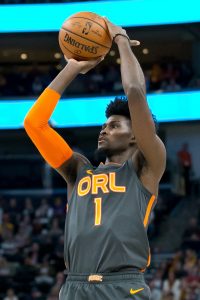
- Jonathan Isaac, Magic: $17,400,000
- Danny Green, Grizzlies: $10,000,000
- James Johnson, Pacers: $2,905,851 *
- Markieff Morris, Nets: $2,905,851 *
- Austin Rivers, Timberwolves: $2,905,851 *
- Matthew Dellavedova, Kings: $2,628,597 *
- Ryan Arcidiacono, Knicks: $2,133,278 *
- Justin Jackson, Celtics: $2,133,278 *
- Luke Kornet, Celtics: $2,133,278
- Dennis Smith Jr., Hornets: $2,133,278 *
- Svi Mykhailiuk, Knicks: $1,968,175 *
- Edmond Sumner, Nets: $1,968,175
- Yuta Watanabe, Nets: $1,968,175 *
- Jaylen Nowell, Timberwolves: $1,930,681
- KZ Okpala, Kings: $1,902,133
- Wenyen Gabriel, Lakers: $1,878,720
- Oshae Brissett, Pacers: $1,846,738
- Nathan Knight, Timberwolves: $1,836,090
- Lamar Stevens, Cavaliers: $1,782,621
- Haywood Highsmith, Heat: $1,752,638
- Stanley Johnson, Spurs: $1,670,643 ^
- Jose Alvarado, Pelicans: $1,563,518
- Vit Krejci, Hawks: $1,563,518
- Jock Landale, Suns: $1,563,518
- Austin Reaves, Lakers: $1,563,518
- Tyrese Martin, Hawks: $1,017,781
(*) cap hit of $1,836,090
(^) cap hit of $1,245,164
Of the 26 players on non-guaranteed contracts who were retained, 24 are earning the minimum salary, so the financial impact of keeping them is relatively minor. Still, open roster spots are valuable at this time of year — some of these players were fortunate not to be let go by a team prioritizing flexibility.
Isaac and Green were the only two players in this group earning more than the minimum. Neither has seen the floor this season while recovering from injury, but both had significant partial guarantees on their respective contracts — Isaac was already owed $16MM and Green was owed $7MM, so it didn’t make sense for either player to be cut.
Players who were waived before their salaries became guaranteed:
Each player’s cap hit is noted here. The team would no longer be on the hook for that cap charge if a player is claimed off waivers.
- Noah Vonleh, Spurs: $1,160,955
- Justin Champagnie, Raptors: $825,000
- Kemba Walker, Mavericks: $684,712
- Chima Moneke, Kings: $500,000
All four of these players were on minimum-salary contracts. Walker was signed well after the regular season got underway and Moneke was earning the rookie minimum, so their dead cap hits are especially modest. Champagnie’s and Moneke’s cap figures are the result of previously negotiated partial guarantees, rather than their prorated minimum salaries.
Vonleh was traded from Boston to San Antonio before being waived, as the Celtics reduced their projected luxury tax bill by getting the Spurs to eat that dead money.
There were a few other players with non-guaranteed salaries who were waived earlier in the season. That group consisted of Facundo Campazzo (Mavericks), Jordan Hall (Spurs), Matt Ryan (Lakers), and Alize Johnson (Spurs). Those moves didn’t go down to the wire like the others listed above, having occurred well in advance of the salary guarantee deadline.
Suns Notes: Payne, Paul, FAs, Bridges, Ayton
Already missing Devin Booker for several weeks, the Suns are finding themselves increasingly shorthanded in the backcourt.
Key reserve Cameron Payne aggravated his right foot injury on Wednesday in his second game back from the ailment and was ruled out for Friday’s contest vs. Miami. Starting point guard Chris Paul was available for that game against the Heat, but didn’t play in the second half due to right hip soreness, writes Duane Rankin of The Arizona Republic.
“It’s tough having guys in and out,” Suns wing Torrey Craig said. “Soon as you think you’re about to get guys back, somebody else gets hurt. Guys get re-injured, but it’s part of the game It’s part of adversity, but we’ve just got to figure out a way to get through all this.”
The banged-up Suns – who have also been without starting forward Cameron Johnson (knee surgery) since early November and former starting forward Jae Crowder (away from team) all season – are in the midst of their worst skid of the last few years — after a 16-7 start, they’ve lost 13 of their last 17 games, including the last five in a row. Now at 20-20 on the year, Phoenix has already lost more games than it did all of last season, when the club led the NBA with a 64-18 record.
“If you think about everything we’ve been through, we’re still .500,” Williams said after Friday’s loss, per Rankin. “We just want to win one. Our guys are hurting to win a game and that’s where as a coach, you just feel bad for those guys because you know how hard we’re playing and how bad they want it.”
Here’s more on the Suns:
- The Suns have an open roster spot and could look to the free agent market for help, writes Greg Moore of The Arizona Republic. Although Moore mentions Carmelo Anthony and Derrick Favors as possibilities, the player he’d really like to see the team call is Josh Jackson. Moore argues that the former Suns lottery pick could help bring the team the “fire and intensity” it needs.
- With Booker and Johnson out and Paul underachieving, there has been more pressure on Mikal Bridges this season to be a two-way force. He has struggled to score as efficiently as he has in the past — his .449 FG% is easily his lowest mark since his rookie year. Gerald Bourguet of GoPHNX.com considers what the Suns and their fans should realistically expect from the fifth-year forward and whether or not he’s meeting those expectations this season.
- After averaging just 10.3 points per game in his previous three appearances, Deandre Ayton bounced back offensively on Friday with 23 points, though it took him 20 field goal attempts. Before Friday’s contest, Ayton spoke about his role on offense, and Rankin has the highlights in a story for The Arizona Republic.