
Mike Conley Thought He'd Be Traded To Clippers
- Jazz point guard Mike Conley believed at one point during the offseason that he was headed to Los Angeles, according to Tony Jones of The Athletic. As Jones reports, Conley received a message from someone he trusted saying that he could be traded to the Clippers, but the team ultimately signed John Wall instead to fortify the point guard spot.
Jazz Notes: Horton-Tucker, Clarkson, Alexander-Walker, Vanderbilt
This year’s Lakers Night at Dodger Stadium included an unexpected surprise for Talen Horton-Tucker, writes Kyle Goon of The Orange County Register. Horton-Tucker was at the ballpark for the August promotion when news broke that he was being sent to the Jazz as part of a trade for Patrick Beverley. The deal ended his time in L.A. just one season after re-signing as a restricted free agent.
A second-round pick in 2019, Horton-Tucker spent three seasons with the Lakers and earned rotation minutes during the last two. He won a championship ring in 2020 and said he learned a lot by breaking into the NBA on a team with so many established veterans.
“Just being able to be around great players, just coming into the league with an understanding of how to work hard, how to become a star in the NBA,” Horton-Tucker said. “Being able to be around them guys, I appreciate it. I appreciate (the Lakers), too. Just welcoming me with open arms, even (LeBron James) texts me to this day, wishing me luck and stuff like that.”
Unlike the Lakers, Utah isn’t built around stars, especially after parting with Rudy Gobert and Donovan Mitchell in offseason trades. Horton-Tucker believes part of the explanation for the team’s 7-3 start is that so many players are eager to show what they can do.
“I feel like guys are hungry to prove they’re good,” he said. “And I feel like we know that we’re good. We got NBA players. So we feel like we can compete with pretty much anybody. So being able to have a team like that, to have an attitude coming into games adds to everything else.”
There’s more on the Jazz:
- After seeing Gobert and Mitchell moved, Jordan Clarkson thought he might be next to go, per Mark Medina of NBA.com. Clarkson prefers to stay in Utah, but adds that he doesn’t get fazed by trade rumors. “I don’t really care about that stuff,” he said. “I just come out and hoop. If I have another jersey on tomorrow, I’ll still try to impact the game and try to win.”
- Nickeil Alexander-Walker played fewer than eight minutes in Friday’s win over the Lakers, but he scored five important points and helped stave off an L.A. run, notes Tony Jones of The Athletic. In a season where he already has four DNPs, Alexander-Walker is learning the importance of taking advantage of whatever opportunities arise. The Jazz traded for him in February, but didn’t give him an extension on his rookie contract, so he’ll be a free agent in July. “I can’t worry about next summer until it gets here,” he said. “Nobody is promised tomorrow, so I think we all have to try and stay in the moment. I’m confident in myself and what I can do. I try to have a Kobe mentality on always being focused mentally. I have great agents that I put my trust in. So, I just want to come out and play hard whenever I have the chance.”
- Teammates say Jarred Vanderbilt is a “maniac” in his approach to rebounding and compare him to Dennis Rodman, according to Sarah Todd of The Deseret News.
Mitchell Not Surprised By Jazz's Success
- The revamped Jazz have surprised a lot of people but not one of their former All-Stars. Donovan Mitchell says Utah still has plenty of talent, the Cavs guard told Steve Bulpett of Heavy.com. “They got hoopers,” Mitchell said. “I don’t know why everybody was so quick to write them off. I think they got phenomenal leaders in that locker room. Mike Conley is a phenomenal leader. Jordan Clarkson is a phenomenal leader. Then they got Collin Sexton and Lauri Markkanen, guys who can really go … Malik Beasley. Like, they’re just not some slump. They have guys that can really go.”
Jazz Notes: Sexton, Conley, NAW, Bolmaro, Strong Start
Jazz point guard Mike Conley has taken new teammate Collin Sexton under his wing and is helping him see the game in a new way, according to Eric Walden of The Salt Lake Tribune. With 16-year veteran Conley held out of the second game of a back-to-back set, Sexton received his first start of the 2022/23 season in Saturday’s win over Memphis, recording 19 points on 7-of-12 shooting and four assists in nearly 32 minutes.
“We’ll walk through, and he’ll be like, ‘Alright, what are you doing in this situation?’ And I’ll let him know, and then he’ll be like, ‘Well, in this situation, I think you should do this. Just try it,’” Sexton explained. “During the game, he’ll be like, ‘OK, you got to the basket — now let’s see if you can pitch [the ball] behind two or three times.’ And I’ll do it. And then he’s like, ‘Alright, now the next time, try to see if you can get all the way there [to the rim].’ It’s opening my mind to multiple ways of playing, and also multiple ways of seeing the game, too. I know he sees it from a different angle than I do.”
As Walden writes, the Jazz have been cautious not to overextend Sexton after he only played 11 games last season with a torn meniscus, which required surgery. He’s technically not on a minutes restriction, but that’s partly why he’s only averaging 19.0 MPG.
Sexton is eager to prove his worth after inking a four-year, $71MM deal as part of the Donovan Mitchell sign-and-trade with Cleveland, but he recognizes he’ll have more opportunities as the season goes on, per Walden.
“Just giving [it all in] the time that I’m out there and just making an impact. And I might play four-minute spurts, so in those four minutes, giving it all I can, whether it’s pressuring the ball or pushing the ball and changing the pace of the game, whether it’s on the defensive side or offensive side,” Sexton said. “Just trying to use the little time that I’m given just to make sure that they know I’m out there, you know what I mean? Because I know once the season continues to go, more minutes, more time [will come].“
Here’s more on the Jazz:
- Little-used guard Nickeil Alexander-Walker got an opportunity for extended run with Conley sidelined against the Grizzlies, and he showed that he can be a positive player when given the opportunity, writes Sarah Todd of The Desert News. Alexander-Walker played solid defense against Desmond Bane and Hardy was pleased with his effort, as Todd relays. “He came in with such a fire,” head coach Will Hardy said of Alexander-Walker. “He really got into the ball with Desmond Bane and I think he got two steals on the ball, just taking the dribble. He has really good instincts and really long arms and he did a good job of just trying to speed up their ball handlers, which I thought was great…It’s a difficult situation. He hasn’t played that much and he got thrown into a big game with Mike out, and I thought he handled himself great.”
- Second-year guard Leandro Bolmaro, who recently had his third-year option declined by Utah, has entered the NBA’s health and safety protocols and is out for Monday’s game against Memphis, tweets Tony Jones of The Athletic. Rudy Gay and Simone Fontecchio are still in the protocols. Rookie center Walker Kessler (non-COVID illness) has also been ruled out for the contest, according to Jones (Twitter link).
- How have the Jazz gotten off to a 5-2 start? Tony Jones tackles that topic for The Athletic, concluding that the team’s depth, offensive pressure, floor spacing, and key adjustments from head coach Will Hardy have been instrumental to the surprising seven-game stretch.
Jazz To Decline Rookie Scale Options For Azubuike, Bolmaro
The Jazz won’t pick up the fourth-year option for Udoka Azubuike or the third-year option for Leandro Bolmaro, tweets Tony Jones of The Athletic. Both players will become unrestricted free agents next July.
Azuibuike would have earned $3,923,484 during the 2023/24 season and Bolmaro would have received $2,588,400. The deadline for rookie scale option decisions is Monday, and those are the only two that Utah faces.
Azubuike, a 23-year-old center, was selected by the Jazz with the 27th pick in the 2020 draft. He has dealt with injuries during his brief NBA career and has played a total of 33 games, including one this season. The former Kansas standout is averaging 3.0 points and 2.6 rebounds in 7.9 minutes per game.
Bolmaro, a 22-year-old swingman, was acquired from the Timberwolves this summer in the Rudy Gobert trade. He appeared in 35 games for Minnesota last season and two so far with Utah, averaging 1.4 points and 1.2 rebounds in 6.9 minutes per night. He was the 23rd pick in 2020, but didn’t come to the NBA until 2021.
Agbaji, Bolmaro Get First Extended Run For Jazz
- Ochai Agbaji and Leandro Bolmaro, two young players acquired in Utah’s blockbuster summer trades, got their first extended run with the Jazz on Friday night, as Sarah Todd of The Deseret News details. Agabaji scored nine points in 19 minutes, while Bolmaro flashed promising play-making and defense and was a plus-16 in 15 minutes. The Jazz have until Monday’s deadline to exercise Bolmaro’s $2.59MM option for the 2023/24 season.
Hardy Telling Players To Keep Proving People Wrong
- The Jazz have gotten off to a surprising 4-1 start, but the “general consensus around the league” is that opposing teams will take them more seriously going forward, writes Sarah Todd of The Deseret News. Head coach Will Hardy is telling his players to keep proving people wrong. “He’s tired of looking at media or even his friends telling him, ‘Wow, you guys are winning, this is crazy,’” Malik Beasley said of Hardy’s message. “It’s not crazy. We’re not even playing well and we’re still winning.”
Jazz Notes: Clarkson, THT, Markkanen, Gay, Fontecchio
The rebuilding Jazz have enjoyed a surprising 4-1 start to their 2022/23 NBA season, but still seem likely to trade several of their veteran players prior to February’s deadline. That said, Zach Lowe of ESPN suggested in his podcast The Lowe Post that the team is hesitant to offload 2021 Sixth Man of the Year Jordan Clarkson, who has thrived thus far this year.
“I’ve heard the same stuff that other people have reported, that they are just super reluctant to move Clarkson,” Lowe said on the podcast (hat tip to RealGM). ”They’re really fond of him for whatever reason. So, I would peg him as the least likely of all these Jazz guys to get traded.”
The 6’4″ combo guard out of Missouri has stepped into a starting role for the Jazz this season, and is playing well for the team under new head coach Will Hardy. Through five games, Clarkson is averaging 18.8 PPG, 5.2 APG, 4.2 RPG and 0.8 BPG. He’s currently posting shooting splits of .452/.429/.769.
There’s more out of Salt Lake City:
- 21-year-old Jazz reserve guard Talen Horton-Tucker had his first stellar turn for Utah in a 14-point, seven-rebound, four-assist, two-steal performance in a 109-101 win over the Rockets Wednesday. Eric Walden of The Salt Lake Tribune wonders if that game could be the catalyst Horton-Tucker needs to start clicking with his new Utah teammates. “[When] opportunity presents itself, I’ll always be ready,” Horton-Tucker said.
- Jazz starting small forward Lauri Markkanen has enjoyed a terrific start to his Utah tenure, to which he in part credits a strong EuroBasket performance this past summer, per Jake Fischer of Yahoo Sports. Through five games, the seven-footer is averaging 22.0 PPG, 8.8 RPG, 3.0 APG, 0.8 SPG and 0.6 BPG in 35.2 MPG. “I think having that experience this summer, coming in confident, I think I showed, yes, to you guys, but even to myself, that I can do all that stuff,” Markkanen told Fischer. “I was the guy this summer. And carrying that over [to Utah], we’ve got a lineup where everybody can do a little bit of everything. But mind-set wise, I’m trying to have that same approach.”
- Jazz reserves Rudy Gay and Simone Fontecchio have both been placed in the league’s COVID-19 health and safety protocols, according to Tony Jones of The Athletic (Twitter link). Both will miss the team’s Friday contest against the Nuggets.
Forbes Releases 2022 NBA Franchise Valuations
For the first time since Forbes began issuing annual valuations of NBA teams over two decades ago, a team other than the Knicks or Lakers ranks atop the publication’s list of 2022’s most valuable franchises.
According to Mike Ozanian and Justin Teitelbaum of Forbes, the Warriors are now considered the NBA’s most valuable club, with a record-setting valuation of $7 billion following a championship season.
Forbes’ duo explains that the Warriors generated more revenue and operating income in 2021/22 than any other team in NBA history, buoyed by $150MM in arena sponsorships and advertising, along with $250MM from premium seating.
While the Warriors enjoyed the biggest bump in value since Forbes’ most recent round of valuations, every other NBA team saw its valuation rise during that time as well, according to Ozanian and Teitelbaum, who say the average franchise is now valued at $2.86 billion. That’s 15% more than a year ago, despite the fact that the stock market is down 15% over the same time period.
Of the NBA’s 30 teams, only one – the Nets – lost money last season, per Forbes’ report, which states that record-setting sponsorship and advertising revenue ($1.35 billion last season) has put the league back on its “pre-Covid growth trajectory.” Further growth is anticipated going forward, with a new television and media deal to be negotiated in the coming years — it will take effect in 2025.
Although Forbes’ figures are just estimates and often don’t quite match up with the sale prices for franchises that change hands, they’re still useful for getting a sense of the league’s most and least valuable teams.
Here’s Forbes’ full list of NBA franchise valuations for 2022:
- Golden State Warriors: $7 billion
- New York Knicks: $6.1 billion
- Los Angeles Lakers: $5.9 billion
- Chicago Bulls: $4.1 billion
- Boston Celtics: $4.0 billion
- Los Angeles Clippers: $3.9 billion
- Brooklyn Nets: $3.5 billion
- Dallas Mavericks: $3.3 billion
- Houston Rockets: $3.2 billion
- Philadelphia 76ers: $3.15 billion
- Toronto Raptors: $3.1 billion
- Miami Heat: $3 billion
- Phoenix Suns: $2.7 billion
- Washington Wizards: $2.5 billion
- Milwaukee Bucks: $2.3 billion
- Portland Trail Blazers: $2.1 billion
- Cleveland Cavaliers: $2.05 billion
- Sacramento Kings: $2.03 billion
- Utah Jazz: $2.025 billion
- San Antonio Spurs: $2 billion
- Atlanta Hawks: $1.975 billion
- Denver Nuggets: $1.93 billion
- Detroit Pistons: $1.9 billion
- Oklahoma City Thunder: $1.875 billion
- Orlando Magic: $1.85 billion
- Indiana Pacers: $1.8 billion
- Charlotte Hornets: $1.7 billion
- Minnesota Timberwolves: $1.67 billion
- Memphis Grizzlies: $1.65 billion
- New Orleans Pelicans: $1.6 billion
Trade Breakdown: Bojan Bogdanovic For Kelly Olynyk
This is the 12th and final entry in our series breaking down the major trades of the 2022 offseason. As opposed to giving out grades, this series explores why the teams were motivated to make the moves. Let’s dive into a deal between the Jazz and Pistons…
On September 22, the Jazz agreed to send Bojan Bogdanovic to the Pistons in exchange for Kelly Olynyk, Saben Lee, and $1,752,638 in cash – that amount was the exact cap hit for Lee, who was subsequently waived before the season began.
The Jazz’s perspective:
None of the players involved in this deal are stars, but it was still a pretty surprising move because most league observers thought the Jazz would receive a young player and/or draft assets for an efficient scorer and shooter like Bogdanovic. So why didn’t they?
For starters, Bogdanovic is playing on a $19.55MM expiring contract, which made matching salaries difficult since nearly every team is over the cap (more on that later). He was rumored to be looking for an extension, which may have impacted his trade value since he’s 33 years old and most contending teams are taxpayers. Bogdanovic also has some clear limitations as a player, which we’ll get into.
By acquiring Lauri Markkanen and Jarred Vanderbilt (in separate trades), the Jazz had a couple of younger players to start at the two forward spots. That made Bogdanovic, another forward, redundant to some extent, and there’s no reason why he’d be interested in a reduced role when he’s still playing at a high level.
Reports after the trade indicated that the Jazz received late first-round pick offers for Bogdanovic that required them to take back longer-term salary, so Utah instead chose to create additional financial flexibility. The Suns reportedly pursued the veteran, but also wanted Vanderbilt in the deal, which caused the talks to break down.
It’s one thing to move an expiring veteran, but Vanderbilt is only 23 years old, under contract for two years, and is one of the league’s most energetic rebounders on top of being a plus defender, making him a coveted asset. It’s understandable why Utah didn’t want to deal him so soon after acquiring him.
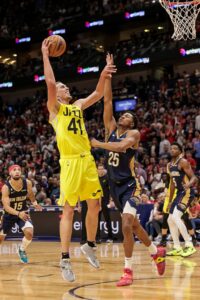 Instead of receiving draft compensation, the Jazz saved $6.75MM ($5MM against the cap) in 2022/23, because Olynyk makes $12.8MM this season. Clearly Lee — a guard who was the 38th overall pick in 2020 — wasn’t in the team’s plans, but Utah essentially got a free look at him in training camp with the cash received offsetting his salary.
Olynyk has been a solid, productive player for a long time and the Jazz lacked a starting-caliber center after trading Rudy Gobert to Minnesota. Rookie first-rounder Walker Kessler (acquired in the Gobert deal) looks promising and could eventually become a starter, but would be a poor spacing fit with Vanderbilt, whereas Olynyk helps in that regard.
There’s an arrhythmic quality to Olynyk’s game that’s difficult to describe. He has some unique qualities for someone 6’11”, and he provides value in atypical ways for a big man.
Olynyk leverages his outside shooting with drives to the basket, creating plays both for himself and teammates. He’s an unselfish passer and is an above-average ball-handler for a player his size.
If you try to put a smaller player on him, he can score over them in the post. He’s smart and runs the floor hard looking for easy buckets. Olynyk is also versatile enough to play both frontcourt positions against bigger lineups, with first-year head coach Will Hardy deploying him alongside Kessler at times.
The Canadian veteran likes flipping up finger rolls near the rim, such as what turned out to be an off-balance game-winning shot against the Pelicans on Sunday – it’s not always aesthetically pleasing, but more often than not it goes in. That’s basically Olynyk in a nutshell — unusual but effective.
I think Olynyk’s sometimes awkward-looking play makes people take him less seriously for some reason. Maybe that’s why writers, analysts and fans alike seemed to overstate the difference in on-court impact between Bogdanovic and Olynyk when evaluating this trade.
Case in point, with the caveat that per 36 numbers are a bit misleading:
Player A’s career per 36 averages (607 games): 18.6 PPG, 4.5 RPG, 1.9 APG (2.0 TO) and 0.7 SPG on .457/.393/.862 shooting. Career advanced stats: 59.2% true shooting percentage, 33.4 win shares, 5.0 value over replacement player, 14.0 player efficiency rating.
Player B’s career per 36 averages (614 games): 16.5 PPG, 8.3 RPG, 3.4 APG (2.4 TO) and 1.2 SPG on .477/.368/.782 shooting. Career advanced stats: 59.0 TS%, 35.6 WS, 9.9 VORP, 15.8 PER.
Player A is Bogdanovic. Player B is Olynyk.
Olynyk is clearly a better inside finisher and passer, while Bogdanovic is a more prolific scorer and higher-level shooter. Neither is a great defender, though Olynyk has the edge as a rebounder and play-maker on that end.
Two big differences: Bogdanovic has started the majority of his career with an average of 29.1 minutes per game, while Olynyk has primarily been a reserve and only holds a career average of 22.0 MPG.
The main reason Olynyk has come off the bench for most of his career is that he isn’t a traditional rim protector and is a below-average rebounder for a center. Protecting the paint is the foundation of any good defense, and it’s probably his biggest weakness as a player (he’s also foul-prone). Bogdanovic doesn’t have to worry about that as much since he’s a forward.
Don’t get me wrong, Bogdanovic is definitely a better player than Olynyk. There’s no question about that. That’s why he got $73MM over four years the last time he was a free agent and Olynyk got $37MM ($28MM guaranteed) over three.
But is Bogdanovic worth an additional $5MM cap hit for one season?
In a vacuum, yeah, probably. But that’s a much tougher call with the context that Utah’s power forward spot was crowded, Olynyk filled a positional need, and reducing the cap hit this season gave the Jazz more flexibility to take on additional salary without going into the luxury tax if they opt to make more trades, which seems highly likely.
Flipping Olynyk down the line is certainly a possibility; he’d have some takers as a floor-spacing big with only $3MM in guaranteed money in ‘23/24 (he’ll make $12.2MM if his contract becomes fully guaranteed). He’s off to a strong start with the Jazz, averaging 15.5 PPG, 3.8 RPG, 3.3 APG and 1.3 SPG on .611/.786/.778 shooting in four games (28.5 MPG). Obviously those shooting splits are unsustainable, but it’s reasonable to believe he’ll have another productive season.
It’s also worth noting that Jazz president Danny Ainge acquired Olynyk’s rights when he was drafted with the 13th overall pick in 2013, and the 31-year-old spent his first four seasons under Ainge with the Celtics. That level of familiarity often plays a factor in trades.
The Pistons’ perspective:
Detroit’s side of things is easier to understand. The Pistons were one of only three teams under the cap this offseason (the Pacers and Spurs are the others), and used their remaining cap room to take on Bogdanovic’s extra salary (though including Lee would’ve allowed them to adhere to salary-matching rules anyway). That enabled them to receive a superior player without having to give up any draft compensation.
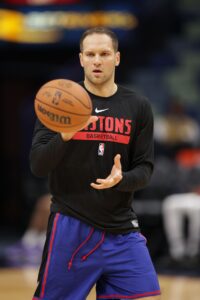 Olynyk was limited to 40 games due to injuries in his first year with the Pistons in ‘21/22 and struggled when he did play, posting career lows of 44.8% from the field, 33.6% on three-pointers, and 19.1 MPG. You’d think that may have depressed his trade value a little, but Utah didn’t seem to mind, instead focusing on his larger body of work.
As with Utah’s forwards, Detroit had a crowded center rotation with Isaiah Stewart, Jalen Duren, Marvin Bagley III, Nerlens Noel and Olynyk all vying for minutes. Removing Olynyk from that equation and adding a forward in Bogdanovic made a lot of sense, because there wasn’t much depth at that spot.
I previously mentioned that per-36 numbers are a bit misleading. Here are Olynyk’s actual per-game averages from 2018-22:
10.3 PPG, 5.3 RPG, 2.2 APG and 0.8 SPG on .468/.360/.823 shooting (.605 TS%) in 256 games (108 starts, 22.9 MPG). 15.1 WS, 4.5 VORP, 15.4 PER.
Here are Bogdanovic’s over the same span:
18.3 PPG, 4.1 RPG, 1.9 APG and 0.6 SPG on .461/.403/.860 shooting (.601 TS%) in 285 games, all starts (31.6 MPG). 21.3 WS, 4.8 VORP, 15.4 PER.
It’s interesting that their TS%, VORP and PER are so similar, but Bogdanovic clearly offers more scoring and outside shooting, two key deficiencies for the Pistons last season (they were 28th in points and 29th in 3PT%). His career assist-to-turnover ratio is negative, which is never great, but he won’t be tasked with much play-making alongside Cade Cunningham and Jaden Ivey.
Young teams like the Pistons need veterans to show them how to be professionals. Bogdanovic leads by example with consistent offensive output. He was the fourth-best player on the league’s top regular season team in ’20/21, and his play hasn’t dropped off since.
While Bogdanovic has the (deserved) reputation of being a sharpshooter, his offensive repertoire is more varied than that title might suggest. He can create his own shot, he’s an above-average finisher at the rim, he can post up smaller players on switches, and he gets to the free throw line at a decent clip.
Like Olynyk, Bogdanovic has gotten off to a great start with his new club. He has been Detroit’s most effective player through five games (31.2 MPG), averaging 23.2 PPG, 3.4 RPG and 2.4 APG on .533/.512/.882 shooting.
The fact that Bogdanovic is such a strong shooter and has reached peak performance in recent seasons might portend well for the future, even if he’s 33. If he enjoys playing for the Pistons, I could see the two sides reaching a short-term extension – maybe something like two years, $40-45MM — before he hits free agency next summer.
Another positive aspect of Bogdanovic’s career is that he’s been quite durable, only missing 33 games in the eight seasons leading up to ‘22/23.
Overall, I think it was a logical trade for both sides, with Bogdanovic and Olynyk filling positional needs for their respective clubs. The Jazz gained financial flexibility by reducing their team salary, and Olynyk’s mid-sized contract theoretically makes him pretty easy to trade once he becomes eligible, if they choose to go that route. The Pistons got the better player, and hope to keep him around beyond this season.