
Jaylin Williams Ready To Make Season Debut
Thunder big man Jaylin Williams is available to make his season debut on Monday. Williams is no longer on the injury report, Joel Lorenzi of The Oklahoman tweets.
Oklahoma City plays the Wizards on Monday. Williams had been on the road with the team the past nine days while it played in the NBA Cup semifinals and finals in Las Vegas, then embarked on a two-game road trip to Florida. He went through individual workouts during that time.
Williams originally suffered a right hamstring strain early in training camp. The team stated in early October that he would miss the remainder of camp and the entire preseason while rehabbing the hamstring. The 22-year-old suffered a setback during a workout in late October. At the time, he was expected to miss four-to-six more weeks.
Williams was a valuable backup for Oklahoma City last season, averaging 4.0 points and 3.4 rebounds per contest in 69 games while shooting 36.8% from three-point range.
With Chet Holmgren still sidelined by a pelvic fracture, Williams could jump right into the rotation. The Thunder haven’t had their frontcourt healthy all season, with Williams sidelined until now, Isaiah Hartenstein‘s debut delayed until November 20, and Holmgren out since Nov. 10. However, they’re 22-5 and lead the Western Conference.
Williams was selected with the 34th pick in the 2022 draft. He signed a four-year contract that runs through the end of next season.
Alex Caruso Signs Four-Year Extension With Thunder
Veteran guard Alex Caruso and the Thunder have agreed to a four-year, $81MM contract extension, Shams Charania of ESPN reports. The team has officially announced the deal in a press release.
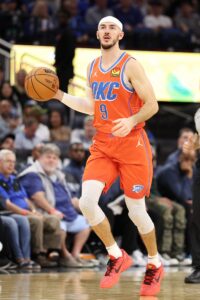 Caruso became eligible for the $81,096,960 extension on Saturday. Because it has been six months since he was traded to the Thunder, he was allowed to sign for up to 140% of this season’s estimated average salary ($12.93MM) and for up to four new years. Prior to Saturday, his maximum extension would have been worth $48,875,400 over three new years.
The extension will begin at $18,102,000 in 2025/26 and will rise annually by 8%, increasing to $22,446,480 by the final season. It’s unclear whether or not it will be fully guaranteed.
Caruso was due to become an unrestricted free agent after this season. He’s in the last year of a four-year, $36.98MM contract.
Caruso was traded straight up by the Bulls for Josh Giddey in June. He’s one of the NBA’s best perimeter defenders, earning All-Defensive team nods each of the past two seasons.
He started 57 of 71 games with the Bulls last season but has come off the bench in all 19 games in which he’s played for his new team this season. He’s averaging 5.7 points, 2.9 rebounds, 2.4 assists and a career-high 1.9 steals in 20.2 minutes per contest.
Caruso shot a career-best 46.8% from the field last season but has struggled with his shooting this season (38.5%). However, he has helped Oklahoma City become the league’s premier defensive club. The Thunder have allowed the fewest points per game in the NBA. They also lead the league in opponents’ field goal percentage and 3-point percentage.
Caruso’s extension means the Thunder no longer project to have any 2025 unrestricted free agents on their standard roster.
John Wall Still Hoping For Another NBA Opportunity
Five-time All-Star point guard John Wall hasn’t given up on his NBA dream, according to Tim Reynolds of The Associated Press.
The 6’3″ Kentucky product hasn’t played in the NBA since a brief, 34-game stint with the Clippers in 2022/23, but he continues to put in reps at the University of Miami, near his Miami offseason home, staying in game shape.
“It’d mean the world,” Wall said of a potential return to the league. “You want to go out on your own terms. I want to finish it the way I want. If I play my last game, I want to walk off the court my way.”
The 34-year-old was recently on hand at the G League’s Orlando Winter Showcase this weekend. Last year, he auditioned for attendant NBA franchises during the Winter Showcase. This season, he made his broadcasting debut, calling a pair of G League games.
“I was here last year working out for a couple teams,” Wall said. “I was on the other court, working out before games. That was fun. This was fun.”
Wall was selected with the No. 1 overall pick out of a loaded Kentucky class in 2010 by the Wizards. A nightmare in the open court, he developed as a passer and jump shooter en route to making five straight All-Star teams from 2014-18. During those five prime seasons, Wall averaged 19.9 points, 9.9 dimes, and 4.4 boards per night, with a shooting line of .436/.340/.787.
An Achilles tendon tear in 2019 forever changed his career trajectory. After sitting out the entire 2019/20 season, Wall was eventually traded to the Rockets ahead of the 2021/22 season. He agreed to a contract buyout with Houston in the summer of 2022 and subsequently signed with the Clippers.
Magic’s Moritz Wagner Tears ACL, Will Miss Rest Of Season
Reserve Magic center Moritz Wagner has been diagnosed with a torn ACL in his left knee and will miss the rest of his club’s 2024/25 season, sources inform Shams Charania of ESPN.
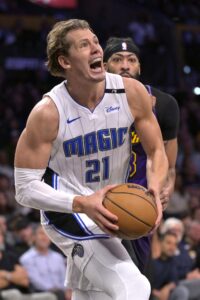
The Michigan alum departed the club’s eventual comeback victory against the Heat on Saturday after injuring the knee. There was immediate concern among Magic players and head coach Jamahl Mosley that the injury was significant.
Across what will wind up being his only 30 games of the season, Wagner averaged a career-best 12.9 points on .562/.360/.718 shooting splits, along with 4.9 rebounds, 1.4 assists and 0.8 steals per night.
Losing the 27-year-old frontcourt standout is another early-season blow for the rising Magic. Orlando is 18-12 on the year despite currently being without both of its top two players, All-Star forward Paolo Banchero and forward Franz Wagner, Moritz’s younger brother. Unlike Moritz, however, Franz and Banchero are expected to return this season from their right oblique tears.
This injury now casts some uncertainty on Moritz Wagner’s long-term future with the club. The veteran big man inked a two-year, $22MM contract with the club as a free agent this past summer, but his $11MM salary for 2025/26 is a team option.
Given that it often takes players a full calendar year – or more – to recover from ACL tears, Wagner’s availability for the start of next season is up in the air, so the Magic may be reluctant to bring him back at that $11MM price point — declining the option and re-signing him to a more team-friendly deal could be one option Orlando considers.
The Magic have the ability to apply for a disabled player exception as a result of Wagner’s injury. It would be worth $5.5MM and would allow the team to acquire a player on an expiring contract via trade or waiver claim or to sign a free agent to a rest-of-season deal.
Community Shootaround: 2024/25 NBA MVP Race
As we relayed on Friday, three-time Most Valuable Player Nikola Jokic led the way in the first MVP straw poll conducted by ESPN’s Tim Bontemps for the 2024/25 season. However, while Jokic earned 57 first-place votes from the 100 media members polled by Bontemps, it’s clearly a three-player race at this point.
Jokic totaled 827 total points in the voting, with Thunder guard Shai Gilgeous-Alexander at 678 points and Bucks forward Giannis Antetokounmpo at 643. Gilgeous-Alexander received 24 first-place votes, while Antetokounmpo got 19 — no other player earned a single first-place vote, and Celtics forward Jayson Tatum was the only other player to even claim a second-place vote (he got three).
Plenty could change between now and the end of the regular season, and injury luck is always a factor, but it seems highly likely at this point that one of Jokic, Gilgeous-Alexander, or Antetokounmpo will be named this season’s Most Valuable Player. Here are their cases so far:
Nikola Jokic:
As usual, the Nuggets center has been an advanced-stats star. He leads the NBA in player efficiency rating (31.9), win shares per 48 minutes (.287), box plus/minus (12.8), and value over replacement player (3.0).
Of course, Jokic’s traditional stats look awfully impressive too. His 31.0 points per game would be a career best, as would his league-leading 50.0% mark on three-point attempts. He’s nearly averaging a triple-double, with 13.0 rebounds and 9.8 assists per game.
The main knock against Jokic at this point is that his Nuggets are fighting to stay out of play-in territory — they’re currently tied for sixth in the Western Conference at 14-11. But it’s hard to blame the big man for that modest record. Denver has a +9.7 net rating in his 819 minutes on the court, while their net rating in the 391 minutes he hasn’t played is a brutal -14.3.
Shai Gilgeous-Alexander:
Gilgeous-Alexander is averaging 30.3 points, 6.2 assists, and 5.5 rebounds per game with a 50.8% field goal percentage, a very strong mark for a guard. He’s also the only player in the NBA who is averaging at least two steals and one block per contest.
The fact that MVPs historically come from teams at or near the top of the standings works in SGA’s favor — his Thunder are 22-5, which is the second-best record in the league and the top mark in the Western Conference. Oklahoma City has a three-game lead in the conference standings on the No. 2 Rockets.
While his supporting cast is certainly stronger than Jokic’s, Gilgeous-Alexander has obviously had a huge hand in OKC’s success. The team has a +15.5 net rating in his 935 minutes and a +1.5 mark in 361 minutes without him on the floor.
The Thunder star also ranks first in the NBA in defensive win shares (2.0) and total win shares (5.4), while placing just behind Jokic in WS/48, BPM, and VORP. His only real weakness is his subpar three-point rate of 33.5% on 6.3 attempts per night.
Giannis Antetokounmpo:
No NBA player has averaged more points per game this season than Antetokounmpo (32.7), who is also among the league leaders in rebounds per game (11.6). The Bucks forward also fills the box score with 6.0 assists and 1.5 blocks per night, along with a career-best field goal percentage of 61.3%.
Giannis is right there with Jokic in terms of PER (31.8) and ranks third behind Jokic and SGA in BPM (9.1) and VORP (2.4). He earns extra points for pulling the Bucks out of an early-season hole, but as a result of that slow start, the team is still just 15-12, fifth in the Eastern Conference. That won’t help his case, so the Bucks will have to keep winning.
Antetokounmpo’s on/off-court numbers are also surprisingly unflattering compared to his top two MVP competitors. Milwaukee’s net rating is essentially the same with him on the court (+1.4) as it is when he’s not playing (+1.3).
We want to know what you think. Which of these three players would you be your MVP pick right now? Which one do you expect to lead the MVP race as the season progresses? Outside of this trio, which player do you think has the best chance to make a run at this season’s MVP award?
Head to the comment section below to weigh in with your thoughts!
Hoops Rumors Glossary: Veteran Contract Extension
An NBA team that want to re-sign a player before he reaches free agency can do so, but only at certain times and if his contract meets specific criteria.
Rookie scale extensions, which can be completed for former first-round picks between the third and fourth years of their rookie scale contracts, were the NBA’s most common form of extension in the past. But the league relaxed its criteria for veteran extensions in its 2017 Collective Bargaining Agreement and loosened them further in the 2023 CBA, resulting in a significant increase in those deals in recent years. They’ve now overtaken rookie scale extensions as the league’s most frequently signed extensions.
[RELATED: 2024/25 NBA Contract Extension Tracker]
A veteran extension is any contract extension that tacks additional years onto a contract that wasn’t a rookie scale deal. Even if the player is still on his first NBA contract, he can technically receive a “veteran” extension if he was initially signed as a second-round pick or an undrafted free agent rather than via the league’s rookie scale for first-rounders.
Here’s a full breakdown of how players become eligible to sign veteran extensions, and the limits that come along with them:
When can a player sign a veteran contract extension?
A team that wants to sign a player to a veteran extension wouldn’t be able to simply complete that extension one year after the initial contract was signed. The team must wait a specified period of time before the player becomes extension-eligible, as follows:
- If the player initially signed a three- or four-year contract: Second anniversary of signing date.
- Note: The second anniversary date also applies if the player previously signed an extension that lengthened his contract to three or four total seasons.
- If the player initially signed a five- or six-year contract: Third anniversary of signing date.
- Note: The third anniversary date also applies if the player previously signed an extension that lengthened his contract to five or six total seasons.
- If the player previously renegotiated his contract and increased his salary by more than 10%: Third anniversary of renegotiation date.
A contract that only covers one or two seasons is ineligible to be extended.
An extension-eligible player who is on an expiring contract can sign an extension at anytime between the start of the league year in July and the end of that league year on June 30. This rule also applies to a player who is in the final standard year of his contract, with a player or team option the following year, as long as that option is declined as part of the extension.
If an extension-eligible player still has more than one non-option year remaining on his contract, he can be extended between the start of the league year and the last day before the regular season tips off. He would be ineligible for an extension during the regular season and would regain his eligibility the following July.
It’s worth noting that an extension signed between October 2 and the start of the regular season is considered – for the purpose of determining its anniversary – to have been signed on October 1.
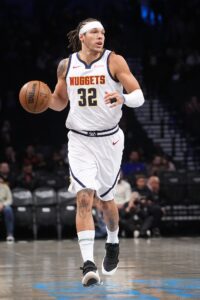 For example, having signed a four-year extension with the Nuggets on Oct. 21, a day before the 2024/25 regular season began, Aaron Gordon – who is now under contract for five total seasons – will become extension-eligible on Oct. 1, 2027, which is considered to be the three-year anniversary of his recently signed extension.
On the other hand, because he signed his most recent extension on Oct. 24, a couple days after the season tipped off, Timberwolves center Rudy Gobert – who is now under contract for four total seasons – will become eligible for his next extension on Oct. 24, 2026, the actual two-year anniversary of his latest deal.
How many years can a player receive on a veteran extension?
A veteran extension can be for up to five years, including the year(s) remaining on the previous contract. The current league year always counts as one of those five years, even if an extension is agreed to as late as June 30.
For instance, when Grayson Allen signed an extension in April with the Suns, he was in the final year of previous contract, which ran through 2023/24. He added four extra years via the extension, maxing out at five years overall. He wouldn’t be able to add a fifth year at that time even though the regular season was over, since the ’23/24 league year still counted toward the total.
If a player signs a “designated” veteran extension, he can receive up to six total years, as we cover in a separate glossary entry. Jaylen Brown got a super-max extension from the Celtics during the 2023 offseason, while his teammate Jayson Tatum was the only player to sign one in 2024.
How much money can a player receive on a veteran extension?
The first-year salary in a veteran extension can be worth up to 140% of the salary in the final year of the player’s previous contract or 140% of the NBA’s estimated average salary, whichever is greater. Annual raises are limited to 8% of the first-year extension salary.
When Jalen Brunson signed an extension with the Knicks during the 2024 offseason, he added four extra years to the one year and $24,960,001 remaining on his previous deal. Because his cap hit comfortably exceeds the league’s estimated average salary, Murray was eligible to earn up to 140% of his final-year salary in the first year of his extension. As such, his new contract begins in 2025/26 with a base salary of $34,944,001, with 8% annual raises from there.
In 2023/24, the NBA’s estimated average salary is $12,930,000, so a player earning less than that amount would be eligible to receive an extension worth up to 140% of that figure. That would work out to a starting salary of $18,102,000 and a four-year total of about $81MM. That’s the maximum deal that Thunder guard Alex Caruso is now eligible to sign.
A contract extension can’t exceed the maximum salary a player is eligible to earn, so there are some instances in which a player won’t be able to get a full 40% raise on a new extension.
For instance, Bam Adebayo‘s new three-year, maximum-salary extension with the Heat should technically award him up to a 40% raise on his $37,096,620 salary in 2025/26. However, that would work out to a $51,935,268 salary in 2026/27. Even if the salary cap increases by the maximum allowable 10% in each of the next two summers, Adebayo’s maximum allowable salary in ’26/27 would be $51,033,600 (30% of that’s season’s cap). So he won’t receive a full 40% raise on his new deal.
Because a player’s own personal maximum salary on an extension is always at least 5% of his salary in the previous season, there are scenarios in which a player could exceed the league-wide maximum salary.
That’s the case for Stephen Curry, who signed a one-year, $62,587,158 extension with the Warriors in August. That extension is for the 2026/27 season. Even if the cap increases by 10% in each of the next two years, the league-wide maximum for a player with 10-plus years of NBA experience in ’26/27 would be $59,539,200. However, Curry is allowed to exceed that figure because he’ll earn $59,606,817 in ’25/26 — his latest one-year extension represents a 5% raise.
Designated veteran extensions and renegotiated contracts have slightly different rules for salaries and raises than standard veteran extensions. You can read about those differences in our glossary entries on those subjects.
Can a player sign a veteran extension as part of a trade?
The NBA’s Collective Bargaining Agreement does allow for extend-and-trade transactions, but the rules governing them are more limiting than for standard veteran extensions.
A player eligible for an extension can sign one in conjunction with a trade, but he would be limited to four overall years and a starting salary worth 120% of the final-year salary on his previous deal (or 120% of the estimated average salary, for players earning below the average). Subsequent annual raises are limited to 5% as well.
A player who receives an extension that exceeds those extend-and-trade limits becomes ineligible to be traded for six months. Conversely, a player who is involved in a trade becomes ineligible to sign an extension for six months if the extension would exceed the extend-and-trade limits.
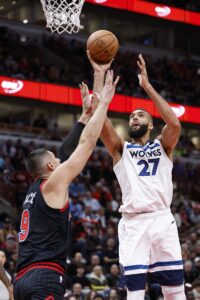 Gobert’s three-year extension with the Timberwolves is an example of a recent extension that didn’t exceed the extend-and-trade limits — he took a pay cut from $43,827,586 to $35MM in the first year of the extension and the deal lengthened his contract to four total years. Because that extension fell within the extend-and-trade parameters, Gobert could still technically be traded this season despite signing in October, though he almost certainly won’t be.
Conversely, since Adebayo’s new extension lengthens his total contract to five years and will feature raises exceeding 5%, he’s be ineligible to be traded until January 6, six months after he signed the deal.
Players who renegotiate their current-year salary as part of an extension can’t be traded for six months. This applies this season to Magic forward Jonathan Isaac, who becomes trade-eligible on January 6, and Jazz forward Lauri Markkanen, who won’t be trade-eligible during the regular season since he renegotiated his deal on August 7 — his trade restriction will lift on Feb. 7, one day after this season’s deadline.
An extension-eligible player can’t be extended-and-traded between the end of the season and June 30 if there’s a chance he could become a free agent that July. That rule applies to both veterans on expiring contracts and veterans with team or player options that have yet to be exercised.
What are the other rules related to veteran extensions?
There are many more minor rules and guidelines related to veteran extensions, including several involving bonuses and option years. A full breakdown can be found in Larry Coon’s CBA FAQ, but here are some of the notable ones most likely to come into play:
- A contract with an option can be extended if the player opts in or the team picks up the option.
- A contract with an option can also be extended if the option is declined, as long as the extension adds at least two new years to the deal. The only exception to this rule involves an early termination option — a contract with an ETO can’t be extended if the ETO is exercised, ending the contract early.
- A newly signed extension can contain a player or team option, but not an early termination option.
- If a contract contains incentive bonuses, a veteran extension must contain the same bonuses. The bonus amounts can be increased or decreased by up to 8%, but they must still be part of the deal. An extension also can’t contain bonuses that weren’t part of the original contract.
- If a contract includes an unearned trade bonus, it doesn’t necessarily have to be applied to the extension. If the team and player elect not to carry over the trade bonus to the extension and the player is dealt before the extension takes effect, the application of the bonus would ignore the extension.
Note: This is a Hoops Rumors Glossary entry. Our glossary posts will explain specific rules relating to trades, free agency, or other aspects of the NBA’s Collective Bargaining Agreement. Larry Coon’s CBA FAQ was used in the creation of this post.
Previous versions of this post were published in 2019, 2022, and 2023.
Pacific Notes: Monk, Allen, Budenholzer, Durant, Kuminga
The Kings are expected to make Kevin Huerter, Trey Lyles, and draft capital available as they go shopping for help on the trade market ahead of the February 6 trade deadline. However, given the fact that Sacramento is off to a 13-16 start this season and is currently out of the play-in picture, teams around the NBA are curious about whether the Kings will consider becoming in-season sellers, according to Jake Fischer of Bleacher Report (video link).
“I’m not reporting that Malik Monk is available,” Fischer said. “However, rival teams certainly want to know if Malik Monk will be someone that the Kings are willing to part with.”
In discussing Monk, Fischer acknowledged it would be “tricky” to move last season’s Sixth Man of the Year runner-up, who signed a new four-year, $78MM contract with the Kings over the summer.
“He’s so crucial to what the Kings have done,” Fischer said. “… He’s best friends with De’Aaron Fox dating back to Kentucky. If you’re curious about the long-term ramifications of keeping De’Aaron Fox in Sacramento, you’re probably not wanting to move his best friend, who he recruited to join the Kings.”
Of course, Fox’s own long-term future in Sacramento isn’t certain either, so the Kings are a team worth watching closely in the coming weeks.
We have more items from around the Pacific:
- The Suns are monitoring swingman Grayson Allen for a possible concussion, head coach Mike Budenholzer said after Saturday’s loss to Detroit (Twitter link via Gerald Bourguet of PHNX Sports). “We’ll see how he is in the morning,” Budenholzer said of Allen, who took a Simone Fontecchio elbow to the head while battling the Pistons forward under the basket in the third quarter (video link).
- Budenholzer and Kevin Durant engaged in a heated discussion during a timeout in the third quarter of Saturday’s loss, with the head coach appearing to call out Durant for a defensive mistake and the Suns star firing back. Both men downplayed the dispute after the game. “We know we got the microscope on us, so any little spat like that may be taken the wrong way, but coach respects my perspective,” Durant said (Twitter video link via PHNX Sports). “… When you look at it from the outside, the chemistry may look off, but I just think that’s part of great chemistry actually, when you can have those conversations in the heat of the moment and move on.” Budenholzer agreed with Durant’s assessment, as Bourguet relays (Twitter video link). “He’s a pro, he’s coachable,” Budenholzer said. “If you don’t have a few of those, there’s probably something wrong with your team. KD’s the best. He wants to be coached, and I love being around him.”
- After starting six games in a row, Warriors forward Jonathan Kuminga came off the bench on Thursday in Memphis and Saturday in Minnesota. However, head coach Steve Kerr said that the experiment of having Kuminga in the starting five isn’t over, explaining that he started Kyle Anderson on Saturday because he liked how the former Timberwolf matched up against his old team (Twitter link via Ohm Youngmisuk of ESPN). It was Anderson’s first start of the season.
Central Notes: Bulls, Nnaji, Strus, Wade, Middleton
Although the Bulls have reportedly talked to the Nuggets about a possible swap centered around Zach LaVine and Michael Porter Jr., they have shown no interest in taking Zeke Nnaji‘s contract back in a deal with Denver, reports K.C. Johnson of the Chicago Sports Network (Twitter link).
Porter is making $35.9MM this season and LaVine’s cap hit is about $43MM. The Nuggets wouldn’t be permitted to take back more salary than they send out in any trade, so adding Nnaji ($8.9MM) would make perfect sense for Denver. However, the forward/center, who is in the first season of a four-year contract and isn’t playing consistent rotation minutes, has negative trade value.
The Bulls’ position on Nnaji doesn’t necessarily mean the two sides can’t get a deal done. The Nuggets could try to offer additional sweeteners to convince Chicago to take him or find a third team willing to absorb Nnaji’s contract along with some sort of draft compensation. The two teams could also make a deal without including Nnaji — it would mean attaching Dario Saric and one more low-salary player (anyone except for Jalen Pickett or Hunter Tyson) to Porter in order to exceed LaVine’s incoming cap hit.
Here’s more from around the Central:
- It was a successful season debut on Friday for Cavaliers wing Max Strus, who made a trio of three-pointers and was a +20 in 19 minutes of action in a blowout win over Milwaukee, writes Chris Fedor of Cleveland.com (subscriber link). Strus, who was sidelined for the first 27 games of the season while recovering from an ankle injury, was on a minutes limit on Friday and then sat out on Saturday during the second game of a back-to-back set for injury management purposes, notes Fedor (Twitter link).
- With Isaac Okoro out and Strus just returning, Dean Wade started at small forward for the Cavaliers on both Friday and Saturday and was a +34 in 46 total minutes, registering 21 total points on 7-of-9 shooting in a pair of resounding victories. As Fedor writes in another Cleveland.com story, Wade’s performance is a reminder that the Cavs will have 11 players worthy of rotation minutes once everyone is healthy. Head coach Kenny Atkinson would ideally like to find playing time for all of them, sources tell Fedor. “Everyone can easily (say), ‘I deserve my minutes. We’re the best record in the league. Why shouldn’t I keep playing my minutes?'” Atkinson said. “But with Max back, we’re going to have those conversations individually and as a team.”
- After missing the first 21 games of the season while recovering from offseason surgeries on both ankles, Bucks forward Khris Middleton is still rounding into form. He took a big step forward on Saturday in a win over Washington, playing in his first back-to-back and setting personal season highs with 18 points, eight assists, six rebounds, four three-pointers, and 24 minutes played. “Still got a little bit to go, but tonight definitely felt like the best night I’ve had thus far,” Middleton said after the game (Twitter link via Eric Nehm of The Athletic). “Always great to get a couple threes going, mid-range going.”
Moritz Wagner Leaves Game With Knee Injury, Will Be Evaluated Sunday
Magic center Moritz Wagner will likely undergo medical imaging on his left knee on Sunday after leaving tonight’s game with a potentially serious injury, according to Jason Beede of The Orlando Sentinel.
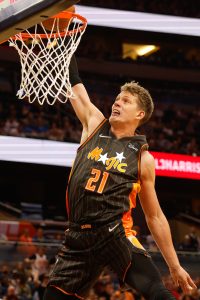 Wagner took an awkward fall less than two minutes into the first quarter, Beede writes, and needed assistance from Jonathan Isaac and Jalen Suggs to walk off the court. The team later issued a statement saying that he wouldn’t return to the game and will undergo further evaluation.
Orlando coach Jamahl Mosley hinted at the concern over the injury when he requested that reporters not ask about it during his post-game press conference, Beede tweets.
“Before you start asking me questions, Moe did what he did to his left knee,” Mosley said. “And so, he’ll be reevaluated tomorrow. So I’m going to ask that we don’t ask any more questions about that because that is a little touchy subject right now for us, for him. And I want to be able to control my emotions because of how much we care about these young men and what they’re going through. We can do another discussion about it another day, please.”
It would be a devastating blow to lose Wagner, who has helped the Magic stay afloat amid long-term injuries to his brother Franz Wagner and Paolo Banchero. Moritz is averaging career highs of 13.3 points and 5.1 rebounds through 29 games, and he posted 32 points last Sunday against New York.
Orlando has managed to remain competitive without its two best players, sitting in fourth place in the East at 18-12. That resiliency was on display tonight as they overcame Wagner’s early injury and the ejection of Wendell Carter Jr. in rallying to beat Miami after trailing by 22 points entering the fourth quarter.
Meeting with reporters, Goga Bitadze and Cole Anthony both dedicated the comeback to Wagner, Beede adds (Twitter link).
“It was for Moe,” Bitadze said. “We’re all praying for Moe.”
And-Ones: Team Canada, DSJ, 2025 Draft, Kendrick
Canadian players are still dealing with the disappointment of not winning a medal at this year’s Summer Olympics, writes Michael Grange of Sportsnet.ca. Featuring a roster loaded with NBA talent, Team Canada had a chance to reach a milestone for the nation’s basketball program. Instead, they left Paris empty-handed with the realization that the next opportunity is four long years away.
“It’s different once it’s over and you realize that you’re not going to be in that position, not have a chance for four more years,” RJ Barrett said. “Like, that’s a rough part about it, especially when we felt like we had a team that had a great mix. I think we had young guys, but not rookies, you know, and we had guys in their prime or close to their prime, and we had some vets that are still at a good stage in their career. We had the experience, and we had the talent, we got we had the coach. We felt like that was our time, but I think experience, and those type of tournaments is huge.”
The Canadians looked like a legitimate threat to capture the gold after going undefeated in pool play against Greece, Australia and Spain, who were all viewed as medal contenders. But their hopes ended quickly with an 82-73 loss to France in the quarterfinal round. Grange notes that Canada was able to control Victor Wembanyama, holding him to seven points on 2-of-10 shooting with Dillon Brooks guarding him for much of the game, but Guerschon Yabusele and Mathias Lessort led the hosts to victory by combining for 35 points.
“Every year, I get a chance to win an NBA championship,” Shai Gilgeous-Alexander said, “(but it’s only) every four years I get a chance to try to win the Olympics, you know?”
There’s more from around the basketball world:
- When Dennis Smith Jr. entered the G League player pool, he was expecting to be claimed by the Spurs‘ affiliate, Marc Stein and Jake Fischer write in a Substack column (subscription required). Instead, he wound up with the Bucks‘ affiliate, making his future in the G League less certain, sources tell The Stein Line. Real Madrid reportedly has interest if Smith wants to play in the EuroLeague.
- Dylan Harper and Ace Bailey are making an impact at Rutgers, but the NBA executives and draft experts who talked to Adam Zagoria of NJ.com believe Duke’s Cooper Flagg remains very likely to be the top pick in 2025.
- Frank Kendrick, who was part of a championship team with the Warriors during his only NBA season, died this week at age 74, the team announced (via Twitter). Kendrick also won an NIT title at Purdue and was inducted into the Indiana Basketball Hall of Fame in 2002.