
Usman Garuba Officially Signs With Real Madrid
Former NBA first-round pick Usman Garuba has joined Real Madrid on a three-year contract, the Spanish team announced today in a press release.
 The move had long been expected. Reporting back in May indicated that Garuba was expected to sign with Real Madrid this offseason, but he responded by saying he had yet to make a decision. In mid-July, Spanish reporter Carlos Sanchez Blas (Twitter links) said that the free agent forward/center had a long-term deal in place with Madrid, and that time Garuba didn’t deny it, so we’ve just been awaiting formal confirmation from the team.
The 23rd overall pick in the 2021 draft, Garuba was born and raised in Madrid and was under contract with his hometown team from 2017-21, so this represents a reunion for the two sides. He played in the NBA for three seasons from 2021-24, appearing in 99 games across two seasons in Houston before being traded to Atlanta and then to Oklahoma City during the 2023 offseason.
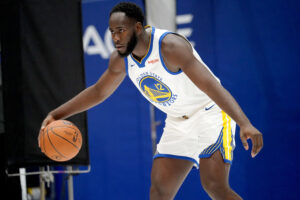
After he was waived by the Thunder, Garuba caught on with the Warriors, spending most of the 2023/24 season on a two-way contract before being promoted to Golden State’s standard roster ahead of the team’s regular season finale. He played in just six regular season contests for the Warriors.
Garuba’s overall contributions across 105 NBA outings (three starts) have been modest. He averaged 2.6 points, 3.8 rebounds, and 0.8 assists in 11.7 minutes per night, making 46.7% of his shots from the floor (including 36.3% of his three-pointers). The big man also played a limited role for Spain in this year’s Olympics, averaging 13.4 MPG off the bench for the national team.
The 22-year-old figures to see more significant action in Madrid, where he’ll team up with fellow newcomer Serge Ibaka in the club’s new-look frontcourt that will reportedly no longer feature Guerschon Yabusele.
Real Madrid is coming off a season in which they went 28-6 in Spanish League (ACB) play and 27-7 against EuroLeague competition. Madrid won the ACB title and nearly achieved the feat in the EuroLeague as well, but fell to Panathinaikos in the championship game.
NBA 2024 Offseason Check-In: Chicago Bulls
Hoops Rumors is checking in on the 2024 offseason for all 30 NBA teams, recapping the summer’s free agent signings, trades, draft picks, departures, and more. We’ll take a look at each team’s offseason moves and consider what might still be coming before the regular season begins. Today, we’re focusing on the Chicago Bulls.
Free agent signings
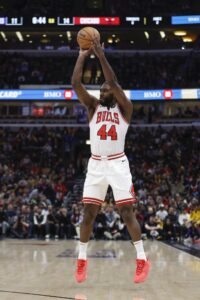 Patrick Williams: Five years, $90,000,000. Fifth-year player option. Re-signed using Bird rights.
- Jalen Smith: Three years, $27,000,000. Signed using non-taxpayer mid-level exception.
- Marcus Domask: One year, minimum salary. Non-guaranteed (Exhibit 10). Signed using minimum salary exception.
- Kenneth Lofton Jr.: One year, minimum salary. Non-guaranteed (Exhibit 10). Signed using minimum salary exception.
Trades
- Acquired Josh Giddey from the Thunder in exchange for Alex Caruso.
- Acquired Chris Duarte, RaiQuan Gray (two-way), the Kings’ 2025 second-round pick, the Kings’ 2028 second-round pick, and cash in a three-team trade in exchange for DeMar DeRozan (signed-and-traded to Kings).
- Note: Gray was subsequently waived.
Draft picks
- 1-11: Matas Buzelis
- Signed to rookie scale contract (four years, $23,950,723).
Two-way signings
Departed/unsigned free agents
- DeMar DeRozan (Kings)
- Henri Drell (Trail Blazers)
- Andre Drummond (Sixers)
- Javonte Green (unsigned)
Other moves
- Waived Andrew Funk (two-way).
Salary cap situation
- Operating over the cap ($140.6MM) and below the luxury tax line ($170.8MM).
- Carrying approximately $166.1MM in salary.
- Hard-capped at $178,132,000.
- $4,250,571 of mid-level exception available.
- Full bi-annual exception available.
- Two traded player exceptions available (largest worth $17,506,232).
The offseason so far
There was some good news for fans in Chicago this summer, as the Bulls’ front office finally accepted that roster changes were needed and that the group in place since 2021 wasn’t about to finally break through and become a contender.
The bad news? That decision probably came too late for the Bulls to get the most out of their veteran trade chips.
Chicago acquired a pair of future second-round picks along with Chris Duarte – a former first-round pick still on his rookie contract – in a sign-and-trade deal sending DeMar DeRozan to Sacramento. That’s a better outcome for the Bulls than letting their top scorer walk for nothing, but it’s a pretty modest return compared to what they might’ve gotten for DeRozan if they’d put him on the trade block before he reached unrestricted free agency.
The other two members of the Bulls’ one-time “big three” – Zach LaVine and Nikola Vucevic – didn’t go anywhere this offseason and may both still be on the roster on opening night. Their contracts (three years, $138MM for LaVine; two years, $41.5MM for Vucevic) are viewed as somewhat onerous relative to their on-court contributions.
While they could be traded, Chicago shouldn’t expect to receive much of value in return for either LaVine, who is coming off season-ending foot surgery, or Vucevic, who will turn 34 years old this October. In fact, moving off LaVine’s maximum-salary deal would probably require attaching assets at this point, so it might make more sense for the team to retain him in the hopes that he’ll increase his value by playing well this fall.
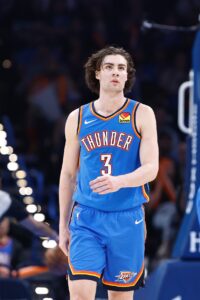 The most interesting move of the Bulls’ summer was trading defensive ace Alex Caruso for former lottery pick Josh Giddey, who had a tumultuous season both on and off the court in 2023/24. Based on reports that Chicago was seeking multiple first-rounders for Caruso, it came as a surprise that the club didn’t acquire a single pick in the deal, especially from a Thunder team loaded with future draft assets.
I understand the Bulls’ thinking to some extent. While his unreliable outside shot made him something of a liability in the postseason, Giddey is a talented ball-handler and play-maker who is still just 21 years old and is on his way to becoming a better pro than most mid-first-rounders in a typical draft class. A player with Giddey’s three-season track record certainly has a higher floor than an untested 19-year-old prospect.
On the other hand, Giddey is entering his fourth season and is currently eligible for a rookie scale extension. Even if he’s not extended by October 21, he’ll be due a major raise next summer when he reaches restricted free agency, whereas a draftee would’ve been on a team-friendly rookie contract for four seasons.
With Giddey expected to take over point guard duties, Patrick Williams back under contract on a five-year, $90MM deal, Jalen Smith added to the frontcourt on a three-year, $27MM contract, and lottery pick Matas Buzelis on track to play a role as a rookie, the Bulls are well on their way to leaning into a youth movement. However, the ongoing presence of LaVine and Vucevic complicates matters, leaving the team somewhat caught in the middle between play-in/playoff contention and a full-fledged rebuild.
Up next
Assuming there are no trades involving LaVine, Vucevic, or any other Bulls before opening night, 14 standard roster spots look spoken for, while the 15th is up for grabs.
Onuralp Bitim and Kenneth Lofton are among the players on non-guaranteed deals who appear to be in the mix for that last roster spot, and it’s possible the club will bring in one or two more players to compete for it in camp. Carrying a player with a non-guaranteed salary as the 15th man would give Chicago the flexibility to make an in-season change if need be.
The Bulls also have an open two-way slot, with Adama Sanogo and DJ Steward occupying two of those three openings for now. It’s possible that spot could be up for grabs in a camp competition too — Lofton and Marcus Domask are both on Exhibit 10 contracts that could be converted into two-way deals before the season begins.
Newcomers Giddey and Duarte are eligible for rookie scale extensions and I’d expect the Bulls to seriously consider signing Giddey. His stock could be much higher in a year than it is right now, assuming he thrives in Chicago with the ball in his hands more often, so locking him up sooner rather than later could pay off in the long run. A preseason agreement with Duarte, who has seen his playing time and production decline in each of his three NBA seasons, is hard to envision.
The only other Bull who is eligible for an extension is Lonzo Ball, but it’s safe to say that’s not happening either. Just getting on the court this fall would be a huge win for Ball, who has been sidelined for over two-and-a-half years due to knee issues. Barring an unlikely bounce-back season for the former No. 2 overall pick, he’s a strong candidate to have his expiring contract traded by February’s trade deadline — or to be waived before the end of the season, if he continues to miss time for health reasons.
Partizan Belgrade Confirms Additions Of Pokusevski, Other Former NBAers
The Serbian club KK Partizan, which is based in Belgrade and competes in the EuroLeague, held an event on Monday to formally introduce its roster for the 2024/25 season, according to Eurohoops.
Partizan’s squad features several players with NBA experience, including guards Frank Ntilikina and Gabriel Lundberg, whose deals were previously announced.
On Monday, the team also confirmed several signings which had been reported earlier in the summer but hadn’t yet been officially confirmed, such as Aleksej Pokusevski, Sterling Brown, Isaac Bonga, Duane Washington, and Brandon Davies.
Pokusevksi is perhaps the most notable name in the group. The 22-year-old forward was the 17th overall pick in the 2020 NBA draft and spent most of the past four seasons with the Thunder before being waived in February. He finished the season in Charlotte, averaging 7.4 points, 4.4 rebounds, and 1.7 assists in 19.2 minutes per game across 18 outings down the stretch for the Hornets.
Brown has 268 NBA regular season appearances under his belt, while Bonga has 143, Washington has 79, and Davies has 78. However, none of the four played in the league in 2023/24.
As Eurohoops notes, former NBA guard Carlik Jones will also play for KK Partizan this season, but wasn’t at Monday’s event — his flight was delayed, according to a report from Mozzart Sport, which indicates that Jones will be at the team’s first practice of the season this week.
Former NBA first-rounder Bruno Caboclo is also under contract with Partizan, but wasn’t in attendance on Monday and isn’t a lock to return to the club. He has reportedly received an offer from Hapoel Tel Aviv, a team in Israel.
Mid-Level, Bi-Annual Projections For 2025/26
The mid-level exception and bi-annual exception are the two key tools that an over-the-cap team typically has at its disposal to sign free agents from other clubs — or to re-sign one of its own free agents, if the player’s Bird rights aren’t available or aren’t sufficient.
The values of the mid-level, room, and bi-annual exceptions are tied to the salary cap and the percentage that it shifts in a given year. Here’s how that math works:
- Non-taxpayer mid-level exception: Worth 9.12% of salary cap.
- Taxpayer mid-level exception: Increases at the same rate as the salary cap.
- Room exception: Worth 5.678% of the salary cap.
- Bi-annual exception: Worth 3.32% of the salary cap.
As such, we don’t know yet exactly what those exceptions will be worth in 2025/26, but we can make an educated estimate. The NBA’s most recent projection for ’25/26 called for a cap of $154,647,000, which is the number we’ll use to project next season’s mid-level and bi-annual exceptions.
[RELATED: Maximum Salary Projections For 2025/26]
[RELATED: Minimum Salary Projections For 2025/26]
Based on a $154,647,000 cap, here’s what the mid-level and bi-annual exceptions would look like in 2025/26:
Mid-Level Exception
| Year | Standard MLE |
Taxpayer MLE | Room MLE |
|---|---|---|---|
| 2025/26 | $14,104,000 | $5,685,000 | $8,781,000 |
| 2026/27 | $14,809,200 | $5,969,250 | $9,220,050 |
| 2027/28 | $15,514,400 | $9,659,100 | |
| 2028/29 | $16,219,600 | – | – |
| Total | $60,647,200 | $11,654,250 | $27,660,150 |
The standard mid-level exception is available to over-the-cap teams who haven’t dipped below the cap to use room and whose team salary remains below the first tax apron. It can run for up to four years, with 5% annual raises. Once a team uses the standard/non-taxpayer MLE, that team is hard-capped at the first tax apron for the rest of the league year.
[RELATED: Hoops Rumors Glossary: Mid-Level Exception]
The taxpayer mid-level exception is for a team whose salary is between the first and second tax aprons, or teams who want the flexibility to surpass the first apron later. It can run for up to two years, with 5% annual raises. Once a team uses the taxpayer MLE, that team is hard-capped at the second tax apron for the rest of the league year.
The room exception is for teams who go under the cap and use their space. Once they’ve used all their cap room, they can use this version of the mid-level exception, which runs for up to three years with 5% annual raises.
Teams can use the non-taxpayer mid-level exception or the room exception – but not the taxpayer mid-level – to acquire a player via trade or waiver claim. The taxpayer MLE can only be used to sign players to new contracts.
Bi-Annual Exception
| Year | BAE Value |
|---|---|
| 2025/26 | $5,134,000 |
| 2026/27 | $5,390,700 |
| Total | $10,524,700 |
The bi-annual exception – which can be used for contracts up to two years, with a 5% raise after year one – is only available to teams that are over the cap and below the first tax apron.
It can also only be used once every two years, which will disqualify the Rockets and Clippers from using it in 2025/26, since Houston and Los Angeles have used their BAEs in 2024/25.
Early NBA Minimum Salary Projections For 2025/26
The NBA’s minimum salary is one of several figures that changes from year to year at the same rate as the league’s salary cap. If the cap increases by 5% from one season to the next, the minimum salary will rise by the same amount.
That means that even though we don’t know yet exactly where the minimum salaries will end up for the 2025/26 season, we can make an educated estimate. The NBA’s most recent projection for ’25/26 called for a $154,647,000 cap (the maximum allowable 10% increase), which is the number we’ll use to project next season’s minimum salaries.
[RELATED: NBA Minimum Salaries For 2024/25]
A player’s minimum salary is determined in part by how much NBA experience he has — a veteran who has 10+ seasons under his belt is eligible for a significantly higher minimum salary than a rookie would be.
Based on the current 2025/26 cap estimate, next year’s rookie minimum salary will surpass $1.27MM, while the minimum for a veteran with 10+ years of service will exceed $3.63MM.
Here are the current minimum salary projections for the 2025/26 season, using a $154,647,000 cap:
| Years of Experience | Salary |
|---|---|
| 0 | $1,272,870 |
| 1 | $2,048,494 |
| 2 | $2,296,274 |
| 3 | $2,378,870 |
| 4 | $2,461,463 |
| 5 | $2,667,947 |
| 6 | $2,874,436 |
| 7 | $3,080,921 |
| 8 | $3,287,409 |
| 9 | $3,303,774 |
| 10+ | $3,634,153 |
It’s worth noting that these figures will only apply to players who sign new minimum-salary contracts in 2025/26. The ’25/26 salaries for players with multiyear minimum deals will look a little different. For example, a rookie who signed a two-year deal worth the minimum ahead of the 2024/25 season would have a second-year salary of $1,955,377 for ’25/26, as we outline here.
We’ll update these projections later in the season if the NBA adjusts its cap estimate for the 2025/26 season, and then again next year when the league officially sets the ’25/26 cap.
NBA 2024 Offseason Check-In: Houston Rockets
Hoops Rumors is checking in on the 2024 offseason for all 30 NBA teams, recapping the summer’s free agent signings, trades, draft picks, departures, and more. We’ll take a look at each team’s offseason moves and consider what might still be coming before the regular season begins. Today, we’re focusing on the Houston Rockets.
Free agent signings
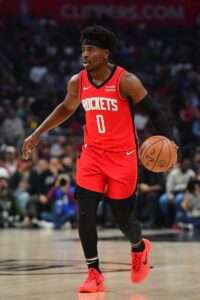 Aaron Holiday: Two years, $9,569,400. Second-year team option. Re-signed using bi-annual exception. Waived right to veto trade.
- Nate Hinton: One year, minimum salary. Non-guaranteed (Exhibit 10). Re-signed using minimum salary exception.
- Jermaine Samuels: One year, minimum salary. Non-guaranteed (Exhibit 10). Re-signed using minimum salary exception.
Trades
- Acquired the Suns’ 2027 first-round pick, either the Mavericks’ or the Suns’ 2029 first-round pick (whichever is more favorable), swap rights for the Suns’ 2025 first-round pick, and swap rights for either the Mavericks’ or Suns’ 2029 first-round pick (whichever is least favorable) from the Nets in exchange for the Nets’ own 2026 first-round pick and control of the Nets’ own 2025 first-round pick (negating the Rockets’ right to swap either their own 2025 first-rounder or the Thunder’s 2025 first-rounder for Brooklyn’s pick).
- Acquired AJ Griffin from the Hawks in a three-team trade in exchange for the draft rights to Pelle Larsson (No. 44 pick; to Heat).
Draft picks
- 1-3: Reed Sheppard
- Signed to rookie scale contract (four years, $45,853,024).
Two-way signings
Departed/unsigned free agents
- Reggie Bullock (unsigned)
- Boban Marjanovic (unsigned)
Other moves
- Exercised Jeff Green‘s 2024/25 team option ($8,000,000).
- Exercised Jae’Sean Tate‘s 2024/25 team option ($7,565,217).
Salary cap situation
- Operating over the cap ($140.6MM) and below the luxury tax line ($170.8MM).
- Carrying approximately $163.9MM in salary.
- Hard-capped at $178,132,000.
- Full mid-level exception ($12.8MM) available.
- One traded player exception available (worth $797,080).
The offseason so far
After making a major splash on the free agent market a year ago by signing several Fred VanVleet, Dillon Brooks, and a handful of other veterans, the Rockets had a much quieter summer in 2024.
Houston’s only real move of note in free agency was to bring back reserve point guard Aaron Holiday on a two-year contract that isn’t guaranteed beyond 2024/25. Holiday was solid in a rotation role last season, but he’s unlikely to play more than 15-18 minutes per game.
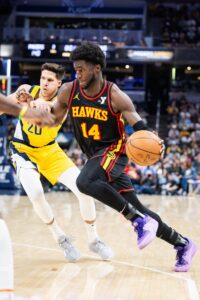 The team also made a minor move on the trade market by acquiring AJ Griffin from Atlanta in exchange for the No. 44 overall pick in this year’s draft. A 2022 first-round pick, Griffin had a promising rookie season, with 8.9 PPG and a .390 3PT%, then missed significant time in 2023/24 due to leg and ankle injuries, as well as personal issues. He wasn’t effective even when he did play, but Houston is betting on a bounce-back season for a player who will remain on his affordable rookie scale contract for two more seasons.
While the Rockets didn’t control their own first-round pick in 2024, one of the first-rounders they acquired from Brooklyn in the James Harden blockbuster paid off in a major way, moving up to No. 3 on lottery night. Houston used that selection to draft Reed Sheppard, who posted a .521 3PT% in his lone college season at Kentucky. Having added Griffin and Sheppard, it’s clear the Rockets made it an offseason priority to improve a three-point percentage (35.2%) that ranked 23rd in the NBA last season.
The rest of the Rockets’ moves are arguably more noteworthy for what they mean going forward than the impact they’ll have in the short term.
Houston picked up its team options on Jeff Green ($8MM) and Jae’Sean Tate ($7.6MM) while guaranteeing Jock Landale‘s $8MM salary for 2024/25, giving the team nearly $24MM in expendable expiring contracts that could come in handy at this season’s trade deadline. Green, Tate, and Landale figure to see some action during the regular season, but none are locks to spend all year in the rotation, especially if the club’s young players continue to improve — they may be more valuable as trade chips.
The Rockets also gave up control of the Nets’ first-round picks in 2025 (they had swap rights) and 2026 (they would’ve acquired Brooklyn’s pick outright) in exchange for two future first-rounders and two future swaps. Three of those four are Suns picks. It’s an interesting play for Houston, which is pushing its trade assets further into the future and betting against Phoenix’s longevity as a contending team, as most of those picks and swaps are for either 2027 or 2029.
Up next
With plenty of expiring money on their books, a surplus of future draft assets, and a handful of talented young players on their roster, the Rockets are well positioned to make a bid for a star if one becomes available on the trade market.
Between now and the start of the regular season, however, the more pressing issue is whether to extend Alperen Sengun and/or Jalen Green. Both players are eligible for rookie scale extensions until October 21.
Sengun enjoyed a breakout year in 2023/24, finishing third in Most Improved Player voting after averaging 21.1 PPG, 9.3 RPG, and 5.0 APG. Green’s scoring average declined, but he continued to show flashes of stardom, including one 20-game stretch from February to April in which he put up 26.6 PPG, 6.1 RPG, and 4.3 APG on .465/.381/.822 shooting.
Still, Green remains an inconsistent overall shooter and defender; Sengun, who was injured to finish the season, isn’t really a rim protector in the middle; and the Rockets had a higher net rating when each player was off the court than when he was on it. That’s not to say that Sengun and Green don’t deserve extensions, but neither case is a no-brainer for Houston, especially if those 2021 first-rounders are seeking maximum salaries or something close to it.
It’s also unclear whether the Rockets want to maintain the flexibility to potentially clear maximum-salary cap room in 2025. If so, it would certainly make sense to hold off on an extension for Sengun, at least. His cap hold as a restricted free agent would be just $16.3MM, far below his projected first-year salary on a new deal. Green’s cap hold would come in just above $31MM, so postponing an extension for him would only create additional cap flexibility if Houston expects to pay him more than that in 2025/26.
Hawks, Nets, Bulls Control Largest Trade Exceptions
As our list of traded player exceptions shows, six NBA teams currently control TPEs worth more than $10MM apiece. Those exceptions are as follows:
- Atlanta Hawks: $25,266,266 (expires 7/7/25)
- Brooklyn Nets: $23,300,000 (expires 7/7/25)
- Chicago Bulls: $17,506,232 (expires 7/8/25)
- Dallas Mavericks: $16,193,183 (expires 7/7/25)
- Memphis Grizzlies: $12,600,000 (expires 2/3/25)
- Washington Wizards: $12,402,000 (expires 2/10/25)
A trade exception allows a team to acquire a player’s contract without sending out matching salary in return. So in theory, the exceptions listed above could put these clubs in position to take on a sizable salary in a preseason or mid-season trade, perhaps acquiring a draft asset or two in the deal for their troubles.
[RELATED: Hoops Rumors Glossary: Traded Player Exception]
In practice though, it will be difficult for any of these teams to make full use of their large TPEs in that sort of move. The Hawks, Nets, Bulls, Mavericks, and Wizards are all hard-capped at the first tax apron, while the Grizzlies would be if they were to use any portion of their exception.
Atlanta, Brooklyn, and Memphis also don’t have much breathing room below the luxury tax line, while Dallas is already in the tax, so they won’t be eager to take on much extra salary anyway.
Chicago could get about $6.6MM below the tax line by waiving Onuralp Bitim‘s non-guaranteed salary, while Washington could get about $11.9MM below that threshold by waiving their non-guaranteed players, so accommodating modest salary dumps could be in play for those clubs — especially the Wizards, whose big TPE will expire at the trade deadline. But generally speaking, these trade exceptions might not prove all that useful until the 2025 offseason.
Our TPE list uses italics to show which exceptions are currently ineligible to be used. As a reminder, teams operating above either tax apron can’t use trade exceptions generated during the previous regular season (2023/24) or the previous offseason (2023), while teams operating above the second tax apron can’t use new TPEs created from sign-and-trades.
That means, for example, that the Timberwolves are ineligible to use the $4MM exception they generated in February when they traded Troy Brown to the Pistons. They’re also ineligible to use the $8.8MM TPE they generated by signing-and-trading Kyle Anderson to Golden State last month. However, they could use the $2.5MM TPE created in July’s Wendell Moore deal, since it’s new since the season ended and wasn’t the result of a sign-and-trade.
Bulls Sign Kenneth Lofton Jr. To Exhibit 10 Contract
AUGUST 17: Lofton’s deal with the Bulls is official, according to RealGM’s transaction log. It’s an Exhibit 10 contract, Hoops Rumors has confirmed.
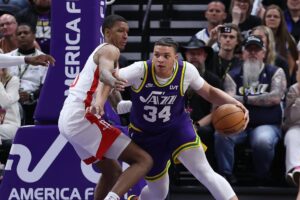 AUGUST 16: Free agent forward Kenneth Lofton Jr. has agreed to a one-year contract with the Bulls, sources tell Shams Charania of The Athletic (Twitter link).
While Charania doesn’t provide any other details on the deal, he says Lofton will have the opportunity in training camp to compete for a spot on Chicago’s regular season roster. That suggests it’ll be a non-guaranteed minimum-salary contract.
Lofton, who turned 22 on Wednesday, began his professional career with the Grizzlies in 2022 after going undrafted out of Louisiana Tech. The bulky 6’6″ forward spent most of his rookie year on a two-way contract with Memphis, appearing in 24 NBA games.
After being converted to a standard contract in April 2023, Lofton began the 2023/24 season on the Grizzlies’ 15-man roster, but was waived in December when Ja Morant was activated from the suspended list. He spent a couple months on a two-way deal with Philadelphia, then was waived again in March and signed a rest-of-season contract with the Jazz, who cut him last month before his ’24/25 salary became partially guaranteed.
Although Lofton didn’t play much at the NBA level in ’23/24, he finished the year strong in Utah, averaging 13.8 points, 5.0 rebounds, and 4.8 assists in 22.8 minutes per game across four April outings for the Jazz. He also had a big year in the G League, earning All-NBAGL First Team honors after putting up 25.1 PPG, 9.5 RPG, 4.4 APG, and 1.6 BPG in 19 regular season games (30.1 MPG) for the Delaware Blue Coats and the Salt Lake City Stars.
The Bulls currently have 14 players on guaranteed standard contracts, with Onuralp Bitim on a non-guaranteed deal, so if Lofton impresses in camp, he could become the team’s 15th man. Chicago also has a two-way spot available, though Lofton would only be eligible to have his contract converted to a two-way deal if it includes Exhibit 10 language.
Hoops Rumors Glossary: Salary Cap Exceptions
There are a number of ways that NBA teams without salary cap space are able to add players. When we discuss trades and free agency at Hoops Rumors, we’ll often refer to these salary cap “exceptions.”
In case you’re wondering what exactly we mean when we mention a “Non-Bird exception” or a “bi-annual exception,” we’ve compiled a brief overview for reference. The NBA’s salary cap exceptions found in the latest Collective Bargaining Agreement are listed below, along with links to more extensive glossary entries on each exception.
- Bird Exception: If a player has been on the same team for three years (not necessarily full seasons), his team can re-sign him for up to the player’s maximum salary. Generally, a player who changes teams via trade retains his Bird rights, but he loses them if he signs with a new team as a free agent. A Bird player can sign for up to five years with maximum annual raises of 8%.
- For further reference: Hoops Rumors Glossary: Bird Rights
- Early Bird Exception: If a player has been on the same team for two years (not necessarily full seasons), his team can re-sign him for up to 175% of his previous salary or 105% of the average player salary from the previous season, whichever is greater. Early Bird contracts must be for at least two seasons (no more than four), with maximum annual raises of 8%.
- For further reference: Hoops Rumors Glossary: Early Bird Rights
- Non-Bird Exception: If a player finishes a season with a team without having earned Bird or Early Bird rights, his team can re-sign him for 120% of his previous salary, 120% of the applicable minimum salary, or – if he’s a restricted free agent – the amount of his qualifying offer. A Non-Bird player can sign for up to four years with maximum annual raises of 5%.
- For further reference: Hoops Rumors Glossary: Non-Bird Rights
- Non-Taxpayer Mid-Level Exception: A team operating below the first tax apron can offer a player a contract for up to four years with maximum annual raises of 5% using the mid-level exception. The MLE amount for 2024/25 is $12,822,000; it will increase annually at the same rate as the salary cap. This exception, which can be used on one or multiple players, can also be used to acquire players via trade or waiver claim.
- For further reference: Hoops Rumors Glossary: Mid-Level Exception
- Taxpayer Mid-Level Exception: A team operating below the second tax apron can offer a player a contract for up to two years with a maximum second-year raise of 5% using the mid-level exception. The taxpayer MLE amount for 2024/25 is $5,168,000; it will increase annually at the same rate as the salary cap. This exception, which can be used on one or multiple players, can only be used to sign players, not to acquire them via trade or waiver claim.
- For further reference: Hoops Rumors Glossary: Mid-Level Exception
- Room Exception: If a team uses room under the cap to sign players, it forfeits its full mid-level exception and receives this exception, which isn’t available to teams above the cap. After using its cap room, a team can offer a player a contract for up to three years with maximum annual raises of 5%. The room exception amount for 2024/25 is $7,983,000; it will increase annually at the same rate as the salary cap. This exception, which can be used on one or multiple players, can also be used to acquire players via trade or waiver claim.
- For further reference: Hoops Rumors Glossary: Mid-Level Exception
- Bi-Annual Exception: A team can offer a player a contract for up to two years with a maximum raise of 5% using the bi-annual exception. However, it’s only available to teams that operate over the cap and below the first tax apron. The bi-annual exception amount for 2024/25 is $4,668,000; it will increase annually at the same rate as the salary cap. This exception, which can be used on one or multiple players, can also be used to acquire players via trade or waiver claim. As its name suggests, the bi-annual exception can only be used every other year.
- For further reference: Hoops Rumors Glossary: Bi-Annual Exception
- Minimum Salary Exception: A team can offer a player a contract for up to two years worth the applicable minimum salary. A team can also use this exception to trade for minimum-salary players, as long as their contracts don’t cover more than two seasons and never included a salary above the minimum. There is no limit to the number of players a team can acquire using this exception.
- For further reference: Hoops Rumors Glossary: Minimum Salary Exception
- Rookie Scale Exception: A team can sign its first-round draft picks for up to 120% of the rookie salary scale amount or as little as 80% of the rookie salary scale amount. The rookie salaries for 2024 first-round picks can be found right here. The rookie scale increases annually at the same rate as the salary cap.
- For further reference: Hoops Rumors Glossary: Rookie Scale Exception
- Second-Round Pick Exception: A team can sign a second-round pick to a three- or four-year contract with a team option on the final year. A contract signed using the second-round exception can exceed the applicable rookie minimum in the first year (or the first two years, for a four-year deal), but not in the final two years. The details for second-round pick exception signings in 2024/25 can be found right here.
- For further reference: Hoops Rumors Glossary: Second-Round Pick Exception
- Disabled Player Exception: If a player suffers an injury deemed more likely than not to sideline him through the following June 15, a team can be granted this exception by the league. It can be used to sign a replacement player for one year, and is worth 50% of the disabled player’s salary or the amount of the non-taxpayer mid-level exception, whichever is lesser. It can also be used to acquire a player via trade or waiver claim if he’s in the final year of his contract. This exception, which must be applied for between July 1 and January 15, can only be used once and is forfeited if not used by March 10 (or the next business day, if March 10 falls on a weekend).
- For further reference: Hoops Rumors Glossary: Disabled Player Exception
- Traded Player Exception: Any team can replace a traded player – or traded players – simultaneously (in the same transaction) with one or more players whose total salaries amount to no more than 100% of the outgoing salary. For teams operating below the tax aprons, the incoming value can increase to as high as 200% of the outgoing salary (plus $250K), depending on the amount of that salary. Alternately, both non-taxpaying and taxpaying teams can replace a traded player non-simultaneously (within one year) with one or more players whose total salaries amount to no more than 100% of the traded player’s salary.
- For further reference: Hoops Rumors Glossary: Traded Player Exception
Note: This is a Hoops Rumors Glossary entry. Our glossary posts will explain specific rules relating to trades, free agency, or other aspects of the NBA’s Collective Bargaining Agreement.
Earlier versions of this post were published in 2012 and 2018.
Early NBA Maximum Salary Projections For 2025/26
Although a number of big-money free agent contracts were completed over the summer, several of the most lucrative deals signed by players so far in 2024/25 have been contract extensions. And many of those extensions have been maximum-salary deals.
 [RELATED: 2024/25 NBA Contract Extension Tracker]
Because those extensions won’t go into effect until at least the 2025/26 season and the NBA won’t finalize the ’25/26 salary cap until next summer, we can only ballpark what many of year’s maximum-salary contracts will look like based on the league’s latest cap estimates.
The NBA’s most recent projection for ’25/26 called for a $154,647,000 cap, which is the number we’ll use to project next season’s maximum salaries. That would represent a 10% increase on this season’s cap, which is the maximum allowable increase for one year league year to the next.
Listed below are the early maximum-salary projections for 2025/26.
The first chart shows the maximum salaries for a player re-signing with his own team — a player’s previous club can offer five years instead of four, and 8% annual raises instead of 5% raises. The second chart shows the maximum salaries for a player signing with a new team.
A player’s maximum salary is generally determined by his years of NBA experience, so there’s a wide gap between potential earnings for younger and older players. Unless they qualify for a more lucrative extension by meeting certain performance criteria, players with no more than six years of NBA experience are limited to a starting salary worth up to 25% of the cap. For players with seven to nine years of experience, that number is 30%. For players with 10 or more years of experience, it’s 35%.
Here are the the early max-salary projections for 2025/26:
A player re-signing with his own team (8% annual raises, up to five years):
| Year | 6 years or less | 7-9 years | 10+ years |
|---|---|---|---|
| 2025/26 | $38,661,750 | $46,394,100 | $54,126,450 |
| 2026/27 | $41,754,690 | $50,105,628 | $58,456,566 |
| 2027/28 | $44,847,630 | $53,817,156 | $62,786,682 |
| 2028/29 | $47,940,570 | $57,528,684 | $67,116,798 |
| 2029/30 | $51,033,510 | $61,240,212 | $71,446,914 |
| Total | $224,238,150 | $269,085,780 | $313,933,410 |
The “6 years or less” column here is what the new extensions for Scottie Barnes, Cade Cunningham, Evan Mobley, and Franz Wagner will look like if none of them make an All-NBA team in 2025. All four players have Rose Rule language in their contracts, however, and could move up to the 30% max column (“7-9 years”) if certain performance criteria are met.
The 30% max column will also apply to players who reach the free agent market next summer with between seven and nine years of NBA experience under their belts. That would be Brandon Ingram‘s maximum contract with his current team, for instance.
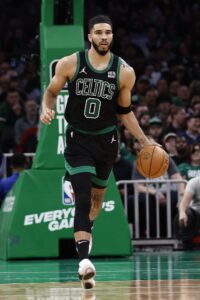
The third column (35%) will apply to the super-max extension signed by Celtics star Jayson Tatum or to a player with 10+ years of NBA service who reaches free agency next summer, such as Mavericks star Kyrie Irving.
A player signing with a new team (5% annual raises, up to four years):
| Year | 6 years or less | 7-9 years | 10+ years |
|---|---|---|---|
| 2025/26 | $38,661,750 | $46,394,100 | $54,126,450 |
| 2026/27 | $40,594,838 | $48,713,805 | $56,832,773 |
| 2027/28 | $42,527,925 | $51,033,510 | $59,539,095 |
| 2028/29 | $44,461,013 | $53,353,215 | $62,245,418 |
| Total | $166,245,525 | $199,494,630 | $232,743,735 |
If a player changes teams as a free agent, he doesn’t have access to a fifth year or 8% raises. So if someone like Alperen Sengun were to sign an offer sheet with a new team next summer, his maximum contract would be a four-year deal projected to be worth just over $166MM.
If a veteran free agent with between seven and nine years of NBA experience – such as Ingram – wants to change teams in 2025, he would be able to sign a four-year contract worth up to a projected $199.5MM.
Irving or another veteran with 10+ years of experience would be able to earn up to $232.7MM across four years if they change teams as free agents in 2025.
Although it happened with Paul George during the 2024 offseason, it’s relatively rare for a player with that many years of experience to sign a four-year, maximum-salary contract with a new team, especially since some of those older stars (like LeBron James) would be ineligible to sign a four-year max deal due to the Over-38 rule.