
And-Ones: Media Rights, Seattle, Vegas, 2025 Draft, Offseason
The NBA’s new media rights agreements with Disney (ESPN/ABC), NBC, and Amazon won’t give those partners matching rights during the next round of negotiations in 11 years, industry sources tell Mike Vorkunov and Andrew Marchand of The Athletic. For instance, if the NBA were to reach an agreement on a rights deal with Netflix in 2035, Amazon wouldn’t be given the right to match Netflix’s offer.
The league presumably didn’t want to deal with that complication again in its next media rights negotiation period, given how Warner Bros. Discovery’s matching rights have affected this year’s talks. Warner Bros. Discovery (the parent company of TNT Sports) reportedly intends to exercise its matching rights on Amazon’s new package of games. The league, in turn, is expected to challenge WBD’s interpretation of those rights, which could result in a legal battle.
The NBA’s new media deals will go into effect at the start of the 2025/26 season and will run through ’35/36.
We have more odds and ends from around the basketball world:
- If Seattle gets a new NBA team in the next round of expansion, the ownership group that controls the NHL’s Seattle Kraken is considered the significant frontrunner, but the bidding for a Las Vegas franchise looks more wide open, according to Randall Williams and Kim Bhasin of Fortune.com, who hears from two sources that the total price tag – including building a new arena – could reach $7 billion. The company that owns the Red Bull brand is among the groups with interest in a Las Vegas team, per Williams and Bhasin.
- Jonathan Wasserman of Bleacher Report has published his “way-too-soon” mock draft for 2025, with Duke forward Cooper Flagg at No. 1, followed by Rutgers guard Dylan Harper. Baylor wing V.J. Edgecombe, Rutgers swingman Ace Bailey, and UNC guard Drake Powell round out Wasserman’s top five.
- In an Insider-only story for ESPN.com, Bobby Marks takes a look at each team’s most impactful transaction of the offseason so far and what moves might still be coming before the regular season tips off.
NBA Teams With Hard Caps For 2024/25
The NBA salary cap is somewhat malleable, with various exceptions allowing every team to surpass the $140,588,000 threshold once their cap room is used up. In some cases, teams blow past not only the cap limit, but the luxury tax line of $170,814,000 as well — the Suns, Timberwolves, and Celtics are among the clubs who project to have massive tax bills this season as a result of their spending.
The NBA doesn’t have a “hard cap” by default, which allows clubs like Phoenix, Minnesota, and Boston to build a significant payroll without violating NBA rules. However, there are certain scenarios in which teams can be hard-capped.
The league’s new Collective Bargaining Agreement has carried over the hard cap rules from the 2017 CBA while also expanding them, adding new scenarios in which teams can face hard caps and creating a second salary level that certain teams can’t exceed.
We went into greater detail earlier this month on how teams become hard-capped, but here’s a brief rundown of the ways it can happen in 2024/25:
- A team becomes hard-capped at the first tax apron ($178,132,000) if it makes any of the following moves:
- Acquires a player via sign-and-trade.
- Uses more than the taxpayer portion (up to two years, with a starting salary of $5,168,000) of the mid-level exception to sign a player.
- Uses any portion of the mid-level exception to acquire a player via trade or waiver claim.
- Uses any portion of the bi-annual exception to sign a player or to acquire a player via trade or waiver claim.
- Takes back more than 100% of the salary it sends out in a trade (when over the cap).
- Uses a traded player exception generated during the previous offseason or regular season.
- Signs a player who was waived during the regular season and whose pre-waiver salary was higher than the non-taxpayer mid-level exception ($12,822,000).
- A team becomes hard-capped at the second tax apron ($188,931,000) if it makes any of the following moves:
- Uses any portion of the mid-level exception to sign a player to a contract.
- Aggregates two or more players in a trade for salary-matching purposes.
- Sends out cash in a trade.
- Sends out a player via sign-and-trade and uses that player’s outgoing salary to take back a contract (either in the same transaction or in a subsequent transaction via the resulting trade exception).
Given how many ways there are to create a hard cap, most clubs who don’t intend to operate over one of the two aprons will likely end up hard-capping themselves at one or the other.
Some teams will have to be hyper-aware of that hard cap when they consider any roster move for the rest of the season, but for others it’s just a technicality that won’t affect their plans in any meaningful way.
Listed below are the hard-capped teams for the 2024/25 league year, along with how they created a hard cap.
In some instances, a team made multiple roster moves that would have imposed a hard cap (e.g. acquired a player via sign-and-trade and used the non-taxpayer mid-level exception). Only the first of those transactions is noted below, though in some cases a team made two moves within a single transaction to create a hard cap, in which case each relevant move is mentioned.
Hard-capped at first tax apron
These teams will be prohibited from exceeding $178,132,000 in team salary.
Atlanta Hawks
- Acquired Cody Zeller via sign-and-trade.
- Used a trade exception generated last offseason (for John Collins) to acquire Larry Nance Jr., Dyson Daniels, E.J. Liddell, and Zeller.
Brooklyn Nets
- Acquired Shake Milton via sign-and-trade.
- Used a trade exception generated last offseason (for Patty Mills) to acquire Milton.
- Used a trade exception generated last season (for Spencer Dinwiddie) to acquire Bojan Bogdanovic.
Charlotte Hornets
- Acquired DaQuan Jeffries, Charlie Brown Jr., and Duane Washington via sign-and-trade.
Chicago Bulls
- Used the non-taxpayer mid-level exception to sign Jalen Smith.
Cleveland Cavaliers
- Took back more than 100% of Caris LeVert‘s outgoing salary in a trade for De’Andre Hunter.
Dallas Mavericks
- Used the non-taxpayer mid-level exception to sign Naji Marshall.
Golden State Warriors
- Acquired Buddy Hield and Kyle Anderson via sign-and-trade.
- Took back more than 100% of Klay Thompson‘s outgoing salary in a trade for Hield and Anderson.
Houston Rockets
- Used a trade exception generated last offseason (for Kevin Porter Jr.) to acquire AJ Griffin.
Los Angeles Clippers
- Used the bi-annual exception to sign Nicolas Batum.
Memphis Grizzlies
- Used the non-taxpayer mid-level exception to sign Scotty Pippen Jr.
Miami Heat
- Used the non-taxpayer mid-level exception to acquire Kyle Anderson.
New Orleans Pelicans
- Took back more than 100% of the aggregated outgoing salaries of Larry Nance Jr., Dyson Daniels, E.J. Liddell, and Cody Zeller in a trade for Dejounte Murray.
Oklahoma City Thunder
- Took back more than 100% of Josh Giddey‘s outgoing salary in a trade for Alex Caruso.
Sacramento Kings
- Acquired DeMar DeRozan via sign-and-trade.
San Antonio Spurs
- Took back more than 100% of the aggregated outgoing salaries of Zach Collins, Tre Jones, and Sidy Cissoko in a trade for De’Aaron Fox.
Toronto Raptors
- Took back more than 100% of Jalen McDaniels‘ outgoing salary in a trade for Sasha Vezenkov.
- Used a trade exception generated last season (for Pascal Siakam) to acquire Davion Mitchell.
Utah Jazz
- Took back more than 100% of Kris Dunn‘s outgoing salary (subject to base year compensation) in a trade for Russell Westbrook.
Washington Wizards
- Took back more than 100% of Deni Avdija‘s outgoing salary in a trade for Malcolm Brogdon.
Hard-capped at second tax apron
These teams will be prohibited from exceeding $188,931,000 in team salary.
Denver Nuggets
- Used the taxpayer mid-level exception to sign Dario Saric.
Detroit Pistons
- Sent out cash in a trade.
Indiana Pacers
- Sent out cash in a trade.
Los Angeles Lakers
- Aggregated the salaries of Max Christie and Jalen Hood-Schifino in a trade for Maxi Kleber.
Milwaukee Bucks
- Sent out cash in a trade.
New York Knicks
- Aggregated the salaries of Bojan Bogdanovic, Shake Milton, and Mamadi Diakite in a trade for Mikal Bridges.
- Took back salary for a player who was sent out via sign-and-trade (Milton).
No hard cap
- Boston Celtics
- Minnesota Timberwolves
- Orlando Magic
- Philadelphia 76ers
- Phoenix Suns
- Portland Trail Blazers
This list, which figures to continue evolving, will be updated throughout the 2024/25 league year as necessary. It can be found anytime in the “Hoops Rumors Features” menu on the right-hand sidebar of our desktop site, or in the “Features” menu on our mobile site.
New York Notes: Knicks, Capela, Hart, Nets, Gilyard, Wilson
Responding to a reader’s question in a video mailbag, Ian Begley of SNY.tv identified Hawks big man Clint Capela as one of the centers the Knicks have checked in on this offseason as they scour the trade market.
“I don’t know how far talks went,” Begley said (Twitter video clip). “I don’t know if they’re active at this very moment. But they did check in on Capela.”
According to Begley, it’s unclear whether the Knicks envisioned Capela replacing Mitchell Robinson on the roster as their starting center or if they viewed the duo as a potential platoon at the five. Either scenario is a long shot, given that Capela will earn $22.3MM in 2024/25. Sending out enough salary to exceed Capela’s cap figure (avoiding a first-apron hard cap) would be tricky, unless the Knicks were to move either Julius Randle ($28.9MM) or multiple rotation players in a deal.
Although the Knicks have kicked the tires on higher-salary center options like Capela, Begley says the most likely scenario is that they add a lower-cost backup for Robinson and enter training camp with a roster that looks very similar to the current group.
Here’s more on the NBA’s two New York teams:
- The influx of money that the NBA’s new media rights deals will bring into the league has Knicks forward Josh Hart rethinking how long he wants to play, he said during an appearance on the Front Office Sports Today podcast. “I wanted to retire at like 34, maybe 35, so I’d still got a bit of juice left,” Hart said (story via Dennis Young of Front Office Sports). “But then I saw (reports of the new $76 billion media deal), and I was like, you know what? I’m gonna play until my knees fall off.”
- Jacob Gilyard is no longer with the Nets‘ Summer League team, according to Brian Lewis of The New York Post (Twitter link). While there are no details yet on Gilyard’s absence, Lewis speculates that the free agent guard’s strong play in Las Vegas – including a .375 3PT% and 3.3 steals per game – may have earned him a contract offer from another NBA club.
- Nets swingman Jalen Wilson, who had already been excelling in Vegas, had 33 points and 10 rebounds in Thursday’s victory over Orlando and looks like a legitimate candidate for this year’s Summer League MVP award, writes Collin Helwig of NetsDaily. Wilson has averaged 24.3 points per game on .463/.556/.882 shooting in four outings. The 23-year-old, who has a $1.89MM minimum-salary contract for 2024/25 that is currently just partially guaranteed for $75K, looks like a safe bet to make Brooklyn’s regular season roster, which would increase that partial guarantee to $325K.
Magic Sign Cory Joseph
July 19: Joseph’s contract is now official, the Magic announced in a press release.
 July 17: The Magic and free agent point guard Cory Joseph have agreed to a deal, reports Michael Scotto of HoopsHype (Twitter link). According to Scotto, Joseph’s new contract will cover two seasons.
A first-round pick in 2011, Joseph has spent 13 seasons in the NBA, playing for the Spurs, Raptors, Pacers, Kings, Pistons, and Warriors since entering the league.
The veteran guard, who will turn 33 next month, averaged just 11.4 minutes per contest in 26 appearances for Golden State last season before being dealt to the Pacers in February in a salary-dump trade. He was subsequently waived by Indiana.
Though he wasn’t effective in 2023/24, Joseph has a solid career résumé as a backup point guard. The Canadian has averaged 6.9 points, 3.0 assists, and 2.5 rebounds in 21.7 minutes per game across 816 regular season outings, with a shooting line of .441/.349/.786.
While the exact terms of Joseph’s agreement haven’t been reported, I’d expect it to be a veteran’s minimum deal.
It’s also unclear whether or not the first year will be fully guaranteed. It seems safe to assume that the second year, at least, will be non-guaranteed, as Orlando has made a habit in recent years of tacking on second-year team options for many of its signees — Gary Harris and Moritz Wagner both got them earlier this month.
[Update: Jason Beede of The Orlando Sentinel (Twitter link) confirms that the second year of Joseph’s contract will be a team option.]
The Magic entered the day with 14 players on standard guaranteed contracts for 2024/25, so Joseph looks like the leading candidate to fill the 15th spot on the club’s standard roster for now.
Assuming he makes the regular season roster, Joseph will provide depth and veteran leadership in a young backcourt that includes Jalen Suggs, Cole Anthony, and Anthony Black. It looks increasingly unlikely that former No. 1 overall pick Markelle Fultz is in Orlando’s plans going forward. Fultz remains an unrestricted free agent.
And-Ones: Flopping, Tiebreakers, Gill, Aprons, Team USA, Durant
The NBA’s Board of Governors voted this week to make the in-game flopping penalty a permanent part of the league rules, according to a press release. The rule, which charges the offending player with a non-unsportsmanlike technical foul and gives the opposing team a free throw attempt, was adopted ahead of the 2023/24 season on a one-year trial basis and will remain in place going forward.
The Board of Governors also approved a tweak to the tiebreaker rules for the NBA Cup (in-season tournament), removing overtime scoring for the purposes of the point differential and total points scored tiebreakers.
There were scenarios last season in which it would have benefited the winning team to play for overtime – where it could build a bigger margin of victory – rather than trying to win in regulation by a smaller margin. That won’t be the case under the new rules, as an NBA Cup group-stage game that goes to overtime will result in a point differential of zero for both teams, regardless of how the extra period plays out.
Here are a few more odds and ends from around the basketball world:
- Anthony Gill is drawing interest from a pair of EuroLeague teams, according to Alessandro Maggi of Sportando, who says that Barcelona and Anadolu Efes are eyeing the veteran free agent forward. Gill has spent the past four seasons with the Wizards, appearing in 179 regular season games during that time, almost exclusively as a reserve.
- Jake Fischer of Yahoo Sports takes a closer look at how the NBA’s new tax apron rules are impacting teams’ decisions this offseason, suggesting that players whose contracts are heavy on unlikely incentives may become harder to trade going forward. Wizards guard Jordan Poole, Heat guard Tyler Herro, and Nets forward Cameron Johnson are a few of those players, Fischer writes — their deals each include between $2.5MM and $4.25MM in annual incentives. Whether or not they’re earned, those incentives are counted when determining where a team is operating relative to the aprons.
- ESPN’s Brian Windhorst recaps Team USA’s Wednesday win over Serbia, while Joe Vardon of The Athletic provides a handful of takeaways from the squad’s time in Abu Dhabi, which also included an exhibition victory over Australia. Kevin Durant (calf strain) didn’t practice with the club in Abu Dhabi, but is hoping to get on the court in London during Team USA’s final stop before heading to Paris, Vardon writes. The U.S. will face South Sudan on Saturday and Germany on Monday in its last pre-Olympic tune-up games.
- The Clippers sent $4.3MM to the Jazz in the Russell Westbrook/Kris Dunn trade, according to ESPN’s Adrian Wojnarowski (Twitter link), more than covering Westbrook’s $4.03MM salary for the 2024/25 season.
Pacific Notes: Hield, Knecht, Hyland, Eubanks, Suns
New Warriors sharpshooter Buddy Hield, who ranks 22nd all-time among NBA players in career three-pointers, will be the de facto replacement for the player who ranks sixth on that all-time list (Klay Thompson). Asked this week if he feels pressure to replicate the production and the outside shooting that Thompson provided for years in Golden State, Hield downplayed that idea.
“There’s no pressure,” Hield said, per Monte Poole of NBC Sports Bay Area. “Just come and do my job. What Klay has done for this organization has been tremendous. I love Klay a lot. I’ve watched him over the years. He’s special. The way he can get hot and the way he can just change the game and be the two-way player that he is, and the champion that he is. So, I don’t look at it as pressure. I think it’s fun just being in that role and seeing if I can get the same looks he got.”
Hield has never been as effective an all-around player as Thompson was in his prime years, and he certainly can’t match the former Warriors’ postseason accomplishments, having appeared in a playoff game for the first time this spring. However, the two players’ career shooting numbers are quite similar — Thompson has made 3.1 of 7.6 three-pointers per game (41.3%) in 793 contests, while Hield has knocked down 3.0 of 7.6 per game (40.0%) in 632 outings.
Here’s more from around the Pacific:
- Dalton Knecht has been the best player on the Lakers‘ Summer League roster and already looks like a potential steal as the No. 17 pick in this year’s draft, according to Jovan Buha of The Athletic, who says the rookie forward projects to be in the top nine of L.A.’s rotation in the regular season. Entering Thursday’s contest, Knecht has averaged 22.0 PPG with a .412 3PT% in his first two games in Vegas.
- Bones Hyland saw more playing time for the Clippers during the final month-and-a-half of the 2023/24 season and won’t have Russell Westbrook ahead of him on the depth chart in ’24/25. However, with Kris Dunn and Kevin Porter Jr. now in the mix in a Los Angeles backcourt that also features James Harden, Norman Powell, and Terance Mann, there’s still no clear path to regular playing time for Hyland, who remains on the trade block, according to Law Murray of The Athletic (Twitter link).
- Although Drew Eubanks decided well ahead of his player option deadline to opt out of his deal and become a free agent, he wasn’t necessarily set on leaving the Suns, as Duane Rankin of The Arizona Republic relays. “The interest was always there for me to return (to Phoenix),” said Eubanks, who ultimately agreed to a deal with Utah. “The notion of it being a ‘mutual split’ is just factually false. There were a lot of conversations about me coming back this next year from the moment the season ended and into free agency. At the end of the day, there were other opportunities and I had to make the best decision for myself and my family. Loved my year in Phoenix.”
- The Suns will hire John Little as the head coach of their new NBA G League affiliate, the Valley Suns, sources tell Michael Scotto of HoopsHype (Twitter link). Little was previously part of G League coaching staffs with Maine and Wisconsin.
Southwest Notes: Kennard, Pelicans, Murphy, Whitmore
Checking in on where things stand between the Grizzlies and Luke Kennard, Damichael Cole of The Memphis Commercial Appeal writes that the sharpshooter’s return to Memphis “still feels inevitable” even though it’s taking longer than expected.
The Grizzlies declined Kennard’s $14.8MM team option at the end of June, but the expectation has always been that he would return on a more team-friendly cap number. He hasn’t been linked to any other suitors since free agency began.
Sources tell Cole that the Grizzlies would like to keep their 15th roster spot for the sake of flexibility entering the regular season. Since the team currently has 14 players on guaranteed standard contracts, re-signing Kennard may mean trading someone else — Ziaire Williams is rumored to be on the block.
Here’s more from around the Southwest:
- While head of basketball operations David Griffin said on an ESPN broadcast this week that the Pelicans are “really excited” about what they have at center and are looking forward to playing “small and fast,” it’s fair to wonder if one more move is coming to shore up the position, writes Christian Clark of NOLA.com. Veteran Daniel Theis currently sits atop New Orleans’ depth chart at the five, with rookies Yves Missi and Karlo Matkovic behind him and Jeremiah Robinson-Earl potentially in the mix as well.
- Within the same story, Clark reports that the Pelicans and fourth-year wing Trey Murphy have opened discussions about a rookie scale extension. The two sides have “differing viewpoints” on Murphy’s value for now, but there’s optimism they’ll find a middle ground and make a deal before the October 21 deadline, Clark writes.
- Rockets forward Cam Whitmore has been shut down for the rest of Summer League, but rookie guard Reed Sheppard will continue playing in Las Vegas, reports Kelly Iko of The Athletic (Twitter link). Last year’s Summer League MVP, Whitmore has struggled with his shooting efficiency this time around, making just 38.3% of his shot attempts, including 1-of-14 three-pointers, but Houston knows what he’s capable of offensively and he impressed in other areas (7.0 RPG, 4.3 APG, 3.3 SPG).
Hoops Rumors Glossary: Rookie Scale
When a player like Zaccharie Risacher enters the NBA, his new team – in this case, the Hawks – can rest assured that there’s essentially no chance of him holding out for a larger contract. That’s because a first-round NBA draft pick is only eligible to sign a rookie scale contract, which limits his leverage and ensures that his draft slot will dictate how much he gets paid.
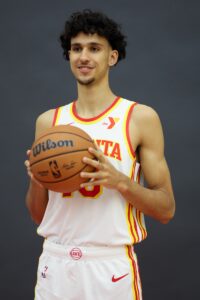 A rookie scale contract for first-rounders is always for two guaranteed seasons, with team options for the third and fourth seasons of the deal. The scale amount is strictly set by draft position for the first three years of the contract, with the amount of the fourth year determined by a percentage raise on the third-year salary, as RealGM’s rookie scale chart for 2024 picks shows.
Players are eligible to sign for as little as 80% or as much as 120% of the scale amount, though almost every player signs for the full 120%. Earlier this month, Knicks first-round pick Pacome Dadiet became the first player since 2019 to sign for just 80% of his rookie scale amount, and even that rate only applies to his rookie season — he’ll get the full 120% in years two through four.
[RELATED: Rookie Scale Salaries For 2024 First-Round Picks]
Under the NBA’s current Collective Bargaining Agreement, the rookie scale increases annually at the same rate as the salary cap. In other words, a 5% salary cap increase would mean a 5% increase to rookie scale salaries.
For the 2024/25 season, the first-year rookie scale amount for the first overall pick is $10,474,200. That number increases to $10,998,100 in year two and $11,521,700 in year three, with a 26.1% raise for year four and a 40% increase for a fifth-year qualifying offer. Risacher signed with the Hawks for 120% of that amount, meaning his contract looks like this:
| Season | Salary |
|---|---|
| 2024/25 | $12,569,040 |
| 2025/26 | $13,197,720 |
| 2026/27 | $13,826,040 |
| 2027/28 | $17,434,636 |
| 2028/29 | $24,408,490 |
- Team option in italics
- Qualifying offer in bold
The scale amounts and fourth- and fifth-year raises vary depending on draft position. Top picks earn the highest salaries, while late first-round picks get the most substantial bumps at the end of their contracts. For instance, the 30th overall pick gets an 80.5% raise between years three and four, with a qualifying offer increase of 60%.
Here are several more details relating to rookie scale contracts:
- Only first-round picks are eligible for rookie scale contracts. Second-rounders can be signed using the second-round pick exception (or cap room or other exceptions).
- A team doesn’t have to be under the cap to sign rookie scale contracts. Any team can give a first-rounder a full 120% rookie contract, regardless of its cap status.
- Because 120% contracts are so common, the cap hold for a first-round pick is also 120% of the player’s rookie scale amount.
- Bonuses can be included in rookie scale contracts as long as they don’t exceed 120% of the player’s rookie scale amount. It’s relatively common for teams to include likely incentives a player can earn for his participation in Summer League and offseason workout programs.
- If a player hasn’t signed by January 10, his rookie scale amount begins to prorate downward each day for the remainder of the season until he signs. If there are 174 days in the regular season, the rookie scale amount would prorate downward by 1/174th per day.
- Teams have until October 31 each year to make decisions on the team-option seasons in rookie scale contracts (or the next business day, if October 31 falls on a weekend). By October 31, 2024, teams will have to decide on the options for the 2025/26 season.
- Players coming off rookie-scale contracts may be eligible for larger or smaller qualifying offers in their fifth year, based on whether or not they meet the “starter criteria.” We explain the starter criteria in greater detail here.
- If a team signs a first-round pick within three years of drafting him, the rookie scale for the year in which he signs is used. For instance, Leandro Bolmaro was selected with the No. 23 overall pick in the 2020 draft but didn’t sign an NBA contract with the Timberwolves until the 2021 offseason. As a result, Bolmaro’s rookie scale contract was equivalent to what the No. 23 pick in the 2021 draft received.
- If a first-round pick signs four or more years after being drafted and his team has cap room, he is eligible to receive a salary greater than 120% of his rookie scale amount. In practice, however, this essentially never happens.
Note: This is a Hoops Rumors Glossary entry. Our glossary posts will explain specific rules relating to trades, free agency, or other aspects of the NBA’s Collective Bargaining Agreement. Larry Coon’s Salary Cap FAQ was used in the creation of this post.
Earlier versions of this post were published in 2012 and 2019.
Hawks Notes: Young, Capela, Gueye, Djurisic, Risacher
As expected, the Hawks moved one of their two starting guards this offseason, sending Dejounte Murray to New Orleans while hanging onto Trae Young. Veteran center Clint Capela also remains on the trade block, sources tell Zach Lowe of ESPN (Insider link).
If the Hawks end up trading Capela, the 25-year-old Young could become the oldest member of a starting lineup that also features Dyson Daniels, Jalen Johnson, No. 1 overall pick Zaccharie Risacher, and Onyeka Okongwu, Lowe suggests, noting that Daniels’ secondary play-making and elite defense could pair well with Young’s skill set, allowing Bogdan Bogdanovic and De’Andre Hunter to lead the second unit. In that scenario, the three-time All-Star could “lead a fun, up-tempo team that might be ready to peak by the middle of his prime,” Lowe writes.
Still, Lowe wonders if that path to eventual contention might progress too slowly for Young’s liking, especially since the team doesn’t control its own first-round picks for the next three years, hindering its ability to continue adding young talent. On the other hand, going all-in by trading their 2029 and 2031 first-round picks for veteran help would probably be too aggressive an approach for the Hawks.
If Atlanta remains stuck in the middle of the Eastern Conference, it could lead to an “inevitable decision point” with Young, Lowe says. The star guard is under contract for at least the next two seasons, with a player option for 2026/27, and trade interest from teams like the Spurs and Lakers has “cooled” in recent months, sources tell ESPN, so it’s a safe bet he’ll open the 2024/25 season with the Hawks. But depending on how the coming year plays out, it may just be a matter of time before Young is once again the subject of trade speculation.
Here’s more on the Hawks:
- Atlanta is optimistic about Mouhamed Gueye‘s chances of earning a rotation spot as early as this fall, sources tell Lowe. The 2023 second-round pick was limited to just six games as a rookie, largely due to a lower back stress fracture and a UCL sprain, but the team remains high on his potential.
- Agent Misko Raznatovic has provided an update on his client Nikola Djurisic, who sustained a left foot fracture in Summer League play. According to Raznatovic (Twitter link), Djurisic is undergoing surgery this week and the plan is for him to get back on the court by the end of September. That timeline suggests the 2024 second-rounder could be ready for training camp in the fall if he signs an NBA contract, though I’d expect the Hawks to take a patient, cautious approach with his recovery.
- Marc J. Spears of Andscape spoke to Zaccharie Risacher and his father Stéphane about the elder Risacher’s long, successful career as a basketball player in Europe and the impact it had on his son. “That was the first player I ever watched,” Zaccharie said. “When I started to grow and I got my first iPad and iPhone, I would go to watch my father’s highlights on YouTube.”
Offseason Observations: Apron Impact, Rockets, Spurs, Okogie
The NBA's offseason is far from over. As we saw last summer, when Damian Lillard was traded to Milwaukee in late September and Jrue Holiday was flipped from Portland to Boston on October 1, the trade market stays open into the fall.
We also could still see impactful moves on the free agent market occurring much later in the offseason, as was the case a year ago when Derrick Jones and P.J. Washington - two key members of the Mavericks' team that made the NBA Finals - signed their respective contracts during the second half of August (Washington signed with the Hornets before being traded to Dallas later in the season).
Still, the pace of the offseason action has certainly slowed down since the start of July, giving us an opportunity to look back and reflect on all that's gone down in the last few weeks.
From one of the biggest storylines of the summer (the impact of the new tax apron rules) to some under-the-radar developments (like the structure of Josh Okogie's new deal with the Suns), we're taking a closer look today at some of the more curious offseason subplots.
Let's dive in...
Has the impact of the new apron restrictions been overstated?
The concept of the tax apron has existed in the NBA's Collective Bargaining Agreement for years, and a second apron was implemented in 2023, but the 2024 offseason is the first time all the new apron-related restrictions introduced in the current CBA have been in place. Those new restrictions affect the trade market most significantly, with teams operating over the first tax apron not permitted to take back more salary than they send out and teams over the second apron prohibited from aggregating player salaries.
While it's true that these rules have made it challenging for teams with high payrolls to make moves as easily as they used to, I think they've also become a convenient scapegoat for teams to justify certain roster decisions.
