
Raptors Exercise Bruce Brown’s 2024/25 Team Option
The Raptors are exercising their $23MM team option on Bruce Brown‘s contract for the 2024/25 season, sources tell ESPN’s Adrian Wojnarowski (Twitter link). According to Josh Lewenberg of TSN.ca (Twitter link), the club has officially confirmed the move.
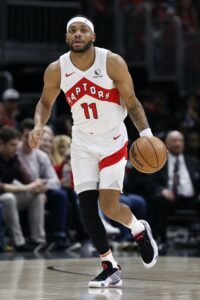 There had been some speculation that Toronto would pick up that option on Brown as part of a trade agreement, and Wojnarowski refers to the swingman as a “valuable trade asset.” However, it doesn’t sound like any deal is in place at this point to send Brown to a new team.
After playing a crucial role off the bench for the Nuggets during their 2022/23 championship season, Brown drew significant interest as a free agent last summer and eventually signed a two-year, $45MM contract with the Pacers. Indiana sent him to Toronto in January as part of a trade package for Pascal Siakam.
In 67 total appearances (44 starts) for the Pacers and Raptors, Brown averaged 10.8 points, 4.2 rebounds, and 2.9 assists in 27.9 minutes per game, posting a shooting line of .478/.323/.824. The 6’4″ wing is considered a solid, versatile perimeter defender who is a good fit next to more ball-dominant players on offense.
Exercising Brown’s $23MM option and taking on salary in their now-official trade with the Kings puts the Raptors on track to operate as an over-the-cap team this offseason. They’ll have a decision to make on another wing Gary Trent Jr., who will be an unrestricted free agent. Re-signing Trent would likely prevent Toronto from using the non-taxpayer mid-level exception while remaining out of tax territory, as Blake Murphy of Sportsnet.ca tweets.
Whether Brown plays out the season in Toronto or is dealt to a new team, he’ll return to unrestricted free agency in 2025, since he won’t become extension-eligible before his current deal expires.
Kings Trade Davion Mitchell, Sasha Vezenkov To Raptors
JUNE 28: The trade is official, the Raptors announced in a press release, confirming the details outlined below. Toronto used the No. 45 pick to select Houston Cougars guard Jamal Shead on Thursday.
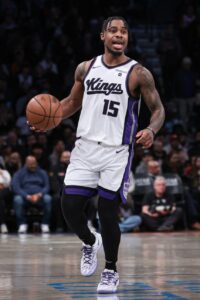 “This trade provides us with a mix of young and veteran players, as well as future flexibility and draft assets, as we continue our quest to win, and so we’re pleased to welcome Davion, Sasha and Jamal to the Raptors and to Toronto,” Raptors general manager Bobby Webster said in a statement. “We thank Jalen for his contributions, and we wish him all the best in the future.”
Because the trade was completed before the new league year began, Toronto completed it using salary-matching and the Siakam trade exception (as explained below) rather than using cap room, which is a signal that they intend to operate over the cap this offseason.
JUNE 27: The Kings have agreed to trade guard Davion Mitchell and forward Sasha Vezenkov to the Raptors, reports Adrian Wojnarowski of ESPN (Twitter link). Toronto is also receiving the No. 45 pick in tonight’s draft, per Wojnarowski (Twitter link), as well as Portland’s 2025 second-round pick, according to Sean Cunningham of FOX 40 Sacramento (Twitter link).
Sacramento will acquire forward Jalen McDaniels from Toronto in the swap, Wojnarowski adds (via Twitter).
The ninth overall pick in the 2021 draft, Mitchell averaged 11.5 points per game as a rookie but is primarily known as a defensive specialist. In 2023/24, he averaged 5.3 points and 1.9 assists in 15.3 minutes per game across 72 appearances for the Kings, almost exclusively in a reserve role.
Keon Ellis‘ emergence last season and the arrival of No. 13 pick Devin Carter created a crowded backcourt picture in Sacramento and it appears Mitchell will be the odd man out.
Vezenkov, the 2022/23 EuroLeague MVP, was selected 57th overall in the 2017 draft but didn’t make the move to the NBA until last summer, when he signed a three-year, $20MM contract with the Kings. It was an up-and-down NBA rookie year for the 28-year-old, who converted 37.5% of his three-point tries but averaged just 12.2 minutes per game in 42 contests, contributing 5.4 PPG and 2.3 RPG.
A series of June reports suggested that a trade involving Vezenkov was a possibility for the Kings, who projected to be up against the luxury tax after agreeing to re-sign Malik Monk to a four-year, $78MM contract. As cap expert Yossi Gozlan tweets, swapping out Vezenkov’s $6.66MM salary and Mitchell’s $6.45MM cap hit for McDaniels’ incoming $4.74MM salary will give Sacramento about $7MM in spending flexibility below the tax heading into free agency.
The move will also open up a spot on the Kings’ 15-man roster and should generate a pair of trade exceptions for Sacramento, including one worth Vezenkov’s salary ($6.66MM).
McDaniels had a poor season in Toronto in 2023/24, averaging just 3.4 PPG on .344/.169/.730 shooting in 50 games (10.8 MPG). But the athletic 6’9″ wing is only one year removed from scoring a career-high 9.4 PPG, and he had a career shooting line of .465/.345/.784 prior to last season.
As for the Raptors, they’ll take on some extra salary for 2024/25 but neither Mitchell nor Vezenkov is owed guaranteed money beyond next season, and both players could vie for rotation minutes if they remain on the roster. Mitchell is extension-eligible this offseason before potentially reaching restricted free agency in 2025, while Vezenkov’s deal includes a $6.98MM team option for 2025/26.
Toronto now controls the No. 31 and No. 45 picks on Thursday after selecting Baylor’s Ja’Kobe Walter at No. 19 on Wednesday.
The Raptors have multiple options for how to complete the deal. If they intend to operate over the cap, they could use McDaniels’ outgoing salary to match Vezenkov’s incoming figure, then take Mitchell’s salary into a $10MM+ trade exception they created in January’s Pascal Siakam deal. If they plan to operate under the cap, they’ll simply absorb the two incoming salaries using their room. Taking the former route would hard-cap them at the first tax apron for 2024/25.
Southwest Notes: Rockets, Mavs, Thompson, Pelicans, Cissoko
The Rockets will have enough cap flexibility to use the full non-taxpayer mid-level exception this offseason, but Jonathan Feigen of The Houston Chronicle (subscription required) is skeptical that they’ll do so. As Feigen explains, Houston will have nearly all of last year’s rotation players back, with No. 3 pick Reed Sheppard joining the mix and Steven Adams and Tari Eason returning from injuries, so there may not be a role available for a mid-level signee.
Since the mid-level exception can be used for the first time in 2024/25 as a de facto trade exception, Feigen expects Houston to be fine with the idea of hanging onto it into the regular season in case it comes in handy on the trade market.
Within that same story, Feigen also briefly touches on the contract situations for Alperen Sengun and Jalen Green, who will both be eligible for rookie scale extensions beginning in July. While the Rockets are expected to explore deals with both players, they’re unlikely to offer either Sengun or Green a maximum-salary contract, says Feigen.
Here’s more from around the Southwest:
- Marc Stein adds another team to the list of possible Klay Thompson suitors, reporting on Substack that the Mavericks will explore the feasibility of adding the veteran Warriors sharpshooter. Dallas will have a little flexibility below the first tax apron after agreeing to send Tim Hardaway to Detroit, but won’t have cap room, so a sign-and-trade deal looks like the only way the Mavs would have any chance at Thompson.
- Pelicans head of basketball operations David Griffin vowed in April that the front office would operate with a sense of “urgency” to upgrade the roster this offseason. He reiterated that message this week, as Christian Clark of NOLA.com relays. “We need to be aggressive,” Griffin said. “I think it’s really a positive thing for our organization that we’ve won more games three years in a row. We’ve built what we’ve built in terms of players wanting to stay here. That’s tremendous. That’s not why we are doing this. We are doing this to win.”
- Spurs forward Sidy Cissoko underwent an arthroscopic clean-up procedure on his right knee last month, according to Tom Orsborn of The San Antonio Express-News (subscription required), who says Cissoko’s participation in Summer League could be limited as a result. While the Spurs are hopeful that the 2023 second-rounder will be able to suit up at the Las Vegas Summer League, he won’t play in the California Classic Summer League that tips off on July 6, per Orsborn.
Pacers’ Jalen Smith To Decline Option, Become Free Agent
Pacers big man Jalen Smith has decided not to pick up his player option for the 2024/25 season, according to Michael Scotto of HoopsHype (Twitter link). Declining that $5.42MM option will make Smith an unrestricted free agent on Sunday.
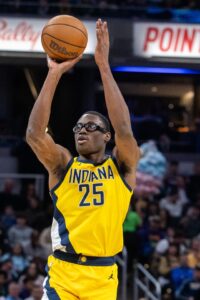 Smith, one of Myles Turner‘s backups at center, was among the beneficiaries of the Pacers’ high-flying offense led by Tyrese Haliburton, setting new career highs in points per game (9.9), field-goal percentage (59.2%), and three-point percentage (42.4%) in 2023/24. He also contributed 5.5 rebounds per game in his part-time role (17.2 MPG).
Teams with interest in Smith may be wary of his leap in efficiency – he was a 48.5% career shooter, including 29.7% on three-pointers prior to ’23/24 – but he’s a versatile forward/center who is still just 24 years old and should get a long look from teams in need of frontcourt depth.
A new agreement with Indiana remains a possibility, since the team will hold his Bird rights and can go over the cap to re-sign him. However, Indiana has already committed to Pascal Siakam on a four-year, maximum-salary contract and will have to deal with Obi Toppin‘s restricted free agency as well.
With the luxury tax line to consider and Isaiah Jackson a candidate to take on a larger role at the five, the Pacers will likely be cautious about how high they go to retain Smith, who came in at No. 42 on our list of this year’s top 50 free agents.
James Borrego Pulls Out Of Pistons’ Coaching Search
Pelicans associate head coach James Borrego has removed his name from consideration for the Pistons‘ head coaching vacancy, league sources tell Chris Haynes of Bleacher Report (via Twitter). Justin Napoli of Boot Krewe Media first tweeted on Thursday that he was hearing Borrego would remain in New Orleans.
Borrego, who also received serious consideration for the Lakers’ and Cavaliers’ head coaching jobs this offseason, was immediately identified as a candidate for Detroit following the dismissal of Monty Williams last week.
The veteran assistant, who served as the head coach of the Hornets from 2018-22, has spent the last two seasons on Willie Green‘s staff in New Orleans, overlapping with new Pistons president of basketball operations and former Pelicans general manager Trajan Langdon.
One recent report from Marc Stein indicated that the Lakers would also have interest in Borrego as an assistant if he didn’t get a head coaching job, though Stein stressed that the Pelicans would be determined to hang onto him in that scenario.
With Borrego off the table, Timberwolves assistant Micah Nori, Mavericks assistant Sean Sweeney, and former Cavs head coach J.B. Bickerstaff are among the candidates to watch for the Pistons. All three have had interviews with the team, per James L. Edwards III of The Athletic.
Warriors, Paul Agree To Push Guarantee Date Back To Sunday
The Warriors and Chris Paul have agreed to push back his salary guarantee deadline from Friday to Sunday, according to ESPN’s Adrian Wojnarowski (Twitter link).
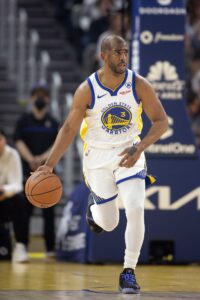 Paul’s $30MM salary for 2024/25 will now become fully guaranteed if he remains under contract through June 30 rather than June 28. The move will give Golden State a couple more days to continue exploring trades involving Paul’s expiring contract.
[RELATED: Early NBA Salary Guarantee Dates For 2024/25]
Paul, who turned 39 in May, remained productive in 2023/24, averaging 9.2 points, 6.8 assists, and 3.9 rebounds in 26.4 minutes per game in 58 appearances (18 starts) for the Warriors. He posted a shooting line of .441/.371/.827.
While those are solid numbers for a backup point guard, they don’t warrant a $30MM investment. Still, rather than simply waiving the 12-time All-Star, the Warriors have been scouring the trade market to see if they can use his expiring salary to accommodate a trade.
The NBA’s salary-matching rules only count the guaranteed portion of a player’s cap hit for outgoing purposes in a trade (his incoming value for a trade partner would be his full $30MM), so in order to use CP3 as a trade chip, Golden State will have to partially or fully guaranteed the contract. That scenario would benefit Paul, who wouldn’t make any of that $30MM otherwise if he’s waived, so he has some incentive to lend the Warriors a hand by giving them more time to find a deal.
Paul George is one possible trade candidate who has been linked to the Warriors this week, with Marc Stein reporting on Substack that Golden State has been “prioritizing the pursuit of George above all other business.” The Clippers forward would have to pick up his 2024/25 player option and request a trade for that to be a feasible possibility.
What happens with Paul could have an impact on the Warriors’ negotiations with Klay Thompson. The team will be hard-capped at the second tax apron in 2024/25 after agreeing to send out cash in a trade on Thursday, so there may not be room under that apron to acquire another player with a significant salary and then re-sign Thompson.
USA Basketball Announces 15-Man Select Team
USA Basketball has announced in a press release that a 15-man Select Team will train with the U.S. Olympic squad as it prepares for the upcoming Olympics. The Select Team, which is made up mostly of younger players and some who have previous Team USA experience, will work out with the men’s national team in Las Vegas from July 6-8.
The members of the Select Team are as follows:
- Jalen Duren (Pistons)
- Cooper Flagg (Duke)
- Langston Galloway (free agent)
- Nigel Hayes-Davis (Fenerbahce)
- Trayce Jackson-Davis (Warriors)
- Jaime Jaquez (Heat)
- Brandon Miller (Hornets)
- Trey Murphy (Pelicans)
- Keegan Murray (Kings)
- Brandin Podziemski (Warriors)
- Micah Potter (Jazz/two-way FA)
- Payton Pritchard (Celtics)
- Jabari Smith Jr. (Rockets)
- Jalen Suggs (Magic)
- Amen Thompson (Rockets)
Perhaps the most notable name on the list is Flagg, who has committed to Duke and will begin his first college basketball season in the fall. He’s viewed as a strong candidate to be the No. 1 pick in the 2025 NBA draft.
Duren, Galloway, Murphy, Murray, and Pritchard were part of the U.S. Select Team that trained with the national team ahead of the 2023 World Cup.
It’s possible some of these players will use their Select Team experience as a springboard to represent Team USA in international competitions down the road. Kawhi Leonard, Devin Booker, Anthony Edwards, and Tyrese Haliburton are among the players on this year’s Olympic team that were members of a Select Team earlier in their respective careers.
The select team will be coached by Magic head coach Jamahl Mosley, who will be joined by assistants Jim Boylen and Matt Painter. Boylen, a former Bulls head coach and current Pacers assistant, was Team USA’s head coach during the qualifying contests. Painter has been the longtime head coach at Purdue.
Trade Rumors: Wiggins, Warriors, Rockets, Ingram, Kings, Jazz
Andrew Wiggins is no longer in the mix for the Canadian national team this summer, according to Doug Smith of The Toronto (Twitter link), who says the Warriors are “playing hardball” with a player they are “looking to move.”
Wiggins was insured and medically cleared by Canada Basketball, tweets Michael Grange of Sportsnet.ca, but it sounds like the Warriors don’t want to risk his health during trade negotiations after he dealt with an ankle issue last season. While Grange says the veteran forward isn’t thrilled about the decision, Anthony Slater of The Athletic (Twitter link) refers to it as a mutual one.
According to Jake Fischer of Yahoo Sports, Wiggins is one of several Warriors veterans who is considered a potential outgoing piece if Golden State makes a major deal. Kevon Looney and Gary Payton II fall into that category, as does Chris Paul, whose $30MM salary remains non-guaranteed for the time being. The Warriors’ decision on Paul’s non-guaranteed salary is due on Friday, but it’s possible the team will give him a partial guarantee in exchange for pushing back that deadline, says Fischer.
Here are a few more trade rumors from around the NBA:
- While some trade rumors earlier this week linked Kevin Durant to Houston, the Rockets are more interested in pursuing younger trade targets whose timeline matches up better with their core, according to Sam Amick and Anthony Slater of The Athletic. Amick and Slater name Suns guard Devin Booker, Cavaliers guard Donovan Mitchell, and Pelicans forward Zion Williamson as some players who would fit that bill for Houston, acknowledging that there’s no indication any of those players will be available this summer.
- Exploring potential trade partners for the Pelicans and forward Brandon Ingram, Fischer mentions the Kings, Sixers, Hawks, and Cavaliers as possibilities. However, he says that Atlanta and New Orleans haven’t had substantive discussions since talking about Dejounte Murray in February, while Cleveland remains reluctant to part with any of its four core players, including potential Pels target Jarrett Allen. It’s also unclear how high Ingram ranks on Philadelphia’s list of possible targets, Fischer adds. Sacramento, meanwhile, has been in the market for help on the wing this offseason, though Fischer doesn’t explicitly say the Kings have talked to New Orleans about Ingram.
- Although rival teams are expected to continue calling to register interest in Lauri Markkanen, the Jazz‘s goal continues to be extending the veteran forward and acquiring another star to complement him, Fischer writes. Adrian Wojnarowski expressed a similar sentiment during ESPN’s draft broadcast this week. Utah talked to the Hawks about Murray in February and also expressed interest in Mikal Bridges before Brooklyn agreed to send him to New York, says Fischer.
Bulls Sign Marcus Domask To Exhibit 10 Contract
JULY 9: The Bulls have officially signed Domask, according to RealGM’s transaction log.
JUNE 28: Undrafted rookie free agent Marcus Domask is expected to sign an Exhibit 10 contract with the Bulls, according to a tweet from the Illinois men’s basketball team.
A Wisconsin native, Domask played a “super-senior” year with the Illini in 2023/24 after spending his first four college seasons at Southern Illinois. In 2023/24, the 6’6″ wing started all 38 games he played, averaging 15.9 points, 5.0 rebounds, and 3.9 assists in 34.5 minutes per contest, with a shooting line of .453/.297/.872.
That three-point mark was well below Domask’s average at Southern Illinois, where he knocked down 35.9% of his tries from beyond the arc.
An Exhibit 10 contract is a non-guaranteed minimum-salary deal that doesn’t count against a team’s cap unless the player makes the regular season roster. It can be converted to a two-way contract before the season begins or can put a player in line to earn a bonus if he’s waived and then spends at least 60 days with his team’s G League affiliate.
Hoops Rumors Glossary: Traded Player Exception
Relying on the trade machine at ESPN or Spotrac is probably the simplest way for NBA fans to verify whether or not a trade will work under league rules, but it’s a worthwhile exercise to examine and understand the primary tool in the NBA’s Collective Bargaining Agreement that determines a trade’s viability — the traded player exception.
Teams with the cap room necessary to make a trade work don’t need to abide by traded player exception rules. However, if a team makes a deal that will leave its total salary more than $250K above the salary cap, the club can use a traded player exception to ensure the trade is legal under CBA guidelines.
There are two different types of traded player exceptions used in NBA deals. One applies to simultaneous trades, while the other applies to non-simultaneous deals.
In a simultaneous trade, a team can send out one or more players and can acquire more salary than it gives up. In a non-simultaneous trade, only a single player can be dealt, and the team has a year to take back the equivalent of that player’s salary (plus $250K for non-tax apron teams).
Let’s look into each scenario in greater detail….
Simultaneous:
In a simultaneous trade, different rules apply to teams whose salaries are below the first tax apron and those whose salaries are above the apron. A non-apron team can trade one or more players and take back the greater of the following amounts:
- The lesser of 200% of the outgoing salary (plus $250K) or the outgoing salary plus $7.5MM.
- Note: This $7.5MM buffer increases by the same amount as the cap each season. In 2024/25, it’s approximately $7.75MM.
- 125% of the outgoing salary (plus $250K), for any amount above $29,000,000.
Here’s a recent example of these rules in effect:
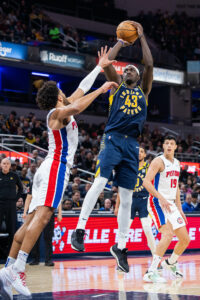 In January, the Pacers traded Bruce Brown, Kira Lewis, and Jordan Nwora to the Raptors in exchange for Pascal Siakam.
Brown was earning $22,000,000 in 2023/24, so if Indiana had traded him on his own, the team could have taken back $29,500,000 (his salary, plus $7.5MM). However, that wouldn’t have been enough to cover Siakam’s salary of $37,893,408.
By adding Lewis ($5,722,116) and Nwora ($3,000,000) to their trade package, the Pacers sent out a total of $30,722,116. The third rule listed above applies to that figure, meaning Indiana was able to take back 125% of the outgoing amount (plus $250K), for $38,652,645 in total — that was enough to cover Siakam’s salary, making the trade legal.
For apron teams, the traded player exception rules for a simultaneous trade are simpler, but far more restrictive. A team whose salary is over either tax apron can take back no more than 100% of the outgoing salary, no matter how much – or how little – outgoing salary is involved.
That means that if the Suns, who project to be a second-apron team in 2024/25, want to trade Nassir Little, they’ll be ineligible to take back a player earning even one dollar more than his $6,750,000 salary for next season.
A team’s position relative to the apron at the conclusion of the transaction dictates which set of rules they have to be abide by. For instance, a team whose salary sits just $2MM below the first tax apron can’t trade a $5MM player for a $10MM player, since that deal would push its salary above the apron. However, a team whose salary is $10MM below the apron could make that move.
In simultaneous transactions, the traded player exception is used to instantly complete the deal, leaving no lingering loose ends. This form of the traded player exception isn’t what we’re talking about if we say a team “has a trade exception” available to use. Those outstanding trade exceptions come as a result of non-simultaneous deals.
Non-simultaneous:
In non-simultaneous deals, a team can trade away a single player without immediately taking salary back in return. The team then has up to one year in which it can acquire one or more players whose combined salaries amount to no more than the traded player’s salary (plus $250K for non-apron teams).
For instance, when the Nets sent Joe Harris to the Pistons along with a pair of second-round picks last offseason, they didn’t take any salary back. That was a non-simultaneous trade from Brooklyn’s perspective, allowing the team to create a traded player exception worth Harris’ salary ($19,928,571).
The Nets subsequently had a year to use that exception to acquire one or more players whose salaries total up to $20,178,571 (Harris’ salary, plus $250K). They used a portion of it to acquire Thaddeus Young and his $8MM salary in a deal with the Raptors, leaving approximately $12MM left over. Trade exceptions expire after a year if they haven’t been used in full — the remainder of that one will expire on July 8.
A team can acquire one or more players as part of a non-simultaneous trade. For example, when the Knicks completed their OG Anunoby trade with the Raptors in December, they sent out RJ Barrett and his $23,883,929 salary, creating a non-simultaneous trade exception worth that amount and immediately taking Anunoby’s $18,642,857 salary into it. That reduced the value of the trade exception to $5,241,072.
A team can create a non-simultaneous trade exception regardless of whether its salary is under or over the tax aprons. If the Suns were to trade the aforementioned Little this offseason for a player earning $3.75MM, they would create a non-simultaneous trade exception worth $3MM and would have one year to use it.
Putting the two together:
When evaluating an NBA trade, it’s worth remembering that two teams can view the deal entirely differently and that they’re allowed to divide a single trade into multiple parts to maximize their flexibility. For example, one team could consider a trade simultaneous, while the other team breaks the transaction down into two separate trades, one simultaneous and one non-simultaneous.
Let’s take a look at a recent real-life example, examining the Anunoby trade mentioned above between the Knicks and Raptors.
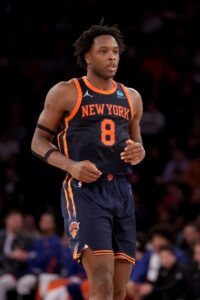 From the Knicks’ perspective, the trade broke down as follows:
- Traded Immanuel Quickley ($4,171,548) for Precious Achiuwa ($4,379,527) and Malachi Flynn ($3,873,025).
- This trade is a simultaneous one for the Knicks, who were operating below both aprons, allowing them to take back up to 200% of Quickley’s salary, plus $250K. That figure works out to $8,593,096; Achiuwa and Flynn were earning a combined $8,252,552, making them a fit.
- Traded RJ Barrett ($23,883,929) for OG Anunoby ($18,642,857).
- This is a non-simultaneous trade, with the Knicks essentially creating a $23.88MM trade exception for Barrett’s outgoing salary and immediately taking Anunoby into it. As noted above, New York has until December 30, 2024 to use the remaining $5,241,072 on the exception.
Here’s how it looked from the Raptors’ perspective:
- Traded OG Anunoby ($18,642,857) for RJ Barrett ($23,883,929).
- In a simultaneous trade of Anunoby, the Raptors (also a non-apron team) were permitted to take back $26,142,857, which is the full amount of his salary, plus $7.5MM. That’s enough to cover Barrett’s $23.88MM salary, but not enough to take on Quickley too, since he was earning more than the $2,258,928 gap between Barrett’s salary and the amount Toronto could take back for Anunoby.
- Traded Malachi Flynn ($3,873,025) for Immanuel Quickley ($4,171,548).
- Because they couldn’t use Anunoby to acquire both Barrett and Quickley, the Raptors had to use Flynn’s outgoing salary in a simultaneous trade to take on Quickley. Toronto could have taken back up to $7,996,050 in salary for Flynn (200% of his salary, plus $250K), so Quickley is an easy fit.
- Traded Precious Achiuwa ($4,379,527) for “nothing.”
- Because Achiuwa’s salary wasn’t required for matching purposes, the Raptors moved him to the Knicks in a non-simultaneous trade, from their perspective, generating a trade exception worth his salary that they have until December 30, 2024 to use. They later used a $3MM chunk of that exception in a trade with the Pacers to take on Jordan Nwora. It’s worth noting that either Flynn or Achiuwa could have matched Quickley’s incoming salary, but teams will always use the smaller salary for matching purposes in that scenario, creating the trade exception with the bigger salary.
When a team can’t use a traded player exception:
Under the league’s current Collective Bargaining Agreement, teams above the first or second tax apron face additional restrictions related to traded player exceptions, besides not being able to take back more salary than they send out.
A team is not permitted to use a (non-simultaneous) traded player exception created during the previous offseason or regular season if its team salary will be above the first tax apron upon the conclusion of the deal. Using a TPE created during the prior year will hard-cap the team at the first tax apron for the subsequent season.
For instance, the Rockets used a trade exception they created in last October’s Kevin Porter trade to acquire AJ Griffin from the Hawks on Thursday. That means Houston’s team salary will be hard-capped at the first apron for the 2024/25 league year. If the Rockets had been operating above the first apron, that deal wouldn’t have been permitted as constructed.
Apron teams are still allowed to use newly created trade exceptions. Circling back once more to the Suns/Little example outlined above, if Phoenix traded Little today for a player earning $3.75MM, the team would be able to use the $3MM TPE generated in that deal for the rest of the offseason or ’24/25 regular season.
But the Suns can’t currently use any of the three trade exceptions they generated in July and September of 2023. If Phoenix were to move below the first tax apron during the 2024/25 league year, those exceptions would become “unfrozen” (assuming they haven’t expired) and could be used.
Here are a couple additional restrictions that apron teams face related to trade exceptions:
- A team is not permitted to aggregate two or more player salaries for matching purposes if that team will be above the second tax apron upon the conclusion of the deal. We have many more details on salary aggregation in a separate glossary entry.
- A team is not permitted to take back salary using a signed-and-traded player as the outgoing matching piece if that team will be above the second tax apron upon the conclusion of the deal. If a team creates a (non-simultaneous) traded player exception by sending out a player via sign-and-trade, that exception can’t be used if the team will be above the second tax apron at the conclusion of the transaction.
More notes on traded player exceptions:
- A team’s outgoing salary for matching purposes is the guaranteed salary rather than the total salary. For example, a player with a $2MM partial guarantee on a $10MM salary would only count for $2MM for salary-matching purposes for the team trading him (the team acquiring him would still have to account for him as $10MM in incoming salary). Between the end of a team’s season and June 30, the outgoing salary for a traded player is the lesser of his full current-season salary and his guaranteed salary for the next season. We have more details on this rule in a separate glossary entry.
- Trade exceptions created in non-simultaneous trades can’t be combined with one another, with other exceptions, or with a player’s salary; they can’t be used to sign a free agent (except in a sign-and-trade); and they can’t be traded outright to another team. However, they can be used to claim a player off waivers.
- The salary in a sign-and-trade can sometimes be subject to base year compensation rules. In that case, the player’s outgoing salary for trade purposes is either his previous salary or 50% of his new salary, whichever is greater. For instance, when the Heat signed-and-traded Max Strus to the Cavaliers last summer, Strus’ incoming salary from Cleveland’s perspective was $14,487,684, but his outgoing salary from Miami’s perspective was just $7,243,842.
- Teams that are under the cap before a trade and go over the cap as a result of the trade can’t create a trade exception as a result of that deal.
- Players signed using the minimum salary exception can also be acquired using the minimum salary exception in a trade, so matching their salary using a traded player exception is not required. A tax apron team is permitted to acquire a player using the minimum salary exception without matching salaries.
- For salary-matching purposes, future draft picks or the draft rights to an unsigned player aren’t taken into consideration. Neither is cash, which can be sent out in a trade by teams below the second apron.
- Teams will be permitted to use the non-taxpayer mid-level, room, and bi-annual exceptions as de facto trade exceptions beginning in 2024/25. For instance, a club could trade for a player earning $10MM using the non-taxpayer mid-level exception.
The traded player exception is one of the CBA’s more complicated tools and can make it challenging for over-the-cap teams to navigate the trade market. It’s undoubtedly simpler to use an online trade machine to determine whether a deal is legal, but examining the rules and figuring out exactly how a blockbuster trade breaks down can provide rewarding insight into an NBA club’s management of its cap.
Note: This is a Hoops Rumors Glossary entry. Our glossary posts will explain specific rules relating to trades, free agency, or other aspects of the NBA’s Collective Bargaining Agreement. Larry Coon’s Salary Cap FAQ was used in the creation of this post.
Earlier versions of this post were published in previous years.