
Suns To Hire Mike Hopkins As Assistant Coach
The Suns have reached a deal with Mike Hopkins to bring the former University of Washington coach aboard as an assistant on Mike Budenholzer‘s staff, sources tell Adrian Wojnarowski and Pete Thamel of ESPN.
Hopkins, who played college basketball at Syracuse from 1989-93, rejoined the Orange as an assistant coach in 1995 and spent over two decades in that role, briefly serving as acting head coach during Jim Boeheim‘s nine-game suspension in 2015/16.
In 2017, Hopkins was hired by Washington as the head coach of the school’s men’s basketball team. He earned Pac-12 Coach of the Year honors in his first two seasons on the job (2018 and 2019) and won a regular season conference title in 2019. However, the Huskies announced earlier this year that he wouldn’t be returning for the 2024/25 season after posting a 122-110 (.526) record across his seven years with the program.
As Wojnarowski and Thamel point out, Hopkins has worked with NBA players before, having been involved with the coaching staffs of several Team USA squads over the years.
Since being hired by the Suns last month to replace Frank Vogel, Budenholzer has been slowly building out his staff for his first year in Phoenix. David Fizdale, Vince Legarza, Chad Forcier, and Chaisson Allen are among the other coaches expected to be Suns assistants under Budenholzer.
Nikola Jokic Included On Serbia’s Preliminary Olympic Roster
The Serbian national team has officially unveiled its preliminary roster for the 2024 Olympics, and that group is headlined by a noteworthy name. Nuggets center Nikola Jokic is one of the 16 players on Serbia’s preliminary roster, which will be cut down to 12 players for this summer’s games in Paris.
Jokic was noncommittal when asked last month at the end of Denver’s season whether he intended to play for Serbia in the Olympics. Svetislav Pesic, the head coach of the national team, recently stated that the Nuggets star remained undecided. Jokic’s inclusion on the 16-man preliminary roster doesn’t guarantee he’ll be in Paris, but it’s a signal that he’s planning to participate.
Even without Jokic, the Serbians claimed a silver medal at the 2023 FIBA World Cup, falling to Germany in the final but qualifying for the Olympics based on that deep World Cup run. Hawks guard Bogdan Bogdanovic and Heat forward Nikola Jovic were among the key players on that team.
Bogdanovic and Jovic are also on the preliminary Olympic roster, and are joined by three more NBA players in Jokic, Hornets guard Vasilije Micic, and Hornets forward Aleksej Pokusevski. Filip Petrusev and Marko Guduric previously played in the NBA, while Nikola Milutinov, Ognjen Jaramaz, and Vanja Marinkovic were selected in past drafts but have never signed NBA contracts.
Serbia will be in Group C along with the United States at the Olympics and can secure a spot in the quarterfinals with a top-two finish in round-robin play. South Sudan and the winner of an Olympic qualifying tournament in Puerto Rico (Lithuania is the top-rated club in that six-team tournament) will be the other competition in Group C. Assuming Jokic plays, he could end up facing fellow Nuggets star Jamal Murray – who will suit up for Canada – at some point in the single-elimination portion of the event.
2024 NBA Offseason Preview: Phoenix Suns
Mat Ishbia made it clear in February 2023 when he took over majority control of the Suns from Robert Sarver that he was prepared to spend aggressively (both in terms of money and trade assets) in a way the team’s previous owner never did. One of his very first moves was to approve a massive deal for star forward Kevin Durant at the 2023 deadline. He doubled down on that all-in strategy by signing off on a blockbuster trade for Bradley Beal last offseason.
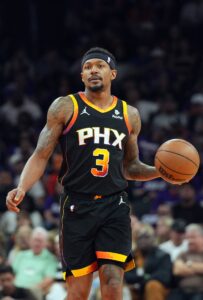 The moves left Phoenix with a top-heavy roster headed by three players who will earn a combined $150MM+ in 2024/25 when Devin Booker‘s new super-max extension begins. That trio will surpass the projected $141MM cap on its own, and once the Suns account for salaries for Jusuf Nurkic ($18.1MM), Grayson Allen ($15.6MM), and Nassir Little ($6.8MM), their team salary will exceed $191MM, putting them over the projected second tax apron of $189.5MM with just six players. Even filling out the rest of the roster with minimum-salary players will push team salary well past the $200MM mark.
Operating over the second apron means two things: Phoenix will be on the hook for a huge luxury tax bill and will also face major restrictions when it comes to making roster moves. Ishbia clearly doesn’t mind writing a big check for luxury tax penalties, so the money shouldn’t be an issue, but those roster-building restrictions are concerning. This team was hardly dominant in its first year together. The Suns clinched a playoff spot on the final day of the season, then were swept out of the first round. The front office can’t simply run it back with the same roster.
Changes are needed, and those changes will be difficult to enact as a second-apron team. The Suns won’t have the mid-level or bi-annual exception at their disposal to sign free agents. They can’t acquire a player via sign-and-trade or use previously generated trade exceptions. They can make trades, but they won’t be able to take back more salary than they send out. They also can’t aggregate player contracts (e.g. trading Nurkic and Little for a $25MM player) and they’re prohibited from offering cash to sweeten an offer.
President of basketball operations James Jones has had a nice run of success in Phoenix since being named the permanent general manager in 2019, serving as the architect of a team that snapped a 10-year playoff drought, made an NBA Finals, and has averaged roughly 50 wins per season over the last four years. But figuring out how to meaningfully upgrade the current version of the roster might be his most challenging assignment yet.
The Suns’ Offseason Plan
When Phoenix’s season came to an end in April, league observers and pundits were quick to suggest that the team’s big three of Durant, Booker, and Beal should be broken up. There’s a logical case to be made for that path. The three stars are all pretty ball-dominant and their fit together is just OK, not great. Trading one of them for two or three lesser-paid players could help balance the roster both on the cap sheet and on the court.
It’s a strategy that sounds better in theory than in practice though. Of the three, Beal is probably the one you’d want to move, but he has a no-trade clause that essentially allows him to control the process, and his value has declined since he last made an All-Star team in 2021. He’s still a talented scorer (his .513/.430/.813 shooting line last season was especially impressive) and is a solid play-maker, but he’s not a plus defender and he’s owed $161MM over the next three seasons. The Suns didn’t have to give up a huge package to acquire him and can’t expect one back if they try to send him elsewhere.
The Suns could command a more substantial haul if they were willing to trade Durant or Booker, but those guys are top-20 players in the NBA, so it’s hard to envision a deal in which one of them is traded and Phoenix is able to increase its championship odds for 2025. With that in mind, it’s no surprise that a May report indicated that the Suns plan to hang onto their big three, which Jones confirmed in a radio appearance later in the month.
If Durant, Booker, and Beal aren’t going anywhere, that leaves Nurkic, Allen, and Little as the likeliest trade chips, though we can probably rule out Allen, who won’t be trade-eligible until October after signing an extension in April and whose three-and-D skill set makes him a valuable role player for the Suns. Little’s usefulness as a trade chip, meanwhile, is limited, since his $6.75MM salary can’t be aggregated, meaning he could only bring back a player earning less than that amount. The same is true of Nurkic, though his larger cap hit ($18.125MM) means the pool of players he could be traded for is much larger.
Unfortunately for the Suns, neither Nurkic nor Little has a ton of trade value on his own. I think Nurkic might be slightly underrated in some ways (he’s a very good rebounder and passer) but he’s obviously not the sort of versatile center who will help you space the floor on offense or guard out to the perimeter on defense, so he’s not a bargain at $18MM+ per year. Little showed some promise in Portland but wasn’t good in his first season in Phoenix, averaging a career-low 3.4 points per game as his three-point percentage dipped to just 30.0%.
The Suns would have to attach a sweetener to either player to realistically land an upgrade. Cash is off limits and Phoenix has traded away most of its future draft assets. However, the club could technically still offer this year’s No. 22 pick (the trade would have to be finalized after a selection is made), as well as its 2031 first-rounder (beginning in July). Would one of those picks along with Nurkic be enough for a meaningful addition?
Gerald Bourguet of PHNX Sports explored this topic recently, suggesting 20 hypothetical trades involving Nurkic and a first-round pick, but most of them either look like long shots or don’t necessarily do a whole lot for the Suns. Of Bourguet’s ideas, the one I find most compelling for both sides might be a deal with Charlotte for a less expensive center (Nick Richards), plus another role player or two. A package of Richards, Cody Martin, and Tre Mann, for instance, would (barely) fit within Nurkic’s outgoing salary — all three players could have roles in Phoenix, but it’s not such a talented trio that the retooling Hornets should realistically expect a better return than what the Suns could offer.
Attaching both movable first-rounders to Nurkic might net a stronger return than that Hornets example, but there’s certainly a ceiling on what the Suns can expect to do on the trade market. That’s why it’s so crucial that they re-sign free agent forward Royce O’Neale. While Phoenix can’t sign an outside free agent for more than the minimum, the team will have O’Neale’s Bird rights, allowing the front office to offer him any salary up to the max.
Of course, O’Neale won’t get nearly that much, but he’ll have some leverage to get a player-friendly deal out of the Suns, who would have no means to replace him with a comparable player if he leaves. A recent report suggested Phoenix might have to offer a three- or four-year deal to ensure O’Neale doesn’t sign with a rival suitor willing to offer him a comparable (or higher) starting salary on a shorter-term contract.
Eric Gordon, Josh Okogie, Drew Eubanks, and Damion Lee will have decisions to make on minimum-salary player options, which will help determine how many back-end roster spots the Suns have to fill. Some of those players (ie. Lee) seem likelier to opt in than others (ie. Gordon), but even if all of them return, the Suns won’t have a full roster and will likely need to make multiple minimum-salary signings.
I’d expect the team to take the same approach in free agency that it did a year ago, offering second-year player options to many of its top FA targets, essentially guaranteeing them up to $5-6MM rather than just offering a single-year minimum salary. Jones and his basketball operations department will look to improve upon last year’s hit rate on minimum-salary players, as signings like Keita Bates-Diop, Yuta Watanabe, and Chimezie Metu didn’t really work out.
While the Suns have few tools to make significant changes to their roster without taking a step backward, no Collective Bargaining Agreement language prevented them from making a major move on the sidelines, where Frank Vogel was fired just one season into a five-year contract worth a reported $31MM.
Phoenix didn’t conduct a lengthy search for Vogel’s replacement, zeroing in quickly on Mike Budenholzer and awarding him a five-year, $50MM deal. The hope will be that even if the 2024/25 roster ends up looking pretty similar to last year’s, Budenholzer will be able to get more out of it than Vogel did.
Salary Cap Situation
Guaranteed Salary
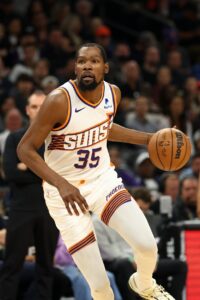 Kevin Durant ($51,179,021)
- Durant’s cap hit includes a $49,856,021 base salary and $1,323,000 in likely incentives.
- Bradley Beal ($50,203,930)
- Devin Booker ($49,350,000)
- Booker’s cap hit is a tentative figure based on 35% of a projected $141MM cap.
- Jusuf Nurkic ($18,125,000)
- Grayson Allen ($15,625,000)
- Nassir Little ($6,750,000)
- David Roddy ($2,847,240)
- Total: $194,080,191
Non-Guaranteed Salary
- None
Dead/Retained Salary
- None
Player Options
- Eric Gordon ($3,356,271): Non-Bird rights
- Josh Okogie ($2,956,734): Early Bird rights
- Damion Lee ($2,845,342): Early Bird rights
- Drew Eubanks ($2,654,644): Non-Bird rights
- Total: $11,812,991
Team Options
- None
Restricted Free Agents
- None
Two-Way Free Agents
Note: Because he’s no longer eligible to sign a two-way contract, Lee’s qualifying offer would be worth his minimum salary (projected to be $2,244,249). It would include a small partial guarantee. Because he’s a former first-round pick who had his third- and/or fourth-year option declined, Azubuike will be an unrestricted free agent.
Draft Picks
- No. 22 overall pick ($3,074,640 cap hold)
- Total (cap holds): $3,074,640
Extension-Eligible Players
- Kevin Durant (veteran)
- Royce O’Neale (veteran)
- Extension-eligible until June 30.
- Jusuf Nurkic (veteran)
Note: Unless otherwise indicated, these players are eligible for extensions beginning in July.
Unrestricted Free Agents
- Royce O’Neale ($18,050,000 cap hold): Bird rights
- Bol Bol ($2,093,637 cap hold): Non-Bird rights
- Isaiah Thomas ($2,093,637 cap hold): Non-Bird rights
- Thaddeus Young ($2,093,637 cap hold): Non-Bird rights
- Total (cap holds): $24,330,911
Other Cap Holds
- Terrence Ross ($2,093,637 cap hold)
- Gabriel Lundberg ($1,867,722 cap hold)
- Total (cap holds): $3,961,359
Note: The cap holds for these players are on the Suns’ books from prior seasons because they haven’t been renounced. They can’t be used in a sign-and-trade deal.
Cap Exceptions Available
Note: The Suns project to operate over the cap and over the second tax apron. That means they won’t have access to the mid-level exception, the bi-annual exception, or any of their three existing trade exceptions.
- None
Dan Hurley Turns Down Lakers’ Offer, Will Stay At UConn
Dan Hurley has passed on a six-year, $70MM contract offer to become the Lakers‘ head coach, according to Adrian Wojnarowski of ESPN, who reports (via Twitter) that the two-time national champion will remain at UConn and will look to lead the Huskies to a third consecutive title in 2024.
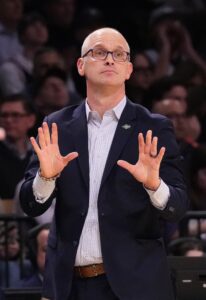 According to Jeff Goodman of Field of 68 (Twitter link), Hurley – who met with Lakers owner Jeanie Buss and head of basketball operations Rob Pelinka on Friday – “strongly considered” making the leap to the NBA but ultimately decided it wasn’t the right career move for him.
While he was impressed with the Lakers’ “vision for him,” Woj adds (via Twitter), Hurley didn’t want to walk away from the opportunity to make history by winning a third straight NCAA title.
Hurley is expected to finalize a new deal with UConn soon that will make him one of college basketball’s highest-paid coaches. Wojnarowski says those negotiations are ongoing, while Goodman hears from a source that Hurley has a six-year offer worth about $50MM on the table from the Huskies (Twitter link).
It’s a disappointing setback for the Lakers, who had talked to other head coaching candidates since dismissing Darvin Ham last month but had zeroed in on Hurley and made him their top choice. According to Wojnarowski (Twitter link), the Lakers will regroup this week and will continue interviewing other candidates for the job in the hopes of filling the vacancy before the June 26-27 draft.
James Borrego – the only candidate to have two in-person meetings with the Lakers so far, per reporting from Woj – will remain in the mix, as will J.J. Redick, whom Shams Charania and other reporters previously described as the frontrunner for the position. Wojnarowski suggests that Redick has yet to have a formal interview with L.A., though Charania said last month that the two sides spoke at length at the draft combine.
As our head coaching search tracker shows, the Lakers have also been linked to a number of veteran assistant coaches around the NBA, including Sam Cassell, David Adelman, Micah Nori, and Chris Quinn.
2024 NBA Offseason Preview: Philadelphia 76ers
For the second time in three years, the Sixers opened their season with a major trade request hanging over the team. Unlike in 2021/22, when the acrimonious Ben Simmons saga dragged out all the way to the February trade deadline, Daryl Morey was able to resolve James Harden‘s trade demand early in the fall, reaching an agreement during the second week of the regular season to send the former MVP to the Clippers in exchange for a package of role players and draft picks.
It’s highly unlikely that any of those future draft picks will ever turn into a player of Harden’s caliber, and none of the four veterans sent to Philadelphia in the swap figure to be long-term keepers. But with a disgruntled player on a pricey expiring deal, the 76ers didn’t have much leverage in trade talks and did well to acquire players who fit the roster in the short term and assets that could be flipped in future moves — one of the players Philadelphia received from L.A., Marcus Morris, was sent out at the trade deadline in a deal for Buddy Hield, for instance.
Perhaps even more important than the assets the Sixers got for Harden was the opportunity his exit created for fourth-year guard Tyrese Maxey. With Harden no longer in the picture, Maxey saw his usage rate increase to a career-high 28.0% and responded by posting new career bests in points (25.9), assists (6.2), and rebounds (3.7) per game, among other categories. His scoring efficiency took a hit, but his .450/.373/.868 shooting line was still just fine, and the 23-year-old was named the NBA’s Most Improved Player for his star turn.
Maxey already looked like a future building block in Philadelphia, but his 2023/24 performance proved he’s capable of being a legitimate No. 2 to former MVP Joel Embiid. The Sixers had a 29-7 record in the games those two played together and outscored opponents by +12.4 points per 100 possessions when they shared the court.
Unfortunately, Embiid’s injury issues flared up again, with a meniscus tear limiting him to 39 regular season games and reducing his mobility and effectiveness in the postseason. For the first time since 2020, the 76ers didn’t win a playoff series this spring, but that early postseason exit wasn’t cause for panic, since the front office had already anticipated making major roster changes during the offseason.
Having dumped P.J. Tucker‘s contract in the Harden trade, the Sixers will head into this summer with only one guaranteed contract (Embiid) on their cap for 2024/25 and Maxey poised to re-sign as a restricted free agent. Besides those two players, no one else who finished the season with Philadelphia is a lock to be back in the fall.
That’s a lot of uncertainty entering an offseason, which is a little scary, but the duo of Embiid and Maxey is a great place to start. So even if the Sixers miss out on their top target(s) and have to turn to Plan B or C, they’re well-positioned to take a step forward following a 47-35 season in ’23/24.
The Sixers’ Offseason Plan
 Taking into account Embiid’s salary, Maxey’s cap hold, the cap hold for the No. 16 overall pick, and rookie-minimum cap holds for nine empty roster spots, the Sixers could generate up to about $62MM in cap room. That figure, which would rely on renouncing all the team’s current free agents and waiving players on non-guaranteed salaries (including Paul Reed), could rise to nearly $65MM if Philadelphia also trades away its draft pick. The club will be able to go over the cap to re-sign Maxey to a maximum-salary contract after it uses up its room.
$65MM is a ton of cap space, but it would disappear quickly with a major move or two. The Sixers’ top target is reportedly Paul George, who can become an unrestricted free agent this summer if he doesn’t reach an extension agreement with the Clippers and turns down his 2024/25 player option. It’s unclear how viable a move to Philadelphia is for George – he may just be using the 76ers for leverage purposes to get the deal he wants in Los Angeles – but if they hope to lure him away from his hometown, the Sixers would have to offer the star forward a maximum-salary contract that would start at a projected $49.35MM.
Jimmy Butler has also frequently been cited as a prime target for Morey, though the former Sixer would need to be acquired via trade, which wouldn’t be easy — the Heat aren’t looking to rebuild, so if the 76ers offered a package heavy on draft assets and cap relief, Miami would have to be confident they could turn those assets into another impact player. If Philadelphia could find a way to pry Butler away from the Heat, it would mean accommodating his $48.8MM salary.
Landing a star like George or Butler would be a home run for the Sixers, since either player would be an ideal fit on the wing alongside Embiid and Maxey. But it would reduce Philadelphia’s remaining cap room to approximately $13-17MM, putting the team in position to realistically make just two or three more signings above the minimum — one or two using that remaining cap room, and another one using the $8MM room exception.
The result would be an awfully top-heavy roster, similar to the one the Suns had this past season. You could certainly make the case that Maxey, George (or Butler), and Embiid would fit together better than Phoenix’s three stars do. However, there would be a lot of pressure on Philadelphia’s stars to stay healthy, which Embiid hasn’t been able to do in the past — neither George nor Butler has the best track record on that front either.
If the Sixers don’t land a star using their cap room – Brandon Ingram and OG Anunoby have been mentioned as other possible targets who wouldn’t be quite as highly paid in 2024/25 as George or Butler – the expectation is that they’ll focus on signing useful role players to lucrative short-term contracts, similar to the one Bruce Brown got from Indiana last summer.
With several teams chasing Brown using the full mid-level exception (starting at $12.4MM), the Pacers took advantage of their cap room to give him a two-year deal that started at $22MM and included a second-year team option worth $23MM. It made Brown an ideal trade chip when the club needed a salary-matching piece for Pascal Siakam a few months later. And if that trade opportunity hadn’t arisen, Indiana would have had the option of clearing Brown’s salary off the books after just one year, regaining cap flexibility.
If Philadelphia takes a similar route, free agents like Kentavious Caldwell-Pope, Klay Thompson, and Malik Monk look like a few of the most logical targets. The Nuggets and Warriors would have luxury-tax and apron concerns if they have to match a big starting salary for Caldwell-Pope or Thompson, respectively, while the Kings are limited to offering Monk a starting salary in the $17.4MM range since they only hold his Early Bird rights.
A tier or two below those guys, Caleb Martin, Kyle Anderson, Monte Morris, Reggie Jackson, Precious Achiuwa, and Malik Beasley are among the other free agents whose current teams may face financial restrictions due to their proximity to the tax (or, in Beasley’s case, a lack of Bird rights). If he hadn’t already had a brief stint in Philadelphia, I’d view center Andre Drummond as another ideal target for the Sixers, since he could back up Embiid and slide into the starting five if and when the star center is unavailable. I still think he makes a lot of sense.
While going this direction could be a more prudent path than spending nearly $50MM on a single player entering his mid-30s, it might cost upwards of $50MM in 2024/25 to land a pair of those top-tier Plan B targets (KCP, Thompson, and Monk), so the Sixers’ cap room could disappear almost as quickly.
No matter what direction Philadelphia goes with its cap space, it will be crucial for the team to nail its minimum-salary signings once its room dries up. That was one of the Suns’ issues this past season — they signed eight players to minimum-salary contracts last summer, but fewer than half of them earned regular minutes. The Sixers will aim to do better with the back half of their roster.
Of the players who finished this past season in Philadelphia, Kyle Lowry, Kelly Oubre, Nicolas Batum, Robert Covington, and Cameron Payne are among the useful role players who might be willing to return for the veteran’s minimum (though I think some of them could do better than that on the open market). There will be other options around the league as well, especially if the Sixers can offer them a shot at regular minutes and a chance to contend.
Tobias Harris, Hield, and De’Anthony Melton aren’t minimum-salary players, so if the Sixers want to bring any of them back, it would cut into their cap room. Harris and Hield seem unlikely to return though, meaning Melton is the only one Philadelphia might have to account for.
The versatile defensive-minded guard made $8MM last season and would be a great re-addition at that price again using the room exception. If he’d finished the season healthy, Melton would definitely have stronger offers than that, but given the back issues that limited him to six games after January 12, that’s no longer a sure thing, which could work in Philadelphia’s favor.
I don’t mind the idea of the 76ers keeping the No. 16 overall pick, since it would give them an opportunity to get a team-friendly four-year contract on their books, but there are scenarios in which I think a trade makes more sense. One of my favorite concepts is a potential deal with the Wizards – who are said to be seeking another first-round pick – for Corey Kispert, a sharpshooter who was drafted by the previous front office in Washington and is in line for a rookie scale extension this offseason.
To be clear, I have no insider information suggesting the Sixers and Wizards are exploring such a trade, and it’s possible Philadelphia would have to sweeten the pot beyond offering a mid-first-rounder in a weak draft. But a trade target like Kispert would make perfect sense, since he’d take up only a small fraction of the team’s cap room this summer (he’s owed $5.7MM in 2024/25, not much more than the $4MM cap hold for the No. 16 pick) and then would get a raise in a year, when the 76ers would be in position to pay him.
With so many options available to them this offseason, it’s impossible to predict exactly how the Sixers’ offseason will play out. But that unpredictability is what will make them one of the most fun clubs to follow in the next month or two, with the pressure on Morey to get Embiid (who turned 30 in March) the supporting cast he needs to vie for his first championship.
Salary Cap Situation
Guaranteed Salary
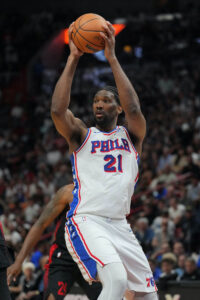 Joel Embiid ($51,415,938)
- Total: $51,415,938
Non-Guaranteed Salary
- Paul Reed ($7,723,000)
- Ricky Council ($1,891,857)
- Total: $9,614,857
Dead/Retained Salary
- None
Player Options
- None
Team Options
- Jeff Dowtin ($2,196,970): Non-Bird rights
- Dowtin’s salary would remain non-guaranteed if his option is exercised.
- Total: $2,196,970
Restricted Free Agents
- Tyrese Maxey ($8,486,620 qualifying offer / $13,031,760 cap hold): Bird rights
- Total (cap holds): $13,031,760
Two-Way Free Agents
Draft Picks
- No. 16 overall pick ($4,032,240 cap hold)
- No. 41 overall pick (no cap hold)
- Total (cap holds): $4,032,240
Extension-Eligible Players
- Robert Covington (veteran)
- Extension-eligible until June 30.
- Joel Embiid (veteran)
- Tobias Harris (veteran)
- Extension-eligible until June 30.
- Buddy Hield (veteran)
- Extension-eligible until June 30.
- KJ Martin (veteran)
- Extension-eligible until June 30.
- De’Anthony Melton (veteran)
- Extension-eligible until June 30.
Note: Unless otherwise indicated, these players are eligible for extensions beginning in July.
Unrestricted Free Agents
- Tobias Harris ($49,350,000 cap hold): Bird rights
- Harris’ cap hold will be his maximum salary (35% of the 2024/25 cap).
- Buddy Hield ($29,767,647 cap hold): Bird rights
- Nicolas Batum ($22,250,554 cap hold): Bird rights
- Robert Covington ($22,215,385 cap hold): Bird rights
- De’Anthony Melton ($15,200,000 cap hold): Bird rights
- Mohamed Bamba ($2,093,637 cap hold): Non-Bird rights
- Kyle Lowry ($2,093,637 cap hold): Non-Bird rights
- KJ Martin ($2,093,637 cap hold): Bird rights
- Kelly Oubre ($2,093,637 cap hold): Non-Bird rights
- Cameron Payne ($2,093,637 cap hold): Non-Bird rights
- Total (cap holds): $149,251,771
Other Cap Holds
- Mike Scott ($9,510,165 cap hold)
- Dewayne Dedmon ($2,093,637 cap hold)
- Paul Millsap ($2,093,637 cap hold)
- Kyle O’Quinn ($2,093,637 cap hold)
- Myles Powell ($1,867,722 cap hold)
- Total (cap holds): $17,658,798
Note: The cap holds for these players are on the Sixers’ books from prior seasons because they haven’t been renounced. They can’t be used in a sign-and-trade deal.
Cap Exceptions Available
Note: The Sixers project to operate under the cap. They would have to renounce six trade exceptions (the largest of which is worth $6,831,413) in order to use cap room.
- Room exception: $8,006,000
International Notes: Theis, Birch, M. James, M. Scott
Clippers center Daniel Theis, who will be an unrestricted free agent, would draw significant interest from EuroLeague teams if he’s unable to find an NBA offer he likes this offseason, according to a report from TeleSport (Twitter link; hat tip to Sportando).
Sources tell TeleSport that Barcelona, Fenerbahce, and Panathinaikos would be among the teams with interest in the German big man if he becomes open to the idea of returning to Europe. Theis has played in the NBA since 2017, but began his professional career in Germany from 2010-17.
After opening the 2023/24 season in Indiana, Theis agreed to a buyout with the Pacers and caught on with the Clippers, who needed a backup center after Mason Plumlee suffered a knee injury. Theis averaged 6.3 points and 4.1 rebounds in 17.1 minutes per game across 59 appearances with Los Angeles.
Here are a few more notes from around the international basketball world:
- Former NBA big man Khem Birch, who is healthy again and finished this past season playing for Girona in Spain, has accepted an invitation to take part in training camp with the Canadian national team this summer, tweets Michael Grange of Sportsnet.ca. It’s unclear whether or not there will be a spot available for Birch on Canada’s 12-man Olympic roster. He didn’t play for the team at least year’s World Cup, with Kelly Olynyk and Dwight Powell serving as Canada’s primary centers. Probable first-round pick Zach Edey will also be in that mix.
- According to Donatas Urbonas of BasketNews.com, sources have disputed the claim that EuroLeague MVP Mike James is on the verge of signing a new contract to remain with AS Monaco. Despite lengthy extension talks between the two sides, no deal is in place and James may explore his options on the open market, sources tell Urbonas. The veteran guard last played in the NBA in 2021 for Brooklyn.
- Former NBA forward Mike Scott has parted ways with French team ASVEL and will continue his career with Gigantes de Carolina in Puerto Rico, tweets Urbonas. The 35-year-old forward appeared in 555 regular season NBA games from 2012-21, last playing for Philadelphia.
NBA Finals Notes: Brown, Porzingis, Mavs’ Centers, Luka, Kyrie
Speaking to reporters during a media session on Saturday, Mavericks head coach Jason Kidd referred to Jaylen Brown as the Celtics‘ “best player” when asked about the challenges of facing the Boston wing (Twitter video link).
“Well, Jaylen’s their best player,” Kidd said. “So just looking at what he does defensively, he picked up Luka (Doncic) full court, he got to the free throw line, he did everything. That’s what your best player does.”
You could certainly make a case that Brown has been the Celtics’ best player in this postseason — his 24.8 points per game during the playoffs rank slightly behind Jayson Tatum‘s 25.3 PPG, but he has got his points far more efficiently, shooting 54.3% from the floor and 36.6% on three-pointers, compared to 43.8% and 29.9% for Tatum.
Still, the general consensus is that Tatum – who has also averaged a team-high 10.4 rebounds and 5.9 assists per game in the postseason – is Boston’s best player, so Kidd’s comments raised some eyebrows. While they may reflect his honest opinion, it’s hard not to read Kidd’s praise of Brown as an attempt at gamesmanship, given that the relationship between the two Celtics stars has been a popular topic of speculation among outsiders over the years.
Here’s more on the NBA Finals, with Game 2 on tap for Sunday:
- Given how well the Celtics played in Game 1 with Kristaps Porzingis coming off the bench, head coach Joe Mazzulla will face an interesting decision on whether to return the big man to his spot in the starting lineup on Sunday, writes Brian Robb of MassLive.com. As Robb notes, Boston played its best basketball with Porzingis on the court and could still manage his minutes over the course of the night if he starts. However, the team has gone 10-1 with Al Horford as its starting center during the playoffs and is riding an eight-game winning streak, so Mazzulla may not want to mess with what’s working.
- Despite Mazzulla saying prior to Game 1 that Porzingis had no minutes limit, the big man told reporters on Saturday that he is in fact facing a minutes restriction (Twitter link via Souichi Terada of MassLive.com). Porzingis, who logged 21 minutes in Game 1, didn’t offer any specifics on that restriction.
- Porzingis’ presence represents a major problem for the Mavericks, according to Brad Townsend of The Dallas Morning News, who says the Celtics’ floor-spacing centers essentially neutralized the impact of Dallas big men Daniel Gafford and Dereck Lively, who had to chase Porzingis and Horford out to the perimeter rather than hanging back and protecting the rim. As Townsend points out, Gafford and Lively combined for just 10 points, eight rebounds, and no blocks on Thursday, while Porzingis and Horford totaled 30 points, 13 rebounds, and five blocks.
- Doncic and Kyrie Irving were unable to beat their defenders one-on-one in Game 1, which would’ve forced the Celtics to send help and created open shots for teammates, writes John Hollinger of The Athletic. As a result, the two stars combined for just three assists, while the team as a whole had only nine. If that doesn’t change going forward and Doncic and Irving can’t do more in those one-on-one situations, it will likely be a quick series, Hollinger opines.
2024 NBA Offseason Preview: Sacramento Kings
The Kings were one of the NBA’s feel-good stories of the 2022/23 season. First-year head coach Mike Brown led Sacramento to its best record (48-34) since 2005 and its first playoff berth since 2006, with no team scoring more points per 100 possessions (118.6) than the Kings.
In many ways, the sequel in 2023/24 was a worthy follow-up — despite dealing with injuries to a couple key role players down the stretch, the Kings won 46 games, registering consecutive seasons above .500 for the first time in nearly two decades.
But the vibes weren’t quite as good in Sacramento for a few reasons. For one, while Brown surely appreciated the improvements on defense (the Kings went from 24th in ’22/23 to 14th this past season), the No. 1 offense took a major step back (to 13th) and wasn’t the crowd-pleasing, well-oiled machine it was a year earlier.
More importantly, with the postseason drought over, the expectations were higher in Sacramento, where the goal was to take another step forward and perhaps win a playoff series. Instead, the Kings found themselves fighting for their postseason life in a more competitive Western Conference.
A year after their 48 wins comfortably earned them the No. 3 seed, the Kings claimed the No. 9 spot in the West despite winning only two fewer regular season games. They got some level of revenge against the Warriors – who eliminated them in the first round in 2023 – in the 9 vs. 10 play-in game, but fell to the Pelicans in the play-in game to determine the conference’s No. 8 seed, bringing their season to an end before the playoffs tipped off in earnest.
A team’s improvement isn’t always linear, so the slight downturn this season doesn’t mean this version of the Kings can’t continue to get better in 2024/25. With no dominant franchises far ahead of the pack in the West, the front office may not have to make major changes to the roster to become a legitimate contender. Still, Monte McNair and his basketball operations team figure to do all they can this summer to figure out how to upgrade the current group with somewhat limited resources.
The Kings’ Offseason Plan
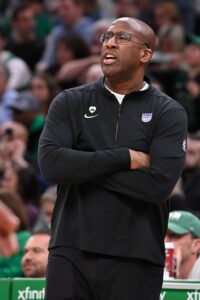 The Kings took care of one of the most important items on their offseason to-do list a week ago, reaching an agreement on a multiyear extension for Brown. The veteran coach signed a four-year contract with the franchise when he was hired in 2022, but the final year was a mutual option, so he would’ve essentially been on an expiring deal in 2024/25 if negotiations between the two sides had reached an impasse, which briefly looked like it might happen last month.
Brown’s has yet to win a championship as a head coach, but his playoff résumé is still relatively strong, which bodes well for Sacramento going forward — he has a winning overall record (50-40) in the postseason and advanced beyond the first round for six straight seasons with the Cavaliers and Lakers. He’s also respected throughout the league, is one year removed from earning Coach of the Year honors, and is the best coach the Kings have had in quite some time.
Given the rising cost of coaching salaries around the NBA, Sacramento did well to secure Brown to a three-year deal with a base value of $8.5MM per year (it can be worth up to $10MM annually with incentives). If things go south in the next year or two, the Kings aren’t on the hook for Brown long-term, and if things go well, they can be more confident about offering him an eight-figure salary commensurate with what some of his more accomplished colleagues around the NBA have received in the last year or two.
With Brown locked up, the focus in the coming weeks will be on the roster, where the biggest question is what will happen with free agent wing Malik Monk. The Sixth Man of the Year runner-up in 2024, Monk has been one of the Kings’ most important rotation players in the past couple years, evolving into more than just a shooter. His 3.9 assists per game in 2022/23 were a career high, which he promptly eclipsed by bumping that number to 5.1 APG in ’23/24.
The challenge when it comes to re-signing Monk is twofold. For one, Sacramento only holds the 26-year-old’s Early Bird rights, which means the team can offer up to a 75% raise on his previous $9.95MM salary (with 8% annual raises in subsequent years). That works out to about $17.4MM in year one and just shy of $78MM in total over four years. That would be a strong offer, but it’s possible a team with cap room and a need for shooting (Detroit? Orlando?) would top it.
In comments to reporters after the season, Monk suggested he wouldn’t necessarily just accept the biggest offer he gets, but if another suitor gives him more money than the Kings can put on the table and offers him a starting role, it could be hard to turn it down.
Even if we assume the Kings are able to re-sign Monk with an Early Bird offer, giving him a sizable salary bump would put the club in danger of surpassing the luxury tax line. Taking into account Keon Ellis‘ non-guaranteed salary and the cap hold for the No. 13 pick, Sacramento has about $155MM on the books for 12 players. Adding a $17.4MM salary for Monk would push that total above the projected luxury tax line ($171.3MM) with at least one more roster spot to be filled.
Letting the veteran shooting guard walk – or losing him to a higher bidder – would create enough breathing room below the tax line for Sacramento use its entire non-taxpayer mid-level exception ($12.9MM) on a replacement, but it would be unrealistic to expect the MLE to yield a player whose impact would match or exceed Monk’s. I expect the Kings to push to re-sign him and then address the tax issue later if necessary — it probably wouldn’t be too challenging to shed a contract or two to duck the tax if that’s what team ownership wants.
Of course, if Monk returns, the Kings’ roster in 2024/25 could look quite similar to the one we saw this past season. The team wouldn’t be able to do much in free agency after re-signing Monk and could end up just adding a new prospect with the No. 13 pick, salary-dumping a modest contract (maybe Sasha Vezenkov and his $6.66MM cap hit), and perhaps swapping out a couple back-of-the-roster minimum-salary players.
While that wouldn’t inspire a ton of excitement heading into the fall, it wouldn’t be a total disaster. Sacramento has high hopes for 2022’s No. 4 overall pick Keegan Murray, a big 23-year-old wing who increased his scoring average to 15.2 PPG in 2023/24 and has made 38.4% of his three-pointers since entering the league two years ago. Murray made improvements on the defensive end in his sophomore season and is the sort of breakout candidate who could legitimately raise the Kings’ ceiling if he continues to develop into a two-way star.
Turning to the trade market would be another option for the Kings, who probably wouldn’t mind upgrading their other forward spot, currently manned primarily by Harrison Barnes and Trey Lyles. Sacramento was viewed as a possible Pascal Siakam suitor before he was traded to the Pacers, but putting together a package for that caliber of player without including Murray isn’t simple.
The Kings’ other recent lottery pick, Davion Mitchell (No. 9 in 2021), is a solid defender, but he fell below a two-way player (Ellis) on the backcourt depth chart at times and doesn’t have nearly the trade value that Murray would. A trade package built around Mitchell and either Barnes or Kevin Huerter and future first-round picks would have some appeal, but could probably be outbid by other would-be contenders seeking a star.
It’s also worth noting that, after finishing in the lottery this year, the Kings still owe a 2025 first-round pick to Atlanta, meaning the earliest first-rounder they can trade (outside of this year’s No. 13 pick) would be in 2027 — and it could be pushed back by a year if Sacramento’s 2025 first-round selection lands in the top 12 and is protected again.
Rather than taking a huge swing on the trade market, perhaps the Kings will gauge the value of a package headlined by Huerter and a future first-rounder (or this year’s No. 13). Huerter is a talented outside shooter, but he’s coming off shoulder surgery and his limitations on defense prompted Brown to experiment with starting Chris Duarte in his place in January.
Barnes’ underrated two-way contributions have arguably been more meaningful than Huerter’s, so the veteran forward should only end up on the trade block if a clear upgrade at his position is available. Huerter looks to me like the more expendable salary-matching piece, especially since the Kings have a good deal of shooting elsewhere on the roster. Sacramento could also potentially add another outside threat with the No. 13 pick in the draft, though the club could go in any number of directions with that lottery selection and should probably just be targeting the best player available if the pick isn’t traded.
We’ve made it this far without mentioning the Kings’ two stars – Domantas Sabonis and De’Aaron Fox – but their contract situations are relatively stable and they won’t be going anywhere anytime soon. That’s especially true of Sabonis, who signed a new deal last summer and will be under team control for four more seasons.
Fox has two years left on his current pact and will be extension-eligible this offseason. The star guard may want to see if he can gain super-max eligibility by making an All-NBA team next spring, lining himself up for a maximum salary worth up to 35% of the cap instead of 30%. So if he and the Kings pass on an extension this offseason, there will be no reason for concern — if they still can’t come to terms in 2025, that could spell trouble, but there’s no indication at this point that we’re headed down that path.
Salary Cap Situation
Guaranteed Salary
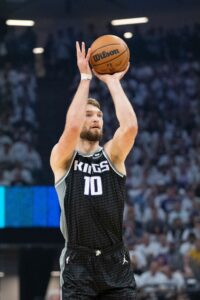 Domantas Sabonis ($40,500,000)
- De’Aaron Fox ($34,848,340)
- Harrison Barnes ($18,000,000)
- Kevin Huerter ($16,830,357)
- Keegan Murray ($8,809,560)
- Trey Lyles ($8,000,000)
- Sasha Vezenkov ($6,658,536)
- Davion Mitchell ($6,451,077)
- Chris Duarte ($5,893,768)
- Colby Jones ($2,120,691)
- Total: $148,112,329
Non-Guaranteed Salary
- Keon Ellis ($2,120,693)
- Mason Jones (two-way)
- Total: $2,120,693
Dead/Retained Salary
- None
Player Options
- None
Team Options
- None
Restricted Free Agents
- Kessler Edwards ($2,409,870 qualifying offer / $2,409,870 cap hold): Early Bird rights
- Total (cap holds): $2,409,870
Two-Way Free Agents
Draft Picks
- No. 13 overall pick ($4,702,800 cap hold)
- No. 45 overall pick (no cap hold)
- Total (cap holds): $4,702,800
Extension-Eligible Players
- Chris Duarte (rookie scale)
- De’Aaron Fox (veteran)
- Kevin Huerter (veteran)
- Extension-eligible as of October 1.
- Davion Mitchell (rookie scale)
Note: Unless otherwise indicated, these players are eligible for extensions beginning in July.
Unrestricted Free Agents
- Malik Monk ($12,929,579 cap hold): Early Bird rights
- Alex Len ($2,093,637 cap hold): Bird rights
- JaVale McGee ($2,093,637 cap hold): Non-Bird rights
- Total (cap holds): $17,116,853
Cap Exceptions Available
Note: The Kings project to operate over the cap and under the first tax apron.
- Non-taxpayer mid-level exception: $12,859,000
- Bi-annual exception: $4,681,000
Pacific Notes: Lakers, Hurley, Beal, Suns, Hield, Clippers, Warriors
Appearing on ESPN’s Get Up (YouTube link) on Friday, Brian Windhorst stressed that Dan Hurley coaching the Lakers is far from a sure thing, despite UConn’s head coach being open to L.A.’s advances.
“I know that this has momentum as (Adrian Wojnarowski) talked about, but it’s been emphasized to me that this is not a done deal,” Windhorst said (hat tip to RealGM). “That there is still relationship building and conversations that need to take place that are probably going to take place over the next couple of days.”
A source tells Jeff Goodman of Field of 68 (Twitter link) that Hurley was going into today’s meeting with the Lakers “completely open-minded” and is expected to fly back home and weigh his decision over the weekend.
Here are a few more notes from around the Pacific:
- Suns guard Bradley Beal underwent a follow-up procedure on his nose shortly after the team was eliminated from the playoffs this spring, reports Duane Rankin of The Arizona Republic. Beal, who initially had a procedure performed on his nose after breaking it in January, said in March that he still had to get his septum “realigned,” adding that it would likely happen after the season.
- Responding to a report that claims the Suns will be among the teams to watch for Buddy Hield this offseason, John Gambadoro of Arizona Sports 98.7 tweets that he doesn’t expect Phoenix to have any interest in the veteran sharpshooter. Barring significant cost-cutting moves, the Suns won’t be able to offer more than the veteran’s minimum to free agents or to acquire them via sign-and-trade, so Hield is probably an unrealistic target to begin with.
- The Clippers hosted four senior guards as part of a pre-draft workout on Thursday, according to Ohm Youngmisuk of ESPN.com, who reports (via Twitter) that Xavier Johnson (Southern Illinois), Tristen Newton (UConn), Cormac Ryan (UNC), and Tyler Thomas (Hofstra) took part in the session. None of those prospects ranks higher than No. 68 (Newton) on ESPN’s big board, but they could be in the second-round mix. The Clippers’ lone 2024 draft pick is 46th overall.
- The Warriors have officially named Jon Phelps their senior director of basketball strategy and team counsel, confirming the front office addition in a press release (Twitter link). Anthony Slater of The Athletic reported last week that Golden State would be hiring Phelps away from the Pistons following his decade-long stint in Detroit.
2024 NBA Draft Picks By Team
The Spurs and Trail Blazers were among the winners on last month’s draft lottery day, with the results on May 12 ensuring that both teams would have a pair of lottery picks in 2024. San Antonio received Toronto’s top-six protected first-rounder when it dropped to No. 8, while Portland was assured of receiving Golden State’s top-four protected first-rounder when it remained at No. 14. Both clubs’ own picks are in the top seven.
Besides being the only NBA teams to control two lottery picks this year, San Antonio and Portland have something else in common — they’re the only two clubs that own more than three total 2024 draft picks. In addition to No. 4 and No. 8, the Spurs have Nos. 35 and 48, while Portland has a pair of early second-rounders (Nos. 34 and 40) to go with its No. 7 and No. 14 picks.
Many of this year’s draft picks have changed hands at some point, with only 24 of 58 total selections held by their original owner, but they’re still a little more evenly distributed than usual. A year ago, 11 teams controlled three or more picks at this time, whereas this year only seven clubs hold more than two picks apiece.
In addition to those seven teams with three or more picks, 13 more clubs own a pair of draft selections, while another nine control one apiece. That leaves just a single NBA team without a draft pick this year: the Nets. Brooklyn traded both of its 2024 picks back in 2021, sending out its first-rounder in a package for James Harden and including its second-rounder later that year in a Sekou Doumbouya salary dump. The Nets could still trade into this draft, but for now they’re the only team on track to sit it out.
To present a clearer picture of which teams are most – and least – stocked with picks for the 2024 NBA draft, we’ve rounded up all 58 selections by team in the space below. Let’s dive in…
Teams with more than two picks:
- San Antonio Spurs (4): 4, 8, 35, 48
- Portland Trail Blazers (4): 7, 14, 34, 40
- Washington Wizards (3): 2, 26, 51
- Memphis Grizzlies (3): 9, 39, 57
- Utah Jazz (3): 10, 29, 32
- New York Knicks (3): 24, 25, 38
- Indiana Pacers (3): 36, 49, 50
Teams with two picks:
- Houston Rockets: 3, 44
- Detroit Pistons: 5, 53
- Charlotte Hornets: 6, 42
- Sacramento Kings: 13, 45
- Miami Heat: 15, 43
- Philadelphia 76ers: 16, 41
- Los Angeles Lakers: 17, 55
- Orlando Magic: 18, 47
- Toronto Raptors: 19, 31
- Milwaukee Bucks: 23, 33
- Minnesota Timberwolves: 27, 37
- Denver Nuggets: 28, 56
- Boston Celtics: 30, 54
Teams with one pick:
- Atlanta Hawks: 1
- Chicago Bulls: 11
- Oklahoma City Thunder: 12
- Cleveland Cavaliers: 20
- New Orleans Pelicans: 21
- Phoenix Suns: 22
- Los Angeles Clippers: 46
- Golden State Warriors: 52
- Dallas Mavericks: 58
Teams with no picks:
- Brooklyn Nets