
Lakers, Reaves Have Mutual Interest In New Deal In Offseason
In the wake of Austin Reaves‘ career night on Sunday, Jovan Buha of The Athletic reports that the Lakers and Reaves’ camp have mutual interest in keeping the guard in Los Angeles beyond this season.
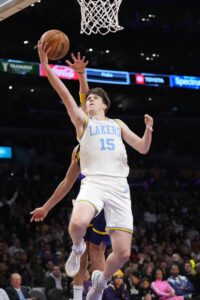 Because Reaves only received a two-year deal from the Lakers when he signed his first standard NBA contract in 2021, he won’t become eligible to sign a contract extension before he reaches restricted free agency this summer. Additionally, the team will only hold his Early Bird rights at that time, rather than his full Bird rights.
As Buha notes, that means L.A. will be limited to offering Reaves approximately $51MM over four years if they negotiate with him directly. At one point, that would have looked like more than enough financial flexibility to bring back Reaves, but his strong play this season has increased his value. Shams Charania of The Athletic (Twitter video link) suggested today that the 24-year-old’s market could be in that four-year, $50MM range, if not higher.
Reaves would have the ability to sign an offer sheet with a rival team that exceeds the Lakers’ best offer. However, the Gilbert Arenas provision would apply to such an offer sheet, meaning it couldn’t exceed the Early Bird amounts in years one or two but could include a substantial third-year raise. And despite only holding Reaves’ Early Bird rights, the Lakers would have the ability to match such an offer via the Arenas provision.
As Buha observes, how Reaves performs down the stretch and possibly in the postseason will help determine how his free agency plays out. But the former Oklahoma Sooner has established himself as a reliable rotation player in his second NBA season, averaging 12.0 points, 3.0 rebounds, and 2.9 assists with an impressive .518/.380/.854 shooting line in 54 games (27.8 MPG).
For his part, Reaves doesn’t sound like someone seeking change of scenery, having expressed gratification on Sunday for the opportunity to play for the Lakers.
“It’s special,” Reaves said after scoring 35 points in a victory over Orlando, per Buha. “I mean, I grew up a Lakers fan. To do it for this organization, especially, is surreal. Sometimes I gotta stop and really think about what I am doing. … All I’m really happy about is the win.”
Hoops Rumors Glossary: Stretch Provision
For NBA teams looking to open up cap room, simply waiving a player isn’t as effective as it is in the NFL, where salaries are often non-guaranteed and most or all of a player’s cap charge can frequently be wiped from a team’s books. Still, the NBA’s Collective Bargaining Agreement does feature a rule that allows teams to spread a player’s cap hit over multiple seasons. This is called the stretch provision.
The stretch provision ensures that any player waived with at least $250K in guaranteed salary remaining on his contract will have the payment schedule of that money spread across multiple years. That schedule is determined as follows:
- If a player is waived between July 1 and August 31, his remaining salary is paid over twice the number of years remaining on his contract, plus one.
- If a player is waived between September 1 and June 30, his current-year salary is paid on its normal schedule, with any subsequent years spread over twice the number of remaining years, plus one.
- If a player in the final year of his contract is waived between September 1 and June 30, the stretch provision does not apply.
While the new payment schedule for a waived player is non-negotiable, teams get to decide whether or not to apply the stretch provision to that player’s cap charges as well. A team can stick to the original schedule for cap hit purposes, if it so chooses.
Rather than singling out a specific active player, we’ll use a hypothetical contract to create a clearer picture of what these rules look like. Let’s say there’s a player earning $19MM this season, $20MM in 2023/24, and $21MM in ’24/25 who has become a candidate to be waived.
Here’s what that contract would look like if it were waived without applying the stretch provision to the cap hits; if it were stretched before August 31; or if it were stretched after August 31:
| Year | Waived without stretching |
Stretched by 8/31/23 |
Stretched after 8/31/23 |
|---|---|---|---|
| 2022/23 | $19,000,000 | $19,000,000 | $19,000,000 |
| 2023/24 | $20,000,000 | $8,200,000 | $20,000,000 |
| 2024/25 | $21,000,000 | $8,200,000 | $7,000,000 |
| 2025/26 | – | $8,200,000 | $7,000,000 |
| 2026/27 | – | $8,200,000 | $7,000,000 |
| 2027/28 | – | $8,200,000 | – |
Because this hypothetical player wasn’t waived and stretched before August 31, 2022, his salary for the current year can no longer be stretched. Stretching his contract last July or August would have resulted in cap hits of about $8.57MM spread across seven seasons (through 2028/29 and including ’22/23).
As this chart shows, it typically makes sense to waive and stretch a player’s contract in July or August if the team is looking to generate immediate cap flexibility for the current season and isn’t as concerned about the impact in future seasons. If this hypothetical player were stretched in July 2023, his team would trim nearly $12MM off its ’23/24 cap, but would remain on the hook for payments through 2028.
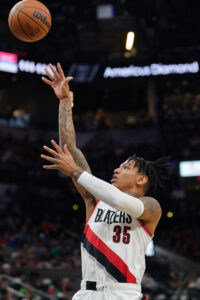 We saw a couple real-life examples of this philosophy at play last summer, when the Trail Blazers waived and stretched Eric Bledsoe and Didi Louzada and the Pacers waived and stretched Nik Stauskas, Juwan Morgan, and Malik Fitts.
Portland was looking to reduce its team salary for the current year in order to sneak below the luxury tax line, while Indiana wanted to carve out a little extra cap room in order to sign Deandre Ayton to a maximum-salary offer sheet.
In each of those cases, the club sought immediate cap relief. That wasn’t the case for the Spurs, who waived Danilo Gallinari last July and decided not to apply the stretch provision to his $13MM cap charge for 2022/23, since they had no specific use for that extra cap room. It made more sense for San Antonio to take the hit this season and keep Gallinari’s money off their future cap sheets.
There are a couple more key rules related to the stretch provision worth noting.
First, while the stretch provision regulates when money is paid out, it doesn’t prevent teams and players from negotiating a reduced salary as part of a buyout agreement.
For example, let’s say a player who has an $18MM expiring contract for 2023/24 agrees this July to give up $3MM in a buyout. As a result of that buyout agreement, his team could stretch his remaining salary and end up with cap hits of $5MM for three seasons (through ’25/26) rather than $6MM.
Second, non-guaranteed money isn’t subject to the stretch provision, since a team isn’t obligated to pay the non-guaranteed portion of a contract once it waives a player.
This rule can come in handy when a club decides to waive a player who has one or two non-guaranteed years tacked onto the end of his contract. For instance, when the Blazers waived Louzada last August, he had three years left on his deal, but only his 2022/23 salary of $1,876,222 was guaranteed — the $4,023,212 owed to him for the two seasons beyond this one was fully non-guaranteed.
That means that when they waived Louzada, the Blazers only owed him just $1,876,222 but were able to stretch that figure across seven seasons (twice the three years remaining on his contract, plus one). As a result, Portland will carry tiny $268,032 cap charges for Louzada on its books through the 2028/29 season.
Note: This is a Hoops Rumors Glossary entry. Our glossary posts will explain specific rules relating to trades, free agency, or other aspects of the NBA’s Collective Bargaining Agreement. Larry Coon’s Salary Cap FAQ was used in the creation of this post.
Earlier version of this post were published in 2013 and 2017.
Pelicans Reportedly Came Close To Acquiring Beasley, Vanderbilt
Before the Jazz agreed to trade Malik Beasley and Jarred Vanderbilt to the Lakers as part of a three-team deal last month, the Pelicans came close to acquiring the duo from Utah, ESPN’s Zach Lowe said on The Lowe Post podcast this week (YouTube link).
“The Pelicans were close to getting Beasley and Vanderbilt from Utah at the trade deadline, or close-ish,” Lowe told ESPN colleague Kevin Pelton. “They had a pretty good offer on the table. It was a draft equity-based offer with a pick that maybe was not as good as the Lakers pick that they ended up trading, but pretty close, I think, from what I’ve heard.
“But one of the issues was – maybe the picks weren’t exactly equivalent – but then another issue was (Mike) Conley and the Jazz’s determination to get off of Conley (who is owed at least $14MM in 2023/24), and could the Pelicans figure that out somehow? And it became a little complicated.”
The trade that the Jazz eventually completed also included the Timberwolves, who acquired Conley and flipped D’Angelo Russell to the Lakers. Los Angeles, in turn, send a top-four protected 2027 first-round pick to Utah as part of the three-way agreement.
The Pelicans still possess all of their own future first-rounders and control a couple others, including the Lakers’ unprotected 2024 pick (which could be deferred to 2025) and the Bucks’ unprotected 2027 selection.
It’s not clear which of those first-rounders they offered to the Jazz, but based on Lowe’s comments, it’s possible the Pelicans wanted to protect the pick they were offering more heavily than the Lakers protected theirs. Or Utah may have simply liked the upside of the ’27 Lakers first-rounder more than any single pick New Orleans was willing to put on the table.
It’s also worth noting that matching salaries for Beasley and Vanderbilt (who earn a combined $20MM) using only expiring or pseudo-expiring contracts would have been nearly impossible for the Pelicans, whose prime salary-matching piece at the deadline was Devonte’ Graham ($11.55MM).
Adding either Jaxson Hayes ($6.8MM) or Garrett Temple ($5.2MM) to Graham would have been sufficient outgoing salary, but Utah likely wouldn’t have been eager to take on Graham’s guaranteed $12.1MM cap charge for 2023/24, especially without Conley involved in the swap. So the Pelicans may have offered additional draft compensation beyond a single first-rounder if Graham was part of the package.
In any case, the Jazz ultimately decided to deal with two other teams in the Western Conference playoff race rather than the Pelicans. That presumably increased the sting of missing out on Beasley and Vanderbilt for New Orleans, as Lowe and Pelton point out.
At the trade deadline, the Pelicans were in a virtual tie in the standings with the Wolves and were 3.5 games up on the Lakers. The slumping Pels – who ended up trading Graham and four second-round picks to San Antnio for Josh Richardson – now trail both teams.
Landry Shamet Cleared To Return For Suns
Veteran guard Landry Shamet will be available on Sunday for the Suns‘ game in Oklahoma City, the team officially confirmed today (via Twitter).
It will be the first time Shamet has been active for the Suns since January 16. He has missed the last two months due to a right foot injury. Prior to going down, the 26-year-old was averaging 9.5 points and 2.2 assists in 21.4 minutes per night and had made 37.7% of his three-point attempts in in 30 games.
Shamet has previously suffered stress fractures in both of his feet and said that this injury – which the Suns referred to as “right foot soreness” – could have had the same result if he had continued playing.
“Caught things right before a stress fracture,” Shamet said, per Duane Rankin of The Arizona Republic. “The buildup process of the discomfort and it’s sore, but you can kind of play through it and then it’s sore. Then it gets worse and worse and worse and worse and then it eventually it just breaks. Luckily we caught that early enough, which is a great thing. So that cleared up.”
Even after averting a stress fracture, Shamet dealt with nagging issues in the foot that delayed his return, as he explained on Saturday.
“Soft tissue, inflammation type situations,” Shamet said. “We worked through it. It was frustrating, very frustrating at times. Very gray. Not knowing what exactly the situation was, but our training staff did a good job of trying to identify things and collaborating with me and my team. Trying to figure it out. So we did a good job and here we are.”
According to head coach Monty Williams, Shamet won’t play a “crazy amount of minutes” immediately upon returning. The Suns have other options on the wing, including Terrence Ross and Damion Lee. Determining which of those players will be part of Phoenix’s playoff rotation will be a major consideration during the final three weeks of the regular season, notes Gerald Bourguet of PHNX Sports (via Twitter). In the meantime, Shamet’s teammates are just looking forward to seeing him back in action.
“Hell yeah, we’ve been waiting on it,” Devin Booker said, according to Rankin. “He’s been rehabbing. I always say how tough that can be. We want everybody healthy at the right time and it’s a good time to be coming back and getting ramped up.”
Northwest Notes: Alexander-Walker, Edwards, Nuggets, Hardy
Timberwolves guard Nickeil Alexander-Walker was an overlooked piece in last month’s three-team blockbuster that sent D’Angelo Russell to Los Angeles and Mike Conley to Minnesota, but the former first-round pick believes he has benefited from the change of scenery he got as a result of that deal, according to Michael Grange of Sportsnet.ca.
“I feel blessed to be in this organization,” Alexander-Walker said on Saturday. “I know what my role is and I’m getting a chance to play through mistakes, help my team by making winning plays. The way the West is, every game matters and it’s a great chance to grow as a player and person.”
As Grange observes, Alexander-Walker hasn’t been given a chance so far in his NBA career to establish any real continuity. The fourth-year guard is already playing for his third team and his sixth head coach since entering the NBA in 2019. He’ll be eligible for restricted free agency this summer, so it’s possible he’ll be playing for yet another team and coach later this year. But the Timberwolves have been impressed with what they’ve seen from the 24-year-old so far, according to head coach Chris Finch.
“We’ve been very pleased with Nickeil. We like him a lot,” Finch said. “Offensively he’s got a versatile game that we like. Defensively he’s really grown, as you would expect. That’s where I’ve seen the most growth since his rookie year, which is natural, but he enjoys defense, he takes the challenge. He’s got really good size, he’s very smart and now he’s putting the pieces together, like understanding game plan and his opponent’s tendencies and stuff like that.
“It’s crazy when you think that Nickeil has played for six coaches in four years,” Finch continued. “So he just needs to be able to be out there. We’ll put our arms around him and keep encouraging him and I think he’s going to be a really good player in this league.”
Here’s more from around the Northwest:
- Timberwolves guard Anthony Edwards is already out of his walking boot and is moving around more after spraining his right ankle on Friday, sources tell Shams Charania of The Athletic (Twitter link). The swelling in Edwards’ ankle has also gone down, Charania adds. Edwards missed Saturday’s loss to Toronto, but is expected to be evaluated on a day-to-day basis going forward, so it’s possible his absence won’t last much longer.
- Denver has now lost five of its last six games, prompting star center Nikola Jokic to acknowledge that the Nuggets “need to be concerned” about their recent slide, per Tim Bontemps of ESPN. As Harrison Wind of DNVR Sports writes, it’s not unusual for top NBA teams to let their foot off the gas late in the season, but the Nuggets will need to rediscover their mojo soon rather than counting on flipping a switch once the postseason begins.
- Jazz players have appreciated Will Hardy‘s willingness to listen to their ideas and implement them if he finds merit in them, according to Sarah Todd of The Deseret News, who notes that Lauri Markkanen and Kelly Olynyk helped convince the first-year head coach to introduce more zone looks on defense. “I think he’s someone who you can approach and he’ll really take your suggestions into consideration,” Olynyk said. “You know, sometimes you go to a restaurant and you see a suggestion box and you never really know if those get read, but he’ll read every one of them. Gotta love it.”
Community Shootaround: New Orleans Pelicans
After finishing last season strong without star forward Zion Williamson available, the Pelicans enjoyed the best of both worlds in the first half of 2022/23. Williamson appeared in 29 of New Orleans’ first 37 games and played at an All-Star level, while the team also performed well in the games he didn’t play, winning six of eight.
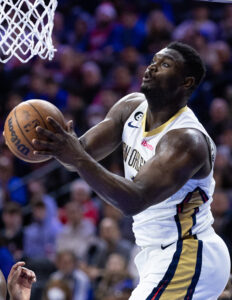
When Williamson went down with a right hamstring strain in early January, the Pelicans looked like they were still in pretty good shape. They’d gotten off to a 23-14 start and – with Brandon Ingram set to return later in the month from a toe injury – there was reason to believe they’d remain competitive even without Zion in the lineup.
That’s not how it’s played out, however. Since January 4, the Pelicans have gone just 10-23 and have cratered offensively, posting a 111.3 offensive rating — only the bottom four teams in the NBA’s standings (the Rockets, Pistons, Spurs, and Hornets) have been less productive offensively during that time. Prior to Williamson’s injury, New Orleans had the league’s eighth-best offensive rating (114.7).
With Williamson still sidelined, having suffered a setback in his rehab process, New Orleans’ months-long slump has caused the team to plummet from a top-three seed to potentially missing the play-in tournament entirely. Heading into Sunday’s games, the Pelicans’ 33-37 record places them 12th in the Western Conference, one game behind the No. 10 Jazz.
Friday’s contest in Houston was supposed to be the start of the softest part of the Pelicans’ rest-of-season schedule. A 4-0 run against the tanking Rockets (twice; on Friday and Sunday), Spurs (Tuesday), and Hornets (Thursday) would’ve helped right the ship in New Orleans and likely allowed the club to reclaim its place in the West’s top 10 entering the season’s home stretch.
Instead, the Pelicans dropped the first of those four favorable matchups, falling 114-112 in Houston.
New Orleans will have a chance to avenge that loss to the Rockets later today, but time is running out for the Pelicans to turn things around. Even if they capture a play-in berth, they don’t look like a great bet to earn a playoff spot, given how they’re playing as of late.
This was supposed to be the year that the Pelicans evolved from exciting young upstarts to genuine contenders — there were comparisons to the 2020/21 Suns, who made the NBA Finals a year after narrowly missing the postseason despite winning all eight games they played in the Disney World bubble. New Orleans followed that blueprint in the early part of the season, but have fallen apart without Williamson in the second half.
The Pelicans have continued to express optimism that the former No. 1 overall pick will return before the end of the season, but that’s hardly a lock. And whether or not he returns this spring, another injury-plagued year for Williamson has raised serious questions about how heavily New Orleans can rely on him going forward.
Williamson’s maximum-salary rookie scale extension will go into effect in 2023/24, so he’s ostensibly the cornerstone the franchise is building around, but he has made just 114 appearances since entering the NBA in 2019.
We want to get your thoughts on both the current and future versions of the Pelicans.
Will this year’s team earn a playoff spot, be eliminated in the play-in tournament, or miss out on the play-in altogether? If the Pels don’t start to climb back up the standings soon, does it even make sense to bring back Williamson this season?
And what about the seasons beyond this one? Do the Pelicans just have to hope for the best regarding Zion’s health or is it time to start getting more serious about potential contingency plans?
Take to the comment section below to let us know what you think!
Atlantic Notes: Embiid, Brunson, Robinson, Stoudamire
Even after emerging as the new betting favorite to win this season’s MVP award, Sixers center Joel Embiid believes he can still take his game to another level this spring, as he tells Spencer Davies of BasketballNews.com.
“I don’t think I’m at my best yet. I think I’m trending towards that. I think I’ve got a lot more to give,” Embiid said. “Defensively, I’m getting there. I’m getting back to myself. Usually, I take another step in the playoffs.”
Embiid’s eye-popping numbers this season include a league-leading 33.5 points per game on .546/.355/.855 shooting. The Sixers have a plus-8.8 net rating when he’s on the court, compared to a minus-0.1 mark when he’s off it.
Here’s more from around the Atlantic:
- Knicks point guard Jalen Brunson, who missed five of the team’s last six games due to what he described as a bone bruise in his left foot, didn’t miss a beat in his return to action on Saturday, scoring 24 points to lead the team to a comeback win over Denver, writes Ethan Sears of The New York Post.
- Following Saturday’s win, Knicks center Mitchell Robinson wasn’t interested in talking about the Snapchat posts he made on Tuesday griping about his role, telling reporters that he’s “moving forward.” As Sears relays for The Post, Robinson explained on Instagram on Friday that his outburst was related to off-court family issues, and his teammates seemed unbothered by his Snapchat content. “We’re all brothers, so we kinda even joked about it on the plane a little bit,” Immanuel Quickley said. “Mitch, he’s a great guy off the floor. Obviously I think everybody knows that. He’s like, a character. He can be funny and outgoing a little bit. “So we understand who Mitch is and we told him, any time we can help you get the ball a little bit more, we’re gonna try to do that.”
- Speaking to Adam Himmelsbach of The Boston Globe, Damon Stoudamire said it wasn’t easy to leave his position as a Celtics assistant as the season enters the home stretch and that he has “nothing but great memories” of his time in Boston. However, he felt he couldn’t pass up on the opportunity to become Georgia Tech’s new head coach. “I think this is an opportunity for me to just see where I stand,” Stoudamire said. “I always want an opportunity on this stage to test who I am, not only as a coach, but test my character, perseverance, and toughness.”
Blazers’ Billups Has Support Of Front Office, Players
Unless they turn things around quickly and drastically, the Trail Blazers will miss the playoffs and the play-in tournament for a second consecutive year since hiring Chauncey Billups as their head coach. However, a high-ranking source within the organization tells Jason Quick of The Athletic that the idea of firing Billups “hasn’t even crossed our minds.”
Billups has also received endorsements from several of Portland’s most important players, including Damian Lillard, Anfernee Simons, and Jerami Grant, according to Quick. Grant, who is eligible for free agency this summer, said that outsiders calling for Billups to be let go are “stupid,” adding that he’s “ready to run through a wall” for his coach.
For his part, Billups told Quick that he’s in frequent contact with Blazers general manager Joe Cronin and isn’t afraid of losing his job.
“I don’t worry about that, at all,” Billups said. “We have our talks and everything, and that will remain between us, but I don’t worry about that at all.”
Billups, who is in the second year of a five-year contract, has led the Blazers to a 58-94 (.382) record since taking the reins from Terry Stotts in 2021. Portland had hoped the first-time head coach could help stabilize a defense that had been one of the NBA’s worst during Stotts’ last two seasons, but there has been no improvement in that area — the Blazers ranked 29th in defensive rating in 2021/22 and currently sit at 27th in ’22/23.
Still, as Quick points out, Billups hasn’t been dealt an easy hand in Portland. The team underwent a front office overhaul just a few months after he was hired and saw its franchise player (Lillard) limited to just 29 games last season due to a major abdominal injury. Several key players, including CJ McCollum, Norman Powell, Robert Covington, and Larry Nance Jr., were traded at the 2022 deadline, and others – Josh Hart and Gary Payton II – were on the move at this season’s deadline.
“It’s been unbelievable … crazy,” Billups said of the Blazers’ front office turmoil, injury woes, and roster turnover. “How is that my fault? Last year I had so many coaches who are either in the league or past coaches saying, ‘Bro, I’ve coached 15, 17 years and I didn’t go through that once.’
“… The sad part about this season is we never got to see our team play. We had Josh, GP, Justise (Winslow) … veterans we know who were really going to help you win. And early in the season, we had a lot of those guys playing, and we were kicking up some dust, playing well. But an injury here … and all the stuff that happened (trades of Hart and Payton) … it was just tough.”
Acknowledging that his win-loss record hasn’t been strong so far, Billups said that his performance should also be evaluated based on the culture he has cultivated in Portland, the buy-in he has gotten from his players, and the progress he has made in developing the Blazers’ youngsters, including Simons, Shaedon Sharpe, and Nassir Little. According to Quick, Billups rated himself “good” on the first point and “very good” on the other two.
Greg Monroe Signs With Puerto Rican Team
Veteran NBA center Greg Monroe has joined Puerto Rican club Osos de Manatí, the team officially announced (via Instagram; hat tip to Sportando).
The seventh overall pick in the 2010 draft, Monroe has appeared in a total of 646 NBA regular season games, averaging 13.0 points and 8.2 rebounds in 27.4 minutes per contest. The 32-year-old big man spent time with four different NBA teams last season, primarily on 10-day contracts, and put up 5.4 PPG and 4.6 RPG in 14 games (13.9 MPG) for the Timberwolves, Wizards, Bucks, and Jazz.
Monroe hasn’t been an NBA regular for the last several years and continues to add new stops to his international résumé. His first move overseas came in 2019, when he joined Germany’s Bayern Munich. Since then, he has also played in Russia and China. He left his Chinese club, the Shanxi Loongs, this January.
Monroe’s new team, Osos de Manatí, competes in Puerto Rico’s top basketball league, Baloncesto Superior Nacional. The 2023 BSN season will tip off on March 22.
Jazz Sign Jarrell Brantley To 10-Day Contract
The Jazz have officially signed forward Jarrell Brantley to a 10-day contract, the team announced today in a press release.
The move represents a reunion for the two sides, as Brantley spent his first two professional seasons with the Jazz from 2019-21 after being selected 50th overall in the 2019 draft out of Charleston. He was waived in September 2021 and has since played in Russia, Puerto Rico, and New Zealand in addition to the G League.
While Brantley excelled at the NBAGL level for the Salt Lake City Stars, he didn’t see a ton of action in the NBA during his two years in Utah. He appeared in a total of 37 contests, averaging 2.4 points and 1.3 rebounds in just 6.3 minutes per contest.
As a member of the New Zealand Breakers in Australia’s National Basketball League this season, Brantley started all 39 games he played for the team, putting up 15.7 points, 6.0 rebounds, 1.6 assists, and 1.5 steals in 28.7 minutes per night.
A roster move had been required today for the Jazz, who had been carrying just 13 players on their standard roster since Frank Jackson‘s 10-day deal expired on March 4. NBA teams can dip below the league-mandated minimum of 14 players on standard contracts, but only for up to two weeks at a time. Utah has now once again reached that 14-player minimum, with one open spot left on their roster.
Brantley’s salary and cap hit on his 10-day deal will be $105,522, as our chart shows. The contract will run through Monday, March 27, covering the Jazz’s next six games. Once it expires, he would be eligible to sign a second 10-day deal with Utah before the team would have to make a decision on whether to let him walk or sign him for the rest of the season.