
NBA Teams With Fewest Players On Guaranteed Contracts
As of Friday, seven of the NBA’s 30 teams are carrying at least 15 players on fully guaranteed contracts and are unlikely to have many additional offseason acquisitions in store. Another nine teams are carrying 14 players on fully guaranteed deals, while 10 others have 12 or 13 guaranteed contracts on their books.
As our roster counts page shows, that leaves four clubs carrying 11 or fewer players on fully guaranteed deals. That doesn’t necessarily mean all four of those teams will sign free agents to guaranteed contracts before the regular season begins, but it’s worth checking in on them to take a closer look at their roster situations.
[RELATED: 2025/26 Non-Guaranteed Contracts By Team]
Atlanta Hawks
Although the Hawks are only carrying 11 players on guaranteed contracts, it’s possible no more additions are coming before the regular season, since they have four more players on partially guaranteed or non-guaranteed deals, and all four could be in the team’s plans.
One of those four players, Vit Krejci, should be a lock for the regular season roster. Krejci has been a regular rotation piece over the past two seasons and $1.5MM of his $2.35MM salary is also guaranteed. N’Faly Dante is the other Hawk with a partial guarantee — only $85,300 of his $2.05MM salary is locked in, but the Hawks probably wouldn’t have gone to the trouble of signing him away from Houston with an offer sheet if they planned to waive him before the season begins.
Former Magic forward Caleb Houstan and 2023 second-round pick Mouhamed Gueye have non-guaranteed minimum salaries for 2025/26. Houstan made 40% of his three-point attempts last season, and the Hawks may not be ready to give up on Gueye, who had his rookie year shortened significantly by a back injury.
Waiving any one of those four players would clear a path for Atlanta to either add a new 15th man or to carry an open roster spot into the regular season.
Cleveland Cavaliers
In addition to their 11 players on guaranteed salaries, the Cavaliers have Dean Wade, a reliable reserve whose contract features a significant partial guarantee, and Craig Porter Jr., a minimum-salary reserve who has been productive in limited minutes and who could play a greater role this fall if Darius Garland misses the start of the season due to toe surgery, as expected.
That’s still just 13 players on standard deals, so Cleveland will need to find a 14th man. Even though they could use some additional depth due to Garland’s toe injury and Max Strus‘ foot surgery, it’s probably safe to assume the Cavs won’t carry a full 15-man roster into the season since they already have the league’s highest payroll and won’t want to further increase their luxury tax bill if they don’t need to.
It wouldn’t be a surprise to see the Cavaliers sign a player to a partially guaranteed or non-guaranteed contract for their 14th spot. That would give the team some flexibility early in the season to make a change at that spot if they need to bring in extra depth at a specific position.
A player on a non-guaranteed deal without an early salary guarantee date won’t have his salary for 2025/26 locked in unless he remains under contract through January 7, so the Cavs could maintain some flexibility with the 14th spot until then. For now, a guard or wing to help fill in for Garland and Strus would make sense.
Golden State Warriors
The offseason practically hasn’t started for the Warriors, who belatedly finalized a pair of draft-night trade agreements on July 6 and haven’t made a single roster move since then. Jonathan Kuminga‘s restricted free agency standoff is the reason for the hold-up. Until they know the exact value of Kuminga’s cap hit – or the cap hits of the players they acquire in a sign-and-trade for Kuminga – the Warriors want to hold off on filling out the rest of their roster, since they may need to navigate a hard cap.
For now, Golden State is carrying just seven players on fully guaranteed contracts, four below the total for any other team. But Trayce Jackson-Davis and Gui Santos, who have non-guaranteed salaries, are probably sticking around, and Kuminga would get them to 10 players if he re-signs.
The Warriors are also believed to have deals lined up with several free agents, starting with Al Horford, who will likely receive most or all of the taxpayer mid-level exception. Horford and De’Anthony Melton (likely on a minimum-salary deal) have been the free agents long assumed to have handshake agreements with Golden State. Seth Curry, Gary Payton II, and Malcolm Brogdon are among the other rumored candidates to sign with the team (Curry seems to be the most likely), along with second-round picks Will Richard and possibly Alex Toohey.
It’s probably safe to assume that some combination of these players will fill out the Warriors’ roster once Kuminga’s free agency is finally resolved. Whether they carry 14 or 15 players could depend on how much Kuminga signs for — if the forward accepts his $8MM qualifying offer, Golden State would be in a way better position to carry a full roster than if he signs the team’s reported proposal that starts at $21.75MM.
New York Knicks
The Knicks have 11 players on guaranteed salaries, with Ariel Hukporti as their non-guaranteed 12th man. Technically, waiving Hukporti to replace him with another player is a possibility, but New York has so little cap flexibility below its second-apron hard cap that it’s not a practical route, since Hukporti’s $1,955,377 cap hit gives the club important extra breathing room that a $2,296,274 veteran’s minimum deal wouldn’t.
As their situation stands, the Knicks have enough room below the second apron to sign one veteran free agent to a minimum-salary contract and one draft-rights-held player to a rookie-minimum deal. A salary-shedding trade could change the equation for the club, but if that doesn’t happen, the Knicks have next to no maneuverability and won’t be able to add a 15th man until near the end of the season.
While swapping non-guaranteed players on and off the roster during the first part of the season is a viable option for a team like Atlanta, it’s not practical for New York, since those moves would burn much-needed room below the hard cap. That may be one reason why the Knicks are taking their time to decide who their 13th and 14th men will be. Once they sign those guys, they may end up committed to them for a while.
NBA 2025 Offseason Check-In: Detroit Pistons
Hoops Rumors is checking in on the 2025 offseason for all 30 NBA teams, recapping the summer’s free agent signings, trades, draft picks, departures, and more. We’ll take a look at each team’s offseason moves and consider what might still be coming before the regular season begins. Today, we’re focusing on the Detroit Pistons.
Free agent signings
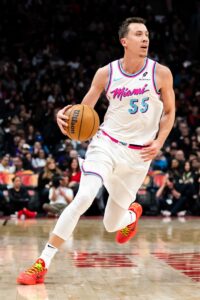 Duncan Robinson: Three years, $47,978,871. Second year partially guaranteed ($2MM). Third year non-guaranteed. Signed using Bird rights and acquired via sign-and-trade from Heat.
- Caris LeVert: Two years, $28,913,200. Signed using non-taxpayer mid-level exception.
- Paul Reed: Two years, $10,938,583. Second year non-guaranteed. Re-signed using Early Bird rights.
- Javonte Green: One year, minimum salary. Partially guaranteed ($925,106). Signed using minimum salary exception.
Trades
- Acquired Duncan Robinson (sign-and-trade) from the Heat in exchange for Simone Fontecchio.
- Acquired the Hornets’ 2026 second-round pick (top-55 protected) from the Kings in exchange for Dennis Schröder (sign-and-trade) and either the Pistons’, Bucks’, or Knicks’ 2029 second-round pick (whichever is least favorable).
Draft picks
- 2-37: Chaz Lanier
- Signed to four-year, $8,785,386 contract. First two years guaranteed. Third year non-guaranteed. Fourth-year team option.
Two-way signings
- Daniss Jenkins
- Details TBD.
- Colby Jones
- Details TBD.
Note: The Pistons carried over Tolu Smith on a two-way contract from 2024/25.
Departed/unsigned free agents
- Malik Beasley (unsigned)
- Tim Hardaway Jr. (Nuggets)
- Dennis Schröder (Kings)
- Lindy Waters III (Spurs)
Other roster moves
- Waived Ron Harper Jr. (two-way contract).
Salary cap situation
- Operating over the cap ($154.6MM) and below the luxury tax line ($187.9MM).
- Carrying approximately $166.8MM in salary.
- Hard-capped at $195,945,000.
- Full bi-annual exception ($5,134,000) available.
- One traded player exception available (worth $14,104,000).
The offseason so far
After a franchise-worst 2023/24 season in which they endured a 28-game losing streak and registered just 14 total victories, the Pistons were one of the NBA’s most pleasant surprises last year, improving by 30 wins to 44-38, making the playoffs for the first time since 2019, and picking up a postseason victory for the first time since 2008 (they’d been swept out of the first round in 2009, 2016, and 2019).
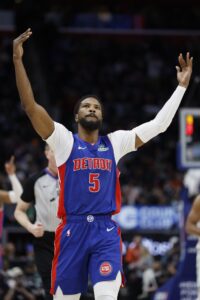 Heading into the offseason, there was speculation that Detroit would try to keep the band together by re-signing free agents Malik Beasley, Dennis Schröder, and Tim Hardaway Jr. — with Cade Cunningham and Jalen Duren still on the rise and Jaden Ivey returning from a season-ending injury, there was a pathway for the Pistons to keep improving internally without necessarily having to make any sort of impact outside addition.
It’s entirely possible that was the initial plan, but if so, it was derailed the day before free agency opened when word broke that Beasley was under investigation by the U.S. District Attorney’s office for gambling allegations involving NBA games and prop bets. Reporting at the time indicated that the Pistons and Beasley were working toward a three-year, $42MM contract agreement, but those talks fell apart as the sharpshooter’s NBA future turned into a giant question mark.
The terms of that proposed deal suggests Detroit intended to either use cap room or its mid-level exception to re-sign Beasley, since they only held his Non-Bird rights. The mid-level route would’ve allowed the Pistons to operate over the cap, maintaining Hardaway’s Bird rights and Schröder’s Early Bird rights, which would’ve put them in position to re-sign both players.
But even before word of the Beasley investigation broke, there were reports suggesting that the Kings intended to make an aggressive play for Schröder. That turned out to be accurate, as Sacramento signed the veteran point guard to a contract equivalent to the full mid-level exception. Hardaway, meanwhile, landed with the Nuggets on a minimum-salary deal, an offer the Pistons could’ve easily topped if they’d made the free agent wing a top priority.
Given what happened with Schröder and Hardaway, we can probably assume then that even if they’d re-signed Beasley, the Pistons were committed to making some offseason changes. Without Schröder, Hardaway, or Beasley, a more drastic overhaul of the club’s supporting cast was necessary.
The Pistons made an effort to replace Beasley’s shooting by sending Simone Fontecchio to Miami in a sign-and-trade deal for forward Duncan Robinson. Beasley is more athletic and versatile than Robinson, but few players shoot the three-ball better than the longtime Heat forward, who has knocked down 39.9% of 7.3 attempts per game over the past six seasons.
While the terms originally reported for Robinson (three years, $48MM) raised eyebrows, his deal is only fully guaranteed in year one, with a $2MM partial guarantee for 2026/27. So the Pistons will have an exit ramp next summer if the first season doesn’t go as planned (or perhaps if Beasley is fully cleared and wants to return).
Having preserved their mid-level exception by acquiring Robinson via sign-and-trade, the Pistons were able to devote that full MLE to signing Caris LeVert, whom J.B. Bickerstaff previously coached in Cleveland. In LeVert, Detroit is getting something of an amalgamation of the three veteran free agents they lost — LeVert can score (albeit not shoot) like Beasley, can serve as a ball-handler like Schröder, and has a frame more like Hardaway’s, allowing him to defend bigger wings instead of just guards.
It still feels like the Pistons could use one more roster addition, and they do have the ability to go out and get one more player — they generated a $14.1MM trade exception in the Schröder sign-and-trade and have more than enough room under the luxury tax line to use the entire thing. But with no obvious target out there for now, Detroit will probably see what its rotation looks like this fall with the newcomers and Ivey back in the mix.
For what it’s worth, minimum-salary signee Javonte Green could make a case for regular minutes, and Beasley remains an option if it looks like he’s in the clear from a legal perspective. He’s no longer a “target” of the federal gambling investigation, but he remains a “subject” of interest. The Pistons still hold Beasley’s Non-Bird rights, giving them the ability to offer him a starting salary worth up to $7.2MM. Now that the market has mostly moved on, that could be the best offer he’ll get this year.
The Pistons made two other minor offseason moves worth mentioning. Detroit was rumored to have some interest in a stretch big like Myles Turner, Naz Reid, or Santi Aldama, but with those top targets out of reach, the team fortified its depth up front by reuniting with Paul Reed, who signed a two-year, $10.9MM deal.
Reed isn’t a long-term answer in the middle and the Pistons presumably don’t view him as such (only the first year of his contract is guaranteed), but he’s a familiar and reliable depth option who can play a modest role while the team continues to consider ways to upgrade its frontcourt.
Finally, having finally conveyed a traded first-round pick to Minnesota after it landed in its protected range for several years in a row, the Pistons only had a second-round pick available in June. They used that selection – No. 37 overall – to nab Tennessee’s Chaz Lanier, a five-year college player who may be polished enough to compete for a rotation role right away.
Up next
As noted above, the Pistons still have a pretty sizable trade exception available and have enough flexibility to add another $20MM to their cap sheet for 2025/26 without going into luxury tax territory. With that in mind, they’re a team worth keeping an eye on as trade talks pick up again this fall. Few playoff clubs have a more favorable short-term cap situation than the Pistons, making them an obvious candidate to make one more move before or during the season.
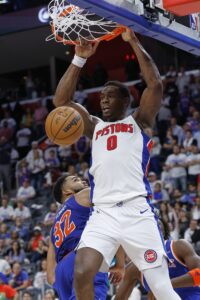 Detroit is currently carrying 13 players on guaranteed contracts, plus Green on a partially guaranteed minimum-salary deal, so even if they don’t do anything major before opening night, the Pistons could add a 15th man in free agency.
The more pressing preseason issue for the front office in the next month-and-a-half will be whether to complete rookie scale extensions with Duren and Ivey. Both players will be eligible for new deals up until October 20 and would become eligible for restricted free agency next summer if they don’t get something done this year.
Even with some teams around the league showing more reluctance this year to invest heavily in non-stars coming off their rookie deals, Duren seems poised to cash in. He has averaged double-doubles in consecutive seasons and is growing as a play-maker and rim protector. He’s also still just 21 years old, and with the Pistons’ long-term cap sheet relatively clean, the front office can afford to make a strong commitment to him, perhaps even via a front-loaded or flat contract that gets more team-friendly in the later years.
Eric Pincus of Bleacher Report suggested a four-year, $112MM deal for Duren, while John Hollinger of The Athletic speculated that a five-year, $125MM arrangement might make sense for both sides. It looks like the four-year, $97MM contract signed by Nic Claxton last summer might be the floor for the Pistons’ big man.
Ivey, on the other hand, may have to wait until 2026 to cash in. His season ended in early January due to a broken leg, and while he appeared headed for a career year at the time, the Pistons will probably want to longer look at him in 2025/26 to see how he fits back into the mix — and to make sure that last season’s injury won’t have any lingering effects.
Longest-Tenured NBA Head Coaches
For the first time since we began taking an annual look at the NBA’s longest-tenured head coaches a decade ago, Gregg Popovich‘s name doesn’t sit atop the list.
The longtime Spurs head coach had been on the sidelines in San Antonio for nearly three decades, having taken over coaching duties in December 1996. However, he gave way to assistant Mitch Johnson last November after suffering a stroke and then announced this spring that he had decided to end his coaching career at age 76.
Popovich retires from NBA coaching as the league’s all-time leader in regular season wins (1,390) and overall victories (1,560). He was also the oldest coach in league history and was the NBA’s longest-tenured coach by over a decade.
The shake-up at the top of our list starts with Popovich, but definitely doesn’t end there. In total, four of the NBA’s six longest-tenured head coaches have been replaced since we checked in last summer, with Michael Malone of the Nuggets (June 2015), Taylor Jenkins of the Grizzlies (June 2019), and Tom Thibodeau of the Knicks (July 2020) having been dismissed by their respective teams in recent months.
While the total number of coaching changes in the past year – six – isn’t abnormally high, it’s unusual for us to be removing so many names at the top of our list.
With all that in mind, here’s the current breakdown of the NBA’s longest-tenured head coaches by team:
- Erik Spoelstra, Heat: April 2008
- Steve Kerr, Warriors: May 2014
- Billy Donovan, Bulls: September 2020
- Tyronn Lue, Clippers: October 2020
- Mark Daigneault, Thunder: November 2020
- Chris Finch, Timberwolves: February 2021
- Rick Carlisle, Pacers: June 24, 2021
- Chauncey Billups, Trail Blazers: June 27, 2021
- Jason Kidd, Mavericks: June 28, 2021
- Jamahl Mosley, Magic: July 11, 2021
- Willie Green, Pelicans: July 22, 2021
- Will Hardy, Jazz: June 2022
- Joe Mazzulla, Celtics: September 2022
- Mazzulla became the Celtics’ interim head coach in September 2022 and was named the permanent head coach in February 2023.
- Quin Snyder, Hawks: February 2023
- Ime Udoka, Rockets: April 2023
- Nick Nurse, Sixers: June 1, 2023
- Darko Rajakovic, Raptors: June 13, 2023
- Brian Keefe, Wizards: January 25, 2024
- Keefe became the Wizards’ interim head coach in January 2024 and was named the permanent head coach in May 2024.
- Doc Rivers, Bucks: January 26, 2024
- Jordi Fernandez, Nets: April 2024
- Charles Lee, Hornets: May 2024
- J.J. Redick, Lakers: June 24, 2024
- Kenny Atkinson, Cavaliers: June 28, 2024
- J.B. Bickerstaff, Pistons: July 2024
- Mitch Johnson, Spurs: November 2024
- Johnson took over as the Spurs’ acting head coach in November 2024 after Gregg Popovich suffered a stroke; he was named the permanent head coach in May 2025 when Popovich stepped down from the position.
- Doug Christie, Kings: December 2024
- Christie became the Kings’ interim head coach in December 2024 and was named the permanent head coach in May 2025.
- Tuomas Iisalo, Grizzlies: March 2025
- Iisalo became the Grizzlies’ interim head coach in March 2025 and was named the permanent head coach in May 2025.
- David Adelman, Nuggets: April 2025
- Adelman became the Nuggets’ interim head coach in April 2025 and was named the permanent head coach in May 2025.
- Jordan Ott, Suns: June 2025
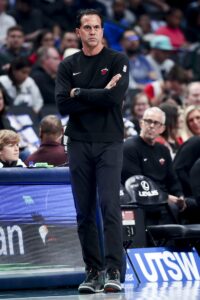
- Mike Brown, Knicks: July 2025
Spoelstra is the new name at the top of the list of longest-tenured coaches, with a comfortable six-year margin between him and second-place Kerr. Incredibly, the gap of six-plus years between Kerr and third-place Donovan is larger than five-year gap between Donovan and Brown, the head coach most recently hired.
In other words, Spoelstra and Kerr are now the only coaches in the NBA who have been with their respective teams for longer than five years, which is a testament to just how difficult it is for a head coach to stick in one place.
Longest-Tenured NBA Players By Team
Since we last checked in on the NBA’s longest-tenured players by team one year ago, a handful of names who were in the top 10 have changed teams either via trade or free agency.
That group includes Karl-Anthony Towns and Myles Turner, who had been with the Timberwolves and Pacers, respectively, since the 2015 draft. De’Aaron Fox is among the other longtime members of a franchise to change teams since last summer, having been dealt from the Kings to the Spurs in February after having played in Sacramento since 2017.
In addition to Minnesota, Indiana, and Sacramento, teams with a new longest-tenured player include the Bulls, Trail Blazers, Raptors, and Jazz, who have parted ways with Zach LaVine, Anfernee Simons, Chris Boucher, and Jordan Clarkson within the past year.
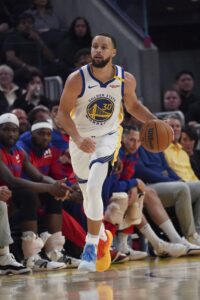 The top name on our list remains unchanged, as Stephen Curry – a member of the Warriors since 2009 – is still the player who has been with his current club for the longest period. He’s entering his 17th season with Golden State this fall.
Because our list includes just one player per team, Draymond Green doesn’t show up in the space below, but if we were simply listing the players who have been with their current clubs the longest, he’d own the No. 2 spot behind Curry, having been with the Warriors since being drafted in 2012. Jamal Murray (a Nugget since June 2016) is another player who would place highly on that version of the list.
Finally, it’s worth noting that a player like Damian Lillard – who was with Portland from 2012-23, spent two years in Milwaukee, then rejoined the Trail Blazers this summer as a free agent – won’t show up on this list, since he has spent time with another team since first becoming a Blazer since 2012. In our view, his tenure with the Blazers reset during his time with the Bucks and restarted this offseason.
Here’s each team’s longest-tenured player, along with how he was acquired:
(Note: This is a snapshot as of September 2, 2025 and won’t be updated throughout the season. Because this list only features each team’s longest-tenured player, one player per team is listed.)
- Golden State Warriors: Stephen Curry (draft), June 2009
- Milwaukee Bucks: Giannis Antetokounmpo (draft), June 2013
- Philadelphia 76ers: Joel Embiid (draft), June 2014
- Denver Nuggets: Nikola Jokic (draft), June 2014
- Dallas Mavericks: Dwight Powell (trade), December 2014
- Phoenix Suns: Devin Booker (draft), June 2015
- Boston Celtics: Jaylen Brown (draft), June 2016
- Orlando Magic: Jonathan Isaac (draft), June 2017
- Miami Heat: Bam Adebayo (draft), June 2017
- Memphis Grizzlies: Jaren Jackson Jr. (draft), June 2018
- Atlanta Hawks: Trae Young (draft trade), June 2018
- Charlotte Hornets: Miles Bridges (draft trade), June 2018 (*)
- New York Knicks: Mitchell Robinson (draft), June 2018
- Los Angeles Lakers: LeBron James (free agent), July 2018
- Los Angeles Clippers: Ivica Zubac (trade), February 2019
- New Orleans Pelicans: Zion Williamson (draft), June 2019
- Cleveland Cavaliers: Darius Garland (draft), June 2019
- Brooklyn Nets: Nic Claxton (draft), June 2019
- Chicago Bulls: Coby White (draft), June 2019
- San Antonio Spurs: Keldon Johnson (draft), June 2019
- Minnesota Timberwolves: Naz Reid (free agent), July 2019
- Oklahoma City Thunder: Luguentz Dort (free agent), July 2019
- Indiana Pacers: T.J. McConnell (free agent), July 2019
- Detroit Pistons: Isaiah Stewart (draft trade), November 2020
- Houston Rockets: Jae’Sean Tate (free agent), November 2020
- Washington Wizards: Anthony Gill (free agent), November 2020
- Toronto Raptors: Scottie Barnes (draft), July 2021
- Sacramento Kings: Domantas Sabonis (trade), February 2022
- Portland Trail Blazers: Shaedon Sharpe (draft), June 2022
- Utah Jazz: Walker Kessler (trade), July 2022
* Note: Bridges was a free agent for the entire 2022/23 season, but the Hornets retained his RFA rights during that time and brought him back for the following season, extending his tenure with the team. If we don’t count Bridges, Charlotte’s longest-tenured player is LaMelo Ball, who was selected in the 2020 draft.
While it’s a safe bet that many players on this list – especially a few near the top – will remain the same when we check in again during the summer of 2026, it’s a lock we’ll see some changes too. Powell (Mavericks), Young (Hawks), Robinson (Knicks), White (Bulls), and – of course – James (Lakers) are among the players on this list who can reach free agency next summer.
Which players do you expect to change teams and come off this list in the next 12 months?
Community Shootaround: Knicks’ Roster Spot
The Knicks have an unusual roster situation with training camps opening late this month.
They have only 12 players on standard contracts, yet they can only sign one more player on a veteran’s minimum contract. How so? They are hard-capped at the second tax apron, since they used the taxpayer mid-level exception to sign Guerschon Yabusele.
They are currently operating roughly $3.72MM below their hard cap, while veteran’s minimum contracts would count as $2,296,274 apiece. Thus, they’ll have to fill their 14th roster spot with a draft-rights-held rookie on a minimum contract ($1,272,870) unless they make a trade for cap relief.
Quite a few free agents have been mentioned as candidates for that veteran contract, mostly guards and wings.
Malik Beasley is no longer the target of a federal gambling investigation but his future in the league remains cloudy. However, Beasley – who had the second-most three-pointers in the league last season – would be an obvious boost to any bench.
The Knicks could instead pivot to a more familiar face. Shooting guard Landry Shamet and point guards Cameron Payne and Delon Wright are still available and each wore a New York uniform last season.
Malcolm Brogdon and Ben Simmons could also be considerations for the 13th spot. And there are plenty of other players looking for a deal — check out the list here.
That brings us to today’s topic: Which free agent should the Knicks sign to a veteran’s minimum contract with their available roster spot?
Please take to the comments section to weigh in on this topic. We look forward to your input.
Five Under-The-Radar Players To Watch In 2025
We’re still 28 days away from most teams beginning training camp, which typically determines multiple positional battles for teams ahead of the coming season. Still, the majority of teams’ offseason roster moves have been completed and preliminary pecking orders are in place, meaning we can take a stab at identifying true breakout players for 2025/26.
In the space below, we’ll be focusing on players who appear poised to go from the fringes of rosters to rotational mainstays. Think of Guerschon Yabusele last season, who went from being out of the league to being one of the NBA’s most coveted role players.
Last year in this exercise, we included Max Christie, who increased his scoring average from 4.2 points to 9.6 points per game. So while Larry Nance Jr. seems primed for a massive year with the Cavaliers as a role player, he has 546 career games under his belt and doesn’t really fit our criteria.
Luka Garza/Josh Minott, Boston Celtics
The Celtics went out of their way to add both Garza and Minott to standard deals early in free agency after the Timberwolves declined options on both players. However, the Wolves opting to not bring them back isn’t necessarily an indictment — more of a testament to the win-now depth Minnesota built ahead of them.
Garza hasn’t played many minutes over the course of his four-year NBA career, but he has certainly produced when given the opportunity. He holds career averages of 4.9 points and 2.0 rebounds in 7.8 minutes per game, which works out to per-36 averages of 22.7 points and 8.9 rebounds.
It would be easy to write off that kind of production since per-36 is hardly an indicative statistic of one’s talents, but that sample comes across 124 career games. And in 39 career regular season G League games, Garza averaged 26.3 points and 9.8 rebounds per contest.
The Celtics lost Luke Kornet in free agency, traded away Kristaps Porzingis, and are not considered likely to bring back Al Horford. That leaves Neemias Queta, Chris Boucher and Xavier Tillman as the only players in front of Garza in the frontcourt. It isn’t out of the realm of possibility that Garza emerges as a starter down the line.
Minott is also included here after his training camp last season had coaches raving. While he never ended up in the rotation, it’s still noteworthy that the Celtics added him early in free agency. Minott will battle Jordan Walsh, Baylor Scheierman and rookie Hugo Gonzalez for minutes off the bench at the wing position. In 32 career regular season G League games, he has averaged 19.2 points, 7.5 rebounds, 1.1 steals and 1.8 blocks.
Nigel Hayes-Davis, Phoenix Suns
If there was an option to select “most likely to be this year’s Yabusele,” Hayes-Davis would have to rank near the top. Hayes-Davis established himself as one of the best international players after not playing in the league since 2017/18. The Suns gave him a standard guaranteed deal after he averaged 15.1 points per game for Fenerbahce. On a new-look Phoenix team, he should get plenty of chances to contribute.
Jaylen Clark, Minnesota Timberwolves
The Timberwolves selected Clark with the No. 53 pick in the 2023 draft, with the Wolves essentially redshirting him while he recovered from injury in 2023/24. Last year, in his first healthy NBA season, Clark emerged as a reliable depth option, averaging 4.1 points across 13.1 minutes in 40 games.
With the loss of Nickeil Alexander-Walker to the Hawks in free agency, the Wolves will look to rely on their younger depth options to establish themselves this season. While all eyes are on Rob Dillingham and Terrence Shannon Jr. to take steps forward, look for Clark (and perhaps Leonard Miller), to gain more of a foothold in the rotation.
Cam Spencer, Memphis Grizzlies
Every opportunity he received, Spencer impressed for the Grizzlies and their G League affiliate. In just 10.1 minutes per game last year (25 appearances), Spencer averaged 4.2 points. In eight regular season G League games, Spencer averaged 23.5 points and 3.5 assists while shooting 53.8% from the field and 49.3% on three-pointers.
Memphis drafted Spencer last year with the No. 53 overall pick, and he spent all of last year on a two-way deal. After standing out in their developmental system, the second-year guard was rewarded with a standard contract this offseason. Even though the Grizzlies are flush with rotation-caliber players, there could be an opportunity for Spencer to earn some bench minutes following the departure of Desmond Bane.
Hoops Rumors’ Lists, Trackers, Features
In addition to passing along news, rumors, and analysis on a daily basis, Hoops Rumors provides a number of additional features and resources that can be found anytime on the right-hand sidebar of our desktop site under “Hoops Rumors Features,” or on the “Features” page in our mobile menu.
Since those links are easy to overlook and aren’t readily accessible to our app users, we want to periodically highlight a number of our lists, trackers, and other features.
For instance, our lists of current free agents by position/type and by team are constantly updated, as are our lists of 2026 free agents by position/type and by team.
We have a number of features related to NBA trades, including a roundup of this offseason’s deals, a recap of the trade exceptions currently available to teams, lists of the players who can’t be traded until December 15 or January 15, and details on which players can veto trades in 2025/26 and which players have trade kickers.
We have info on how teams are using mid-level and bi-annual exceptions in 2025/26, as well as which clubs are hard-capped and which have open roster spots. Our free agent tracker, two-way contract tracker and contract extension tracker provide information on most of the deals signed this summer, while our list of non-guaranteed contracts by team helps provide a more complete picture of each team’s roster.
We’ve got details on how much this season’s maximum salaries, minimum salaries, and mid-level/bi-annual exceptions are worth, as well as more details on the key cap figures for the 2025/26 season. We’ve also shared early projections for maximum salaries, minimum salaries, and mid-level/bi-annual figures for 2026/27.
The Hoops Rumors Glossary provides in-depth explanations on many concepts related to the salary cap and Collective Bargaining Agreement, presented in the simplest possible terms. We’ve updated the majority of our entries to reflect the changes made in the most recent CBA.
Finally, we’re in the process of breaking down all 30 teams’ summer moves in our Offseason Check-In series.
Many of our features and trackers are cyclical and will be reintroduced as the year goes on. For example, during draft season next spring, we’ll be keeping tabs on all the early entrants for the 2026 NBA draft.
Be sure to check out the sidebar on our desktop site or our Features page for all of our current resources.
17 Players Remain Eligible For Rookie Scale Extensions
Players who are entering the fourth and final year of their rookie scale contracts were permitted to sign rookie scale extensions as of early July. Those players, who were all 2022 first-round selections, will have until the day before the 2025/26 regular season starts (October 20) to finalize long-term agreements with their current teams.
Players eligible for rookie scale extensions can sign new deals that run for up to five years, with those contracts taking effect beginning in 2026/27. If they don’t sign extensions during the offseason, those players will be eligible for restricted free agency in the summer of 2026.
As our tracker shows, four players — Paolo Banchero, Jabari Smith Jr., Chet Holmgren and Jalen Williams — have already signed rookie scale extensions with their respective teams this offseason. A fifth — Blake Wesley — is no longer eligible after reaching a buyout agreement with Washington and subsequently signing a one-year deal with Portland.
Eight other 2022 first-round picks are ineligible rookie scale deals for various reasons.
That leaves 17 players — including Defensive Player of the Year runner-up Dyson Daniels — who remain eligible for rookie scale extensions this offseason:
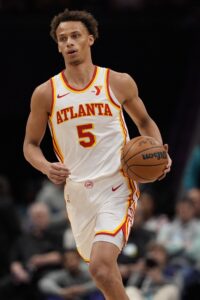 Ochai Agbaji (Raptors)
- Malaki Branham (Wizards)
- Christian Braun (Nuggets)
- Dyson Daniels (Hawks)
- Ousmane Dieng (Thunder)
- Jalen Duren (Pistons)
- Tari Eason (Rockets)
- Jaden Ivey (Pistons)
- Nikola Jovic (Heat)
- Walker Kessler (Jazz)
- Bennedict Mathurin (Pacers)
- Keegan Murray (Kings)
- Shaedon Sharpe (Trail Blazers)
- Jeremy Sochan (Spurs)
- Dalen Terry (Bulls)
- Peyton Watson (Nuggets)
- Mark Williams (Suns)
While some of these players almost certainly won’t sign new deals, we should still see several more extensions signed before the October 20 deadline. There has been an uptick in rookie extensions over the past several offseasons as more teams look to lock up their promising young players in advance of free agency. Since 2020, at least 10 players have signed rookie extensions every year, topping out at a record-setting 14 in 2023.
NBA 2025 Offseason Check-In: Denver Nuggets
Hoops Rumors is checking in on the 2025 offseason for all 30 NBA teams, recapping the summer’s free agent signings, trades, draft picks, departures, and more. We’ll take a look at each team’s offseason moves and consider what might still be coming before the regular season begins. Today, we’re focusing on the Denver Nuggets.
Free agent signings
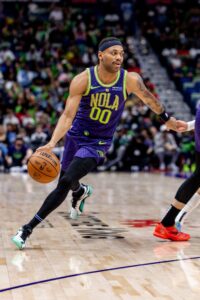 Bruce Brown: One year, minimum salary. Signed using minimum salary exception.
- Tim Hardaway Jr.: One year, minimum salary. Signed using minimum salary exception.
- Kessler Edwards: One year, minimum salary. Non-guaranteed (Exhibit 10). Signed using minimum salary exception.
Trades
- Acquired Cameron Johnson from the Nets in exchange for Michael Porter Jr. and the Nuggets’ 2032 first-round pick.
- Acquired Jonas Valanciunas from the Kings in exchange for Dario Saric.
Draft picks
- None
Two-way signings
- Tamar Bates
- One year, $85,300 partial guarantee (will increase to $318,218 at start of regular season).
- Curtis Jones
- One year, $85,300 partial guarantee (will increase to $318,218 at start of regular season).
- Spencer Jones
- One year, $85,300 partial guarantee.
Departed/unsigned free agents
- Trey Alexander (Pelicans)
- Vlatko Cancar (Olimpia Milano)
- PJ Hall (Grizzlies)
- DeAndre Jordan (unsigned)
- Russell Westbrook (unsigned)
Other roster moves
- None
Salary cap situation
- Operating over the cap ($154.6MM) and above the luxury tax line ($187.9MM).
- Carrying approximately $188.3MM in salary.
- No hard cap.
- Taxpayer mid-level exception ($5,685,000) available.
- Two traded player exceptions available (largest worth $6,880,985).
The offseason so far
Typically, a team firing both its general manager and its head coach with less than a week left in the regular season would be a sign of major dysfunction and a signal that the roster of that presumably free-falling franchise is next in line for an overhaul.
But the Nuggets, who parted ways with Calvin Booth and Michael Malone on April 8, actually had a very strong finish this spring — they won the rest of their regular season games under new leadership, knocked off a tough Clippers team in the first round of the playoffs, then took the 68-win Thunder to seven games in the second round, giving the eventual champions the most difficult challenge they faced in the Western Conference bracket.
Denver has since internally promoted executive Ben Tenzer to replace Booth and handed the head coaching reins to former Malone assistant David Adelman. The decision to stay in house to fill both jobs suggests that management believes the Booth/Malone duo, specifically, was the problem and that a full-fledged organizational reset isn’t necessary.
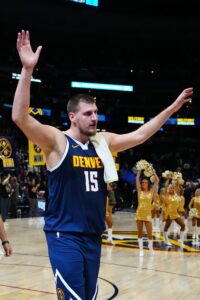 That thinking carried over for the most part this offseason to the roster, where a starting group headed up by Nikola Jokic, Jamal Murray, and Aaron Gordon has been the Nuggets’ strength in recent years, while the bench has lagged behind. Only seven Denver players appeared in all seven games of the OKC series this spring, and only six of those players averaged at least 15 minutes per game, an indicator of how heavily the team leaned on its starters even after Malone’s departure.
So with one exception (which we’ll get to in a minute), the Nuggets focused this summer on upgrading their bench. They reunited with Bruce Brown, who played a significant role as a jack-of-all-trades off the bench during the club’s championship run in 2023. Based on his play that year, Brown got too expensive for Denver to retain at the time, but his stock had dropped following up-and-down stints in Indiana, Toronto, and New Orleans, opening the door for the Nuggets to bring him back on a minimum-salary deal.
The Nuggets also got a team-friendly veteran’s minimum rate for Tim Hardaway Jr., a veteran wing who hasn’t averaged fewer than 26 minutes per game or made less than $16MM in a season since 2016/17. Hardaway isn’t exactly a two-way dynamo, but he’s a solid role player who can make three-pointers (.361 career 3PT%) and is versatile enough to guard multiple positions on defense. Getting him on the minimum should pay off, especially since he’s the sort of player who could benefit from playing with Jokic.
Speaking of Jokic, the Nuggets hadn’t made it a priority in recent years to find him a reliable backup, but that was a goal this offseason, resulting in a trade that sent Dario Saric to Sacramento in exchange for Jonas Valanciunas.
It seemed for a few weeks as if Valanciunas was looking to get out of his NBA contract in order to sign with Panathinaikos in Greece, but the Nuggets wanted the big man in Denver, and non-stars who are under contract generally have little leverage to steer themselves to preferred destinations. So it didn’t come as a real surprise when Valanciunas eventually confirmed he’d be reporting to the Nuggets and expressed enthusiasm about playing for the team.
If Valanciunas embraces the opportunity available for him in Denver, he should be a great fit behind Jokic. The bruising Lithuanian is a talented low-post scorer and rebounder whose steady production could allow the Nuggets to lean a little less heavily on their three-time MVP than they’ve had to in recent years — Jokic averaged a career-high 36.7 minutes per game in 2024/25, but I’d be pretty shocked if he played that much again in ’25/26.
While much of Denver’s offseason work focused on improving the bench, the team did make one noteworthy change to its starting lineup, sending Michael Porter Jr. and an unprotected 2032 first-round pick to Brooklyn in exchange for Cameron Johnson.
Porter was an important part of the Nuggets’ title team and has been an effective secondary scorer – and their most reliable three-point shooter – in recent years. But he was a negative on the defensive end and was overpaid on his maximum-salary contract.
Swapping him out for Johnson, who is owed just $44MMish over the next two seasons, will give Denver a comparable scorer and shooter (Johnson averaged 18.8 PPG and made 39.0% of his threes for Brooklyn last season) who should be more of an asset defensively — it also created the financial flexibility necessary to bring in a player like Valanciunas and his $10.4MM cap hit. That 2032 first-rounder, which will convey when Jokic is 37 years old, could end up being a pretty valuable pick, but the Nuggets deemed it a worthwhile risk to give it up in an effort to maximize their superstar’s prime.
Up next
The Nuggets are carrying just 14 players on guaranteed contracts and have room to add a 15th man. While they technically have several cap exceptions available, including the mid-level, bi-annual, and a pair of modest trade exceptions, using any of those – with the exception of the taxpayer portion of the mid-level exception – would hard-cap them at the first tax apron. The club is already less than $3MM away from that threshold.
That means if Denver does carry a 15th man, it’s more likely to be a minimum-salary player whose contract isn’t fully guaranteed, in order to give the team some in-season flexibility. Veteran forward Kessler Edwards, who signed an Exhibit 10 deal, is one candidate to make the roster in that capacity.
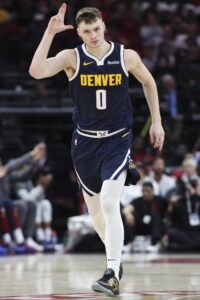 For what it’s worth, due to incentives in the Johnson and Gordon contracts, the Nuggets are relatively close to the first apron despite only being $400K or so above the luxury tax line. While Denver has gone out of its way not to hard-cap itself so far this offseason, I still think the club is probably more likely to finish the 2025/26 season below the tax line than above the first apron — the Nuggets have been a taxpayer for three straight years, so dipping below that threshold this season could be an important first step toward resetting the repeater clock.
Jokic and Johnson are both eligible for veteran contract extensions this offseason, but Jokic has reportedly conveyed a preference to wait until 2026 (when he’d be eligible for a more lucrative deal), while Johnson faces extend-and-trade restrictions after being dealt to Brooklyn and may want to wait until next summer too.
That leaves Christian Braun and Peyton Watson as the Nuggets’ most important preseason extension candidates, with Braun leading the way. Having been elevated to the starting lineup last fall in the wake of Kentavious Caldwell-Pope‘s free agency departure, Braun has emerged as a critical supporting player in Denver, setting career highs with 15.4 points per game and a .397 3PT% in 2024/25.
The Nuggets will obviously want to keep Braun long-term, but with lucrative deals for Jokic, Murray, Gordon, and Johnson already on the books, the team will have to be careful about navigating the tax aprons going forward. Denver’s previous front office made a habit of freely handing out extensions and being willing to overpay to get them done, but being too generous with Braun could create some difficult roster decisions down the road. The team should be wary of going much beyond about $85-90MM for four years.
2025/26 NBA Waiver Claims
As of the 2024/25 league year, the non-taxpayer mid-level exception, room exception, and bi-annual exception can all be used to acquire players via waiver claims, giving teams new ways to land other clubs’ roster casualties whose salaries don’t exceed the MLE (approximately $14.1MM in ’25/26)
[RELATED: Values Of 2025/26 Mid-Level, Bi-Annual Exceptions]
In the past, in order to claim a player off waivers, a team generally had to be able to fit the player’s entire salary into cap room, a traded player exception, or a disabled player exception.
Despite the new options available to teams eyeing a player who has recently been cut, waiver claims will likely continue to be infrequent going forward. Once the draft and the early part of the free agent period have passed, many teams around the NBA aren’t in position to take on additional salary or don’t have excess roster spots available for newcomers. Plus, most of the players who end up on waivers are being cut because their current contracts aren’t considered great values.
With all that in mind, it’s perhaps no surprise that the players most frequently claimed on waivers are those on minimum-salary deals, since any club is eligible to place a claim on those players using the minimum salary exception.
Even for minimum-salary claims, there are some caveats — the minimum salary exception can only be used to sign players for up to two years, so the same rules apply to waiver claims. If a player signed a three-year, minimum salary contract, he can’t be claimed using the minimum salary exception, even if he’s in the final year of his deal. And if a player received more than the minimum salary in an earlier season, he can’t be claimed using the minimum salary exception.
Essentially, the minimum salary exception can only be used to claim a player whose current contract could have been signed using the minimum salary exception.
Taking into account all the factors that reduce the odds of a waiver claim, it makes sense that nearly all of the players who get released ultimately clear waivers. The 2021/22 and ’22/23 league years each featured just six waiver claims each, for instance, while there were only three in ’23/24. Last season’s seven waiver claims were the most in a single league year since 2019/20.
Despite how infrequent they are, we still want to track all the waiver claims that take place during the 2025/26 league year, since you never know which claim may end up being crucial. Last season, for example, the Pelicans claimed Brandon Boston Jr. off waivers from San Antonio in October and he became a regular – and reasonably effective – rotation player for the banged-up team.
We’ll track this year’s waiver claims in the space below, updating the list throughout the season to include the latest moves. Here’s the current list:
- Suns claim Jordan Goodwin from Lakers (July 23) (story)
- Goodwin was a valuable role player for the Lakers during the second half of the 2024/25 season, but when Los Angeles needed to create room below its first-apron hard cap to sign Marcus Smart, he was the odd man out due to the fact that his minimum-salary contract ($2.35MM) was only partially guaranteed for $25K. As it turns out, the Lakers won’t even be on the hook for that $25K after the Suns took on Goodwin’s contract via waivers. The veteran guard is expected to compete for a spot on Phoenix’s roster with Jared Butler, who is also coming to camp on a non-guaranteed deal.
- Pistons claim Isaac Jones from Kings (November 6) (story)
- In search of reliable veteran frontcourt depth to help make up for an early-season Keegan Murray injury, the Kings waived second-year forward Isaac Jones in order to sign Precious Achiuwa. Jones, who gave Sacramento pretty solid minutes in a limited role as a rookie in 2024/25, didn’t make it through waivers. The Pistons, who had an open spot on their 15-man roster, placed a claim and made him their 15th man, at least for now — Jones’ minimum salary is non-guaranteed until January 7, so Detroit has a couple months to decide whether or not he’s a keeper.