
2015/16 D-League Usage Report: Pacers
The NBA’s relationship with the D-League continues to grow, and this season a total of 19 NBA teams had one-to-one affiliations with D-League clubs. Those NBA organizations without their own affiliates were required to assign players to D-League clubs associated with other NBA franchises. D-League teams could volunteer to take on the assigned players, and if no volunteers emerged, the players were assigned at random.
This significant change from the 2014/15 season came about after the Pacers purchased the Fort Wayne Mad Ants and turned them into their one-to-one partner for the 2015/16 campaign. Other NBA teams have interest in following suit in the years ahead, and the NBA’s ultimate goal for the D-League is for all 30 NBA franchises to have their own D-League squads. You can view the complete list of D-League affiliates here.
We at Hoops Rumors are recapping the D-League-related activity for the 2015/16 campaign for each team and we’ll continue with the Indiana Pacers, whose D-League affiliate is the Fort Wayne Mad Ants:
The Pacers made 13 assignments for the 2015/16 season, sending four players to the D-League for a total of 294 days. Listed below are all the assignments and recalls made by Indiana for the 2015/16 campaign:
- November 2nd: Assigned Rakeem Christmas (1st) — Recalled December 31st
- November 2nd: Assigned Shayne Whittington (1st) — Recalled December 27th
- December 11th: Assigned Joe Young (1st) — Recalled December 14th
- December 27th: Assigned Glenn Robinson III (1st) — Recalled December 28th
- December 27th: Assigned Joe Young (2nd) — Recalled December 28th
- December 28th: Assigned Shayne Whittington (2nd) — Recalled December 31st
- January 1st: Assigned Rakeem Christmas (2nd) — Recalled January 30th
- January 25th: Assigned Shayne Whittington (3rd) — Recalled January 25th
- January 30th: Assigned Shayne Whittington (4th) — Recalled February 3rd
- February 2nd: Assigned Rakeem Christmas (3rd) — Recalled April 3rd
- February 8th: Assigned Shayne Whittington (5th) — Recalled March 15th
- March 16th: Assigned Shayne Whittington (5th) — Recalled March 16th
- March 20th: Assigned Shayne Whittington (6th) — Recalled April 3rd
Here is how the Pacers’ players performed while on assignment to the D-League this season:
- Rakeem Christmas: In 48 appearances, Christmas averaged 13.9 points, 7.2 rebounds and 1.7 blocks in 30.1 minutes per night. His shooting line was .473/.250/.732.
- Glenn Robinson III: The forward appeared in one contest and scored 11 points, grabbed 11 rebounds and dished out two assists in 41 minutes of action.
- Shayne Whittington: In 41 appearances, Whittington averaged 12.1 points, 7.9 rebounds and 1.4 assists in 30.8 minutes per contest. His shooting line was .429/.310/.816.
- Joe Young: In three appearances, Young averaged 24.3 points, 3.3 rebounds and 2.0 assists in 34.9 minutes per game. His shooting line was .433/.636/.933.
Offseason Outlook: Charlotte Hornets
Hoops Rumors is looking ahead to offseason moves for all 30 teams. We’ll examine free agency, the draft, trades and other key storylines for each franchise as the summer approaches.
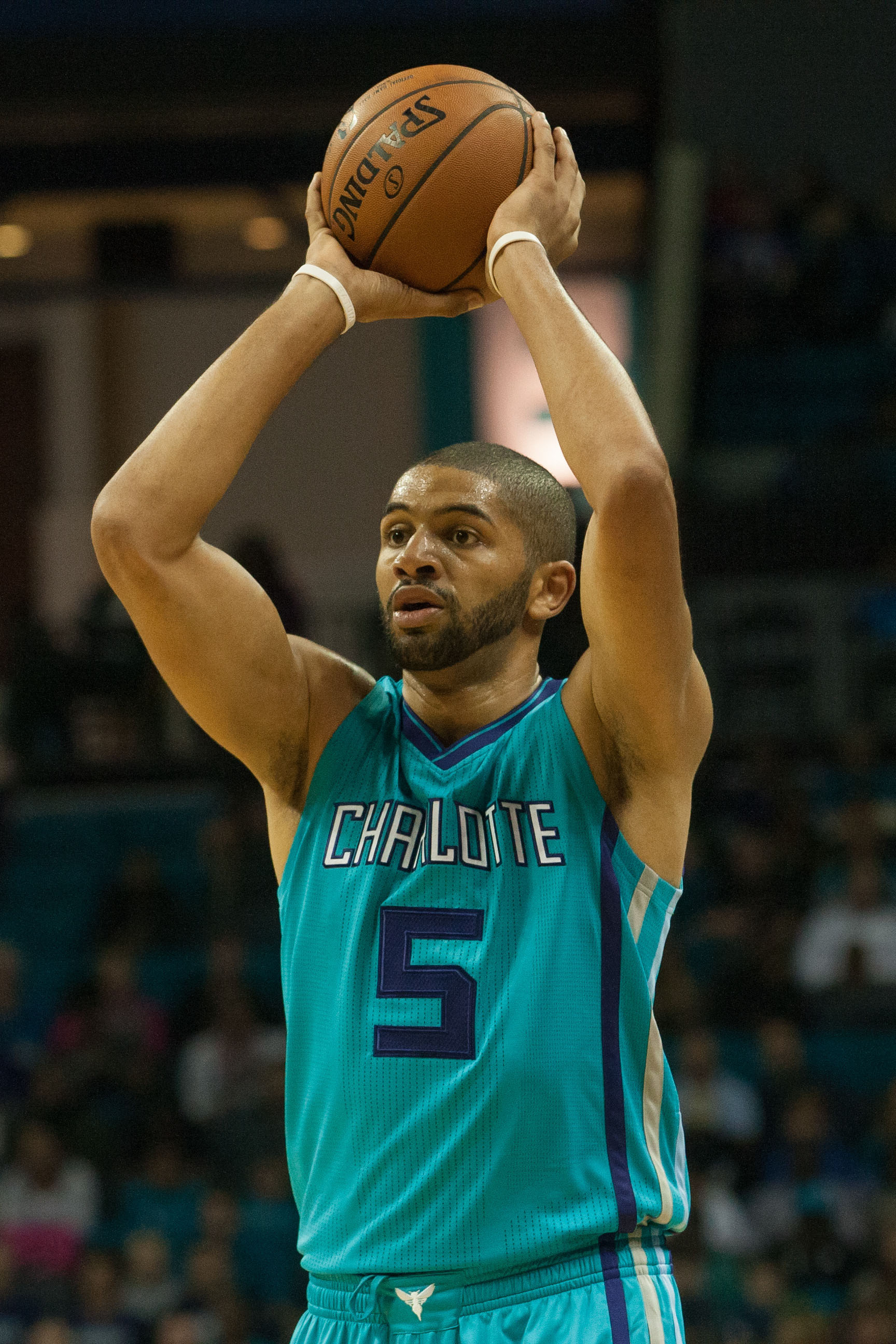
Nicolas Batum‘s Free Agency
GM Rich Cho says re-signing Batum is his top priority, and the Bouna Ndiaye client has pledged to make the Hornets the first team he speaks with when he becomes a free agent July 1st. The question appears to be a financial one, as Cho and company must ponder whether it’s wise to offer a max contract starting at an estimated $26MM to a swingman who fell shy of averaging 15 points and 35% 3-point shooting in his career year this season. The market will probably dictate that the Hornets go to the max to keep him, given the dearth of other attractive free agent options amid a surging salary cap. Zach Lowe of ESPN.com wrote in January that Batum was likely to draw max offers, and while his scoring and outside shooting percentage dipped somewhat after that report, the market probably hasn’t changed.
Other Incumbent Free Agents
The Hornets have to fight battles on multiple fronts with five members of their rotation poised to hit free agency, assuming Jeremy Lin turns down his player option. Cho said he wants to re-sign as many as possible, but coming to terms with all of them will be a tall order. The most pivotal question surrounds Al Jefferson, who’s just two years removed from having been Third Team All-NBA. Injury and a marijuana suspension marred his season this year and turned him into a reserve, though he popped back into the starting lineup midway through the first-round series loss to the Heat. He was still a shadow of what he was two years ago in five postseason starts, averaging just 11.0 points and 6.2 rebounds. Just 31 years old, he’s not ancient by any standard, but he’s old enough that the Hornets will likely shy away from a long-term deal, and he’ll probably have to take a pay cut to remain in Charlotte, too.
Marvin Williams is another fascinating case. He’s become a quintessential stretch four, hitting a career-best 40.2% of his 3-pointers this past season, so he’ll be in high demand. Still, he turns 30 this year, and it’s fair to wonder whether he and Michael Kidd-Gilchrist, who was injured for most of the season, can successfully share the floor. Most problematic is that the Hornets only have Early Bird rights on him, and with Cho’s plan to keep the team intact, Charlotte probably won’t have the cap space necessary to offer him more than $12.5MM for next season, which might not be enough.
It would be difficult to envision both Williams and Courtney Lee re-signing as long as Batum comes back, since there wouldn’t be room in the same starting lineup for the two of them with Batum and Kidd-Gilchrist around. Lee saw fewer shot opportunities than he did before the trade that brought him from Memphis, and while he and Williams would provide much-needed floor spacing alongside Kidd-Gilchrist, Lee will probably seek a larger role elsewhere.
The Hornets will be even more fenced in with Lin if he opts out than they are with Williams, since they’d have only Non-Bird rights on Lin. That would provide for a salary of $2,566,800, not enough for someone who was one of the best backup point guards in the league this year. Charlotte would likely have to turn to the $5.628MM mid-level exception to keep him. Still, he said he enjoyed his year with the Hornets so much, he’d be willing to give the team a discount on his next deal, so it remains to be seen how generous he’ll be.
Outside Free Agent Targets
The Hornets are apparently one of four favorites to sign Dwight Howard this summer, and they reportedly had exploratory trade talks about him with the Rockets before the February deadline. Coach Steve Clifford was an assistant for the Magic and Lakers when Howard was with those teams, but despite all that, the idea of Howard in Charlotte still seems far-fetched. The Hornets would have to renounce the rights to every one of their significant free agents aside from Batum and Lin to open enough cap space to even approach the roughly $30MM max Howard would be eligible for, barring major salary-clearing trades. The same goes for any chance the team might have at Charlotte-area native Hassan Whiteside. The salary-cap math just makes it prohibitive. More realistic free agent additions will likely come via whatever portion of the mid-level Lin doesn’t take, so don’t expect the team to make a major signing.
Cody Zeller‘s Extension Candidacy
Assuming the team doesn’t make a game-changing swap, Zeller represents the future of the center position in Charlotte. The madness of the heightened cap will have had its effect on the market by the time rookie scale extension talks begin in earnest in the fall, and while there might be wisdom in tying up Zeller before the cap leaps from this year’s projected $92MM to next year’s projection of $107MM, the Hornets will probably wait to see what Zeller does over a full season as a starter before committing to him. That said, Charlotte struck a rookie scale extension with Jeremy Lamb last fall less than a week after his first official game with the team.
Potential Trades
Lamb and Spencer Hawes appear to have the most tradeable contracts on the Hornets, though Lamb’s disappearance from the rotation at the end of the season won’t help his appeal to other teams. Still, he had his most productive year, even though he didn’t shoot well. Hawes showed signs of life after a miserable season with the Clippers, and he’s still just 28. A 3-point shooting big man has value on the market if Charlotte wants to test it.
Draft Outlook
- First-round picks: 22nd
- Second-round picks: None
It’ll be the first year in a while the Hornets won’t have a lottery pick, so they can only expect so much here. They could go for shooting with Florida State two-guard Malik Beasley, but this part of the first round is heavy on size. Don’t be surprised if they go the international route with centers Ivica Zubac or Ante Zizic.
Other Decisions
The opening of Charlotte’s new D-League affiliate bodes well for Aaron Harrison, who has a non-guaranteed salary, since the Hornets will have the opportunity to closely monitor the development of the once-highly touted prospect on that squad. The team may well have interest in keeping soon-to-be restricted free agent Troy Daniels, given his 3-point shooting ability, but fellow impending free agents Jorge Gutierrez and Tyler Hansbrough were insurance policies the Hornets never found much use for.
Final Take
Charlotte overcame plenty of adversity this season to not only make the playoffs but come within a game of the second round, and with Kidd-Gilchrist poised to come back from his shoulder injury, plenty of reason for optimism exists. The trick this summer is to keep the team together, and Cho seems willing to embrace the challenge.
Guaranteed Salary
- Michael Kidd-Gilchrist ($13,000,000)
- Kemba Walker ($12,000,000)
- Jeremy Lamb ($6,511,628)
- Spencer Hawes ($6,348,759)
- Cody Zeller ($5,318,313)
- Frank Kaminsky ($2,730,000)
- Total: $45,908,700
Player Options
- Jeremy Lin ($2,235,255)
Team Options
- None
Non-Guaranteed Salary
- Aaron Harrison ($874,636)
Restricted Free Agents (Qualifying Offers/Cap Holds)
- Troy Daniels ($1,215,696/$1,215,696)
- Jorge Gutierrez ($1,215,696/$1,215,696)
- Totals: ($2,431,392/$2,431,392)
Unrestricted Free Agents (Cap Holds)
- Al Jefferson ($20,250,000)
- Nicolas Batum ($19,687,961)
- Courtney Lee ($10,782,500)
- Marvin Williams ($9,100,000)
- Jeremy Lin ($2,566,800) — pending player option
- Tyler Hansbrough ($980,431)
- Total: $63,367,692
Other Cap Holds
- No. 22 pick ($1,199,900)
- Jason Maxiell ($980,431)
- Jeff Taylor ($980,431)
- Total: $3,160,762
Projected Salary Cap: $92,000,000
The Basketball Insiders salary pages were used in the creation of this post.
2016 Free Agent Power Rankings
Two months from now, it’ll be the 10th day of NBA free agency and most of the major names will already be off the board. Time is ticking toward the meat of the offseason even as the playoffs churn forward. It’s been a rough postseason for many of the best players on expiring contracts as several within our top 10 suffered injuries, failed to perform up to their normal standards, or both. It just makes what the top name on this list decides to do all the more important. Here’s our latest ranking of the elite 2016 NBA free agents:
- Kevin Durant — Last season’s injury seems like a distant memory as the Warriors and Spurs, who averaged 70 wins between them this year, prepare to make major overhauls if necessary to land the former MVP. The Thunder would need to make no such changes but seemingly need to prove they can hang with two historically great teams in the playoffs. Regardless, the next two months will be fascinating for Durant and the balance power atop the NBA. Last time: No. 1.
- LeBron James (player option) — It’s easy to forget, amid the Durant hubbub and more competitive series elsewhere, that James is about to hit free agency for the third summer in a row. Still, no serious questions about his commitment to Cleveland have surfaced this year, and any uncertainty surrounding the Cavs will likely have much more to do with his supporting cast should the team again fall short of a title. Last time: No. 2.
- Andre Drummond (restricted) — The Pistons center slumped down the stretch, and Tristan Thompson and the Cavaliers held him to just nine rebounds per game in the playoffs after he averaged a league-high 14.8 in the regular season. Still, the momentum toward new “Hack-a-Shaq” rules promises to mitigate his poor free-throw shooting and enhance his value to the Pistons, who’ll be keeping him this summer. Last time: No. 3.
- Al Horford — His rebounding also disappeared against Thompson and the Cavs, and it wasn’t otherwise a stellar postseason for the big man who turns 30 in June, but Horford embodies the versatility required of modern centers, especially given his sudden development of a 3-point game. His age will concern some teams, but assuming his comments this week don’t mean he’s completely sold on staying in Atlanta, he’s the best of the obtainable free agent big men. Last time: No. 5
- Dwight Howard (player option) — Some teams that don’t mind baggage and have faith that Howard’s declining offensive production was merely a function of Houston’s offense will rank the new Perry Rogers client in front of Horford. Howard is not what he used to be, but he remains an elite rebounder. The Magic, Bucks, Blazers and Hornets are reportedly the front-runners for him at last check. Last time: No. 6.
- DeMar DeRozan (player option) — Perhaps no one has had as disconcerting a playoff run as DeRozan has. His points per game, free-throw attempts per game and, most notoriously, his field-goal percentage, are all down markedly. Still, it’s probably not enough of a slump to dissuade the Raptors from committing a max deal to a player who’s expressed his affection for Toronto at every opportunity and who’s coming off career highs in points per game and 3-point percentage. Last time: No. 4.
- Mike Conley — It was a lost spring in Memphis as Conley was among the many Grizzlies who suffered season-ending injuries. It’s never a positive sign for anyone’s free agency to succumb to a sore Achilles tendon, but it didn’t tear, and it doesn’t appear as though the injury to his left leg will threaten his long-term health. More worrisome for the Grizzlies is Conley’s wait-and-see approach to his free agency, seemingly opening the door for teams with cap flexibility and a need at point guard, with the Nets and Knicks most prominent among them. Last time: No. 7.
- Bradley Beal (restricted) — It was an up-and-down year for Beal, who averaged a career-high 17.4 points per game but shot below 40% from 3-point range for the first time since he was a rookie. He played in 55 games, the fewest of his four NBA seasons, and admitted he’ll probably have to watch his minutes for the rest of his career. Still, it’s unlikely to dissuade the Wizards from committing the max to a promising talent who’s still only 22. Last time: No. 8.
- Nicolas Batum — An injury variously described as a left foot strain and a sprained left ankle interrupted the playoffs for Batum, and though he made it back to play before Charlotte’s seventh-game elimination at the hands of Miami, he clearly wasn’t himself. That probably won’t matter this summer, with the Hornets seemingly prepared to go all-in to keep him the Bouna Ndiaye client who fit in well during his lone season with Charlotte. Last time: No. 9.
- Hassan Whiteside — It’s oddly fitting that the top 10 would end with a player who’s injured and whose numbers declined in the playoffs, given how the past month and a half has gone for the top free agents of 2016. Still, Whiteside regained his starting role just before the postseason and posted five double-doubles in 10 playoff games. Agent Sean Kennedy is closing in on the opportunity to take Whiteside from the minimum salary to the max in the span of less than two years. Last time: No. 10.
His miserable half-season in Dallas still clouds his reputation, but Rajon Rondo delivered one of his best seasons yet in the relative obscurity of Sacramento, where DeMarcus Cousins and former coach George Karl siphoned most of the headlines. The 30-year-old point guard who tied his career high with 11.7 assists and shattered his previous high with 36.5% 3-point shooting leads our next 10 free agents:
11. Rajon Rondo
12. Dwyane Wade
13. Chandler Parsons (player option)
14. Harrison Barnes (restricted)
15. Evan Fournier (restricted)
16. Ryan Anderson
17. Pau Gasol (player option)
18. Luol Deng
19. Kent Bazemore
20. Jordan Clarkson (restricted and subject to Gilbert Arenas Provision)
See all the previous editions of our rankings here. See the full list of 2016 free agents here.
Community Shootaround: Warriors’ Title Drive
The breaking news on Monday, as reported by ESPN.com’s Marc Stein, that Stephen Curry would be named the league’s Most Valuable Player again came as no surprise. The only mystery regarding Curry’s second straight MVP is whether anyone else got a first-place vote after the Warriors’ historic season.
As for Curry’s health, there’s plenty of uncertainty. Curry has only appeared in two of the Warriors’ eight postseason games, first because of an ankle injury and currently due to a sprained right MCL. Golden State managed to win four of those six games, but his absence may be wearing on the club, as evidenced by its 12-point loss to Portland in Game 3 on the Western Conference semifinals on Saturday.
Curry returned to action Monday night, but it’s fair to wonder how the injuries will affect him going forward. Physically, he may not have full mobility until he can rest and rehab in the offseason.
Moreover, it’s always difficult for an athlete to completely trust their body if there’s any lingering pain or fear that certain movements could aggravate the injury.
The Warriors certainly don’t have an easy road to a second straight title, even if Curry is feeling spry. They’ve got to get past the pesky Trail Blazers, and face either a veteran, deep perennial contender in the Spurs or a revived, hungry Thunder unit with two of the league’s top players.
Should they survive that acid test, they’ll probably see the Cavs and their trio of stars, who have been playing lights out thus far in the playoffs.
This leads us to our question of the day: Can the Warriors still repeat if Stephen Curry isn’t 100% healthy the remainder of the postseason?
Please take to the comments section below to share your thoughts and opinions on the subject. We look forward to what you have to say.
Offseason Outlook: Detroit Pistons

Hoops Rumors is looking ahead to offseason moves for all 30 teams. We’ll examine free agency, the draft, trades and other key storylines for each franchise as the summer approaches.
Re-signing Drummond
The Pistons’ long climb back to respectability began when the previous regime drafted Andre Drummond with the No. 9 pick in the 2012 draft. Owner Tom Gores labeled Drummond as a “max player” a year ago and, for the most part, Drummond lived up to that billing this past season. He made his first All-Star appearance while leading the league in rebounding and displaying a much-improved low-post game.
Drummond decided not to sign an extension prior to the start of the season, knowing he could get a much bigger contract in restricted free agency this summer. There has been no hint that Drummond will shop his services, considering the Pistons are willing to pay top dollar to retain him.
There were some uneasy moments between Drummond and head coach/president of basketball operations Stan Van Gundy as the season wore on, due to Drummond’s woeful free-throw shooting. Drummond’s playing time decreased as Van Gundy often kept him on the bench during crunch time rather than allowing opponents to employ Hack-A-Dre strategies.
However, Drummond has expressed willingness to try different approaches to his biggest flaw instead of allowing it to be a divisive issue.
“We all know it’s an important thing — Andre more than any of us — and he’s pretty open to anything,” Van Gundy said during his postseason press conference. “There’s a lot of ways to attack this problem, and we’ll all have a hand in it.”
It’s likely that a contract agreement will be reached once free agency begins, with Drummond holding off on signing it while the Pistons use their salary-cap space to pursue free agents and trades. Any other outcome would be a major surprise.
Upgrading The Bench
Van Gundy improved his starting unit by acquiring starting forwards Marcus Morris and Tobias Harris in trades and signing point guard Reggie Jackson to a long-term contract last summer. The Pistons led the league with 27 games in which their starters all scored in double figures. The flip side was that they were over-reliant on that group because of an unimposing second unit. That group was weakened by the Harris swap with the Magic, as backup point guard Brandon Jennings headed to Orlando. Aging Steve Blake wound up running the point when Jackson rested.
They were also thin at the forward spots, with journeyman Anthony Tolliver in the rotation most of the season. The Pistons seemingly resolved that problem by dealing for Donatas Motiejunas from the Rockets but days later rescinded the trade because of long-range concerns how his back would hold up after he underwent surgery last spring.
Free Agent Targets
If the Pistons make a splash in free agency, it will come in the form of a tall power forward with an outside stroke. Acquiring that type of player remains a high priority, either as a main reserve or even to supplant Harris or Morris in the lineup. Both of the current starters are undersized by power forward standards.
With approximately $64.5MM in guaranteed salary commitments, the Pistons have the flexibility to make a run at a top-tier free agent, even when adding Drummond’s $8.18MM cap hold to that figure.
A trio of names leap off the page regarding unrestricted big men. Ryan Anderson, a 6’10” power forward and career 37.7% 3-point shooter, would be an ideal fit in Van Gundy’s system. Marvin Williams, who shot 40.2% from long range while starting every game for the Hornets, is another player who would seemingly thrive in that role.
The Pistons could go for an even bigger prize and make a spirited run at Al Horford, who has developed into a respectable 3-point shooter. They were linked to Horford over the winter and value his leadership skills.
There are also plenty of free agent point guards the Pistons could pursue to head their second unit, including two players that Van Gundy traded, Jennings and D.J. Augustin. Jeremy Lin, who has a player option, would also be a consideration along with other proven veterans like Aaron Brooks, Mario Chalmers and Ish Smith.
Potential Trades
Van Gundy has overhauled the roster mainly through trades, knowing that Detroit wasn’t a desirable free agent option during the rebuilding process. The Pistons’ situation is much more attractive now with the team on the upswing but Van Gundy isn’t afraid to pull the trigger on a deal if free agency doesn’t go his way.
Draft Outlook
- First-round picks: 18th
- Second-round picks: 49th
The Pistons were willing to give up a non-lottery pick to acquire Motiejunas, and they’ll be willing to deal their pick again to acquire a rotation player. If they retain the pick, they could go the draft-and-stash route. They could also take a point guard if there’s one they believe can run their second unit immediately. Demetrius Jackson and Tyler Ulis would likely head that list if they slide out of the lottery.
Other Decisions
Veteran center Joel Anthony has a $2.5MM non-guaranteed contract and the Pistons would like to keep him around as insurance. Van Gundy soured on reserve point guard Spencer Dinwiddie and is unlikely to pick up his non-guaranteed salary. Shooting guard Darrun Hilliard has a partially guaranteed contract and showed enough promise during his rookie season for the club to keep him around. Blake won’t return, and unless Tolliver accepts a reduced role and salary, don’t look for him to be back, either.
Final Take
The Pistons still have work to do roster-wise to progress from a fringe playoff team to a true contender. Some of the improvements must come from growth by young players already on the roster. The rest will come from Van Gundy’s desire to get another impact player in the frontcourt and a much better option behind Jackson at the point.
Guaranteed salary
- Tobias Harris ($17,200,000)
- Reggie Jackson ($14,956,522)
- Aron Baynes ($6,500,000)
- Jodie Meeks ($6,540,000)
- (Josh Smith $5,331,729) — Salary remaining from release via stretch provision
- Marcus Morris ($4,625,000)
- Kentavious Caldwell-Pope ($3,678,319)
- Stanley Johnson ($2,969,880)
- Reggie Bullock ($2,255,644)
- Darrun Hilliard ($500,000) — Partial guarantee; non-guaranteed portion listed below
- Total: $64,557,094
Player options
- None
Team options
- None
Non-guaranteed salary
- Joel Anthony ($2,500,000)
- Lorenzo Brown ($1,015,696)
- Spencer Dinwiddie ($980,431)
- Darrun Hilliard ($374,636) — Partial guarantee; guaranteed portion listed above
- Total: $4,870,763
Restricted Free Agents (Qualifying Offers/Cap Holds)
- Andre Drummond ($4,433,683/$8,180,228)
Unrestricted Free Agents (Cap Holds)
- Anthony Tolliver ($3,900,000)
- Steve Blake ($2,821,605)
- Total: $6,721,605
Other Cap Holds
- No. 18 pick ($1,420,100)
Projected Salary Cap: $92,000,000
The Basketball Insiders salary pages were used in the creation of this post.
Longest-Tenured NBA Head Coaches
The coaching moves around the NBA have been plentiful in recent months, with 11 teams having made a change since we last ranked NBA head coaches by the length of their respective tenures this past August. Thus, Tyronn Lue, having just taken the Cavaliers job in January, is poised to start next season having been in his job longer than a third of his NBA colleagues.
Four of the top 10 longest-tenured coaches in August are no longer in their jobs, with Frank Vogel, who had been No. 4, the latest to become unemployed. Whispers surrounded current No. 4 Dwane Casey entering this year’s playoffs, but GM Masai Ujiri gave Dwane Casey a strong endorsement as the postseason dawned.
Here’s the current ranking of NBA head-coaching tenures:
- Gregg Popovich, Spurs: December 1996
- Erik Spoelstra, Heat: April 2008
- Rick Carlisle, Mavericks: May 2008
- Dwane Casey, Raptors: June 2011
- Terry Stotts, Trail Blazers: August 2012
- Mike Budenholzer, Hawks: May 2013
- Steve Clifford, Hornets: May 2013
- Doc Rivers, Clippers: June 2013
- Brad Stevens, Celtics: July 2013
- Brett Brown, Sixers: August 2013
- Stan Van Gundy, Pistons: May 2014
- Steve Kerr, Warriors: May 2014
- Quin Snyder, Jazz: June 2014
- Jason Kidd, Bucks: July 2014
- Billy Donovan, Thunder: April 30th, 2015
- Scott Skiles, Magic: May 29th, 2015
- Alvin Gentry, Pelicans: May 31st, 2015 (remained Warriors assistant through playoffs)
- Fred Hoiberg, Bulls: June 2nd, 2015
- Michael Malone, Nuggets: June 15th, 2015
- Tyronn Lue, Cavaliers: January 22nd, 2016
- Earl Watson, Suns: February 1st, 2016
- Kurt Rambis, Knicks: February 8th, 2016 (interim coach)
- Kenny Atkinson, Nets: April 17th, 2016 (Hawks assistant through Atlanta’s playoff run)
- Tom Thibodeau, Timberwolves: April 20th, 2016
- Scott Brooks, Wizards: April 26th, 2016
- Luke Walton, Lakers: April 29th, 2016 (Warriors assistant until end of Golden State’s season)
- Dave Joerger, Kings: Reportedly agreed to deal today
The Grizzlies, Pacers and Rockets jobs are vacant.
Commenting Policy
We strongly encourage commenting at Hoops Rumors, but we do have basic rules of civility. Comments of this nature are not allowed at Hoops Rumors:
- Attacks or insults toward other commenters, the post author, journalists, teams, players, or agents.
- Inappropriate language, including swearing and related censor bypass attempts, lewdness, insults, and crude terms for body parts, bodily functions, and physical acts. In essence, we don’t want any language that parents would not want their kids to see.
- Juvenile comments or extensive use of text message-type spelling.
- Writing comments in all or mostly caps.
- Spam-type links or self-promotion.
- Comments about how you’re sick of this topic or it’s not newsworthy.
- Inappropriate avatars or images.
- Anything else we deem bad for business.
If you see comments that fit the above criteria, please flag them and/or contact us. Bans may be handed out liberally by our moderators, without second chances. Remaining civil is not that difficult, and most commenters have no problems doing so, nor with helping rein each other in. We are grateful for long-time commenters and readers, though this policy applies equally regardless of tenure.
All comments on Hoops Rumors or the Hoops Rumors Facebook page may be repurposed as a part of the Hoops Rumors Featured Feedback series. In these instances, comments may be edited and abridged.
This policy is always available at the bottom of the site, and will be re-posted monthly.
Offseason Salary Cap Digest: Atlanta Hawks
The Hawks face major uncertainty for the second offseason in a row, but the financial squeeze doesn’t appear quite as dire as it was last summer. Atlanta proved unable to afford to re-sign both Paul Millsap and DeMarre Carroll in large measure because the Hawks only had Early Bird rights on Carroll, but the Hawks should have the wherewithal to re-sign Al Horford and Kent Bazemore this summer despite Early Bird rights on Bazemore. That’s a product of Al Horford’s bargain $12MM salary this season, which creates only an $18MM cap hold, much lower than the roughly $26MM he’ll likely end up with on a max contract. The Hawks would have some $20MM available for Bazemore if they secure a quick commitment from Horford. Atlanta won’t need cap space to re-sign Horford, since he has full Bird rights, so the Hawks can refrain from officially signing him until they’ve used cap space on Bazemore. In other words, timing is key. See how Atlanta’s cap situation looks for 2016/17 as Hoops Rumors continues itsoffseason salary cap digest series.
Guaranteed Salary
- Paul Millsap ($20,072,033)
- Tiago Splitter ($8,550,000)
- Jeff Teague ($8,000,000)
- Kyle Korver ($5,239,437)
- Thabo Sefolosha ($3,850,000)
- Dennis Schröder ($2,708,582)
- Tim Hardaway Jr. ($2,281,605)
- Edy Tavares ($1,000,000)
- Total: $51,701,657
Player Options
- None
Team Options
- Mike Muscala ($1,015,696) — salary non-guaranteed even if option picked up
Non-Guaranteed Salary
- Mike Scott ($3,333,334)
- Lamar Patterson ($874,636)
- Total: $4,207,970
Restricted Free Agents
- None
Unrestricted Free Agents (Cap Holds)
- Al Horford ($18,000,000)
- Kent Bazemore ($2,600,000)
- Kris Humphries ($1,200,000)
- Total: $21,800,000
Other Cap Holds
- No. 21 pick ($1,249,800)
Projected Salary Cap: $92,000,000
The Basketball Insiders salary pages were used in the creation of this post.
Community Shootaround: Coaching Vacancies
For NBA players, free agency doesn’t start until July 1st. But for coaches, it began weeks ago.
The coaching carousel kept spinning this week, with Indiana’s Frank Vogel and Memphis’ Dave Joerger both getting tossed off. In addition, the Rockets will have to continue their coaching search without interim mentor J.B. Bickerstaff, who has withdrawn his name from consideration. Five teams are currently in the market for new coaches, and there are ups and downs to all of them:
- Pacers — Whoever takes over in Indiana will inherit a playoff team with one of the league’s best players in Paul George and a budding young star in Myles Turner. But the new coach will be under pressure to keep winning while scoring more points to please executive Larry Bird, who wants faster-paced Pacers than Vogel could provide.
- Grizzlies — There’s a culture of success in Memphis, created over the years by the Grit ‘n Grind core of Marc Gasol, Zach Randolph, Mike Conley and Tony Allen. Their veteran leadership and early-season success helped the Grizzlies reach the playoffs in a nightmarish year that saw 28 players pass through the roster. The next coach will be expected to keep winning with a rapidly aging team and possibly without Conley, who is easily the top point guard on the free agent market.
- Rockets — Maybe this season was nothing to brag about, but a year ago Houston was on its way to a conference finals showdown with the Warriors. The Rockets have been accused of quitting on coach Kevin McHale and barely got started under Bickerstaff, but an intriguing amount of talent still remains, even if Dwight Howard finds a new home in free agency.
- Knicks — Bright lights, big city, an established star in Carmelo Anthony and a popular rookie in Kristaps Porzingis. Only trianglers need apply, at least in the eyes of team president Phil Jackson. Jackson is so devoted to the offense that won him 11 rings that he has become a strong proponent of keeping interim coach Kurt Rambis. Or if not him, then someone else who learned the triangle system with the Lakers.
- Kings — George Karl survived with his health, a little bit of hair and a few scraps of dignity, but he was clearly shaken by the year and a half he spent in Sacramento. Karl was locked in a constant feud with DeMarcus Cousins and says management always sided with the player. Beyond that, there were numerous levels of front-office red tape and an expectation to win right away. Despite Karl’s warnings, Sacramento is willing to spend to improve and could be an attractive job for someone with a firm hand and the support of management.
That brings us to tonight’s question: If you were an NBA coach, which of the five openings would you consider most attractive? Take to the comments section below to share your thoughts and opinions on the topic. We look forward to what you have to say.
Offseason Outlook: Memphis Grizzlies
Hoops Rumors is looking ahead to offseason moves for all 30 teams. We’ll examine free agency, the draft, trades and other key storylines for each franchise as the summer approaches.

Mike Conley‘s Free Agency
The offseason for the Grizzlies is somewhat similar to their offseason last year. The top priority again will be attempting to retain a premier player, something they were able to accomplish last year when they re-signed Marc Gasol to a five-year max deal. This July, the team hopes to lock up Mike Conley. He believes this team can still be a championship contender. “We might have a different team with a lot of different faces,” Conley said last month after a postseason loss against the Spurs. “But with the core group of guys we have instilled here, and with [Gasol] coming back healthy, we definitely have a chance to continue in this window to be successful.” This is a team that has made the playoffs in each of the past six seasons, but its chances of making the playoffs again next season and the direction of its offseason are dependent on Conley putting pen to paper in Memphis.
Coaching Search
The Grizzlies parted ways with Dave Joerger and whom they choose to be the next coach should shine some light on what their plans are going forward. The team reportedly intends to pursue Frank Vogel, who was not retained by the Pacers. Such a move could signal that they intend to keep the core of Conley, Gasol and Zach Randolph together, as Vogel has extensive experience coaching teams that employ two traditional big men, although that is simply my speculation.
Potential Trades
Trading Randolph seems to be the deal that could bring in the most without sacrificing a potential All-Star. The power forward has one year at slightly under $10.4MM left on his deal. That’s an attractive contract for a player who displayed superb offensive ability as recently as this postseason. If they do make him available, he would be a good fit for the Raptors, as he could easily steal Luis Scola‘s minutes. Ultimately, I suspect that the team keeps its beloved big man for at least another season, assuming the Grizzlies also keep Conley and don’t go into any sort of rebuild.
Free Agent Targets
Again, the offseason plans are directly related to Conley’s decision. If the team isn’t in the market for a starting point guard, its priority should be adding a shooter or two. The Grizzlies shot 33.1% from behind the arc as a team, which was good for only 29th in the league, and only three teams made fewer 3-pointers than Memphis did. The Grizzlies only have slightly over $47.6MM in guaranteed contracts on the books for next season against a projected salary cap of $92MM.
They hope to have Conley’s new contract on the books as well, and if they can come to an agreement quickly with the point guard, they could operate in the same way the Spurs did when they re-signed Kawhi Leonard, as Chuck Myron of Hoops Rumors detailed in the team’s Salary Cap Digest. Conley’s cap hold is slightly under $14.1MM, which is significantly less than the $26MM maximum salary he’s likely to garner. Securing a verbal commitment from Conley would allow them to use their cap space on another target before circling back and re-signing the 28-year-old.
Nicolas Batum would be a nice addition. Batum isn’t a great 3-point shooter, but he has hit 36% of his shots from behind the arc during his career. He would give the Grizzlies a third option on the court for the next several years behind Conley and Gasol, and he would add some much-needed youth to the roster. Signing Chandler Parsons would achieve the same goals. He’s a better shooter than Batum is, though he’s likely going to be even harder to pry away from his incumbent team. Harrison Barnes is an appealing option, but I speculate that he re-signs with Golden State.
Could the Grizzlies be the team that impetuously offers Kent Bazemore a hefty deal? If they want to add a player who could become a mainstay in their core, they may have to settle for a gamble like Bazemore. Landing a more proven commodity with a mix of youth and shooting on the free agent market will likely be a difficult feat. There simply aren’t many big-time free agents that are realistic fits for Memphis, and no, Kevin Durant is not walking through that door. More likely, the team adds a few pieces around its existing core, taking a gamble on some young talent or adding a veteran shooter, such as Jared Dudley, with the hope that his shooting can supplement the team’s offense.
Draft Outlook
- First-round picks: 17th
- Second-round picks: 57th
Adding talent through the draft will be crucial. They’ve had some misses recently in the latter half of the first-round, like their decision to choose Jordan Adams over Rodney Hood. Memphis should be in a position where the No.17 overall pick doesn’t necessarily need to contribute next season, but the team badly needs a player who can develop into a contributor down the road.
Other Decisions
The Grizzlies will have to decide whether they should pick up Lance Stephenson‘s team option, which is worth slightly over $9.4MM. If the team hires Vogel, it would likely keep Stephenson and see if it can recreate the success that the shooting guard enjoyed in Indiana, although that is just my speculation.
Final Take
The Grizzlies saw 28 different players suit up for them this season, as a result of injuries and the subsequent trades. Before the injuries, they were considered contenders for the Western Conference crown and if they can retain Conley, add a few pieces and hire the right coach, they could easily keep their championship window open for a few more years.
Guaranteed Salary
- Marc Gasol ($21,165,675)
- Zach Randolph ($10,361,445)
- Brandan Wright ($5,709,880)
- Tony Allen ($5,505,618)
- Vince Carter ($2,000,000) — Partial guarantee; non-guaranteed portion listed below
- Jordan Adams ($1,465,080)
- Jarell Martin ($1,286,160)
- (Jamaal Franklin $163,296) — Salary remaining from release via stretch provision
- Total: $47,657,154
Player Options
- None
Team Options
- Lance Stephenson ($9,405,000)
- Xavier Munford ($874,636)
- Total: $10,279,636
Non-Guaranteed Salary
- Vince Carter ($2,264,057) — Partial guarantee; guaranteed portion listed above
- JaMychal Green ($980,431)
- Total: $3,244,488
Restricted Free Agents (Qualifying Offers/Cap Holds)
- Bryce Cotton ($1,180,431/$1,180,431)
- Xavier Munford ($1,074,636/$1,074,636) — Pending team option
- Totals: ($2,255,067/$2,255,067)
Unrestricted Free Agents (Cap Holds)
- Mike Conley ($14,082,639)
- Lance Stephenson ($11,700,000) — Pending team option
- Chris Andersen ($9,500,000)
- Matt Barnes ($6,730,750)
- P.J. Hairston ($1,253,160)1
- Jordan Farmar ($980,431)
- Total: $44,246,980
Other Cap Holds
- No. 17 pick ($1,494,800)
- Nick Calathes ($1,180,431)
- Keyon Dooling ($980,431)
- Total: $3,655,662
Projected Salary Cap: $92,000,000
Footnotes:
- The Grizzlies can’t re-sign Hairston to a contract with a starting salary worth more than the amount listed here because the Hornets declined their team option on his rookie scale contract before the start of the season. Charlotte subsequently traded Hairston to Memphis, which inherits the restriction.
The Basketball Insiders salary pages were used in the creation of this post.
Chuck Myron contributed to this post