
Rockets Waive Isaiah Hartenstein
10:27pm: The Rockets have officially waived Hartenstein, the team announced in a press release. Their deal with Nwaba is official now as well.
8:45pm: The Rockets are waiving Isaiah Hartenstein, according to Kelly Iko of The Athletic.
Houston agreed to sign David Nwaba on a two-year deal earlier today, creating a need to open up a spot on the 15-man roster. The 27-year-old Nwaba is still recovering from an Achilles injury, so he won’t actually play for the Rockets in Orlando.
Hartenstein, 22, showed some flashes earlier in the season filling in for Clint Capela. In 23 total games (11.6 MPG), he averaged 4.7 PPG and 3.9 RPG with a .657 FG%.
The Rockets have since traded Capela and committed to a center-less approach, which makes Hartenstein expendable. Houston won’t be on the hook for any of his salary beyond this season, since his $1,663,861 cap hit for 2020/21 is non-guaranteed.
Teams Viewing July 1 As Deadline For Players To Opt Out Of NBA Campus
When the NBA announced its plans to resume the season in Orlando, one of the caveats was that players were not required to go. June 24 was announced as the date that players needed to notify their team of that choice. However, Adrian Wojnarowski of ESPN.com (Twitter link) hears that teams view Wednesday as a soft target date for the players’ decisions.
Franchises are treating July 1 as a deadline, per Woj. NBA teams are required to submit their roster of eligible players to the league by then.
Players are technically allowed to opt out of the league’s restart up until the playoffs, ESPN’s Bobby Marks explains on Twitter. Teams are allowed to replace the excused player with a substitute, though if that’s done after the teams arrive in Orlando, the substitute would have to quarantine for 10 days upon traveling to Florida.
Davis Bertans and Trevor Ariza are the only players whose decisions to skip the NBA’s return have been reported so far.
Southeast Notes: Fournier, Bertans, Gordon
Evan Fournier is not a fan of Wizards forward Davis Bertans sitting out of the NBA’s return. The Magic wing tweeted, “This is what’s wrong with the NBA nowadays” in response to the report that Bertans wasn’t going to Orlando.
“Seriously tho. If you think its ok to sit and watch your teammates play while you re perfectly healthy its says a lot about you,” Fournier continued in a second tweet.
Bertans, who is one of multiple NBA players expected to sit out the resumed season in Florida, will be a free agent at the end of the season, though the Magic are not expected to have the cap space to make a reasonable offer to the 27-year-old power forward, so Fournier will not have to worry about Bertans joining his team.
Here’s more from the Southeast Division:
- Heat swingman Derrick Jones plans to play when the NBA returns, as Anthony Chang of The Miami Herald relays. Jones will hit free agency after the season and figures to be in line for a significant raise after earning the minimum during his first four NBA seasons.
- Trading Aaron Gordon for a perimeter threat could be the best way to maximize the talent on the Magic, John Hollinger writes for The Athletic. Trading away Gordon would allow Jonathan Isaac more playing time.
- Clint Capela, who was traded to the Hawks at the trade deadline, recently spoke about what it takes to win in the league, which is something he’ll look to help his young teammates learn. “The main goal is really to be a winning team, have this winning mentality, be able to night in, night out go get wins,” Capela said (via Sarah K. Spencer of the Atlanta Journal-Constitution). “…It doesn’t matter if you play good or bad, but you have to have that dog mentality to make stops, to at least get a win.”
Justin Holiday Unsure About Going To NBA Campus
When the NBA released its six-phase plan to restart the season in Orlando, one major detail confirmed by the league was that players do not have to attend. Players would not receive their game checks in the event that they take this route, but there would be no penalty – such as a fine or suspension – beyond that.
J. Michael of the Indianapolis Star hears that Justin Holiday is the only member of the Pacers deliberating whether or not to go. Sources tell Michael that Holiday is 50/50 on joining the club in Orlando.
Holiday was one of the players on the recent Kyrie Irving-led conference call, during which the Nets point guard questioned the league for returning the play in the midst of social justice reform.
Players have until June 24 to notify their team that they will not be participating in the remainder of the season in Orlando.
Sixers Notes: Playoff Rotation, Richardson, Embiid
Alec Burks, who was traded to the Sixers at the trade deadline, could find himself out of the team’s playoff rotation if Brett Brown decides to go with a nine-man rotation, Derek Bodner of The Athletic argues in his latest mailbag. Bodner trusts Glenn Robinson III‘s shot more than Burks’ and cites Robinson’s comfort level playing off the ball as reasons for the choice.
Shake Milton, Josh Richardson, and Tobias Harris would likely start alongside Ben Simmons and Joel Embiid. Al Horford and Matisse Thybulle are strong candidates for major minutes and Bodner see Mike Scott getting considerable run, though Brown could mix things up depending on the opponent, with Furkan Korkmaz also an option.
Here’s more from Philadelphia:
- Richardson could wind up being a trade chip if the salary cap decreases and ownership doesn’t want to pay a massive luxury tax bill, Bodner writes in the same piece. The scribe adds that from an on-court standpoint, the 26-year-old shooting guard can be a valuable long-term piece for the franchise.
- The challenges of putting together a playoff rotation this season are different than last year for the Sixers, Rich Hofmann of The Athletic explains. The team had a statically superior starting five last season and just had to configure the bench, which was a tough ask. This season, there’s no clear dominant five. And while there are more options on the bench, Brown won’t be able to make decisions based on a large sample size due to the suspended season.
- Chris Mannix is optimistic about the Sixers’ chances once play resumes, as he writes for Sports Illustrated. With every team out of tune, Mannix believes low-post play could become more important than shooting, and Philadelphia has the most dominant big man in the Eastern Conference.
More Details Emerge On NBA Campus Plan
Details emerged about the NBA’s six-phase plan earlier today and more information is trickling in. According to Adrian Wojnarowski of ESPN.com (Twitter link), the league has confirmed it will not suspend the season again if some players test positive for COVID-19.
“The occurrence of a small or otherwise expected number of COVID-19 cases will not require a decision to suspend or cancel the resumption of the 2019-20 season,” the NBA Health and Safety protocol read.
Here’s more on the league’s return to play:
- In the NBA campus, teams will have two rows on the bench and Shams Charania of The Athletic (Twitter links) relays what the protocol for those spots will be. The first row will have players and coaches. No mask will be required, though it’s recommended that coaches wear one. In the second row, other players and coaches will be required to wear a mask at all times unless the player is an active player.
- Referees will not be required to wear masks on the court, Charania adds.
- All players, team staff, and guests will be required to acknowledge in writing that they will adhere to all rules set forth by the league while on the NBA campus, Charania tweets. Failure to adhere to the rules could result in discipline that may include a warning, fine, suspension, or getting kicked off the campus.
Players Bringing Guests To NBA Campus Face Restrictions
Earlier today, Shams Charania of The Athletic published a lengthy document disguised as an article that provided the league’s plan to resume the 2019/20 season. The six-phase plan will gradually take steps toward playing real basketball in Orlando and the NBA is taking every feasible step toward providing a safe environment for its players.
Part of that includes restrictions for players’ guests. They won’t be permitted on the campus through the first five phases and will only be allowed once the first round of the playoffs concludes. Here are some details on the guest situation:
- Every remaining team following the first round of the playoffs will be allowed to reserve up to 17 guest rooms (one for every player, so if a club only has 15 men on the roster, then it will only be 15).
- Players are responsible to pay for their guests’ housing. However, the cost of meals and COVID-19 testing will not be charged to players.
- Guests will have to undergo three days of self-quarantine outside of the NBA campus. This can be done in the team’s home market or in Orlando.
- If a guest does not return a positive COVID-19 test, then they may join the NBA campus. However, upon arrival in the bubble, the guest will have to quarantine for four additional days and receive testing each day.
- Agents are not allowed to go unless that person is also a family member.
- Once a guest leaves the campus, they are not allowed back in.
NBA Introduces Six Phases For Return
The NBA’s plan to return is starting to take shape and Shams Charania of The Athletic has some details on the league’s bubble campus at Disney World in Orlando.
For starters, players are not obligated to attend. Any player who chooses not to play in the resumption of the season in Orlando will have to notify his team by June 24. Players will not be penalized for missing the contests (fines, future suspensions) but they will not be paid for the games. Compensation would be reduced by 1/92.6 for each game missed.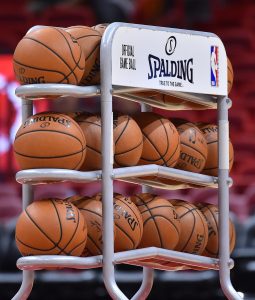
Some players, however, will fall under the “excused” or “protected” player criteria, meaning they will not have their salaries reduced as a result of missing time. “Protected” players are those whom the team believes has a higher risk for severe illness from COVID-19. “Excused” players will need a panel of three medical experts to determine that they have a higher risk for severe illness.
Here are more details on the NBA’s return:
Phase 1: June 12-22
All players will undergo mandatory coronavirus testing in their home markets beginning on June 23. All players who were outside the United States should have returned to their home market already (June 15 was the deadline) and all other players should return to their home market by June 22.
- The Raptors are an exception, as they are the league’s only international franchise. The team will gather in Naples, Florida and use Florida Gulf Coast University’s facilities to practice.
During Phase 1, several guidelines are in play:
- Team facilities are open to players and only individual workouts are permitted, though participation is voluntary. Virtual meetings/workouts are also allowed.
- Once players return to their home market, they are expected to leave the house only for essentials and trips to the team’s facilities. That extends to anyone in their households.
Phase 2: June 23-30
By now, all players are expected to be utilizing their team facilities with the exception of the Raptors. Players are still expected to uphold the same guidelines for leaving their homes as in Phase 1. In Phase 2:
- Mandatory COVID-19 testing will begin, which will consist of nasal swabs and oral swabs as well as blood drawn. There’s a long swab called the nasopharyngeal. That will not be used as it was reported to have caused discomfort. Players have the option of volunteering to participate in a Yale study that is designed to come up with a saliva-based test.
- Players must self-report if they or a member of their household are feeling sick or have symptoms. That information will go to the team’s medical staff.
Phase 3: July 1-7
Head coaches enter the picture in Phase 3.
- Workouts, which will still be conducted at the team’s home locations (again, with the exception of Toronto), will be mandatory. Group workouts are still not allowed and no more than eight players will be allowed in the facilities at any given time.
Phase 4: July 7-11
Teams will begin to head to Disney World. Travel will be staggered via either flight or bus to Orlando between July 7-9.
Once teams arrive in Florida, there are some unique guidelines and protocols:
- Players and team staff will stay isolated in their rooms. That will be the case until they have two negative COVID-19 tests at least 24 hours apart.
- It’s optional, but players can wear proximity alarms which will buzz if someone spends more than five seconds within six feet of another human being. For the alarm to work, the other person must also be wearing the alarm.
- Team and league staff must wear the alarm. It remains to be seen whether referees will have to wear it.
Everyone on the campus will have to wear face masks. Some Disney employees will not be required to reside in the bubble nor undergo COVID-19 testing. Their temperature will be checked daily and they will be checked for symptoms.
Phase 4 Continued: July 11-21
By this point, everyone is at the NBA Campus. Group workouts will be allowed after the initial self isolation, though players will undergo COVID-19 testing routinely as well as undergoing daily temperature checks and other tests.
Players can only eat meals and participate in activities with other people staying in their hotel. The hotel situation is based on seeding, as Charania adds on Twitter. Here are the three groups:
Gran Destino:
- Bucks
- Lakers
- Raptors
- Clippers
- Celtics
- Nuggets
- Jazz
- Heat
Grand Floridian:
- Thunder
- 76ers
- Rockets
- Pacers
- Mavericks
- Nets
- Grizzlies
- Magic
Yacht Club:
- Blazers
- Kings
- Pelicans
- Spurs
- Suns
- Wizards
The split means you won’t see Ben Simmons playing golf (one of the activities allowed, along with playing cards) with LeBron James before July 21. Some other restrictions include:
- Any meal eaten with a player from another team must be done outside.
- Players are not allowed to hang out in each other’s hotels.
- There may be a few exceptions, but all food will be prepared on the NBA campus. However, players are allowed to hire a personal chef to prepare meals to be delivered to the campus.
Players are allowed to leave the campus, but the expectation is that they will stay on it. If a player leaves without prior approval, he will be subjected to testing, including that uncomfortable nasopharyngeal swab testing and a 10-to-14 day self-quarantine. The player could also be subjected to a reduction in pay for games he misses.
Phase 5: July 22-29
Each team will play three scrimmages against other clubs that are staying at the same hotel. Starting July 22, players and team staff are allowed to socialize with anyone from any of the hotels. Players still can’t go into another person’s hotel.
Phase 6: July 30-Oct 13
We are playing basketball.
- Teams will play eight regular-season contests to determine seeding (“seeding games”). If necessary, there will be a play-in tournament for the eighth seed.
- After all is sorted out, we will have a traditional 16-team, four-round, best-of-seven playoff format.
Once a team is eliminated, its players and staff will be tested and then immediately depart from the NBA campus.
In years past, players of championship teams have looked at the camera and said “I’m going to Disney World.” This year, the last remaining team at the resort will be crowned the champion.
Photo courtesy of USA Today Sports Images.
Avery Bradley, Players’ Coalition Outline Priorities Prior To NBA Return
Avery Bradley, who co-leads the players’ coalition along with Kyrie Irving, spoke with Malika Andrews and Adrian Wojnarowski of ESPN.com to outline what the group would like to see done before the NBA resumes its season.
Among the priorities is the improved hiring practices for black front office and head coaching positions in the NBA. Bradley also suggested that the league’s front offices should better reflect its composition of players. Currently, there are just eight black general managers – including only four that have final say on basketball decisions – and seven black head coaches.
“Regardless of how much media coverage will be received, talking and raising awareness about social injustice isn’t enough,” Bradley said. “Are we that self-centered to believe no one in the world is aware of racism right now? That as athletes, we solve the real issues by using our platforms to speak?
“We don’t need to say more. We need to find a way to achieve more. Protesting during an anthem, wearing T-shirts is great, but we need to see real actions being put in to the works.”
Another priority is which organizations the league does business with and which foundations it provides donations to. The black community should be better represented in those areas, Bradley argues. Additionally, Bradley calls for the owners to stand behind the players. The Lakers guard hopes that the league’s owners will follow the charitable work of Mavericks owner Mark Cuban and Hornets owner Michael Jordan. Both made substantial contributions in the wake of George Floyd’s death.
“I agree [the] Orlando [restart] will give the players checks to contribute back into their communities,” Bradley said. “But how much of that bubble check are players actually able to contribute? Why [is] all of the responsibility being put on the players?”
Bradley added that he hasn’t seen a plan from the NBA for league-wide action.
“Don’t put all of the weight on your player to take care of the issue,” Bradley said. “If you care about us, you can’t remain silent and in the background.”
Other players are behind Irving and Bradley, though the ESPN duo notes that many are reluctant to speak out for fear of backlash.
“The actual act of sitting out doesn’t directly fight systemic racism,” Bradley said. “But it does highlight the reality that without black athletes, the NBA wouldn’t be what it is today. The league has a responsibility to our communities in helping to empower us — just as we have made the NBA brand strong.”
Pacers Interested In Gordon Hayward?
Gordon Hayward has the option to hit the market this offseason and the Pacers may have eyes for the former Butler wing. J.Michael of the Indianapolis Star (via NBC Sports Boston’s Celtics Talk Podcast) indicates that Indiana would have a level of interest in the 30-year-old.
“There’s no doubt (he) would be (a potential target for the Pacers),” Michael said. “…the kind of player Hayward is, is the kind of player they would definitely be interested in.”
Hayward, who has a player option on his deal for next season worth $34.2MM, can play multiple positions and that would be valuable alongside Indiana’s core.
“You can play an even more small-ball lineup,” Michael said. “Say for instance, you moved on (Myles Turner) or (Domantas Sabonis). Now you have space where you can go with real small-ball lineups and slot guys like him at the (power forward) and come up with some real diverse lineups that could give teams troubles and still have that big man/rim protector underneath to help keep the defensive integrity.”
With the COVID-19 pandemic shortening the season, the exact value of the 2020/21 salary cap is to be determined. Same with the following year. Still, Indiana has approximately $122.8MM in guaranteed contracts on the books for next season, which creates obstacles to Indiana outright signing Hayward if he were to opt to hit the market.