
Cap Notes: Yi, Lakers, Black, Mavs, Pacers
The Lakers‘ contract with Yi Jianlian is very team-friendly in its structure, and could make the Chinese big man a solid trade chip this season, writes Eric Pincus of Basketball Insiders. Although he has already provided a few details on Yi’s unorthodox contract, Pincus gets a little more specific in his latest piece, writing that the new Laker will earn $2.3MM incentive bonuses when he reaches 20 games played, 40 games, and 59 games.
Because those incentives are considered “likely,” Yi currently counts for $8MM against the salary cap, but he won’t receive his full salary unless he remains on an NBA roster beyond January 10, 2017, and appears in at least 59 games. If the former lottery pick fails to make an impact early on with the Lakers, he could be traded after December 15 and before his salary becomes guaranteed in January, since his cap hit would significantly outweigh the money owed to him, and he could easily be waived.
Here are a few more contract and cap notes from Pincus:
- Tarik Black‘s new two-year deal with the Lakers is worth about $12.85MM in total, but the second year is fully non-guaranteed, tweets Pincus. Los Angeles will have to make a decision on Black’s 2017/18 salary by July 4 or three days before the end of the July moratorium, whichever happens later.
- The Mavericks paid $3.2MM to the Pacers in last month’s Jeremy Evans trade, according to Pincus (Twitter link). Dallas had to dump Evans’ guaranteed $1,227,286 salary to create cap room for new, incoming players, and Indiana made a profit by agreeing to take him. Teams can send out a maximum of $3.5MM in trades during a league year, so Dallas used nearly all its trade cash in that move.
- On the other end of the spectrum, the Trail Blazers sent just $75K to the Magic to acquire Shabazz Napier in July, per Pincus (Twitter link). Orlando no longer had use for Napier, so the team was willing to move him in exchange for the minimum amount of cash a team can receive a deal — $75K.
Poll: DeMarcus Cousins’ Future
DeMarcus Cousins has been a popular topic of trade speculation for multiple seasons, which comes as no surprise. Cousins is one of the NBA’s more talented big men, but his Kings haven’t won more than 33 games in a season during the six years he has been in Sacramento, and he hasn’t always seen eye-to-eye with the team’s head coaches.
With another new coach – Dave Joerger – taking over for 2016/17, the Kings and Cousins have agreed to take a “fresh-start approach” to their relationship, according to Steve Kyler of Basketball Insiders, who noted this week that Cousins liked the hiring of Joerger. As Kyler details, Sacramento has been turning away any inquiries from rival teams on Cousins, and expects to play out the ’16/17 season with Cousins as the cornerstone of the roster.
Still, Cousins is only under contract with the Kings for two more years, and if the team doesn’t become a playoff contender soon, that summer of 2018 could begin looming larger and larger. As Zach Harper of CBSSports.com writes, many people around the NBA believe Cousins will leave Sacramento when his contract expires, and think the Kings need to seriously consider moving him at some point before then.
“They’re fooling themselves if they think he’s sticking around,” one league executive said to Harper. “The good news for them is his value will always be high. There isn’t a point of no return in which you’re not getting high value for him. Teams will bid against each other in the trade market. Maybe [Cousins] doesn’t go for the biggest money in free agency, but you’d love to have that card to play.”
As dysfunctional a franchise as Sacramento has been for the last several years, Joerger is a well-respected coach, and the team made some solid moves this offseason, inking veteran free agents Arron Afflalo, Matt Barnes, Garrett Temple, and Anthony Tolliver to multiyear deals, and adding three first-round prospects in Georgios Papagiannis, Malachi Richardson, and Skal Labissiere. If the Kings start playing well, Cousins trade rumors figure to remain on the back burner for the foreseeable future. But if the team struggles out of the gate, the rumor mill figures to be more active than ever.
What do you think Cousins’ future holds? Will the Kings ultimately decide to trade him? Will he leave in two years as a free agent? Or will Cousins remain in Sacramento long-term after a rocky first few years with the franchise? Vote in our poll, and weigh in below in our comment section with your thoughts on the All-Star big man.
What does DeMarcus Cousins' future hold?
-
The Kings will trade him by 2018 63% (681)
-
He'll leave as a free agent in 2018 26% (284)
-
He'll remain with the Kings beyond 2018 11% (124)
Total votes: 1,089
Trade Rumors app users, click here to vote.
Phil Jackson Regrets Not Acquiring Jae Crowder
Knicks president Phil Jackson met with Charley Rosen of TodaysFastBreak.com throughout the 2015/16 season to discuss the state of his franchise, and Rosen has been passing along the Zen Master’s comments in a series called “The Phil Jackson Chronicles.” In the latest installment of the series, Jackson admitted that he passed up on acquiring Jae Crowder in a 2014 trade, and views that as the “biggest mistake” he has made since joining the Knicks.
“One of the first deals I engineered when I came back to New York was to trade Tyson Chandler and Raymond Felton to Dallas for Shane Larkin, Jose Calderon, Wayne Ellington, Samuel Dalembert, plus a second-round pick that the Mavs owed to the Celtics,” Jackson said. “In talking with Boston, I was given the option of taking that pick or else taking Jae Crowder.
“I liked Crowder but I thought he wouldn’t get much of a chance to play behind Carmelo [Anthony], so I took the pick which turned out to be Cleanthony Early. While Cleanthony has missed lots of time in the past two seasons with us, he still has the potential to be a valuable player. Even so, I should have taken Crowder.”
Either Jackson’s comments or Rosen’s transcript seem a little off here, since the Celtics should have had no involvement in the Knicks’ negotiations with the Mavericks. The second-round pick that ultimately became Early was sent to Dallas by Boston in 2013, and the Mavs traded Crowder to the Celtics a few months after the Chandler deal, but the C’s weren’t involved in that Knicks/Mavs trade at all.
In any case, the main point of Jackson’s anecdote – that the Knicks had a choice of taking the No. 34 overall pick or Crowder – appears accurate, and of course Jackson ultimately choice the pick, using it to select Early.
At the time of the trade, Crowder was coming off a season in which he averaged just 4.6 PPG and 2.5 RPG in 16.1 minutes per contest. He was a career 40.9% shooter at that point in his career and hadn’t been more than a part-time role player, so it’s hard to criticize Jackson too much for not seeing a breakout coming — or not thinking that he could potentially get a similar player early in the second round of the 2014 draft.
Since then, however, Crowder has developed into one of the Celtics’ most valuable pieces. In 2015/16, he set career highs with 14.2 PPG, 5.1 RPG, 1.7 SPG, and a shooting line of .443/.336/.820. He’s also locked up on an affordable long-term deal through the 2019/20 season.
It’s impossible to know if Crowder would have enjoyed the same success in New York, or if the team would have been able to lock him up long-term, or even how his presence would have affected the Knicks’ other roster moves. But it’s still an interesting “what if?” worth considering, particularly since it may have had a domino effect on the Rajon Rondo trade between Boston and Dallas.
Jazz Waive Kendall Marshall
As expected, the Jazz have waived newly-acquired point guard Kendall Marshall, the team announced today in a press release. Utah’s tweets announcing the trade for Marshall and the point guard’s release came 25 minutes apart, so the former 13th overall pick was officially a member of the Jazz for less than a half-hour.
Marshall’s $2MM+ salary for 2016/17 would have become guaranteed within the next few days if he had remained on an NBA roster. By acquiring him in a deal for Tibor Pleiss, who has a guaranteed $3MM salary, Utah created $3MM in cap room and avoided paying any salary, though the team did send the Sixers some cash in the deal.
Marshall, who turned 25 last Friday, has played for the Suns, Lakers, Bucks, and Sixers since entering the NBA as a lottery pick in 2012, and will now be seeking a new home for the 2016/17 campaign. This is the third time he has been traded and subsequently waived — it also happened in 2013 and 2015.
Despite the fact that Marshall has failed to stick with an NBA team for more than a single season since his debut, several league executives believe there’s still a spot in the league for the former lottery pick as a backup point guard, writes Adrian Wojnarowski of The Vertical.
Marshall’s best season as a pro came in 2013/14, when he averaged 29 minutes per game in 54 contests for the Lakers. The former UNC standout averaged a career-high 8.0 PPG and 8.8 APG that year, while shooting 39.9% on three-point attempts. Marshall has taken a step back since then, though he was off to a solid start as a backup for the Bucks in 2014/15 before he suffered a season-ending ACL injury.
Tibor Pleiss May Not Stick With Sixers
The Jazz and Sixers completed a trade today that sent Kendall Marshall to Utah and Tibor Pleiss to Philadelphia, with both teams officially confirming that the deal is done. Reports have indicated that Utah will waive Marshall soon, avoiding having his contract become guaranteed. And even though Pleiss has a fully guaranteed $3MM salary, it sounds like he may ultimately be cut as well.
Adrian Wojnarowski of The Vertical reports (via Twitter) that the Sixers are still evaluating whether Pleiss will be a part of the team’s roster this season or whether he’ll be waived. According to Jessica Camerato of CSNPhilly.com (via Twitter), Philadelphia is likely to waive the German big man.
Pleiss, a former second-round pick who signed with the Jazz last summer, barely saw any action in his first NBA season, playing just 82 total minutes for Utah. The German big man was assigned to the D-League for a good chunk of the season, and he played well there, averaging 12.3 PPG and 10.4 RPG in 28 contests.
Because Pleiss’ salary is already fully guaranteed, there’s no rush for the Sixers to make a move right away. The team could bring the 26-year-old to training camp and make a decision on him shortly before the start of other regular season. However, Philadelphia reportedly agreed to a deal with Cat Barber last month and has yet to make that deal official because the 20-man offseason roster has been full — perhaps Pleiss will be waived to make room for Barber.
Here are a couple more notes on today’s Jazz/Sixers trade, and the fallout:
- According to Derek Bodner of PhillyMag.com, the Sixers will receive the most favorable and the least favorable of Utah’s four 2017 second-round selections. The Jazz currently hold their own second-rounder, along with the Knicks’, Pistons’, and Warriors’ picks. All four teams have playoff (or championship) aspirations, so there’s a chance neither of the picks Philadelphia gets will be that high.
- Despite the fact that Marshall has failed to stick with an NBA team for more than a single season since entering the league in 2012, several league executives believe there’s still a spot in the league for the former lottery pick as a backup point guard, writes Adrian Wojnarowski of The Vertical.
Jazz, Sixers Swap Tibor Pleiss, Kendall Marshall
11:07am: The deal is official, the Jazz announced in a press release.
9:38am: The Jazz and Sixers have agreed to a trade that will send point guard Kendall Marshall to Utah, reports Adrian Wojnarowski of The Vertical (via Twitter). According to Wojnarowski, the Jazz will send Tibor Pleiss, two second-round picks, and cash to Philadelphia in exchange for Marshall. Utah will subsequently waive Marshall, whose deal is not guaranteed, tweets Wojnarowski.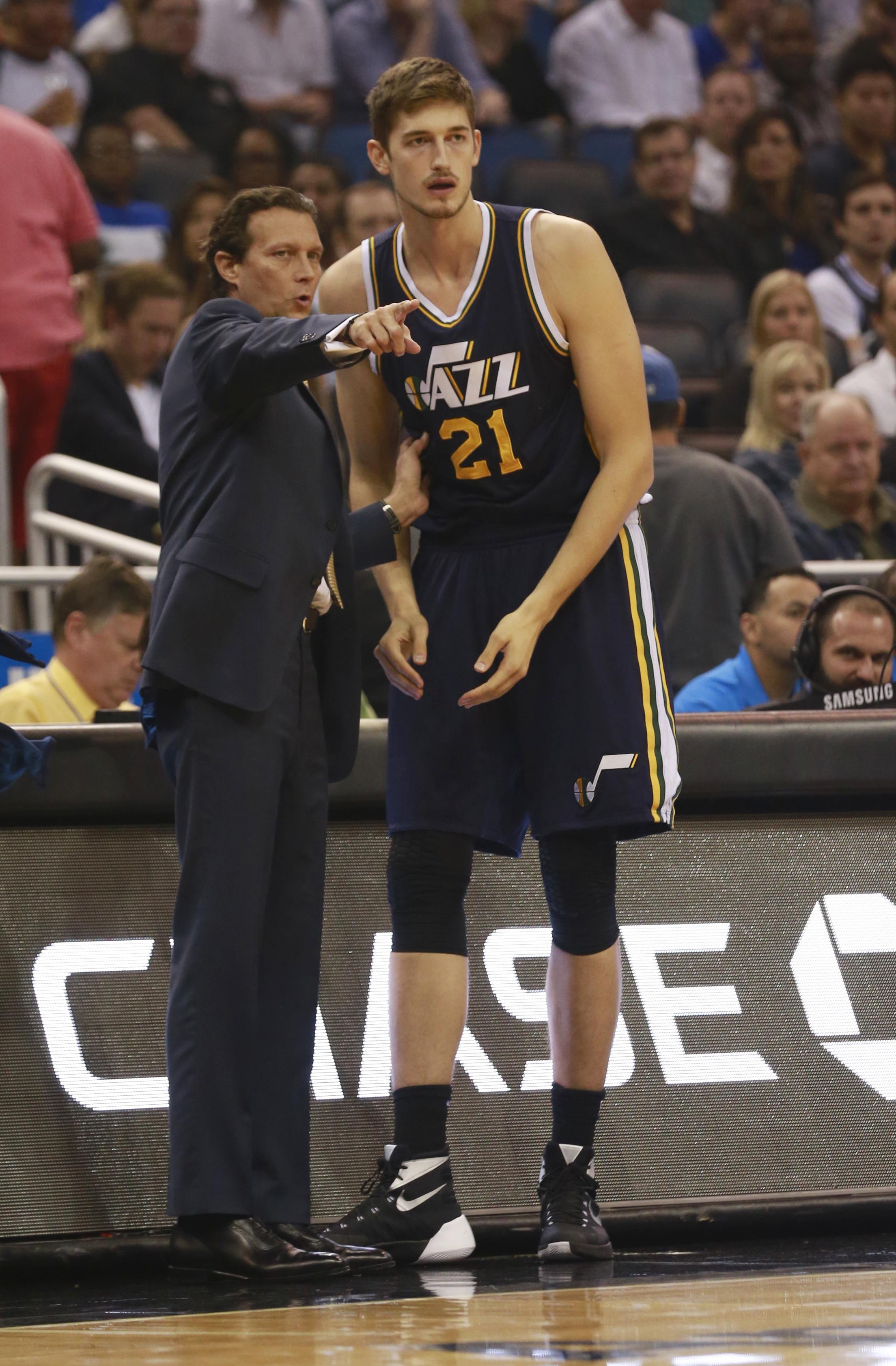
It’s essentially a cost-cutting move for the Jazz, who had been on track to pay Pleiss a guaranteed $3MM salary in 2016/17. Utah ditches that contract and takes on Marshall’s deal, which is fully non-guaranteed for now. The point guard’s $2,048,257 salary is set to become guaranteed soon, but the Jazz will waive him before that happens.
The move seems somewhat unusual on the surface for Utah, whose cap commitments for 2016/17 only totaled about $85MM prior to the trade. It’s possible though that the club is opening up a little extra cap room in order to renegotiate and extend Derrick Favors‘ contract. The Jazz will now have more than enough cap room to give Favors a pay raise to the max for 2016/17, while locking him up for additional seasons. Dana Gauruder of Hoops Rumors recently examined Favors’ case for an extension.
Whether or not the Jazz extend Favors this year, the team created more cap flexibility for 2017/18, when Pleiss would have had a modest $500K guarantee on his salary. With Favors and Rudy Gobert both candidates for max extensions, and Utah potentially wanting to lock up George Hill beyond this season as well, every little bit of cap room could help.
The Jazz also created an opening on their 15-man roster for the coming season, which is good news for the players competing for a spot. Utah selected three players – Joel Bolomboy, Marcus Paige, and Tyrone Wallace – in the second round of the 2016 draft, and the odds are good that at least one or two of those players make the regular-season roster.
As for the Sixers, they’re still well below the salary floor, and even if they don’t plan to use Pleiss at all, they’ll pick up a pair of future second-round picks and some cash for their trouble. The conditions on those second-rounders isn’t known, but Philadelphia didn’t have much to lose by making the deal.
Pleiss, a former second-round pick who signed with the Jazz last summer, barely saw any action in his first NBA season, playing just 82 total minutes for Utah. The German big man was assigned to the D-League for a good chunk of the season, and he played well there, averaging 12.3 PPG and 10.4 RPG in 28 contests.
Marshall, meanwhile, continues to jump from team to team, having failed to develop into a reliable NBA point guard since being selected 13th overall in 2012. The 25-year-old has played for the Suns, Lakers, Bucks, and Sixers since entering the league, and will now be seeking a new home for the 2016/17 campaign. This will be the third time he has been traded and subsequently waived — it also happened in 2013 and 2015.
Photo courtesy of USA Today Sports Images.
Celtics Notes: Iverson, Zeller, Olynyk
- Center Tyler Zeller re-signed with the club for two years and $16MM this summer but his role is undefined, as A. Sherrod Blakely of CSNNE.com examines. Zeller’s ability to run the floor makes him a candidate to start at some point during the season but he’s not enough of an offensive threat to remain in the lineup, Blakely speculates. His playing time will fluctuate and there may be games where he doesn’t play at all, Blakely adds.
- Big man Kelly Olynyk believes the club will miss swingman Evan Turner in a number of ways this season, Forsberg reports in a separate story. Turner, who signed a four-year contract with the Trail Blazers as a free agent this summer, was not only a rotation player but a strong influence in the locker room, according to Olynyk. “He’s somebody who really helps guys out. I think that his voice, that’s something that people respect,” Olynyk told Forsberg. “He just keeps it real, keeps it 100 (percent) every time you talk to him. You know what you’re getting from him.” The link to the interview can be found here.
Extension Candidate: Rudy Gobert
The increased usage of smaller lineups, along with a greater emphasis on 3-point shooting, theoretically reduces the need for a quality center. Considering the contracts being handed out, that’s not the case.
 Hassan Whiteside, despite a somewhat limited track record, was a hot commodity on the free agent market this summer. He received a max four-year extension to stick with the Heat. Joakim Noah, who lost his starting job with the Bulls and was injured the second half of last season, got a truckload of money to sign with the Knicks.
Andre Drummond, even with his free throw shooting issues, received a max five-year extension from the Pistons.
Unheralded centers such as Timofey Mozgov, Ian Mahinmi and Bismack Biyombo landed giant contracts while jumping teams.
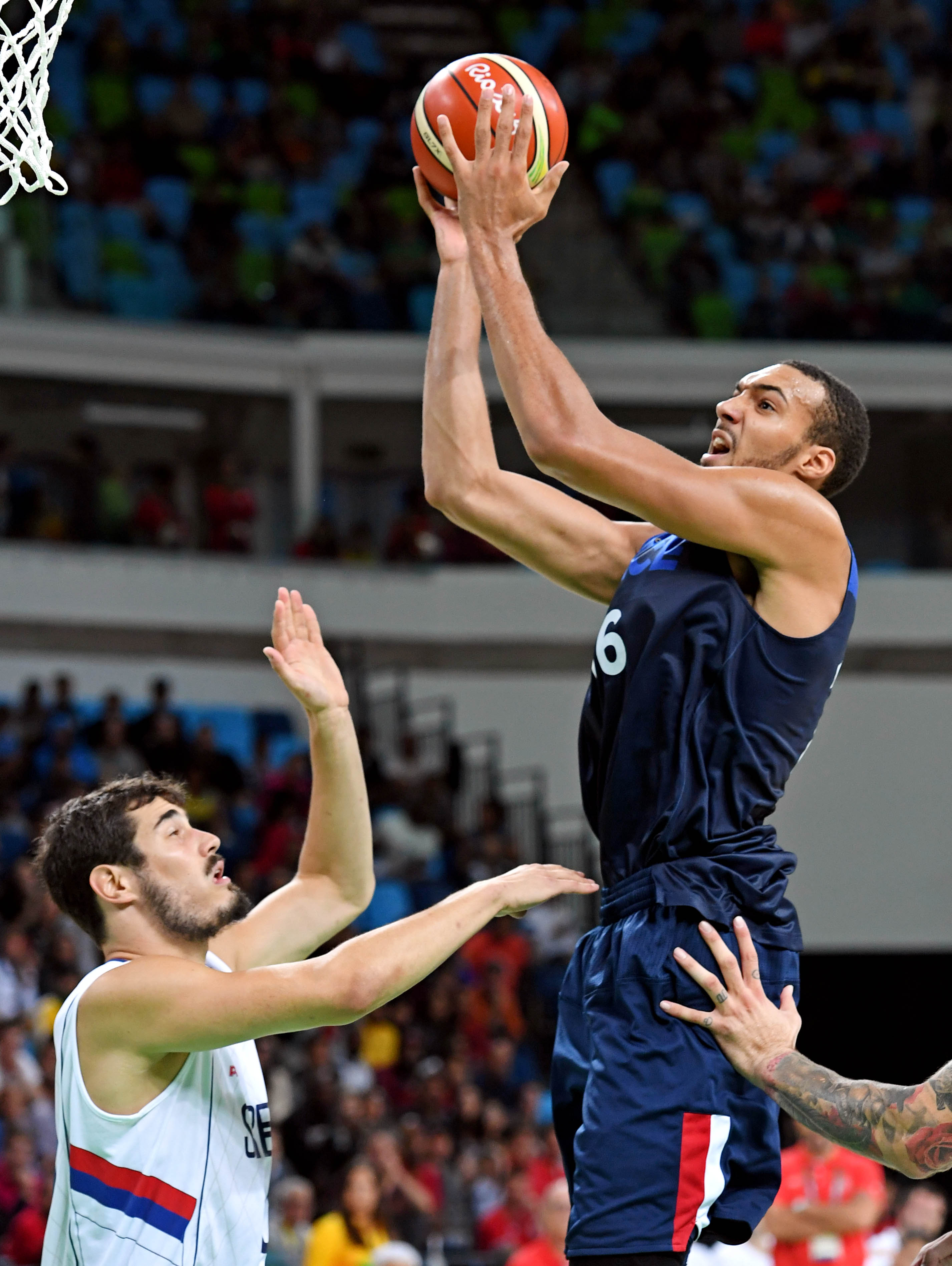
Given those developments, Rudy Gobert shouldn’t have much trouble receiving a max contract offer — or something close to it — from the Jazz. The biggest question mark is whether Utah will decide to lock up its defensive stalwart prior to the regular season or take some risk by waiting until next summer, when Gobert can become a restricted free agent.
The two parties agreed to delay the process until the Rio Olympics wrapped up. Gobert was busy playing for Team France, then decided to stay overseas for a couple of weeks before returning to Utah late this month or in early September to get ready for the NBA season.
From a salary cap standpoint, the Jazz certainly have the freedom to hammer out an agreement by the end of training camp, the deadline for rookie scale contract extensions. One or both parties might also want to get it done before the possibility that NBA Players’ Association or the league opts out of the current Collective Bargaining Agreement. That could occur in mid-December and go into effect after the season.
Utah has just $34.3MM in guaranteed salary commitments for 2017/18, though its inclusive totals (non-guaranteed salaries, early termination options, etc.) is closer to $78.3MM. The projected salary cap for that season is $102MM.
So why would the Jazz wait to extend Gobert entering his prime years at 24 years old? The 7’1” Gobert has a modest $5.3MM cap hold. That gives the Jazz plenty of flexibility in terms of re-signing their free agents, pursuing top free agents and making trades next offseason if they hold off on Gobert’s extension.
Utah also has some major decisions regarding two of its other top players. Power forward Derrick Favors is eligible for a veteran’s extension right now. Small forward Gordon Hayward can opt out of the final year of his contract and become an unrestricted free agent next summer. Hayward will almost certainly command a max salary if Utah tries to retain him.
Point guard George Hill, arguably the Jazz’s biggest addition this offseason, is entering his walk year. Hill’s current $8MM salary is well under market value for a starter and if the Jazz want to make him a competitive offer next summer, they’ll probably have to give him a huge raise.
Gobert has not been a major part of the Jazz’s offense, even as his playing time has grown the past two seasons. He’s never averaged more than six shot attempts in his three NBA seasons.
As a part-time starter in 2014/15, Gobert averaged 8.4 points, 9.5 rebounds and 2.3 blocks. Those numbers improved slightly to 9.1/11.0/2.2 as a starter last season, though he was limited to 61 games because of injuries.
Free throw shooting is also a problem for Gobert — he’s made 58.5% of his foul shots during his short NBA career.
His value on the defensive end overshadows his offensive deficiencies. According to Basketball-Reference.com’s Defensive Box Rating, he was the league’s second-best defender (4.8) last season behind the Spurs’ recently-retired Tim Duncan (5.0). His Defensive Box Rating the previous season was even higher at 5.1, behind only the Warriors’ Andrew Bogut (5.5).
Difference makers on either side of the ball are hard to find and there’s no viable option on the roster to replace Gobert. Thus, it’s reasonable to assume he’ll be maxed out, though it’s conceivable he could give the club a little discount in order to get the extension done early. Remember, if the Players’ Association or league opts out of the CBA, the rules regarding contracts could be significantly altered.
How much could Gobert receive? According to Eric Pincus of Basketball Insiders, players with less than seven years of service could get a max of approximately $24MM under the projected cap of $102MM. With 7.5% raises each season, Gobert could sign a four-year extension worth approximately $107.35MM. A five-year extension could max out around $139.4MM.
That’s an awful lot of money to shell out for someone who isn’t an offensive threat or considered a franchise-type player. Having multiple players making max money severely curtails what clubs can do with their rosters, even with the recent rise in the salary cap. The Jazz might be hesitant to commit about half its cap to Hayward and Gobert, who fall short of superstar status.
Yet it’s abundantly clear that retaining Gobert will require something at or close to the max. The market for big men is as competitive as ever, whether or not teams continue to play small ball.
(Photo courtesy of John David Mercer / USA Today Sports Images)
Wall, Beal Issues Could Lead To Eventual Breakup
The disconnect between the Wizards backcourt duo of John Wall and Bradley Beal could eventually convince the front office to deal one of them, according to Kevin O’Connor of The Ringer.
Wall recently admitted in a TV interview with CSN’s Chris Miller that he and Beal don’t have great on-court chemistry, claiming they have “a tendency to dislike each other on the court.” Beal told CSNMidAtlantic.com’s J. Michael that he and Wall “lose sight of the fact that we need each other.”
O’Connor takes it a step further, quoting an unnamed agent who says the dislike extends beyond the basketball floor.
“Whatever is public, multiply it by five and that’s how they really feel about each other,” the agent told O’Connor. “It’s probably a total disaster.”
New Wizards head coach Scott Brooks will have the challenge of getting them to become a more cohesive pair but if that fails, the club may have no choice but to break them up, O’Connor opines. Beal just signed a $127MM contract but Wall’s contract, with three years and $54.2MM remaining, can easily be moved if the Wizards go in that direction, O’Connor adds.
Wall’s willingness to become more accountable and a respected leader will go a long way in determining how Washington handles the situation, Michael asserts in a different column. The backcourt pair, while not the best of friends, don’t hate each other, Michael continues. But assistant coach Sidney Lowe contends Wall must do more to win over everyone in the locker room.
“It’s your communication and get your players to feel good about you. And the way you do that is by you getting them to feel good about themselves,” Lowe told Michael. “There’s something to that. Obviously that’s an area where I can work with and talk to with John and help him out a little bit.”
Wall’s habit of publicly displaying his displeasure over contracts handed out to opposing players does not help his cause, O’Connor contends. Wall criticized the Pistons last summer for giving out a big contract to Reggie Jackson. Wall apparently had similar feelings about the extension James Harden received from the Rockets this summer, with a front-office executive telling O’Connor that Wall was “rankled” by that four-year, $118MM contract.
Poll: 2008 NBA Draft Take Two (Pick No. 7)
Scouting players and predicting how their skills will translate to the NBA is one of the more difficult tasks front offices have on their plates. Looking back over past drafts and how many lottery picks never evolved into stars, or even made a significant impact in the league, illustrates just how often stats, combine numbers and pure gut instinct often come up short.
Of course, we get the opportunity to critique these moves with the benefit of hindsight — a luxury that GMs don’t have on draft night. Having said that, it’s still fun to go back in time and take a theoretical look at how these drafts should have/could have gone.
We recently finished revisiting the lottery portion of the 2005 NBA Draft, which was one of the weakest in recent memory. In drafts light on impact talent, the GM who can find a diamond in the rough is king. But drafts that have a number of star-potential players can also be difficult and many an executive has made what turned out to be the wrong call. Greg Oden over Kevin Durant immediately springs to mind (sorry Blazers fans), likewise taking Sam Bowie over Michael Jordan…ouch!
The 2008 draft, which is the one we’re tackling now, had a number of players who have gone on to post big numbers in the league. This was the year of Derrick Rose (No. 1 overall), Russell Westbrook (No. 4), Kevin Love (No. 5), Brook Lopez (No. 10) and Nicolas Batum (No. 25). Over the next few weeks, we’ll be posting a series of polls asking readers to vote on whom teams should have selected in each spot.
We’ll continue with the Clippers, who held the No. 7 overall pick that year. In the “real world” draft, the Clippers selected Eric Gordon. When healthy, Gordon has been a productive player. He’s averaged 16.6 points and 3.3 assists during his career while shooting 38.3% on 3-point tries.
The problem has been his inability to get through the 82-game grind. Knee injuries, in particular, have often forced Gordon out of action. The 6’4” shooting guard has not played more than 64 games in any season since his rookie campaign. That didn’t deter the Rockets from handing Gordon a four-year, $53MM contract during free agency this summer.
So cast your vote for who the Clippers should have selected and check back on Friday to see the results, as well as to vote on who the Bucks should have taken with the No. 8 pick.
Also, don’t limit yourself to a simple button click. Take to the comments section below and share your thoughts on the pick and why you voted the way that you did. If we fail to list a player who you think should be selected, feel free to post that in the comments section and we’ll be certain to tally those votes as well.
- Bulls — Russell Westbrook [Actual Pick — Derrick Rose]
- Heat — Kevin Love [Actual Pick — Michael Beasley]
- Wolves — Derrick Rose [Actual Pick — O.J. Mayo]
- Sonics/Thunder — DeAndre Jordan [Actual Pick — Russell Westbrook]
- Grizzlies — Brook Lopez [Actual Pick — Kevin Love]
- Knicks — Serge Ibaka [Actual Pick — Danilo Gallinari]
With the No. 7 Pick, the Clippers Select...
-
Nicolas Batum 50% (726)
-
Gorac Dragic 15% (226)
-
Danilo Gallinari 10% (142)
-
Eric Gordon 6% (84)
-
Ryan Anderson 4% (62)
-
George Hill 3% (37)
-
Roy Hibbert 2% (34)
-
Robin Lopez 2% (27)
-
O.J. Mayo 1% (16)
-
Courtney Lee 1% (13)
-
Michael Beasley 1% (11)
-
Nikola Pekovic 1% (10)
-
Marreese Speights 1% (8)
-
Mario Chalmers 1% (8)
-
Omer Asik 1% (8)
-
JaVale McGee 1% (8)
-
Brandon Rush 0% (7)
-
Timofey Mozgov 0% (7)
-
Anthony Randolph 0% (6)
-
Joe Alexander 0% (5)
-
Jerryd Bayless 0% (4)
-
Brian Roberts 0% (3)
-
J.J. Hickson 0% (2)
-
Jason Thompson 0% (2)
-
Anthony Morrow 0% (1)
-
D.J. Augustin 0% (1)
-
Kosta Koufos 0% (1)
Total votes: 1,459