
2018 Free Agent Stock Watch: Denver Nuggets
After years of being a beloved up-and-coming Western Conference hopeful, the Nuggets have lost some of their sheen due to circumstances somewhat out of their control. The franchise made its intentions clear by signing Paul Millsap to a contract north of $31MM this season, which only adds to the frustration caused by a relatively mediocre start.
The Nuggets had their hands full adding Millsap to the fold alongside 22-year-old Nikola Jokic, so we can’t exactly fault the club for getting out to a slow start, but – at just 16-15 – they have. When word broke that the 32-year-old free agent would miss months with a wrist injury, the outlook grew even more bleak.
All told, the Nuggets may not be quite as mysteriously captivating as they were in the past, but that doesn’t mean they can’t still be a solid team eventually given the still-very-much intriguing young pieces that dot the roster.
Darrell Arthur, PF, 30 (Down) – Signed to a three-year, $23MM deal in 2016
While Arthur has played nine seasons with just two NBA franchises, carving out a role as a consistently reliable rotation player on both despite never logging more than the 21.7 minutes per game, his pedestrian career marks of 6.6 points and 3.6 rebounds per game aren’t likely to yield much on the open market. For that reason, expect him to pick up his $7.5MM player option.
Will Barton, SG, 27 (Up) – Signed to a three-year, $10MM deal in 2015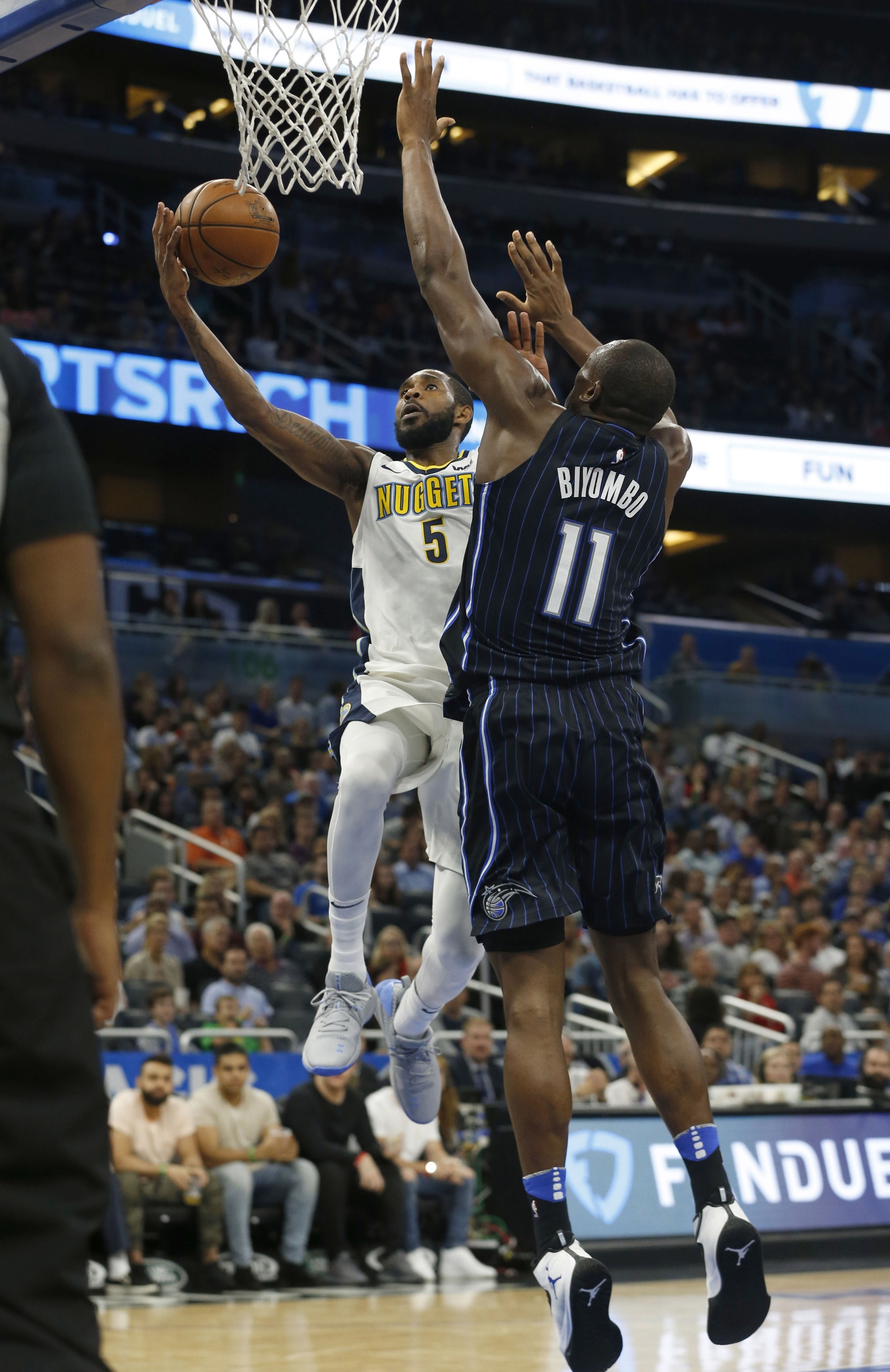
In three and a half seasons with the Nuggets, Barton has made a name for himself as a solid spark plug off the bench. The soon-to-be 27-year-old unrestricted free agent will hit the open market in July and seems likely to command more from another suitor than the Nuggets would be comfortable matching given the other building blocks they’ll need to commit to.
Wilson Chandler, SF, 31 (Down) – Signed to a four-year, $47MM deal in 2015
Despite having a career year in 2016/17 and starting every game of the season for the Nuggets so far this year, Chandler isn’t a major part of Denver’s long-term plans. Given that we may see more penny pinching next summer than we did the last two because of a league-wide dearth of cap room, it’s hard to imagine the forward landing more than what he’ll be able to get just by accepting the $13MM player option he has for $2018/19.
Richard Jefferson, SF, 38 (Down) – Signed to a one-year, $2MM deal in 2017
After landing with the Nuggets on a minimum deal following his release from the Cavaliers at the start of the season, Jefferson will hit free agency once again next summer. At the ripe age of 38, no longer privy to the luxuries of competing for a championship, don’t put it past the podcasting superstar to retire.
Nikola Jokic, C, 23 (Up) – Signed to a four-year, $6MM deal in 2015
The Nuggets have options for dealing with Jokic’s inevitable free agency. There’s no denying that the affable big man with a 24.1 career PER will command max money whenever he’s eligible to sign a new deal — whether that happens next summer or the one after that is the question. Denver holds a team option for Jokic’s 2018/19 campaign. While they could technically turn down his team option and look to lock him up as a restricted free agent in 2018, the Nuggets are already flirting with the luxury tax for next season without a monster Jokic deal on their books (or a possible Barton deal, for that matter). The front office could be better suited accepting the team option and then making a major play for the big man in 2019, once the contracts of Chandler, Arthur and Kenneth Faried expire. Still, there are optics to think about in that scenario. Regardless, Jokic has earned big money, so let’s pull up some chairs and watch how Tim Connelly and Arturas Karnisovas try to figure this out.
Photo courtesy of USA Today Sports Images.
Atlantic Notes: Nets, Ujiri, Porzingis
There’s no denying that the Nets were in a pickle when Sean Marks took over from Billy King as general manager of the franchise. In the time since, Kevin O’Connor of The Ringer writes, the former Spurs‘ staffer has changed the culture of the franchise by consistently and patiently strategizing ways to improve.
Another transformative figure within the Nets organization is head coach Kenny Atkinson. O’Connor details Atkinson’s hands-on approach and willingness to get in the foxhole with his players.
The results speak for themselves. While the Nets don’t exactly strike fear in their opponents yet, they’ve managed to amass a solid cache of promising young players despite the previous regime having unloaded a bounty of picks in one of the worst trades in sports history.
There’s more from the Atlantic Division:
- Ex-Celtics big man and current Heat forward Jordan Mickey gives his former boss the benefit of the doubt regarding his release from the team. Adam Himmelsbach of the Boston Globe tweets that Mickey was surprised about being waived in the summer but that he trusts that Danny Ainge knows what he’s doing.
- Give Masai Ujiri more credit for his work with the Raptors, Tom Ziller of SB Nation writes. The Raps’ president of basketball operations has turned a fledgling squad into a consistent playoff team and now a potential contender, all without bottoming out.
- Desperate to build enough strength to avoid injuries, Knicks forward Kristaps Porzingis has been working with famous personal trainer Carlon Colker, Stefan Bondy of the New York Daily News writes. The doctor and former MMA fighter has worked previously with Shaquille O’Neal and, uh, Justin Bieber.
Latest On Joel Embiid
DECEMBER 21, 5:42pm: Embiid will not play tonight, Jessica Camerato of NBC Sports Philadelphia tweets. The big man went through warmups, however.
DECEMBER 21, 11:18am: Embiid has been upgraded to questionable for Thursday night’s game against the Raptors, tweets Jessica Camerato of NBC Sports Philadelphia. While that doesn’t mean he’ll play tonight, it’s a sign that Embiid is nearing a return, perhaps even before Monday’s Christmas Day game.
DECEMBER 20, 6:20pm: Injuries continue to plague Joel Embiid, with a back issue the latest ailment to keep him off the court. Adrian Wojnarowski of ESPN.com reports that big man will likely miss the next two games, though he’s expected to return to action against the Knicks on Monday.
The Sixers looked like a playoff team earlier this season, something fueled in part by Embiid’s success. The Cameroon native has missed seven games this season, including that last two, and Philadelphia has lost six of those contests.
Embiid, who is averaging 24.1 points, 11.0 rebounds and nearly two blocks per game this season, signed a massive five-year, $146.5MM extension back in October. The deal included unique clauses which protect the Sixers, allowing them to waive Embiid without paying him his full guaranteed salary if he misses 25 or more regular season games or fails to play at least 1,650 minutes in a season as a result of specifically named injuries. Those clauses do not kick in until next season, though it’s worth noting that the named injuries include Embiid’s back.
It’s extremely unlikely that Philadelphia waives Embiid unless he suffers a catastrophic, career-altering injury. The center simply has too much talent to let go of if the team feels he can still play. However, the nature of back injuries, coupled with Embiid’s contract language, makes this a situation worth monitoring.
Jazz Release Big Man Eric Griffin
The Jazz have released Eric Griffin, the team’s public relations department tweeted. The 27-year-old rookie was unloaded in order for the team to sign Erik McCree to a two-way contract.
[RELATED: Jazz sign Erik McCree to two-way deal]
Griffin has started 19 games with Utah’s G League affiliate so far this season, averaging 17.3 points and 5.2 rebounds per game for those Salt Lake City Stars.
Griffin was previously a training camp cut by the Heat, Mavs and Pistons in 2013, 2014 and 2015 respectively.
Jazz Sign Erik McCree To Two-Way Deal
The Jazz have signed forward Erik McCree to a two-way contract, the team’s public relations department announced. McCree went undrafted out of Louisiana Tech last summer but played through training camp with the Heat.
In order to make room on the roster, the club had to release big man Eric Griffin, who had also been on a two-way deal with the franchise (their second two-way signee, who will remain under contract, is Nate Wolters).
Given that the contract is being inked partially through the season, McCree’s 45-day NBA service alotment will be pro-rated to around 30 days, as was the case with Sean Kilpatrick (who signed with the Bucks on December 16).
McCree profiles as a four with three-point shooting range and will look to pilfer some of Jonas Jerebko‘s minutes when up with the big league club. The rest of the time he’ll suit up for the team’s G League affiliate, the Salt Lake City Stars.
Southwest Notes: Gasol, Pelicans, Paul
While they may not be pleased with their 9-22 record through mid-December, there’s still hope for the Grizzlies to contend for a playoff spot. So long as that’s their goal, Chris Herrington of the Memphis Commercial Appeal writes, center Marc Gasol will be working alongside them toward it.
If circumstances change, the big man’s goals may change with them. Gasol, who turns 33 next month, cites his age as the primary reason why he has no interest in throwing away the season in an attempt to rebuild or retool.
“If they decide to go a different direction… I’ve said it before, I’ll do anything,” Gasol said. “I’ll make everybody look good. I’ll say to you guys whatever I need to say if I need to go anywhere else and they need to [pursue] a goal where I’m not the guy.”
There’s more from the Southwest Division:
- Did the Grizzlies break up their “core four” too soon by letting Zach Randolph and Tony Allen walk last summer? Marc Gasol thinks so. Ronald Tillery of the Memphis Commercial Appeal writes that the big man didn’t understand why the team didn’t bring them back.
- The combination of DeMarcus Cousins and Anthony Davis doesn’t have enough support to win in New Orleans, Michael Lee of Yahoo Sports writes. The scribe writes that the Pelicans “grossly overpaid” Jrue Holiday this season and that the rest of the roster is made up of “contract albatrosses” and “bargain bin” players.
- The Rockets are going to take their time with Chris Paul‘s left adductor strain, head coach Mike D’Antoni told Mark Berman of Fox 26 and the media. Paul will miss Friday night’s contest and be considered day-to-day. This isn’t the first time the squad has been very conservative with their fancy new superstar point guard.
Southeast Notes: Wizards, Walton Jr., Monk
A lack of depth played a role in the Wizards‘ recent loss to a short-handed Cavaliers team, Chase Hughes of NBC Sports Washington writes. In a matchup where both teams were missing players, the Cavs still managed to hurt them with a capable 10-man rotation.
Hughes writes that the Wizards will be in a better position when John Wall and Markieff Morris completely return to full health but even then it may not be enough to legitimately compete with an elite team like the Cavs.
That presents one question for Washington’s front office; whether the Wizards should make a move prior to the trade deadline considering that a trip to the NBA Finals will almost certainly have to go through Cleveland at some point.
There’s more from the Southeast Division today:
- Two-way Heat signee Derrick Walton Jr. has already spent at least 22 days with the big league club, Ira Winderman of the Sun Sentinel writes. The new contract format permits players to spend 45 games total with the NBA squad and the rest with a team in the G League.
- The Hornets have cut back rookie guard Malik Monk‘s role because of his weak defense, Bryan Kalbrosky of Hoops Hype writes. Charlotte has been outscored by 15.4 points per 100 possessions with Monk on the court, worse than any other player in their 12-man rotation.
- It’s reasonable to picture Heat president Pat Riley showing an interest in Paul George if he were to be made available by the Thunder. Ira Winderman of the Sun Sentinel discussed the possibility in a question-and-answer feature with readers.
Poll: Will LaVar Ball’s Junior Basketball Association Work?
As we detailed on Wednesday, outspoken basketball dad LaVar Ball announced this week that he intends to launch a new professional league called the Junior Basketball Association for high school grads who don’t want to attend college before going pro.
While Ball has perhaps worn out his welcome with a segment of basketball fans tired of hearing him promote his sons (and himself), his latest idea has some merit. With NBA rules currently prohibiting prospects from entering the draft until they’re at least one year removed from high school, top young players are generally one-and-done in college – where they don’t get paid – or head overseas, where the exposure is minimal and they can have a hard time earning minutes.
Ball’s proposal reportedly calls for an 80-player, 10-team league, which would be fully funded by Big Baller Brand and would pay salaries ranging from $3-10K per month. The idea would be to recruit top prospects who want to focus fully on basketball – and be paid for their work – rather than making a cameo at a college before making the leap to the NBA.
The plan makes sense, but it’s ambitious, and there would be plenty of roadblocks in its way. As Steve Kyler of Basketball Insiders writes, recruiting top prospects would be challenging. And without top prospects, fans are unlikely to pack arenas and the league probably wouldn’t be able to secure a big broadcast-rights deal. In turn, that would make it hard to afford to pay salaries, travel fees, arena fees, and all the other costs that come with running a successful league.
On top of all that, the NBA is reportedly considering altering its one-and-done rule and once again giving players the option of entering the draft out of high school. That could happen as soon as 2019 or 2020, and would limit the appeal of a hypothetical Junior Basketball Association.
What do you think? Will this league actually get off the ground? And if it does, will it have a chance to be a success? Vote in our poll below and then weigh in with your thoughts in the comment section.
Will the Junior Basketball Association work?
-
It won't actually ever happen 66% (974)
-
It won't succeed 20% (290)
-
It will succeed 15% (219)
Total votes: 1,483
Trade Rumors app users, click here to vote.
And-Ones: Referees, Baron Davis, Ball Brothers
Having become dissatisfied working with the NBA to moderate issues between referees and players, Lee Seham, the general counsel for the National Basketball Referees Association recently met with NBPA executive director Michele Roberts to discuss those issues, reports Adrian Wojnarowski of ESPN. After meeting at the players’ union’s Manhattan offices, Seham and Roberts plan to hold another informal sitdown at All-Star weekend in Los Angeles, which will include a few top referees and players.
As Wojnarowski details, both the referees’ union and players’ union have expressed concerns about how treatment from the other side — the NBRA believes that the league office has become too lenient in allowing players to verbally go after referees, while players are put off by what they view as dismissive or disrespectful reactions from refs when they ask about a call.
The NBA would ultimately need to sign off on any official changes to the way its referees are trained, or the way that disputes between players and refs are handled. However, if the referees’ and players’ unions can reach common ground on some of those issues, they’d have added leverage to take those suggestions to the league.
Here are a few more odds and ends from around the basketball world:
- Ice Cube’s BIG3 basketball league has added another former NBA All-Star to its ranks, announcing this week in a press release that Baron Davis has signed with the BIG3 and will play for 3’s Company next season. “Hearing about the fun they had this past summer really made me excited to suit up,” Davis said. “I have a lot of basketball left, and this is a great opportunity to fill that void I’ve been missing.”
- In a fascinating piece for The Washington Post, Candance Buckner shines a light on some of the NBA’s behind-the-scenes power brokers, including a video game marketing director, a fashion designer, and a skills trainer.
- How did LiAngelo Ball and LaMelo Ball end up landing with a little-known team in Lithuania? Andrew Keh of The New York Times takes a deep dive into the city of Prienai and its basketball club (Prienu Vytautas), which has already added five more people to its modest staff to help handle the increased marketing workload.
Hoops Rumors Glossary: Stretch Provision
For NBA teams looking to open up cap room, simply waiving a player isn’t as effective as it is in the NFL, where salaries are often non-guaranteed and most or all of a player’s cap charge can frequently be wiped from a team’s books. Still, the NBA’s Collective Bargaining Agreement does feature a rule that allows teams to spread a player’s cap hit over multiple seasons. This is called the stretch provision.
The stretch provision ensures that any player waived with at least $250K in guaranteed salary remaining on his contract will have the payment schedule of that money spread across multiple years. That schedule is determined as follows:
- If a player is waived between July 1 and August 31, his remaining salary is paid over twice the number of years remaining on his contract, plus one.
- If a player is waived between September 1 and June 30, his current-year salary is paid on its normal schedule, with any subsequent years spread over twice the number of remaining years, plus one.
- Note: If a player in the final year of his contract is waived between September 1 and June 30, the stretch provision does not apply.
To create a clearer picture of what these rules look like, let’s focus on a specific player. We’ll use Knicks center Joakim Noah as our example, since his exorbitant salary makes him a candidate to be stretched at some point. Here’s what Noah’s current contract looks like, along with what it would look like if the Knicks waive and stretch him by next August 31, or after August 31:
| Year | Current contract | Stretched by 8/31/18 |
Stretched after 8/31/18 |
|---|---|---|---|
| 2017/18 | $17,765,000 | $17,765,000 | $17,765,000 |
| 2018/19 | $18,530,000 | $7,565,000 | $18,530,000 |
| 2019/20 | $19,295,000 | $7,565,000 | $6,431,666 |
| 2020/21 | – | $7,565,000 | $6,431,667 |
| 2021/22 | – | $7,565,000 | $6,431,667 |
| 2022/23 | – | $7,565,000 | – |
Because the Knicks didn’t waive and stretch Noah before August 31, 2017, his 2017/18 salary is locked in at $17,765,000, barring a buyout. If New York had wanted to reduce that number, the club could have waived and stretched him in July or August and spread his cap hits across seven years (at about $7.94MM annually). That would have created additional ’17/18 cap room, but the Knicks determined that wasn’t necessary.
If the Knicks do stretch Noah, they’ll have to decide whether to do it before August 31 or sometime after that. The decision may come down to whether or not the team wants to create cap room in 2018 at the expense of future flexibility. Stretching Noah in July or August would create nearly $11MM in additional room right away, but it would mean taking on mid-sized cap hits for the following five years. If the Knicks were to stretch Noah after August, they wouldn’t gain immediate cap room, but their future commitments would be far more modest.
Here are a few more rules related to the stretch provision:
- Although the stretch provision regulates when money is paid out, it doesn’t prevent teams and players from negotiating a reduced salary as part of a buyout.
- Non-guaranteed money isn’t subject to the stretch provision, since a team isn’t obligated to pay any non-guaranteed portion of a contract once it waives a player.
- While the new payment schedule for a waived player is non-negotiable, teams have the option of whether or not to apply the stretch provision to that player’s cap charges as well. A team can stick to the original schedule for cap-hit purposes, if it so chooses.
All these rules came together when the Hawks waived Jamal Crawford in July. Crawford had two years and approximately $28.7MM left on his contract, but only about $17.2MM of that money was guaranteed. So if the Hawks had decided to stretch his cap hits, they’d only have had to account for that guaranteed portion, spreading $17.2MM across five years.
Instead, the team negotiated a buyout with Crawford, who wanted to go to a contender, reducing his total guaranteed salary to about $13.24MM. The Hawks then decided not to stretch Crawford’s cap hits, since they preferred cap flexibility in future seasons rather than in 2017. After the buyout, Atlanta could have stretched Crawford’s cap charges across five years at about $2.65MM annually. Instead, he’ll count against the Hawks’ cap for $10.94MM this year, then $2.3MM next year.
Here’s one final example of how a team can use the stretch provision to create a tiny bit of extra cap room: Back in July, the Celtics waived Demetrius Jackson when he had three years left on his contract, but only $650K in guaranteed money. The final year of Jackson’s deal was a team option, which would normally be declined when a players is waived. In Jackson’s case though, the team option was non-guaranteed.
That meant the Celtics could exercise the option without being on the hook for any extra guaranteed money, and doing so allowed the team to stretch Jackson’s cap charges across seven years instead of five years, since there were now officially three years left on his deal instead of two. So instead of counting against Boston’s cap for the next five years at $130K annually, Jackson will count for about $93K for the next seven years. Gaining that extra $37K of flexibility this season helped the Celtics make use of every last dollar under the cap.
Note: This is a Hoops Rumors Glossary entry. Our glossary posts will explain specific rules relating to trades, free agency, or other aspects of the NBA’s Collective Bargaining Agreement. Larry Coon’s Salary Cap FAQ was used in the creation of this post.
An earlier version of this post was published in 2013 by Chuck Myron.