
Warriors Notes: Curry, Porzingis, Horford, Kerr, Green
Warriors star Stephen Curry tells Anthony Slater of ESPN his right knee injury is “trending in the right direction,” but he’ll miss his third straight game on Saturday and it doesn’t sound like his return is imminent.
“It’s a matter of learning as I go what works rehab-wise,” Curry said. “Because it’s still painful. You have to try to get rid of all the inflammation and pain. It’s something we still have to monitor and injury-manage, but it’s something where, if I come back too early, it could flare up.”
The 37-year-old guard also addressed the trade addition of big man Kristaps Porzingis, who has been limited to 17 games this season due to multiple ailments.
“I’m learning some Latvian,” Curry said when asked about Porzingis. “I’m just hoping that he’s healthy, first and foremost, so that he can do what he can do on the floor. Him and Al [Horford] won a championship together. Different context, but there’s a familiarity and skill set and size and presence that we’ve been looking for a while.”
Here’s more on the Warriors:
- Horford was pleasantly surprised to learn he’d be playing with his former Celtics teammate again, and he’s optimistic about the veteran center’s fit with Golden State, writes Dalton Johnson of NBC Sports Bay Area. “It was special, it was just really fun,” Horford said of playing with Porzingis in Boston. “We all know everything he can do. He can shoot the three, can post up, draw fouls, kind of play the mid-range offensively. He’s just very potent. Defensively, protects the rim. I’m just looking forward for him to be here and help us, because I feel like he’ll be a big help for us.”
- Head coach Steve Kerr said the team’s medical and performance staff, led by Rick Celebrini, vetted Porzingis’ health prior to completing the trade, Johnson adds. “I don’t think we would have made the trade if we didn’t think he could be healthy and consistent in terms of being in the lineup, so that’s the plan,” Kerr said. “Obviously he’s got to get here and Rick has got to work with him, but Rick and the staff did their due diligence. There’s a hope that we can really help him get right. When he’s right, he’s a hell of a player. We’re looking at a guy who really fits what we need: Size, space, shooting, rim protection. Every team needs that, but we’ve always needed that since I’ve been here. We’ve never really had a player like him.”
- Kerr concedes Golden State may not be a title contender in the wake of Jimmy Butler‘s torn ACL, but he still thinks the team has the potential to do damage in the playoffs, Slater writes in another story for ESPN. “We still have a good team,” Kerr said. “A very good team. Even without Jimmy, we can make a playoff run. The ceiling is absolutely lower. I’m not going to sit here and lie.”
- Former Defensive Player of the Year Draymond Green likes Porzingis’ fit with the Warriors, per Nick Friedell of The Athletic. The longtime forward/center also admitted to being nervous about being involved in trade talks for Giannis Antetokounmpo. “It got nerve-wracking towards the end,” Green said after Thursday’s comeback win over Phoenix. “But yeah, it is what it is. Move forward. It’s not something I want to get used to, though.”
Knicks Notes: Deadline, Alvarado, Robinson, Kolek, McBride
President Leon Rose deserves kudos for making the Knicks better at the trade deadline, contends Stefan Bondy of The New York Post (subscriber link).
While Rose made a mistake by signing Guerschon Yabusele in free agency last summer, he corrected his error by essentially flipping the French forward/center and a pair of second-round picks to acquire Jose Alvarado. The backup point guard fills a position of need, and his smaller salary also gives the Knicks enough breathing room beneath their second-apron hard cap that they should be players on the buyout market, Bondy writes.
The fact that Giannis Antetokounmpo is still a Buck benefited the Knicks as well, Bondy notes, since the star forward wasn’t sent to an Eastern Conference rival. New York will have the option of revisiting trade talks for the two-time MVP in the offseason, when the team will have a pair of first-round picks to offer.
Here’s more on the Knicks:
- Prior to Friday’s game, head coach Mike Brown said he was excited about what Alvarado will bring to the Knicks, according to Bondy (Twitter link). “He just brings a level of toughness to the team, his energy is unmatched. What he can do defensively in the full court and even in the frontcourt on the ball especially on pick-and-rolls and stuff like that, is at a pretty high level,” Brown said. “He shoots it better than most people think. We want to play fast and we believe he’s a guy who will come in and push the pace. Get us into our offense and all that other stuff. Because he is quick, he’s got a low center of gravity. Been around for a while, he’ll touch the paint and make others better. We’re a big spray team and he should be good in that area too. So excited to have him.”
- The Knicks love Mitchell Robinson. Will they extend him or re-sign him in free agency this summer? “As one team put it to me a couple days ago, they may value him more than (any other team) in the league,” Ian Begley of SNY.tv said (Twitter video link). ” … Because of that, and because of the signals some Knick people have given out to other teams, I assume they’re going to do what they can — do what they have to do — to re-sign him.”
- Second-year guard Tyler Kolek said he’s looking forward to competing with Alvarado for minutes in the wake of Miles McBride‘s sports hernia surgery, Bondy writes for The New York Post. “There’s always competition in this league. Obviously Deuce is out for a little bit. We’re trying to be a championship-level team so you bring in as much talent as you can,” Kolek said Friday. “I’m going to compete every single day. He’s going to compete. Everybody on this team is going to compete for minutes. So it’s no slight to anybody.” Citing league sources, Begley hears McBride is expected to return to action in six-to-eight weeks after he undergoes the procedure (Twitter link).
- New York’s eight-game winning streak was snapped on Friday when the team was blown out by the top-seeded Pistons in Detroit. Karl-Anthony Towns (right eye laceration) and OG Anunoby (right toe soreness) were out for the Knicks, while Jalen Duren (right knee soreness) was sidelined for Detroit.
Blazers Notes: Deadline, Cissoko, Love, Thybulle, Krejci, Arena
After making a minor move at the start of the week to acquire Vit Krejci from Atlanta, the Trail Blazers didn’t make any additional trades between Monday and Thursday. As Joe Freeman of The Oregonian writes, that was a relief to the Blazers’ players, who admitted to being nervous in the days leading up to the deadline.
“The players were joking around a little bit, (saying) ‘We’re all back,'” interim head coach Tiago Splitter said on Thursday. “I get it. There’s a little bit of tension. But I’m glad everybody’s back. Everybody’s happy to be here and ready to move forward and finish the season.”
Although Portland didn’t shake up its roster in a major way, there will be some changes coming to the rotation. Krejci will have a chance to earn regular minutes, and point guard Scoot Henderson is making his season debut on Friday vs. Memphis after recovering from a hamstring tear. Forward Deni Avdija is out on Friday for a third straight game due to a low back strain, but when he returns, the Blazers will be as healthy as they’ve been all season.
“I’m happy to have that challenge, make them produce and excel at their positions,” Splitter said. “Guys that were used to playing more minutes (are) going to play a little less. Guys that were out (are) going to start to play more minutes and produce for us. We have still like 30 games or so left. Hopefully, this is the normal for us from now on.”
Here’s more on the Blazers:
- One downside of Portland’s deadline inactivity is that the team still has a full 15-man roster, with two-way players Sidy Cissoko and Caleb Love on track to reach their respective 50-game limits this month, writes Sean Highkin of The Rose Garden Report (Substack link). Highkin views Cissoko as the more likely candidate for a promotion, since he has a clearer role than Love when the team is healthy, and suggests Matisse Thybulle could be a buyout candidate. Brett Siegel of ClutchPoints (Twitter link) agrees that Thybulle could be the odd man out, though he says no decision has been made on the wing’s future yet.
- Krejci said earlier this week that he’s “very excited” to join the Blazers, adding that they have a “really great roster,” according to Freeman. “I think this team has a lot of good drivers and that opens (things) up,” Krejci said. “As a shooter, you love playing with guys like that, because they keep slashing, they keep going at the rim.”
- While the Trail Blazers’ basketball operations department ended up having a relatively quiet deadline, the organization’s business operations department is negotiating a crucial deal of its own. According to Bill Oram of The Oregonian, the Blazers continue to work with state, city, and county officials in an effort to secure roughly $600MM in funding viewed as necessary to upgrade the Moda Center and keep the team in Portland long term.
- As Oram details, Multnomah County is believed to be reluctant to commit approximately $40MM in business tax revenue from the Blazers’ sale to the arena renovation. The city of Portland is also receiving push-back on plans to pull as much as $75MM from a clean energy fund to put toward the project, according to Shane Dixon Kavanaugh and Oram of The Oregonian. Oregon governor Tina Kotek spoke to commissioner Adam Silver last week, per Oram, in an effort to reinforce her support for the arena deal and to ensure the team doesn’t consider relocation under a new ownership group led by Tom Dundon. The Blazers’ Moda Center lease agreement with the city runs through 2030.
Bulls, Hornets Amend Coby White Trade
The Bulls and Hornets have amended the terms of the trade that sent Coby White to Charlotte after a physical revealed the seventh-year guard had a left calf injury, which will require him to miss some games, league sources tell Fred Katz of The Athletic (Twitter link).
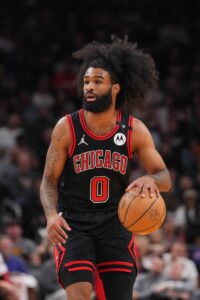 On the NBA’s official injury report, White is listed as out due to a left calf strain.
White, who turns 26 years old later this month, had played in 11 of Chicago’s last 12 games before being traded to Charlotte, but Hornets president of basketball operations Jeff Peterson suggested White would likely be held out through the All-Star break because of his calf injury.
The Hornets originally agreed to send three second-round picks — the Nuggets’ or Hornets’ 2029 selection (whichever was least favorable), the Nuggets’ 2031 pick, and the Knicks’ 2031 second — to the Bulls in the deal. According to Katz, the Hornets will retain that 2029 pick and will send Chicago the two second-rounders in 2031.
The full deal saw White and Mike Conley head to Charlotte for Collin Sexton, Ousmane Dieng and the pair of 2031 second-round picks. Conley was subsequently waived by the Hornets and intends to rejoin the Timberwolves, while the Bulls rerouted Dieng to the Bucks for Nick Richards.
Although this is the first trade of 2025/26 in which the terms were altered due to a player’s health, it’s certainly not unprecedented. For instance, the Sixers added a second-round pick to last year’s Quentin Grimes–Caleb Martin swap when the Mavericks flagged Martin’s hip injury.
The Lakers also rescinded their deal with the Hornets last February after failing Mark Williams‘ physical, though a voided trade is obviously different than the terms being changed. After the trade deadline has passed, a trade can only be voided or accepted as is — the Hornets and Bulls agreed to amend the terms of the White deal prior to Thursday’s deadline, even though the change wasn’t reported until now.
A North Carolina native who played his college ball at UNC, White has battled calf issues on both legs this season. The impending free agent has averaged 18.6 points, 4.7 assists and 3.7 rebounds on .438/.346/.805 shooting through 29 games in ’25/26 (29.1 minutes per contest).
Heat Notes: Deadline, Giannis, Morant, Rozier, Young, More
The Heat were one of only three teams that didn’t make a trade ahead of Thursday’s deadline. As Anthony Chiang of The Miami Herald writes, the team has been trending in the wrong direction for two months, going just 13-18 over its past 31 games after a 14-7 start.
Despite having another middling record (27-25), the Heat are optimistic brighter days are ahead.
“League-wide, I think everybody is just glad that all of that is behind us,” head coach Erik Spoelstra said following Friday’s morning shooting shootaround in Boston. “And we can just focus on the next 30 games. We have great opportunities still ahead of us. We know what we have to work on is our consistency. We have a high ceiling, but we need to do it more consistently.”
Consistency was a major talking point for Spoelstra, who said variations of the word several more times on Friday.
Captain and starting center Bam Adebayo said the players breathed a sigh of relief when they learned they were sticking with Miami, according to Chiang.
“Guys got that weight off their shoulders, where they don’t know what’s going to happen to them,” Adebayo said. “It’s good to have that type of clarity. So now we can focus on basketball and try to stack these wins.”
Here’s more from Miami:
- The Heat were one of the primary suitors for Giannis Antetokounmpo, and aside from Adebayo, they were willing to discuss every other player on the roster in talks for the Bucks star, a league source tells Chiang. Miami also had “some level of interest” in Ja Morant, but his maximum-salary contract and injury history were among the factors that made the Heat leery of pursuing the Grizzlies guard, Chiang reports.
- Andrew Wiggins was mentioned as a possible trade candidate this season, but the Heat were never offered a first-round pick for the veteran forward, according to Chiang. Terry Rozier, who has been away from the team throughout 2025/26 after being arrested and indicted on federal charges related to illegal gambling, was another player who stayed put. Chiang hears Miami’s brain trust is still weighing the possibility of waiving Rozier’s expiring contract, which would open up a second spot on the standard roster — the Heat have only been carrying 14 players due to their proximity to the luxury tax line.
- Jahmir Young has been named the G League’s Player of the Month for games played in January, the NBA announced (via Twitter). Young, a second-year guard who is on a two-way contract with the Heat, averaged 29.5 points, 9.6 assists and 4.9 rebounds last month for the Sioux Falls Skyforce, Miami’s NBAGL affiliate.
- Ira Winderman of The South Florida Sun Sentinel takes a look at some options the Heat could consider to fill out their standard roster, including converting a two-way player like Young or taking a flier on a veteran on the buyout/free agent market. Pat Connaughton, Georges Niang and Chris Boucher are a few of the veterans Winderman lists.
- For better or worse, the Heat stuck to their guiding principles ahead of the deadline, according to Barry Jackson of The Miami Herald, who considers whether that was the right call and explores what the consequences of maintaining the status quo could be both now and going forward.
GM Scott Perry Not Expecting Buyouts For Kings Veterans
Speaking to the media on Friday, Kings general manager Scott Perry said he’s not anticipating to reach any buyout agreements with the veteran players on the team’s roster, as James Ham of TheKingsBeat.com relays (via Twitter).
“I expect the veterans to be here through the end of the season,” said Perry, who added that he wants to see the vets play hard when they’re in the game and serve as mentors when they’re not.
Sacramento was said to be open to trading veterans like Zach LaVine, DeMar DeRozan, Domantas Sabonis and Malik Monk leading up to the deadline, but all of those players are on multiyear contracts and none are likely to be bought out.
That said, there are a few players on the roster who make some sense as buyout candidates, starting with former NBA MVP Russell Westbrook, who is on a one-year, minimum-salary deal. While Westbrook’s game has long been polarizing, he remains productive at age 37, averaging 15.3 points, 6.7 assists, 5.8 rebounds and 1.4 steals on .430/.348/.703 shooting in 49 games (29.6 minutes per contest).
John Hollinger of The Athletic recently ranked 54 potential buyout candidates, and Westbrook is No. 1 in Hollinger’s top tier, which he titled “rotation-caliber additions.” Backup big man Drew Eubanks is No. 27 on Hollinger’s list, falling under the category of “maybe there’s something left in the tank?”
At 12-40, the Kings currently hold the worst record in the league, though they’re within four games of five other teams (New Orleans, Indiana, Brooklyn, Washington, Utah) in the reverse standings.
Sixers Notes: McCain Trade, Draft Assets, Roster Spots, Barlow
Despite exceeding expectations so far this season and holding a top-six spot in the Eastern Conference playoff race at 29-22, the Sixers were sellers at the trade deadline, sending second-year guard Jared McCain to Oklahoma City in exchange for a 2026 first-round pick and three future second-rounders.
Speaking today to reporters, Sixers president of basketball operations Daryl Morey explained that the team remained active after agreeing to terms on that McCain deal in the hopes of adding win-now help.
“Because we’re playing well, we were trying to upgrade the team and add to the team now. That was goal number one,” Morey said, per Adam Aaronson of PhillyVoice. “Obviously, no deal materialized, including using the picks we got from the Jared deal. We were trying to.
“That’s why we did that move a little early (in the week). We were trying to reuse those draft picks to add now. … The picks we got were offered to many teams, and nothing materialized for a player that we thought could move the needle with those picks now. But we feel like going forward, those picks will help us build the team in the future in a good way.”
McCain got off to an excellent start as a rookie in 2024/25 but underwent season-ending knee surgery and then had his 2025/26 debut delayed due to a procedure on his thumb. Despite the stop-and-start nature of his NBA career so far, the Thunder were willing to give up the sort of package for him that Morey felt he couldn’t turn down.
“I am quite confident we were selling high,” Morey said. “… And (we) weren’t looking to sell, I’ll be frank. Like, teams came to us with aggressive offers for him, and you could say, ‘Yeah, that’s ’cause he’s a good player.’ I agree with that. We thought this return was above, for the future value for our franchise, what we could get.
“… That return is for a starter quality player on a good team. That is – it’s actually above that. We do a lot of analysis on how we think things will play out, both here and around the league going forward in terms of the quality of play, what kinds of returns will return, what players in the future. And the bottom line is, Jared’s a player who is a great future bet and a potential great player, and we wish him luck. We feel like this return sets us up better to set up the team in the future better.”
Here’s more from Morey on the Sixers, via Aaronson:
- The fact that that the first-round pick Philadelphia acquired in the McCain deal will be in a 2026 draft considered to be loaded with talent wasn’t a determining factor in the Sixers pulling the trigger, according to Morey. “We’re not necessarily using the pick in this draft,” he said. “It could be used for moves around the draft. The three seconds that we got with it, we think could be used to move up in this draft. I and our front office have done a lot of deals over the years, and this just gives us more tools to make the moves that we think will help our future.”
- After ducking the luxury tax for a third straight trade deadline, Morey said he understands criticisms about the team’s approach to that tax threshold. However, he pointed out that the Sixers’ current ownership group has paid tax penalties in the past and would do so again if he identified an opportunity that warranted it. “I understand the perception, and I’d hoped to defeat it by finding a deal that I can go to ownership and say, ‘We think this move is the right move to do for that and create the apron issues that it would create,'” Morey said. “But I haven’t been able to recommend that move yet.”
- The Sixers have a full 15-man roster for the time being, but two of those spots are occupied by players on 10-day deals. Asked about how Philadelphia could eventually fill them, Morey mentioned a guard and a wing, but said the team will focus on adding the best player available. A Jabari Walker promotion from his two-way deal also remains a possibility, per Morey, who added that the team expects to be in on players on the buyout market as well. “I think we’re in the mix (for buyout players),” he said. “I think they see a really good team or a really good market. We’ve had a lot of conversations already. We’re obviously in competition with other teams, so I don’t know if we’ll get the first option necessarily, but we’ll be in there with getting some of the top options.”
- While Walker remains on his two-way deal, ineligible to suit up unless he’s converted to a standard contract, the Sixers’ other two-way standout, Dominick Barlow, was officially promoted to the 15-man roster on Thursday. According to Bobby Marks of Sports Business Classroom, Barlow was signed using a portion of Philadelphia’s taxpayer mid-level exception and will earn $3.4MM for the rest of this season, with a $3.4MM team option for 2026/27. Morey said on Friday that the 76ers would have liked to do a longer-term deal and aren’t ruling out the possibility of working out another multiyear contract with Barlow in the summer rather than picking up his option.
Pistons Plan To Promote Daniss Jenkins This Weekend
Pistons head of basketball operations Trajan Langdon said on Friday that the team plans to promote two-way standout Daniss Jenkins to a standard contract over the weekend, per Omari Sankofa II of The Detroit Free Press (Twitter video link).
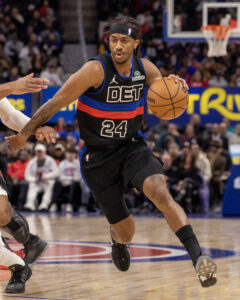 Jenkins, who reportedly turned down a two-year, minimum-salary contract offer near the end of January, will hit his 50-game active limit on Friday against New York.
“We’re having conversations with (Jenkins’) agent about what that looks like going forward,” Langdon said. “We’ll convert him over the weekend and he’ll be a rostered player in our game in Charlotte (on Monday). At least that’s the goal, that’s the hope.”
Langdon praised the former undrafted free agent for the steady improvements he has made during his two seasons with the Pistons.
“Kudos to him, he’s worked his butt off,” Langdon continued. “All last season, playing a ton of games for Motor City (Detroit’s G League affiliate), we saw his improvement during the year. And I think everybody saw how he played in the Summer League in (Las) Vegas, and he just continued to improve.
“ … (He) had a great camp and he’s just continued this trajectory on getting better. When the opportunities came, he’s taken advantage of them.”
Jenkins has been the Pistons’ primary backup point guard for most of the 2025/26 campaign. Through 41 appearances, the 24-year-old is averaging 7.9 points, 3.3 assists, 1.8 rebounds and 0.9 steals in 16.8 minutes per game, with a shooting slash line of .421/.385/.797.
Detroit still has a full 15-man roster after the trade deadline, but veteran big man Dario Saric, who was acquired along with Kevin Huerter in a deal with Chicago, seems likely to be on the chopping block to make space for Jenkins.
Magic Sign Jevon Carter To Rest-Of-Season Deal
4:46 pm: Carter’s rest-of-season deal is now official, the Magic announced (via Twitter).
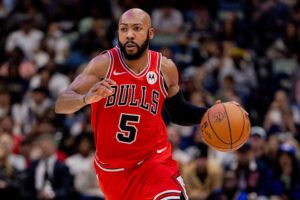 9:55 am: The Magic intend to sign point guard Jevon Carter for the rest of the season, agents Mark Bartelstein and Reggie Brown tell Shams Charania of ESPN (Twitter link).
Carter was cut by the Bulls earlier in the week in order to accommodate the acquisition of Dario Saric, the first of seven trades Chicago made between Sunday and Thursday. Having been placed on waivers five days ago, the 30-year-old guard went unclaimed on Tuesday and became an unrestricted free agent.
An eighth-year NBA veteran, Carter has appeared in 435 regular season games for Memphis, Phoenix, Brooklyn, Milwaukee, and Chicago since entering the league as a second-round pick in 2018. He had his best season in 2022/23 in Milwaukee, starting 39 of 81 games and averaging career highs in points (8.0), assists (2.4), and rebounds (2.5) per game.
That performance earned Carter a three-year, $19.5MM deal with Chicago that summer, but he ended up playing a limited role in a crowded Bulls backcourt. In 23 games (11.0 MPG) this season, he scored 5.4 PPG on .398/.410/1.000 shooting.
The Magic’s lone move at this week’s trade deadline was to send Tyus Jones and his $7MM salary to Charlotte along with a pair of second-round picks. That move allowed Orlando to duck below the luxury tax line but also removed a veteran point guard from the roster, so adding Carter will help fill a hole on the depth chart.
As a result of the Jones trade, the Magic moved approximately $1.4MM below the tax threshold and opened up a second spot on their 15-man roster. Carter will fill one of those two openings and – if he officially signs on Friday – would carry a prorated minimum-salary cap hit of $871K. That will allow Orlando to stay out of the tax and potentially sign a 15th man later in the season.
While Carter’s cap hit will be $871K, his rest-of-season salary will be approximately $1.17MM, with the NBA making up the gap between the two figures.
Grizzlies’ Kleiman Talks Deadline Moves, Cites Change In ‘Organizational Direction’
It was less than one year ago that Grizzlies general manager Zach Kleiman definitely stated “we are not trading” Ja Morant and referred to speculation from rival executives about a deal involving the star point guard a “fantasy.”
The Grizzlies didn’t move Morant at Thursday’s deadline, but they reportedly attempted to do so and plan to renew those efforts this summer. Speaking to reporters on Friday, Kleiman was less inclined than he was last February to make any definitive statements about Morant’s future, but he acknowledged that the team’s direction has changed drastically within the past 12 months, per Jonah Dylan of The Memphis Commercial Appeal.
“We’ve been incredibly supportive of Ja for many years,” Kleiman said. “This is about organization direction, though. This is not about Ja in particular. I understand that Ja is Ja and there’s more attention kind of paid to that. But all of this is grounded in organizational direction and building a team that we believe can achieve the highest level of success in this league.”
As Dylan observes, Kleiman repeatedly cited a change in “organizational direction” when discussing the next steps in Memphis and the trade that sent Jaren Jackson Jr. to Utah this week. The Grizzlies moved Jackson after having traded Desmond Bane to Orlando last summer, seemingly paving the way to fully break up their former “big three” by dealing Morant next.
While there has been some speculation that the relationship between the team and the star point guard is shaky and could get worse now that his days in Memphis appear numbered, Kleiman downplayed the idea that there’s friction between Morant’s camp and the Grizzlies.
“I think we’ve been incredibly supportive of Ja,” he said. “Because Ja is Ja, there’s a lot of attention paid to Ja and everything around him. I honestly think a lot of it is overblown. I’ve had open, constructive, honest conversation with Ja and his camp and I’m going to continue to.”
Here’s more on the Grizzlies:
- Kleiman made it clear during Friday’s media session that the Grizzlies are “turning the page” and building around their young players, including Zach Edey, Cedric Coward, Jaylen Wells, and Cam Spencer, according to Damichael Cole of The Memphis Commercial Appeal. “I’m not going to sit here and crown any of them and say they’re going to be the next this, they’re going to be the next that, but we have a critical mass of players that fit the identity that we’re going for,” Kleiman said. “They’re tough-minded, they’re physically tough, they’re unselfish (and) they play the right way. I think they fit the way the NBA is going if you look at teams that are achieving the highest level of success this season.”
- Kleiman also singled out 2025 first-round pick Walter Clayton, one of four players who came over from Utah in the Jackson trade, as a player the Grizzlies like and who could be part of the club’s core going forward, Cole notes. “He fits the characteristics we are looking for,” Kleiman said. “Physically tough, tough-minded, smart, (and a) winner.”
- Although the Grizzlies are going through a roster reset, they don’t envision this as the beginning of a long, “drawn-out” rebuild, as Dylan relays. “I don’t think this is some five-year, try-to-be-terrible (process),” Kleiman said. “I don’t believe in that method of team building. Between the assets that we’ve accumulated and the players that we have, we’re very optimistic about what we have.”
- There are “conversations ongoing” about how the Grizzlies will use the 15-man roster spot they opened on Friday when they waived Eric Gordon, according to Kleiman (via Cole), but he acknowledged that addressing the frontcourt will likely be a priority. With Edey and Brandon Clarke recovering from injuries, Memphis doesn’t currently have any healthy centers
- New additions Clayton, Kyle Anderson, and Taylor Hendricks aren’t listed on Memphis’ injury report for Friday’s game vs. Portland and should be available to make their debuts, according to Cole. Of course, it’ll be a Grizzlies return rather than a Grizzlies debut for Anderson, who played for the team from 2018-22.