
Celtics Announce New Ownership Structure, Titles
Following last week’s announcement that the NBA’s Board of Governors had approved the sale of the Celtics to a group led by William Chisholm, the team put out a press release on Tuesday confirming the ownership change and the closing of the sale while sharing more details on the new hierarchy at the top of the organization.
As expected, Chisholm has taken over as the Celtics’ governor, with Aditya Mittal and former majority owner Wyc Grousbeck named alternate governors.
Although the plan to have Grousbeck retain his governor position until 2028 fell through, he’ll still hold the CEO and co-owner titles, and will run day-to-day operations alongside Chisholm, per today’s press release. Grousbeck retained a stake in the franchise, but no longer controls at least a 15% share, making him ineligible to remain on as the team’s primary governor.
As for Mittal, reporting in May indicated that he was expected to be the second-largest stakeholder in Chisholm’s ownership group. In addition to Chisholm, Mittal, and Grousbeck, shareholders in the franchise include Bruce Beal, Andrew Bialecki, Dom Ferrante, Robert Hale, Mario Ho, Ian Loring, and the investment firm Sixth Street.
“This truly is a dream come true for me and my family,” Chisholm, a lifelong Celtics fan, said in a statement. “I feel so fortunate to be here as part of this new investor group, who are accomplished, driven people who care deeply about the Celtics and the Boston community. On behalf of our group I am thrilled to partner with Wyc, (president of basketball operations) Brad Stevens and (president of business operations) Rich Gotham to move this outstanding organization forward. We are committed to building on the legacy of the Celtics and raising banners, and I can’t wait for the team to get back out there this fall.”
The Celtics’ announcement also includes a brief statement from Grousbeck:
“The Celtics have been my life’s work for the past 23 years. This incredible ride is now continuing. I am fired up to be shoulder to shoulder with Bill as we pull every lever to go after another banner. There is nothing better than winning.”
NBA 2025 Offseason Check-In: Portland Trail Blazers
Hoops Rumors is checking in on the 2025 offseason for all 30 NBA teams, recapping the summer’s free agent signings, trades, draft picks, departures, and more. We’ll take a look at each team’s offseason moves and consider what might still be coming before the regular season begins. Today, we’re focusing on the Portland Trail Blazers.
Free agent signings
 Damian Lillard: Three years, $41,606,800. Third-year player option. No-trade clause. Signed using non-taxpayer mid-level exception.
- Blake Wesley: One year, minimum salary. Signed using minimum salary exception.
Trades
- Acquired the draft rights to Yang Hansen (No. 16 pick), the Magic’s 2028 first-round pick, the Hawks’ 2027 second-round pick, and the Kings’ 2028 second-round pick from the Grizzlies in exchange for the draft rights to Cedric Coward (No. 11 pick).
- Acquired Jrue Holiday from the Celtics in exchange for Anfernee Simons.
Draft picks
- 1-16: Yang Hansen
- Signed to rookie scale contract (four years, $21,393,587).
Two-way signings
- Caleb Love
- One year, $85,300 partial guarantee (will increase to $318,218 at start of regular season).
Note: The Trail Blazers carried over Sidy Cissoko on a two-way contract from 2024/25.
Departed/unsigned free agents
- Dalano Banton (unsigned)
- Bryce McGowens (Pelicans)
- Justin Minaya (unsigned)
- Jabari Walker (Sixers)
Other roster moves
- Bought out Deandre Ayton (gave up $10,000,000 of $35,550,814 salary).
- Exercised team option on Rayan Rupert ($2,221,677).
Salary cap situation
- Operating over the cap ($154.6MM) and below the luxury tax line ($187.9MM).
- Carrying approximately $186.4MM in salary.
- Hard-capped at $195,945,000.
- Full bi-annual exception ($5,134,000) available.
The offseason so far
Mired in mediocrity (or worse) for several seasons, the Trail Blazers finally experienced a breakthrough in the second half of the 2024/25 season. Following a 13-28 start, they finished the year on a 23-18 run, as a defense that ranked 28th through the first 41 games of the season was the NBA’s third-best across the final 41.
That second-half success was driven largely by Portland’s young players. No Blazer logged more minutes during the final 41 games than Toumani Camara, who was recognized with a spot on the All-Defensive second team. Deni Avdija and Shaedon Sharpe were the team’s leading scorers after the All-Star break, averaging 23.3 and 21.2 points per night, respectively. And 2024 lottery pick Donovan Clingan became the full-time starter at center as Deandre Ayton missed the final 28 games of the season due to a calf injury.
The question entering the summer, then, was would the Blazers continue to patiently add young pieces to their improving core, or would they look to build on their second-half run by adding win-now veterans capable of helping the club get back to the playoffs in 2026?
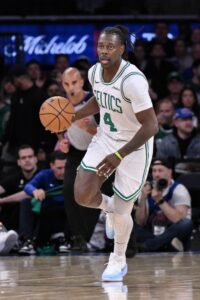 The first major agreement Portland’s front office reached this offseason was a trade sending Anfernee Simons and a pair of second-round picks to Boston in exchange for Jrue Holiday. The move raised eyebrows, given that the 26-year-old Simons is on an expiring $27.7MM deal, while the 35-year-old Holiday has three years and $104.4MM left on his contract. It seemed to be a signal that the Blazers, leaning into the defense-first identity they established during the final months of the 2024/25 season, were focused on taking another step forward in the short term.
But the rest of the Blazers’ offseason moves didn’t really fit that narrative. On draft night, the front office moved down from No. 11 to 16 and made arguably the most shocking pick of the first round by nabbing Chinese center Yang Hansen. The big man wasn’t widely projected to come off the board in round one — ESPN had ranked him 35th overall, while The Athletic had him at No. 48 on its big board. But there were rumblings that the Blazers didn’t feel comfortable moving down any further than No. 16 because they believed another team was eyeing Hansen within the next few spots.
The long-term potential of Hansen, who has earned comparisons to Yao Ming and Nikola Jokic, is tantalizing, and he showed flashes of brilliance in the Las Vegas Summer League. But the 20-year-old will require some patience and probably isn’t ready to play a major role right away for a team with postseason aspirations.
The Blazers continued to show with their next couple moves that they aren’t necessarily all-in on contending in the immediate future — they bought out Ayton, their maximum-salary starting center, a day before free agency opened, then reached a deal a few weeks later to reunite with Damian Lillard, who will spend the 2025/26 season recovering from an Achilles tear.
Ayton’s buyout wasn’t a total shocker, given the emergence of Clingan and the addition of Hansen, but it signals that Portland is comfortable turning the frontcourt over to its youngsters. As for the reunion with Lillard, who spent his first 11 seasons with the Blazers, the 35-year-old is theoretically a win-now piece, but he won’t be able to contribute at all for a year. If the team were more focused on making the postseason in ’25/26, it could have used its mid-level exception on a rotation player who will actually be healthy and available.
With the benefit of hindsight and a more complete picture of the Blazers’ offseason moves, the Holiday trade – which ended up being completed without the two second-round picks due to minor concerns about the guard’s physical – reads a little differently. The two-time NBA champion is being brought in to supplement, rather than supplant, the young duo of Sharpe and Scoot Henderson, who should benefit from Holiday’s veteran leadership and his ability to take on the tougher defensive assignments in which Simons would’ve been overmatched.
It’s fair to question whether it was the right move for the Blazers to invest in a mid-30s guard who is making nearly $35MM per year and whose production slipped to new lows in 2024/25. But it certainly still seems like the ultimate goal in Portland is to build around that young core. After Avdija, Camara, and Clingan showed last season that they’re very much on the right track, the Blazers are hoping that Holiday’s guidance will help ensure that Sharpe and Henderson are right there with them.
The other major story of the Blazers’ offseason broke within the last week, as billionaire Tom Dundon reached a tentative agreement to purchase the franchise from Paul Allen‘s estate.
It’s hard to get a clear sense of how a new team owner will operate until he actually takes control and starts making moves, and it may be a little while before that happens, since the deal will require the approval of the NBA’s Board of Governors. But Blazers fans should be encouraged by the job Dundon has done with the NHL’s Carolina Hurricanes since buying the team in 2018. On the heels of a nine-year playoff drought, the Hurricanes have made the postseason seven straight times and won nine playoff series in Dundon’s first seven full seasons as majority owner.
Up next
The Trail Blazers have 15 players on fully guaranteed contracts and only have a little breathing room below the luxury tax line, so unless they plan to make a trade before the preseason begins, their roster looks pretty set.
Having said that, it’s worth noting that there’s no shortage of trade candidates on the roster — Jerami Grant and Robert Williams, for instance, likely aren’t part of the long-term plans in Portland, and Williams is on an expiring contract. But Grant has a sizable cap hit and is coming off a down year, while Williams has only appeared in 26 games over the past two seasons due to injuries, so neither one has much trade value at this point.
Portland does have a two-way contract slot open, with no obvious candidate to fill it. If they don’t sign anyone to a two-way deal in the coming weeks, there could be an open competition in training camp for that spot. Undrafted rookies Sean Pedulla and Andrew Carr are among the players said to have received camp invites on Exhibit 10 contracts.
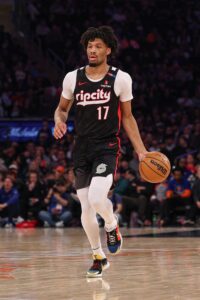 With no major roster decisions on tap in the short term, the Blazers’ biggest decision this fall may be whether or not to extend Sharpe. The former seventh overall pick has been inconsistent as a shooter and defender since entering the NBA and missed most of his second year due to an abdominal injury, but he’s an incredible athlete who is still just 22 years old and has exhibited legitimate scoring ability — he put up a career-best 18.5 points per game last season.
Finding the right price for Sharpe could be tricky, but if the Blazers are still big believers in his upside and think a breakout could be around the corner, this might be their best chance to sign him to a team-friendly long-term contract. Of course, if Sharpe and his camp believe the same thing, they probably won’t be inclined to settle for too modest a deal. Perhaps there’s a middle ground for Sharpe and the Blazers somewhere between the four-year rookie scale extensions signed a year ago by Corey Kispert ($54MM) and Trey Murphy ($112MM).
While Sharpe has an Oct. 20 deadline for a rookie scale extension, there’s no such restriction for Camara, who will remain eligible for a veteran extension all season long, assuming his minimum-salary team option for 2026/27 is declined as part of an agreement. Camara would be eligible to receive up to approximately $87MM for four seasons on an extension starting in ’26/27 or roughly $63MM over three seasons if his ’26/27 option is exercised and a new deal begins in ’27/28.
The former second-round pick earned praise from opponents for his defensive tenacity and showed off an improved offensive game in his second NBA season, knocking down 37.5% of his three-point attempts. He’s an important part of the future in Portland.
Starting an extension for Camara a year later would benefit the Blazers, who are in position to have some cap flexibility during the 2026 offseason. But if giving him a significant raise in ’26/27 is what it takes to get a deal done, Portland shouldn’t hesitate to pull the trigger — especially since, without an extension, the team may end up needing to decline that option anyway in order to make him a restricted free agent next July.
Marco Belinelli Announces Retirement
Longtime NBA wing Marco Belinelli has announced his retirement as a player, as Eurohoops relays. Belinelli confirmed the decision in a social media post on Monday (Instagram link).
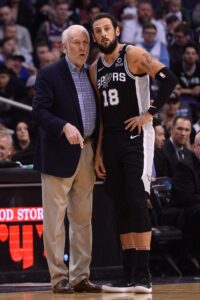 “I gave it my heart,” Belinelli wrote. “Every piece of me. Every single day. Basketball gave me everything… and I gave it everything I had. Saying goodbye isn’t easy. But it’s time. I carry with me every emotion, every sacrifice, every cheer. Thank you to those who always believed. To the next generation—I leave a dream. Make it count.”
Belinelli, who turned 39 in March, was selected with the 18th overall pick in the 2007 draft and spent the next 13 seasons in the NBA, appearing in 860 total regular season games for nine teams.
The 6’5″ Italian swingman held career NBA averages of 9.7 points, 2.1 rebounds, and 1.7 assists in 22.7 minutes per game, with a shooting line of .424/.376/.846. Known for his outside shooting, he made 1,216 career three-pointers.
Belinelli’s best season came in 2013/14 in San Antonio, when he averaged 11.4 PPG and made a career-high 43.0% of his three-point tries. He won the NBA’s three-point contest that season and was part of the Spurs‘ championship team, appearing in all 23 playoff games the team played that spring.
Belinelli also suited up for Golden State, Toronto, New Orleans, Chicago, Charlotte, Atlanta, and Philadelphia.
Since leaving the NBA in 2020, Belinelli has played for Virtus Bologna, the Italian club with whom he began his career as a teenager. He has bolstered his career résumé in recent years, winning a pair of Lega Serie A titles in 2021 and 2025, earning Sixth Man of the Year honors in 2022 and 2023, and claiming an MVP award in 2024.
Rockets Decline To Match Hawks’ Offer Sheet For N’Faly Dante
3:09 pm: The Hawks have officially announced in a press release that they’ve signed Dante.
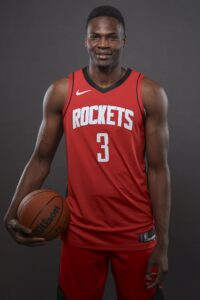 2:08 pm: Big man N’Faly Dante will join the Hawks, according to Michael Scotto of HoopsHype, who reports (via Twitter) that the Rockets aren’t matching the two-year, $4.5MM offer sheet Dante signed with Atlanta.
Dante appeared in just four NBA regular season games last season after going undrafted out of Oregon. However, he was a mainstay for the Rio Grande Valley Vipers in the G League while on a two-way contract with Houston, averaging 15.1 points, 9.8 rebounds, and 2.2 blocks in 26.8 minutes per game across 42 outings at the G League level.
Dante, who will turn 24 in October, earned a two-way qualifying offer from Houston in June, but the Rockets have since filled all of their two-way slots by signing Kevon Harris, Isaiah Crawford, and JD Davison, which was perhaps an indication that they weren’t counting on having Dante back.
The Hawks’ two-year offer sheet to Dante appears to just be worth the minimum salary, but even that modest price was too steep for the Rockets, who are operating just $1.26MM below a first-apron hard cap and can’t add a 15th man on a veteran’s minimum deal without shedding salary. Given the team’s cap situation, Scotto’s report that Houston isn’t matching the Hawks’ offer doesn’t come as a real surprise.
Once they officially add Dante to their roster, the Hawks will have 14 players on standard contracts, with Caleb Houstan reportedly expected to join the team as well. Dante will provide depth in a frontcourt that also includes incumbent center Onyeka Okongwu, offseason addition Kristaps Porzingis, rookie Asa Newell, and third-year big man Mouhamed Gueye.
Dante is the first two-way restricted free agent to sign a qualifying offer since Tyrone Wallace did so in 2018. Wallace was a Clippers RFA who signed an offer sheet with the Pelicans and had it matched by L.A.
The Hawks, meanwhile, will become the first team to sign a restricted free agent to an offer sheet that goes unmatched since they did it themselves with Kings RFA Bogdan Bogdanovic in 2020.
Magic To Sign Lester Quinones To Exhibit 10 Contract
The Magic have agreed to a deal with free agent guard Lester Quinones, reports Michael Scotto of HoopsHype (Twitter link). It will be a non-guaranteed Exhibit 10 contract, a league source tells Jason Beede of The Orlando Sentinel (Twitter link).
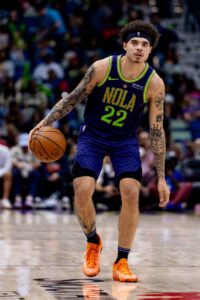 Quinones has appeared in 54 total NBA regular season games in three years since going undrafted out of Memphis in 2022. His best season came in 2023/24, when he averaged 4.4 points and 1.9 rebounds in 10.6 minutes per night with a .364 3PT% in 37 outings for Golden State.
The 6’4″ guard began last season on a two-way contract with the Sixers, was waived in December, then finished the year with the Pelicans after signing a two-way deal in early March. That contract covered two seasons, but New Orleans waived Quinones last month.
Quinones only made 13 NBA appearances in 2024/25, but saw action in 41 total G League games for the Birmingham Squadron and Delaware Blue Coats. He put up impressive averages of 21.6 points, 6.8 rebounds, 4.9 assists, and 1.4 steals per contest, though he struggled a bit with his shooting efficiency (.431/.331/.713) and turnovers (3.7 per game).
According to Scotto, Quinones will have an opportunity to compete for a roster spot or a two-way deal in Orlando. The latter is more likely than the former, given that the Magic are bumping right up against a first-apron hard cap and don’t have enough room to carry a 15th man into the season at the moment.
An Exhibit 10 contract can be converted to a two-way deal up until October 20. The Magic have one open two-way slot alongside Orlando Robinson and Jamal Cain. If Quinones is waived before the season, he could potentially join the Osceola Magic and earn an Exhibit 10 bonus worth up to $85,300, but Orlando’s NBAGL affiliate would need to acquire his returning rights.
Paul Jesperson To Coach Suns’ G League Affiliate
The Suns have named Paul Jesperson the head coach of their G League affiliate, the Valley Suns, the team announced today in a press release.
“Paul is ready to take this next step in his career as he moves into the role of head coach,” Valley Suns GM Brendan Sabean said in a statement. “His background and experience complement our vision to utilize the G League as a lifeline of development for Suns and Valley Suns players. He’s a natural fit for the job and I’m looking forward to seeing the impact he can make as head coach.”
Jesperson was an assistant on the Valley Suns’ bench last season, so on one hand, the move looks like a fairly straightforward internal promotion. However, it happened in a roundabout way.
A report in May stated that the Kings had reached an agreement with Jesperson to make him their head of player development, and when Sacramento officially announced Doug Christie‘s staff a few weeks later, Jesperson was named to that position. However, earlier this month, reporting indicated that D.J. Ham had agreed to become the Kings’ head of player development after Jesperson stepped away from the team.
We now know that Jesperson left that new position in Sacramento in order to rejoin the Valley Suns. He’ll replace former head coach John Little, who was named an assistant under new Phoenix head coach Jordan Ott.
Jesperson, who played college basketball at Virginia and Northern Iowa before briefly spending time in the G League and in Europe, worked for the Hawks and the Oklahoma Sooners before joining Phoenix’s NBAGL team as an assistant last season.
NBA 2025 Offseason Check-In: Toronto Raptors
Hoops Rumors is checking in on the 2025 offseason for all 30 NBA teams, recapping the summer’s free agent signings, trades, draft picks, departures, and more. We’ll take a look at each team’s offseason moves and consider what might still be coming before the regular season begins. Today, we’re focusing on the Toronto Raptors.
Free agent signings
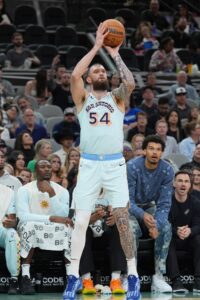 Sandro Mamukelashvili: Two years, minimum salary. Second-year player option. Signed using minimum salary exception.
- Garrett Temple: One year, minimum salary. Re-signed using minimum salary exception. Waived right to veto trade.
- David Roddy: One year, minimum salary. Non-guaranteed (Exhibit 10). Signed using minimum salary exception.
- Olivier Sarr: One year, minimum salary. Non-guaranteed (Exhibit 10). Signed using minimum salary exception.
Trades
- None
Draft picks
- 1-9: Collin Murray-Boyles
- Signed to rookie scale contract (four years, $28,822,764).
- 2-39: Alijah Martin
- Signed to two-way contract.
Two-way signings
- Chucky Hepburn
- One year, $85,300 partial guarantee.
- Alijah Martin
- One year, $85,300 partial guarantee (will increase to $318,218 at start of regular season).
Note: The Raptors carried over Ulrich Chomche on a two-way contract from 2024/25.
Departed/unsigned free agents
- Chris Boucher (Celtics)
Other roster moves
- Signed Jakob Poeltl to a three-year, $84,084,000 contract extension that begins in 2027/28. Exercised ’26/27 player option ($19.5MM base salary; $500K in incentives) as part of agreement. Third year is partially guaranteed for $5MM (partial guarantee can increased based on performance criteria). Includes trade kicker (5%).
- Waived Colin Castleton (non-guaranteed contract).
- Waived Jared Rhoden (two-way contract).
Salary cap situation
- Operating over the cap ($154.6MM) and above the luxury tax line ($187.9MM).
- Carrying approximately $190.7MM in salary ($188.4MM guaranteed).
- No hard cap.
- Taxpayer mid-level exception ($5,685,000) available.
The offseason so far
When we talk about a team getting a head-start on the summer by making its big offseason moves at the trade deadline, the 2025 Raptors are exactly what we’re talking about.
 Toronto was well on its way to a lottery finish in 2024/25 when the front office swung a deal to acquire Pelicans forward Brandon Ingram, a former All-Star who had been sidelined since December due to an ankle injury and ultimately ended up missing the rest of the season.
Shortly after giving up two players and a pair of draft picks (including a lightly protected first-rounder) to acquire him, the Raptors signed Ingram to a three-year, $120MM contract extension to ensure he didn’t reach unrestricted free agency this summer.
The Ingram trade and extension were clearly completed with an eye toward the 2025/26 season (and beyond), and the fact that the Raptors made them well ahead of the offseason meant that it ended up being a fairly quiet summer in Toronto, at least in terms of roster changes.
The Raptors are one of just three teams that hasn’t made a single trade since the regular season ended. They also haven’t added a free agent on a contract worth more than the minimum — outside of re-signing veteran locker room leader Garrett Temple, their only real foray into free agency was adding big man Sandro Mamukelashvili to a two-year, minimum-salary deal to add more depth to the frontcourt as longest-tenured Raptor Chris Boucher departed Toronto.
The Raptors did have a lottery pick at No. 9 overall, which they used to select Collin Murray-Boyles out of South Carolina. The belief in some corners was that the team should have used that pick on Duke center Khaman Maluach, who unexpectedly slipped out of the top eight. But Toronto is clearly high on Murray-Boyles, who has drawn Draymond Green comparisons and had a solid Summer League debut last month, with averages of 10.5 points, 5.5 rebounds, 2.0 assists, and 1.8 steals per game on 57.1% shooting.
Expecting Murray-Boyles to make an immediate impact this fall may not be realistic, but the 20-year-old is an intriguing young building block for Toronto. And while it will be tempting to compare his progress in the coming years to Maluach’s, the Raptors made it clear by extending Jakob Poeltl through 2029/30 that they view their starting center of the present as their center of the future too, at least for the next few seasons.
The $28MM-per-year price tag on the three seasons newly added to Poeltl’s contract may be a little higher than some fans expected, but the third year isn’t fully guaranteed, and the big man picked up his more team-friendly $19.5MM option for 2026/27 as part of the agreement. Plus, the stark contrast between the Raptors’ metrics when Poeltl is on and off the court over the past couple seasons suggests he’s one of the league’s more underrated big men.
While drafting Murray-Boyles and extending Poeltl were important moves that will impact the club for years to come, the dismissal of longtime team president Masai Ujiri may have been the most consequential long-term decision made by the Raptors this summer.
Ujiri, who took over as Toronto’s head of basketball operations in 2013, built the first championship roster in franchise history (2018/19) and helped shape the organization’s culture during his decade-plus with the team. Given his reputation and the timing of the move (a day after the draft), the news of his ouster came as a bit of a surprise, but Ujiri had also made his share of questionable roster decisions in recent years and didn’t see eye-to-eye with the new ownership group.
The Raptors continue to search for a full-time replacement for Ujiri, with general manager Bobby Webster – who is currently running basketball operations – viewed as a candidate for the role.
Up next
Hiring a permanent president of basketball operations may be the top remaining item on Toronto’s offseason to-do list, but it’s not the only task on the agenda.
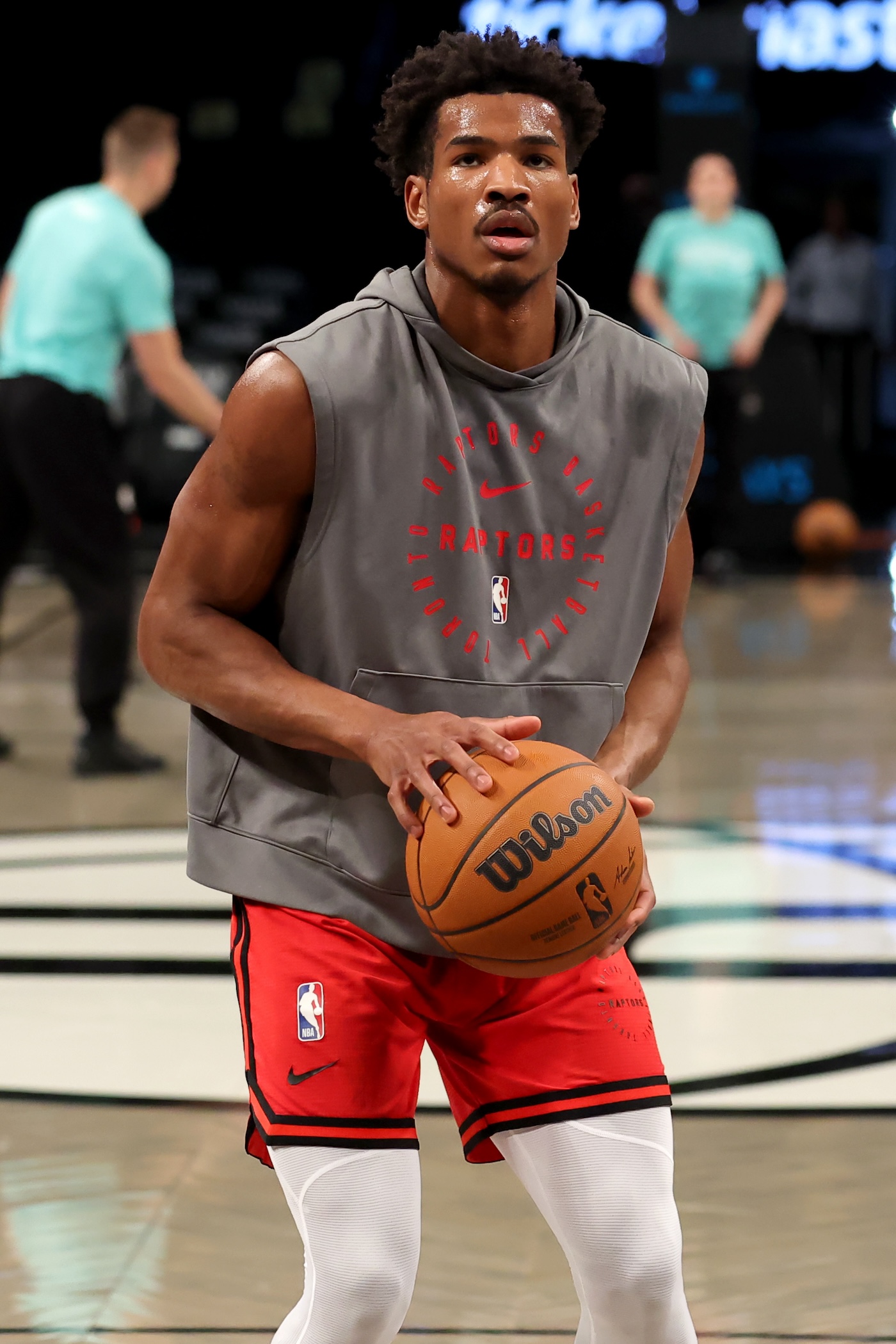 Perhaps most pressingly, the Raptors are currently operating over the luxury tax line, which presumably isn’t the end goal for a team coming off a 30-win season. They also find themselves above the first tax apron due to the incentives in the Immanuel Quickley, RJ Barrett, and Poeltl contracts.
Getting under the first apron would be straightforward enough. Waiving A.J. Lawson‘s non-guaranteed contract and beginning the season with 14 players on the standard roster would do the trick. That would afford the Raptors all the flexibility of a non-apron team, including being able to take back more salary than they send out in a trade (albeit with little breathing room under the apron to actually do so).
But getting out of tax territory is probably the more important consideration, and cutting Lawson wouldn’t quite get them there — the Raptors would still be in the tax by about $800K in that scenario.
That amount is so modest that it wouldn’t be hard for the club to address the issue with a minor trade during the season, so it doesn’t necessarily have to be done by opening night. In fact, it could make more sense to wait until the Raptors have a better sense of how Ingram fits together with the rest of the roster. While moving off a minimum-salary player at the trade deadline would get Toronto out of the tax, the team may be inclined to make a more significant deal involving a higher-paid player in which one of the goals would be to take back a little less salary than is sent out.
It’s also worth keeping an eye on former lottery pick Ochai Agbaji in the next couple months. The fourth-year wing has shown some promise, but it’s unclear whether he’s still part of the long-term plans in Toronto as he enters the final season of his rookie contract. He’s extension-eligible until October 20, and if he doesn’t sign a new deal by that time, his expiring $6.4MM deal could make him a trade candidate.
Latest On Jonathan Kuminga
There has been “renewed” dialogue between the Warriors and Jonathan Kuminga‘s camp during the last week as the two sides continue to propose contract concepts, ESPN’s Anthony Slater said during a Friday appearance on NBA Today (YouTube link).
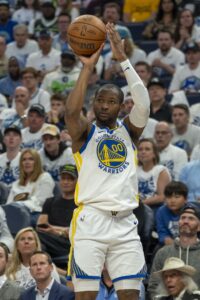 As he has reported previously, Slater says that Kuminga and his representatives are seeking a contract that positions him to be more of a building block than simply a trade chip.
“The word I’ve heard used from the Kuminga side is ‘pawn,'” Slater said. “He doesn’t want to sign this two-year, $45MM deal with a team option where he is clearly just being used to be traded mid-season. That’s not something he wants to sign up for.
“Now if you’re talking about a three-year deal, if you’re talking about something with a player option that shows him a little bit more commitment, that’s something he’d be interested in. But as of now, the Warriors have been hesitant to do that, and because of that, Kuminga is signaling to those around him that he’s very willing – and prefers – (to sign) the qualifying offer over the two-year, $45MM deal. That’s dangerous for the Warriors. They can try to call his bluff, but right now, it seems to be trending toward the qualifying offer.”
A handful of Warriors free agent targets – including big man Al Horford – are awaiting resolution on the Kuminga situation before they can potentially finalize deals with Golden State. However, with training camps not scheduled to start until the end of September and no crucial dates coming up for restricted free agents until the October 1 deadline to accept a qualifying offer, Slater wouldn’t be surprised if the standoff extends into September.
“August is a lot easier for people to just be like, ‘OK, we’ll get to you when we get to you,'” Slater said. “September’s where it starts to get a little bit more uncomfortable. I don’t know if there will be movement or a little bit more angst on the Warriors’ or Kuminga’s side, but September is where this could get a little bit dicier.”
As Slater acknowledges, it would be somewhat surprising if Kuminga gives up $14MM in 2025/26 salary and signs his $8MM qualifying offer instead of taking a two-year, $45MM offer from Golden State. But accepting the QO would put him in a better position to dictate his future, since it comes with a no-trade clause for ’25/26 and the ability to reach unrestricted free agency next summer.
[RELATED: Details On Qualifying Offers For Remaining RFAs]
“You talk to people around him and he’s pretty dug in,” Slater said. “If two for $45MM with the team option is going to be the best offer, he will see them in training camp on an ($8MM) expiring qualifying offer which includes a no-trade clause. Because he wants either to be viewed as more of a building block or he wants his freedom, his control of his future. And the qualifying offer, while less money, gives him control of his future.”
Bulls Have Reportedly Rebuffed Trade Interest In Coby White
The Bulls have received a number of trade inquiries about guard Coby White this offseason, but there has been no indication that they’re looking to move him as he enters a contract year, according to Ashish Mathur of Dallas Hoops Journal.
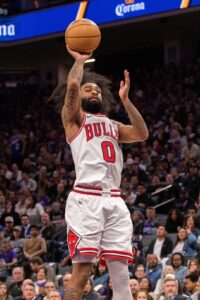 “I know multiple teams tried to trade for Coby this summer,” an NBA executive told Mathur. “There was some chatter that he was almost traded on draft night. The Bulls love him though. He’s not going anywhere. They have shot down trade inquiries for him.”
The idea that the Bulls may have nearly traded White on draft night and have also “shot down” inquiries on him seem to be at odds, but the executive’s remarks may indicate that the team hasn’t been willing to seriously engage on trade discussions regarding White since draft night.
The seventh overall pick in 2019, White was a regular rotation player off the bench for the Bulls for his first four seasons before taking on an increased role as a full-time starter over the past two years.
He set a career high with 19.1 points per game in 2023/24, then topped that figure with 20.4 PPG in ’24/25. The 25-year-old has also put up 4.8 assists and 4.1 rebounds per contest while making 37.3% of his three-pointers since the start of the ’23/24 season.
White emerged as Chicago’s go-to scoring option down the stretch this past spring after the team traded away Zach LaVine. The 6’5″ guard averaged 25.0 PPG in his final 25 outings and led the Bulls to a 17-8 record in those games.
While the Bulls did well to re-sign White to a three-year, $36MM contract as a restricted free agent in 2023, that team-friendly deal has made it virtually impossible to sign him to an extension before he reaches unrestricted free agency in 2026. Chicago could go up to about $87MM over four years, but White likely believes he’ll receive more lucrative offers on the open market next summer, either from the Bulls or another suitor (or both).
[RELATED: Hoops Rumors Glossary: Veteran Contract Extension]
There has been some speculation that an inability to extend White ahead of free agency might make the Bulls more inclined to consider trading him rather than risk losing him for nothing next summer, and Chicago may still consider that route before February’s trade deadline. But for now it sounds like the team is confident about its ability to re-sign White next July.
The Bulls will hold White’s full Bird rights and have a pretty clean cap sheet going forward, so they’re well positioned to make a strong offer in free agency, but they wouldn’t have the right of first refusal if the guard decides he wants to play elsewhere.
Heat Trade Haywood Highsmith To Nets
The Heat and Nets have agreed to a trade that sends wing Haywood Highsmith to Brooklyn along with a 2032 second-round pick in exchange for a protected 2026 second-rounder, reports Shams Charania of ESPN (Twitter links).
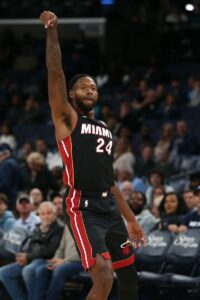 The Nets have officially confirmed the deal, announcing that they’ve acquired Miami’s unprotected 2032 second-round selection and Highsmith in exchange for their own top-55 protected 2026 second-rounder.
It’s a financially motivated deal for the Heat, who will move under the luxury tax line as a result of the move. Miami entered the day operating about $1.6MM above the tax threshold with 14 players under contract.
Sending Highsmith’s expiring $5.6MM contract to Brooklyn will give the Heat nearly $4MM in breathing room below the tax, with at least one standard roster spot to fill before the season begins — the club will likely keep its 15th roster spot open to start the season to avoid going back above the tax line.
The Heat were always considered likely to duck the tax this season in order to reset their repeater clock.
When I identified Miami earlier this month as a good bet to make a cost-cutting move, I mentioned Highsmith as a potential trade candidate and speculated that he should have a little value based on his play as a three-and-D wing last season. The 28-year-old made 74 appearances (42 starts) for the Heat, averaging 6.5 points and 3.4 rebounds in 24.6 minutes per game and posting a .458/.382/.721 shooting line.
However, word broke last Friday that Highsmith had sustained a torn meniscus during an offseason workout and underwent surgery to address the injury. The recovery process is expected to sidelined him for at least eight-to-10 weeks, jeopardizing his availability for the start of the season and reducing his value as a trade chip, which is why the Heat had to give up a second-round pick to move him.
Miami will create a trade exception worth Highsmith’s outgoing salary ($5,616,000), which the club will have one year to use.
As for the Nets, they continue to use their cap room to stockpile draft assets, having acquired a pair of first-round picks in separate deals for Michael Porter Jr. and Terance Mann earlier this summer. It’s unclear whether or not Highsmith will be part of their plans for the 2025/26 season, given that there may be a roster crunch in Brooklyn, but taking on his contract puts only a small dent into their remaining cap space.
As Bobby Marks of ESPN tweets, Brooklyn still has $22MM in room after accounting for Cam Thomas‘ $12.1MM cap hold, though that figure doesn’t include reported two-year, $12MM deals with Day’Ron Sharpe or Ziaire Williams, which aren’t yet official. One of those signings could be completed using the room exception, but at least one will have to use the Nets’ cap space.