
Timberwolves Sign Eugene Omoruyi, Skylar Mays
SEPTEMBER 17: Both deals are official, per RealGM’s transaction log. Both Omoruyi and Mays signed Exhibit 10 contracts, as expected, Hoops Rumors has confirmed.
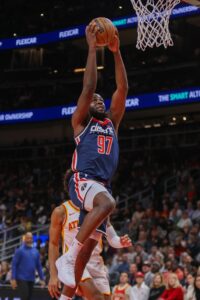 SEPTEMBER 16: The Timberwolves have agreed to sign free agents Eugene Omoruyi and Skylar Mays, reports Michael Scotto of HoopsHype (Twitter link).
While Scotto doesn’t specify the terms of the agreements, Omoruyi and Mays seem likely to sign non-guaranteed contracts that include Exhibit 9 and/or Exhibit 10 language. The Exhibit 9 clause protects teams in the event of a preseason injury, while the Exhibit 10 clause allows for a bonus worth up to $77.5K if the player is waived by his NBA team and then spends at least 60 days with the club’s G League affiliate.
Omoruyi, 27, has played for the Mavericks, Thunder, Pistons, and Wizards since making his NBA debut in the fall of 2021. The 6’7″ forward made a career-high 43 appearances for Washington last season, averaging 4.8 PPG, 2.0 RPG, and 0.8 APG in 9.1 MPG. His contract with the Wizards covered the 2024/25 season, but his salary was non-guaranteed and Washington opted to waive him in August.
Mays, the 50th overall pick in the 2020 draft, has appeared in 105 games across four seasons for the Hawks, Trail Blazers, and Lakers. The 27-year-old guard, who played his college ball at LSU, split his time between Portland and L.A. last season, appearing in 38 total NBA games and averaging 4.1 points, 2.2 assists, and 1.1 rebounds in 11.4 minutes per contest. He owns a career shooting line of .445/.345/.859.
Mays was rumored last month to be drawing interest from Italian team Olimpia Milano, but it appears he’ll be remaining stateside at least for the time being. He’s no longer eligible for a two-way contract, whereas Omoruyi – who has three years of NBA service – has one more season of two-way eligibility.
The Wolves currently have 17 players under contract. Once they complete reported deals with Omoruyi, Mays, and Chasson Randle, they’ll be one away from the 21-player preseason limit.
2024/25 NBA Over/Unders: Pacific Division
With the 2024/25 NBA regular season set to tip off next month, we’re getting serious about predictions for the upcoming campaign and continuing an annual Hoops Rumors tradition.
With the help of the lines from a series of sports betting sites – including Bovada and BetOnline – we’re running through the predicted win totals for each of the NBA’s 30 teams, by division. In a series of team-by-team polls, you’ll get the chance to weigh in on whether you think those forecasts are too optimistic or too pessimistic.
In 2023/24, our voters went 16-14 on their over/under picks. Can you top that in ’24/25?
We’ll wrap up our series today with the Pacific Division…
Phoenix Suns
- 2023/24 record: 49-33
- Over/under for 2024/25: 48.5 wins
- Major offseason moves:
How many games will the Suns win in 2024/25?
-
Over 48.5 58% (215)
-
Under 48.5 42% (158)
Total votes: 373
Sacramento Kings
- 2023/24 record: 46-36
- Over/under for 2024/25: 47.5 wins
- Major offseason moves:
How many games will the Kings win in 2024/25?
-
Over 47.5 63% (227)
-
Under 47.5 37% (136)
Total votes: 363
Golden State Warriors
- 2023/24 record: 46-36
- Over/under for 2024/25: 44.5 wins
- Major offseason moves:
How many games will the Warriors win in 2024/25?
-
Under 44.5 54% (211)
-
Over 44.5 46% (177)
Total votes: 388
Los Angeles Lakers
- 2023/24 record: 47-35
- Over/under for 2024/25: 43.5 wins
- Major offseason moves:
- Added: Dalton Knecht, Bronny James
- Lost: Taurean Prince, Spencer Dinwiddie
How many games will the Lakers win in 2024/25?
-
Under 43.5 52% (205)
-
Over 43.5 48% (190)
Total votes: 395
Los Angeles Clippers
- 2023/24 record: 51-31
- Over/under for 2024/25: 39.5 wins
- Major offseason moves:
How many games will the Clippers win in 2024/25?
-
Under 39.5 51% (186)
-
Over 39.5 49% (180)
Total votes: 366
Previous voting results:
- Boston Celtics (58.5 wins): Over (69.7%)
- New York Knicks (53.5 wins): Over (58.8%)
- Philadelphia 76ers (52.5 wins): Under (51.7%)
- Toronto Raptors (30.5 wins): Under (58.7%)
- Brooklyn Nets (19.5 wins): Over (54.3%)
- Dallas Mavericks (49.5 wins): Over (78.0%)
- Memphis Grizzlies (47.5 wins): Under (65.6%)
- New Orleans Pelicans (46.5 wins): Under (60.6%)
- Houston Rockets (43.5 wins): Under (51.4%)
- San Antonio Spurs (36.5 wins): Under (52.9%)
- Orlando Magic (47.5 wins): Over (57.1%)
- Miami Heat (44.5 wins): Under (63.1%)
- Atlanta Hawks (35.5 wins): Under (66.4%)
- Charlotte Hornets (29.5 wins): Under (63.1%)
- Washington Wizards (20.5 wins): Under (56.6%)
- Oklahoma City Thunder (56.5 wins): Over (68.1%)
- Minnesota Timberwolves (52.5 wins): Over (65.2%)
- Denver Nuggets (51.5 wins): Over (54.3%)
- Utah Jazz (29.5 wins): Under (60.1%)
- Portland Trail Blazers (22.5 wins): Under (54.7%)
- Milwaukee Bucks (50.5 wins): Over (63.2%)
- Cleveland Cavaliers (48.5 wins): Under (51.6%)
- Indiana Pacers (47.5 wins): Over (57.2%)
- Chicago Bulls (28.5 wins): Under (61.9%)
- Detroit Pistons (24.5 wins): Over (60.2%)
NBA 2024 Offseason Check-In: Portland Trail Blazers
Hoops Rumors is checking in on the 2024 offseason for all 30 NBA teams, recapping the summer’s free agent signings, trades, draft picks, departures, and more. We’ll take a look at each team’s offseason moves and consider what might still be coming before the regular season begins. Today, we’re focusing on the Portland Trail Blazers.
Free agent signings
- Devonte’ Graham: One year, minimum salary. Non-guaranteed. Signed using minimum salary exception.
- Henri Drell: One year, minimum salary. Non-guaranteed (Exhibit 10). Signed using minimum salary exception.
Trades
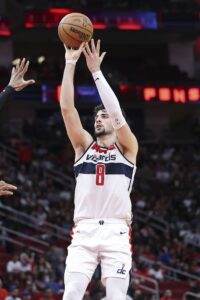 Acquired the Timberwolves’ 2027 second-round pick; either the Pacers’ or Wizards’ 2029 second-round pick (whichever is least favorable); and the Knicks’ 2030 second-round pick from the Knicks in exchange for the draft rights to Tyler Kolek (No. 34 pick).
- Acquired the draft rights to Quinten Post (No. 52 pick) and cash from the Thunder in exchange for the draft rights to Oso Ighodaro (No. 40 pick).
- Acquired cash from the Warriors in exchange for the draft rights to Quinten Post (No. 52 pick).
- Acquired Deni Avdija in exchange for Malcolm Brogdon; the draft rights to Carlton Carrington (No. 14 pick); either the Trail Blazers’, Celtics’, or Bucks’ 2029 first-round pick (whichever is second-most favorable); the Warriors’ 2028 second-round pick; and the Trail Blazers’ 2030 second-round pick.
Draft picks
- 1-7: Donovan Clingan
- Signed to rookie scale contract (four years, $31,085,018).
Two-way signings
Departed/unsigned free agents
- Ibou Badji (Bucks)
- Moses Brown (unsigned)
- Ashton Hagans (unsigned)
Other moves
- Exercised Dalano Banton‘s 2024/25 team option ($2,196,970).
Salary cap situation
- Operating over the cap ($140.6MM) and below the luxury tax line ($170.8MM).
- Carrying approximately $167.1MM in salary.
- No hard cap.
- Full mid-level, bi-annual exceptions available.
- Three traded player exceptions available (largest worth $8,778,377).
- Note: The $8,778,377 exception expires on 9/27. The second-largest TPE is worth $6,875,000.
The offseason so far
After finishing the 2023/24 season with a 21-61 record, worst in the Western Conference, the Trail Blazers entered the offseason projecting to be a taxpayer in ’24/25, which wasn’t exactly ideal for a team still far away from contention.
As a result, Portland had two primary goals this summer: First, continue adding young talent to its core. And second, shed enough salary to get under the tax line and avoid paying a premium for a roster almost certain to finish in lottery territory again.
Armed with the Nos. 7, 14, 34, and 40 picks in the 2024 draft, the Trail Blazers were well positioned to add more prospects to their roster, but opted against keeping all of those draft assets, recognizing they could use one of those lottery picks to help address both of their offseason goals. Rather than hanging onto the No. 14 pick, Portland packaged it with Malcolm Brogdon, a future first-rounder, and a pair of second-round picks to acquire Deni Avdija from the Wizards.
While it may look like a significant price to pay for Avdija, Brogdon didn’t have a long-term place in a crowded Portland backcourt, this year’s draft class was considered weak, and the future first-round pick the Blazers surrendered is just a second-most favorable pick in 2029, meaning they’ll still hold a more favorable first-rounder in the spring of ’29.
Plus, even though Avdija is a four-year veteran, he just turned 23 years old this year and is on a team-friendly contract that he signed last fall prior to an impressive breakout season in 2023/24. The four-year, $55MM deal starts at about $15.6MM and descends from there, making it a relative bargain for a player who posted career highs in PPG (14.7), RPG (7.2), APG (3.8), FG% (.506), and 3PT% (.374) last season. The former Wizard immediately becomes a long-term building block in Portland.
The trade also ensured the Blazers will stay out of tax territory in 2024/25. Brogdon’s $22.5MM expiring contract exceeds Avdija’s ’24/25 cap charge by nearly $7MM, and the No. 14 pick would’ve received a salary just shy of $4.5MM, so Portland essentially trimmed eight figures worth of salary in the transaction.
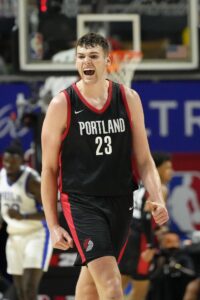 Besides acquiring Avdija, the only other major addition the Blazers made this offseason was drafting center Donovan Clingan with the No. 7 overall pick in June.
It was a somewhat curious choice, given that Portland has no shortage of centers already under contract (Deandre Ayton, Robert Williams, Duop Reath). But the Blazers are still early enough in their rebuild to favor a “best player available” approach to the lottery, and Clingan – who was widely considered a possible top-three pick leading up to draft night – presumably fit that bill for them.
It’s not as if the Blazers already have a star at the position either. Ayton is a former No. 1 overall pick, but he has been inconsistent, isn’t an elite rim protector, and didn’t cement his place as the long-term answer in the middle during his first year in Portland. Williams, meanwhile, missed most of last season due to knee surgery, and Reath projects as more of a second or third option on the depth chart.
Interestingly, after trading away the 14th overall pick in the draft, the Blazers also opted not to use either No. 34, which they traded to New York for three future second-rounders, or No. 40, which they sold for cash.
I was a little surprised that a rebuilding and cost-conscious Portland team didn’t hang onto at least one of those selections, which would’ve allowed them to add another rookie on the cheap. But the front office must feel as if there are already enough projects on the roster for the coaching staff to develop — six Blazers players, including lottery picks Scoot Henderson and Shaedon Sharpe, were selected in either the 2022 or 2023 draft.
Up next
The Blazers’ logjam at center makes them a logical candidate for a preseason or in-season trade. Ayton would be difficult to move due to his maximum-salary contract, but Williams is earning around the mid-level and could be an intriguing target if he’s able to show he’s back to 100% health.
The situation in the backcourt may not be best described as a “logjam,” but the Blazers are clearly hoping that Henderson and Sharpe will be their starting guards of the future. In the present, Anfernee Simons has the stronger résumé and probably wouldn’t be thrilled if he finds himself out of the starting five. That’s not to say that finding a taker for Simons is a top priority in the short term (there should be plenty of playing time to go around for all three guards), but it wouldn’t be surprising if his name pops up in trade rumors prior to February’s deadline.
Simons, Ayton, and Williams are all eligible for veteran extensions up until October 21, but are unlikely candidates to sign new contracts by that point — they each have two years left on their current deals, so if the Blazers do decide one or more of them are keepers, they could try to work out longer-term contracts during the 2025 offseason.
Jabari Walker is the least heralded but perhaps most viable extension candidate of the bunch. He’s entering the final year of his minimum-salary contract after averaging 8.9 points and 7.1 rebounds per game in a part-time role (23.6 MPG) last season.
As for the Blazers’ projected regular season roster, they’re currently carrying 14 players on guaranteed standard contracts and three on two-way deals, so barring trades, only the 15th standard spot looks up for grabs. Dalano Banton is probably the favorite for that last opening, with camp invitee Devonte’ Graham also in the mix.
Jazz Sign Max Abmas
The Jazz have signed free agent guard Max Abmas to a contract, the team announced today in a press release.
Abmas, who finished his college career at Texas after spending four years at Oral Roberts, went undrafted in June after averaging 16.8 points, 4.1 assists, and 3.1 rebounds in 35.1 minutes per game for the Longhorns across 34 outings (all starts) in 2023/24.
Abmas led the Summit League in scoring in each of his last three seasons at Oral Roberts, averaging 23.0 PPG in 92 games (all starts) with a .444/.394/.889 shooting line during his sophomore, junior, and senior years before transferring to Texas to take advantage of his extra year of eligibility.
After suiting up for Utah’s Summer League team and averaging 12.3 PPG on .452/.412/.778 shooting in four games in Las Vegas, Abmas will likely now end up with the Salt Lake City Stars, the Jazz’s G League affiliate.
While the Jazz’s announcement didn’t provide any details on Abmas’ deal, it will likely be an Exhibit 10 contract, putting him in line to receive a bonus worth up to $77.5K (on top of his standard G League salary) if he’s waived by Utah and then spends at least 60 days with the Stars.
The Jazz now have 20 players under contract, including 15 on standard contracts, three on two-way deals, and two (Abmas and Babacar Sane) on camp contracts.
Lakers Frontrunners To Sign Christian Koloko
The Lakers are the frontrunners to sign free agent big man Christian Koloko, reports Shams Charania of The Athletic (Twitter links). According to Charania, Koloko is also drawing interest from the Clippers, the Spurs, and his former team, the Raptors.
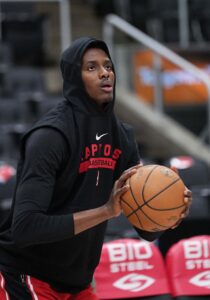 Koloko, who is still finalizing his decision on where he’ll sign, is on the comeback trail after missing all of the 2023/24 season due to a blood clot issue.
Sportsnet’s Blake Murphy reported in July that the seven-footer had received medical clearance to resume playing, while agent Calvin Andrews of Klutch Sports said last month that his client had a “major breakthrough” with his blood clot issue, which was addressed via corrective surgery.
Koloko held a workout for potential suitors during the Las Vegas Summer League in July and has been able to participate in five-on-five, full-contact drills this offseason as he attempts to get back to 100% health. Chris Johnson, a trainer who has worked with a number of NBA players, posted a YouTube video in August of Koloko taking part in a scrimmage alongside Kentavious Caldwell-Pope, Jalen Johnson, Jordan Clarkson, Delon Wright, and several other active NBAers.
Although Koloko is still awaiting formal clearance from the NBA’s Fitness-to-Play panel, it sounds like he continues to trend in the right direction. And according to Charania, the 24-year-old is technically eligible to sign with a team before being cleared by that panel.
The 33rd overall pick in the 2022 draft, Koloko appeared in 58 games (19 starts) for the Raptors as a rookie, averaging 3.1 points, 2.9 rebounds, and 1.0 block in 13.8 minutes per contest. He was the Pac 12’s Defensive Player of the Year and Most Improved Player in his final college season at Arizona in 2021/22
The Lakers will be without center Christian Wood this fall after the big man underwent knee surgery this week that is expected to sideline him for at least eight weeks, so they could use more depth in their frontcourt. However, Los Angeles is currently carrying 15 players on fully guaranteed standard contracts and is narrowly operating below the second tax apron.
It’s unclear if the Lakers’ plan would be to sign Koloko to a standard deal or perhaps to bring him on a two-way contract. Inking him to a two-way pact would require waiving one of Armel Traore, Blake Hinson, or Colin Castleton, who currently occupy L.A.’s two-way slots.
The Clippers and Spurs also have 15 players on guaranteed standard contracts, while the Raptors have 14 players on guaranteed deals, plus Bruno Fernando on a non-guaranteed salary. The Clippers have a two-way slot open; San Antonio and Toronto don’t, for now.
Free Agents Signed After Sunday Won’t Become Trade-Eligible On December 15
Unless he’s part of a sign-and-trade deal, an NBA free agent who signs a new contract can’t be traded immediately. The Collective Bargaining Agreement states that a newly signed free agent is ineligible to be traded until December 15 or until he’s been under contract for three months, whichever comes later.
Based on that rule, the majority of the free agents who signed new contracts in July, August, and the first half of September will become trade-eligible on December 15 (a smaller group of free agents who met certain specific criteria won’t become trade-eligible until January 15).
By our count, at least 87 players are currently on track to become eligible to be moved on December 15. That doesn’t take into account any players signed to Exhibit 10 contracts who might earn regular season roster spots, since they’re not included on our list (they’ll be added if they haven’t been waived by opening night).
However, with the exception of camp invitees who unexpectedly stick around for the regular season, that list won’t continue to expand to include any additional names after Sunday, which will be exactly three months away from December 15. A free agent who signs a new contract after September 15 will remain trade-eligible for a full three months, rather than becoming trade-eligible on December 15.
For instance, a player who signs on September 22 would become eligible to be dealt on December 22; one who signs on October 4 would become trade-eligible on January 4, and so on.
November 6 is an important date in this discussion, since this season’s trade deadline will land on February 6. A player who signs a free agent contract on November 7 or later will be ineligible to be dealt during the 2024/25 season.
Once the season begins next month and we have a better sense of which players signed after Sept. 15 have earned spots on regular season rosters, we’ll publish a new list of those players’ trade eligibility dates to complement our December 15 and January 15 round-ups.
Celtics Sign, Waive Jordan Schakel
SEPTEMBER 13: The Celtics have waived Schakel, according to NBA’s official transaction log. Schakel’s Exhibit 10 deal includes a $77.5K bonus, which he’ll earn by spending at least 60 days with Maine.
SEPTEMBER 11: The Celtics have signed free agent swingman Jordan Schakel to an Exhibit 10 contract, sources tell Bobby Manning of CelticsBlog.
The move gives Boston a full 21-man offseason roster, with 14 players on standard contracts, three on two-way deals, and four on Exhibit 10 pacts.
A former San Diego State standout, Schakel has spent most of the past three seasons playing in the G League since going undrafted in 2021. He also had brief stints in the NBA with the Wizards in 2021/22 and ’22/23, appearing in six games for Washington during that time, and spent part of this summer playing in Puerto Rico for Leones de Ponce.
Before a knee injury prematurely ended his season, Schakel played for the Maine Celtics in ’23/24, averaging 13.0 points, 5.2 rebounds, and 1.2 assists in 28.1 minutes per game across 24 outings, with a shooting line of .417/.402/.826.
Although the Celtics’ roster is full for the time being, they’ll likely continue to make tweaks before training camp begins next month. Manning notes that the team is expected to sign Jay Scrubb to an Exhibit 10 contract once he fully recovers from ACL surgery.
Players on Exhibit 10 deals who are waived before the season begins are eligible to earn bonuses worth up to $77.5K if they spend at least 60 days with their team’s G League affiliate. That’s likely the plan for Schakel, who figures to return to Maine this fall.
Bucks Sign, Waive Ibou Badji
8:28pm: The Bucks officially signed Badji, per RealGM’s transaction log, and waived him, according to the transaction log at NBA.com.
As expected, it was an Exhibit 10 deal, Hoops Rumors can confirm, so Badji is on track to report to the Wisconsin Herd and earn a $77.5K bonus.
11:00am: The Bucks and free agent big man Ibou Badji have agreed to a contract, league sources tell Michael Scotto of HoopsHype (Twitter link).
While Scotto doesn’t specify what kind of deal Badji is signing, it will almost certainly be a non-guaranteed Exhibit 10 pact. Exhibit 10 contracts don’t count against the cap and be converted to two-way deals before opening night. They also put a player in line to receive a bonus worth up to $77.5K if he’s waived by his NBA team and then spends at least 60 days with the team’s G League affiliate.
Badji, who will turn 22 next month, went undrafted in 2022 and signed with the Bucks shortly thereafter. He was waived by Milwaukee ahead of the 2022/23 season and joined the Wisconsin Herd in the G League before being snatched up by the Trail Blazers that November, agreeing to a two-way contract with the club.
Badji subsequently spent most of the past two seasons on separate two-way deals with Portland, eventually making his NBA debut in December 2023 and appearing in 22 games last season for the Blazers. He averaged 1.5 points, 2.3 rebounds, and 0.9 blocks in 10.3 minutes per contest.
In 19 total G League games last season for the Herd and the Rip City Remix, Badji posted averages of 4.5 PPG, 3.5 RPG, and 2.7 BPG in 18.9 MPG.
The Bucks/Herd still hold Badji’s returning rights, so it appears the plan is for him to return to Milwaukee’s G League affiliate to start the 2024/25 season. The signing will give the Bucks a full 21-man offseason roster.
Two CBA Measures Coming In 2025 Will Make Dynasty-Building Even Harder
The NBA's current Collective Bargaining Agreement went into effect fairly recently, in 2023, and many of the more punitive restrictions on tax apron teams weren't implemented until 2024, but we're already feeling the impact of the new CBA on the league's highest-spending clubs.
The Celtics, Bucks, Suns, and Timberwolves, who are operating above the second tax apron in 2024/25, were unable to sign any outside free agents for more than the veteran's minimum this offseason. They've also faced significant limitations on the trade market, including an inability to aggregate salaries, trade cash, use previous trade exceptions, or take back more salary than they send out.
Those restrictions have been a major factor in the clubs' relative inactivity on the trade market. Boston and Milwaukee are two of just four teams around the NBA who haven't made any trades this summer. The Lakers, another one of those four teams who haven't made a deal, are operating just a hair below the second apron).
Meanwhile, of the four second-apron teams, the Suns are the only one to have acquired a player on an NBA contract in an offseason trade. That deal - David Roddy for E.J. Liddell - was a straightforward salary dump that ultimately resulted in the newly acquired player (Liddell) being waived for luxury tax savings, which serves as an important reminder -- on top of their roster-building limitations, those apron teams will be on the hook for substantial tax payments at season's end.
Still, as impactful as the latest Collective Bargaining Agreement has already been on some of the NBA's most expensive rosters, some of the toughest penalties being imposed on the league's biggest spenders are still to come in 2025. Today, we're taking a closer look at a couple more notable ways in which the current CBA will complicate teams' dynasty-building efforts in the coming years by further disincentivizing big spending.
Let's dive in...

Jimmy Butler Among Stars Warriors Monitoring
After missing out on targets like Paul George and Lauri Markkanen this offseason, the Warriors remain on the lookout for stars who might become available on the trade market, according to Sam Amick of The Athletic, who said on The TK Show (YouTube link) that Heat forward Jimmy Butler is among the players Golden State is monitoring.
“Jimmy Butler’s going to be a free agent next summer, didn’t get an extension done,” Amick said. “The Warriors, as you know, have interest there and I think probably made a couple calls during the summer.”
As Amick observes, the Warriors aren’t in position to pursue top free agents due to their salary cap situation, so if they’re going to acquire a star to complement Stephen Curry, they’ll almost certainly need to do so via trade. Golden State will be hoping for the “wheels to fall off” for a would-be contender, resulting in an All-Star caliber player seeking a change of scenery, Amick notes.
Butler, who will turn 35 on Saturday, is entering what could be a contract year in Miami. Although by all accounts he remains committed to the Heat, the six-time All-Star has reportedly told the team he won’t sign an extension before next summer and will reevaluate his options next offseason, when he holds a $52.4MM player option for 2025/26.
If the Heat get off to a poor start this season, it’s possible they’ll consider the idea of moving Butler at the trade deadline, though there’s no indication they’ve seriously considered that possibility to this point.
Should Butler finish the season in Miami, there would be myriad options available to him next summer — he could re-up with the Heat (either on an extension or a new contract), he could decline his option to sign elsewhere, or he could work out an opt-in-and-trade deal that sends him to a new destination. That last scenario would be the most viable path for him to land in Golden State. The Warriors explored a similar arrangement with George before he declined his player option in June.
Amick also names Lakers forward LeBron James, Bucks forward Giannis Antetokounmpo, and Suns stars Kevin Durant and Devin Booker as some other players the Warriors are likely monitoring. However, he acknowledges that they’re long shots and could only emerge as possible targets if they sour on their current situations.
“It’s that level of a player, where you just kind of hope that one of them starts looking out for greener pastures,” Amick said.