
Community Shootaround: Best, Worst Big-Money Offseason Signings
Since the 2024/25 league year began, six free agents have signed contracts that are worth $100MM or more. Here are those six players, with their accompanying contract details:
- OG Anunoby (Knicks): Five years, $212.5MM (fifth-year player option)
- Paul George (Sixers): Four years, $211.6MM (fourth year player option)
- Tyrese Maxey (Sixers): Five years, $203.9MM
- Pascal Siakam (Pacers): Four years, $189MM
- Immanuel Quickley (Raptors): Five years, $162.5MM (includes $12.5MM in unlikely incentives)
- LeBron James (Lakers): Two years, $101.4MM (second-year player option)
On top of that, another 10 players have signed contract extensions exceeding $100MM in total value. Those 10 players – whose extensions will take effect in 2025/26, with one exception – are as follows:
- Jayson Tatum (Celtics): Five years, $313.9MM (fifth-year player option) *
- Scottie Barnes (Raptors): Five years, $224.2MM *
- Cade Cunningham (Pistons): Five years, $224.2MM *
- Evan Mobley (Cavaliers): Five years, $224.2MM *
- Franz Wagner (Magic): Five years, $224.2MM *
- Lauri Markkanen (Jazz): Four years, $195.9MM (includes an additional $24.1MM applied to 2024/25 cap hit, for a total of $220MM in new money)
- Bam Adebayo (Heat): Three years, $165.3MM (third-year player option) *
- Note: Extension begins in 2026/27.
- Jalen Brunson (Knicks): Four years, $156.5MM (fourth-year player option)
- Donovan Mitchell (Cavaliers): Three years, $150.3MM (third-year player option) *
Contracts marked with an asterisk (*) include projected salary figures based on 10% cap increases for the next two seasons. Barnes’, Cunningham’s, Mobley’s, and Wagner’s contracts could be worth up to as much as $269.1MM if certain Rose Rule performance criteria are met.
Even with the NBA’s salary cap set to continue increasing at a pretty rapid rate in the coming years, these deals represent massive significant investments for their respective teams.
In some cases, those commitments were no-brainers. Maxey, for example, is 23 years old, made his first All-Star team last season, and was named the NBA’s Most Improved Player. Paying him big money for his prime years was an easy decision for the Sixers.
Brunson’s $156.5MM contract with the Knicks is well below the maximum he could have earned if he had waited until free agency to sign a new deal. And after finishing fifth in MVP voting last season, the veteran point guard appeared to be on a maximum-salary trajectory, so New York presumably didn’t hesitate to sign off on that extension.
Some other deals on these lists carry more risk. Anunoby and George have worrisome injury histories, and George is 34 years old. Quickley, Cunningham, Mobley, and Wagner have never made an All-Star team (neither has Anunoby). James is turning 40 later this year, though he has shown no signs of slowing down and his two-year contract is the shortest-term deal in this group.
We want to know what you think. From a team’s perspective, which of these nine-figure contracts would you feel most comfortable carrying? Which one would make you the most nervous?
In two years, will any of these players find themselves in a situation like Zach LaVine‘s in Chicago (ie. a trade candidate whose contract is too onerous to move)? Or will some of these deals look like smarter investments in two years than they do now?
Head to the comment section below to weigh in with your thoughts on the most lucrative contracts of the 2024 offseason!
NBA 2024 Offseason Check-In: Indiana Pacers
Hoops Rumors is checking in on the 2024 offseason for all 30 NBA teams, recapping the summer’s free agent signings, trades, draft picks, departures, and more. We’ll take a look at each team’s offseason moves and consider what might still be coming before the regular season begins. Today, we’re focusing on the Indiana Pacers.
Free agent signings
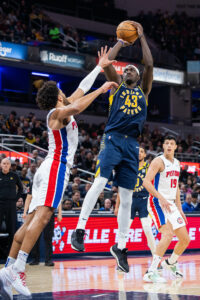 Pascal Siakam: Four years, maximum salary ($188,950,272). Re-signed using Bird rights.
- Obi Toppin: Four years, $58,000,000. Includes $2MM in unlikely incentives. Re-signed using Bird rights.
- James Wiseman: Two years, minimum salary ($4,784,366). First year partially guaranteed ($500,000). Second-year team option. Signed using minimum salary exception.
- James Johnson: One year, minimum salary. Partially guaranteed ($750,000). Re-signed using minimum salary exception.
- Cole Swider: One year, minimum salary. Non-guaranteed. Signed using minimum salary exception.
- Kyle Mangas: One year, minimum salary. Non-guaranteed (Exhibit 10). Signed using minimum salary exception.
- Cameron McGriff: One year, minimum salary. Non-guaranteed (Exhibit 10). Signed using minimum salary exception.
Trades
- Acquired the draft rights to Johnny Furphy (No. 35 pick) from the Spurs in exchange for the draft rights to Juan Nunez (No. 36 pick) and cash.
Draft picks
- 2-35: Johnny Furphy
- Signed to four-year, $8,589,485 contract. First three years fully guaranteed. Fourth-year team option.
- 2-49: Tristen Newton
- Signed to two-way contract.
- 2-50: Enrique Freeman
- Signed to two-way contract.
Two-way signings
Departed/unsigned free agents
- Doug McDermott (unsigned)
- Jalen Smith (Bulls)
- Oscar Tshiebwe (Jazz)
- Isaiah Wong (unsigned)
Other moves
- Signed Andrew Nembhard to a three-year, $58,650,480 veteran extension that begins in 2025/26. The first year of the extension replaces Nembhard’s $2,187,699 team option for ’25/26.
Salary cap situation
- Operating over the cap ($140.6MM) and below the luxury tax line ($170.8MM).
- Carrying approximately $170.4MM in salary.
- Hard-capped at $188,931,000.
- Full mid-level, bi-annual exceptions available.
The offseason so far
The Pacers finished with a solid but not spectacular 47-35 record last season and would have had to go through the play-in tournament to secure a playoff berth if not for a favorable tiebreaker that gave them the sixth seed in the Eastern Conference. Heading into the 2024/25 season, there are at least five teams (Boston, New York, Philadelphia, Milwaukee, and Cleveland) widely believed to be ahead of Indiana in the East, and maybe one or two more, depending on how you feel about the Magic and Heat.
Still, this club is coming off an appearance in the Eastern Conference Finals, even without All-Star guard Tyrese Haliburton operating at full health. Of course, Haliburton was still able to suit up and play for most of the postseason, which is more than can be said for a few notable opposing players during the first two rounds, including Giannis Antetokounmpo and Julius Randle. But the Pacers beat the teams in front of them in each of those two rounds and showed themselves to be a growing threat in the East.
The Pacers operated this offseason as if they’re confident last season’s results weren’t a mirage, investing heavily to bring back starting power forward Pascal Siakam (four years, maximum salary) and key reserve Obi Toppin (four years, $58MM, plus incentives).
As a result, Indiana’s team salary is hovering right around the luxury tax line, a threshold the small-market franchise rarely crosses. Barring another mid-season splash similar to last year’s Siakam acquisition, the Pacers should be able to remain out of the tax for at least this season, but with a couple rotation players due for raises next season, that may not be the case for much longer, assuming the club wants to continue pushing toward title contention.
Outside of their significant long-term investments in Siakam and Toppin, the Pacers’ front office mostly shopped in the bargain bin this summer. That included taking a flier on former No. 2 overall pick James Wiseman, who signed a partially guaranteed minimum-salary contract covering the next two seasons. With Jalen Smith departing in free agency, Isaiah Jackson will likely get the first shot to be Myles Turner‘s primary backup at the five, but Wiseman should have the opportunity to show he deserves minutes in that role.
The Pacers didn’t have a first-round pick in 2024 as a result of last season’s Siakam trade, but they had three second-rounders in the 35-50 range. Two of those players, Tristen Newton and Enrique Freeman, will start their professional careers on two-way deals, while No. 35 pick Johnny Furphy has a spot on the 15-man roster.
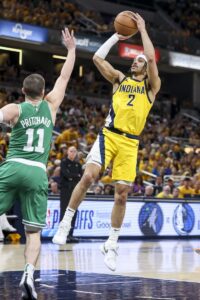 A projected first-round pick who slipped to day two, Furphy is one of just two second-rounders in this year’s class to receive three fully guaranteed years on his first NBA contract, signaling that the Pacers are high on him. Indiana has a good recent track record of finding gems near the end of the first round (Ben Sheppard) or the start of the second round (Andrew Nembhard) — we’ll see if Furphy can join that group.
Speaking of Nembhard, he signed a new three-year extension that replaces his minimum-salary team option for 2025/26 and tacks on two new years beyond that. The $58.7MM the Pacers gave him is the most they could have offered on a veteran extension for those three years.
The 24-year-old has emerged as a reliable rotation piece and played some of the best basketball of his career in the Eastern Finals with Haliburton sidelined. Still, it was a little surprising to see the terms of his new deal, as it would’ve made more sense for the Pacers to begin Nembhard’s extension after his ’25/26 team option in order to keep him on that bargain contract for one additional season.
On the other hand, it’s possible Nembhard wouldn’t have agreed to that structure, and while Indiana could have waited a year to sign him to the same extension, the team likely didn’t want to risk making the mistake Dallas did with Jalen Brunson. The Pacers guard may not have Brunson’s upside, but if Haliburton misses extended time at any point in the next season or two, Nembhard could thrive in a larger role and significantly increase his value. Locking him up sooner rather than later allows the Pacers to avoid a scenario in which his price tag soars by 2026.
Up next
After extending Nembhard, the Pacers will have to weigh whether or not to reward another important part of their backcourt rotation with a new deal — T.J. McConnell is extension-eligible as he enters a contract year.
McConnell will turn 33 during the upcoming season and may not be part of the long-term plan in Indiana, but he has posted very strong numbers (9.4 PPG, 5.4 APG, .550/.427/.823 shooting) in a reserve role over the past two seasons. He began last season out of the rotation, but ultimately proved so invaluable off the bench that he ended up earning Sixth Man of the Year votes in the spring.
I expect Indiana to make a strong effort to lock up McConnell for another year or two beyond 2024/25 as long as the price is in the neighborhood of his current $9.3MM salary. Mike Conley‘s two-year, $20.75MM contract with Minnesota could serve as a useful point of comparison in negotiations — Conley is a starter for the Wolves, but he’s also nearly five years older than McConnell.
The Pacers’ top two centers – Turner and Jackson – are also entering contract years, but Turner, who signed his last contract midway through the 2022/23 season, won’t be extension-eligible this season, so Indiana can’t get anything done with him before he reaches unrestricted free agency.
Jackson is extension-eligible until October 21 and may be in line for an increased role in his fourth year, but he averaged a career-low 13.1 MPG last season. I’d be surprised if the cap-conscious Pacers aggressively pursue a long-term deal for him this fall.
Indiana will have some questions at the back of their roster to answer before the regular season begins. The team is currently carrying just 12 players on fully guaranteed salaries, with Wiseman and James Johnson on partially guaranteed deals and Kendall Brown and Cole Swider on non-guaranteed contracts.
Those partial guarantees probably give Wiseman and Johnson the inside track for spots on the roster. The Pacers certainly aren’t obligated to carry a full 15-man squad entering opening night, but if they do, Brown may have to hold off camp invitee Swider for the final spot.
Traded Second-Round Picks For 2025 NBA Draft
We’re using the space below to keep tabs on each NBA team’s second round pick for 2025, continually updating it as necessary throughout the year. Our list of traded first-round picks for 2025 can be found right here.
We’ve listed all 30 teams here, so even if a team hasn’t traded its second round pick, that will be noted. We’ll also provide details on protections for each traded pick, including what happens to the pick in 2026 if it doesn’t change hands in 2025.
Here’s the full breakdown on the status of each 2025 second-round pick:
Atlantic
- Boston Celtics: Traded to Knicks or Magic.
- The Knicks will receive the most favorable pick of the Celtics’ and Grizzlies’ second-rounders; the Magic will receive the least favorable of the two.
- Brooklyn Nets: Own pick.
- New York Knicks:
Own pick.- The Knicks will forfeit this pick due to free agency gun-jumping.
- Philadelphia 76ers: Possibly traded to Suns.
- The Sixers will receive the more favorable pick of the Sixers’ and Nuggets’ second-rounders; the Suns will receive the least favorable of the two.
- Toronto Raptors: Traded to Pistons.
Central
- Chicago Bulls: Traded to Kings.
- Cleveland Cavaliers: Own pick.
- Detroit Pistons: Traded to Celtics, Mavericks, Wizards, Knicks, Bucks, or Grizzlies.
- Details outlined at bottom of article.
- Indiana Pacers: Own pick.
- Milwaukee Bucks: Traded to Cavaliers.
Southeast
- Atlanta Hawks: Traded to Trail Blazers or Thunder.
- The Trail Blazers will receive this pick if it lands between 31-40; the Thunder will receive if it lands between 41-59. The Hawks’ obligation to whichever team doesn’t receive the pick will be extinguished.
- Charlotte Hornets: Traded to Pacers (top-55 protected).
- If this pick lands in its protected range, the Hornets will keep it and their obligation to the Pacers will be extinguished.
- Miami Heat: Traded to Pacers or Warriors.
- The Pacers will receive this pick if it lands between 31-37; the Warriors will receive if it lands between 38-59. The Heat’s obligation to whichever team doesn’t receive the pick will be extinguished.
- Orlando Magic: Own pick.
- Washington Wizards: Possibly traded to Celtics or Mavericks.
- Details outlined at bottom of article.
Northwest
- Denver Nuggets: Traded to Sixers or Suns.
- The Sixers will receive the more favorable pick of the Nuggets’ and Sixers’ second-rounders; the Suns will receive the least favorable of the two.
- Minnesota Timberwolves: Traded to Clippers.
- Oklahoma City Thunder: Traded to Grizzlies or Rockets.
- The Grizzlies will receive the more favorable pick of the Thunder’s and Rockets’ second-rounders; the Rockets will receive the least favorable of the two.
- Portland Trail Blazers: Traded to Raptors.
- Utah Jazz: Traded to Timberwolves.
Pacific
- Golden State Warriors: Traded to Celtics, Mavericks, Wizards, Bucks, or Grizzlies.
- Details outlined at bottom of article.
- Los Angeles Clippers: Traded to Jazz.
- Los Angeles Lakers: Own pick.
- Phoenix Suns: Traded to Wizards, Bucks, or Grizzlies.
- Details outlined at bottom of article.
- Sacramento Kings: Traded to Bulls.
Southwest
- Dallas Mavericks: Traded to Celtics or Jazz.
- Details outlined at bottom of article.
- Houston Rockets: Traded swap rights to Grizzlies.
- The Grizzlies will receive the more favorable pick of the Rockets’ and Thunder’s second-rounders; the Rockets will receive the least favorable of the two.
- Memphis Grizzlies: Traded to Knicks or Magic.
- The Knicks will receive the more favorable pick of the Grizzlies’ and Celtics’ second-rounders; the Magic will receive the least favorable of the two.
- New Orleans Pelicans: Traded to Hornets.
- San Antonio Spurs: Own pick.
Here are the details on how the Pistons‘, Wizards‘, Warriors‘, Suns‘, and Mavericks‘ second-round picks will be distributed:
The Celtics will receive the most favorable of the following picks:
- The Wizards’ second-round pick.
- The Warriors’ second-round pick.
- The Mavericks’ second-round pick.
- The Pistons’ second-round pick (56-59 protected).
The Jazz will receive the least favorable of the following picks:
- The Mavericks’ second-round pick.
- The most favorable of the Wizards’ second-round pick, the Warriors’ second-round pick, and the Pistons’ second-round pick (56-59 protected).
The Wizards will receive the most favorable of the following picks, while the Bucks will receive the second-most favorable and the Grizzlies will receive the least favorable:
- The Suns’ second-round pick.
- The least favorable of the Wizards’ second-round pick and the Warriors’ second-round pick.
- The least favorable of the following picks:
- The more favorable of the Wizards’ second-round pick and the Warriors’ second-round pick.
- The Pistons’ second-round pick (56-59 protected).
If the Pistons’ pick lands in the 56-59 range, it will be sent to the Knicks. In that scenario, the Bucks would receive the more favorable of the first two picks listed above and the Grizzlies would receive the least favorable of the two.
Information from RealGM was used in the creation of this post.
Hoops Rumors’ 2024 Offseason Check-In Series
In advance of training camps, Hoops Rumors is checking in on the 2024 offseason for all 30 NBA teams, recapping the summer’s free agent signings, trades, draft picks, departures, and more. We’re taking a look at each team’s offseason moves and consider what might still be coming before the regular season begins.
All of our Offseason Check-In articles are linked below, sorted by conference and division.
Eastern Conference
Atlantic
Central
Southeast
Western Conference
Northwest
Pacific
Southwest
NBA 2024 Offseason Check-In: Memphis Grizzlies
Hoops Rumors is checking in on the 2024 offseason for all 30 NBA teams, recapping the summer’s free agent signings, trades, draft picks, departures, and more. We’ll take a look at each team’s offseason moves and consider what might still be coming before the regular season begins. Today, we’re focusing on the Memphis Grizzlies.
Free agent signings
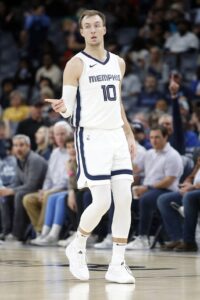 Luke Kennard: One year, $9,250,000. Includes $1,387,500 in unlikely incentives. Re-signed using Bird rights after team option was declined.
Trades
- Acquired the draft rights to Cam Spencer (No. 53 pick) from the Pistons in a four-team trade in exchange for the draft rights to Ulrich Chomche (No. 57 pick; to Raptors) and the Grizzlies’ 2030 second-round pick (top-50 protected; to Timberwolves).
- Acquired Mamadi Diakite and the draft rights to Nemanja Dangubic in exchange for Ziaire Williams and the Mavericks’ 2030 second-round pick.
Draft picks
- 1-9: Zach Edey
- Signed to rookie scale contract (four years, $26,202,576).
- 2-39: Jaylen Wells
- Signed to four-year, minimum-salary contract ($7,895,796). First two years guaranteed. Third year non-guaranteed. Fourth-year non-guaranteed team option.
- 2-53: Cam Spencer
- Signed to two-way contract.
Two-way signings
Departed/unsigned free agents
- Jordan Goodwin (unsigned)
- Lamar Stevens (unsigned)
- Yuta Watanabe (Chiba Jets)
Other moves
- Waived Trey Jemison (two-way).
Salary cap situation
- Operating over the cap ($140.6MM) and below the luxury tax line ($170.8MM).
- Carrying approximately $170MM in salary.
- No hard cap.
- Full mid-level, bi-annual exceptions available.
- Four traded player exceptions available (largest worth $12,600,000).
The offseason so far
It has been a quiet summer in Memphis, where the Grizzlies will bet on the return of a handful of starters and rotation players from injuries to propel them to a bounce-back season in 2024/25. There’s reason to believe that could be a fruitful strategy. After all, this roster is pretty similar to the one that racked up 56 wins in 2021/22 and 51 more in ’22/23.
Injuries to Desmond Bane (he played 42 games last season), Marcus Smart (20 games), Brandon Clarke (six games), Luke Kennard (39 games), Steven Adams (zero games), and especially Ja Morant (nine games) derailed Memphis in 2024/25, but the team will have all of those players back on the court next season, with the exception of Adams, who was sent to Houston ahead of the February trade deadline.
While the Grizzlies didn’t lose any key players this offseason, they still had a hole to fill up front, where they lost Adams and Xavier Tillman during the season. Operating right up against the luxury tax line, Memphis wasn’t in position to add an impact veteran center, but the club used its lottery pick to bring in a potential long-term answer at the position, drafting Zach Edey ninth overall.
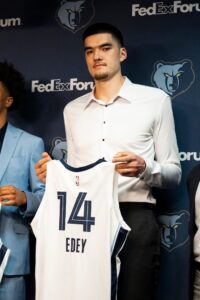 Edey is coming off a monster college career at Purdue, where he was named the NCAA’s player of the year in each of the past two seasons. And he showed some promise when he was able to suit up in Summer League last month, averaging 10.0 points, 9.0 rebounds, and 2.5 blocks in 21.0 minutes per game, though he was limited to just two appearances (one in Salt Lake City and one in Las Vegas) due to ankle issues.
Still, it remains to be seen how the 22-year-old will adjust to the speed and athleticism of the NBA game, especially with opposing offenses looking to lure him away from the rim and out to the perimeter. If Edey’s not ready to take on a substantial role as a rookie, the Grizzlies will otherwise have to rely on non-traditional fives like Jaren Jackson Jr., Santi Aldama, and Clarke.
Edey represents the only major addition of the summer for the Grizzlies, who also re-signed Kennard to a new one-year deal and drafted a couple players in the second round in June — Jaylen Wells will have a spot on the team’s 15-man roster, while Cam Spencer begins his career on a two-way deal.
Of the offseason departures, Ziaire Williams is the most notable. He was drafted with the 10th overall pick in 2021, but never developed into a consistent contributor and was dealt to Brooklyn in a salary dump.
Up next
The Grizzlies currently have 14 players on fully guaranteed contracts, with Mamadi Diakite occupying the 15th roster spot — his $2.27MM salary is partially guaranteed for approximately $1.39MM.
Due to that partial guarantee, the Grizzlies don’t have the ability to waive Diakite and then sign a new 15th man for the veteran’s minimum without surpassing the luxury tax line — unless they cut Diakite within the next week and stretch his partial guarantee across three seasons.
I haven’t gotten the sense that Memphis is especially motivated to bring in a new 15th man, so the team may ultimately stick with Diakite for now. If the Grizzlies need to create a little spending flexibility below the tax line down the road, he could probably be traded relatively easily, perhaps with just some cash attached rather than any future draft assets.
Scotty Pippen Jr., who was impressive down the stretch for Memphis last season, may be the leading candidate to eventually supplant Diakite as the club’s 15th man. For the time being, Pippen is on a two-way deal and there will likely be no real urgency to promote him until he nears his 50-game limit.
The Grizzlies do have a few extension candidates on their roster worth watching, starting with Aldama, who is eligible for a rookie scale extension. After a promising sophomore season in 2022/23, Aldama didn’t take a significant step forward in year three, but if Memphis believes that was just a blip in an otherwise ascendant trajectory, the team could look to lock him up this fall rather than risk having his price tag go up in 2025.
Jackson and Smart are each eligible for a veteran extension this offseason, though both players are also under team control through 2026, so if nothing gets done before the season begins, that’s not a cause for concern. A new deal for Smart seems unlikely, given that he barely played due to health problems during his first year in Memphis.
Jackson is a better bet to be a long-term fixture with the franchise, but if he wants to try to make himself super-max-eligible by winning another Defensive Player of the Year award or earning an All-NBA spot in 2024/25, he’ll wait a year to sign anything. He may wait anyway, since his $23.4MM salary for ’25/26 will make it hard for the Grizzlies to offer him a deal worthy of his on-court value (they’re limited to a 40% raise in year one, with 8% annual raises after that).
Hoops Rumors Glossary: Disabled Player Exception
Most salary cap workarounds, such as the mid-level exception, can be used every year — or at least every other year, as in the case of the bi-annual exception. However the disabled player exception is only available under certain circumstances. Like other salary cap exceptions though, the DPE allows a team to sign a player without using cap space.
If a player is seriously injured, his team can apply for the disabled player exception to replace him. In order for the exception to be granted, an NBA-designated physician must determine that the player is “substantially more likely than not” to be sidelined through at least June 15 of that league year.
If granted, the disabled player exception allows a club to sign a replacement player for 50% of the injured player’s salary or for the amount of the non-taxpayer’s mid-level exception, whichever is lesser.
For instance, if a team is granted a disabled player exception this season for a player earning $10MM, the exception would be worth $5MM. But if the injured player is earning $30MM, the DPE would be worth the equivalent of the mid-level exception ($12,822,000 in 2024/25).
 A team must formally apply for a disabled player exception and it requires the approval of the NBA. If the league-designated physician determines the player will likely be fully recovered and available before June 15, the team’s request will be denied. That happened last season when the Knicks attempted to secure a disabled player exception for Mitchell Robinson‘s ankle injury. That turned out to be the right call by the league, given that Robinson returned to action in late March.
The cutoff to apply for a DPE each season is January 15. If a team has a player go down with a season-ending injury after that date, it cannot obtain a DPE to replace him. A team must also use the exception by March 10 of the current season or it will expire (this deadline can be pushed back to the next business day if March 10 lands on a weekend).
Unlike mid-level, bi-annual, or trade exceptions, the disabled player exception can only be used on a single player, rather than spread out across multiple players. However, a team can use it in a variety of ways — the DPE can be used to sign a free agent, to claim a player off waivers, or to acquire a player in a trade.
If a team uses its disabled player exception to take on salary in a trade, it can acquire a player making up to 100% of the DPE amount, plus $100K. For example, a $5,000,000 DPE could be used to trade for a player making $5,100,000.
A free agent signed using the DPE can only be offered a rest-of-season deal, while a player acquired via trade or waiver claim using the DPE must be in the final year of his contract. Essentially, the purpose of the exception is to give the team some flexibility to replace an injured player for the rest of the season, but not beyond the current season.
The team must have room on its roster to sign the replacement player — the disabled player exception doesn’t allow the club to carry an extra man beyond the usual limits.
In the event that a team is granted a disabled player exception, uses it to acquire a player, and then has its injured player return ahead of schedule (ie. before the end of the season), the team is allowed to carry both players.
However, if a team has an unused disabled player exception and then trades its injured player, the team would lose the exception. The same is true if the injured player returns to action before the DPE has expired or been used.
Most disabled player exceptions ultimately go unused. For instance, the Nuggets were granted a DPE due to DaRon Holmes‘ season-ending Achilles tear, but because he’s earning just $3,065,640 as a rookie, the exception is worth only $1,532,820, 50% of that amount. It doesn’t hurt for a team to have that tool as its disposal, but it will be difficult for Denver to do much with that.
More sizable disabled player exceptions can come in handy, most frequently in trades, where they can allow sometimes allow a team to generate a new trade exception with an outgoing contract rather than using it to match the incoming salary.
For example, after being granted a $12,405,000 DPE in the wake of Ja Morant‘s season-ending shoulder injury last season, the Grizzlies made a trade with Houston that sent out Steven Adams ($12.6MM) and brought back Victor Oladipo‘s expiring $9.45MM contract. Rather than using Adams’ outgoing salary as a salary-matching piece to acquire Oladipo, Memphis used its DPE to take on Oladipo’s deal, generating a new $12.6MM trade exception for Adams’ salary.
Notably, the Grizzlies had also been granted a separate $6.3MM disabled player exception for Adams after losing the big man to a season-ending knee injury, but they were forced to forfeit that DPE when they traded Adams away.
Note: This is a Hoops Rumors Glossary entry. Our glossary posts explain specific rules relating to trades, free agency, or other aspects of the NBA’s Collective Bargaining Agreement. Larry Coon’s Salary Cap FAQ was used in the creation of this post.
Earlier versions of this post were published in 2012, 2017, and 2022.
2026 NBA Free Agents
Hoops Rumors’ up-to-date list of 2026 free agents is below. These are players who are eligible for restricted or unrestricted free agency after the 2025/26 season. The player’s 2026 age is in parentheses.
Players who are currently free agents are not seen here. Players with team or player options for the 2026/27 season are listed below, unless they’re still on their rookie scale contracts.
This list will be continually updated. You’ll be able to access it anytime under the “Hoops Rumors Features” menu on the right sidebar on our desktop site, or in the “Free Agent Lists” section of our mobile menu. If you have any corrections or omissions, please contact us.
Updated 4-7-26 (11:41 pm CT)
Unrestricted Free Agents
Point Guards
- Jevon Carter (31)
- Mike Conley (39)
- Collin Gillespie (26)
- Jordan Goodwin (28)
- Aaron Holiday (30)
- Tyus Jones (30)
- Kyle Lowry (40)
- Jordan McLaughlin (30)
- Cameron Payne (32)
- Terry Rozier (32)
- Gabe Vincent (30)
- Russell Westbrook (38)
- Coby White (26)
- Brandon Williams (27)
Shooting Guards
- Bruce Brown (30)
- Jordan Clarkson (34)
- Seth Curry (36)
- Ayo Dosunmu (26)
- Keon Ellis (26)
- Quentin Grimes (26)
- Kevin Huerter (28)
- Bones Hyland (26)
- Luke Kennard (30)
- CJ McCollum (35)
- Josh Okogie (28)
- Gary Payton II (34)
- Norman Powell (33)
- Collin Sexton (27)
- Landry Shamet (29)
- Anfernee Simons (27)
- Garrett Temple (40)
- Matisse Thybulle (29)
- Lindy Waters (29)
- Blake Wesley (23)
Small Forwards
- Amir Coffey (29)
- Simone Fontecchio (31)
- Javonte Green (33)
- Tim Hardaway Jr. (34)
- Jett Howard (23)
- Joe Ingles (39)
- LeBron James (42)
- Doug McDermott (34)
- Khris Middleton (35)
- Kelly Oubre (31)
- Jae’Sean Tate (31)
Power Forwards
- Precious Achiuwa (27)
- Kyle Anderson (33)
- Thanasis Antetokounmpo (34)
- Harrison Barnes (34)
- Kobe Brown (26)
- John Collins (29)
- Anthony Gill (34)
- Jeff Green (40)
- Rui Hachimura (28)
- Tobias Harris (34)
- Maxi Kleber (34)
- Kevin Love (38)
- Larry Nance Jr. (33)
- Jeremy Sochan (23)
- Dean Wade (30)
- Guerschon Yabusele (31)
Centers
- Marvin Bagley III (27)
- Charles Bassey (26)
- Bismack Biyombo (34)
- Tony Bradley (28)
- Thomas Bryant (29)
- Zach Collins (29)
- Andre Drummond (33)
- Drew Eubanks (29)
- Jaxson Hayes (26)
- DeAndre Jordan (38)
- Jock Landale (31)
- Jusuf Nurkic (32)
- Kelly Olynyk (35)
- Mason Plumlee (36)
- Kristaps Porzingis (31)
- Dwight Powell (35)
- Nick Richards (29)
- Mitchell Robinson (28)
- Xavier Tillman (27)
- Nikola Vucevic (36)
- Moritz Wagner (29)
- Robert Williams (29)
Restricted Free Agents
Point Guards
- Pat Spencer (30)
- Keaton Wallace (27)
Shooting Guards
- Ochai Agbaji (26)
- Jaylen Clark (25)
- Keshad Johnson (25)
Small Forwards
- Mohamed Diawara (21)
- Ousmane Dieng (23)
- Spencer Jones (25)
- Bennedict Mathurin (24)
- Peyton Watson (24)
- Jalen Wilson (26)
Power Forwards
- Tari Eason (25)
Centers
- Jalen Duren (23)
- Ariel Hukporti (24)
- Walker Kessler (25)
- Quinten Post (26)
- Mark Williams (25)
Player Options
Point Guards
- Jose Alvarado (28) — $4,500,000 (Knicks)
- James Harden (37) — $42,317,307 (Cavaliers)
- Kevin Porter Jr. (26) — $5,390,700 (Bucks)
- D’Angelo Russell (30) — $5,969,250 (Wizards)
- Marcus Smart (32) — $5,390,700 (Lakers)
- Fred VanVleet (32) — $25,000,000 (Rockets)
- Trae Young (28) — $48,967,380 (Wizards)
Shooting Guards
- Bradley Beal (33) — $5,621,700 (Clippers)
- Kentavious Caldwell-Pope (33) — $21,621,500 (Grizzlies)
- Gary Harris (32) — $3,815,861 (Bucks)
- Zach LaVine (31) — $48,967,380 (Kings)
- De’Anthony Melton (28) — $3,451,779 (Warriors)
- Austin Reaves (28) — $14,898,786 (Lakers)
- Gary Trent Jr. (27) — $3,881,960 (Bucks)
Small Forwards
- Taurean Prince (32) — $3,815,861 (Bucks)
- Andrew Wiggins (31) — $30,169,644 (Heat)
Power Forwards
- Draymond Green (36) — $27,678,571 (Warriors)
Centers
- Deandre Ayton (28) — $8,104,000 (Lakers)
- Al Horford (40) — $5,969,250 (Warriors)
- Sandro Mamukelashvili (27) — $2,801,346 (Raptors)
- Jericho Sims (28) — $2,801,346 (Bucks)
Team Options
Point Guards
- Jamaree Bouyea (27) — $2,584,539 (Suns)
- JD Davison (24) — $2,584,539 (Rockets)
- Killian Hayes (25) — $3,018,158 (Kings)
- Daniss Jenkins (25) — $4,000,000 (Pistons)
- Ryan Nembhard (23) — $2,150,917 (Mavericks)
- Craig Porter Jr. (26) — $2,406,205 (Cavaliers)
- Jamal Shead (24) — $2,296,271 (Raptors)
Shooting Guards
- Bogdan Bogdanovic (34) — $16,020,000 (Clippers)
- Kobe Bufkin (23) — $2,497,812 (Lakers)
- Pat Connaughton (33) — $3,815,861 (Bucks)
- Andre Jackson (25) — $2,406,205 (Bucks)
- Pelle Larsson (25) — $2,296,271 (Heat)
- Bez Mbeng (23) — $2,150,917 (Jazz)
- Jalen Pickett (27) — $2,406,205 (Nuggets)
- Kobe Sanders (24) — $2,150,917 (Clippers)
- Max Shulga (24) — $2,150,917 (Celtics)
- Malachi Smith (27) — $2,150,917 (Nets)
- Jamir Watkins (25) — $2,150,917 (Wizards)
Small Forwards
- Jamal Cain (27) — $2,584,539 (Magic)
- Julian Champagnie (25) — $3,000,000 (Spurs)
- Luguentz Dort (27) — $17,722,222 (Thunder)
- Ron Harper Jr. (26) — $2,584,539 (Celtics)
- Jordan Miller (26) — $2,497,812 (Clippers)
- Leonard Miller (23) — $2,406,205 (Bulls)
- Josh Minott (24) — $2,584,539 (Nets)
- Julian Phillips (23) — $2,406,205 (Timberwolves)
- Jordan Walsh (22) — $2,406,205 (Celtics)
- Kenrich Williams (32) — $7,163,000 (Thunder)
- Ziaire Williams (25) — $6,250,000 (Nets)
Power Forwards
- Dominick Barlow (24) — $3,415,000 (Sixers)
- Nicolas Batum (38) — $5,881,680 (Clippers)
- Mouhamed Gueye (24) — $2,406,205 (Hawks)
- GG Jackson (22) — $2,406,205 (Grizzlies)
- Jonathan Kuminga (24) — $24,300,000 (Hawks)
- Jonathan Mogbo (25) — $2,296,271 (Raptors)
- Olivier-Maxence Prosper (24) — $2,497,812 (Grizzlies)
- Trendon Watford (26) — $2,801,346 (Sixers)
Centers
- Isaiah Hartenstein (28) — $28,500,000 (Thunder)
- Trayce Jackson-Davis (26) — $2,406,205 (Raptors)
- Kevon Looney (30) — $8,000,000 (Pelicans)
- Brook Lopez (38) — $9,187,500 (Clippers)
- Karlo Matkovic (25) — $2,296,271 (Pelicans)
- Micah Potter (28) — $2,801,346 (Pacers)
- Neemias Queta (27) — $2,667,944 (Celtics)
- Day’Ron Sharpe (25) — $6,250,000 (Nets)
- Amari Williams (25) — $2,150,917 (Celtics)
Two-Way Free Agents
Point Guards
- Sharife Cooper (26)
- Tyson Etienne (27)
- Chucky Hepburn (23)
- Yuki Kawamura (25)
- Mac McClung (27)
- TyTy Washington Jr. (25)
- Jahmir Young (26)
Shooting Guards
- Trey Alexander (23)
- Brooks Barnhizer (24)
- Koby Brea (24)
- Elijah Harkless (26)
- Curtis Jones (25)
- Trevor Keels (23)
- A.J. Lawson (26)
- Caleb Love (25)
- Chris Manon (25)
- Alijah Martin (25)
- Tyrese Martin (27)
- Kevin McCullar (25)
- Wendell Moore Jr. (25)
- Daeqwon Plowden (28)
- Antonio Reeves (26)
- Rayan Rupert (22)
- Nick Smith Jr. (22)
- John Tonje (25)
- Jeenathan Williams (26)
Small Forwards
- Alex Antetokounmpo (25)
- Patrick Baldwin Jr. (24)
- MarJon Beauchamp (26)
- Isaiah Crawford (25)
- Harrison Ingram (24)
- Chaney Johnson (24)
- Dillon Jones (25)
- David Jones Garcia (25)
- Isaiah Livers (28)
- Jalen Slawson (27)
- Dalen Terry (24)
Power Forwards
- Enrique Freeman (26)
- E.J. Liddell (26)
- Lachlan Olbrich (23)
- Norchad Omier (25)
- David Roddy (25)
- Drew Timme (26)
Centers
- Branden Carlson (27)
- Colin Castleton (26)
- Moussa Cisse (24)
- Hunter Dickinson (26)
- Vladislav Goldin (25)
- Trey Jemison (27)
- Christian Koloko (26)
- Josh Oduro (26)
- Orlando Robinson (26)
- Olivier Sarr (27)
- Oscar Tshiebwe (27)
NBA Seeks To Dismiss Warner Bros. Discovery Lawsuit
AUGUST 24: Baxter Holmes of ESPN provides more details on the NBA’s motion for a dismissal, writing that the league is arguing Warner Bros. Discovery attempted to improperly rewrite the terms of Amazon’s offer and then accept those terms.
“(Turner Broadcasting System) chose not to match NBCUniversal’s offer, which would have enabled TBS to continue distributing games via its TNT linear cable network,” the league wrote in its filing. “Instead, TBS purported to match the less-expensive Amazon offer, but only after revising it to include traditional distribution rights and making numerous other substantive changes.
“… TBS made substantive revisions to eight of the Amazon offer’s 27 sections (including revisions to 22 different subsections), changed 11 defined terms that are collectively used roughly 100 separate times, struck nearly 300 words, and added over 270 new words, substantially altering the parties’ rights and obligations in the process.
“… Far from accepting each term of Amazon’s offer, TBS’s revisions constituted a counteroffer that the NBA was free to reject.”
The NBA is asking the court to dismiss the lawsuit with prejudice, which means it couldn’t be refiled in the future, according to Holmes. More information on the league’s arguments can be found within the full ESPN story.
AUGUST 23: The NBA filed a response to Warner Bros. Discovery’s lawsuit in New York’s Supreme Court on Friday, according to Brian Steinberg of Variety, who reports that the league has sought to dismiss the suit.
Warner Bros. Discovery is the parent company of TNT Sports, the NBA’s longtime broadcast partner which didn’t reach an agreement with the league during the latest round of media rights negotiations, losing out to Disney (ESPN/ABC), NBC, and Amazon Prime Video. TNT sought to exercise its matching rights on Amazon’s offer but was rejected by the NBA.
In documents filed on Friday, the league reiterated its belief that WBD/TNT failed to match the terms of Amazon’s offer. According to Steinberg, the NBA specified several ways in which TNT’s offer differed from Amazon’s, including:
- Amazon’s deal is for distribution via streaming only, whereas WBD’s bid would include games on both the TNT cable network and the Max streaming service.
- Amazon agreed to establish a rights fee escrow account into which it will “deposit and maintain three seasons of rights fee payments on a rolling basis and from which rights fees would automatically be disbursed to the NBA on the agreed-upon payment schedule.” WBD, meanwhile, offered to provide the league with letters of credit as an alternative form of security and to only make them available if the company “failed to make a rights fee payment on a timely basis.” In other words, Amazon’s proposal provides more certainty that payments will be made on time, without the risk of delays.
- Amazon has promised to promote NBA games during its widest-reaching sports broadcasts, including Thursday Night Football (NFL). WBD “substituted an obligation to promote the NBA in any major sporting league” distributed on TNT or Max — WBD defines “major sporting league” as including NASCAR and various college sporting events, making it a less valuable commitment than Amazon’s in the NBA’s view, Steinberg explains.
As Mike Vorkunov of The Athletic previously outlined, August 23 was the deadline for the NBA to file its initial response to the lawsuit. Warner Bros. Discovery now has until September 20 to file its opposition, then the league will have until October 2 to respond again.
According to Steinberg, the NBA said in Friday’s filing that it intends to move for dismissal at an October 4 hearing in New York City.
Previous reporting has noted that neither the NBA nor WBD likely wants an extended legal battle in which private conversations could be made public during the discovery process, so a settlement of some sort remains a possibility.
Key 2024 NBA Preseason Dates, Deadlines
The most notable dates of the 2024 NBA offseason are behind us now that we’re well clear of the draft and the free agent period. However, there are still a number of dates and deadlines to keep an eye on in the coming weeks and months before teams take the court for the 2024/25 regular season.
Here’s the breakdown:
August 29
- Last day for teams to waive players and apply the stretch provision to their 2024/25 salaries.
September 24
- Media day for the Celtics and Nuggets.
September 25
- Training camps open for the Celtics and Nuggets.
September 30
- Media day for the other 28 teams.
October 1
- Training camps open for the other 28 teams.
October 4
- Preseason begins.
October 12-13
- Naismith Basketball Hall of Fame enshrinement weekend for the 2024 class.
October 18
- Preseason ends.
October 19
- Last day for players on fully non-guaranteed contracts to be waived and not count at all against a team’s 2024/25 cap. They must clear waivers before the first day of the regular season.
October 21
- Last day of the 2024 offseason.
- Roster limits decrease from 21 players to 18 (4:00 pm CT). Teams will be limited to carrying 15 players on standard contracts and three on two-way deals as of this deadline.
- Last day for teams to sign a player to a rookie scale extension (5:00 pm CT).
[RELATED: Players eligible for rookie scale extensions] - Last day for teams to sign an extension-eligible veteran player with multiple seasons left on his contract (such as Stephen Curry) to an extension. An extension-eligible veteran player on an expiring deal (like Brandon Ingram) can still be extended after October 21.
- Last day for teams to complete sign-and-trade deals.
- Last day for teams to convert an Exhibit 10 contract into a two-way contract.
October 22
- 2024/25 regular season begins.
[RELATED: 2024/25 schedules by team]
Information from NBA.com and ESPN’s Bobby Marks was used in the creation of this post.
And-Ones: Diamond RSNs, Dragic, Nowtizki, Oppenheimer
Diamond Sports Group – the parent company of the Bally Sports regional networks – announced on Friday that it has reached an agreement with the NBA to continue local broadcasts for 13 teams for the 2024/25 season, according to Evan Drellich and Mike Vorkunov of The Athletic.
Diamond’s agreements, including a deal with the NHL to continue broadcasting nine teams’ games, will need to be approved by a federal bankruptcy judge. That hearing is scheduled for September 3, per Drellich and Vorkunov. While the new deals will only cover the 2024/25 season for now, they could extend beyond that if Diamond gets out of bankruptcy.
Diamond won’t be moving forward on deals with the Pelicans or the Mavericks, according to Friday’s announcement. The Pelicans news was reported earlier this month, with the team making plans to broadcasting its games for free over the air through Gray TV.
The Mavericks’ broadcast plans for the coming season remain unclear. However, The Athletic characterized the split with Dallas as mutual, and an NBA spokesperson told The Dallas Morning News that the Mavs “declined to continue distributing their games” through Diamond/Bally Sports, so it sounds like the club has a new plan in the works.
The 13 teams whose games will continue to air on Diamond’s regional sports networks in 2024/25 are the Hawks, Hornets, Cavaliers, Pistons, Pacers, Clippers, Grizzlies, Heat, Bucks, Timberwolves, Thunder, Magic, and Spurs.
Here are a few more odds and ends from around the basketball world:
- Saturday’s farewell game in honor of Goran Dragic‘s retirement – dubbed “The Night of the Dragon,” will stream on the NBA App at 2:00 pm Eastern time, the league announced today (Twitter link). Luka Doncic and Nikola Jokic will team up as part of “Team Luka,” while Dragic’s roster features former MVP Steve Nash. Eurohoops published the full rosters on Twitter.
- Speaking to reporters ahead of Dragic’s farewell game, Dirk Nowitzki suggested that he would like to continue working in basketball in some capacity, but he doesn’t plan on becoming a full-time coach for any team. “I don’t think I see coaching in my future,” Nowitzki said, per Cesare Milanti of Eurohoops. “Things could change very quickly, but I don’t see myself as a team coach. I see more myself as an individual coach.”
- Former Bucks assistant Josh Oppenheimer has accepted a job on Porter Moser‘s coaching staff at Oklahoma, reports Adrian Wojnarowski of ESPN (Twitter link). Milwaukee parted ways with Oppenheimer – who had a “close working relationship” with Giannis Antetokounmpo, according to Wojnarowski – back in May as Doc Rivers made changes to his staff ahead of his first full season with the Bucks.