
Poll: Will The Pacers Make The Playoffs?
Coming into the 2022/23 NBA season, the Pacers were projected to be the worst team in the Eastern Conference and one of the league’s bottom-feeders, a prime candidate to be in the mix for projected No. 1 pick Victor Wembanyama. When we asked our readers in September whether Indiana would win over or under 23.5 games, 62.8% of poll respondents took the under.
Like the Jazz in the West though, the Pacers haven’t looked at all like a tanking team during the first several weeks of the season. After losing three of their first four games while starting center Myles Turner sat out with an ankle injury, the Pacers have won nine of their last 13.
A number of those wins have come over probable lottery teams, including the Rockets, Pistons, Hornets, and Magic (twice). But Indiana has mixed some impressive victories into its run, beating Brooklyn, Miami, New Orleans, and Toronto.
Tyrese Haliburton‘s evolution into a legitimate All-Star candidate has been a key factor in the Pacers’ early-season success. The former lottery pick is leading the NBA in assists per game (10.9) while averaging nearly 20 points per game (19.8) and posting an extremely efficient .484/.388/.863 shooting line.
He’s gotten plenty of help in the backcourt from this year’s No. 6 overall pick, Bennedict Mathurin, who looks like a contender for both the Rookie of the Year and Sixth Man of the Year awards. In 17 games off the bench, the rookie is putting up 19.4 PPG on .444/.433/.817 shooting.
The fact that Indiana’s backcourt of the future is producing at such a high level in the present is the most important reason why the team no longer appears to be involved in the Wembanyama sweepstakes. But Haliburton and Mathurin are surrounded by nice mix of veterans and up-and-comers.
In addition to his usual rim protection, Turner is posting the best offensive numbers of his career so far, including 18.6 PPG and a .452 3PT%; Buddy Hield remains one of the NBA’s best shooters, scoring 17.2 points and making 3.8 threes per game at a 37.6% clip; and former first-round picks Jalen Smith, Chris Duarte, and Isaiah Jackson have emerged as solid rotation pieces, as has rookie Andrew Nembhard.
The Pacers don’t have the talent to contend for a title this season, of course, but they’ve historically done all they can to avoid tanking, and this doesn’t look at all like a bottom-five NBA team. It may not even be a bottom-five team in the East.
At 10-7, the Pacers currently hold the conference’s No. 5 seed, but a number of the teams behind them in the standings – including the Raptors, Sixers, Nets, Bulls, and Heat – have playoff aspirations and will be looking to push Indiana out of top six. The Wizards and Knicks are also just behind Indiana in the standings and look capable of being play-in teams.
We want to know what you think. Will the Pacers fade after their strong start, or should we expect to see them in the play-in tournament – or even the playoffs – this spring?
Vote in our poll, then head to the comment section to weigh in with your predictions.
How will the Pacers' season play out?
-
They'll secure a playoff spot in the play-in tournament 33% (325)
-
They'll be a top-six team in the East 31% (303)
-
They'll get eliminated from the play-in tournament 22% (219)
-
They'll be a bottom-five team in the East 13% (130)
Total votes: 977
Five Draft-And-Stash Players Worth Knowing
Not every player drafted in a given year signs an NBA contract right away. Each year, at least a handful of draftees are “stashed” either in the G League or in various professional leagues around the world. The NBA team that drafted the player retains his exclusive NBA rights as he continues to develop his skills elsewhere.
Some of these players never end up making it to the NBA, whether by choice or because they don’t turn into an NBA-caliber contributor. Their draft rights eventually become more useful as placeholders in minor trades than for the possibility of the player coming stateside.
But many draft-and-stash players do eventually turn into useful contributors. Bogdan Bogdanovic, Davis Bertans, Cedi Osman, Dario Saric, Willy Hernangomez, Raul Neto, and Furkan Korkmaz are among the current NBA veterans who were stashed for at least one year after being drafted before signing an NBA contract.
Another member of that group? Nuggets star Nikola Jokic, the 41st pick in the 2014 draft, who remained in Serbia for a year before signing with Denver in 2015.
None of the players currently being stashed overseas are likely to turn into a Jokic-esque superstar at the NBA level, but there are certainly a few who look capable of cracking a rotation sooner or later.
Here are five of the most noteworthy draft-and-stash played worth keeping an eye on at the moment:
Vasilije Micic
- Current team: Anadolu Efes (EuroLeague)
- Drafted: 2014 (No. 52 overall)
- NBA rights held by: Oklahoma City Thunder
Long considered one of the best guards in Europe, Micic was the EuroLeague’s Most Valuable Player in 2021 and has been named the MVP of the league’s Final Four in each of the last two seasons.
It looked like there was a chance he’d make his way to the NBA for the 2022/23 season, but there were a number of hurdles to overcome. Micic was reportedly seeking a salary close to the full mid-level exception and wanted a real, defined role rather than just coming over to sit on the bench.
The biggest roadblock may have been the fact that his NBA rights are held by the Thunder — the Serbian would reportedly prefer to join a contender, and Oklahoma City remains very much in the rebuilding stage.
Despite some offseason trade rumors, the Thunder ultimately held onto Micic and he opted to re-sign with Anadolu Efes in Turkey. He’s once again thriving in EuroLeague play, ranking third in points per game (18.9) and second in assists per game (6.6) through nine appearances.
Micic will turn 29 in January, so if he wants to try to make his mark in the NBA, it probably has to happen soon.
Sasha Vezenkov
- Current team: Olympiacos (EuroLeague)
- Drafted: 2017 (No. 57 overall)
- NBA rights held by: Sacramento Kings
Vezenkov is coming off his best season in 2021/22, having led the Greek Basket League in scoring en route to an MVP award and a championship. He also earned a spot on the All-EuroLeague First Team.
The 27-year-old forward has looked even better so far in the ’22/23 season. Through 10 EuroLeague games, he’s second in scoring (20.1 PPG) and first in rebounding (8.7 RPG), leading Olympiacos to a 7-3 record.
After acquiring Vezenkov’s rights from Cleveland in a draft-day trade, the Kings reportedly planned to meet with him during the Las Vegas Summer League to discuss his future. However, that meeting didn’t end up taking place and Sacramento ultimately didn’t sign Vezenkov for the 2022/23 season.
It’s unclear whether it was the Kings or Vezenkov who backed off a potential deal, but based on how this season has played out so far, there’s reason to believe both sides could be more interested in teaming up next summer. Sacramento is off to a 10-7 start and has one of the NBA’s most exciting offenses, while Vezenkov is making a legitimate case for a EuroLeague MVP consideration.
Juhann Begarin
- Current team: Paris Basketball (EuroCup)
- Drafted: 2021 (No. 45 overall)
- NBA rights held by: Boston Celtics
Still only 20 years old, Begarin played a significant role for Paris Basketball last season during the team’s first year in France’s top league (LNB Pro A) and is doing so again in 2022/23. The French shooting guard is a long-distance threat who showed off his scoring ability in Las Vegas this July, averaging 18.2 PPG in five games for Boston’s Summer League team.
It makes sense that a team with title aspirations like the Celtics wasn’t necessarily eager to bring over a 20-year-old prospect right away, but it seems like it’ll be just a matter of time before he gets his shot.
Former NBA assistant Will Weaver, who is now Paris’ head coach, raved about Begarin last month, referring to him as an NBA-caliber player who “can make an impact in Boston.”
Filip Petrusev
- Current team: Crvena zvezda (EuroLeague)
- Drafted: 2021 (No. 50 overall)
- NBA rights held by: Philadelphia 76ers
Still just 22 years old, Petrusev already has an impressive international résumé. He was named Most Valuable Player of the Adriatic League (ABA) in 2021 as a member of Mega Basket, then won a EuroLeague title with Micic and Anadolu Efes in 2022.
The forward/center is currently playing for Crvena zvezda in his home country of Serbia and has been an effective role player in 10 EuroLeague appearances, averaging 7.0 PPG and 4.7 RPG on .543/.455/.625 shooting in 18.4 MPG. In five ABA games, his shooting percentages have been even better (.609/.800/.824).
Petrusev was reportedly interested in joining the Sixers this past summer, but there wasn’t room for him on a veteran-heavy roster. He has since expressed confidence in Philadelphia’s “plan” for him and said he believes competing in the EuroLeague will be a boon for his development.
Gabriele Procida
- Current team: Alba Berlin (EuroLeague)
- Drafted: 2022 (No. 36 overall)
- NBA rights held by: Detroit Pistons
Procida is one of eight prospects who are playing in international leagues this season after being selected in the 2022 draft. The Italian wing was the first of those eight players to come off the board in June and may be the most intriguing of the bunch at the moment.
Although he’s only 20 years old, Procida is playing a rotation role for Alba Berlin in EuroLeague competition, averaging 7.2 PPG with a .351 3PT% in 16.7 minutes per contest.
Procida’s contract with Alba Berlin is a three-year deal and details about possible NBA outs haven’t been reported, so it’s unclear if and when we might see him in the NBA. However, he told Orazio Cauchi of BasketNews that the Pistons are in frequent contact with him and visited him in Berlin, so it sounds like he’s in the club’s plans going forward.
Hoops Rumors Glossary: Waivers
When an NBA team cuts a player, he doesn’t immediately become a free agent. Instead, the player is placed on waivers, which serves as a sort of temporary holding ground as the other 29 teams decide if they want to try to add him to their roster.
A player remains on waivers for at least 48 hours after he is formally cut by his team. During that time, a team can place a waiver claim in an attempt to acquire the player. If two or more clubs place a claim, the team with the worst record takes priority (before December 1, records from the previous season determine waiver order).
If a team claims a player off waivers, it assumes his current contract and is on the hook for the remainder of his salary. The claiming team also pays a $1,000 fee to the NBA office. If no claims are placed on the player, he clears waivers at 4:00 pm Central time two days after his release (or three days later, if he was cut after 4:00 pm CT) and becomes an unrestricted free agent.
While the waiver format is simple enough, not every team will have the salary cap flexibility to make a claim for any waived player it wants. There are only a handful of instances in which a club is able to claim a player off waivers:
- The team is far enough under the salary cap to fit the player’s entire salary.
- The team has a traded player exception worth at least the player’s salary.
- The team has a disabled player exception worth at least the player’s salary, and he’s in the last year of his contract.
- The player’s contract is for one or two seasons and he’s paid the minimum salary.
- The player is on a two-way contract.
Since most NBA teams go over the cap and sizable TPEs and DPEs are somewhat rare, the majority of players who are claimed off waivers are either on minimum-salary contracts or two-way deals. Claiming those players simply requires an open roster slot.
More often than not though, waived players go unclaimed. In that case, the player’s original team remains on the hook for the rest of his salary.
Unless the player is in the final year of his contract and is waived after August 31, his club has the option of “stretching” his remaining cap hit(s) over multiple years using the stretch provision, which we explain in a separate glossary entry. A team that waives a player and uses the stretch provision on him cannot re-acquire that player until after his contract would have originally expired.
In the case of any player without a fully guaranteed contract, the non-guaranteed portion of a player’s salary is removed from a club’s cap immediately once the player is waived.
When a player is “bought out” by his club, he’s placed on waivers as part of the agreement. He and his team agree to adjust the guaranteed portion of his contract, reducing the amount owed to the player by the team, assuming he clears waivers.
Here are several more notes related to waiver rules:
- Players can be waived and claimed off waivers during the July moratorium.
- A player waived after March 1 is ineligible for the postseason if he signs with a new team.
- A player on an expiring contract (or a contract that could become expiring as a result of an option decision) can’t be waived between the end of the regular season and the start of the next league year. He also can’t be waived at the end of the regular season if he won’t clear waivers before the date of each team’s final regular season game.
- A player claimed off waivers can’t be traded for 30 days. If he’s claimed during the offseason, he can’t be traded until the 30th day of the regular season.
- If a player is traded and then is waived by his new team, he can’t re-sign with his former club until one year after the trade or until the July 1 after his original contract would have expired, whichever is earlier.
- Note: If a player is traded twice before being waived, he’s allowed to re-sign with the team that first traded him.
- A player who has Early Bird or full Bird rights retains Early Bird rights if he’s claimed off waivers.
- If a team makes a successful waiver claim, it doesn’t lose its spot in the waiver order — the 30th-ranked team at the end of a season remains atop the waiver priority list until December 1 of that year, even if that team makes multiple offseason claims.
- A team with a full roster can submit a waiver claim and wouldn’t have to clear a spot on its roster for a claimed player until it’s determined that the claim is successful.
Note: This is a Hoops Rumors Glossary entry. Our glossary posts will explain specific rules relating to trades, free agency, or other aspects of the NBA’s Collective Bargaining Agreement. Larry Coon’s Salary Cap FAQ was used in the creation of this post.
Earlier versions of this post were published in 2012, 2018, and 2020.
Community Shootaround: Early Check-In On MVP Race
Every NBA team has played between 16 and 20 games so far this fall, meaning we’re nearly at the one-quarter mark of the 2022/23 season. While it’s too early to draw any sweeping conclusions about how the rest of the season will play out, enough time has passed for a handful of stars to emerge as early frontrunners for this season’s MVP award.
In his weekly look at the MVP race, Michael C. Wright of NBA.com highlights Nuggets center and reigning two-time MVP Nikola Jokic, who has moved into his top three this week after returning in style from a stint in the NBA’s health and safety protocols. In his two games since coming back, Jokic has racked up 70 points, 19 rebounds, and 19 assists with a scorching .742 FG%, increasing his full-season averages to 22.7 PPG, 9.5 RPG, and 9.0 APG with a .627 FG%.
While Jokic isn’t scoring or rebounding at quite the same rate that he did in his past two MVP seasons, his field goal percentage and assists per game would be career highs, and it seems like he’s just hitting his stride for a Denver team making a push for a top spot in the Western Conference standings — at 11-7, the Nuggets are just a half-game behind the No. 1 Suns.
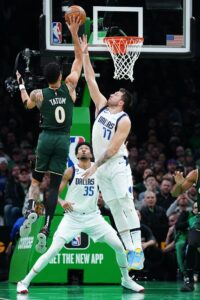 Still, Jokic ranks behind two players that remain atop Wright’s list for a second consecutive week. At No. 1, it’s Mavericks guard Luka Doncic, who leads the NBA with an astonishing 34.0 points per game on a career-best 50.3% from the floor.
As usual, Doncic is filling up the box score, with 9.0 RPG, 8.1 APG, and a career-best 1.8 SPG. He hasn’t gotten a ton of help from his teammates so far, so Dallas is just 9-8 on the season, but the team’s No. 10 seed is somewhat misleading. The West’s top 10 teams are separated by just two games.
Celtics forward Jayson Tatum, the No. 2 player on Wright’s list, has his team’s performance working in his favor. At 14-4, Boston comfortably holds the NBA’s best record in the early going, and Tatum has clearly been the player most responsible for that success. He’s posting a career-best 30.6 PPG to go along with 7.9 RPG, 4.7 APG (a career high), 1.3 BPG (also a career high), and a rock-solid .472/.353/.868 shooting line.
Interestingly, none of these three players are the betting favorite at BetOnline.ag. The site has Bucks forward Giannis Antetokounmpo as the frontrunner at +270, just ahead of Doncic (+275) and Tatum (+280), with Jokic all the way down at +2800 (potential voter fatigue is likely factored into those odds).
Antetokounmpo, the No. 4 player on Wright’s list, certainly has as strong a case as ever. He has missed a little time, but in 14 games, he’s putting up a career-high 30.5 PPG on 52.3% shooting, plus 11.6 RPG and 5.5 APG. He also might be the best defender of the top MVP candidates, with one Defensive Player of the Year award already on his résumé.
Warriors guard Stephen Curry, Wright’s No. 5 choice and the fourth betting favorite on BetOnline, should become a serious contender if Golden State starts winning a few more games. The Warriors are below .500 for now (9-10), but Curry has been as good as ever, with 31.6 PPG on a career-high .524 FG%. He’s also contributing 7.2 APG and 6.6 RPG (a career high) while making an eye-popping 5.2 threes per game at a 44.4% clip.
Grizzlies guard Ja Morant, Sixers center Joel Embiid, and Nets forward Kevin Durant are among the stars capable of making an MVP push, and dark-horse candidates like Cavaliers guard Donovan Mitchell and Suns guard Devin Booker will force their way into the conversation if they continue playing like they have and their teams keep winning.
We want to know what you think. Who would your MVP pick be if the season ended today? Who do you expect to strengthen their case as the season progresses? Who would you put your money on as the year-end winner at this point?
Head to the comment section below to share your thoughts!
Pacers, Spurs Remain Well Below NBA’s Salary Floor
Besides being the NBA’s only two teams with any cap room still available this season, the Pacers and Spurs are also the only two clubs whose team salaries remain well below the league’s salary “floor.”
As we explain in a glossary entry, the salary floor is the minimum amount that NBA teams are required to spend on player salaries in a given season. That amount is set at 90% of the season’s cap, rounded to the nearest thousand. So, since the cap for the 2022/23 campaign is $123,655,000, the floor is $111,290,000.
By our estimation, the Pacers’ team salary for the 2022/23 season is just under $96MM, while the Spurs’ figure is just shy of $95MM. Both clubs have the ability to create upwards of $28-30MM in cap room — they’re also both more than $15MM short of the salary floor.
There’s no rule stating that the Pacers and Spurs must sign free agents or trade for players to make up that $15MM+ difference. Last season, for example, the Thunder finished the season far below the salary floor.
In that scenario, the team is simply obligated to make up the difference by distributing the shortfall to the players on its roster. Oklahoma City players earned a nice year-end bonus last season, and players in Indiana and San Antonio may be hoping that their teams don’t add major salary in the coming months so that they’ll get similar salary bumps at the end of this season.
However, it’s unlikely that the Pacers and Spurs will both simply let all of their leftover cap room go unused. It figures to come in handy leading up to the February 10 trade deadline, when teams around the NBA may be looking to shed a contract or two. Indiana and San Antonio are well positioned to accommodate salary dumps if their trade partners entice them to take on unwanted contracts by attaching draft picks and/or young prospects.
The two teams’ cap room will also allow them to explore mismatched trades. For instance, there have been rumors that the Lakers and Spurs have discussed the possibility of a deal that would send Russell Westbrook and draft compensation to San Antonio in exchange for Doug McDermott and Josh Richardson. McDermott’s and Richardson’s combined cap hit is just below $26MM, which wouldn’t be nearly enough to match Westbrook’s $47MM+ salary if both teams were operating over the cap. But the Spurs could take on that extra salary using their cap space.
As we discussed last week, the Pacers have another potential path for using a big chunk of their cap room and getting above the salary floor. Signing Myles Turner to a contract extension that includes a salary renegotiation for the current season, giving him an immediate raise, would be a way to make use of their cap flexibility and incentivize Turner to sign on the dotted line, assuming there’s mutual interest in a long-term deal. The Spurs don’t have any player eligible for renegotiation.
The Thunder’s relative inactivity at last season’s trade deadline is a reminder that we shouldn’t necessarily expect major action when a team is sitting on unused cap room during the season. Still, it’s safe to assume that teams around the league will be in touch with the Pacers and Spurs in the coming weeks and months, proposing creative ways for the two clubs to make use of their cap flexibility. Indiana and San Antonio will be two teams worth watching closely as February 10 nears.
And-Ones: Frazier, Offseason Moves, 2023 Draft, Rookies
Former Rockets guard Michael Frazier has signed with the Illawara Hawks of Australia’s National Basketball League, the team announced in a press release. Frazier will serve as an injury replacement for another former NBA player, George King.
Frazier, 28, went undrafted out of Florida in 2015 and spent several seasons in the G League, plus one in Italy, before getting an opportunity to make his NBA debut in 2020 for Houston. He appeared in 13 games during the 2019/20 season as a Rocket, then returned to the G League before spending last season in Australia with the Perth Wildcats.
Having seen Frazier play for Perth last season, Illawara Hawks head coach Jacob Jackomas believes his team is getting a quality player: “He is a willing defender with great size and strength, and be it at the 3-point line or getting downhill and attacking the basket, we feel like he will make an immediate impact on the group.”
Here are a few more odds and ends from around the basketball world:
- The Kings, Trail Blazers, and Pacers look like some of the under-the-radar winners of the 2022 offseason, writes ESPN’s Bobby Marks (subscription required). Marks also highlights Magic big man Bol Bol, Bucks guard Jevon Carter, and Suns wing Damion Lee as some of the best value signings of the summer.
- Jonathan Wasserman of Bleacher Report has updated his 2023 mock draft, projecting all 58 picks and providing analysis for each one. Next year’s draft will only be 58 picks instead of 60 because the Sixers and Bulls have forfeited their second-rounders due to free agency gun-jumping violations.
- Sam Vecenie of The Athletic ranks this season’s top 15 rookie performers to date, with Magic forward Paolo Banchero and Pacers guard Bennedict Mathurin leading the way. The only second-round pick to crack the top 15 is Raptors big man Christian Koloko, who was selected 33rd overall but ranks eighth on Vecenie’s list.
2022/23 NBA Disabled Player Exceptions
A disabled player exception can be granted when an NBA team has a player go down with an injury deemed to be season-ending. The exception gives the club some additional spending flexibility, functioning almost as a cross between a traded player exception and a mid-level exception.
We go into more detail on who qualifies for disabled player exceptions and how exactly they work in our glossary entry on the subject. But essentially, a DPE gives a team the opportunity to add an injury replacement by either signing a player to a one-year contract, trading for a player in the final year of his contract, or placing a waiver claim on a player in the final year of his contract.
Because the rules related to disable player exceptions are somewhat restrictive and the exceptions themselves often aren’t worth a lot, they often simply expire without being used. Still, it’s worth keeping an eye on which disabled player exceptions have been granted, just in case.
We’ll use this space to break down the teams with disabled player exceptions available for the 2022/23 league year, updating it as the season progresses if more teams are granted DPEs and/or to indicate which ones have been used.
Teams have until January 15 to apply for a disabled player exception and until March 10 to actually use them.
Here’s the list so far:
Available disabled player exceptions:
- Boston Celtics:
- $3,239,500 (Danilo Gallinari) (story)
The Celtics used the entire taxpayer mid-level exception to bring in Gallinari as a free agent, but the Italian forward tore his left ACL during a World Cup qualifying game before even getting a chance to suit up for Boston.
The Celtics didn’t announce a recovery timeline when they announced Gallinari’s surgery, and the 34-year-old said he’s holding out hope of returning before the team’s season is over. However, the odds appear slim, so Boston was granted a disabled player exception.
Because the C’s have two trade exceptions worth more than the Gallinari DPE, the team probably won’t use it in a trade, but it could come in handy on the buyout market if Boston is up against a rival that can only offer the veteran’s minimum.
- Detroit Pistons:
- $5,276,400 (Cade Cunningham) (story)
The Pistons’ former No. 1 overall pick saw his sophomore NBA season come to an early end due to a left tibial stress fracture. He underwent surgery to address the injury and was limited to just 12 games in 2022/23.
Even though Cunningham is just a second-year player, he was earning over $10.5MM due to the rising rookie scale, so the Pistons received a decently sized disabled player exception as a result of his season-ending surgery.
Detroit won’t be a player on the buyout market, but it’s possible the team could find a use for the exception in a smaller trade.
- Toronto Raptors:
- $3,000,000 (Otto Porter) (story)
Porter underwent season-ending foot surgery less than a week before the deadline to apply for a disabled player exception, allowing the Raptors to get their request in at the 11th hour.
Word of the Raptors being granted a DPE didn’t break until after the trade deadline had already passed, so it’s safe to assume Toronto’s exception won’t be used in a trade. It could be useful on the buyout market, but the Raptors don’t seem likely to be a major player for free agents in February and March.
Used disabled player exceptions:
- Oklahoma City Thunder:
- $4,945,620 (Chet Holmgren) (story)
- Used to acquire Maurice Harkless ($4,564,980) from Hawks.
- $4,945,620 (Chet Holmgren) (story)
Like Gallinari, Holmgren had yet to make his regular season debut for his new team when he suffered a season-ending injury in a non-NBA game. The No. 2 pick in this year’s draft had at least played for the Thunder in the Las Vegas Summer League before he went down with a a Lisfranc injury in his right foot during a Seattle pro-am game.
Because Holmgren was such a high draft pick, his salary as a rookie is nearly $10MM, allowing the Thunder to receive a disabled player exception big enough to absorb Harkless’ $4.5MM+ expiring contract in a deal with Atlanta.
The Thunder sent out Vit Krejci in that trade, but he only had a $781,759 partial guarantee, and even if his $1,563,518 had been fully guaranteed as part of the deal, it wouldn’t have been enough to match Harkless’ incoming salary. As such, Oklahoma City had to use an exception to complete the deal.
Harkless wasn’t part of OKC’s plans for the 2022/23 season (he was subsequently flipped to the Rockets in a salary dump), but taking him on allowed the Thunder to acquire a future second-round pick from the Hawks and amend the protections on another second-rounder owed to them by Atlanta.
Raptors Notes: Injuries, Trent, Young, Anunoby
The Raptors have been hit hard by the injury bug this month and played Wednesday’s game – a loss to Brooklyn – without Pascal Siakam (groin), Fred VanVleet (non-COVID illness), Scottie Barnes (ankle), Precious Achiuwa (ankle), Dalano Banton (ankle/illness), and Otto Porter Jr. (toe).
Although head coach Nick Nurse is known for getting creative with lineups and schemes, he said on Wednesday that he’s not exactly relishing the opportunity to have to cobble together five-man units without so many of his key players available, according to Michael Grange of Sportsnet.ca.
“Not really, to be honest with you. Once in a while, you might enjoy the challenge, but not for three weeks in a row here. It’s getting… it’s not that enjoyable,” Nurse said. “… It’s not the end of the world, and it’s not like we haven’t played very well, because I think we have. If you look at some of our metrics… I think we’re still top 10 in offense and defense in the league and all that stuff, with all these injuries we’ve had for multiple weeks.”
The Raptors do have the 10th-best offensive rating in the NBA (112.7), but have slipped a few spots on defense in the last week and now rank 14th in defensive rating (110.9).
Here’s more out of Toronto:
- Gary Trent Jr.‘s offense has been up and down this season, as he’s shooting just 40.7% from the floor and 31.1% on three-pointers, his worst marks since his rookie year. However, Nurse is more concerned about Trent’s regression as a defender this season, and issued a challenge this week to the fifth-year swingman. “We’re gonna get him his shots and get him his points, but we want him to be a disruptor,” Nurse said, per Josh Lewenberg of TSN.ca. “He kinda fits us if he does that, and if he doesn’t, he doesn’t fit us.”
- According to Lewenberg, the Raptors told inquiring teams over the summer that they view Trent as an important part of their core, so it’s unlikely that stance has changed this early in the season. Still, he’ll be a player worth watching as the season progresses. He holds an $18.8MM player option for 2023/24, so he can become an unrestricted free agent next summer if he declines that option.
- Veteran forward Thaddeus Young wasn’t part of Toronto’s regular rotation during the first couple weeks of the season, but he has been playing more lately and has provided some stability with so many players sidelined, Lewenberg writes in a separate TSN.ca story. “He’s been good. He’s doing a good job leadership-wise, too,” Nurse said of Young. “He’s good in the huddles and he’s trying to keep those guys going. So, he’s been a true pro.”
- The Raptors have several talented defenders on their roster, but OG Anunoby has turned into the club’s top weapon on that side of the ball, says Doug Smith of The Toronto Star. Anunoby is under contract through the 2023/24 season, with a player option for ’24/25, and will become extension-eligible next October.
Knicks’ Isaiah Hartenstein Discusses Role, Achilles Issue
Last season with the Clippers, center Isaiah Hartenstein served as a play-maker in the middle, averaging 4.7 assists per 36 minutes. According to Stefan Bondy of The New York Daily News, the Knicks sold Hartenstein on playing a similar role in New York when he joined the team in the offseason as a free agent.
However, so far this fall, Hartenstein is handing out a career-low 1.2 assists per 36 minutes and averaging just 0.8 seconds per touch (as opposed to 2.06 seconds per touch last season). The big man acknowledged on Wednesday that he has been asked to play more like a traditional center with the Knicks.
“It’s adjusting to a different role where it’s playing more like (the Knicks’ other centers), I guess. Not more of what I’m used to,” Hartenstein said. “That’s been a little more difficult. And so I’m just adjusting to more of a Mitch (Robinson) role, where I’m just rolling into the pick-and-roll.”
As Bondy relays, Hartenstein reiterated multiple times during his media session that he’s fine with making the adjustment, but said it has been a challenge and has required some extra film work to get comfortable.
It doesn’t help that the 24-year-old has been dealing with an inflamed Achilles tendon since the summer and still only feels “about 80 percent.” Hartenstein believes the issue is hindering his athleticism and may be having an impact on his defense and rebounding, according to Bondy.
“I feel like I’m a little slower than I normally am,” he said. “Little slower to get up to defend the shots where I normally am able to do really good.”
When Robinson missed some time this month due to a knee injury, third-string center Jericho Sims entered the rotation and had some strong performances. With Robinson back, all three centers have played at least 13 minutes apiece in each of the Knicks’ past two games, but Bondy says head coach Tom Thibodeau typically prefers to use just two centers in his rotation, especially if he wants to try to get Julius Randle and Obi Toppin some minutes together.
Hartenstein, who signed a two-year, $16MM contract and has appeared in every game so far this season, may not end up being the odd man out, but he said he’s willing to accept a reduced role if the team wants to lean more on its traditional centers or use a two-power-forward look.
“I know what I can do,” Hartenstein said. “It’s now just doing whatever I can do in the role that’s given to me. I have a lot of respect for Jericho and Mitch. So if that’s what coach thinks is the best thing to do – if coach thinks it’s best to go with Julius and Obi, then do that. I’m just here to help the team win at the end of the day and if coach thinks that way, or if coach thinks that way. I’m ready to do that.”
Hoops Rumors Glossary: Disabled Player Exception
Most salary cap workarounds, such as the mid-level exception, can be used every year — or at least every other year, as in the case of the bi-annual exception. However the disabled player exception is only available under certain circumstances. Like other salary cap exceptions though, the DPE allows a team to sign a player without using cap space.
If a player is seriously injured, his team can apply for the disabled player exception to replace him. In order for the exception to be granted, an NBA-designated physician must determine that the player is “substantially more likely than not” to be sidelined through at least June 15 of that league year.
If granted, the disabled player exception allows a club to sign a replacement player for 50% of the injured player’s salary or for the amount of the non-taxpayer’s mid-level exception, whichever is lesser.
For instance, if a team is granted a disabled player exception for a player earning $10MM, the exception would be worth $5MM. But if the injured player is earning $30MM, the DPE would be worth the equivalent of the mid-level exception (this season, that’s $10,490,000).
A team must formally apply for a disabled player exception and it requires the approval of the league. The cutoff to apply for a DPE each season is January 15. If a team has a player go down with a season-ending injury after that date, it cannot obtain a DPE to replace him. A team must also use the exception by March 10 of the current season or it will expire.
Unlike mid-level, bi-annual, or trade exceptions, the disabled player exception can only be used on a single player, rather than spread out across multiple players. However, a team can use it in a variety of ways — the DPE can be used to sign a free agent, to claim a player off waivers, or to acquire a player in a trade.
If a team uses its disabled player exception to take on salary in a trade, it can acquire a player making up to 100% of the DPE amount, plus $100K. For example, a $5,000,000 DPE could be used to trade for a player making $5,100,000.
A free agent signed using the DPE can only be offered a rest-of-season deal, while a player acquired via trade using the DPE must be in the final year of his contract. A player claimed off waivers must also be in the final year of his contract, and his salary must fit into the team’s DPE. Essentially, the purpose of the exception is to give the team some flexibility to replace a player following a season-ending injury, but not beyond the current season.
The team must have room on its roster to sign the replacement player — the disabled player exception doesn’t allow the club to carry an extra man.
In the event that a team is granted a disabled player exception, uses it to acquire a player, and then has its injured player return ahead of schedule (ie. before the end of the season), the team is allowed to carry both players.
However, if a team has an unused disabled player exception and then trades its injured player, the team would lose the exception. The same is true if the injured player returns to action before the DPE has expired or been used.
Most disabled player exceptions ultimately go unused, but some come in handy in trades. For example, after being granted a DPE in the wake of Chet Holmgren‘s season-ending foot injury earlier this year, the Thunder used that exception to acquire Maurice Harkless from Atlanta in a deal where Vit Krejci‘s outgoing salary wasn’t sufficient for matching purposes.
Note: This is a Hoops Rumors Glossary entry. Our glossary posts explain specific rules relating to trades, free agency, or other aspects of the NBA’s Collective Bargaining Agreement. Larry Coon’s Salary Cap FAQ was used in the creation of this post.
Earlier versions of this post were published in 2012 and 2017.