
10-Day Contract Window Opens Sunday; Salary Guarantee Deadline Looms
As of tomorrow – Sunday, January 5 – NBA teams can begin signing free agents to 10-day contracts.
A 10-day contract, as we outline in our glossary entry, allows a team to add a player to its roster for either 10 days or three games (whichever occurs later) without any commitment beyond that. A player can sign up to two 10-day deals with the same team in a single season — after those two contracts, the team must decide whether to sign him to a rest-of-season contract or part ways with him.
For some teams, the 10-day contract provides an opportunity to take a flier on a young player to see if he deserves a longer-term look. Other clubs may utilize 10-day deals for short-term injury fill-ins or simply to meet minimum roster requirements.
The NBA’s 10-day signing window always opens just ahead of the league-wide salary guarantee deadline. If a team wants to let go of a player on a non-guaranteed contract to avoid being on the hook for his full-season salary, it must release that player on or before Tuesday, January 7 to ensure he clears waivers prior to the guarantee date of Jan. 10.
The start of the 10-day contract period and the salary guarantee deadline go hand in hand, since teams cutting players before their salaries become fully guaranteed often sign players to 10-day contracts to fill those newly opened roster spots. In some cases, the same player who was waived at the salary guarantee deadline returns to his team on a 10-day contract, as clubs looks to maximize their roster flexibility.
The Timberwolves waived PJ Dozier last week before his full-season salary could become guaranteed. No other players on non-guaranteed deals have been cut since then, but we’ll likely see at least a small handful released by Tuesday evening.
Eleven teams, including Minnesota, currently have an 15-man roster opening, though most of those clubs won’t rush to fill their open roster spots with 10-day signees. Nine of the 11 teams with roster openings are in luxury tax territory and a 10th (Detroit) has cap room, so they won’t be eager to add even a modest 10-day cap hit to their books, since it would increase their tax penalty or cut into their cap room. The Rockets are the only team with an open roster spot that doesn’t fall into either category.
Teams may also want to maximize their roster flexibility in advance of the trade deadline — the majority of 10-day signings during a typical season occur after the deadline has passed.
Hoops Rumors Glossary: Hard Cap
The NBA’s salary cap is a “soft” cap, which is why most teams’ salaries have surpassed the $140,588,000 threshold for the 2024/25 season. Once a team uses up all of its cap room, it can use a series of “exceptions” – including the mid-level, bi-annual, and various forms of Bird rights – to exceed the cap.
Since the NBA’s Collective Bargaining Agreement doesn’t feature a “hard” cap by default, teams can construct rosters that not only exceed the cap but also blow past the luxury tax line ($170,814,000 in ’24/25). While it would be nearly impossible in practical terms, there’s technically no rule restricting a club from having a team salary worth double or triple the salary cap.
However, there are certain scenarios in which a team can become hard-capped at one of two thresholds, known as the “tax aprons.” Those scenarios are as follows:
A team becomes hard-capped at the first tax apron if:
- The team uses its bi-annual exception to sign a player or to acquire a player via trade or waiver claim.
- The team uses more than the taxpayer portion of the mid-level exception to sign a player (or multiple players).
- Note: In 2024/25, the taxpayer MLE is worth $5,168,000, compared to $12,822,000 for the full non-taxpayer MLE. The taxpayer MLE can be used to complete deals up to two years, while the non-taxpayer MLE can be used to complete deals up to four years.
- Note: In 2024/25, the taxpayer MLE is worth $5,168,000, compared to $12,822,000 for the full non-taxpayer MLE. The taxpayer MLE can be used to complete deals up to two years, while the non-taxpayer MLE can be used to complete deals up to four years.
- The team uses any portion of its mid-level exception to acquire a player via trade or waiver claim.
- The team acquires a player via sign-and-trade.
- The team signs a player who was waived during the current regular season and whose pre-waiver salary exceeded the amount of the non-taxpayer mid-level exception for that season.
- The team takes back more than 100% of the salary it sends out in a trade via salary-matching.
- The team uses a traded player exception generated during the prior year (ie. between the end of the previous regular season and the end of the most recent regular season).
A team making any of those roster moves must ensure that its team salary is below the first tax apron when it finalizes the transaction and remains below the apron for the rest of the league year.
For the 2024/25 league year, the first apron is set at $178,132,000, which is $7,318,000 above the tax line. A team that completes one of the moves listed above can’t surpass that line under any circumstances.
A team becomes hard-capped at the second tax apron if:
- The team uses any portion of the mid-level exception (up to the taxpayer amount) to sign a player.
- The team aggregates two or more player salaries in a trade.
- The team sends out cash as part of a trade.
- The team sends out a player via sign-and-trade and either uses that player’s outgoing salary to take back a contract or uses the resulting traded player exception to acquire a player via trade or waiver claim.
For the 2024/25 league year, the second apron is set at $188,931,000, which is $18,117,000 above the tax line.
So far in ’24/25, a total of 15 teams have hard-capped themselves at the first tax apron by acquiring a player via sign-and-trade, using the non-taxpayer mid-level exception, using the bi-annual exception, taking back more than 100% of the outgoing salary in a trade, or using a traded player exception generated last season.
Three more teams have hard-capped themselves at the second apron by using the mid-level exception, aggregating player salaries, sending out cash in a trade, or taking back salary for a player sent out via sign-and-trade.
For many of those teams, the restriction is barely noticeable — they remain far below their hard cap and haven’t had to worry about whether a roster move might put them over it. However, a handful of clubs, including the Warriors, Mavericks, and Knicks, will have to be wary of that hard cap as they approach the trade deadline.
It’s worth noting that even if a team starts a new league year above the tax apron, that doesn’t mean they can’t become hard-capped at some point later in the season. For example, the Bucks are currently operating above the second apron, but if they were to shed significant salary in a trade and then aggregated salaries in a subsequent deal, a hard cap would be imposed and they’d be ineligible to surpass the $188.9MM second apron for the rest of the league year.
In other words, the hard cap applies from the moment a team completes one of the transactions listed above, but isn’t applied retroactively.
Typically, a team’s hard cap expires on June 30 when the current league year comes to an end, with the team getting a clean slate on July 1. However, under the current CBA, if a team engages in any of the trade-related transactions prohibited for first or second apron teams between the end of the regular season and June 30, the team will not be permitted to exceed that apron level during the following season.
If, for example, a team sends out cash in a trade in June of 2025, that team won’t be allowed to exceed the second tax apron during the 2025/26 league year. The inverse is also true — a team whose 2025/26 salary projects to be over the second apron won’t be able to trade cash in June.
This rule only applies to trade-related transactions because the ones related to free agency don’t come into effect between the end of the regular season and the start of the next league year.
We go into more detail in a separate story on the transactions that result in hard caps for NBA teams.
Note: This is a Hoops Rumors Glossary entry. Our glossary posts will explain specific rules relating to trades, free agency, or other aspects of the NBA’s Collective Bargaining Agreement. Larry Coon’s Salary Cap FAQ was used in the creation of this post.
Previous versions of this post was published in 2020, 2021, and 2023.
NBA Dates, Deadlines To Watch In January
At the start of the 2024/25 campaign, we looked ahead and identified several dates and deadlines to watch on the NBA calendar this season. While that list covered the general highlights, it’s worth taking a closer look at some of those key dates to keep an eye out for in January, which should be a busy month.
Let’s dive in…
Non-guaranteed contracts become guaranteed
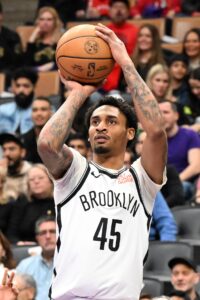 January 10 is the date that all non-guaranteed NBA contracts for 2024/25 will officially become guaranteed, but January 7 is really the day to watch.
If a team wants to avoid having a salary become guaranteed, the player must clear waivers before January 10, which means he needs to be cut by January 7 — at the latest.
There are currently 23 players around the NBA who are on non-guaranteed deals. Many of those players without fully guaranteed salaries aren’t in danger of being waived by next Tuesday, but some teams will take the opportunity to save a little money and open up a roster spot.
[RELATED: Examining Upcoming Decisions On Non-Guaranteed Salaries]
Players on two-way deals (which are non-guaranteed) are subject to that January 7 waiver deadline as well, and will have their salaries become fully guaranteed if they’re still under contract as of January 8.
Prior to the 2023/24 season, the annual salary guarantee date for players on two-way contracts was January 20, but that changed in the NBA’s latest Collective Bargaining Agreement.
Teams can begin signing players to 10-day contracts
As of January 5, clubs will be able to sign players to standard 10-day contracts, which count against team salary for cap and tax purposes and require an opening on the 15-man roster to complete.
Prior to Jan. 5, teams were able to sign players to 10-day contracts only if they qualified for a hardship exception. While there were at least one or two injury-plagued teams who met the criteria for that exception in the fall, no teams have completed a hardship 10-day signing so far in 2024/25.
Rebuilding teams generally use 10-day contracts to audition G League standouts or other prospects to see if they might be worth investing in beyond this season. Contending clubs are more inclined to use 10-day contracts to bring in veterans who can step in right away to address a need or provide depth at a position hit hard by injuries.
Currently, 11 teams have an open spot on their 15-man rosters, making them candidates to sign a player to a 10-day deal. That number will likely increase after next week’s salary guarantee deadline.
More players become trade-eligible
 A significant portion of the NBA’s offseason signees became eligible to be traded on December 15, but there are still many players who can’t be dealt. By the end of January, that list of players ineligible to be traded will shrink further, since there are 28 players currently on track to have those restrictions lift between now and January 31.
January 15 is the key date, with 17 players becoming trade-eligible as of that Wednesday. That 17-player group includes several standouts who almost certainly aren’t going anywhere, such as OG Anunoby and Tyrese Maxey.
Still, a handful of players on the list could be involved in trade rumors in 2025. Some, like Patrick Williams, Precious Achiuwa, KJ Martin, and Josh Okogie, have already been the subjects of speculation.
Eleven other offseason signees have unique trade-eligible dates in January, since they either signed as a free agent in October or inked a veteran extension in July.
That list features names both big (like Bam Adebayo) and small (such as DaQuan Jeffries). None of the 11 players in that group have been at the center of any real trade rumors so far this season though.
Last day to apply for a disabled player exception
January 15 is the last day that teams can apply for a disabled player exception to replace an injured player who is deemed unlikely to return this season. If a player suffers a season-ending injury on January 16, his team would be ineligible to apply for a DPE.
A disabled player exception gives a club some extra cap flexibility, but not an extra roster spot, so they often go unused. So far this season, the Hornets, Jazz, and Nuggets have each been granted one DPE, while the Pacers have received two.
NBA Players Who Can’t Be Traded This Season
As we explained when we identified the players who will become trade-eligible on unique dates this season, there’s a small group of players whose trade restrictions won’t lift until sometime after the February 6 trade deadline. These players meet one of the following criteria:
- They signed a free agent contract or were promoted from a two-way contract after November 6.
- A player who signs a free agent contract or is promoted from a two-way contract is ineligible to be traded for at least three months.
- They signed a veteran contract extension (meeting certain criteria) after August 6.
- A player who signs a veteran extension that keeps him under contract for more than four total years (including his current contract), includes a first-year raise greater than 20%, includes a subsequent raise exceeding 5%, or includes a renegotiation is ineligible to be traded for six months.
- They signed a super-max contract.
- A player who signs a super-max contract (also known as a designated veteran contract) is ineligible to be traded for one year.
We identified all the players who fell into these three categories in our previous story on unique trade dates, but they may have slipped through the cracks amid the larger list of players we discussed in that article.
With that in mind, we want to specifically single them out today to make sure it’s clear which players won’t become trade-eligible at all until sometime after the 2024/25 regular season.
Here are the players who fall into the three aforementioned groups and who can’t be traded this season:
Players who have signed standard contracts since November 6:
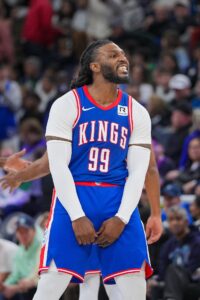 Branden Carlson (Thunder)
- Jae Crowder (Kings)
- Keshad Johnson (Heat)
- Paul Reed (Pistons)
- Landry Shamet (Knicks)
There hasn’t been a ton of action on the free agent market since the regular season began, with most players who have signed with NBA teams receiving two-way contracts rather than standard deals.
Still, the Thunder and Kings added 15th men on non-guaranteed contracts; the Heat promoted Johnson from his two-way deal; and the Knicks and Pistons re-signed veterans whom they waived earlier in 2024/25.
All of those players are ineligible to be moved this season, and this list will continue to grow if more free agents sign standard contracts between now and February 6.
Players who have signed veteran contract extensions meeting certain criteria since August 6:
- Wendell Carter Jr. (Magic)
- Alex Caruso (Thunder)
- Joel Embiid (Sixers)
- Aaron Gordon (Nuggets)
- Lauri Markkanen (Jazz)
- T.J. McConnell (Pacers)
- Jamal Murray (Nuggets)
- Ivica Zubac (Clippers)
A few players on this list wouldn’t have been trade candidates regardless of whether or not they signed extensions in recent months. Others, including Carter and Markkanen, had been the subject of offseason trade speculation. Now all of them are ineligible to be dealt until the 2025 offseason.
It’s not uncommon for some players who are eligible for in-season veteran extensions to sign new deals well into the season, as Caruso did last week, so it’s certainly possible more names will be added to this group before February’s trade deadline.
Players who have signed super-max contracts:
- Jayson Tatum (Celtics)
Tatum signed his designated veteran extension on July 6, 2024, which means he won’t become trade-eligible until July 6, 2025.
No other players will join the Celtics forward on this list prior to next month’s trade deadline, since super-max deals can’t be signed during the season.
Note: This article refers to players on standard contracts. Players on two-way contracts can’t be traded for 30 days after signing, meaning any player who signs a two-way deal after January 7 this season will be ineligible to be dealt by the deadline.
What Each NBA Team Can, Can’t Do On The Trade Market
The NBA’s current Collective Bargaining Agreement went into effect at the start of the 2023/24 season, but not all of the new rules and restrictions in that agreement were implemented immediately. Many of them were introduced when the ’24/25 league year began, which means that this is the first season the new CBA is really showing its teeth.
With so many new rules in place, it’s worth taking a closer look at exactly how each team will be affected as they pursue trades this season. In the space below, we’re examining what every club can and can’t do on the trade market ahead of the February 6 deadline.
Within each section, we’re sorting teams by their total apron salary (as of Dec. 25), from highest to lowest.
Let’s dive in…
Teams operating above the second tax apron:
- Phoenix Suns
- Minnesota Timberwolves
- Boston Celtics
- Milwaukee Bucks
Teams whose total salaries exceed the second tax apron of $188,931,000 don’t face any sort of hard cap, but their trade options are limited. Here are the restrictions they face:
❌ Not permitted to aggregate two or more player salaries for matching purposes.
❌ Not permitted to use an outgoing player’s salary for matching purposes to take back more than 100% of his salary.
❌ Not permitted to use a traded player exception that was generated during the 2023/24 regular season.
❌ Not permitted to use a traded player exception that was generated using a signed-and-traded player.
❌ Not permitted to use the bi-annual exception or mid-level exception to acquire a player via trade.
❌ Not permitted to send out cash in a trade.
The first two rules here explain why, when we talk about the reported mutual interest between Jimmy Butler and the Suns, we say that Phoenix could only acquire Butler by trading Kevin Durant, Devin Booker, or Bradley Beal. The Suns can’t aggregate two or more players salaries to match Butler’s $48.8MM cap hit, and Durant, Booker, and Beal are the only three players on their roster whose salaries are higher than Butler’s.
The third and fourth rules listed here both apply to the Timberwolves. They created a $4MM trade exception at last season’s trade deadline when they sent out Troy Brown and generated an $8.78MM TPE during the summer when they signed-and-traded Kyle Anderson to Golden State. They’re not permitted to use either.
Here are a few things that second-apron teams can do on the trade market:
✅ Acquire a player using the minimum salary exception.
✅ Acquire a player using a traded player exception created during the 2024 offseason or earlier in the 2024/25 regular season (as long as it wasn’t created using a signed-and-traded player).
✅ Send out multiple players in the same trade (as long as their salaries aren’t aggregated).
✅ Trade draft picks up to seven years out (2031).
The rule prohibiting second-apron teams from taking back more salary than they send out only applies when the outgoing player salary is being used for matching purposes. That means any club is allowed to acquire a player who is on a one- or two-year minimum-salary contract using the minimum salary exception.
The minimum salary exception allowance can be used on its own or as part of a larger deal. For instance, if the Suns were to send Beal ($50.2MM) to Miami in exchange for Butler ($48.8MM) and Alec Burks (who is on a minimum-salary contract with a cap hit of $2.1MM), they’d technically be taking back more total salary than they’re sending out. However, because only Beal’s salary would be used to match Butler’s, with Burks acquired “separately” using the minimum salary exception, the swap would be legal.
Circling back to the Timberwolves’ traded player exceptions, while we’ve already mentioned a couple trade exceptions that they can’t use, they do have TPEs worth $2.5MM and $4.7MM created in this year’s Wendell Moore and Karl-Anthony Towns deals that they can use, since they were created since the offseason began in non-sign-and-trade moves.
The fourth item here serves as a reminder that the rule freezing a second-apron team’s first-round draft pick seven years out won’t go into effect until the 2025 offseason. So these teams are still permitted to trade their 2031 first-rounders this season — the Wolves have already done so, but the other three haven’t.
Teams operating between the first and second aprons:
- Los Angeles Lakers
- New York Knicks *
- Miami Heat
- Denver Nuggets *
- Philadelphia 76ers
(* Teams marked with an asterisk are hard-capped at the second apron.)
In addition to doing everything that second-apron teams can do on the trade market, teams operating above the first apron ($178,814,000) and below the second apron can also do the following:
✅ Aggregate two or more player salaries for matching purposes.
✅ Send out cash in a trade.
✅ Use a traded player exception that was generated using a signed-and-traded player.
However, the following restrictions remain in place for teams operating over the first apron:
❌ Not permitted to use an outgoing player’s salary (or two or more aggregated player salaries) for matching purposes to take back more than 100% of that salary.
❌ Not permitted to use a traded player exception that was generated during the 2023/24 regular season.
❌ Not permitted to use the bi-annual exception or mid-level exception to acquire a player via trade.
It’s important to note that if a team aggregates salaries, sends out cash, or uses a TPE generated via a sign-and-trade, that club becomes hard-capped at the second apron for the remainder of the league year. That’s already the case for the Knicks, who aggregated salaries in both the Mikal Bridges and Towns blockbusters.
The Nuggets are also hard-capped at the second apron, though that was the result of a move in free agency, not on the trade market — they used the taxpayer mid-level exception to sign Dario Saric.
While the other three teams in this group don’t currently face a hard cap, it’s something they’ll have to keep in mind as they navigate the trade market. For example, the Lakers are operating just $30K below the second apron, so if they aggregate salaries in a deal before the Feb. 6 deadline, they’ll face a second-apron hard cap for the rest of the season, which will significantly limit their ability to make additional moves (unless they shed some salary in the trade that hard-caps them).
Teams operating over the salary cap and below the first apron:
- Golden State Warriors *
- Dallas Mavericks *
- New Orleans Pelicans *
- Cleveland Cavaliers
- Los Angeles Clippers *
— Luxury tax line — - Indiana Pacers
- Atlanta Hawks *
- Brooklyn Nets *
- Sacramento Kings *
- Memphis Grizzlies *
- Portland Trail Blazers
- Chicago Bulls *
- Toronto Raptors *
- Washington Wizards *
- Houston Rockets *
- Oklahoma City Thunder *
- Charlotte Hornets *
- San Antonio Spurs
- Orlando Magic
- Utah Jazz *
(* Teams marked with an asterisk are hard-capped at the first apron.)
While these teams all technically fall into the same category, there are some major differences among their respective situations. The Jazz, for instance, are narrowly above the salary cap and have more than $27MM breathing room below the luxury tax line, giving them significantly more flexibility than a team like the Hawks, who are hovering about $1.3MM below the tax line and $5.4MM from the first apron.
Those teams right below the tax, like the Pacers, Hawks, and Nets, will have to be careful about adding extra salary, since they’ll have no desire to become taxpayers. Teams right up against first-apron hard caps like the Warriors and Mavericks will also be limited in their ability to take on extra salary, even if they wouldn’t mind doing so.
Generally speaking, however, these are the actions that teams in this group are allowed to take on the trade market:
✅ Everything that first-apron teams are allowed to do.
✅ Use one or more outgoing salaries up to $7,500,000 to take back up to 200% of that salary (plus $250K) via matching.
✅ Use one or more outgoing salaries between $7,500,001 and $29,000,000 to take back up to that salary plus $7.5MM via matching.
✅ Use one or more outgoing salaries worth above $29,000,000 to take back up to 125% of that salary (plus $250K) via matching.
✅ Use a traded player exception that was generated within the past year (with a $250K allowance above the TPE amount).
✅ Use the bi-annual exception or mid-level exception to acquire a player via trade.
Again, a team’s ability to take advantage of each of these rules varies depending on that club’s specific position relative to the first apron.
For example, while these salary-matching rules suggest the Warriors would be permitted to take back up to nearly $33.8MM in return for Andrew Wiggins‘ outgoing salary (approximately $26.3MM), they’re only about $330K away from their first-apron hard cap, which they’re not allowed to exceed. So without a move that sheds salary, Golden State can’t take back more than about $26.6MM for Wiggins.
On the other hand, a team like the Jazz, with so much space to operate below the first apron, would have no problem taking back up to approximately $34.1MM in incoming salary in exchange for John Collins‘ $26.6MM outgoing amount.
Teams operating below the salary cap:
- Detroit Pistons
The Pistons, who are currently sitting about $14MM below the salary cap, are the only NBA team that still has cap room available.
Because they’re below the cap, the Pistons don’t have the mid-level exception, bi-annual exception, or any traded player exceptions available, so they can’t acquire players using any of those paths. However, they can do the following:
✅ Acquire incoming salary up to the salary cap ($140,588,000), plus $250K.
✅ Use the room exception to acquire a player via trade.
Although the Pistons only have about $14MM in room, they could acquire a player earning more than that amount if they send out a player as part of the transaction. For example, if they were to trade Tim Hardaway Jr., who has a cap hit of about $16.2MM, they could take back a player earning a little over $30MM, since the swap would still leave them at the salary cap cutoff.
However, Detroit isn’t permitted to combine its cap room and its room exception — cap space and the room exception operate separately, so the remaining room could be used to acquire a $14MM player and the room exception could be used to take on a player earning nearly $8MM, but they couldn’t be paired to acquire a player earning $22MM.
Community Shootaround: Christmas Day Games
Merry Christmas from the Hoops Rumors staff!
As usual, the NBA has a five-game slate on tap for Christmas Day, with many of the league’s top teams and biggest stars in action on December 25. Here’s today’s schedule:
- 11:00 am CT: San Antonio Spurs (15-14) at New York Knicks (19-10)
- 1:30 pm CT: Minnesota Timberwolves (14-14) at Dallas Mavericks (19-10)
- 4:00 pm CT: Philadelphia 76ers (10-17) at Boston Celtics (22-7)
- 7:00 pm CT: Los Angeles Lakers (16-13) at Golden State Warriors (15-13)
- 9:30 pm CT: Denver Nuggets (16-11) at Phoenix Suns (14-14)
While the goal on Christmas Day is generally to showcase some of the day’s biggest stars and best teams, this year’s schedule is a little lacking in the latter.
Despite featuring seven teams from the Western Conference, today’s slate of games doesn’t include any of the West’s top three seeds, the Thunder, Rockets, and Grizzlies. While Houston and Memphis weren’t necessarily expected to be this good, Oklahoma City’s absence is conspicuous, given that the Thunder were the No. 1 seed in the West last season.
Over in the East, we’ve got the No. 2 and 3 seeds in action today, but the NBA’s best team, the 26-4 Cavaliers, won’t be part of the Christmas Day slate. Instead, the third Eastern club is the 12th-seeded Sixers, who have been plagued by injuries but at least will have their big three available on Wednesday — Tyrese Maxey and Paul George aren’t on the injury report, and Joel Embiid is listed as available.
Despite the absence of so many top teams, each matchup still has something going for it, with plenty of star power on display.
The afternoon will feature rising phenom Victor Wembanyama visiting Madison Square Garden and the streaking Knicks, who have won four games in a row; a rematch of last year’s Western Conference Finals between the Timberwolves and Mavericks, who should have star guards Kyrie Irving (available) and Luka Doncic (probable) active today; and those aforementioned three Sixers stars going up against the defending champions in Boston.
The first evening contest between the Lakers and Warriors pits the No. 7 seed in the West against No. 8, but it also could be one of the last few times that NBA legends LeBron James and Stephen Curry face one another. James is considered questionable due to left foot injury management, but I’d be shocked if he didn’t play. A couple more would-be Western contenders who have had up-and-down starts will wrap up the day when the Nuggets visit Phoenix in a game that will feature a pair of former MVPs in Nikola Jokic and Kevin Durant.
We want to know what you think. Are there any teams you wish were or weren’t part of today’s schedule? Which of these five games are you most looking forward to? Which five teams are you picking to win this year’s Christmas Day matchups?
Head to the comment section below to weigh in, and feel free to use it as an open thread to discuss today’s games.
Community Shootaround: Pistons’ Postseason Chances
The Pistons won only 14 games last season, their worst mark in franchise history. With a new head coach and revamped front office, they’re no longer a laughingstock.
In many games last season, the Pistons looked overmatched from the opening tip. Thanks to some veteran upgrades, they’ve put up a fight in most games this season.
Following road wins against the Suns and Lakers, Detroit is now just one shy of last season’s win total at 13-17. Cade Cunningham (23.9 points, 9.7 assists, and 7.0 rebounds per game) is playing at an All-Star level.
Backcourt partner Jaden Ivey (17.4 PPG, 4.2 APG, 4.2 RPG) has played with more confidence under new coach J.B. Bickerstaff. President of basketball operations Trajan Langdon signed or traded for Tobias Harris, Tim Hardaway Jr. and Malik Beasley to complement the team’s young core. Those additions have made a major difference.
Beasley, in particular, has proved to be a bargain signing on a one-year deal. He’s averaging 16.6 points per game, mostly off the bench, while making 41.6 percent of his three-pointers.
Naturally, those vets could be dealt for assets, but that’s not a given. There’s value in learning how to win and perhaps getting a taste of the postseason.
The latter is not far-fetched. The Pistons are currently tied for ninth in the Eastern Conference, which would get them one of the last two play-in spots.
Detroit has posted some other solid wins this season. The Pistons have notched two overtime victories over the Heat, a home win over the Lakers and road victories against the Pacers and Knicks.
Most of the teams behind them are either in tank mode or simply awful. Among that group, only the Sixers figure to move up the standings. On the flip side, the Bulls and Hawks could slide down the standings, depending on what they decide to do in the trade market.
That brings us to today’s topic: Will the Pistons, last season’s worst team, qualify for the play-in tournament? Should they hold onto to the veterans who have improved the team or should they look to deal them for assets?
Please take to the comments section to weigh in on this topic. We look forward to your input.
Community Shootaround: 2024/25 NBA MVP Race
As we relayed on Friday, three-time Most Valuable Player Nikola Jokic led the way in the first MVP straw poll conducted by ESPN’s Tim Bontemps for the 2024/25 season. However, while Jokic earned 57 first-place votes from the 100 media members polled by Bontemps, it’s clearly a three-player race at this point.
Jokic totaled 827 total points in the voting, with Thunder guard Shai Gilgeous-Alexander at 678 points and Bucks forward Giannis Antetokounmpo at 643. Gilgeous-Alexander received 24 first-place votes, while Antetokounmpo got 19 — no other player earned a single first-place vote, and Celtics forward Jayson Tatum was the only other player to even claim a second-place vote (he got three).
Plenty could change between now and the end of the regular season, and injury luck is always a factor, but it seems highly likely at this point that one of Jokic, Gilgeous-Alexander, or Antetokounmpo will be named this season’s Most Valuable Player. Here are their cases so far:
Nikola Jokic:
As usual, the Nuggets center has been an advanced-stats star. He leads the NBA in player efficiency rating (31.9), win shares per 48 minutes (.287), box plus/minus (12.8), and value over replacement player (3.0).
Of course, Jokic’s traditional stats look awfully impressive too. His 31.0 points per game would be a career best, as would his league-leading 50.0% mark on three-point attempts. He’s nearly averaging a triple-double, with 13.0 rebounds and 9.8 assists per game.
The main knock against Jokic at this point is that his Nuggets are fighting to stay out of play-in territory — they’re currently tied for sixth in the Western Conference at 14-11. But it’s hard to blame the big man for that modest record. Denver has a +9.7 net rating in his 819 minutes on the court, while their net rating in the 391 minutes he hasn’t played is a brutal -14.3.
Shai Gilgeous-Alexander:
Gilgeous-Alexander is averaging 30.3 points, 6.2 assists, and 5.5 rebounds per game with a 50.8% field goal percentage, a very strong mark for a guard. He’s also the only player in the NBA who is averaging at least two steals and one block per contest.
The fact that MVPs historically come from teams at or near the top of the standings works in SGA’s favor — his Thunder are 22-5, which is the second-best record in the league and the top mark in the Western Conference. Oklahoma City has a three-game lead in the conference standings on the No. 2 Rockets.
While his supporting cast is certainly stronger than Jokic’s, Gilgeous-Alexander has obviously had a huge hand in OKC’s success. The team has a +15.5 net rating in his 935 minutes and a +1.5 mark in 361 minutes without him on the floor.
The Thunder star also ranks first in the NBA in defensive win shares (2.0) and total win shares (5.4), while placing just behind Jokic in WS/48, BPM, and VORP. His only real weakness is his subpar three-point rate of 33.5% on 6.3 attempts per night.
Giannis Antetokounmpo:
No NBA player has averaged more points per game this season than Antetokounmpo (32.7), who is also among the league leaders in rebounds per game (11.6). The Bucks forward also fills the box score with 6.0 assists and 1.5 blocks per night, along with a career-best field goal percentage of 61.3%.
Giannis is right there with Jokic in terms of PER (31.8) and ranks third behind Jokic and SGA in BPM (9.1) and VORP (2.4). He earns extra points for pulling the Bucks out of an early-season hole, but as a result of that slow start, the team is still just 15-12, fifth in the Eastern Conference. That won’t help his case, so the Bucks will have to keep winning.
Antetokounmpo’s on/off-court numbers are also surprisingly unflattering compared to his top two MVP competitors. Milwaukee’s net rating is essentially the same with him on the court (+1.4) as it is when he’s not playing (+1.3).
We want to know what you think. Which of these three players would you be your MVP pick right now? Which one do you expect to lead the MVP race as the season progresses? Outside of this trio, which player do you think has the best chance to make a run at this season’s MVP award?
Head to the comment section below to weigh in with your thoughts!
Hoops Rumors Glossary: Veteran Contract Extension
An NBA team that want to re-sign a player before he reaches free agency can do so, but only at certain times and if his contract meets specific criteria.
Rookie scale extensions, which can be completed for former first-round picks between the third and fourth years of their rookie scale contracts, were the NBA’s most common form of extension in the past. But the league relaxed its criteria for veteran extensions in its 2017 Collective Bargaining Agreement and loosened them further in the 2023 CBA, resulting in a significant increase in those deals in recent years. They’ve now overtaken rookie scale extensions as the league’s most frequently signed extensions.
[RELATED: 2024/25 NBA Contract Extension Tracker]
A veteran extension is any contract extension that tacks additional years onto a contract that wasn’t a rookie scale deal. Even if the player is still on his first NBA contract, he can technically receive a “veteran” extension if he was initially signed as a second-round pick or an undrafted free agent rather than via the league’s rookie scale for first-rounders.
Here’s a full breakdown of how players become eligible to sign veteran extensions, and the limits that come along with them:
When can a player sign a veteran contract extension?
A team that wants to sign a player to a veteran extension wouldn’t be able to simply complete that extension one year after the initial contract was signed. The team must wait a specified period of time before the player becomes extension-eligible, as follows:
- If the player initially signed a three- or four-year contract: Second anniversary of signing date.
- Note: The second anniversary date also applies if the player previously signed an extension that lengthened his contract to three or four total seasons.
- If the player initially signed a five- or six-year contract: Third anniversary of signing date.
- Note: The third anniversary date also applies if the player previously signed an extension that lengthened his contract to five or six total seasons.
- If the player previously renegotiated his contract and increased his salary by more than 10%: Third anniversary of renegotiation date.
A contract that only covers one or two seasons is ineligible to be extended.
An extension-eligible player who is on an expiring contract can sign an extension at anytime between the start of the league year in July and the end of that league year on June 30. This rule also applies to a player who is in the final standard year of his contract, with a player or team option the following year, as long as that option is declined as part of the extension.
If an extension-eligible player still has more than one non-option year remaining on his contract, he can be extended between the start of the league year and the last day before the regular season tips off. He would be ineligible for an extension during the regular season and would regain his eligibility the following July.
It’s worth noting that an extension signed between October 2 and the start of the regular season is considered – for the purpose of determining its anniversary – to have been signed on October 1.
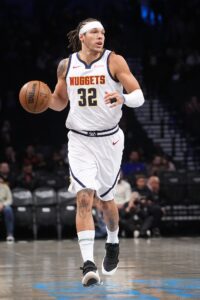 For example, having signed a four-year extension with the Nuggets on Oct. 21, a day before the 2024/25 regular season began, Aaron Gordon – who is now under contract for five total seasons – will become extension-eligible on Oct. 1, 2027, which is considered to be the three-year anniversary of his recently signed extension.
On the other hand, because he signed his most recent extension on Oct. 24, a couple days after the season tipped off, Timberwolves center Rudy Gobert – who is now under contract for four total seasons – will become eligible for his next extension on Oct. 24, 2026, the actual two-year anniversary of his latest deal.
How many years can a player receive on a veteran extension?
A veteran extension can be for up to five years, including the year(s) remaining on the previous contract. The current league year always counts as one of those five years, even if an extension is agreed to as late as June 30.
For instance, when Grayson Allen signed an extension in April with the Suns, he was in the final year of previous contract, which ran through 2023/24. He added four extra years via the extension, maxing out at five years overall. He wouldn’t be able to add a fifth year at that time even though the regular season was over, since the ’23/24 league year still counted toward the total.
If a player signs a “designated” veteran extension, he can receive up to six total years, as we cover in a separate glossary entry. Jaylen Brown got a super-max extension from the Celtics during the 2023 offseason, while his teammate Jayson Tatum was the only player to sign one in 2024.
How much money can a player receive on a veteran extension?
The first-year salary in a veteran extension can be worth up to 140% of the salary in the final year of the player’s previous contract or 140% of the NBA’s estimated average salary, whichever is greater. Annual raises are limited to 8% of the first-year extension salary.
When Jalen Brunson signed an extension with the Knicks during the 2024 offseason, he added four extra years to the one year and $24,960,001 remaining on his previous deal. Because his cap hit comfortably exceeds the league’s estimated average salary, Murray was eligible to earn up to 140% of his final-year salary in the first year of his extension. As such, his new contract begins in 2025/26 with a base salary of $34,944,001, with 8% annual raises from there.
In 2023/24, the NBA’s estimated average salary is $12,930,000, so a player earning less than that amount would be eligible to receive an extension worth up to 140% of that figure. That would work out to a starting salary of $18,102,000 and a four-year total of about $81MM. That’s the maximum deal that Thunder guard Alex Caruso is now eligible to sign.
A contract extension can’t exceed the maximum salary a player is eligible to earn, so there are some instances in which a player won’t be able to get a full 40% raise on a new extension.
For instance, Bam Adebayo‘s new three-year, maximum-salary extension with the Heat should technically award him up to a 40% raise on his $37,096,620 salary in 2025/26. However, that would work out to a $51,935,268 salary in 2026/27. Even if the salary cap increases by the maximum allowable 10% in each of the next two summers, Adebayo’s maximum allowable salary in ’26/27 would be $51,033,600 (30% of that’s season’s cap). So he won’t receive a full 40% raise on his new deal.
Because a player’s own personal maximum salary on an extension is always at least 5% of his salary in the previous season, there are scenarios in which a player could exceed the league-wide maximum salary.
That’s the case for Stephen Curry, who signed a one-year, $62,587,158 extension with the Warriors in August. That extension is for the 2026/27 season. Even if the cap increases by 10% in each of the next two years, the league-wide maximum for a player with 10-plus years of NBA experience in ’26/27 would be $59,539,200. However, Curry is allowed to exceed that figure because he’ll earn $59,606,817 in ’25/26 — his latest one-year extension represents a 5% raise.
Designated veteran extensions and renegotiated contracts have slightly different rules for salaries and raises than standard veteran extensions. You can read about those differences in our glossary entries on those subjects.
Can a player sign a veteran extension as part of a trade?
The NBA’s Collective Bargaining Agreement does allow for extend-and-trade transactions, but the rules governing them are more limiting than for standard veteran extensions.
A player eligible for an extension can sign one in conjunction with a trade, but he would be limited to four overall years and a starting salary worth 120% of the final-year salary on his previous deal (or 120% of the estimated average salary, for players earning below the average). Subsequent annual raises are limited to 5% as well.
A player who receives an extension that exceeds those extend-and-trade limits becomes ineligible to be traded for six months. Conversely, a player who is involved in a trade becomes ineligible to sign an extension for six months if the extension would exceed the extend-and-trade limits.
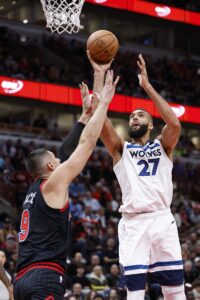 Gobert’s three-year extension with the Timberwolves is an example of a recent extension that didn’t exceed the extend-and-trade limits — he took a pay cut from $43,827,586 to $35MM in the first year of the extension and the deal lengthened his contract to four total years. Because that extension fell within the extend-and-trade parameters, Gobert could still technically be traded this season despite signing in October, though he almost certainly won’t be.
Conversely, since Adebayo’s new extension lengthens his total contract to five years and will feature raises exceeding 5%, he’s be ineligible to be traded until January 6, six months after he signed the deal.
Players who renegotiate their current-year salary as part of an extension can’t be traded for six months. This applies this season to Magic forward Jonathan Isaac, who becomes trade-eligible on January 6, and Jazz forward Lauri Markkanen, who won’t be trade-eligible during the regular season since he renegotiated his deal on August 7 — his trade restriction will lift on Feb. 7, one day after this season’s deadline.
An extension-eligible player can’t be extended-and-traded between the end of the season and June 30 if there’s a chance he could become a free agent that July. That rule applies to both veterans on expiring contracts and veterans with team or player options that have yet to be exercised.
What are the other rules related to veteran extensions?
There are many more minor rules and guidelines related to veteran extensions, including several involving bonuses and option years. A full breakdown can be found in Larry Coon’s CBA FAQ, but here are some of the notable ones most likely to come into play:
- A contract with an option can be extended if the player opts in or the team picks up the option.
- A contract with an option can also be extended if the option is declined, as long as the extension adds at least two new years to the deal. The only exception to this rule involves an early termination option — a contract with an ETO can’t be extended if the ETO is exercised, ending the contract early.
- A newly signed extension can contain a player or team option, but not an early termination option.
- If a contract contains incentive bonuses, a veteran extension must contain the same bonuses. The bonus amounts can be increased or decreased by up to 8%, but they must still be part of the deal. An extension also can’t contain bonuses that weren’t part of the original contract.
- If a contract includes an unearned trade bonus, it doesn’t necessarily have to be applied to the extension. If the team and player elect not to carry over the trade bonus to the extension and the player is dealt before the extension takes effect, the application of the bonus would ignore the extension.
Note: This is a Hoops Rumors Glossary entry. Our glossary posts will explain specific rules relating to trades, free agency, or other aspects of the NBA’s Collective Bargaining Agreement. Larry Coon’s CBA FAQ was used in the creation of this post.
Previous versions of this post were published in 2019, 2022, and 2023.
The Bucks Players Who Benefited Most From NBA Cup Prize Money
The Bucks‘ team salary this season is approximately $193MM, which is over the second tax apron and far exceeds the $160.4MM on the Thunder‘s books.
However, only two players on Oklahoma City’s roster are on minimum-salary contracts and just three of 15 Thunder players on standard deals are earning less than $3MM this season. By comparison, Milwaukee has eight players with salaries below $3MM, plus a ninth earning just a hair above $3MM. Seven of those nine players are earning their respective minimums.
While the $514,970 bonus for winning the NBA Cup may be a drop in the bucket for maximum-salary Bucks stars Giannis Antetokounmpo and Damian Lillard, it represents a significant pay raise for the players on the lower two-thirds of Milwaukee’s cap sheet, as well as the players on two-way contracts who will receive bonuses worth $257,485 apiece.
[RELATED: Details On NBA Cup Prize Money For 2024]
The NBA Cup prize money results in at least a 17% raise for each of the following Bucks players, whose 2024/25 salaries are noted in parentheses:
Players receiving a $514,970 bonus:
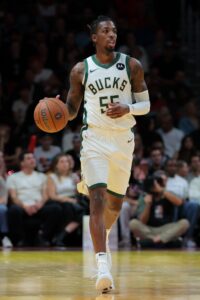 Delon Wright ($3,003,427)
- Taurean Prince ($2,988,550)
- AJ Johnson ($2,795,294)
- MarJon Beauchamp ($2,733,720)
- Gary Trent Jr. ($2,613,120)
- A.J. Green ($2,120,693)
- Andre Jackson ($1,891,857)
- Chris Livingston ($1,891,857)
- Tyler Smith ($1,157,153)
Players receiving a $257,485 bonus:
- Liam Robbins ($578,577)
- Ryan Rollins ($578,577)
- Stanley Umude ($578,577)
The bonuses for Smith and the Bucks’ two-way players represent a raise of roughly 44.5% on their respective base salaries.
None of this prize money will count against the salary cap, so the Bucks’ team salary for cap, tax, and apron purposes remains unchanged, as do the team salaries for Oklahoma City and the other six clubs who made the knockout round of the IST. Their prize money is as follows:
- Oklahoma City Thunder: $205,988 per player ($102,994 for two-way players)
- Atlanta Hawks and Houston Rockets: $102,994 per player ($51,497 for two-ways)
- Dallas Mavericks, Golden State Warriors, New York Knicks, and Orlando Magic: $51,497 per player ($25,749 for two-ways)