
Caldwell-Pope, Roberson Receive Qualifying Offers
Two more players will officially become restricted free agents when the new NBA league year begins on July 1. According to RealGM’s transactions log, Kentavious Caldwell-Pope and Andre Roberson have received qualifying offers from the Pistons and Thunder, respectively.
Caldwell-Pope, the eighth overall pick in the 2013 draft, is coming off a 2016/17 season in which he averaged 13.8 PPG, 3.3 RPG, and 2.5 APG, with a shooting line of .399/.350/.832. The Pistons reportedly plan to be aggressive in matching any offer sheet for Caldwell-Pope, perhaps even going up to the max, if necessary.
As for Roberson, his offensive numbers have always been modest, and that didn’t change in 2016/17 — despite setting a new career high in scoring, he still only averaged 6.6 PPG. However, Roberson is one of the league’s best perimeter defenders, earning a spot on the NBA’s All-Defensive Second team earlier today.
Caldwell-Pope’s qualifying offer from the Pistons will be worth $4,958,374, while Roberson’s QO from Oklahoma City has increased to $4,588,840 after he met the starter criteria. As long as the Pistons and Thunder don’t withdraw those qualifying offers, they’ll retain the right of first refusal on their respective free agents, giving them the opportunity to match any offers.
Both Caldwell-Pope and Roberson will have the option of accepting those one-year qualifying offers, but they’re expected to receive much larger multiyear offers in free agency. Generally, the only reason a coveted RFA would sign his qualifying offer is in order to leave his current team as soon as possible — signing the QO would put a player on track to reach unrestricted free agency a year from now.
NBA Minimum Salaries For 2017/18
While some NBA teams will head into free agency with more than enough cap room to add a maximum salary player, others clubs will be totally capped out. However, each of the NBA’s 30 clubs will be on common ground in one respect: No team will be ineligible to sign a player to a minimum salary contract.
Teams with cap room available will have a little more flexibility to sign players to longer-term minimum salary contracts, but over-the-cap clubs will still be able to use the minimum salary exception to add as many players as they want. Unlike other exceptions, such as the mid-level or the bi-annual, the minimum salary exception can be used multiple times, for contracts of up to two years.
[RELATED: Values of 2017/18 mid-level, bi-annual exceptions]
Undrafted free agents and late second-round picks are often recipients of minimum salary contracts, but there are plenty of veterans who end up settling for the minimum too. Of course, because a player’s minimum salary is determined by how much NBA experience he has, many veterans will earn more than twice as much money as a rookie will in 2017/18 on a minimum salary contract.
Listed below are 2017/18’s minimum salary figures, sorted by years of NBA experience. If a player spent any time on an NBA club’s active regular season roster in a given season, he earned one year of experience. So any player with zero years of experience has not yet made his NBA debut.
Here’s the full breakdown:
| Years of Experience | Salary |
|---|---|
| 0 | $815,615 |
| 1 | $1,312,611 |
| 2 | $1,471,382 |
| 3 | $1,524,305 |
| 4 | $1,577,230 |
| 5 | $1,709,538 |
| 6 | $1,841,849 |
| 7 | $1,974,159 |
| 8 | $2,106,470 |
| 9 | $2,116,955 |
| 10+ | $2,328,652 |
Because the NBA doesn’t want teams to avoid signing veteran players in favor of cheaper, younger players, the league reimburses clubs who sign veterans with three or more years of experience to one-year, minimum salary contracts. Those deals will only count against the cap – and against a team’s bank balance – for $1,471,382, the minimum salary for a player with two years of experience.
For instance, if David Lee – who has 12 years of NBA experience – signs a one-year, minimum salary contract with a new team, that team would only be charged $1,471,382 for Lee’s contract. He’d earn $2,328,652, but the NBA would make up the difference. This only applies to one-year contracts, rather than multiyear deals.
If a player signs a minimum salary contract after the regular season begins, he’ll earn a pro-rated portion of the amount listed above.
New York Notes: Knicks, Rubio, Nets, Redick
The Knicks, who explored a possible Ricky Rubio deal at the trade deadline, talked internally prior to the draft about revisiting their pursuit of Rubio, according to Ian Begley of ESPN.com (via Twitter). Nothing came of those talks on draft night, and New York nabbed its point guard of the future in Frank Ntilikina with the No. 8 overall pick.
Still, Rubio reportedly remains on the trade block, and Ntilikina likely won’t be ready to step into the starting lineup right away, so it’s worth keeping an eye on the Knicks to see if they make a move for Rubio or another point guard when the new league year begins.
Here are a few more notes on the NBA’s two New York teams:
- The Nets continue to be cited as a probable suitor for J.J. Redick, with Kevin O’Connor of The Ringer reporting that multiple league sources expect both the Nets and Sixers to make a “hard push” for the free agent guard.
- The Nets had $3.4MM available to use in draft-day deal, but GM Sean Marks didn’t see any prospects worth trading into the second round to acquire, tweets Brian Lewis of The New York Post. As Lewis notes, Brooklyn has until this Friday to use that cash before spending resets for the 2017/18 league year.
- French big man Louis Labeyrie, whose draft rights belong to the Knicks, will play on the team’s Summer League squad for the third straight July, according to Marc Berman of The New York Post. Berman suggests the 2014 second-rounder could have a better chance to earn an NBA contract this time around, with the Knicks in rebuilding mode.
- Earlier today, our Mark Suleymanov rounded up the highlights of the Nets‘ D’Angelo Russell/Timofey Mozgov introductory presser in Brooklyn.
D’Angelo Russell ‘Surprised’ By Trade To Brooklyn
With current Nets players practicing on the court behind the main stage, Brooklyn’s newest acquisitions, D’Angelo Russell and Timofey Mozgov, were showcased for the first time on Monday at the team’s practice facility.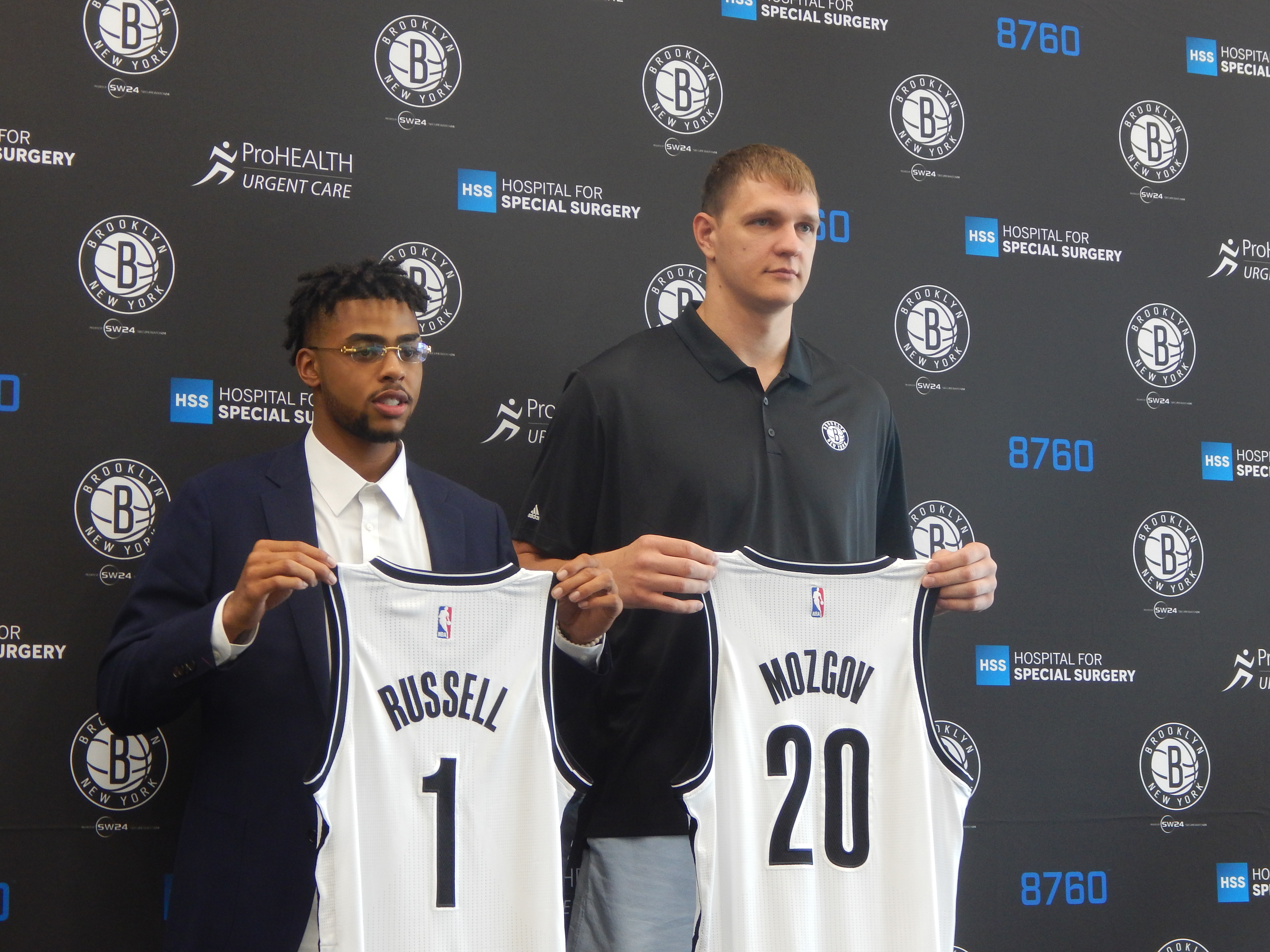
Acquired from the Lakers in a blockbuster trade last week, the 21-year-old point guard and NBA champion center now join a rebuilding Nets franchise coming off a season in which the team had a league-worst 20-62 record. After two controversial years in Los Angeles, the former second overall pick Russell is excited about his fresh start.
“I was surprised,” Russell told the media – including Hoops Rumors – today. “I’ve never really been traded before and I didn’t know what to expect.”
On his way out of California, Russell was seemingly criticized by Lakers president Magic Johnson, who said he selected Lonzo Ball with the No. 2 pick and traded Russell because he was “looking for a leader.” However, Russell dismissed the criticism and expressed his excitement in moving from one big city to another.
“I can’t control what they [the Lakers] say. I’m gone so it’s the past,” Russell said. “Being 21 [years old], living in Los Angeles and coming to New York is not a complaint for me or my family.”
As for Mozgov, the 30-year-old Russian joins Brooklyn with three years left on the four-year, $64MM albatross of a contract he signed with the Lakers last season. Mozgov averaged 7.4 PPG and 4.9 RPG in 54 games (52 starts) last season and frequently received DNP-CDs late in the season so that the Lakers could play their youngsters.
The former NBA champion with the 2015/16 Cavaliers is familiar with New York City. Mozgov had a 34-game cameo with the Knicks in 2010/11 before he was traded to Nuggets as part of the deal that brought Carmelo Anthony to New York. In that brief time, then-Knicks assistant coach and current Nets head coach Kenny Atkinson saw the 7’1″ center develop – and believes Mozgov will be an asset in 2017/18.
“Timmy fits perfectly [in our system], he’s a competitive player, he’s a guy that loves to run the court he’s a physical player, and I think he rolls to the rim on pick and roll, which we love,” Nets head coach Kenny Atkinson said. “At the end of the day, I love the person…so he fits perfectly in what we’re trying to build.”
Unless the Nets acquire another center, Mozgov figures to open the 2017/18 season as the starting big man in Brooklyn. The Nets will miss Brook Lopez – who was sent to the Lakers in the trade for the Nets’ new duo – and his three-point shooting. After attempting just 31 threes in his first eight years with the Nets, Lopez added a long-range game last season, making almost 35% (134 for 387) of his shots from beyond the arc. Mozgov has attempted 40 treys in his career and made just seven (17.5%) in his career, but will do what is asked of him.
“We’ll see if coach lets me shoot. [If he does], I will shoot,” Mozgov said. “I’m the guy who does whatever coach tells me to do; if he says shoot from half court, I will shoot from half court.”
Trust will be the key for a young Nets team. Russell was at the center of a highly publicized off-court saga with former teammate Nick Young in Los Angeles and his maturity was also questioned. The young point guard has already shown early signs of dedication, posting an Instagram video of him working out at the Nets’ practice facility late Sunday morning. Russell also mentioned speaking with Jeremy Lin and other Nets teammates about functioning well next season.
“It’s going to take time, not just D’Angelo, but anybody coming into the organization,” Brooklyn general manager Sean Marks said. “To develop trust and respect, I think he’s well on his way to doing it.”
“There’s been some criticism and some doubts about him, but we’re a positive culture, positive coaching staff,” Atkinson added. “We’ll hold him accountable and be honest with him and that’s how guys better. He’s got a clean slate with us.”
Green, Gobert Headline 2016/17 NBA All-Defensive Teams
The NBA has announced its All-Defensive teams for the 2016/17 season, and Defensive Player of the Year finalists Draymond Green, Rudy Gobert, and Kawhi Leonard all earned a place on the First Team. Green led the way with 99 First Team votes, while Gobert received 97 votes for a spot on the First Team.
Here are the full rosters for the NBA’s All-Defensive teams:
First Team:
- Draymond Green (Warriors)
- Rudy Gobert (Jazz)
- Kawhi Leonard (Spurs)
- Chris Paul (Clippers)
- Patrick Beverley (Rockets)
Second Team:
- Tony Allen (Grizzlies)
- Danny Green (Spurs)
- Anthony Davis (Pelicans)
- Andre Roberson (Thunder)
- Giannis Antetokounmpo (Bucks)
Avery Bradley (Celtics), Klay Thompson (Warriors), and John Wall (Wizards) were among the other players receiving votes who just missed out on an All-Defensive spot.
As Bobby Marks of The Vertical observes (via Twitter), Gobert’s cap hit for the 2017/18 season will now increase by $500K to $21.9MM based on his spot on the All-Defensive First Team.
Brogdon, Saric Headline 2016/17 NBA All-Rookie Teams
The NBA has announced its All-Rookie teams for the 2016/17 season, with Bucks guard Malcolm Brogdon and Sixers forward Dario Saric headlining the First Team. Brogdon and Saric were the only two players who were unanimously named to the NBA’s All-Rookie First Team.
Here’s the full breakdown of this year’s All-Rookie squads:
First Team:
- Malcolm Brogdon (Bucks)
- Dario Saric (Sixers)
- Joel Embiid (Sixers)
- Buddy Hield (Kings)
- Willy Hernangomez (Knicks)
Second Team:
- Jamal Murray (Nuggets)
- Jaylen Brown (Celtics)
- Marquese Chriss (Suns)
- Brandon Ingram (Lakers)
- Yogi Ferrell (Mavericks)
Brogdon, Saric, and Embiid are the finalists for the 2016/17 NBA Rookie of the Year award, which will be announced later tonight during the league’s TV broadcast on TNT.
Pistons Notes: Luxury Tax, Point Guard, Drummond
With approximately $95MM in guaranteed salaries on their books for 2017/18, the Pistons will be in danger of going into luxury tax territory if they re-sign Kentavious Caldwell-Pope to a maximum salary contract or something close to it.
However, Vince Ellis of The Detroit Free Press tweets that a source in the know told him the Pistons would be okay with being slightly over the tax line. As Ellis notes in a piece for The Free Press, even if Detroit begins the ’17/18 season in the tax, that doesn’t necessarily mean the team will be on the hook for tax penalties at the end of the year. Luxury tax penalties aren’t determined until the final day of the regular season, so the Pistons could make trades to sneak back under the threshold, if necessary.
Here’s more out of Detroit:
- Given their current cap situation, the free agent market won’t offer an easy path to roster upgrades for the Pistons, Ellis writes for The Free Press. Ellis expects Detroit to attempt to find a point guard to play behind Reggie Jackson and Ish Smith, but that would likely be a minor move. Within the piece, Ellis also suggests that Caldwell-Pope’s restricted free agency may not get resolved quickly if he doesn’t find an offer sheet he likes.
- Andre Drummond‘s name surfaced in trade rumors again last week, and while Drummond has been “hurt” in the past at being mentioned in trade rumors, he’s most accustomed to it now, per head coach Stan Van Gundy (link via The Detroit Free Press).
- The Kings, who have had interest in Drummond in the past, were linked to the veteran center again last week, but Ellis writes that Detroit wasn’t motivated to make a move. “It’s part of the usual draft-day dance,” a Pistons source told Ellis shortly before the draft. “Sacramento making a play for him and would like to make it happen. Us not so much.”
- Shawn Windsor of The Detroit Free Press wonders if the Pistons will end up regretting making the “safe” play and picking Luke Kennard on draft day.
Wolves Still Looking To Trade Ricky Rubio?
JUNE 26, 10:32am: Despite Scott Layden‘s assertion (noted below) that Rubio will have a “great career” in Minnesota, Marc Stein of ESPN.com (Twitter link) hears that the Timberwolves remain intent on trading the veteran point guard.
A report over the weekend indicated that Minnesota may be eyeing a handful of notable free agent point guards. However, Jon Krawczynski of the AP cautions (via Twitter) that a Rubio deal is “no sure thing.”
JUNE 23, 9:46am: Appearing on KFAN FM 100.3 in Minnesota, Timberwolves GM Scott Layden suggested this morning that the team is planning on keeping Rubio, according to Jon Krawczynski of The Associated Press (Twitter links). Krawczynski acknowledges that things could always change, but says Layden praised Rubio’s second half and added that the point guard will “have a great career here.”
JUNE 22, 8:22pm: After completing the night’s biggest blockbuster, the Timberwolves continue to seek a trade involving Ricky Rubio, reports Jeff Zillgitt of USA Today (via Twitter). According to Zillgitt, the Wolves would plan on finding a new point guard in free agency if they make a deal involving Rubio.
[RELATED: Bulls agree to trade Jimmy Butler to Timberwolves]
In their deal with the Bulls, the Wolves included last year’s fifth overall pick Kris Dunn, who was viewed as Minnesota’s potential point guard of the future. That would appear to open the door for Rubio to hold the job for the foreseeable future without having to look over his shoulder — particularly since another one of the team’s top ball-handlers, Zach LaVine, was sent to Chicago as well. However, it seems that the Wolves may have their eye on another point guard for next season.
Rubio has been linked to a handful of teams in recent months, including the Mavericks, Pistons, and Knicks. One interesting potential trade partner for the Wolves is Utah. The Jazz were reportedly discussing Rubio earlier in the day, and have enough cap room to acquire the veteran point guard immediately without sending out any salary. If the Jazz were to land Rubio, that would likely pave the way for George Hill‘s exit in free agency.
Values Of 2017/18 Mid-Level, Bi-Annual Exceptions
The salary cap for the 2017/18 NBA league year won’t be finalized and announced for several more days, which means we’re still relying on the NBA’s $99MM projection when we calculate the value of maximum salary contract or attempt to determine how much cap room teams will have.
[RELATED: NBA Maximum Salary Projections for 2017/18]
However, while some contract figures won’t be finalized until we know where the salary cap ultimately lands for 2017/18, others have already been established. In the case of the mid-level, bi-annual, and room exceptions, the NBA’s latest Collective Bargaining Agreement includes specific figures for the ’17/18 season, so we already know what the values of those exceptions will be next year.
Listed below are the maximum annual and total values of each of these exceptions, along with a brief explanation of how they work and which teams will have access to them.
Mid-Level Exception (Non-Taxpayer):
| Year | Salary |
|---|---|
| 2017/18 | $8,406,000 |
| 2018/19 | $8,826,300 |
| 2019/20 | $9,246,600 |
| 2020/21 | $9,666,900 |
| Total | $36,145,800 |
The non-taxpayer mid-level exception is the primary tool available for over-the-cap teams to add free agents. As long as a team hasn’t dipped below the cap and doesn’t go over the tax apron (currently projected to be $127MM) at all, it can use this MLE, which runs for up to four years with 5% annual raises.
In 2016/17, this exception was only worth up to $5,628,000 in year one, so it will rise in value significantly next season. That makes it a legitimate option to land second- or third-tier free agents who would have required cap room to sign in the past.
Mid-Level Exception (Taxpayer):
| Year | Salary |
|---|---|
| 2017/18 | $5,192,000 |
| 2018/19 | $5,451,600 |
| 2019/20 | $5,711,200 |
| Total | $16,354,800 |
If an over-the-cap team currently projects to be a taxpayer, or expects to move into tax territory later in the 2017/18 season, it will have access to this smaller mid-level exception for taxpaying teams. If a team uses more than $5.192MM of its mid-level exception, it is forbidden from surpassing the tax apron (projected at $127MM) at any time during the league year. So even if a team isn’t above the apron when it uses its MLE, it might make sense to play it safe by avoiding using the full MLE and imposing a hard cap.
In 2016/17, the taxpayer mid-level exception – which was only used by the Cavs – was worth $3,477,000. The taxpayer MLE can be used to sign a player for up to three years, with 5% annual raises.
Room Exception:
| Year | Salary |
|---|---|
| 2017/18 | $4,328,000 |
| 2018/19 | $4,544,400 |
| Total | $8,872,400 |
Although this is also a mid-level exception of sorts, it’s colloquially known as the “room” exception, since it’s only available to teams that have used cap room. If a club goes under the cap, it loses its full mid-level exception, but gets this smaller room exception, which allows the team to go over the cap to sign a player, once the team has used up all its cap space.
In 2016/17, this exception was worth $2,898,000, and resulted in some valuable signings, including Seth Curry (Mavericks), Dion Waiters (Heat), Zaza Pachulia (Warriors), and Nene (Rockets). It can be used to sign players for up to two years, with a 5% raise for the second season.
Bi-Annual Exception:
| Year | Salary |
|---|---|
| 2017/18 | $3,290,000 |
| 2018/19 | $3,454,500 |
| Total | $6,744,500 |
The bi-annual exception, as its name suggests, is only available to teams once every two years. Of the NBA’s 30 clubs, only the Clippers used it in 2016/17, signing Luc Mbah a Moute to a deal that started at $2,203,000. That means the league’s other 29 teams could theoretically use it this season.
Still, even if a team didn’t use its BAE in ’16/17, that club doesn’t necessarily have access to it for the coming year. As is the case with the non-taxpayer MLE, this exception disappears once a team goes under the cap. It’s also not available to teams over the tax apron — using the BAE creates a hard cap at the apron.
The BAE can be used to sign players for up to two years, with a 5% raise after year one.
Pacific Notes: Lakers, Clippers, Russell, McGee
As free agency nears, the Lakers may avoid signing players to contracts that extend past 2017/18 for fear of eating into potential Paul George cap space, Justin J. Page of ESPN writes. The club is currently expected to have $18MM to work with this summer and potentially over $40MM next summer, depending on the status of Julius Randle.
Considering that the key here would be to retain flexibility to make a move for George when he officially hits free agency in 2018, the Lakers could zero in on players with one-year deals when the 2017 free agency period begins next week. Los Angeles could justifiably overpay for players in 2017/18 so long as they come with team options for anything beyond that.
Page also writes that fans can expect the franchise to continue shedding as much salary as possible, the primary target being Luol Deng and the $54MM remaining over the course of the last three years of his deal.
There’s more out of the Pacific Division:
- The Clippers ended up agreeing to pay $2MM for the Bucks draft pick that turned into Sindarius Thornwell at No. 48, Eric Pincus of Basketball Insiders tweets.
- Shortly after trading the No. 2 pick of the 2015 draft, Magic Johnson called to question D’Angelo Russell‘s leadership abilities. Per Baxter Holmes of ESPN, when Johnson introduced rookie Lonzo Ball at the Lakers’ practice facility, he implied that the team needed a leader and somebody that other players want to play with.
- After finding a seemingly impeccable fit with the Warriors, JaVale McGee is eager to remain in the Bay Area, Scott Reiss of KTVU tweets.
- As speculation mounts that LeBron James could be targeting a move to Los Angeles next summer, the battle between the Lakers and Clippers gains momentum. Mark Heisler of the Los Angeles Daily News points out that the potential pursuit of James may see L.A. legends Magic Johnson and Jerry West squaring off.