
NBA 2025 Free Agency: June 30 Recap
Even after several of this year’s top free agents – including James Harden, Kyrie Irving, Naz Reid, Julius Randle, and Fred VanVleet – reached contract agreements with their respective teams well before the first day of free agency, it was still an eventful June 30 in the NBA, with news of deals coming in both before and after the free agent period officially got underway at 5:00 pm Central time.
Listed below are all the free agent agreements and other notable news items from the first day of free agency.
Free agent agreements
These deals aren’t yet official, so the reported terms could change — or agreements could fall through altogether. Generally speaking though, teams and players are on track to finalize these agreements sometime after the moratorium ends on July 6.
Note: Some of these salary figures may include options, incentives, or non-guaranteed money.
- Nickeil Alexander-Walker, Hawks agree to four-year, $62MM contract (sign-and-trade).
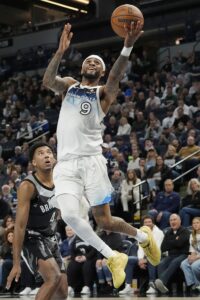
- Dorian Finney-Smith, Rockets agree to four-year, $53MM contract.
- Santi Aldama, Grizzlies agree to three-year, $52.5MM contract.
- Luke Kornet, Spurs agree to four-year, $41MM contract.
- Caris LeVert, Pistons agree to two-year, $29MM contract.
- Ty Jerome, Grizzlies agree to three-year, $27.7MM contract.
- Tre Jones, Bulls agree to three-year, $24MM contract.
- Clint Capela, Rockets agree to three-year, $21.5MM contract (sign-and-trade).
- Brook Lopez, Clippers agree to two-year, $18MM contract.
- Kevon Looney, Pelicans agree to two-year, $16MM contract.
- Jake LaRavia, Lakers agree to two-year, $12MM contract.
- Day’Ron Sharpe, Nets agree to two-year, $12MM contract.
- Ziaire Williams, Nets agree to two-year, $12MM contract.
- D’Angelo Russell, Mavericks agree to two-year, $11.7MM contract.
- Nicolas Batum, Clippers agree to two-year, $11.5MM contract.
- Paul Reed, Pistons agree to two-year, $11MM contract.
- Luke Kennard, Hawks agree to one-year, $11MM contract.
- Kevin Porter Jr., Bucks agree to two-year, $10.5MM contract.
- Gary Trent Jr., Bucks agree to two-year, $7.6MM contract.
- Tyus Jones, Magic agree to one-year, $7MM contract.
- Luka Garza, Celtics agree to two-year, minimum-salary contract.
- Taurean Prince, Bucks agree to two-year, minimum-salary contract.
- Cam Spencer, Grizzlies agree to two-year, minimum-salary contract.
- Trendon Watford, Sixers agree to two-year, minimum-salary contract.
- Bruce Brown, Nuggets agree to one-year, minimum-salary contract.
- Jeff Green, Rockets agree to one-year, minimum-salary contract.
- Nigel Hayes-Davis, Suns agree to one-year, minimum-salary contract.
- Aaron Holiday, Rockets agree to one-year, minimum-salary contract.
- Joe Ingles, Timberwolves agree to one-year, minimum-salary contract.
- Mason Plumlee, Hornets agree to one-year, minimum-salary contract.
- Jae’Sean Tate, Rockets agree to one-year, minimum-salary contract.
- Collin Gillespie, Suns agree to one-year contract.
Other notable headlines
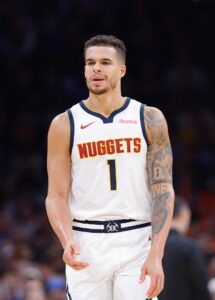 Nuggets agree to trade Michael Porter Jr., unprotected 2032 first-round pick to Nets for Cameron Johnson.
- Grizzlies agree to renegotiate, extend Jaren Jackson Jr.‘s contract (five years, $240MM).
- Suns, Hornets officially finalize Mark Williams trade.
- Lakers, Bulls officially finalize draft-night trade.
- Thunder wing Jalen Williams to undergo wrist surgery.
- Mike Brown to interview a second time for Knicks‘ head coaching job.
- Kings expected to sign Dennis Schröder, with a sign-and-trade scenario involving Malik Monk going to the Pistons potentially in play.
- Jazz buy out Jordan Clarkson; he’s expected to sign with Knicks.
- Jazz guarantee Svi Mykhailiuk‘s 2025/26 salary.
- Suns waive Cody Martin.
- Jazz waive Johnny Juzang.
Notably, five of the first 10 players in our list of this year’s top 50 free agents are still on the board as of late Monday night: Myles Turner, Josh Giddey, Jonathan Kuminga, Cam Thomas, and Quentin Grimes don’t yet have deals in place.
The full list of available free agents can be found right here.
NBA Minimum Salaries For 2025/26
An NBA team that has spent all its cap space and doesn’t have any of its mid-level or bi-annual exception available still always has the ability to sign a player to a minimum-salary contract, unless that club is right up against its hard cap.
Teams with cap room or with access to the non-taxpayer mid-level exception will have a little more flexibility to sign players to longer-term minimum-salary contracts. However, teams without cap room and without any other exceptions on hand can still use the minimum salary exception to add as many players as roster limits and the hard cap allow, for contracts of up to two years.
[RELATED: Values of 2025/26 mid-level, bi-annual exceptions]
Undrafted free agents and second-round picks are often recipients of minimum-salary contracts, but there are plenty of veterans who end up settling for the minimum too. Because a player’s minimum salary is determined by how much NBA experience he has, many veterans will earn more than twice as much money as a rookie will in 2025/26 on a minimum-salary contract.
Listed below are 2025/26’s minimum salary figures, sorted by years of NBA experience. If a player spent any time on an NBA club’s active regular season roster in a given season, he earned one year of experience. So any player with zero years of experience has not yet made his NBA debut.
These figures represent approximately a 10% increase on last season’s minimum salaries, since that’s the amount of the NBA’s salary cap increase for 2025/26.
Here’s the full breakdown:
| Years of Experience | Salary |
|---|---|
| 0 | $1,272,870 |
| 1 | $2,048,494 |
| 2 | $2,296,274 |
| 3 | $2,378,870 |
| 4 | $2,461,463 |
| 5 | $2,667,947 |
| 6 | $2,874,436 |
| 7 | $3,080,921 |
| 8 | $3,287,409 |
| 9 | $3,303,774 |
| 10+ | $3,634,153 |
Because the NBA doesn’t want teams to avoid signing veteran players in favor of cheaper, younger players, the league reimburses clubs who sign veterans with three or more years of experience to one-year, minimum-salary contracts. Those deals will only count against the cap – and against a team’s bank balance – for $2,296,274, the minimum salary for a player with two years of experience.
For instance, Mason Plumlee, who has 12 seasons of NBA experience, will reportedly sign a one-year, minimum-salary contract with the Hornets, who will only be charged $2,296,274 for Plumlee’s contract. He’ll earn $3,634,153, but the NBA will make up the difference. This rule only applies to one-year contracts, not to multiyear deals.
If a player signs a minimum-salary contract after the regular season begins, he’ll earn a prorated portion of the amount listed above.
Those figures listed above also only apply to players who are signing new contracts in 2025/26. Players who are in the second, third, or fourth year of a minimum-salary deal will be earning a slightly different predetermined amount.
For example, Knicks big man Ariel Hukporti – who signed a minimum-salary contract last season and now has one year of NBA experience – will earn a $1,955,377 salary in the second year of his contract, less than than the $2,048,494 he would receive if he were signing a new minimum deal this fall. That’s because his second-year salary is based on a 5% raise over last season’s minimum salary for a player with one year of experience, whereas the cap rose by 10%.
Here’s what multiyear minimum-salary contracts signed in 2025/26 will look like:
| Experience |
2025/26 | 2026/27 | 2027/28 | 2028/29 |
|---|---|---|---|---|
| 0 | $1,272,870 | $2,150,917 | $2,525,901 | $2,735,698 |
| 1 | $2,048,494 | $2,411,090 | $2,616,754 | $2,830,685 |
| 2 | $2,296,274 | $2,497,812 | $2,707,612 | $3,068,140 |
| 3 | $2,378,870 | $2,584,539 | $2,934,742 | $3,305,598 |
| 4 | $2,461,463 | $2,801,346 | $3,161,876 | $3,543,059 |
| 5 | $2,667,947 | $3,018,158 | $3,389,014 | $3,780,524 |
| 6 | $2,874,436 | $3,234,968 | $3,616,151 | $3,799,340 |
| 7 | $3,080,921 | $3,451,779 | $3,634,152 | $4,179,277 |
| 8 | $3,287,409 | $3,468,962 | $3,997,570 | $4,179,277 |
| 9 | $3,303,774 | $3,815,861 | $3,997,570 | $4,179,277 |
| 10+ | $3,634,153 | $3,815,861 | $3,997,570 | $4,179,277 |
Technically, a minimum-salary contract could cover five years for a player with full Bird rights, but in actuality, that never happens.
While some second-round picks and undrafted free agents will sign three- or four-year minimum-salary contracts, a minimum deal exceeding two years is rare for a player with more than a year or two of NBA experience under his belt.
Data from RealGM was used in the creation of this post.
Values Of 2025/26 Mid-Level, Bi-Annual Exceptions
The salary cap for the 2025/26 NBA league year has officially been set, with the league announcing that the cap will be $154,647,000, a 10% increase on last year’s number.
Under the league’s current Collective Bargaining Agreement, the values of the mid-level, room, and bi-annual exceptions are tied to the salary cap and the percentage that it shifts in a given year. Here’s how that math works:
- Non-taxpayer mid-level exception: Worth 9.12% of salary cap.
- Taxpayer mid-level exception: Increases at the same rate as the salary cap.
- Room exception: Worth 5.678% of the salary cap.
- Bi-annual exception: Worth 3.32% of the salary cap.
Listed below are the maximum annual and total values of each of these exceptions, along with a brief explanation of how they work and which teams will have access to them. For more information, check out glossary entries on the mid-level exception and the bi-annual exception.
Mid-Level Exception (Non-Taxpayer):
| Year | Salary |
|---|---|
| 2025/26 | $14,104,000 |
| 2026/27 | $14,809,200 |
| 2027/28 | $15,514,400 |
| 2028/29 | $16,219,600 |
| Total | $60,647,200 |
The non-taxpayer mid-level exception is the primary tool available for over-the-cap teams to add free agents. As long as a team hasn’t dipped below the cap to use cap space and doesn’t go over the first tax apron ($195,945,000) at all, it can use this MLE, which runs for up to four years with 5% annual raises.
This exception can also be used to acquire players via trade or waiver claim.
Mid-Level Exception (Taxpayer):
| Year | Salary |
|---|---|
| 2025/26 | $5,685,000 |
| 2026/27 | $5,969,250 |
| Total | $11,654,250 |
This lesser form of the mid-level exception is capped at two years and can only be used to sign free agents, not to acquire players via trade or waiver claim. It includes a maximum raise of 5% for the second season.
This exception is essentially available to teams who expect their total salaries to fall between the first tax apron and the second apron ($207,824,000). It’s not available to teams above the second tax apron, so a team that does use it becomes hard-capped at that second apron. A team that uses more than $5,685,000 of its mid-level exception will be hard-capped at the first apron.
Room Exception:
| Year | Salary |
|---|---|
| 2025/26 | $8,781,000 |
| 2026/27 | $9,220,050 |
| 2027/28 | $9,659,100 |
| Total | $27,660,150 |
Although this is also a mid-level exception of sorts, it’s colloquially known as the “room” exception, since it’s only available to teams that go below the cap and use their cap room.
If a club goes under the cap, it loses its full mid-level exception, but gets this smaller room exception, which allows the team to go over the cap to sign a player once the team has used up all its cap space.
The room exception can be used to sign players for up to three years, with 5% annual raises. It can also be used to acquire players via trade or waiver claim.
Bi-Annual Exception:
| Year | Salary |
|---|---|
| 2025/26 | $5,134,000 |
| 2026/27 | $5,390,700 |
| Total | $10,524,700 |
The bi-annual exception, as its name suggests, is only available to teams once every two years. Of the NBA’s 30 clubs, only two – the Rockets and Clippers – used it in 2024/25, so they won’t have access to it in ’25/26. The league’s other 28 teams could all theoretically use it this season.
Still, even if a team didn’t use its BAE in ’24/25, that club doesn’t necessarily have access to it for the coming year. As is the case with the non-taxpayer MLE, this exception disappears once a team goes under the cap to use room. It’s also not available to teams over the first tax apron — using the BAE creates a hard cap at that apron.
The BAE can be used to sign players for up to two years, with a 5% raise after year one. It can also be used to acquire players via trade or waiver claim.
NBA Maximum Salaries For 2025/26
Now that the NBA has set its salary cap for the 2025/26 league year at $154,647,000, we have a clear idea of what maximum-salary contracts will look like for the coming season.
Listed below are the maximum-salary contracts for players signing contracts that start in 2025/26.
 The first chart shows the maximum salaries for a player re-signing with his own team — a player’s previous team can offer five years instead of four, and 8% annual raises instead of 5% raises. The second chart shows the maximum salaries for a player signing with a new team.
These figures will apply to a number of players who signed maximum-salary contract extensions that will go into effect in 2025/26: Giannis Antetokounmpo, Damian Lillard, Jimmy Butler, Anthony Davis, Jayson Tatum, Jamal Murray, Donovan Mitchell, Cade Cunningham, Evan Mobley, Scottie Barnes, and Franz Wagner.
They’ll also apply to anyone who signs a maximum-salary contract with his own team as a free agent in ’25/26.
A player’s maximum salary is generally determined by his years of NBA experience, so there’s a wide gap between potential earnings for younger and older players.
In the charts below, the “6 years or less” column details the maximum contract for a player like Barnes or Wagner, as well as what a free agent like Josh Giddey is eligible for.
The “7-9 years” column applies to players like Murray and Mitchell, as well as Cunningham and Mobley, who both qualified for a Rose Rule rookie scale extension.
The “10+ years” column applies to the league’s most experienced vets, including Antetokounmpo, Lillard, Butler, and Davis, along with those who qualified for the super-max, like Tatum.
Here are the maximum salary figures for 2025/26:
A player re-signing with his own team (8% annual raises, up to five years):
| Year | 6 years or less | 7-9 years | 10+ years |
|---|---|---|---|
| 2025/26 | $38,661,750 | $46,394,100 | $54,126,450 |
| 2026/27 | $41,754,690 | $50,105,628 | $58,456,566 |
| 2027/28 | $44,847,630 | $53,817,156 | $62,786,682 |
| 2028/29 | $47,940,570 | $57,528,684 | $67,116,798 |
| 2029/30 | $51,033,510 | $61,240,212 | $71,446,914 |
| Total | $224,238,150 | $269,085,780 | $313,933,410 |
A player signing with a new team (5% annual raises, up to four years):
| Year | 6 years or less | 7-9 years | 10+ years |
|---|---|---|---|
| 2025/26 | $38,661,750 | $46,394,100 | $54,126,450 |
| 2026/27 | $40,594,838 | $48,713,805 | $56,832,773 |
| 2027/28 | $42,527,925 | $51,033,510 | $59,539,095 |
| 2028/29 | $44,461,013 | $53,353,215 | $62,245,418 |
| Total | $166,245,525 | $199,494,630 | $232,743,735 |
It’s worth noting that none of the maximum-salary figures listed above will apply to extension-eligible players whose new contracts will start in 2026/27.
This group includes maximum-salary rookie scale extension candidates like Paolo Banchero and Jalen Williams. It also includes players who signed max extensions in previous years that will begin in ’26/27, such as Joel Embiid and Bam Adebayo
The exact value of those players’ contracts will depend on where the cap lands for 2026/27, which won’t be officially announced until next June.
Bucks Re-Sign Taurean Prince
July 8: Prince is officially back under contract with the Bucks, according to a press release from the team.
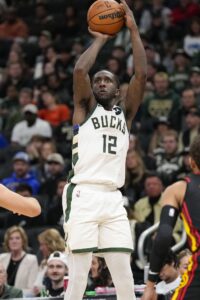 June 30: The Bucks and free agent forward Taurean Prince have reached an agreement on a two-year, minimum-salary contract, reports Shams Charania of ESPN (Twitter links). The second year of the deal will be a player option.
Prince started 73 of the 80 games he played for the Bucks in 2024/25, averaging 8.2 points, 3.6 rebounds, and 1.9 assists in 27.1 minutes per night.
Prince’s ability to guard multiple positions on defense and knock down three-pointers on offense makes him a valuable rotation player on the wing. He made a career-high 43.9% of his attempts from beyond the arc in 2024/25.
Still, it’s worth noting that the 31-year-old struggled badly in the playoffs, scoring just six points on 2-of-10 shooting in 61 total minutes during the first-round series vs. Indiana. He lost his starting job after the first two games of the series and likely won’t be assured of reclaiming that role heading into training camp this fall.
Prince is the third Bucks free agent who has reached an agreement to re-sign with the team, joining Bobby Portis and Kevin Porter. However, Brook Lopez is leaving Milwaukee for the Clippers, so the club figures to be in the market for additional frontcourt help.
Bucks Re-Sign Kevin Porter Jr. To Two-Year Deal
July 7: Porter has officially re-signed with the Bucks, according to NBA.com’s transaction log.
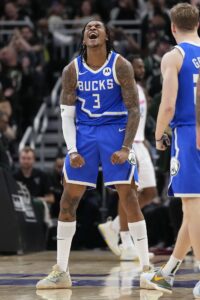 June 30: The Bucks and free agent guard Kevin Porter Jr. have agreed to a two-year deal worth $11MM, sources tell Shams Charania of ESPN (Twitter link).
Porter turned down a $2.55MM player option over the weekend in order to become a free agent. He’ll have an opportunity to return to the open market again in a year, as his new deal will feature a player option for 2026/27, per Charania.
Porter opened the 2024/25 season with the Clippers before being sent to Milwaukee at the trade deadline. He finished the season strong with the Bucks, averaging 11.7 points, 3.9 rebounds, and 3.7 assists in 19.9 minutes per game while shooting 49.4% from the floor, including 40.8% on threes.
The 25-year-old’s off-court history – ranging from a locker-room incident that ended his time in Cleveland to a domestic altercation that led to his exit from Houston – have limited his value to some extent in recent years, preventing him from securing big money or longer-term commitments. However, the Bucks liked their brief stint with Porter last season enough to move forward with him.
The Bucks will use the bi-annual exception to re-sign Porter, since they wouldn’t be able to complete the deal using his Non-Bird rights, notes Fred Katz of The Athletic (Twitter link). The BAE will be worth about $10.5MM over two seasons.
Nuggets Trade Michael Porter, First-Round Pick To Nets For Cam Johnson
July 8: The trade is official, the Nets announced in a press release.
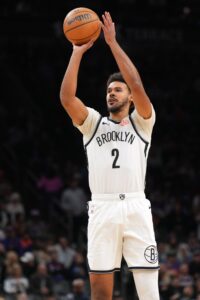 June 30: The Nuggets and Nets have agreed to a trade that will send Michael Porter Jr. and an unprotected 2032 first-round pick to the Nets in exchange for Cameron Johnson, reports Shams Charania of ESPN (Twitter link).
The move will create significant cap flexibility for Denver. Porter is owed a little over $79MM across the next two seasons, while Johnson’s contract has a base value of $44MM over those same two years (he also has some unlikely incentives that count toward the tax aprons).
It also looks like a potential on-court upgrade for the Nuggets. While Porter is an extremely talented scorer and shooter who averaged 18.2 points per game on a .504/.395/.768 shooting line in 77 games for Denver in 2024/25, Johnson is considered a strong defender and is a pretty good scorer and shooter in his own right.
Johnson scored a career-high 18.8 points per game on .475/.390/.893 shooting in 57 outings for the Nets this past season. He also set a new career high with 3.4 assists per contest.
The trade will move the Nuggets’ team salary more than $13MM below the first apron, potentially opening up the non-taxpayer mid-level exception to use in free agency, notes Keith Smith of Spotrac (Twitter link). That could be a valuable tool for a Denver team looking to add quality depth to support a strong starting lineup.
The Nets, meanwhile, will use a chunk of their cap room to accommodate Porter’s incoming salary — if they had been operating over the cap, they wouldn’t be able to swap Johnson straight up for MPJ and his $38.3MM cap hit.
The move will reduce their cap room to about $17MM, tweets ESPN’s Bobby Marks, though that number is fluid, depending on how the team handles its non-guaranteed contracts and whether either of the reported deals for Day’Ron Sharpe and Ziaire Williams go into the room exception.
The unprotected 2032 first-round pick is clearly the prize of the deal for Brooklyn. Nikola Jokic will be 37 years old in 2032, and there’s no guarantee he’ll still be a Nugget anyway, so that pick has a good deal of variability and could turn into a very valuable asset.
Still, the Nets don’t view Porter as a mere salary dump. They’re excited about the former lottery pick – who celebrated his 27th birthday on Sunday – and intend to keep him, tweets Ramona Shelburne of ESPN.
Lakers Sign Jake LaRavia To Two-Year Contract
July 6: LaRavia has signed with the Lakers, per the official transaction log at NBA.com.
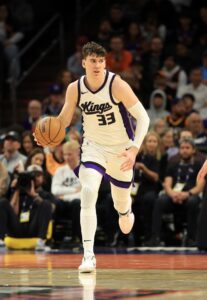 “Jake is a high IQ two-way player with ideal skills for a JJ Redick basketball system,” Lakers president of basketball operations Rob Pelinka said in a statement within the team’s press release confirming the deal. “He’s a disruptive defender who uses his size and physicality to create turnovers. Offensively, he can score at all three levels and has a knack for creating space for himself and his teammates.
“Being just 23 years old, we think Jake has significant basketball upside, which will be honed nicely in our Lakers basketball development program.”
June 30: The Lakers have agreed to a two-year, $12MM deal with free agent forward Jake LaRavia, reports Shams Charania of The Athletic (Twitter link).
Dan Woike of The Athletic, confirming the news, adds (via Twitter) that LaRavia’s contract will be fully guaranteed and refers to him as the team’s “top wing target” once Dorian Finney-Smith committed to Houston.
The Grizzlies turned down LaRavia’s fourth-year rookie scale option for 2025/26 last October, and he responded by playing some of the best basketball of his career through 47 games for Memphis — he made 44.4% of his three-pointers and the team was better when he was on the court than when he wasn’t.
The forward’s production dipped a little following a trade-deadline deal to Sacramento, but he still give the Kings good rotation minutes off the bench and finished the season with total averages of 6.9 points, 3.9 rebounds, and 2.4 assists in 20.4 minutes per game and a .475/.423/.678 shooting line for the two teams.
LaRavia’s solid season prompted Grizzlies head of basketball operations Zach Kleiman to admit after the season that he probably made a mistake by declining the former first-round pick’s $5.16MM option for ’25/26. Sacramento didn’t have the ability to exceed that $5.16MM figure on a starting salary for LaRavia, but other teams – like the Lakers – were allowed to go higher.
A two-year contract worth the full amount of the taxpayer mid-level exception would be worth $11.7MM, so it’s possible LaRavia’s contract will be signed that way. However, the Lakers – who are in desperate need for a center – have more free agent shopping to do, so I’d except LaRavia’s deal to come out of the non-taxpayer mid-level exception. Assuming that’s the case, the club would have about $8.3MM left on it, notes cap expert Yossi Gozlan (Twitter link).
Dorian Finney-Smith Signs Four-Year Contract With Rockets
July 7: The Rockets have officially signed Finney-Smith, the team confirmed in a press release.
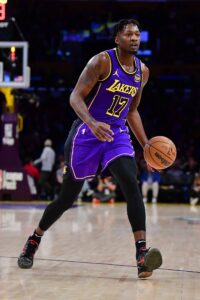 The deal is fully guaranteed for two seasons, with a non-guaranteed third year and a non-guaranteed fourth-year player option, per Scotto (Twitter link).
June 30: Free agent forward Dorian Finney-Smith is leaving the Lakers in order to sign a four-year, $53MM contract with the Rockets, sources tells Shams Charania of ESPN (Twitter link).
The agreement includes a trade kicker and a mutual option (ie. a non-guaranteed player option) in year four, tweets Michael Scotto of HoopsHype.
Finney-Smith will likely be signed using Houston’s non-taxpayer mid-level exception. A full mid-level deal, starting at the maximum $14.1MM, would be worth $60.6MM, so the Rockets should still have a small portion of the exception left over after signing Finney-Smith, assuming the contract has a standard ascending structure.
Finney-Smith, who was traded from Brooklyn to Los Angeles last December, appeared in 43 games for the Lakers in 2024/25, making 20 starts. He averaged 7.9 points, 3.9 rebounds, and 1.4 assists in 28.8 minutes per game, posting a shooting line of .442/.398/.714.
While his box-score numbers certainly don’t jump off the page, Finney-Smith’s midseason arrival helped fuel a defensive turnaround in L.A. and his reliable three-point shooting helped space the floor on offense.
His impact was reflected by his on/off-court numbers — no Lakers rotation player had a better regular season net rating than Finney–Smith’s +11.1 mark in 1,239 minutes. The club had a -3.5 mark in the 1,214 minutes he didn’t play after the trade.
In Houston, he’ll serve as the type of three-and-D wing the Rockets lost when they agreed to trade Dillon Brooks to Phoenix in the Kevin Durant blockbuster.
It’s a major loss for the Lakers, given the role Finney-Smith both on and off the court for the franchise. As Dan Woike of The Athletic tweets, the 32-year-old was a popular presence in the locker room and was well-liked by Luka Doncic. However, a four-year deal for Finney-Smith didn’t fit into L.A.’s long-term plans.
Salary Cap, Tax Line Set For 2025/26 NBA Season
The NBA has officially set the salary cap for its 2025/26 season. The cap has come in at $154,647,000, which was the projection all season long. It represents an increase of 10% on last season’s $140,588,000 cap.
Here are the details, courtesy of a league press release (Twitter link), ESPN’s Bobby Marks (Twitter link), and Eric Pincus of Bleacher Report (Twitter link):
- Salary cap: $154,647,000
- Luxury tax line: $187,895,000
- First tax apron: $195,945,000
- Second tax apron: $207,824,000
- Minimum salary floor: $139,182,000
- Non-taxpayer mid-level exception: $14,104,000
- Taxpayer mid-level exception: $5,685,000
- Room exception: $8,781,000
- Bi-annual exception: $5,134,000
- Maximum salaries:
- 6 years or fewer: $38,661,750
- 7-9 years: $46,394,100
- 10+ years: $54,126,450
- Early Bird exception: $13,936,650
- Estimated average salary: $13,870,000
- Trade cash limit: $7,964,000
- Maximum Exhibit 10 bonus: $85,300
- Expanded traded player exception amount: $8,527,000
The first tax apron for the 2025/26 league year ($195,945,000) will be the hard cap for any team that acquires a player via sign-and-trade, signs a player using more than the taxpayer portion of the mid-level exception, signs or acquires a player using a bi-annual exception, uses any portion of its mid-level exception to add a player via trade or waiver claim, uses an expanded traded player exception (ie. takes back more than 100% of a player’s salary using salary-matching), uses a trade exception generated prior to the start of the 2025 offseason, or signs a player who is waived during the regular season and had a salary exceeding $14,104,000.
The second tax apron ($207,824,000) represents the hard cap for a team that uses any portion of the mid-level exception, aggregates two or more player salaries in a trade, sends out cash in a trade, or uses a signed-and-traded player to take back salary.
The salary floor ($139,182,000) is the minimum amount a team must pay its players in 2025/26. A team that doesn’t spend up to that amount by the start of the regular season will pay the shortfall to the NBA and won’t be eligible for its full share of the luxury tax distribution at season’s end.
[RELATED: NBA Maximum Salaries For 2025/26]
[RELATED: Values Of 2025/26 Mid-Level, Bi-Annual Exceptions]
The trade cash limit is the maximum amount of money a team can send or receive during the 2025/26 league year. The sent and received categories are separate, so if a team sends out $7,240,000 in one trade and receives $7,240,000 in another, they aren’t back at square one — they’ve reached both limits.
The Early Bird amount represents the maximum starting salary a team can offer a player it intends to re-sign using his Early Bird rights, assuming that amount is greater than 175% of his previous salary.
Players earning below the estimated average salary in 2025/26 who are eligible for a veteran extension can receive a starting salary of up to 140% of the estimated average salary on a new deal. So the maximum starting salary for a player earning below the league average who signs an extension that begins in 2026/27 will be $19,418,000.
The maximum Exhibit 10 bonus is, as its name suggests, the highest possible bonus available to a player who signs an Exhibit 10 contract with an NBA team, gets cut, then spends at least 60 days with that club’s G League affiliate.
This amount ($85,300) is also the maximum two-way protection amount, which means a player who signs a two-way contract before the season can get up to $85,300 guaranteed upon signing. A player who signs a contract with more than $85,300 guaranteed is not subsequently eligible for a two-way contract with that team in 2025/26.
The expanded traded player exception amount ($8,527,000) is the amount of excess salary a team operating under both tax aprons is permitted to take back in a simultaneous trade, assuming that amount plus the player’s (or players’) outgoing salary is: (A) less than 200% (plus $250K) of the outgoing salary; and (B) more than 125% (plus $250K) of the outgoing salary. For instance, a non-apron team trading a player with a $10MM cap hit could legally acquire a player earning $18,527,000. We have more information on this rule in our traded player exception glossary entry.
The NBA is projecting its salary cap to rise by 7% in 2026/27, tweets Marks. Most salary projections for contracts signed in ’26/27 and beyond had assumed annual 10% cap increases, so it’s notable that the first official estimate from the league is coming in a little lower than that.