
Jazz Sign Kyle Filipowski
The Jazz have signed second-round pick Kyle Filipowski to his first NBA contract, the team announced today in a press release.
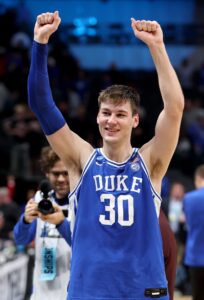 Filipowski, a 7’0″ forward/center, declared for the draft this spring as an early entrant after averaging 16.4 points, 8.3 rebounds, 2.8 assists, and 1.5 blocks in 30.4 minutes per game across 36 starts in his sophomore year at Duke.
He posted a shooting line of .505/.348/.671 in his final college season for the Blue Devils and was a consensus second-team All-American.
Although he was invited to the green room for the first night of the 2024 draft, Filipowski fell out of the first round and was selected by Utah with the 32nd overall pick on day two. He impressed last month at the Las Vegas Summer League, averaging 16.4 PPG, 6.8 RPG, and 2.4 APG in five games (25.3 MPG).
While Filipowski’s contract details aren’t yet known, the Jazz’s announcement indicates he received a standard contract rather than a two-way deal, which was expected. Given his draft slot, a three- or four-year deal with at least a couple guaranteed seasons seems likely.
Filipowski was one of the last 2024 draftees to officially sign a contract, as the Jazz looked to maximize their cap room well into the offseason in case trade opportunities arose. They’ve been in the process of using up that cap space in recent days, renegotiating and extending Lauri Markkanen‘s contract, then officially signing Drew Eubanks and Svi Mykhailiuk.
Utah now has 13 players on standard contracts, with Johnny Juzang‘s reported four-year contract still to be finalized. The team has also filled all three of its two-way slots, so its roster could be almost ready for the regular season.
Contract Details: Mykhailiuk, Eubanks, Swider, Two-Ways
The four-year contract that veteran swingman Svi Mykhailiuk signed with the Jazz only includes $3.5MM in guaranteed money, Hoops Rumors has learned — that $3.5MM is the salary Mykhailiuk will earn in 2024/25.
The second and third years of Mykhailiuk’s deal, worth $3.675MM and $3.85MM respectively, are non-guaranteed, as is his $4.025MM team option for the 2027/28 season. The 27-year-old could earn up to a total of $15.05MM if he plays out the entire contract, but $11.55MM of that money is non-guaranteed.
June 30 represents Mykhailiuk’s annual salary guarantee date, so the Jazz would have to waive him by June 30, 2025 to avoid being on the hook for his full ’25/26 salary. That deadline also applies to each of the following two seasons.
Here are more details on recently signed contracts from around the NBA:
- Drew Eubanks will earn a $5MM guaranteed salary from the Jazz this season, with a $4.75MM non-guaranteed salary for 2025/26, Hoops Rumors has learned. Both Mykahiliuk and Eubanks were signed using a portion of Utah’s leftover cap room.
- Cole Swider‘s one-year, non-guaranteed contract with the Pacers is worth the minimum salary and includes Exhibit 9 language, Hoops Rumors has learned. It doesn’t feature Exhibit 10 language, which suggests the plan probably isn’t for Swider to join Indiana’s G League team if he’s waived during training camp. The third-year forward vie for a spot on the Pacers’ 15-man regular season roster.
- The two-way contracts recently signed by Enrique Freeman with the Pacers and Anzejs Pasecniks with the Bucks are each one-year deals, so both players will be eligible for restricted free agency in 2025.
Hoops Rumors Glossary: Designated Veteran Contract
The NBA’s maximum salary is determined by a player’s years of NBA experience. Players with between zero and six seasons under their belts are eligible for a starting salary worth up to 25% of the salary cap. That figure increases to 30% for players with seven to nine years of NBA experience, and to 35% for players with 10+ years of service.
However, there are certain scenarios in which a player can achieve a higher maximum salary than his years of service dictate. When a player who would normally qualify for the 30% max becomes eligible for a starting salary worth up to 35% of the cap before he gains 10+ years of NBA experience, he can sign a Designated Veteran contract, also known as a “super-max” deal.
A player who has seven or eight years of NBA service with one or two years left on his contract becomes eligible for a Designated Veteran contract extension if he meets the required performance criteria. A Designated Veteran contract can also be signed by a player who is a free agent if he has eight or nine years of service and meets the required performance criteria.
However, a player can’t sign a Designated Veteran deal with a new team — only his current team. Additionally, if he has been traded at any time since his first four years in the NBA or previously changed teams via free agency at any point in his career, he becomes ineligible for such a deal.
That means players like Donovan Mitchell, Lauri Markkanen, and Jalen Brunson would have had no path to becoming eligible for Designated Veteran deals with their current teams, but Brandon Ingram (who was traded during his first four seasons) could become eligible if he remains with the Pelicans and meets the performance criteria.
Speaking of that performance criteria, here’s what it looks like. At least one of the following must be a true for a player to be eligible to sign a Designated Veteran contract:
- He was named to an All-NBA team in the most recent season, or in two of the last three seasons.
- He was named NBA MVP in any of the three most recent seasons.
- He was named NBA Defensive Player of the Year in the most recent season, or in two of the last three seasons.
Given the exclusivity of the MVP and Defensive Player of the Year awards, players who qualify for a Designated Veteran contract do so most often by earning All-NBA nods.
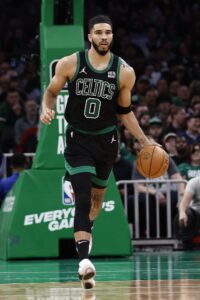 Celtics forward Jayson Tatum was the only player eligible to sign a Designated Veteran contract this offseason. Tatum actually met the performance criteria a year ago by making his second consecutive All-NBA team, but he only had six years of NBA service at the time. He was able to sign his super-max extension this offseason once he registered his seventh year of service.
Tatum was named an All-NBA first-teamer again in 2024, but would have been eligible even if he’d missed out on an All-NBA spot this year, since his nods in 2022 and 2023 ensured he’d made an All-NBA team in at least two of the past three seasons.
Thunder guard Shai Gilgeous-Alexander and Mavericks guard Luka Doncic are following in Tatum’s footsteps. Both players have made All-NBA teams in each of the past two seasons but still have just six years of service under their belts. They’ll meet the service time criteria next summer and will be eligible to sign Designated Veteran contract extensions in July 2025 whether or not they earn All-NBA honors in 2024/25.
As outlined above, if the Thunder were to trade Gilgeous-Alexander or the Mavericks were to trade Doncic, they would no longer be super-max eligible. But obviously those 2024 MVP finalists aren’t going anywhere in the next year.
While the Designated Veteran rule allows players with fewer than 10 years of NBA experience to qualify for contracts that begin at 35% of the cap instead of 30%, the “Rose Rule” allows players with fewer than seven years of service to qualify for contracts that begin at 30% of the cap instead of 25%.
Those are technically two separate rules, and we’ve discussed the Rose Rule at greater length in a separate glossary entry. However, they’re closely linked, and both types of contracts are sometimes referred to a “super-max” deals.
Here are a few other rules related to Designated Veteran contracts:
- Even if a player qualifies for a Designated Veteran contract, his team isn’t obligated to start its extension offer at 35% of the cap. The player is eligible for a salary up to that amount, but the exact amount is still a matter for the two sides to negotiate. For example, after becoming super-max eligible in 2020, Rudy Gobert signed a contract with the Jazz that began at just over 31% of the cap.
- A Designated Veteran extension can’t exceed six years, including the number of years left on the player’s contract. So if a player signs a Designated Veteran extension when he has two years left on his current contract, he could tack on four new years to that deal.
- A player signing a Designated Veteran contract as a free agent can’t sign for more than five years.
- A Designated Veteran extension can only be signed between the end of the July moratorium and the last day before the start of the regular season.
- If a player signs a Designated Veteran contract, he is ineligible to be traded for one year.
- Under the 2017 Collective Bargaining Agreement, a team wasn’t permitted to carry more than two players on Designated Veteran contracts at a time. However, that rule didn’t carry over to the 2023 CBA and that limit no longer applies.
Our list of the players who have signed Designated Veteran contracts since their inception in 2017 can be found right here.
Note: This is a Hoops Rumors Glossary entry. Our glossary posts will explain specific rules relating to trades, free agency, or other aspects of the NBA’s Collective Bargaining Agreement. Larry Coon’s Salary Cap FAQ was used in the creation of this post.
Previous versions of this glossary entry were published in 2018 and 2023.
NBA 2024 Offseason Check-In: Boston Celtics
Hoops Rumors is checking in on the 2024 offseason for all 30 NBA teams, recapping the summer’s free agent signings, trades, draft picks, departures, and more. We’ll take a look at each team’s offseason moves and consider what might still be coming before the regular season begins. Today, we’re focusing on the Boston Celtics.
Free agent signings
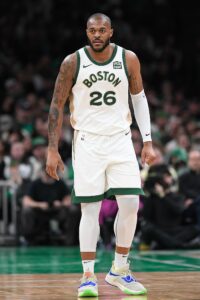 Neemias Queta: Three years, minimum salary ($7,180,128). Second year partially guaranteed ($1,174,789). Third-year team option. Re-signed using Non-Bird rights.
- Xavier Tillman: Two years, minimum salary ($4,784,366). Re-signed using minimum salary exception.
- Luke Kornet: One year, minimum salary. Re-signed using minimum salary exception.
- Tristan Enaruna: One year, minimum salary. Non-guaranteed (Exhibit 10). Signed using minimum salary exception.
- Ron Harper Jr.: One year, minimum salary. Non-guaranteed (Exhibit 10). Signed using minimum salary exception.
Trades
- None
Draft picks
- 1-30: Baylor Scheierman
- Signed to rookie scale contract (four years, $12,810,352).
- 2-54: Anton Watson
- Signed to two-way contract.
Two-way signings
Departed/unsigned free agents
- Oshae Brissett (unsigned)
- Svi Mykhailiuk (Jazz)
Other moves
- Signed Jayson Tatum to a five-year, super-max contract extension that begins in 2025/26. The deal includes a fifth-year player option and has a projected value of $313,933,410.
- Signed Derrick White to a four-year, $118,048,000 contract extension that begins in 2025/26. The deal includes $7,840,000 in incentives and a 15% trade kicker.
- Exercised Sam Hauser‘s 2024/25 team option ($2,092,344); signed Hauser to a four-year, $45,000,000 contract extension that begins in 2025/26.
Salary cap situation
- Operating over the cap ($140.6MM), over the luxury tax line ($170.8MM), and above the second tax apron ($188.9MM).
- Carrying approximately $196.6MM in salary.
- No hard cap.
- No form of mid-level or bi-annual exception available.
- Two traded player exceptions frozen/unavailable (largest worth $2,019,706).
The offseason so far
The Celtics dominated the 2024/25 campaign, posting the NBA’s best regular season record (64-18) and net rating (+11.7) by a wide margin, then losing just three playoff games (no more than one in any series) en route to a league-record 18th championship.
It’s no surprise then that the front office’s strategy this offseason was simply to keep this group intact, especially since the team’s position relative to the tax aprons made it difficult to bring in outside help.
Of the seven Celtics players who reached free agency this offseason, five are back under contract with the team — big men Luke Kornet, Xavier Tillman, and Neemias Queta each returned on minimum-salary contracts, while Drew Peterson and JD Davison signed new two-way deals.
Little-used wing Svi Mykhailiuk is the only free agent to join a new team (Utah), while another reserve wing, Oshae Brissett, is the only one who remains unsigned. The Celtics still have one open 15-man roster spot, so it’s not out of the question that Brissett returns, but it looks like the team will be happy adding a pair of draft picks (Baylor Scheierman and Anton Watson) to the back of the roster and entering the fall with that last spot still open.
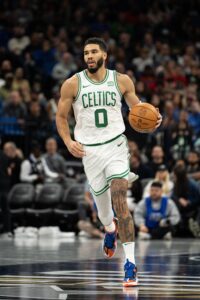 Besides re-signing most of their own free agents, the Celtics agreed to long-term extensions with All-NBA forward Jayson Tatum, All-Defensive guard Derrick White, and sharpshooting reserve Sam Hauser. With the exception of 38-year-old big man Al Horford, the Celtics’ top eight rotation players are now under contract for multiple seasons, with five of them locked up for at least the next four years.
It hasn’t been a perfect offseason in Boston. Top assistant Charles Lee left Joe Mazzulla‘s staff to take the head coaching job in Charlotte, and the Celtics’ majority ownership group put control of the franchise up for sale, raising some questions about the long-term feasibility of maintaining one of the NBA’s most expensive rosters, which will only get pricier in 2025/26 as many of those aforementioned extensions take effect.
For now though, the outlook in Boston remains overwhelming positive, with the Celtics poised to enter the 2024/25 season as the favorites to repeat.
Up next
It’s possible the Celtics’ offseason business is over. The team has 14 players on standard guaranteed contracts and three on two-way deals, so the roster is regular-season-ready.
The only remaining extension-eligible player is fourth-year guard Jaden Springer, who probably hasn’t shown enough to warrant a long-term investment at this point. He logged just 7.6 minutes per game across 17 regular season appearances with the Celtics after being acquired from Philadelphia at the 2024 trade deadline, and only saw garbage-time action in four playoff contests.
With two open spot on Boston’s 21-man offseason roster, the team will probably bring in a couple more camp invitees on Exhibit 10 contracts. And maybe those players will even get the opportunity to compete for one of the two-way spots currently held by Davison or Peterson (I wouldn’t expect Watson, who holds the third two-way, to be cut before his rookie season).
But for the most part, a quiet fall should be in store for the Celtics, who will be eager to get their title defense underway this October.
NBA 2024 Offseason Check-In: Dallas Mavericks
Hoops Rumors is checking in on the 2024 offseason for all 30 NBA teams, recapping the summer’s free agent signings, trades, draft picks, departures, and more. We’ll take a look at each team’s offseason moves and consider what might still be coming before the regular season begins. Today, we’re focusing on the Dallas Mavericks.
Free agent signings
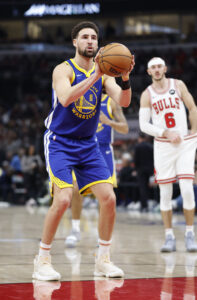 Klay Thompson: Three years, $50,000,000. Includes 15% trade kicker. Signed using Bird rights and acquired via sign-and-trade from Warriors.
- Naji Marshall: Three years, $27,000,000. Includes 5% trade kicker. Signed using non-taxpayer mid-level exception.
- Spencer Dinwiddie: One year, minimum salary. Signed using minimum salary exception.
- Jazian Gortman: One year, minimum salary. Non-guaranteed (Exhibit 10). Signed using minimum salary exception.
- Emanuel Miller: One year, minimum salary. Non-guaranteed (Exhibit 10). Signed using minimum salary exception.
- Jamarion Sharp: One year, minimum salary. Non-guaranteed (Exhibit 10). Signed using minimum salary exception.
Trades
- Acquired the draft rights to Melvin Ajinca (No. 51 pick) from the Knicks in exchange for the draft rights to Ariel Hukporti (No. 58 pick), the draft rights to Petteri Koponen, and cash ($1MM).
- Acquired Quentin Grimes from the Pistons in exchange for Tim Hardaway Jr., the Raptors’ 2025 second-round pick, the Heat’s 2028 second-round pick, and either the Clippers’ or Hornets’ 2028 second-round pick (whichever is least favorable).
- Acquired Klay Thompson (sign-and-trade) and either the Nuggets’ or Sixers’ second-round pick (whichever is more favorable in a six-team trade in exchange for Josh Green (to Hornets) and the Mavericks’ 2031 second-round pick (to Sixers).
Draft picks
- 2-51: Melvin Ajinca
- Signed with ASVEL in France.
Two-way signings
Departed/unsigned free agents
- Greg Brown (unsigned)
- Derrick Jones (Clippers)
- Markieff Morris (unsigned)
Other moves
- Waived Alex Fudge.
Salary cap situation
- Operating over the cap ($140.6MM) and above the luxury tax line ($170.8MM).
- Carrying approximately $176.1MM in salary.
- Hard-capped at $178,132,000.
- Approximately $4.25MM of mid-level exception available; full bi-annual exception ($4.67MM) available.
- Two traded player exceptions available (largest worth $16,193,183).
The offseason so far
The vibes were good in Dallas after the Mavericks made an unexpected run to the NBA Finals this spring, with general manager Nico Harrison suggesting after the team’s loss to Boston that his plan was to simply keep the core intact and to find a way to re-sign starting small forward Derrick Jones.
The Mavs’ ability to give Jones a raise on his previous minimum-salary contract was limited because they only held his Non-Bird rights, but Harrison vowed that bringing back the talented defensive swingman was “priority 1A and 1B” for the organization.
When Dallas struck a deal to send Tim Hardaway Jr. and some future second-round picks to Detroit in exchange for Quentin Grimes, the team’s intentions looked pretty clear — having created nearly $12MM in extra cap flexibility as a result of that move, the Mavs gained the ability to use the non-taxpayer mid-level exception to re-sign Jones.
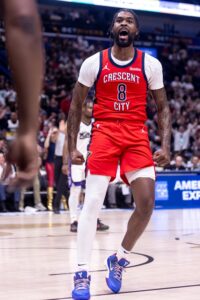 That didn’t happen though. Instead, Jones opted to sign a three-year, $30MM contract with the Clippers, prompting the Mavs to pivot to another free agent, Naji Marshall. Dallas used a portion of its MLE to bring in Marshall – a three-and-D forward – on a three-year, $27MM deal.
That signing hard-capped the Mavs at the first tax apron for the rest of the 2024/25 league year, but the front office wasn’t done wheeling and dealing yet. The club reached an agreement with the Warriors and Hornets on a three-team trade that would send Josh Green to Charlotte and Klay Thompson to Dallas on a three-year, $50MM contract. The move was eventually combined with a handful of other transactions and completed as a six-team deal.
When the dust settled, the Mavs had essentially replaced three wings – Jones, Hardaway, and Green – with three new ones in Thompson, Marshall, and Grimes. Thompson isn’t the perennial All-Star he once was, and Grimes is coming off a disappointing, injury-plagued season, but between Thompson’s shooting ability and Marshall’s and Grimes’ three-and-D skill sets, Dallas has a good chance to come out ahead in the series of wing swaps, strengthening a roster that just won the West.
The Mavs also brought back Spencer Dinwiddie, who had a down year with the Nets and Lakers in 2023/24, but thrived in Dallas during the one-year period from the 2022 trade deadline (when he was acquired in the deal sending Kristaps Porzingis to Washington) to the 2023 deadline (when he was sent out as part of the package for Kyrie Irving). A potential bargain on a minimum-salary deal, Dinwiddie will provide additional depth behind the star-studded backcourt of Irving and Luka Doncic.
Up next
The Mavericks have 15 players on standard contracts, but they’ll likely make a change to their 15th spot at some point before training camp. Reports throughout the summer have indicated that veteran forward Markieff Morris is expected to return to Dallas on a new deal.
A.J. Lawson, who is on a non-guaranteed contract, would almost certainly be waived if Morris officially re-signs, since he’s the clear 15th man and the Mavs don’t have enough flexibility below their hard cap to eat a guaranteed salary.
Dallas also still has a two-way slot available alongside Brandon Williams and Kessler Edwards. It’s unclear if the Mavs have anyone specific in mind for that opening or if the team’s current Exhibit 10 players (Jazian Gortman, Emanuel Miller, and Jamarion Sharp) might get a chance to compete for that last two-way deal.
The Mavs have several players who are either already extension-eligible or will become eligible for new deals prior to opening night, though it’s possible none of them will sign contracts before the regular season tips off.
Maxi Kleber has one more guaranteed season on their respective contracts after 2024/25, so there’s no urgency to work something out this year. Grimes, who is eligible for a rookie scale extension, has yet to suit up for the Mavs and will likely need to prove 2023/24 was an aberration before the team is willing to invest long-term in him.
Doncic could technically sign an extension now, but despite meeting the performance criteria for a super-max contract, he needs to have one more year of experience under his belt to actually sign that super-max, so he’ll wait until 2025.
Third-year guard Jaden Hardy is an interesting extension candidate, but unlike the three aforementioned players, he’ll remain eligible for the entire 2024/25 season, not just until October 21, so the Mavs could postpone their decision on him until the winter or the spring.
Cavs Notes: Roster, Okoro, Bates, Nance, Travers
The Cavaliers are still carrying just 10 players on standard guaranteed contracts for the 2024/25 season. However, the team doesn’t appear likely to make a series of roster additions before the regular season begins.
Craig Porter, who has a partially guaranteed salary, and Sam Merrill, who has a non-guaranteed deal, are penciled in as the 11th and 12th players on the 15-man regular season roster. And, as Chris Fedor of Cleveland.com explains, one of the other roster openings remains earmarked for restricted free agent Isaac Okoro. There hasn’t been any movement recently in negotiations with Okoro, per Fedor, with Cleveland having made its position clear to the forward’s camp.
If Okoro returns as the 13th man, the 14th spot on the roster would likely be reserved for a “cost-effective, playable, end-of-bench veteran,” according to Fedor, who suggests that the ideal target would be a player who could provide depth and locker room leadership, like Tristan Thompson did last season.
New Cavaliers head coach Kenny Atkinson, who is serving as an assistant for the French national team, is expected to meet with members of Cleveland’s front office after the Olympics to discuss what he’s looking for with that 14th roster spot, as well as possible targets, Fedor writes.
As for the 15th spot, the plan is to leave it open to begin the regular season in order to save some money and maximize the team’s roster flexibility, Fedor concludes.
Here’s more on the Cavs:
- Cleveland doesn’t yet have any players signed to two-way contracts for the coming season, but Fedor expects Emoni Bates to return in one of those slots. A two-way qualifying offer remains on the table for Bates, making him a restricted free agent. Pete Nance, who finished last season on a two-way contract and played a significant role on the Cavs’ Summer League team, is another strong candidate for a two-way deal, Fedor adds.
- When draft-and-stash prospect Luke Travers left Melbourne United to pursue other professional opportunities, he made that decision in conjunction with the Cavs, sources tell Cleveland.com. However, the plan for Travers remains up in the air — having him sign a two-way contract is the most logical outcome, but it isn’t a certainty yet, says Fedor.
- As Fedor observes, as long as the Cavs are carrying just 14 players on their standard roster instead of 15, their two-way players are limited to 90 total games (instead of 50 apiece), meaning Travers could spend plenty of time in the G League with the Cleveland Charge if he comes stateside on a two-way deal. That might be fine with him, but Fedor suggests that a deal in Europe – where he’d presumably have a bigger role than he would in the NBA – is another option that may still be in play for the 22-year-old Australian wing. The Cavs could also trade Travers’ NBA rights, though there’s no indication they’re pursuing that path.
Latest On Christian Koloko’s Comeback Effort
Former Raptors big man Christian Koloko, who missed all of the 2023/24 season due to a blood clot issue that was said to be career-threatening, is on the comeback trail, according to Aaron Rose of SI.com.
After Sportsnet’s Blake Murphy reported last month that Koloko had received medical clearance to resume playing, agent Calvin Andrews of Klutch Sports provided an update to Rose on where things stand now with his client.
“We had a major breakthrough with his blood clot issue,” Andrews said. “They found the issue and he had corrective surgery and has been recovering (for) the last four months.”
According to Andrews, Koloko has been off blood thinners for the last month and will undergo a scan for blood clots later in August. “If there’s none, then everything is fine,” Andrews said.
Koloko held a workout for potential suitors during last month’s Las Vegas Summer League and has been able to participate in five-on-five, full-contact drills in recent weeks as he attempts to get back to 100% health. Chris Johnson, a trainer who has worked with a number of NBA players, posted a YouTube video this week of Koloko taking part in a scrimmage alongside Kentavious Caldwell-Pope, Jalen Johnson, Jordan Clarkson, Delon Wright, and several other active NBAers.
However, Koloko isn’t free to sign an NBA contract yet. As Rose details, the seven-footer will still need to be cleared by the league’s Fitness-to-Play panel, which could take a few more weeks. The hope is that it will happen before the start of the 2024/25 season, in which case Koloko would be able to join any NBA team — including his former club.
“The Raptors have kept very close eyes on his situation,” Andrews said. “And Koloko would have no problem coming back to the Raptors.”
The 33rd overall pick in the 2022 draft, Koloko appeared in 58 games for Toronto as a rookie, averaging 3.1 points, 2.9 rebounds, and 1.0 block in 13.8 minutes per game across 58 appearances (19 starts). The former Arizona standout is still just 24 years old.
New York Notes: Brunson, Lessort, Schröder, Nets
Speaking on Thursday to reporters, including Stefan Bondy of The New York Post, Knicks guard Jalen Brunson explained why he was willing to accept a four-year, $156.5MM contract extension this summer. The deal was the biggest one Brunson was able to sign at this point, but he could have landed a significantly more lucrative payday if he had waited another year.
“Priority A, I secured I think a decent amount of money to support myself and my family, my extended family in the current time. I didn’t have to wait a year,” Brunson said. “Like I said, a lot can happen in a year. Everyone in this room has seen a lot happen in a year when players wait out. So that’s one thing. No. 2 — I would love to be here, I want to be here the rest of my career. And winning trumps everything I do individually. Like I said, when you win as a team, individuals can grow from that. That’s at the front of my mind at all times — what can I do to win?”
While Brunson will have a chance down the road to make up much of the money he “lost” by signing an early extension, his deal will provide the Knicks with added cap flexibility for the next few seasons. The veteran point guard told reporters that he has studied team-first champions from other sports, such as Tom Brady and Derek Jeter, and that he took those examples into account when making his decision.
“First, Tom Brady and Derek Jeter are in a class of their own. I’m not saying I’m a part of that class,” Brunson said. “Second, those dudes are the epitome of winning. They did whatever it took to win. That was on the forefront of their minds. I just knew if I did this, it would give us a lot of flexibility and put us in position to win.
“And I know that a lot of people don’t agree with it. A lot of people are saying it’s not the smart thing from a personal standpoint. But I just know — I’m comfortable here. This is home for me. I don’t worry about what anybody else says, what they think. That’s their opinion. They can have it.”
Here’s more on the NBA’s two New York teams:
- The Knicks, who acquired Mathias Lessort‘s draft rights back in 2020, inquired earlier this offseason about the 28-year-old’s interest in coming stateside, according to Ian Begley of SNY.tv. However, the two sides weren’t able to find common ground, says Begley. Vincent Collet, the head coach of the French national team, recently expressed surprise that Lessort isn’t in the NBA.
- In a conversation with Marc J. Spears of Andscape, Nets point guard Dennis Schröder talked about growing up in Germany, playing in the Olympics, and his desire to remain in Brooklyn for the final year of his current contract — and potentially well beyond that. “I want to be in Brooklyn long-term. Hopefully that works out,” Schröder said. “I want to be a veteran who shows the young people the way and how we should play and how we play as a team. I understand that the NBA is always more individual, but I want to make one team like we had in Atlanta where it was about just winning and really not (caring) who scores. And I want to bring that back to the NBA, to the Brooklyn Nets.”
- While plenty can change between now and July 2025, the Nets are currently the only team projected to have significant cap room next summer, tweets ESPN’s Bobby Marks. Even before accounting for possible in-season trades and/or extensions, cap projections can vary significantly depending on which cap holds and options are assumed to be on the books, but Keith Smith of Spotrac (Twitter link) also projects Brooklyn to have the most cap space of any team in 2025.
And-Ones: Guy, WBD Lawsuit, 21-And-Under Players, More
Former Virginia star Kyle Guy, who was the 55th overall pick in the 2019 NBA draft, is returning to his alma mater as an athlete development mentor and special assistant, according to a press release from the program.
“C’ville I am back!” Guy said in a statement. “I want to sincerely thank Coach (Tony) Bennett and (athletic director) Carla Williams for trusting me with the opportunity to come back and begin this next chapter of my life. This was not an easy decision for me, but knowing how much love I have for this culture and community made it very clear where I should be with my family. I’m beyond excited to help this team and the University in any way needed.”
Guy, who will turn 27 on Sunday, spent three years in the NBA from 2019-22, appearing in a total of 53 regular season games for the Kings and Heat and averaging 3.1 points in 8.1 minutes per contest. He spent the past two seasons playing internationally in Spain and Greece. However, his new role and his accompanying statement suggest that he’s prepared to put his playing career behind him.
Here are a few more odds and ends from around the basketball world:
- The judge who is overseeing Warner Bros. Discovery’s lawsuit against the NBA has given the league until August 23 to respond, according to Mike Vorkunov of The Athletic (Twitter link). If the NBA moves to dismiss the suit, WBD would have until September 20 to file its opposition, then the league would have until October 2 to respond again. The lawsuit was a response to the league rejecting TNT’s right to match Amazon’s offer for NBA media rights.
- James L. Edwards III, Kelly Iko and Will Guillory of The Athletic conducted a 24-player mock draft of NBA players who were 21 or younger at the end of the 2023/24 season. Victor Wembanyama, unsurprisingly, was the top pick, followed by Paolo Banchero, Alperen Sengun, Brandon Miller, and Dereck Lively.
- The rest of the basketball world hasn’t caught up to the United States, but a down-to-the-wire semifinal game against Serbia at the Olympics was a reminder that the gap is narrowing, writes Seerat Sohi of The Ringer. Sohi notes that France, led by Wembanyama and youngsters like Zaccharie Risacher, Alex Sarr, Tidjane Salaun, and projected 2025 lottery pick Nolan Traore, could be a future powerhouse, while Canada is still on the rise despite a disappointing 2024 outcome.
NBA 2024 Offseason Check-In: Atlanta Hawks
Hoops Rumors is checking in on the 2024 offseason for all 30 NBA teams, recapping the summer’s free agent signings, trades, draft picks, departures, and more. We’ll take a look at each team’s offseason moves and consider what might still be coming before the regular season begins. Today, we’re focusing on the Atlanta Hawks.
Free agent signings
- Cody Zeller: Three years, $11,025,000. Second and third years non-guaranteed. Signed using Non-Bird rights and acquired via sign-and-trade from Pelicans.
- Vit Krejci: Four years, $10,185,213. Second year partially guaranteed ($1.5MM). Third year non-guaranteed. Fourth-year team option. Re-signed using Non-Bird rights.
Trades
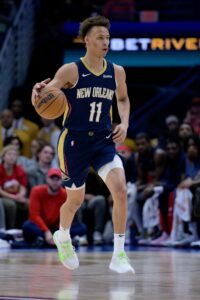 Acquired the draft rights to Nikola Djurisic (No. 43 pick) from the Heat in a three-team trade in exchange for the draft rights to AJ Griffin (to Rockets) and cash (to Heat).
- Acquired Larry Nance Jr., Dyson Daniels, E.J. Liddell, Cody Zeller (sign-and-trade), the Lakers’ 2025 first-round pick, and either the Pelicans’ or Bucks’ 2027 first-round pick (whichever is least favorable; top-four protected) from the Pelicans in exchange for Dejounte Murray.
- Acquired David Roddy from the Suns in exchange for E.J. Liddell.
Draft picks
- 1-1: Zaccharie Risacher
- Signed to rookie scale contract (four years, $57,027,436).
- 2-43: Nikola Djurisic
- Unsigned.
Two-way signings
Departed/unsigned free agents
- Saddiq Bey (Wizards)
- Trent Forrest (Baskonia)
- Wesley Matthews (unsigned)
- Dylan Windler (unsigned)
Other moves
- Exercised Garrison Mathews‘ 2024/25 team option ($2,230,253).
- Waived Bruno Fernando.
Salary cap situation
- Operating over the cap ($140.6MM) and below the luxury tax line ($170.8MM).
- Carrying approximately $169.5MM in salary.
- Hard-capped at $178,132,000.
- Full mid-level, bi-annual exceptions available.
- Two traded player exceptions available (largest worth $25,266,266).
The offseason so far
The Hawks’ offseason began with a bang, as the team unexpectedly landed the No. 1 overall pick in the draft lottery, moving up nine spots from No. 10 in the pre-lottery odds.
In another year (say, 2023), that stroke of luck might’ve fundamentally changed the direction of the franchise. However, the 2024 draft class didn’t feature a generational prospect – or even a clear-cut top option – so moving up to first overall didn’t really alter Atlanta’s offseason goals. The team still had a backcourt situation to address, with either Dejounte Murray or Trae Young considered likely to be traded
It was ultimately Murray who was on the move, sent to the Pelicans in exchange for a package that included a promising young guard (Dyson Daniels), a useful role player (Larry Nance Jr.), a couple salary-matching pieces, and some draft assets.
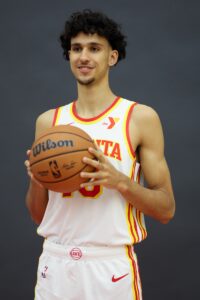 While Atlanta made two more minor deals this summer, trade candidates like Young, Clint Capela, and De’Andre Hunter remain on the roster, with little indication that the club is aggressively looking to move any of them. And it was a quiet summer in free agency for the Hawks, whose only signings were Cody Zeller (part of the Murray deal via sign-and-trade) and Vit Krejci (who got a promotion after finishing last season on a two-way deal).
The Hawks now appear caught somewhere in between contending and rebuilding. With Young, Capela, Bogdan Bogdanovic, and rising star Jalen Johnson on the roster, Atlanta isn’t about to bottom out, but there’s not enough talent spread throughout the rest of the roster to make the team a legit threat to win the Eastern Conference. The development of No. 1 pick Zaccharie Risacher will also require some patience, as he’s unlikely to become a high-level rotation player right away.
The Hawks’ roster underwent some changes this summer, but it still feels like more could be coming, either in the fall or at the 2025 trade deadline.
Up next
With Murray gone, I wouldn’t expect Young to go anywhere this summer or fall, but his situation will be worth monitoring going forward if the Hawks remain stuck in the middle. Capela is the more likely trade candidate in the short term, given that he’s entering a contract year and the club has his potential long-term replacement (23-year-old Onyeka Okongwu) under team control through 2028.
The Hawks currently have 15 players on guaranteed standard deals and are operating just under the tax line, so if they do make a deal, they won’t want to take on any extra salary. It wouldn’t be a surprise if this is the group they take into the regular season.
Even if that’s the case, there’s one more major contract situation to address: Johnson is eligible for a rookie scale extension up until October 21, the day before the regular season begins. And after a breakout year in which he averaged 16.0 points, 8.7 rebounds, and 3.6 assists in 33.7 minutes per game across 56 contests, he’ll have some leverage in those negotiations.
On the latest episode of Yahoo Sports’ No Cap Room podcast (YouTube link), Jake Fischer indicated that the fourth-year forward is hoping for a maximum-salary deal and that his agency – Klutch Sports – will likely open negotiations with Atlanta by asking for that amount, if that hasn’t happened already.
“The Hawks made basically everyone available for trade since February besides him,” Fischer said. “So of course you’re going to be thinking, ‘Well, pay me that way.'”
Still, as Fischer points out, Johnson has had some injury issues and played an extremely limited role prior to the 2023/24 season, so the Hawks won’t just hand him a maximum-salary contract. If that’s his demand, he’ll likely reach restricted free agency in 2025 and have to show in ’24/25 that he’s worth that sort of investment. If he’s willing to compromise with the club, perhaps the two sides will work something out by this year’s Oct. 21 deadline.
No. 43 overall pick Nikola Djurisic‘s situation is also worth keeping an eye on. He’s one of the last remaining unsigned 2024 draftees, but he’s recovering from foot surgery and will miss the start of the season, while Atlanta doesn’t currently have a 15-man or two-way roster spot available.
It’d be easy enough for the Hawks to open up a two-way spot if that’s the plan for Djurisic, but he looks like a candidate to become a draft-and-stash prospect. That would mean spending the 2024/25 season either playing overseas or as a member of the College Park Skyhawks, the Hawks’ G League affiliate.