
Timberwolves Notes: Staff Changes, Edwards, Towns
The Timberwolves have promoted college scouting coordinator Josh Gershon to director of basketball intelligence and assistant general manager of the Iowa Wolves, their G League affiliate, the team announced today in a press release. Minnesota also announced the promotions of Jeff Newton (assistant coach/quality control coach) and James White (player development assistant).
White’s name is probably the most recognizable of those three — he was the 31st overall pick in the 2006 draft and appeared in a total of 63 NBA games with the Spurs, Rockets, and Knicks between 2006-13. He has since transitioned to coaching, having been an assistant in Iowa last season. Both he and Newton – who was Iowa’s head coach for the past two years – will join Chris Finch‘s staff in Minnesota.
“All three have earned their new roles and added responsibilities. Working with each has been wonderful,” president of basketball operations Tim Connelly said of Gershon, Newton, and White. “As an organization we have benefited greatly from their unique backgrounds. Excited to see the continued growth of Josh, Jeff and James. All three have tremendously bright futures.”
Here’s more on the T-Wolves:
- Rising star Anthony Edwards is changing his jersey number from No. 1 to No. 5 for the coming season, per Shams Charania and Jon Krawczynski of The Athletic. While a number change shouldn’t have any real on-court impact on Edwards, The Athletic’s duo – in detailing the importance of No. 5 to the Timberwolves guard – note that he’s a “vibes player,” so if he feels better wearing his new number, it should only benefit the team. “He’s already a player that has confidence, but I think you’ll see a little step up in his swagger with the No. 5 on his chest,” said Edwards’ friend and business manager Justin Holland.
- In the latest episode of his Jon Krawczynski Show podcast, the beat writer from The Athletic discusses Karl-Anthony Towns‘ decision to represent the Dominican Republic in the upcoming World Cup, observing that the Timberwolves big man is feeling 100% again after missing most of last season due to a calf injury. “He said it several times, both publicly and privately as well, that he could just feel that that calf was not where it needed to be,” Krawczynski said (per HoopsHype). “And when I caught up with him in Las Vegas, he said that he was feeling fully healthy again, for the first time since before he was injured.”
- As our roster counts page shows, the Timberwolves are currently carrying 14 players on standard contracts and a pair on two-way deals, with a two-way qualifying offer still on the table for swingman Matt Ryan. If Ryan were to accept that QO, Minnesota would have no open two-way slots left, but would still have room to add up to four additional players to its offseason roster.
Rockets Sign Jermaine Samuels To Two-Way Contract
1:30pm: Samuels’ two-way contract is official, according to NBA.com’s transaction log.
8:30am: The Rockets have reached a contract agreement with free agent forward Jermaine Samuels, according to Shams Charania and Kelly Iko of The Athletic (Twitter link), who report that Samuels is signing a two-way deal with the club.
Samuels, 24, went undrafted out of Villanova in 2022 and spent his first professional season with the Pacers’ G League affiliate, the Fort Wayne Mad Ants. In 32 regular season NBAGL games, he averaged an impressive 18.3 points and 9.2 rebounds per game, making 66.6% of his shots from the floor.
Samuels’ strong G League play didn’t earn him an NBA call-up as a rookie, but he was invited to play for the Rockets’ Summer League team in Las Vegas last month and performed well, averaging 11.3 PPG, 5.0 RPG, and 3.3 APG in six appearances (27.3 MPG).
Reporting at the start of the Vegas Summer League indicated that Samuels had impressed team officials in practices and had emerged as a candidate for a two-way deal for the Rockets.
Trevor Hudgins and Darius Days are currently on two-way contracts for Houston, so Samuels will fill the team’s third and final two-way slot. Since two-way deals only feature small partial guarantees and don’t count against the cap at all, the Rockets could still make changes before opening night, but for now the team will have no available two-way spots after officially signing Samuels.
Devonte’ Graham Suspended Two Games By NBA
Spurs guard Devonte’ Graham has been suspended without pay for two games by the NBA, the league announced today in a press release (Twitter link).
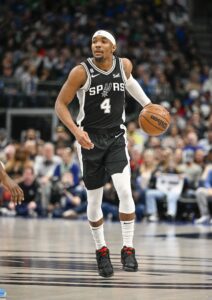 The suspension stems from a 2022 misdemeanor charge of driving while impaired. Graham pleaded guilty to the charge in June and was subsequently sentenced to 12 months of probation, per TMZ Sports.
As TMZ details, Graham was initially charged in July 2022 after police alleged that he was driving 63 miles per hour in a 40 MPH zone while intoxicated in his hometown of Raleigh, North Carolina. The incident occurred at around 3:00 am.
Graham was a member of the Pelicans at the time of his arrest but was traded from New Orleans to San Antonio at the 2023 deadline in a deal involving Josh Richardson. He appeared in a total of 73 games for the two teams last season, averaging 7.4 points and 2.7 assists in 18.3 minutes per night, with a shooting line of .374/.352/.748.
Graham remains under contract with the Spurs on a guaranteed $12.1MM cap hit for 2023/24; his contract also covers ’24/25, but only $2.85MM of his $12.65MM salary for that year is guaranteed.
The two-game suspension, which Graham will serve during the first two games of the 2023/24 regular season as long as he’s healthy and remains under contract, will cost him $166,897. That figure represents 2/145ths of his $12.1MM salary.
If the Spurs, who are facing a potential roster crunch this fall, waive Graham prior to the season and he doesn’t sign a new contract right away, he’ll be considered to have served his suspension following San Antonio’s third game of the season.
NBA Players Who Can Veto Trades In 2023/24
No-trade clauses are rare in the NBA, since a player must meet a specific set of criteria in order to qualify for one. And even those players who become eligible may not have the leverage to demand a no-trade clause, which significantly limits a team’s flexibility in future trade negotiations.
 To be eligible to negotiate a no-trade clause, a player must have at least eight years of NBA experience and has to have spent at least four years (not necessarily the most recent four years) with his current team. He also must be signing a free agent contract, rather than an extension.
[RELATED: Hoops Rumors Glossary: No-Trade Clause]
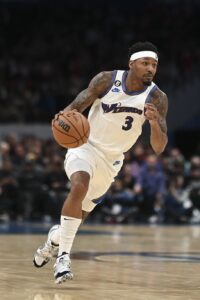
Bradley Beal is the only NBA player who currently has a no-trade clause in his contract. The presence of that clause limited his trade market this past offseason when the Wizards sought to move him and helped steer him to a preferred destination (Phoenix) for a relatively modest return.
Although Beal is the only player who has an explicit no-trade clause, there are several others who will have implicit no-trade clauses in 2023/24, giving them the ability to veto trades during the current league year.
A player who re-signs with his previous team on a one-year contract – or a two-year deal with an option year – is given no-trade protection, unless he agrees to give up that protection when he inks his deal. That group doesn’t include players on two-way contracts, but it does include players who accept standard (non two-way) one-year qualifying offers.
A player who signs an offer sheet and has that offer matched by his previous team also has the ability to veto a trade for a full calendar year.
With those criteria in mind, here are the players who must give their consent if their teams want to trade them during the ’23/24 league year:
Players with a no-trade clause:
- Bradley Beal (Suns)
Players whose offer sheets were matched:
- Paul Reed (Sixers)
- Matisse Thybulle (Trail Blazers)
Players re-signing for one year (or two years, with a second-year player/team option):
- Thanasis Antetokounmpo (Bucks)
- Miles Bridges (Hornets)
- Jae Crowder (Bucks)
- DeAndre Jordan (Nuggets)
- Damion Lee (Suns)
- Kevin Love (Heat)
- Markieff Morris (Mavericks)
- Josh Okogie (Suns)
- Mason Plumlee (Clippers)
- Russell Westbrook (Clippers)
If any player who re-signed for one year approves a trade during the 2023/24 league year, he’ll have Non-Bird rights at season’s end instead of Early Bird or full Bird rights.
A handful of players with veto rights consented to trades during the 2022/23 season, including Mike Muscala, Serge Ibaka, Ryan Arcidiacono, and Kessler Edwards. Muscala and Edwards eventually had their team options for ’23/24 picked up, so their Bird rights – only lack thereof – didn’t come into play this summer. Ibaka and Arcidiacono, meanwhile, were waived before season’s end, meaning they didn’t enter the offseason with any form of Bird rights anyway.
Any player who approves a trade will retain his veto ability on his new team, and would have to consent to any subsequent deal during the 2023/24 season.
The following players were re-signed to one-year contracts (or two-year deals with an option year), but agreed to give up their right to veto a trade in 2023/24:
- Deonte Burton (Kings): Waived
- Taj Gibson (Wizards): Waived
- Montrezl Harrell (Sixers): Waived
- Reggie Jackson (Nuggets)
- Alex Len (Kings)
- Sandro Mamukelashvili (Spurs)
- Boban Marjanovic (Rockets)
- D’Angelo Russell (Lakers)
- Moritz Wagner (Magic)
And-Ones: 2024 Draft, Flagg, J. Harper, What-Ifs
The projected NBA draft class of 2024 doesn’t have a clear-cut No. 1 prospect like Victor Wembanyama in 2023, but it features a handful of potential high-impact players who could make legitimate cases for that No. 1 spot with strong seasons, writes Kevin O’Connor of The Ringer.
For now, O’Connor’s “way-too-early” big board for the 2024 draft is headed by G League point forward Matas Buzelis, followed by his Ignite teammate Ron Holland at No. 2. Baylor freshman Ja’Kobe Walter, UConn freshman Stephon Castle, and another Ignite prospect, power forward Izan Almansa, round out O’Connor’s top five.
Here are a few more odds and ends from around the basketball world:
- Although he won’t be eligible for the 2024 draft, 16-year-old phenom Cooper Flagg looks like a potential No. 1 overall pick in 2025 or 2026, says Sean Deveney of Heavy.com. Deveney spoke to multiple NBA evaluators to get a sense of what to expect from Flagg. “The kid is going to be a star, as long as he puts in the work,” one GM told Heavy.com. “The book on him is that he has a really good work ethic so you don’t expect that to be a problem, but you can’t tell with guys that young, how they will develop.”
- Veteran point guard Jared Harper, who has appeared in NBA games for the Suns, Knicks, and Pelicans, has re-signed with Valencia Basket, the Spanish club announced in a press release. Harper first signed with Valencia last September after finishing the 2021/22 season on a two-way deal with New Orleans.
- In a pair of entertaining articles for ESPN.com, Tim Bontemps takes a look back at the biggest “what-ifs” in the Eastern Conference and Western Conference over the past five years. Lonzo Ball‘s knee injury, Kawhi Leonard‘s free agency departure from Toronto, the Warriors’ decision to draft James Wiseman over LaMelo Ball, and the Rockets’ and Lakers’ trades for Russell Westbrook were among the sliding doors moments explored by Bontemps.
Community Shootaround: Which Non-Heat Team Should Pursue Lillard?
We’re now more than a month removed from Damian Lillard‘s trade request, which he submitted on July 1, and the Trail Blazers don’t appear to be much closer to moving the star guard today than they were at that time.
Lillard’s insistence that he only wants to play for the Heat has limited his market, as have the four years and $216MM left on his contract, which has reportedly made teams wary about giving up a significant package for him.
The Blazers are essentially stuck at an impasse, apparently “disinclined” to seriously engage with the Heat but also without any other viable options available to them for the time being, as ESPN’s Brian Windhorst said during an NBA Today appearance on Tuesday (YouTube link).
“As I look across the league and have conversations with executives and agents, I can’t identify another team that is seriously making an offer for Dame Lillard at this point,” Windhorst said. “And so my belief is that the Heat can’t either.
“And so while people can look at what the Heat’s offer might be and scoff at it, if their offer is the only one on the table, it therefore is the best one on the table. And the fact that Portland isn’t going forward with anything is a verification of that, that they don’t have another offer. So, very low incentive for the Heat to improve their offer at this point, and no incentive really right now for Portland to take that offer. And we have a stare-down.”
As ESPN’s Windhorst and Adrian Wojnarowski have said, and as Barry Jackson of The Miami Herald reiterates, Miami has no desire to bid against itself in an effort to bring Portland back to the negotiating table, but remains hopeful that the Blazers will be willing to reopen those conversations at some point in the coming weeks.
A veteran assistant coach who spoke to Jackson suggests that the Heat and Blazers both have some incentive to try to get something done before the regular season begins. If Miami is going to acquire Lillard, the assistant observes, the team would prefer to do it sooner rather than later in order to begin establishing chemistry with its new-look roster following the loss of guards Gabe Vincent and Max Strus. Portland, meanwhile, would presumably like to have a clean slate to begin the 2023/24 season rather than keeping a disgruntled star on the roster and remaining in a holding pattern.
The clearest way for the negotiations to move forward would be for a second suitor besides the Heat to emerge as a serious contender for Lillard. Even if the Blazers don’t ultimately make a deal with that non-Heat team, the presence of another bidder could help push Miami to increase its offer to the point that Portland would be more willing to seriously consider it.
So our Community Shootaround question for today is this: Which non-Heat team makes the most sense as a suitor for Lillard?
The team would presumably have to meet a few criteria.
It would need to have the young player(s) and/or draft picks necessary to put together a strong offer for Lillard, as well as a strong enough core to seriously contend for a title after giving up several assets to land the veteran guard.
It would need to be comfortable with the idea of paying Lillard $60MM+ per year in 2025/26 and ’26/27.
And it would need to be confident in its leaders and culture to sell the seven-time All-Star on embracing a new NBA home somewhere besides Miami.
What do you think? Which non-Heat team is the best bet – or the most logical candidate – to emerge as a contender for Lillard? Head to the comment section below to weigh in with your thoughts!
Lakers Notes: Rotation, Point Guards, Christie, Hayes, Davis
Breaking down the Lakers‘ potential lineup decisions for the 2023/24 season, Jovan Buha of The Athletic forecasts a 10-man rotation, led by stars LeBron James and Anthony Davis.
At this point, Buha favors incumbent Lakers D’Angelo Russell, Austin Reaves, and Rui Hachimura – all of whom signed lucrative new contracts this offseason – to fill out the starting lineup. He predicts the 10-man rotation will be filled out by Jarred Vanderbilt, Max Christie, and newcomers Gabe Vincent, Taurean Prince, and Jaxson Hayes.
As Buha notes, the Lakers will want to avoid overworking James and Davis to ensure that they’re healthy for the playoffs, so players outside his projected 10-man rotation, including free agent addition Cam Reddish and rookies Jalen Hood-Schifino and Maxwell Lewis, could get a chance to earn some minutes too.
Here’s more on the Lakers:
- Although Buha has Russell penciled in as the starting point guard, he acknowledges that could change, observing that Vincent’s 3-and-D skill set is a better fit next to the Lakers’ stars. It’s a “coin flip” as to who will end up as the go-to point guard, Buha writes, suggesting that both players will have important roles.
- Christie is the most difficult Laker to project for the 2023/24 season, says Buha. If he breaks out like he believes he can, he should have no problem securing a spot as the eighth or ninth man in the rotation. If not, he may end up battling Reddish for minutes as the 10th man.
- According to Buha, the Lakers hope that Hayes will be able to start alongside Davis in scenarios when the team opts to roll with a two-big lineup. However, Buha doesn’t foresee a major regular role for Hayes, noting that there are only so many frontcourt minutes to go around as long as James, Davis, Hachimura, and Vanderbilt are healthy. If the Lakers were to sign another free agent center such as Christian Wood or Bismack Biyombo, Hayes’ spot in the regular rotation would be even less certain, though injuries and/or load management could ultimately open the door for him to play frequently.
- In the latest Hoop Collective podcast (YouTube link), ESPN’s Brian Windhorst, Tim Bontemps, and Tim MacMahon discuss the fact that Davis will become extension-eligible later this week and consider the odds of he and the Lakers working out a deal before the season begins. Windhorst doesn’t necessarily expect the two sides to reach a deal immediately, but believes there’s mutual interest in working something out. “There’s no time crunch. He doesn’t have to make a decision by August 5 or anything,” Windhorst said. “But I do think there is an expectation that the Lakers do make some sort of offer this week, or at least show their intention to make such an offer.”
Hoops Rumors Glossary: NBA Roster Limits
The rules governing the number of players an NBA team can carry on its roster vary depending on the time of year.
Between the start of the regular season and the last day of a team’s season, a club isn’t allowed to carry more than 15 players on its roster, except in rare instances. Generally, when a club with 15 players on its roster acquires a new player, it must waive someone to clear a spot. In the offseason though, teams are permitted to carry up to 21 players on their rosters.
The regular season limit applies to players on standard contracts, while the offseason limit applies to players on any form of contract.
During both the regular season and offseason, a team is permitted to carry up to three players on two-way contracts, which are a non-standard form of deal that allows a player to be transferred back and forth between the NBA and G League.
In the regular season, two-way players don’t count toward the 15-man limit, meaning teams can essentially have 18 players under contract at a time. However, two-way players do count toward the 21-man limit in the offseason. If a club is carrying 21 players on standard NBA contracts in August, it can’t sign a player to a two-way deal without waiving someone.
[RELATED: 2023/24 NBA Roster Counts]
In some cases, a team ravaged by injuries will receive one or more extra spots on its regular season roster via the hardship provision. The NBA can grant a hardship exception – which allows the club to sign a player to a 10-day contract without requiring a roster spot – when a team has at least four players who have missed three consecutive games and who are expected to remain sidelined for at least the next two weeks due to injury or illness.
A team qualifies for a single hardship exception when it has four players who meet that criteria, but it can become eligible for additional hardship exceptions if it has a fifth or sixth injured/ill player. For example, if a club has six players who have missed at least three consecutive games due to injury and are expected to remain out for two more weeks, it could be granted three hardship exceptions, allowing the club to temporarily carry three extra players beyond its usual 15 (not counting two-ways).
A club is also permitted to add a 16th man to its regular season roster if it has a player on the suspended list. A player who is suspended by his team for four or more games may be placed on the suspended list following the third game of his ban, while a player suspended by the NBA for six or more games can be placed on the suspended list following the fifth game of his ban. Teams can’t make use of the suspended list for shorter suspensions.
Generally speaking, the fewest number of players an NBA team can have on its roster during the regular season is 14, not counting two-way players. However, a team is permitted to dip to 12 or 13 players for a limited period. That club can’t carry fewer than 14 players on standard contracts for more than two weeks at a time or more than 28 total days during a regular season.
The rules for in-game roster minimums and maximums are as follows:
- A team can have between 12 or 15 players listed as active for a game.
- A team can carry as few as 11 active players for up to two weeks at a time or up to 28 total days during a regular season.
- A team must have at least eight players dressed for a game (at least three or four players beyond those eight must technically be listed as active).
Note: This is a Hoops Rumors Glossary entry. Our glossary posts will explain specific rules relating to trades, free agency, or other aspects of the NBA’s Collective Bargaining Agreement. Larry Coon’s Salary Cap FAQ was used in the creation of this post.
Earlier versions of this post were published in 2012 and 2013 by Luke Adams.
How 2024 Cap Increase Will Determine Value Of Brown’s Record-Setting Contract
When Jaylen Brown agreed to a five-year, super-max extension with the Celtics, it was widely reported to be a $304MM deal. That number is subject to change though, since the value of the contract will depend on the value of the NBA’s 2024/25 salary cap, which won’t be officially determined until next June.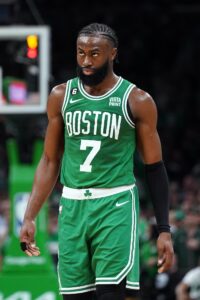
Brown’s contract will start at 35% of the ’24/25 cap and will feature 8% annual raises after that.
The $304MM estimate for Brown’s super-max deal is based on a projected salary cap increase of 10%. The NBA and NBPA have agreed not to increase the cap by more than 10% per year in order to avoid a repeat of the 2016 offseason, when a 34.5% bump helped create a Warriors super-team and resulted in a number of regrettable contracts for other teams around the league.
With that ceiling in mind, a 10% cap increase next summer would represent a best-case scenario for Brown. But it’s also a realistic outcome — the cap has risen by 10% in each of the past two offseasons, so it’s forecasting it to happen again is certainly within reason.
If the cap were to increase 10% for 2024/25, Brown’s contract would look like this:
| Year | Salary |
|---|---|
| 2024/25 | $52,368,050 |
| 2025/26 | $56,557,494 |
| 2026/27 | $60,746,938 |
| 2027/28 | $64,936,382 |
| 2028/29 | $69,125,826 |
| Total | $303,734,690 |
Of course, the NBA hasn’t actually formally projected a 10% cap increase for 2024/25, so it’s a little early to lock in those figures for Brown.
If the cap were to instead increase by a more modest 5%, his deal would instead look like this:
| Year | Salary |
|---|---|
| 2024/25 | $49,987,700 |
| 2025/26 | $53,986,716 |
| 2026/27 | $57,985,732 |
| 2027/28 | $61,984,748 |
| 2028/29 | $65,983,764 |
| Total | $289,928,660 |
In either case, Brown’s contract would become the richest deal in NBA history, comfortably surpassing Nikola Jokic‘s five-year, $276,122,630 deal that begins in 2023/24. The only scenario in which Brown’s extension wouldn’t exceed Jokic’s is if the salary cap doesn’t increase at all in a year — then Brown’s deal would look exactly the same as Jokic’s.
A lot could happen in the next 11 months, but it would require very unusual circumstances for the cap not to rise at all. Since 2010, that has only happened amidst shortened seasons (due to a lockout and the COVID-19 pandemic). So we can confidently project Brown’s contract to be worth more than Jokic’s.
For what it’s worth, Brown won’t be the only player earning 35% of the cap in 2024/25. Devin Booker and Karl-Anthony Towns also signed super-max contracts that will go into effect a year from now, and their deals will look exactly the same as Brown’s from 2024-28. The only reason those aren’t considered record-setting contracts in their own right is because they’ll cover four years instead of five, since Booker and Towns signed extensions with two years left on their respective contracts rather than just one.
Of course, even Brown’s record is unlikely to stand for long. With an in-season tournament being introduced later this year and a new media rights deal around the corner, the NBA’s revenue and salary cap will likely only continue to grow in the coming years.
Brown’s Celtics teammate Jayson Tatum, who met the super-max performance criteria this spring and will meet the service time criteria in 2024, is the best bet to be the next recipient of the richest contract in league history. If the cap increases by 10% next year and another 10% in 2025, this is what a super-max deal for Tatum could look like:
| Year | Salary |
|---|---|
| 2025/26 | $57,604,750 |
| 2026/27 | $62,213,130 |
| 2027/28 | $66,821,510 |
| 2028/29 | $71,429,890 |
| 2029/30 | $76,038,270 |
| Total | $334,107,550 |
Hoops Rumors Glossary: Mid-Level Exception
The mid-level exception is the most common way for over-the-cap NBA teams to sign free agents from other clubs for more than the minimum salary. It helps ensure that virtually every team heads into the offseason with a little spending flexibility.
Teams are eligible to use specific types of mid-level exceptions depending on their proximity to the salary cap. The most lucrative form of mid-level is available to teams that are over the cap but below the first tax apron. Clubs above the first apron, and even those operating under the cap, have access to lesser versions of the MLE.
Here’s a breakdown of how the various forms of the exception are structured:
For teams over the cap and below the first tax apron:
- Commonly called either the full mid-level exception or the non-taxpayer mid-level exception.
- Contract can cover up to four seasons.
- First-year salary is worth $12,405,000 in 2023/24; maximum four-year value is $53,341,500.
- Once used, the team cannot surpass the first tax apron (approximately $7MM above the tax line in 2023/24) for the remainder of the season.
- Beginning in 2024/25, this form of mid-level exception can be used to acquire a non-free-agent via trade or waiver claim, as long as his contract fits into the exception (in terms of years and dollars). Only the player’s current-year salary must fit into the MLE.
For teams operating under the cap:
- Commonly called the room exception.
- Contract can cover no more than three seasons.
- First-year salary is worth $7,723,000 in 2023/24; maximum three-year value is $24,327,450.
- Beginning in 2024/25, this form of mid-level exception can be used to acquire a non-free-agent via trade or waiver claim, as long as his contract fits into the exception (in terms of years and dollars). Only the player’s current-year salary must fit into the room exception.
For teams over the cap and the first tax apron, but below the second apron:
- Commonly called the taxpayer mid-level exception.
- Contract can cover up to two seasons.
- First-year salary is worth $5,000,000 in 2023/24; maximum two-year value is $10,250,000.
- Once used, the team cannot surpass the second tax apron ($17.5MM above the tax line in 2023/24) for the remainder of the season.
For teams over the cap and both tax aprons:
- No mid-level exception is available.
Each form of the mid-level allows for annual raises of up to 5% of the value of the first season’s salary.
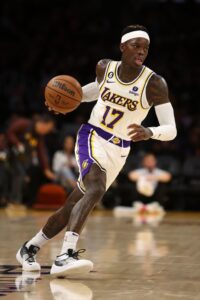 Teams can use their entire mid-level exception to sign one player. However, only one club has taken this route so far in 2023/24, with the Raptors signing Dennis Schröder to a multiyear contract that’s worth $12,405,000 in year one.
Teams are also allowed to split the mid-level among multiple players, and that has become an increasingly common course of action. For instance, the Mavericks have used their MLE to sign Seth Curry ($4MM) and Dante Exum ($3MM) so far in ’23/24 and still have more than $5MM remaining.
In the past, players drafted in the second round often signed contracts using a portion of the mid-level because the exception allows teams to offer more years and more money than the minimum salary exception provides. However, the new second-round pick exception has all but eliminated the need for teams to use the MLE on second-round picks.
Still, if a team wants to sign an undrafted free agent to a longer-term contract or convert a two-way player to a multiyear deal, the mid-level can come in handy. The Pelicans used their MLE this summer to move E.J. Liddell from his two-way deal to a three-year contract that begins at the minimum ($1,801,769).
Some front offices prefer to leave all or part of their mid-level exception unused in the offseason so it’s still available during the second half of the regular season. At that point, a contender could dangle its MLE in an effort to outbid rivals for top players on the buyout market. A non-contending club, on the other hand, could use its MLE to lock up an intriguing developmental player to a long-term contract.
Unlike the bi-annual exception, the mid-level exception can be used every season. So whether or not a team uses any of its mid-level in 2023/24, each club below the second tax apron in ’24/25 will have the opportunity to use some form of the MLE.
The amount of each form of mid-level exception increases – or decreases – at the same rate as the salary cap, ensuring that its value relative to cap room remains about the same from year to year. So if the salary cap rises by 10%, the mid-level values would rise by the same amount.
Here are a few more notes related to the mid-level exception:
- A contract signed using a mid-level exception can include bonuses as long as the player’s maximum potential compensation doesn’t exceed the maximum value of the exception. For example, in 2023/24, a team can’t sign a player to a contract using the non-taxpayer mid-level exception that has a base salary of $12,405,000 and another $1MM in incentives. But a contract with a base salary of $11,405,000 and $1MM in incentives is permitted.
- A team is only allowed to use one form of mid-level exception in a given season. For instance, an over-the-cap club that uses a portion of its non-taxpayer mid-level exception before shedding salary and dipping below the cap would not then be permitted to use the room exception.
- On the day after the trade deadline, the value of a team’s unused mid-level exception begins to prorate downward. The exact amount of proration depends on how much of the MLE was unused as of January 10 and how many total days there are in the regular season. For example, if a team had $3MM of its mid-level left on January 10 and there are 174 days in that season, the MLE would decrease in value by $17,241 per day (1/174th of $3MM).
Note: This is a Hoops Rumors Glossary entry. Our glossary posts will explain specific rules relating to trades, free agency, or other aspects of the NBA’s Collective Bargaining Agreement. Larry Coon’s Salary Cap FAQ was used in the creation of this post.
Earlier versions of this post were published in previous years.