
Irving’s Agent: Kyrie Doesn’t “Hate” Marks, Nash
Responding to a New York Post report in which a source claimed that Kyrie Irving “hates” Nets general manager Sean Marks and head coach Steve Nash, Irving’s agent and stepmother Shetallia Riley Irving told Brian Lewis and Josh Kosman of The New York Post that’s not the case.
“I am not sure where this narrative is coming from but Kyrie does not hate Steve nor Sean,” Shetallia Riley Irving said. “That’s not a part of his being nor how he represents himself in the world. He’s about peace, love and acceptance.”
While Kyrie and agent may dispute the notion that he “hates” Marks or Nash, that doesn’t necessarily mean he loves the job they’ve been doing in Brooklyn.
Irving and the Nets have been at odds in multiple instances over the past year. The club’s front office and ownership group opted not to allow Irving to be a part-time player at the start of last season when he was ineligible to play in Brooklyn due to New York City’s vaccine mandate. The Nets were then unwilling to offer him a lucrative long-term contract this summer, prompting him to explore a move to another team before he eventually decided to pick up his 2022/23 player option.
According to Lewis and Kosman, Shetallia Riley Irving declined to comment on whether Irving agrees with Kevin Durant, who reportedly told Nets owner Joe Tsai that he must decide between trading Durant or firing Marks and Nash.
Gorgui Dieng Signs One-Year Deal With Spurs
AUGUST 9: Dieng’s signing is official, the Spurs announced in a press release.
JULY 5: The Spurs and free agent big man Gorgui Dieng have agreed to a one-year deal, according to Shams Charania of The Athletic (Twitter link).
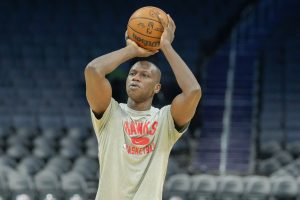 It’s a reunion for Dieng and the Spurs — he signed with San Antonio on the buyout market near the end of the 2020/21 season before joining the Hawks last summer.
Terms of the new agreement aren’t yet known, but Dieng is coming off a one-year, $4MM contract and wasn’t a regular part of Atlanta’s rotation in 2021/22, appearing in 44 games and averaging a career-low 8.4 minutes per contest. His 3.5 PPG and 2.8 RPG were also career worsts. In other words, it seems unlikely he’ll get more than the veteran’s minimum from the Spurs.
The 32-year-old, who will be entering his 10th NBA season, has also spent time with the Timberwolves and Grizzlies since entering the league as the 21st overall pick out of Louisville in 2013.
Dieng will be San Antonio’s 14th player, assuming the team signs all three of its first-round picks and retains Tre Jones and Keita Bates-Diop, both of whom are on non-guaranteed contracts.
The Spurs still have a ton of cap room at their disposal, so it’s possible a more significant roster shake-up is coming, but it remains unclear how they intend to use that room.
No Changes To U.S.-Canada Border Rules For Unvaccinated NBA Players
The NBA informed teams today in a memo that, as things currently stand, players who are unvaccinated against COVID-19 without a valid medical reason will remain ineligible to play games in Toronto for the 2022/23 season, according to Jake Fischer of Bleacher Report (Twitter link).
Fischer’s report is missing some key contextual information. For one, the policy that prevents unvaccinated players from playing in Toronto wasn’t implemented by the Raptors or the NBA, but by the Canadian government, which has restrictions against non-residents entering the county without being vaccinated.
Last season, there were no exemptions from this rule for NBA players, and it appears that won’t change going forward.
It’s also worth noting that the United States has a border policy on unvaccinated travelers that’s virtually identical to Canada’s (it’s why, for instance, tennis star Novak Djokovic isn’t expected to be eligible to play in the U.S. Open later this month). However, since most NBA travel takes place domestically within the U.S., that policy doesn’t prevent unvaccinated players from suiting up in any cities besides Toronto unless that city has a specific vaccine mandate of its own, as New York did for much of the 2022/23 season.
There has been no indication that the Canadian government will drop its vaccination requirement for travelers anytime soon, which is presumably why the NBA sent out a memo to teams now reminding them of that policy. But if that requirement is amended or dropped at some point during the 2022/23 season, there’s no reason to believe the NBA would institute any new restrictions preventing unvaccinated players from traveling back and forth across the U.S.-Canada border.
A huge majority of NBA players are vaccinated against COVID-19 — the exact percentage was estimated last season to be around 97%. So only a small handful of players, including Nets star Kyrie Irving, figure to be affected by the border policy.
Contract Details: Muscala, Harden, Blazers, More
The new contract that veteran forward/center Mike Muscala signed with the Thunder is essentially identical to the one he signed with the team in 2021, Hoops Rumors has learned.
Muscala’s new deal covers two years and has matching $3.5MM cap hits in each of those two seasons for a total of $7MM. The first year is guaranteed, while the second year is a team option. All of those details also applied to the two-year, $7MM contract he signed in ’21.
The Thunder chose to decline Muscala’s $3.5MM team option for 2022/23 back in June, but will now pay him that exact salary next season, with another $3.5MM team option for ’23/24. Since Oklahoma City had Muscala’s Bird rights, the club didn’t have to dip into its mid-level exception to complete the signing.
Here are a few more details on recently signed contracts from around the NBA:
- James Harden‘s new two-year contract with the Sixers will pay him exactly $33MM in 2022/23 and includes a 2023/24 player option worth $35.64MM. The two-year, $68.64MM pact includes a 15% trade kicker.
- The training camp contracts that Norvel Pelle and Isaiah Miller signed with the Trail Blazers include Exhibit 10 language. That gives Portland the option of converting either contract into a two-way deal before the regular season begins.
- The new two-way contracts signed by Duane Washington (Suns) and Trent Forrest (Hawks) are each just for one season.
Nets’ Durant Reportedly Reiterates Trade Request, Gives Tsai Ultimatum
In a face-to-face meeting with Nets owner Joe Tsai in London on Saturday, star forward Kevin Durant reiterated his desire to be traded and gave Tsai an ultimatum, reports Shams Charania of The Athletic.
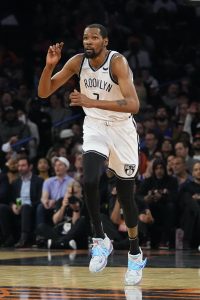 According to Charania, Durant told the Nets owner that he needs to choose between trading him or firing general manager Sean Marks and head coach Steve Nash. Durant said that he doesn’t have faith in the team’s direction, sources tell The Athletic.
Charania says his sources described Saturday’s meeting as “transparent and professional,” adding that the Nets have “direct knowledge of the reasons behind Durant’s request” and have reason to believe he’ll be resolute in his stance. People around the NBA have speculated about the possibility that the two-time Finals MVP won’t report to training camp if the Nets don’t make a deal within the next seven weeks, per Charania.
Sources tell The Athletic that Brooklyn has spoken to nearly every team in the NBA about a possible Durant trade, but no club has met the Nets’ “sky-high” asking price. According to Charania, the Celtics, Heat, and Raptors are widely viewed as the most legitimate suitors for the 33-year-old, who is entering the first season of a four-year, maximum-salary extension.
Charania cites sources who say that Tsai and the Nets have “made clear privately that they will take every last asset from a team that trades for Durant.” However, it’s hard to see how the team has the leverage to make that sort of deal, given these latest developments in the summer saga.
Of course, Marks and Nash held their current positions when Durant signed that four-year extension a year ago, and the star forward was believed to have played a role in Nash’s hiring in the first place, back in 2020. It’s unclear why Durant has soured to such a significant extent on Brooklyn’s leadership group.
It’s possible Durant’s dissatisfaction is related, at least in part, to the team’s handling of his good friend Kyrie Irving. The Nets refused to allow Irving to be a part-time player during the first half of last season when vaccine requirements prohibited him from playing home games. The club then opted against offering Kyrie a lucrative long-term extension this offseason.
While recent reports have indicated that Irving plans to be a Net to start the 2022/23 season, there’s a belief that Brooklyn will seriously consider trading him if and when the team finds a Durant deal it likes.
Checking In Again On Unsigned 2022 Draft Picks
We’re about a month-and-a-half removed from the 2022 NBA draft, and – as our tracker shows – 46 of the 58 players selected on June 23 have signed their first NBA contracts.
The 12 unsigned players are as follows:
- Toronto Raptors: Christian Koloko, F/C
- Detroit Pistons: Gabriele Procida, G
- Cleveland Cavaliers: Khalifa Diop, C
- New Orleans Pelicans: E.J. Liddell, F
- Denver Nuggets: Ismael Kamagate, C
- Indiana Pacers: Kendall Brown, F
- Minnesota Timberwolves: Matteo Spagnolo, G
- New Orleans Pelicans: Karlo Matkovic, F
- Washington Wizards: Yannick Nzosa, C
- Golden State Warriors: Gui Santos, F
- Cleveland Cavaliers: Luke Travers, G/F
- Milwaukee Bucks: Hugo Besson, G
Most of these prospects will likely spend the 2022/23 season playing in non-NBA leagues around the world. Procida, Diop, Kamagate, Spagnolo, Matkovic, Nzosa, Santos, Travers, and Besson are all good bets to be draft-and-stash players.
That essentially just leaves three 2022 draftees in limbo: Koloko, Liddell, and Brown.
A player selected within the first five picks of the second round, like Koloko was, virtually always receives a multiyear contract that includes at least a year or two of guaranteed money. It’s hard to imagine that won’t be the case for Koloko, despite the Raptors‘ roster crunch. Toronto already has 13 players on guaranteed contracts, with three players on partial guarantees vying for a regular season spot, so if Koloko signs, it would leave one fewer spot up for grabs.
It’s worth noting that once Koloko officially signs, he’ll be ineligible to be traded for 30 days, so it’s possible the Raptors are keeping their options open in case their Kevin Durant trade talks with the Nets get serious.
Toronto may also be mulling whether to use a portion of its mid-level exception to sign Koloko to a contract that spans three or four years. Taking that route, instead of signing him to a two-year, minimum-salary contract, would ensure he remains under team control for an extra season or two, but would hard-cap the Raptors for the 2022/23 season, since the club already used $6MM of its MLE to sign Otto Porter.
Liddell, meanwhile, suffered an unfortunate break to begin his professional career, tearing his ACL during the Las Vegas Summer League. Before he sustained that injury, the question was probably whether Liddell would receive a standard contract or a two-way deal. Now, the question is whether New Orleans still willing to sign him to a two-way contract or whether the team wants to use that slot on someone who could actually contribute on the court in 2022/23.
If they fill their two-way slots, the Pelicans would probably like to see Liddell sign a G League contract and spend the season rehabbing with the Birmingham Squadron before he signs his first NBA deal a year from now.
As for Brown, it remains to be seen whether he’ll begin the season on the Pacers‘ standard 15-man roster or on a two-way deal. For now, Indiana could go in either direction, but the club could be waiting to see whether there are any more trades to be made before training camp begins — if the Pacers were to complete a deal involving Myles Turner and/or Buddy Hield, the number of players they receive in that trade would have an impact on whether or not there’s room on the standard roster for Brown.
For example, if Indiana send Turner and Hield to the Lakers in exchange for Russell Westbrook and draft assets, then bought out Westbrook, it would open up two extra spots on the projected 15-man roster. In that scenario, signing Brown to a three- or four-year standard contract would make sense.
Hawks Sign Trent Forrest To Two-Way Deal
The Hawks have filled their open two-way slot by signing free agent guard Trent Forrest to a two-way contract, the team announced today in a press release.
[RELATED: 2022/23 NBA Two-Way Contract Tracker]
Forrest, 24, signed a two-way deal with the Jazz in 2020 after going undrafted out of Florida State. He spent most of the next two seasons on two-way contracts in Utah, eventually earning a promotion to the standard roster on the last day of the 2021/22 campaign in order to make him playoff-eligible.
Forrest has appeared in 90 regular season games at the NBA level in his first two professional seasons, including 60 in 2021/22. He averaged 3.3 PPG and 1.8 APG in ’21/22, making 49.0% of his shots from the floor in 12.8 minutes per contest. He even earned six starts in the backcourt over the course of the season.
The Jazz had the opportunity to give Forrest a qualifying offer in June to make him a restricted free agent, but chose not to, so he hit the market as an unrestricted free agent.
Having officially signed Forrest, Atlanta now has 16 players under contract. Of those 16 players, 13 have fully guaranteed standard contracts, while Tyrese Martin has a partially guaranteed deal and Forrest and Chaundee Brown are on two-way pacts.
George King Signs With Illawarra Hawks
After briefly returning to the NBA during the 2021/22 season, veteran forward George King is headed back overseas to resume his playing career. King has signed with the Illawara Hawks of Australia’s National Basketball League, the team announced today.
The 59th overall pick in the 2018 draft, King signed a two-way contract with the Suns and spent his rookie season with Phoenix, though he played in just one game at the NBA level. After reaching free agency in 2019, King spent time in Italy, Poland, and Germany from 2019-21.
The former Colorado standout returned stateside for the 2021/22 season and spent most of the year with the Agua Caliente Clippers of Ontario in the G League, appearing in 32 regular season NBAGL game (33.6 MPG) and averaging 13.5 PPG, 6.4 RPG, and 2.3 APG on .445/.378/.760 shooting. He also saw action in four contests with the Mavericks on a 10-day hardship contract in December.
King will join an Illawara Hawks team that finished second in the NBL’s regular season standings a year ago and is looking to replace a group of departing players that includes Antonius Cleveland and Xavier Rathan-Mayes.
“We’re excited to have someone with King’s international experience join our young core group,” Illawara head coach Jacob Jackomas said. “He gives us elite shooting and defending on the perimeter and we believe he will complement the other guys on the team.”
How Players Who Declined Options Fared In Free Agency
Of the 19 veterans who had player options on their contracts for the 2022/23 season, 13 picked up those options, choosing the security of the guaranteed money over the uncertainty of the open market. That leaves six players who turned down their options and became unrestricted free agents.
Here’s a breakdown of how those players fared in free agency:
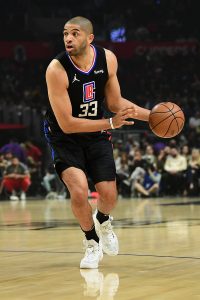 Nicolas Batum
- Option: $3,328,530 (Clippers)
- Free agent contract: Two years, $22,554,168 (Clippers).
Bobby Portis
- Option: $4,564,980 (Bucks)
- Free agent contract: Four years, $48,578,208 (Bucks). Player option. Trade kicker (15%)
Batum and Portis had been in virtually the exact same boat for the last couple years. After successful initial stints with the Clippers and Bucks, respectively, during the 2020/21 season, they re-signed in 2021 on team-friendly deals for the maximum allowable salaries they could receive using Non-Bird rights.
Having accrued Early Bird rights by this summer, both players turned down their ’22/23 options in order to sign more lucrative multiyear contracts. Portis – who is six years younger than Batum – got two extra years on his deal, but both players received starting salaries of $10,843,350, the maximum allowed this year using the Early Bird exception.
Patty Mills
- Option: $6,184,500 (Nets)
- Free agent contract: Two years, $13,281,950 (Nets). Includes unlikely incentives ($1,207,452).
Mills was one of the few players this offseason whose option decision wasn’t a no-brainer. He had a solid first year in Brooklyn, but entering his age-34 season, it was unclear how eager teams would be to give him multiple years.
As it turns out, the Nets were on board with giving him one extra year, with a modest raise. After signing a year ago for the team’s full taxpayer mid-level exception, Mills re-signed for a base salary of $6,479,000, the exact amount of this season’s taxpayer MLE. Because Brooklyn had his Non-Bird rights, the club was able to tack on some unlikely incentives to Mills’ new contract.
P.J. Tucker
- Option: $7,350,000 (Heat)
- Free agent contract: Three years, $33,043,500 (Sixers). Player option.
Tucker’s two-way contributions during the Heat’s playoff run made him a popular target in free agency this offseason, even at age 37. The three-year offer the Sixers gave him was worth the full mid-level exception and was the most that any team could put on the table for Tucker without using cap room or acquiring him via sign-and-trade (the Over-38 rule prevented Philadelphia or another team from offering four years). It’s a huge win for a player who will have celebrated his 40th birthday by the time the contract expires (unless he opts out again in 2024).
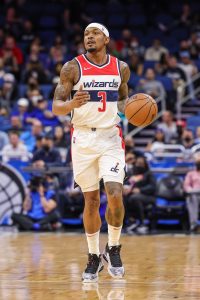 Bradley Beal
- Option: $36,422,136 (Wizards)
- Free agent contract: Five years, $251,019,650 (Wizards). Player option. Trade kicker (15%). No-trade clause.
No player who declined an option this June made out better than Beal. In fact, Beal’s deal was easily the most lucrative of any free agent contract signed this offseason.
Not only did Beal get a five-year, maximum-salary contract that starts at 35% of the 2022/23 cap, but he also got plenty of perks, including a fifth-year player option, a trade kicker, and a full no-trade clause. He was the first NBA player in several years to receive a formal no-trade clause.
James Harden
- Option: $47,366,760 (Sixers)
- Free agent contract: Two years, $68,640,000 (Sixers). Player option. Trade kicker (15%).
Of the six players who turned down options for 2022/23, only Harden took a pay cut for the coming season. But that was a deliberate choice by the former MVP, who opted to accept a more team-friendly cap number in order to allow the 76ers to use their full mid-level exception and bi-annual exception while remaining under the hard cap.
Harden will still earn a salary worth $33MM in ’22/23, and will be in position to opt out and sign a more lucrative deal next summer if he enjoys a bounce-back year.
25 Of NBA’s 30 Teams Have Made At Least One Offseason Trade
Since the 2022 NBA offseason began, 26 trades have been made, as our tracker shows. A total of 25 teams have been involved in those 26 deals, with 15 clubs (half the league) completing multiple trades.
The Raptors, Heat, Bulls, Pelicans, and Clippers are the only teams that have not been part of at least one trade since their seasons ended this spring. While most of those clubs were pretty active in free agency, it has been an especially quiet offseason in New Orleans, where the Pelicans also haven’t made a single free agent signing.
On the opposite end of the spectrum, the Timberwolves have been the NBA’s most active team on the trade market this summer, with new president of basketball operations Tim Connelly putting his stamp on the franchise in his first few months on the job. After making four draft-night deals in June, Minnesota finalized the offseason’s biggest trade by acquiring Rudy Gobert from the Jazz just over a month ago.
The Hawks and Knicks, with four deals apiece, have been the next most active teams on the trade market. A pair of Atlanta’s moves were minor, but the other two – acquiring Dejounte Murray and sending Kevin Huerter to Sacramento – will have a major impact on the team going forward. As for New York, most of Leon Rose‘s deals involved shuffling around draft picks and clearing cap room for the team’s free agent signings of Jalen Brunson and Isaiah Hartenstein.
Here are a few more details on this summer’s 26 trades:
- The Pacers, Pistons, Nuggets, Grizzlies, and Kings have each made three trades. The other teams to make multiple deals are the Hornets, Thunder, Jazz, Trail Blazers, Mavericks, Rockets, and Spurs, with two apiece.
- That leaves the Sixers, Nets, Celtics, Cavaliers, Bucks, Magic, Wizards, Lakers, Warriors, and Suns as the clubs that have each completed just one trade.
- All 26 of this offseason’s trades have consisted of just two teams, with no three- or four-team deals made so far. A draft-night agreement involving the Hornets, Knicks, and Pistons was originally reported as a three-team trade, but was ultimately completed as two separate deals.
- Not a single player has been signed-and-traded so far during the 2022 offseason. That’s pretty surprising, since 27 free agents changed teams via sign-and-trade in the three years from 2019-21 and only four teams used cap room this offseason — sign-and-trades are typically more common in years when most clubs are operating over the cap.
- Eight first round picks from the 2022 draft were traded this summer, and four of those were dealt twice: Jalen Duren (Charlotte to New York to Detroit); Walker Kessler (Memphis to Minnesota to Utah); Wendell Moore (Dallas to Houston to Minnesota); and TyTy Washington (Memphis to Minnesota to Houston).
- Another dozen second round 2022 picks changed hands this offseason, including one that was on the move twice (No. 46 pick Ismael Kamagate from Detroit to Portland to Denver).
- A total of 15 future first round picks (2023 and beyond) were included in trades this summer, including a pair that changed hands twice. Six of those first round picks were unprotected, while nine included protections.
- Another 19 future second round picks (2023 and beyond) were also traded, with two of those 19 dealt twice. All but one of those traded second rounders was unprotected.