
NBA 2025 Offseason Check-In: San Antonio Spurs
Hoops Rumors is checking in on the 2025 offseason for all 30 NBA teams, recapping the summer’s free agent signings, trades, draft picks, departures, and more. We’ll take a look at each team’s offseason moves and consider what might still be coming before the regular season begins. Today, we’re focusing on the San Antonio Spurs.
Free agent signings
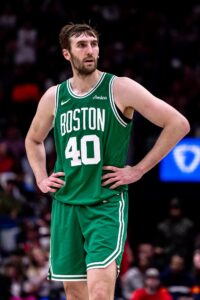 Luke Kornet: Four years, $40,700,000. Third year partially guaranteed ($2.55MM). Fourth year non-guaranteed. Signed using non-taxpayer mid-level exception.
- Jordan McLaughlin: One year, minimum salary. Re-signed using minimum salary exception. Waived right to veto trade.
- Lindy Waters III: One year, minimum salary. Partially guaranteed ($500K). Signed using minimum salary exception.
- Adam Flagler: One year, minimum salary. Non-guaranteed (Exhibit 10). Signed using minimum salary exception.
- Micah Potter: One year, minimum salary. Non-guaranteed (Exhibit 10). Signed using minimum salary exception.
Trades
- Acquired the Kings’ 2030 second-round pick and cash ($2.5MM) from the Pacers in exchange for the draft rights to Kam Jones (No. 38 pick).
- Acquired Kelly Olynyk from the Wizards in exchange for Malaki Branham, Blake Wesley, and either the Mavericks’, Thunder’s, or Sixers’ 2026 second-round pick (whichever is least favorable).
Draft picks
- 1-2: Dylan Harper
- Signed to rookie scale contract (four years, $56,140,113).
- 1-14: Carter Bryant
- Signed to rookie scale contract (four years, $23,419,858).
Two-way signings
- Harrison Ingram
- One year, $85,300 partial guarantee.
- David Jones Garcia
- One year, $85,300 partial guarantee (will increase to $318,218 at start of regular season).
- Riley Minix
- One year, $85,300 partial guarantee.
Departed/unsigned free agents
- Charles Bassey (unsigned)
- Bismack Biyombo (unsigned)
- David Duke Jr. (unsigned)
- Sandro Mamukelashvili (Raptors)
- Chris Paul (Clippers)
Other roster moves
- Signed De’Aaron Fox to a four-year, maximum-salary veteran contract extension that begins in 2026/27. Projected value of $222,394,368.
Salary cap situation
- Operating over the cap ($154.6MM) and below the luxury tax line ($187.9MM).
- Carrying approximately $179.9MM in salary.
- Hard-capped at $195,945,000.
- Portion of non-taxpayer mid-level exception ($3,104,000) available.
- Full bi-annual exception ($5,134,000) available.
The offseason so far
It’s the sort of champagne problem that any NBA team would probably welcome, but the two best things to happen to the Spurs this year have created something of a redundancy on their roster, resulting in some uncertainty about whether this is what their core will look like going forward or whether a trade will be necessary to balance the depth chart.
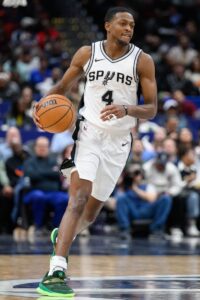 The first of the Spurs’ big breaks came in January, when De’Aaron Fox made it clear to the Kings that he wouldn’t be signing an extension with the team and had just one trade destination on his wish list: San Antonio. With some leverage in trade talks, the Spurs were able to get a pretty good deal on Fox, acquiring him for a package made up of bench players, two first-round picks, and five second-round selections. Seven draft picks isn’t nothing, but those two first-rounders were far less than it cost to acquire non-All-Stars like Mikal Bridges and Desmond Bane on the trade market in recent years.
San Antonio’s second fortunate turn of events occurred at the draft lottery, when the club entered the night in the No. 8 slot and came away with the second overall pick. With Cooper Flagg considered the consensus top pick in this year’s draft class, that put the Spurs in position to nab Rutgers guard Dylan Harper at No. 2 in June’s draft.
The only problem? Fox, Harper, and reigning Rookie of the Year Stephon Castle are all guards who thrive with the ball in their hands and who haven’t developed a reliable outside shot. That doesn’t mean they’re not valuable players — all three absolutely are. But given their overlapping skill sets, it remains an open question whether the Spurs can make it work with all of them playing big minutes (and at least two of them sharing the court for most of the game).
That question fueled speculation that the Spurs might dangle that No. 2 overall pick in trade talks to bolster their roster on the wing or in the frontcourt, passing up Harper and simply rolling with Fox and Castle in the backcourt. But Harper – who almost certainly would’ve been the No. 1 pick if he were in last year’s class – was ultimately too good a prospect to pass on.
The Spurs clearly envision Harper as a part of their long-term future, and Castle is in that group too after earning Rookie of the Year honors this spring. But what about Fox? He entered the offseason on an expiring contract, with the ability to become an unrestricted free agent in 2026. Would the Spurs be more reluctant to extend him after drafting Harper? Would adding Harper at least make them more inclined to draw a hard line in extension negotiations with Fox?
The answer to both of those questions was no. Immediately after his six-month restriction lifted in early August, Fox signed a four-year, maximum-salary extension that will keep him under contract even beyond the end of Castle’s and Harper’s rookie deals.
It wasn’t really a shocking outcome. The Spurs and Fox likely planned on that extension back when the trade with Sacramento was made, and it would’ve been bad business for the club not to hold up its end of the bargain for an All-Star caliber player who essentially forced his way to San Antonio. But it puts the Spurs in a fascinating position going forward and will make their backcourt chemistry one of the most interesting Western Conference storylines to monitor in 2025/26.
While the Harper pick and the Fox extension were the two most meaningful transactions of the summer for the Spurs, the team also made a pair of notable moves to bolster its frontcourt around rising star Victor Wembanyama, who missed the last two months of the 2024/25 season after being diagnosed with a deep vein thrombosis in his right shoulder. San Antonio used most of its non-taxpayer mid-level exception to sign Luke Kornet, then later sent a pair of former first-round picks (Malaki Branham and Blake Wesley) to Washington along with a second-round pick for Kelly Olynyk.
There may have been some sticker shock when word broke that Kornet – who had never earned more than $2.5MM in a season – signed a four-year, $41MM deal. But only the first two years are fully guaranteed, and Kornet easily outplayed his minimum-salary deal with Boston last season. The Celtics had a +14.9 net rating during Kornet’s 1,361 minutes of action — no Boston player had an individual net rating higher than that.
While Kornet gives the Spurs another solid rebounder and defender in the middle, Olynyk will add more shooting to their frontcourt. A career 37.1% three-point shooter, Olynyk has been even better in recent years, making nearly 40.0% of his outside attempts since the start of the 2022/23 season. With Western Conference powers increasingly leaning into double-big lineups, San Antonio now has more options to deploy that sort of look, given the ability of both Olynyk and Wembanyama to stretch the floor and play outside the paint on offense.
Of course, it’s worth noting that the one making those lineup decisions on the Spurs’ sidelines will be Mitch Johnson, who took over head coaching duties last fall after Gregg Popovich suffered a stroke and was given the job on a full-time basis this spring. It’s the first coaching change in nearly three decades in San Antonio, but all indications last season were that Johnson had the full support of everyone within the organization, from players to management to Popovich himself.
Finally, while Harper will be the Spurs rookie under the spotlight this season, we should mention the fact that the team actually had two lottery picks and used the second one, No. 14 overall, to draft Arizona wing Carter Bryant. Bryant struggled in six Summer League games, making just 28.6% of his shots from the field (25.8% of his threes) and turning the ball over 3.2 times in just 24.1 minutes per game, but he’s considered a strong three-and-D prospect who could become a long-term fixture in San Antonio.
Up next
The Spurs have 13 players on fully guaranteed contracts, with guard Lindy Waters III on a minimum-salary deal that includes a $500K partial guarantee. Even if the team intends to carry Waters on its regular season roster – which seems likely – there’s an open roster spot available, and adding a 15th man wouldn’t come with any tax or apron concerns.
 If San Antonio does intend to fill that roster spot before the season begins, it could make sense to add one more big man for depth purposes, given that Wembanyama is coming off a health scare and Olynyk isn’t exactly a true center. For what it’s worth, former Spur Charles Bassey remains unsigned and has been reasonably productive in limited minutes for San Antonio.
I expect any major trade activity to take place closer to the deadline rather than before the regular season, but Keldon Johnson and – to a lesser extent – Devin Vassell have been frequent subjects of trade speculation and are worth keeping an eye on going forward.
Harrison Barnes (veteran) and Jeremy Sochan (rookie scale), meanwhile, are the most noteworthy extension candidates on San Antonio’s roster. At age 33, Barnes may not be part of the Spurs’ long-term plans, but he has been an iron man in recent years, having not missed a game since December 2021, and was a full-time starter last season. I wouldn’t expect him to sign another long-term deal, but a one- or two-year extension might work for both sides.
While Barnes has long established his skill set and his value to an NBA team, Sochan is a little more difficult to evaluate. The 22-year-old has been used in different roles across his three years in the league and had multiple extended injury absences last season. He’s a good defender and a solid rebounder for his size, but he’s not all that dangerous on offense, scoring almost exclusively from inside the arc.
When Eric Pincus of Bleacher Report previewed rookie scale extension candidates in the spring, he cited Moses Moody and his three-year, $37.5MM extension as a possible comparable for Sochan and projected a three-year, $33MM extension for the Spurs forward. That sounds about right to me, but whether Sochan would accept that sort of offer remains to be seen. It’s possible it will take something a bit more lucrative to keep him off the 2026 restricted free agent market.
Community Shootaround: Malik Beasley’s Future
Malik Beasley could be considered the top unrestricted free agent on the market now that he is no longer a target of a federal gambling investigation.
Beasley played a major role in Detroit’s return to relevance last season. He was the runner-up in the Sixth Man of the Year voting after knocking down 319 three-pointers during the regular season, second only to Timberwolves All-Star Anthony Edwards (320).
The investigation – and Beasley’s financial issues – came to light at the worst possible time. He was reportedly poised to sign a three-year, $42MM contract with the Pistons but that offered was pulled during the federal probe.
Detroit pivoted from Beasley and acquired Caris LeVert via free agency and Duncan Robinson in a sign-and-trade to serve as the wings on its second unit. The Pistons still hold Beasley’s Non-Bird rights but can only offer him a starting salary of $7.2MM. On paper, the Pistons don’t really have a pressing need to bring back Beasley.
If Detroit doesn’t re-sign him, Beasley will almost certainly have to take less in the marketplace, considering the salary cap challenges that a majority of teams are facing. Beasley might even have to settle for a veteran’s minimum deal and hope for better luck next summer.
The Knicks are one of the teams believed to have interest in Beasley but they could only give him a minimum deal. The Timberwolves, Cavaliers, Warriors and Sixers are some of the other teams with roster openings that might be looking to add another shooter, but all four clubs project to be taxpayers and have limited cap flexibility.
That brings us to today’s topic: Now that Malik Beasley is no longer a target in a federal gambling investigation, where will the unrestricted free agent wind up? Will he re-sign with Detroit or head elsewhere? Which contender would benefit the most from signing Beasley, one of the league’s premier three-point shooters?
Please take to the comments section to weigh in on this topic. We look forward to your input.
Checking In On Two-Way Contract Slots Around NBA
NBA teams are each permitted to carry up to three players on two-way contracts; at any given time there could be a maximum of 90 players on two-way deals around the league. These players generally bounce back and forth between the NBA and G League, but remain under team control and can’t be poached by rival franchises.
[RELATED: Hoops Rumors Glossary: Two-Way Contract]
While we can expect the NBA-wide total to hover at or near 90 for much of the regular season, many teams have yet to fill all of their two-way slots for the 2025/26 campaign. That isn’t surprising, since we’re still about five weeks away from the start of training camps and two months away from the beginning of the regular season.
As our 2025/26 two-way contract tracker shows, 14 NBA teams still have open two-way spots for a total of 18 two-way openings. Two more are reportedly spoken for — Timberwolves restricted free agent guard Tristen Newton is expected to sign his two-way qualifying offer and Branden Carlson is expected to complete a two-way deal with the Thunder.
Here’s the current breakdown of the two-way openings across the league:
Teams with multiple open two-way slots
- Golden State Warriors (2)
- New York Knicks (3)
- Oklahoma City Thunder (2)
Some of these spots may already be spoken for. As we noted above, Carlson is expected to sign a two-way contract with the Thunder. The Warriors have a two-way qualifying offer on the table for Taran Armstrong, while the Knicks (Kevin McCullar Jr.) also have a two-way restricted free agent who has yet to sign.
Some of these clubs also have second-round picks from this year’s draft who look like logical candidates for two-way spots. Golden State selected Alex Toohey at No. 52 and Will Richard at No. 56 — it would be a surprise if at least one of them doesn’t end up on a two-way deal. New York has yet to sign No. 51 pick Mohamed Diawara, though he’s a candidate for a standard roster spot, as we discussed earlier this month.
Teams with one open two-way slot
- Brooklyn Nets
- Cleveland Cavaliers
- Dallas Mavericks
- Los Angeles Lakers
- Memphis Grizzlies
- Miami Heat
- Minnesota Timberwolves
- Orlando Magic
- Portland Trail Blazers
- Utah Jazz
- Washington Wizards
Minnesota’s inclusion in this section is likely a formality, since Newton is reportedly returning on a two-way deal. Utah also has yet to sign No. 53 overall pick John Tonje, who could be earmarked for the Jazz’s last two-way spot.
There’s not a single clear-cut candidate for all of these openings though, so agents whose clients are seeking an 18-man roster spot will likely reach out to these clubs to see how they intend to use their third two-way contract slots.
Players with NBA experience who sign Exhibit 10 deals for training camp are also candidates to monitor, since some of them are also eligible for two-way deals and could be converted before the season begins. Colin Castleton (Orlando) is a recent example of a player who fits this bill.
Teams with no two-way openings
- Atlanta Hawks
- Boston Celtics
- Charlotte Hornets
- Chicago Bulls
- Denver Nuggets
- Detroit Pistons
- Houston Rockets
- Indiana Pacers
- Los Angeles Clippers
- Milwaukee Bucks
- New Orleans Pelicans
- Philadelphia 76ers
- Phoenix Suns
- Sacramento Kings
- San Antonio Spurs
- Toronto Raptors
In theory, these 16 teams are good to go for training camp. In actuality, several of them could make two-way changes both before and after camps begin.
NBA 2025 Offseason Check-In: Orlando Magic
Hoops Rumors is checking in on the 2025 offseason for all 30 NBA teams, recapping the summer’s free agent signings, trades, draft picks, departures, and more. We’ll take a look at each team’s offseason moves and consider what might still be coming before the regular season begins. Today, we’re focusing on the Orlando Magic.
Free agent signings
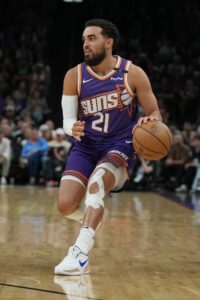 Tyus Jones: One year, $7,000,000. Signed using non-taxpayer mid-level exception.
- Moritz Wagner: One year, $5,000,000. Re-signed using Bird rights.
Trades
- Acquired Desmond Bane from the Grizzlies in exchange for Kentavious Caldwell-Pope, Cole Anthony, the No. 16 pick in the 2025 draft, the Magic’s 2026 first-round pick (with swap rights; details below), the Magic’s 2028 first-round pick, the Magic’s 2030 first-round pick, and the right to swap first-round picks with the Magic in 2029 (top-two protected).
- Note: The Grizzlies will have the ability to swap the Magic’s 2026 first-round pick for the Suns’ 2026 pick (if the Wizards’ first-rounder lands outside of the top eight) or for the least favorable of the Suns’ and Wizards’ 2026 picks (if the Wizards’ first-rounder lands in the top eight).
- Acquired the draft rights to Noah Penda (No. 32 pick) from the Celtics in exchange for the draft rights to Amari Williams (No. 46 pick), the draft rights to Max Shulga (No. 57 pick), either the Pistons’, Bucks’, or Magic’s 2026 second-round pick (whichever is most favorable), and either the Celtics’ or Magic’s 2027 second-round pick (whichever is most favorable).
- Note: The Celtics had traded their 2027 second-round pick to the Magic in a previous deal.
Draft picks
- 1-25: Jase Richardson
- Signed to rookie scale contract (four years, $15,308,562).
- 2-32: Noah Penda
- Signed to four-year, $8,685,386 contract. First two years guaranteed. Third year non-guaranteed. Fourth-year team option.
Two-way signings
- Jamal Cain
- One year, $85,300 partial guarantee (will increase to $318,218 at start of regular season).
- Orlando Robinson
- One year, $85,300 partial guarantee (will increase to $318,218 at start of regular season).
Departed/unsigned free agents
- Gary Harris (Bucks)
- Caleb Houstan (Hawks)
- Cory Joseph (unsigned)
- Mac McClung (unsigned)
- Trevelin Queen (unsigned)
Other roster moves
- Signed Paolo Banchero to a five-year, maximum-salary rookie scale contract extension that begins in 2026/27. Projected value of $239,934,400. Projected value can increase to $287,921,280 if Banchero makes an All-NBA team or is named MVP or Defensive Player of the Year.
- Declined their team options on Gary Harris and Cory Joseph.
- Waived Ethan Thompson (two-way contract).
Salary cap situation
- Operating over the cap ($154.6MM) and above the luxury tax line ($187.9MM).
- Carrying approximately $193.5MM in salary.
- Hard-capped at $195,945,000.
- Portion of non-taxpayer mid-level exception ($7,104,000) available.
- Full bi-annual exception ($5,134,000) available.
The offseason so far
The most significant roster move the Magic made since their season ended was actually completed before the summer or the NBA offseason officially began. While the NBA Finals were still in progress, the front office struck a deal to acquire swingman Desmond Bane from the Grizzlies, giving up four first-round picks and a first-round pick swap to get it done.
It was a steep price to pay for someone who has never made an All-Star team and who averaged fewer than 20 points per game in 2024/25, but Bane is exactly the type of player Orlando needed.
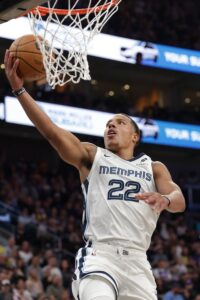 Even as the roster jelled and they returned to the playoffs during the past two seasons, three-point shooting remained an issue for the Magic. The team’s 31.8% success rate last season didn’t just rank dead last in the NBA — the gap between Orlando and 29th-place Washington was bigger than the gap between the third- and 17th-place teams in that category.
Bane is one of the NBA’s top marksmen from beyond the arc — he holds a career average of 41.0% on 6.3 attempts per game and has never made fewer than 38.1% in a season. And while he’s not an All-Defensive caliber player, he won’t hurt you at all on that end of the court, especially since he likely won’t handle the toughest assignments for a Magic team that ranked second in the league in defensive rating without him last season.
Of course, it’s worth noting that the Magic signed three-and-D specialist Kentavious Caldwell-Pope in free agency a year ago for many of the same reasons they acquired Bane this summer, and that was a bust. Caldwell-Pope’s 34.2% 3PT% in 2024/25 was his worst mark in nearly a decade. But Bane is a more well-rounded and dynamic player than KCP, has a more consistent track record as a shooter and scorer, and is five years younger. At age 27, Bane is still very much in his prime and should be part of Orlando’s core for years to come.
Besides ranking last in the NBA in three-point shooting last season, the Magic also finished 30th in assists per game. Jalen Suggs‘ lengthy injury absence was a factor, but even when he’s on the court, Suggs isn’t really a traditional point guard, so adding a player who better fit that bill was a top priority this summer. Orlando achieved that goal by using about half of its non-taxpayer mid-level exception to sign Tyus Jones to a one-year, $7MM contract.
Jones’ one-year stint in Phoenix was a disappointment, but little went right for the Suns in 2024/25, so it’s hard to place too much of the blame blame on Jones. He averaged double-digit points and at least five assists per game for a third straight season while continuing to take care of the ball at an elite level (his minuscule 1.1 turnovers per contest were, improbably, a career worst). Crucially, he matched a career high by making 41.4% of his three-pointers, an important consideration for a Magic team that won’t want to rely solely on Bane to upgrade its outside shooting.
With Bane and Jones on the books and Jase Richardson (No. 25) and Noah Penda (No. 32) added in June’s draft, the Magic were already moving into luxury tax territory, but they were still willing to go up to $5MM to re-sign Moritz Wagner to a one-year deal rather than targeting a 14th man willing to accept the veteran’s minimum.
That Wagner deal will make it a little more difficult for the Magic to duck under the tax line later in the season, but it could turn out to be a bargain if the big man is able to return during the first half of the season from the ACL tear he suffered last December. Prior to that injury, Wagner was on track for a career year, setting or matching career highs in several categories, including points (12.9) and rebounds (4.9) per game. He’ll provide important frontcourt depth if and when he’s back to 100%.
Given all the first-round picks the Magic gave up for Bane, we probably have to consider that trade the most meaningful transaction the team made this offseason. But if so, signing former No. 1 overall pick Paolo Banchero to a five-year, maximum-salary rookie scale extension comes a very close second.
Banchero was limited to 46 games due to an oblique injury and saw his shooting percentages drop a little in his third NBA season, but he averaged 25.9 points and 7.5 rebounds per game, both career highs. A year earlier, the Magic had signed Franz Wagner to a maximum-salary rookie scale extension after he experienced a similar shooting dip in his third year, so there was no doubt that Banchero would get the same commitment.
Now the big question is whether Banchero will make an All-NBA team in 2026. If he does, it would bump his projected first-year salary from $41.4MM (25% of the cap) to $49.6MM (30%), and the cap/apron crunch that’s already facing Orlando beginning in 2026/27 would only become more challenging to navigate.
Up next
The Magic have 14 players on guaranteed standard contracts and have a team salary of $193.5MM, which would seemingly give them just enough room below their $195.9MM hard cap to add a 15th man on a minimum-salary contract. However, because Bane’s contract includes $1.2MM in unlikely incentives that count against the apron, Orlando doesn’t have the ability at this time to fill that final roster spot. Unless the team makes a cost-cutting move, that will have to happen later in the season.
There is still a two-way opening on the roster though, alongside new additions Jamal Cain and Orlando Robinson. Last season’s two-way players Trevelin Queen and Mac McClung remain unsigned, but Queen is no longer eligible for a two-way deal and the Magic withdrew their qualifying offer for McClung last month, suggesting that they’ll go in another direction with that spot.
When Lester Quinones recently agreed to an Exhibit 10 contract with Orlando, reporting indicated he’ll be given a chance to compete for a two-way deal in training camp. I’d expect the Magic to sign at least a couple more players to get in on that competition before their camp gets underway.
With Banchero locked up, there are no extension candidates remaining for Orlando this fall. The team’s most important players – Banchero, Wagner (Franz, not Moritz), Bane, and Suggs – are all already under contract through at least 2028/29, while promising young guard Anthony Black won’t become eligible for a rookie scale extension until next July.
NBA 2025 Offseason Check-In: Los Angeles Clippers
Hoops Rumors is checking in on the 2025 offseason for all 30 NBA teams, recapping the summer’s free agent signings, trades, draft picks, departures, and more. We’ll take a look at each team’s offseason moves and consider what might still be coming before the regular season begins. Today, we’re focusing on the Los Angeles Clippers.
Free agent signings
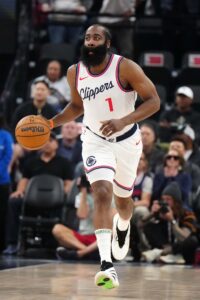 James Harden: Two years, $81,500,000. Second-year player option (partially guaranteed for $13,317,307 if exercised). Trade kicker (15%). Re-signed using Bird rights.
- Brook Lopez: Two years, $17,937,500. Second-year team option. Signed using non-taxpayer mid-level exception.
- Nicolas Batum: Two years, $11,483,280. Second-year team option. Trade kicker (15%). Re-signed using Non-Bird rights.
- Bradley Beal: Two years, $10,975,700. Second-year player option. Trade kicker (15%). Signed using non-taxpayer mid-level exception.
- Chris Paul: One year, minimum salary. Signed using minimum salary exception.
- Patrick Baldwin Jr.: One year, minimum salary. Non-guaranteed (Exhibit 10). Signed using minimum salary exception.
- Jason Preston: One year, minimum salary. Non-guaranteed (Exhibit 10). Signed using minimum salary exception.
- TyTy Washington Jr.: One year, minimum salary. Non-guaranteed (Exhibit 10). Signed using minimum salary exception.
Trades
- Acquired the draft rights to Kobe Sanders (No. 50 pick) from the Knicks in exchange for the draft rights to Mohamed Diawara (No. 51 pick) and the draft rights to Luka Mitrovic.
- Acquired John Collins (from Jazz) in a three-team trade in exchange for Norman Powell (to Heat), the Clippers’ 2027 second-round pick (to Jazz), and cash ($2.5MM; to Jazz).
Draft picks
- 1-30: Yanic Konan Niederhauser
- Signed to rookie scale contract (four years, $14,091,596).
- 2-50: Kobe Sanders
- Signed to two-way contract.
Two-way signings
- Trentyn Flowers
- One year, $85,300 partial guarantee.
- Jordan Miller
- One year, $85,300 partial guarantee (will increase to $318,218 at start of regular season).
- Kobe Sanders
- Two years, $85,300 partial guarantee (will increase to $318,218 at start of regular season); second year non-guaranteed.
Departed/unsigned free agents
- Amir Coffey (Bucks)
- Patty Mills (unsigned)
- Ben Simmons (unsigned)
Other roster moves
- Waived Jordan Miller.
- Miller was waived from a standard contract and re-signed to a two-way deal.
- Waived Patrick Baldwin Jr.
- Baldwin was waived from a two-way contract and re-signed to an Exhibit 10 deal.
Salary cap situation
- Operating over the cap ($154.6MM) and above the luxury tax line ($187.9MM).
- Carrying approximately $194.7MM in salary.
- Hard-capped at $195,945,000.
- Three traded player exceptions available (largest worth $6,539,000).
The offseason so far
The Clippers’ decision not to match the Sixers’ four-year, maximum-salary offer for Paul George last July looks savvy in retrospect, following an injury-plagued 2024/25 campaign in which George’s production dropped off significantly. But even at the time of George’s departure, there was a strong case to be made that the Clippers made the right move choosing financial flexibility over a massive investment in an aging star.
With George on the books, the Clippers would’ve been operating in tax-apron territory for the foreseeable future, with limited resources to add quality role players to the roster. Without George, the club dropped below the first apron and had the ability to add Derrick Jones Jr., Nicolas Batum, and Kris Dunn a year ago via the mid-level exception, the bi-annual exception, and sign-and-trade, respectively.
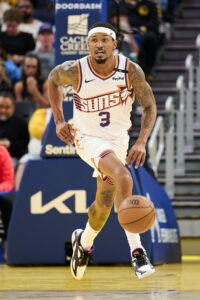 The Clippers made excellent use of their spending flexibility again during the 2025 offseason. While the bi-annual exception wasn’t available again in 2025, the club used every dollar of the non-taxpayer mid-level exception to sign center Brook Lopez and guard Bradley Beal. And because the Clippers’ team salary remained below the first apron, they had the ability to take back more salary than they sent out when they traded Norman Powell to Miami in a three-team deal that landed John Collins in L.A.
As effective as Powell was as a scorer and shooter in 2024/25 (21.8 PPG on .484/.418/.804 shooting), the Clippers seemed unlikely to extend his $20.5MM expiring contract and were able to bring in Beal, a replacement with a similar skill set, for a fraction of the price ($5.4MM). While Beal’s time in Phoenix was a disappointment, his production (17.6 PPG on .505/.407/.808 shooting over two seasons) will play a lot better when his cap hit comes in at roughly 1/10th of his previous maximum salary.
Even if you view Beal as a downgrade on Powell (which is debatable), the upgrades the Clippers were able to make in their frontcourt represent a worthwhile trade-off. Ivica Zubac made the All-Defensive second team and received Defensive Player of the Year votes on the heels of the best season of his career, but he doesn’t spread the floor at all on offense or rack up blocked shots on defense, so the club was seeking a new dimension up front and achieved that goal by bringing in Lopez and Collins.
Lopez was probably overextended as Milwaukee’s full-time center averaging 32 minutes per game, but he should thrive as a rim protector and outside shooter in a part-time role. Collins, meanwhile, will immediately become the best scorer in Los Angeles’ big man rotation. Lopez can anchor the defense when Zubac is off the floor, and Collins is capable of playing alongside either center, giving head coach Tyronn Lue more options in terms of two-big lineups.
The Clippers’ other notable veteran addition was a somewhat fortuitous one. There were probably teams willing to give Chris Paul more than the minimum-salary contract he ultimately signed, but those teams weren’t as conveniently located as the Clippers — reuniting with his former team will give the future Hall-of-Famer the ability to be around his family in Los Angeles, which was his top priority this offseason.
Paul will back up starting point guard James Harden, who received a slight raise on a new two-year deal after making the All-NBA third team this past season. Harden got a player option on that second year, but the Clippers protected themselves in the event of a major injury or drop-off in play. Only $13.3MM of Harden’s $42.3MM salary in 2026/27 will be guaranteed if he picks up his option.
Batum, Amir Coffey, and Ben Simmons were among the other Clippers veterans to reach unrestricted free agency this summer. While all three veterans logged regular minutes for the team down the stretch, Batum was the only one to maintain a rotation role in the postseason and was the only one of the three re-signed. After using the bi-annual exception to sign him a year ago, L.A. was able to give the forward a 20% raise using his Non-Bird rights.
Finally, the Clippers made two roster additions in the draft, including No. 30 overall pick Yanic Konan Niederhauser. At the time the Clippers made that selection, Zubac was the only center on the roster, and it looked like Niederhauser might get a shot to compete for regular minutes.
But the team subsequently acquired Lopez and Collins, and Niederhauser didn’t stand out at the Las Vegas Summer League. Unless he really impresses in camp or the Clippers have some frontcourt injuries to deal with, I expect the former Penn State standout to spend most of the first half of the season in the G League.
Up next
There shouldn’t be many items left on the Clippers’ offseason to-do list. They have one opening on their projected regular season roster, but don’t have enough breathing room below their hard cap to carry a 15th man into the regular season. Their two-way contract slots are all full. And Collins, the only extension-eligible player on the roster, could sign a new deal at any time between now and June 30, 2026, so he’s not facing any sort of October deadline.
Still, that doesn’t necessarily mean it’ll be an entirely uneventful fall in L.A. in terms of roster moves. It’s worth noting, for example, that the team has already signed a handful of players with NBA experience (Patrick Baldwin Jr., TyTy Washington Jr., and Jason Preston) to Exhibit 10 contracts. Despite the current lack of openings, it wouldn’t surprise me if those camp invitees are given an opportunity to compete for a two-way deal, with Trentyn Flowers‘ spot perhaps the most at risk.
NBA 2025 Offseason Check-In: Oklahoma City Thunder
Hoops Rumors is checking in on the 2025 offseason for all 30 NBA teams, recapping the summer’s free agent signings, trades, draft picks, departures, and more. We’ll take a look at each team’s offseason moves and consider what might still be coming before the regular season begins. Today, we’re focusing on the Oklahoma City Thunder.
Free agent signings
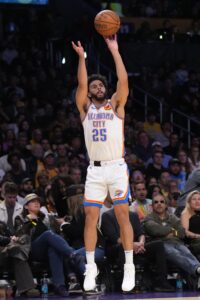 Ajay Mitchell: Three years, $8,700,000. Second year partially guaranteed ($1.5MM). Third-year team option. Re-signed using Non-Bird rights.
- Malevy Leons: One year, minimum salary. Non-guaranteed (Exhibit 10). Signed using minimum salary exception.
Trades
- Acquired the Spurs’ 2027 first-round pick (top-16 protected) from the Kings in exchange for the draft rights to Nique Clifford (No. 24 pick).
- Acquired Colby Jones from the Wizards in exchange for Dillon Jones and the Rockets’ 2029 second-round pick.
- Note: Jones was subsequently waived by the Thunder.
Draft picks
- 1-15: Thomas Sorber
- Signed to rookie scale contract (four years, $22,512,733).
- 2-44: Brooks Barnhizer
- Signed to two-way contract.
Two-way signings
- Brooks Barnhizer
- One year, $85,300 partial guarantee (will increase to $318,218 at start of regular season).
Departed/unsigned free agents
- Branden Carlson (unsigned)
- Alex Ducas (Brisbane Bullets)
- Adam Flagler (Spurs)
Other roster moves
- Signed Shai Gilgeous-Alexander to a four-year, maximum-salary veteran contract extension that begins in 2027/28. Projected value of $285,405,792 (super-max). Includes fourth-year player option.
- Signed Jalen Williams to a five-year, maximum-salary rookie scale contract extension that begins in 2026/27. Projected value of $239,934,400. Projected value can increase to $249,531,776 if Williams makes the All-NBA third team; $259,129,152 if Williams makes the All-NBA second team; or $287,921,280 if Williams makes the All-NBA first team or is named MVP or Defensive Player of the Year.
- Signed Chet Holmgren to a five-year, maximum-salary rookie scale contract extension that begins in 2026/27. Projected value of $239,934,400.
- Signed Jaylin Williams to a three-year, $24MM veteran contract extension that begins in 2025/26. Includes third-year team option.
Salary cap situation
- Operating over the cap ($154.6MM) and below the luxury tax line ($187.9MM).
- Carrying approximately $186.9MM in salary.
- No hard cap.
- Full mid-level exception ($14,104,000) available.
- Full bi-annual exception ($5,134,000) available.
- One traded player exception ($501,669) available.
The offseason so far
A year ago, the Celtics were able to retain 13 of the 15 players from their title-winning roster. Given the rate at which modern-day NBA rosters turn over, I assumed that was an achievement that wouldn’t be repeated by another NBA champion for at least a few years.
But the Thunder aren’t just going to match that feat — they’re about to one-up the Celtics. After winning a championship this spring, Oklahoma City is set to bring back 14 members of last season’s 15-man roster. 2024 first-round pick Dillon Jones, who was traded to Washington in July in order to ensure OKC remained under the luxury tax line, is the only player who won’t be back, and he wasn’t even part of the Thunder’s rotation for the majority of the 2024/25 season.
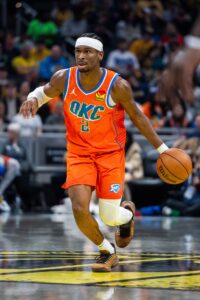 In addition to boding well for their odds of repeating as champions, the Thunder’s continuity is an indication of what sort of offseason it was in Oklahoma City. The club’s only roster additions came in the draft, when the front office used the 15th overall pick to draft Thomas Sorber and the No. 44 pick to nab Brooks Barnhizer, who will begin his career on a two-way contract.
The Thunder won a title last season despite getting no meaningful contributions from their first-round picks, Jones and Nikola Topic, who spent the year recovering from a knee injury. With virtually the same group coming back for 2025/26, they clearly don’t have any glaring need for Sorber in the short term, so while he may get a chance to compete for a modest rotation role, I’d expect him to be brought along slowly and to spend some time in the G League as a rookie.
Oklahoma City’s most important pieces of offseason business have all been contract extensions. No NBA team this summer has extended more players – or committed more money to those extensions – than the Thunder, who signed Shai Gilgeous-Alexander to a four-year super-max contract, locked up Jalen Williams and Chet Holmgren to maximum-salary rookie scale extensions, and finalized a more modest three-year, $24MM deal for center Jaylin Williams.
There’s only so much negotiating a team can do with a maximum-salary contract, but the Thunder did well along the edges in their three mega-deals. Gilgeous-Alexander could have secured an even more lucrative five-year payday if he had waited another year to sign his next contract, but put pen to paper sooner rather than later.
More importantly, instead of simply giving Williams and Holmgren the ability to increase their first-year salaries from 25% of the cap to 30% by making any All-NBA team next season, the Thunder included escalators for Williams (detailed above) and avoided Rose Rule language for Holmgren altogether. That could really pay off in the long run, since – as we saw with Cade Cunningham and Evan Mobley this year – that 5% salary bump can have a significant impact on a team’s long-term cap situation.
As for the Jay-Will extension, it will fly under the radar compared to the other three deals – for good reason – but the $8MM-per-year agreement (which includes a third-year team option) is a savvy investment in a solid role player.
As the Thunder’s roster gets more expensive in the coming years, they’ll need players like Williams and Ajay Mitchell – who signed a three-year, $8.7MM deal as a restricted free agent – to step into the roles currently occupied by higher-salary veterans. Those new contracts line up Williams and Mitchell to be more cap-friendly alternatives to players like Isaiah Hartenstein and Isaiah Joe down the road.
Up next
With a full 15-man roster, the Thunder will likely enter the season with their current group, though it’s worth keeping an eye on former lottery pick Ousmane Dieng.
Unlike fellow 2022 first-rounders J-Dub and Holmgren, Dieng has never developed into a regular contributor in Oklahoma City and won’t be signing a rookie scale extension before his fourth year. If the team needs to open up a roster spot at some point this fall or during the season for any reason, Dieng’s spot is probably the most at risk — he’s on an expiring $6.67MM contract.
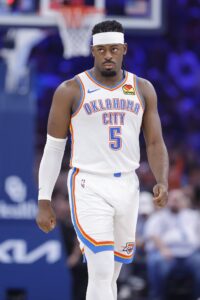 The Thunder have a pair of open two-way slots alongside Barnhizer, though one seems to be earmarked for Branden Carlson — since he reportedly agreed to a new two-way deal back on July 8, there has been no indication that it has been finalized or that the agreement has fallen through.
Even if we assume he gets one of OKC’s two-ways, that leaves one spot available. And given that Carlson and Mitchell showed last season that the club is willing to use its two-way players, it’s worth keeping an eye on who will get that last two-way deal.
Meanwhile, if the Thunder have one more extension agreement up their sleeves this offseason, it would probably be with Luguentz Dort, who is entering the fourth season of the five-year contract he signed as a restricted free agent in 2022.
However, the All-Defensive first-teamer likely won’t be able to reach free agency until 2027, since OKC holds a team option for 2026/27. That means the Thunder can afford to postpone serious contract talks until next offseason and decide at that point whether a raise for Dort (who is owed $36.4MM over the next two years) fits into their long-term financial plans.
NBA Players With Trade Kickers In 2025/26
A trade kicker is a contractual clause that pays an NBA player a bonus when he’s traded. They’re one of the tools teams have at their disposal to differentiate their free agent offers from the ones put on the table by competing clubs — or to incentivize a player to sign an extension before he reaches free agency.
Sometimes the kicker is worth a fixed amount, but usually it’s based on a percentage of the remaining value of the contract. So, a player who has a 10% trade kicker is eligible for a bonus worth 10% of the amount of money he has yet to collect on his deal (not counting an option year).
Regardless of whether a trade kicker is set at a fixed amount or a percentage, the bonus can’t exceed 15% of the remaining value of the contract. Most trade kickers are worth 15%, the highest percentage allowed.
A trade bonus must be paid by the team that trades the player, rather than the team acquiring him. The current Collective Bargaining Agreement also allows a player to waive part or all of his trade kicker as part of a deal, if he so chooses.
If you want a more detailed explanation of how trade kickers work, check out the Hoops Rumors Glossary entry on the subject.
Here’s a list of the NBA players who have active trade kickers for 2025/26, listed alphabetically, along with the details of those trade bonuses:
- Nickeil Alexander-Walker, Hawks (7.5%)
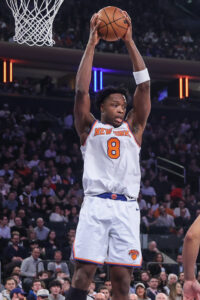
- OG Anunoby, Knicks (15%)
- LaMelo Ball, Hornets (15%)
- Nicolas Batum, Clippers (15%)
- Bradley Beal, Clippers (15%)
- Devin Booker, Suns (10%)
- Jalen Brunson, Knicks (15%)
- Clint Capela, Rockets (5%)
- Anthony Edwards, Timberwolves (15%)
- Dorian Finney-Smith, Rockets (3.232%)
- Paul George, Sixers (15%)
- Shai Gilgeous-Alexander, Thunder (15%)
- Rudy Gobert, Timberwolves (7.5%)
- Aaron Gordon, Nuggets (3%)
- Draymond Green, Warriors (15%)
- Tyrese Haliburton, Pacers (15%)
- James Harden, Clippers (15%): Traded
- Al Horford, Warriors (15%)
- Kyrie Irving, Mavericks (15%)
- LeBron James, Lakers (15%)
- Ty Jerome, Grizzlies (15%)
- Derrick Jones, Clippers (5%)
- Jonathan Kuminga, Warriors (15%): Traded
- Kawhi Leonard, Clippers (15%)
- Naji Marshall, Mavericks (5%)
- Austin Reaves, Lakers (15%)
- Klay Thompson, Mavericks (15%)
- Matisse Thybulle, Trail Blazers (15%)
- Myles Turner, Bucks (15%)
- Derrick White, Celtics (15%)
- Trae Young, Hawks (15%): Traded
- Ivica Zubac, Clippers (5%): Traded
The following players have trade bonuses on their contracts, but those bonuses would be voided if they were to be traded during the 2025/26 league year, since they’re already earning this season’s maximum salary:
- Giannis Antetokounmpo, Bucks (15%)
- Scottie Barnes, Raptors (15%)
- Jaylen Brown, Celtics (7% or $7MM, whichever is lesser)
- Stephen Curry, Warriors (15%)
- Darius Garland, Cavaliers (15%): Traded
- Nikola Jokic, Nuggets (15%)
- Evan Mobley, Cavaliers (15%)
- Ja Morant, Grizzlies (15%)
- Jayson Tatum, Celtics (15%)
The following players have signed contract extensions that will include trade kickers, but those extensions won’t go into effect until at least the 2026/27 season:
- Mikal Bridges, Knicks (5.69%)
- Aaron Nesmith, Pacers (7.5%)
- Jakob Poeltl, Raptors (5%)
NBA 2025 Offseason Check-In: Portland Trail Blazers
Hoops Rumors is checking in on the 2025 offseason for all 30 NBA teams, recapping the summer’s free agent signings, trades, draft picks, departures, and more. We’ll take a look at each team’s offseason moves and consider what might still be coming before the regular season begins. Today, we’re focusing on the Portland Trail Blazers.
Free agent signings
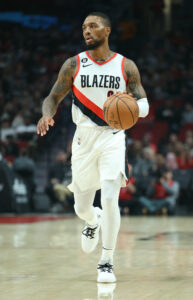 Damian Lillard: Three years, $41,606,800. Third-year player option. No-trade clause. Signed using non-taxpayer mid-level exception.
- Blake Wesley: One year, minimum salary. Signed using minimum salary exception.
Trades
- Acquired the draft rights to Yang Hansen (No. 16 pick), the Magic’s 2028 first-round pick, the Hawks’ 2027 second-round pick, and the Kings’ 2028 second-round pick from the Grizzlies in exchange for the draft rights to Cedric Coward (No. 11 pick).
- Acquired Jrue Holiday from the Celtics in exchange for Anfernee Simons.
Draft picks
- 1-16: Yang Hansen
- Signed to rookie scale contract (four years, $21,393,587).
Two-way signings
- Caleb Love
- One year, $85,300 partial guarantee (will increase to $318,218 at start of regular season).
Note: The Trail Blazers carried over Sidy Cissoko on a two-way contract from 2024/25.
Departed/unsigned free agents
- Dalano Banton (unsigned)
- Bryce McGowens (Pelicans)
- Justin Minaya (unsigned)
- Jabari Walker (Sixers)
Other roster moves
- Bought out Deandre Ayton (gave up $10,000,000 of $35,550,814 salary).
- Exercised team option on Rayan Rupert ($2,221,677).
Salary cap situation
- Operating over the cap ($154.6MM) and below the luxury tax line ($187.9MM).
- Carrying approximately $186.4MM in salary.
- Hard-capped at $195,945,000.
- Full bi-annual exception ($5,134,000) available.
The offseason so far
Mired in mediocrity (or worse) for several seasons, the Trail Blazers finally experienced a breakthrough in the second half of the 2024/25 season. Following a 13-28 start, they finished the year on a 23-18 run, as a defense that ranked 28th through the first 41 games of the season was the NBA’s third-best across the final 41.
That second-half success was driven largely by Portland’s young players. No Blazer logged more minutes during the final 41 games than Toumani Camara, who was recognized with a spot on the All-Defensive second team. Deni Avdija and Shaedon Sharpe were the team’s leading scorers after the All-Star break, averaging 23.3 and 21.2 points per night, respectively. And 2024 lottery pick Donovan Clingan became the full-time starter at center as Deandre Ayton missed the final 28 games of the season due to a calf injury.
The question entering the summer, then, was would the Blazers continue to patiently add young pieces to their improving core, or would they look to build on their second-half run by adding win-now veterans capable of helping the club get back to the playoffs in 2026?
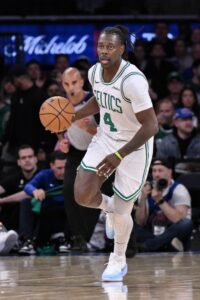 The first major agreement Portland’s front office reached this offseason was a trade sending Anfernee Simons and a pair of second-round picks to Boston in exchange for Jrue Holiday. The move raised eyebrows, given that the 26-year-old Simons is on an expiring $27.7MM deal, while the 35-year-old Holiday has three years and $104.4MM left on his contract. It seemed to be a signal that the Blazers, leaning into the defense-first identity they established during the final months of the 2024/25 season, were focused on taking another step forward in the short term.
But the rest of the Blazers’ offseason moves didn’t really fit that narrative. On draft night, the front office moved down from No. 11 to 16 and made arguably the most shocking pick of the first round by nabbing Chinese center Yang Hansen. The big man wasn’t widely projected to come off the board in round one — ESPN had ranked him 35th overall, while The Athletic had him at No. 48 on its big board. But there were rumblings that the Blazers didn’t feel comfortable moving down any further than No. 16 because they believed another team was eyeing Hansen within the next few spots.
The long-term potential of Hansen, who has earned comparisons to Yao Ming and Nikola Jokic, is tantalizing, and he showed flashes of brilliance in the Las Vegas Summer League. But the 20-year-old will require some patience and probably isn’t ready to play a major role right away for a team with postseason aspirations.
The Blazers continued to show with their next couple moves that they aren’t necessarily all-in on contending in the immediate future — they bought out Ayton, their maximum-salary starting center, a day before free agency opened, then reached a deal a few weeks later to reunite with Damian Lillard, who will spend the 2025/26 season recovering from an Achilles tear.
Ayton’s buyout wasn’t a total shocker, given the emergence of Clingan and the addition of Hansen, but it signals that Portland is comfortable turning the frontcourt over to its youngsters. As for the reunion with Lillard, who spent his first 11 seasons with the Blazers, the 35-year-old is theoretically a win-now piece, but he won’t be able to contribute at all for a year. If the team were more focused on making the postseason in ’25/26, it could have used its mid-level exception on a rotation player who will actually be healthy and available.
With the benefit of hindsight and a more complete picture of the Blazers’ offseason moves, the Holiday trade – which ended up being completed without the two second-round picks due to minor concerns about the guard’s physical – reads a little differently. The two-time NBA champion is being brought in to supplement, rather than supplant, the young duo of Sharpe and Scoot Henderson, who should benefit from Holiday’s veteran leadership and his ability to take on the tougher defensive assignments in which Simons would’ve been overmatched.
It’s fair to question whether it was the right move for the Blazers to invest in a mid-30s guard who is making nearly $35MM per year and whose production slipped to new lows in 2024/25. But it certainly still seems like the ultimate goal in Portland is to build around that young core. After Avdija, Camara, and Clingan showed last season that they’re very much on the right track, the Blazers are hoping that Holiday’s guidance will help ensure that Sharpe and Henderson are right there with them.
The other major story of the Blazers’ offseason broke within the last week, as billionaire Tom Dundon reached a tentative agreement to purchase the franchise from Paul Allen‘s estate.
It’s hard to get a clear sense of how a new team owner will operate until he actually takes control and starts making moves, and it may be a little while before that happens, since the deal will require the approval of the NBA’s Board of Governors. But Blazers fans should be encouraged by the job Dundon has done with the NHL’s Carolina Hurricanes since buying the team in 2018. On the heels of a nine-year playoff drought, the Hurricanes have made the postseason seven straight times and won nine playoff series in Dundon’s first seven full seasons as majority owner.
Up next
The Trail Blazers have 15 players on fully guaranteed contracts and only have a little breathing room below the luxury tax line, so unless they plan to make a trade before the preseason begins, their roster looks pretty set.
Having said that, it’s worth noting that there’s no shortage of trade candidates on the roster — Jerami Grant and Robert Williams, for instance, likely aren’t part of the long-term plans in Portland, and Williams is on an expiring contract. But Grant has a sizable cap hit and is coming off a down year, while Williams has only appeared in 26 games over the past two seasons due to injuries, so neither one has much trade value at this point.
Portland does have a two-way contract slot open, with no obvious candidate to fill it. If they don’t sign anyone to a two-way deal in the coming weeks, there could be an open competition in training camp for that spot. Undrafted rookies Sean Pedulla and Andrew Carr are among the players said to have received camp invites on Exhibit 10 contracts.
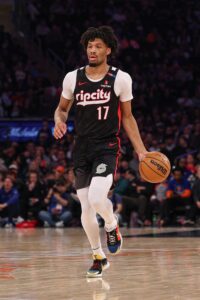 With no major roster decisions on tap in the short term, the Blazers’ biggest decision this fall may be whether or not to extend Sharpe. The former seventh overall pick has been inconsistent as a shooter and defender since entering the NBA and missed most of his second year due to an abdominal injury, but he’s an incredible athlete who is still just 22 years old and has exhibited legitimate scoring ability — he put up a career-best 18.5 points per game last season.
Finding the right price for Sharpe could be tricky, but if the Blazers are still big believers in his upside and think a breakout could be around the corner, this might be their best chance to sign him to a team-friendly long-term contract. Of course, if Sharpe and his camp believe the same thing, they probably won’t be inclined to settle for too modest a deal. Perhaps there’s a middle ground for Sharpe and the Blazers somewhere between the four-year rookie scale extensions signed a year ago by Corey Kispert ($54MM) and Trey Murphy ($112MM).
While Sharpe has an Oct. 20 deadline for a rookie scale extension, there’s no such restriction for Camara, who will remain eligible for a veteran extension all season long, assuming his minimum-salary team option for 2026/27 is declined as part of an agreement. Camara would be eligible to receive up to approximately $87MM for four seasons on an extension starting in ’26/27 or roughly $63MM over three seasons if his ’26/27 option is exercised and a new deal begins in ’27/28.
The former second-round pick earned praise from opponents for his defensive tenacity and showed off an improved offensive game in his second NBA season, knocking down 37.5% of his three-point attempts. He’s an important part of the future in Portland.
Starting an extension for Camara a year later would benefit the Blazers, who are in position to have some cap flexibility during the 2026 offseason. But if giving him a significant raise in ’26/27 is what it takes to get a deal done, Portland shouldn’t hesitate to pull the trigger — especially since, without an extension, the team may end up needing to decline that option anyway in order to make him a restricted free agent next July.
Community Shootaround: 2025 Rookie Class
The 2025 draft lottery produced some unexpected results, with the Mavericks (No. 1), Spurs (No. 2) and Sixers (No. 3) leapfrogging multiple teams to select Cooper Flagg, Dylan Harper and VJ Edgecombe, respectively.
Flagg is, unsurprisingly, the odds-on favorite (-190 at ESPN BET) to win Rookie of the Year for the 2025/26 season, according to Kevin Pelton of ESPN.com.
But the last two American prospects who were as hyped as Flagg — Zion Williamson and Anthony Davis — didn’t end up winning the award, so it’s not a given that the 18-year-old will claim it next spring, even if it currently seems as though it will “probably be Flagg’s award to lose,” as Pelton puts it.
Which players from the 2025 rookie class are best positioned to challenge Flagg for the award? Pelton groups them into categories, with the “contenders” being Kon Knueppel (No. 4; Hornets), Tre Johnson (No. 6; Wizards) and Ace Bailey (No. 5; Jazz).
As Pelton explains, Johnson, Knueppel and Bailey were selected by three of the NBA’s worst teams from last season should be given plenty of opportunities to earn both shots and minutes. While Knueppel is a distant sixth in betting odds (+2800), Pelton thinks the former Duke guard/forward might be in the best position to have a strong start to his career, followed by Johnson (+750) and Bailey (+1600).
Harper (+1000) and Edgecombe (+1200) are in their own “wild cards” tier. Although they’re undeniably talented, Pelton writes that both guards are joining crowded backcourts on teams that are striving to be competitive, so their playing time might be limited, barring injuries.
Pelton’s final group of rookies — Walter Clayton Jr. (No. 18; Jazz), Nique Clifford (No. 24; Kings), Egor Demin (No. 8; Nets), Jeremiah Fears (No. 7; Pelicans), Ryan Kalkbrenner (No. 34; Hornets) and Derik Queen (No. 13; Pelicans) — are the “long shots” to win the award. Kalkbrenner is the only second-rounder of the bunch and isn’t among the top 28 betting favorites, but Pelton is “intrigued” by his potential as a rookie, noting that the former Creighton center could be a day-one starter in Charlotte.
We want to know what you think. Do you agree with Pelton’s categories of the players best positioned to challenge Flagg for Rookie of the Year? Is there anyone who wasn’t mentioned that you believe could be a dark-horse contender? Head to the comment section to weigh in.
NBA 2025 Offseason Check-In: Toronto Raptors
Hoops Rumors is checking in on the 2025 offseason for all 30 NBA teams, recapping the summer’s free agent signings, trades, draft picks, departures, and more. We’ll take a look at each team’s offseason moves and consider what might still be coming before the regular season begins. Today, we’re focusing on the Toronto Raptors.
Free agent signings
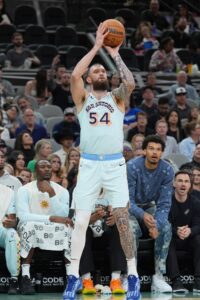 Sandro Mamukelashvili: Two years, minimum salary. Second-year player option. Signed using minimum salary exception.
- Garrett Temple: One year, minimum salary. Re-signed using minimum salary exception. Waived right to veto trade.
- David Roddy: One year, minimum salary. Non-guaranteed (Exhibit 10). Signed using minimum salary exception.
- Olivier Sarr: One year, minimum salary. Non-guaranteed (Exhibit 10). Signed using minimum salary exception.
Trades
- None
Draft picks
- 1-9: Collin Murray-Boyles
- Signed to rookie scale contract (four years, $28,822,764).
- 2-39: Alijah Martin
- Signed to two-way contract.
Two-way signings
- Chucky Hepburn
- One year, $85,300 partial guarantee.
- Alijah Martin
- One year, $85,300 partial guarantee (will increase to $318,218 at start of regular season).
Note: The Raptors carried over Ulrich Chomche on a two-way contract from 2024/25.
Departed/unsigned free agents
- Chris Boucher (Celtics)
Other roster moves
- Signed Jakob Poeltl to a three-year, $84,084,000 contract extension that begins in 2027/28. Exercised ’26/27 player option ($19.5MM base salary; $500K in incentives) as part of agreement. Third year is partially guaranteed for $5MM (partial guarantee can increased based on performance criteria). Includes trade kicker (5%).
- Waived Colin Castleton (non-guaranteed contract).
- Waived Jared Rhoden (two-way contract).
Salary cap situation
- Operating over the cap ($154.6MM) and above the luxury tax line ($187.9MM).
- Carrying approximately $190.7MM in salary ($188.4MM guaranteed).
- No hard cap.
- Taxpayer mid-level exception ($5,685,000) available.
The offseason so far
When we talk about a team getting a head-start on the summer by making its big offseason moves at the trade deadline, the 2025 Raptors are exactly what we’re talking about.
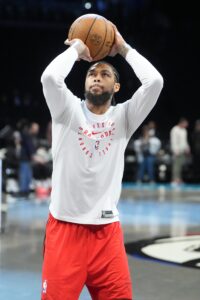 Toronto was well on its way to a lottery finish in 2024/25 when the front office swung a deal to acquire Pelicans forward Brandon Ingram, a former All-Star who had been sidelined since December due to an ankle injury and ultimately ended up missing the rest of the season.
Shortly after giving up two players and a pair of draft picks (including a lightly protected first-rounder) to acquire him, the Raptors signed Ingram to a three-year, $120MM contract extension to ensure he didn’t reach unrestricted free agency this summer.
The Ingram trade and extension were clearly completed with an eye toward the 2025/26 season (and beyond), and the fact that the Raptors made them well ahead of the offseason meant that it ended up being a fairly quiet summer in Toronto, at least in terms of roster changes.
The Raptors are one of just three teams that hasn’t made a single trade since the regular season ended. They also haven’t added a free agent on a contract worth more than the minimum — outside of re-signing veteran locker room leader Garrett Temple, their only real foray into free agency was adding big man Sandro Mamukelashvili to a two-year, minimum-salary deal to add more depth to the frontcourt as longest-tenured Raptor Chris Boucher departed Toronto.
The Raptors did have a lottery pick at No. 9 overall, which they used to select Collin Murray-Boyles out of South Carolina. The belief in some corners was that the team should have used that pick on Duke center Khaman Maluach, who unexpectedly slipped out of the top eight. But Toronto is clearly high on Murray-Boyles, who has drawn Draymond Green comparisons and had a solid Summer League debut last month, with averages of 10.5 points, 5.5 rebounds, 2.0 assists, and 1.8 steals per game on 57.1% shooting.
Expecting Murray-Boyles to make an immediate impact this fall may not be realistic, but the 20-year-old is an intriguing young building block for Toronto. And while it will be tempting to compare his progress in the coming years to Maluach’s, the Raptors made it clear by extending Jakob Poeltl through 2029/30 that they view their starting center of the present as their center of the future too, at least for the next few seasons.
The $28MM-per-year price tag on the three seasons newly added to Poeltl’s contract may be a little higher than some fans expected, but the third year isn’t fully guaranteed, and the big man picked up his more team-friendly $19.5MM option for 2026/27 as part of the agreement. Plus, the stark contrast between the Raptors’ metrics when Poeltl is on and off the court over the past couple seasons suggests he’s one of the league’s more underrated big men.
While drafting Murray-Boyles and extending Poeltl were important moves that will impact the club for years to come, the dismissal of longtime team president Masai Ujiri may have been the most consequential long-term decision made by the Raptors this summer.
Ujiri, who took over as Toronto’s head of basketball operations in 2013, built the first championship roster in franchise history (2018/19) and helped shape the organization’s culture during his decade-plus with the team. Given his reputation and the timing of the move (a day after the draft), the news of his ouster came as a bit of a surprise, but Ujiri had also made his share of questionable roster decisions in recent years and didn’t see eye-to-eye with the new ownership group.
The Raptors continue to search for a full-time replacement for Ujiri, with general manager Bobby Webster – who is currently running basketball operations – viewed as a candidate for the role.
Up next
Hiring a permanent president of basketball operations may be the top remaining item on Toronto’s offseason to-do list, but it’s not the only task on the agenda.
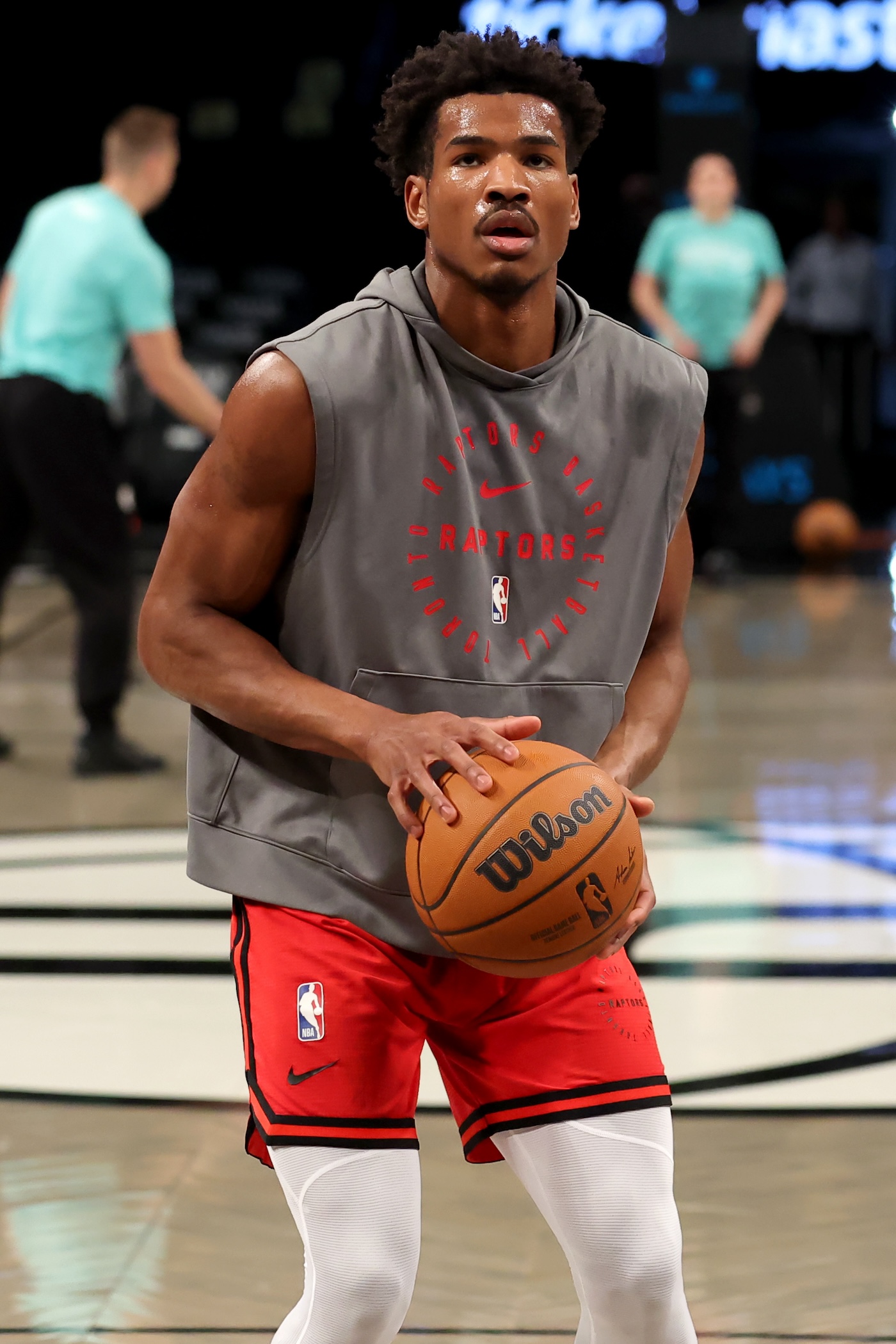 Perhaps most pressingly, the Raptors are currently operating over the luxury tax line, which presumably isn’t the end goal for a team coming off a 30-win season. They also find themselves above the first tax apron due to the incentives in the Immanuel Quickley, RJ Barrett, and Poeltl contracts.
Getting under the first apron would be straightforward enough. Waiving A.J. Lawson‘s non-guaranteed contract and beginning the season with 14 players on the standard roster would do the trick. That would afford the Raptors all the flexibility of a non-apron team, including being able to take back more salary than they send out in a trade (albeit with little breathing room under the apron to actually do so).
But getting out of tax territory is probably the more important consideration, and cutting Lawson wouldn’t quite get them there — the Raptors would still be in the tax by about $800K in that scenario.
That amount is so modest that it wouldn’t be hard for the club to address the issue with a minor trade during the season, so it doesn’t necessarily have to be done by opening night. In fact, it could make more sense to wait until the Raptors have a better sense of how Ingram fits together with the rest of the roster. While moving off a minimum-salary player at the trade deadline would get Toronto out of the tax, the team may be inclined to make a more significant deal involving a higher-paid player in which one of the goals would be to take back a little less salary than is sent out.
It’s also worth keeping an eye on former lottery pick Ochai Agbaji in the next couple months. The fourth-year wing has shown some promise, but it’s unclear whether he’s still part of the long-term plans in Toronto as he enters the final season of his rookie contract. He’s extension-eligible until October 20, and if he doesn’t sign a new deal by that time, his expiring $6.4MM deal could make him a trade candidate.