
Poll: 2008 NBA Draft Take Two (Pick No. 9)
Scouting players and predicting how their skills will translate to the NBA is one of the more difficult tasks front offices have on their plates. Looking back over past drafts and how many lottery picks never evolved into stars, or even made a significant impact in the league, illustrates just how often stats, combine numbers and pure gut instinct often come up short.
Of course, we get the opportunity to critique these moves with the benefit of hindsight — a luxury that GMs don’t have on draft night. Having said that, it’s still fun to go back in time and take a theoretical look at how these drafts should have/could have gone.
We’ve been revisiting 2008 draft, which had a number of players who have gone on to post big numbers in the league. This was the year of Derrick Rose (No. 1 overall), Russell Westbrook (No. 4), Kevin Love (No. 5), Brook Lopez (No. 10) and Nicolas Batum (No. 25). Over the next few weeks, we’ll be posting a series of polls asking readers to vote on whom teams should have selected in each spot.Read more
Hoops Rumors Originals: 8/21/16-8/27/16
Here’s a look back at the original content and analysis generated by the Hoops Rumors staff this past week.
- We examined Steven Adams and Rudy Gobert as extension candidates.
- We asked readers to do over the 2008 NBA Draft. Here’s who you selected for picks No. 3, No. 4, No. 5, No. 6, No. 7 and No. 8 overall.
- You can stay up to date on any contract extensions agreed to this season with our tracker.
- Here are the NBA D-League affiliations for the upcoming season.
- In a reader poll, we asked if the Nets should trade Brook Lopez.
- We ran down the remaining free agents who logged the most minutes in 2015/16.
- Will Joseph highlighted some of the better basketball blogs around in his weekly installment of Hoops Links.
- We looked at the 2016/17 Salary Cap figures for the:
- Arthur answered reader questions in our Weekly Mailbag. Here’s how you can submit your own questions for our mailbag feature.
- In our Community Shootarounds this week we discussed:
- How good will the Knicks be in 2016/17?
- Which 12 players will represent the United States at the 2020 Games in Tokyo?
- Which player is likeliest to make a comeback this season?
- Our Free Agent Tracker continues to have up-to-date data on this summer’s contract agreements and signings from around the NBA.
- If you haven’t already, be sure to download the Trade Rumors app for your iOS or Android device.
Submit Your Questions For Hoops Rumors Mailbag
We at Hoops Rumors love interacting with our readers. This is why we provide an opportunity for you to hit us up with your questions in our weekly mailbag feature, which is posted every Sunday.
Have a question regarding player movement, free agent rumors, the salary cap, the NBA draft, or the top storylines of the week? You can e-mail them here: hoopsrumorsmailbag@gmail.com. Feel free to send emails throughout the week, but please be mindful that we may receive a sizable number of questions and might not get to all of them.
If you missed out on any past mailbags and would like to catch up, you can view the full archives here.
Salary Cap Snapshot: Minnesota Timberwolves
With the free agent signing period winding down and teams looking ahead to the preseason, we at Hoops Rumors will be tracking the Salary Cap figures for each team around the league. These posts will be maintained throughout the season once financial data is reported. They will be located on the sidebar throughout the year, once all the teams’ cap figures have been relayed. You can always check RosterResource.com for up-to-date rosters for each franchise, with the Wolves’ team page accessible here.
Here’s a breakdown of where the Wolves currently stand financially:
Guaranteed Salary
- Ricky Rubio —$13,575,000 [Year-end cap hit adjusted due to bonuses]
- Nikola Pekovic —$12,100,000
- Kevin Garnett —$8,000,000 [Waived by team]
- Cole Aldrich —$7,643,979
- Andrew Wiggins —$6,006,600
- Karl-Anthony Towns —$5,960,160
- Jordan Hill —$4,000,000
- Kris Dunn —$3,872,520
- Nemanja Bjelica —$3,800,000
- Brandon Rush —$3,500,000
- Shabazz Muhammad —$3,046,299
- Gorgui Dieng —$2,348,783
- Zach LaVine —$2,240,880
- Adreian Payne —$2,022,240
- Kevin Martin —$1,360,305 [Waived via Stretch Provision]
- Tyus Jones —$1,339,680
- John Lucas III —$635,753 [Waived by team]
- Omri Casspi —$138,414
- Lance Stephenson —$57,672 [10-day contract (Feb 8); actual salary — $72,193]
- Lance Stephenson —$57,672 [10-day contract (Mar 8); actual salary — $72,193]
Total Guaranteed Salary= $81,705,957
Cash Sent Out Via Trade: $0 [Amount Remaining $3.5MM]
Cash Received Via Trade: $0 [Amount Remaining $3.5MM]
Payroll Exceptions Available
- Room Exception — $2,898,000
Total Projected Payroll: $81,705,957
Salary Cap: $94,143,000
Estimated Available Cap Space: $12,437,043
Luxury Tax Threshold: $113,287,000
Amount Below Luxury Tax: $31,581,043
Salary Cap Floor: $84,729,000
Amount Below Salary Cap Floor: $3,023,043
Last Updated: 4/15/17
The Basketball Insiders salary pages and The Vertical’s salary database were used in the creation of this post.
Poll: 2008 NBA Draft Take Two (Pick No. 8)
Scouting players and predicting how their skills will translate to the NBA is one of the more difficult tasks front offices have on their plates. Looking back over past drafts and how many lottery picks never evolved into stars, or even made a significant impact in the league, illustrates just how often stats, combine numbers and pure gut instinct often come up short.
Of course, we get the opportunity to critique these moves with the benefit of hindsight — a luxury that GMs don’t have on draft night. Having said that, it’s still fun to go back in time and take a theoretical look at how these drafts should have/could have gone.
We recently finished revisiting the lottery portion of the 2005 NBA Draft, which was one of the weakest in recent memory. In drafts light on impact talent, the GM who can find a diamond in the rough is king. But drafts that have a number of star-potential players can also be difficult and many an executive has made what turned out to be the wrong call. Greg Oden over Kevin Durant immediately springs to mind (sorry Blazers fans), likewise taking Sam Bowie over Michael Jordan…ouch!
The 2008 draft, which is the one we’re tackling now, had a number of players who have gone on to post big numbers in the league. This was the year of Derrick Rose (No. 1 overall), Russell Westbrook (No. 4), Kevin Love (No. 5), Brook Lopez (No. 10) and Nicolas Batum (No. 25). Over the next few weeks, we’ll be posting a series of polls asking readers to vote on whom teams should have selected in each spot.
We’ll continue with the Bucks, who held the No. 8 overall pick that year. In the “real world” draft, Milwaukee selected Joe Alexander, who has career averages of 4.2 points and 1.8 rebounds in just 67 NBA games. This is one pick I’m sure Bucks fans are still lamenting, especially given the talented players who were still available at that slot.
So cast your vote for who the Bucks should have selected and check back on Saturday to see the results, as well as to vote on who the Bobcats/Hornets should have taken with the No.9 pick. Also, don’t limit yourself to a simple button click. Take to the comments section below and share your thoughts on the pick and why you voted the way that you did. If we fail to list a player who you think should be selected, feel free to post that in the comments section and we’ll be certain to tally those votes as well.
- Bulls — Russell Westbrook [Actual Pick — Derrick Rose]
- Heat — Kevin Love [Actual Pick — Michael Beasley]
- Wolves — Derrick Rose [Actual Pick — O.J. Mayo]
- Sonics/Thunder — DeAndre Jordan [Actual Pick — Russell Westbrook]
- Grizzlies — Brook Lopez [Actual Pick — Kevin Love]
- Knicks — Serge Ibaka [Actual Pick — Danilo Gallinari]
- Clippers — Nicolas Batum [Actual Pick — Eric Gordon]
- Bucks — ?? [Actual Pick — Joe Alexander]
With the No. 8 Overall Pick, the Bucks Select...
-
Goran Dragic 48% (475)
-
Danilo Gallinari 19% (187)
-
Eric Gordon 8% (78)
-
Ryan Anderson 5% (54)
-
George Hill 5% (49)
-
Roy Hibbert 4% (42)
-
Robin Lopez 3% (33)
-
Joe Alexander 1% (8)
-
O.J. Mayo 1% (7)
-
Nikola Pekovic 1% (7)
-
JaVale McGee 1% (7)
-
Luc Mbah a Moute 1% (6)
-
Sasha Kaun 1% (6)
-
Michael Beasley 1% (5)
-
Courtney Lee 0% (3)
-
Timofey Mozgov 0% (3)
-
Anthony Randolph 0% (3)
-
Marreese Speights 0% (3)
-
Mario Chalmers 0% (2)
-
Jerryd Bayless 0% (2)
-
Anthony Morrow 0% (2)
-
Omer Asik 0% (1)
-
Brandon Rush 0% (1)
-
J.J. Hickson 0% (1)
-
Brian Roberts 0% (1)
-
Kosta Koufos 0% (1)
-
D.J. Augustin 0% (1)
-
Jason Thompson 0% (0)
-
Darrell Arthur 0% (0)
Total votes: 988
If you’re a Trade Rumors app user, click here to vote.
Extension Candidate: Rudy Gobert
The increased usage of smaller lineups, along with a greater emphasis on 3-point shooting, theoretically reduces the need for a quality center. Considering the contracts being handed out, that’s not the case.
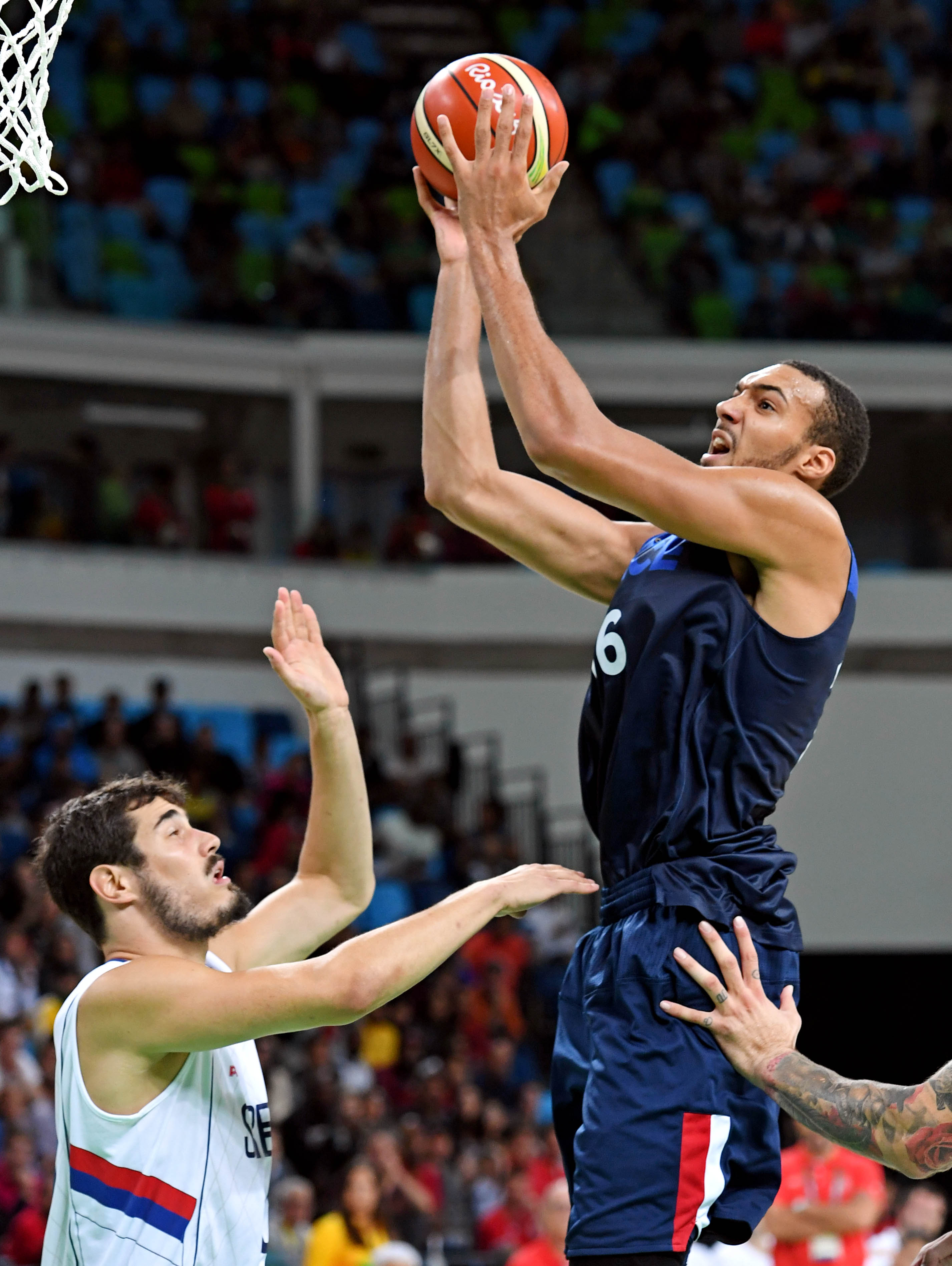 Hassan Whiteside, despite a somewhat limited track record, was a hot commodity on the free agent market this summer. He received a max four-year extension to stick with the Heat. Joakim Noah, who lost his starting job with the Bulls and was injured the second half of last season, got a truckload of money to sign with the Knicks.
Andre Drummond, even with his free throw shooting issues, received a max five-year extension from the Pistons.
Unheralded centers such as Timofey Mozgov, Ian Mahinmi and Bismack Biyombo landed giant contracts while jumping teams.
Given those developments, Rudy Gobert shouldn’t have much trouble receiving a max contract offer — or something close to it — from the Jazz. The biggest question mark is whether Utah will decide to lock up its defensive stalwart prior to the regular season or take some risk by waiting until next summer, when Gobert can become a restricted free agent.
The two parties agreed to delay the process until the Rio Olympics wrapped up. Gobert was busy playing for Team France, then decided to stay overseas for a couple of weeks before returning to Utah late this month or in early September to get ready for the NBA season.
From a salary cap standpoint, the Jazz certainly have the freedom to hammer out an agreement by the end of training camp, the deadline for rookie scale contract extensions. One or both parties might also want to get it done before the possibility that NBA Players’ Association or the league opts out of the current Collective Bargaining Agreement. That could occur in mid-December and go into effect after the season.
Utah has just $34.3MM in guaranteed salary commitments for 2017/18, though its inclusive totals (non-guaranteed salaries, early termination options, etc.) is closer to $78.3MM. The projected salary cap for that season is $102MM.
So why would the Jazz wait to extend Gobert entering his prime years at 24 years old? The 7’1” Gobert has a modest $5.3MM cap hold. That gives the Jazz plenty of flexibility in terms of re-signing their free agents, pursuing top free agents and making trades next offseason if they hold off on Gobert’s extension.
Utah also has some major decisions regarding two of its other top players. Power forward Derrick Favors is eligible for a veteran’s extension right now. Small forward Gordon Hayward can opt out of the final year of his contract and become an unrestricted free agent next summer. Hayward will almost certainly command a max salary if Utah tries to retain him.
Point guard George Hill, arguably the Jazz’s biggest addition this offseason, is entering his walk year. Hill’s current $8MM salary is well under market value for a starter and if the Jazz want to make him a competitive offer next summer, they’ll probably have to give him a huge raise.
Gobert has not been a major part of the Jazz’s offense, even as his playing time has grown the past two seasons. He’s never averaged more than six shot attempts in his three NBA seasons.
As a part-time starter in 2014/15, Gobert averaged 8.4 points, 9.5 rebounds and 2.3 blocks. Those numbers improved slightly to 9.1/11.0/2.2 as a starter last season, though he was limited to 61 games because of injuries.
Free throw shooting is also a problem for Gobert — he’s made 58.5% of his foul shots during his short NBA career.
His value on the defensive end overshadows his offensive deficiencies. According to Basketball-Reference.com’s Defensive Box Rating, he was the league’s second-best defender (4.8) last season behind the Spurs’ recently-retired Tim Duncan (5.0). His Defensive Box Rating the previous season was even higher at 5.1, behind only the Warriors’ Andrew Bogut (5.5).
Difference makers on either side of the ball are hard to find and there’s no viable option on the roster to replace Gobert. Thus, it’s reasonable to assume he’ll be maxed out, though it’s conceivable he could give the club a little discount in order to get the extension done early. Remember, if the Players’ Association or league opts out of the CBA, the rules regarding contracts could be significantly altered.
How much could Gobert receive? According to Eric Pincus of Basketball Insiders, players with less than seven years of service could get a max of approximately $24MM under the projected cap of $102MM. With 7.5% raises each season, Gobert could sign a four-year extension worth approximately $107.35MM. A five-year extension could max out around $139.4MM.
That’s an awful lot of money to shell out for someone who isn’t an offensive threat or considered a franchise-type player. Having multiple players making max money severely curtails what clubs can do with their rosters, even with the recent rise in the salary cap. The Jazz might be hesitant to commit about half its cap to Hayward and Gobert, who fall short of superstar status.
Yet it’s abundantly clear that retaining Gobert will require something at or close to the max. The market for big men is as competitive as ever, whether or not teams continue to play small ball.
(Photo courtesy of John David Mercer / USA Today Sports Images)
Poll: 2008 NBA Draft Take Two (Pick No. 7)
Scouting players and predicting how their skills will translate to the NBA is one of the more difficult tasks front offices have on their plates. Looking back over past drafts and how many lottery picks never evolved into stars, or even made a significant impact in the league, illustrates just how often stats, combine numbers and pure gut instinct often come up short.
Of course, we get the opportunity to critique these moves with the benefit of hindsight — a luxury that GMs don’t have on draft night. Having said that, it’s still fun to go back in time and take a theoretical look at how these drafts should have/could have gone.
We recently finished revisiting the lottery portion of the 2005 NBA Draft, which was one of the weakest in recent memory. In drafts light on impact talent, the GM who can find a diamond in the rough is king. But drafts that have a number of star-potential players can also be difficult and many an executive has made what turned out to be the wrong call. Greg Oden over Kevin Durant immediately springs to mind (sorry Blazers fans), likewise taking Sam Bowie over Michael Jordan…ouch!
The 2008 draft, which is the one we’re tackling now, had a number of players who have gone on to post big numbers in the league. This was the year of Derrick Rose (No. 1 overall), Russell Westbrook (No. 4), Kevin Love (No. 5), Brook Lopez (No. 10) and Nicolas Batum (No. 25). Over the next few weeks, we’ll be posting a series of polls asking readers to vote on whom teams should have selected in each spot.
We’ll continue with the Clippers, who held the No. 7 overall pick that year. In the “real world” draft, the Clippers selected Eric Gordon. When healthy, Gordon has been a productive player. He’s averaged 16.6 points and 3.3 assists during his career while shooting 38.3% on 3-point tries.
The problem has been his inability to get through the 82-game grind. Knee injuries, in particular, have often forced Gordon out of action. The 6’4” shooting guard has not played more than 64 games in any season since his rookie campaign. That didn’t deter the Rockets from handing Gordon a four-year, $53MM contract during free agency this summer.
So cast your vote for who the Clippers should have selected and check back on Friday to see the results, as well as to vote on who the Bucks should have taken with the No. 8 pick.
Also, don’t limit yourself to a simple button click. Take to the comments section below and share your thoughts on the pick and why you voted the way that you did. If we fail to list a player who you think should be selected, feel free to post that in the comments section and we’ll be certain to tally those votes as well.
- Bulls — Russell Westbrook [Actual Pick — Derrick Rose]
- Heat — Kevin Love [Actual Pick — Michael Beasley]
- Wolves — Derrick Rose [Actual Pick — O.J. Mayo]
- Sonics/Thunder — DeAndre Jordan [Actual Pick — Russell Westbrook]
- Grizzlies — Brook Lopez [Actual Pick — Kevin Love]
- Knicks — Serge Ibaka [Actual Pick — Danilo Gallinari]
With the No. 7 Pick, the Clippers Select...
-
Nicolas Batum 50% (726)
-
Gorac Dragic 15% (226)
-
Danilo Gallinari 10% (142)
-
Eric Gordon 6% (84)
-
Ryan Anderson 4% (62)
-
George Hill 3% (37)
-
Roy Hibbert 2% (34)
-
Robin Lopez 2% (27)
-
O.J. Mayo 1% (16)
-
Courtney Lee 1% (13)
-
Michael Beasley 1% (11)
-
Nikola Pekovic 1% (10)
-
Marreese Speights 1% (8)
-
Mario Chalmers 1% (8)
-
Omer Asik 1% (8)
-
JaVale McGee 1% (8)
-
Brandon Rush 0% (7)
-
Timofey Mozgov 0% (7)
-
Anthony Randolph 0% (6)
-
Joe Alexander 0% (5)
-
Jerryd Bayless 0% (4)
-
Brian Roberts 0% (3)
-
J.J. Hickson 0% (2)
-
Jason Thompson 0% (2)
-
Anthony Morrow 0% (1)
-
D.J. Augustin 0% (1)
-
Kosta Koufos 0% (1)
Total votes: 1,459
If you’re a Trade Rumors app user, click here to vote.
Extension Candidate: Steven Adams
The Thunder locked up their top extension candidate of the offseason earlier this month, when they inked Russell Westbrook to a new three-year deal that will keep him under team control though at least the 2017/18 season. Still, even after extending Westbrook, the Thunder have more candidates for new deals than virtually any other team in the NBA.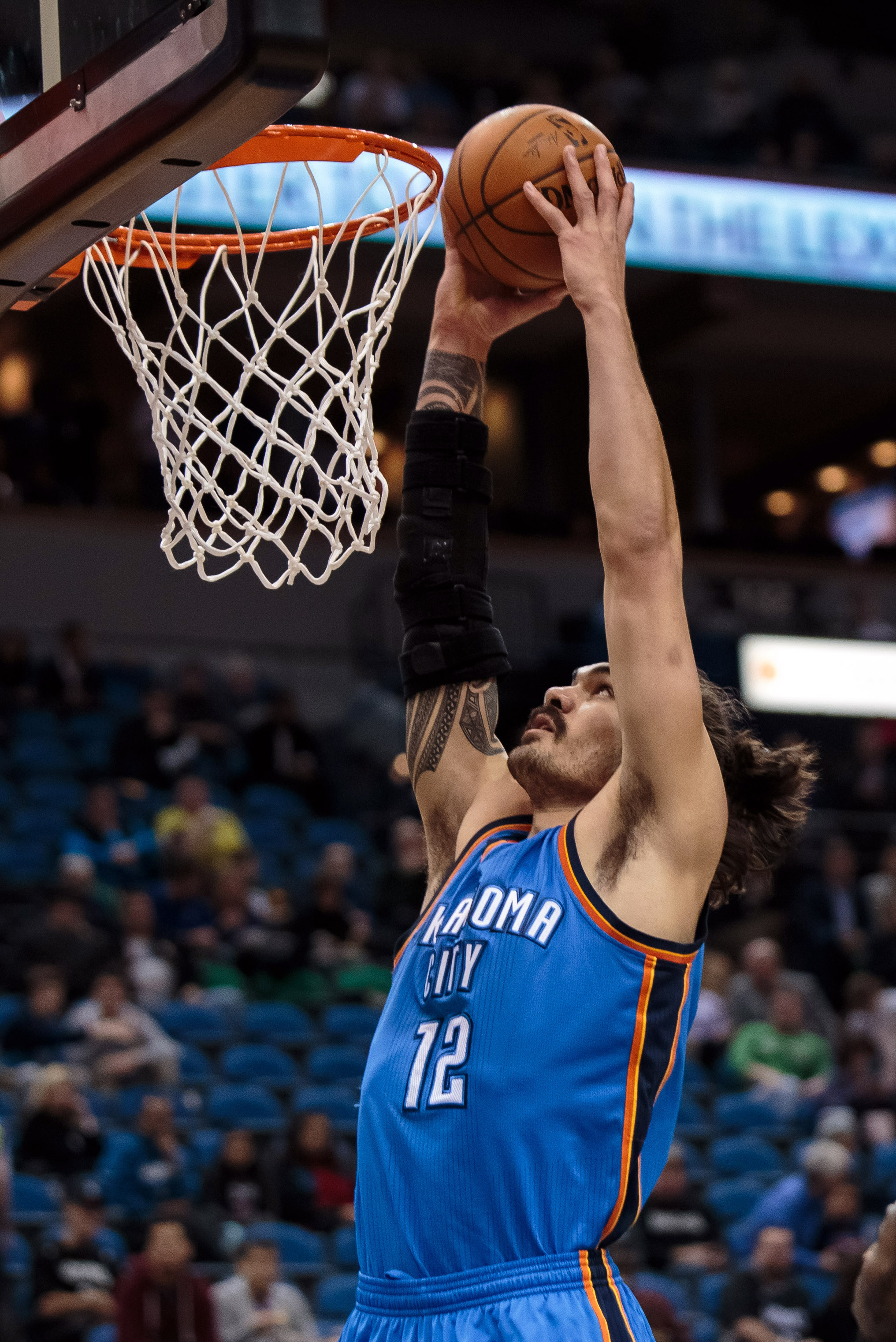
Arthur Hill of Hoops Rumors recently examined the case for a new contract for Victor Oladipo, who arrived in Oklahoma City as a part of the Serge Ibaka trade and is entering the final year of his rookie deal. Like Oladipo, Andre Roberson is also extension-eligible for the first time this offseason, as his rookie contract nears its end. With Kevin Durant no longer a member of the Thunder, the team figures to rely on Oladipo and Roberson to take on larger roles in the short term than they otherwise would have, and may be counting on them to be long-term pieces as well.
[RELATED: Players eligible for rookie-scale extensions]
With Westbrook locked up though, the title of the Thunder’s most important extension candidate now belongs to Steven Adams. A former lottery pick, Adams single-handedly salvaged the James Harden trade for Oklahoma City, and has evolved into one of the NBA’s more steady and reliable centers.
In 2015/16, Adams averaged a modest 8.0 PPG to go along with 6.7 RPG, 1.1 BPG, and a .613 FG%. Those numbers aren’t eye-popping, and his career .551 FT% is a cause for some concern. However, Adams’ showing in the postseason provided a better picture of his importance to the Thunder. In 18 playoff games, the New Zealand native saw his minutes per game increase from 25.2 to 30.7, and he nearly averaged a double-double in those contests, with 10.1 PPG and 9.5 RPG.
Durant’s departure means that there will be a few more shots to go around on offense, and the loss of Ibaka will put more pressure on the Thunder’s remaining interior defenders, so the franchise may be expecting a major step forward from Adams on both ends of the floor. The former University of Pittsburgh standout just turned 23 last month, so his best years should still be ahead of him, and he’s in a great position to have a breakout season in 2016/17. Which raises the question: Should the Thunder lock him up now to avoid having him reach restricted free agency next summer?
To answer that question, it’s worth considering what an extension for Adams would cost. A huge 2016/17 season would certainly make him a lock for a maximum-salary deal next July, but given the jump the salary cap took this year, and the free agent prices we saw last month, Adams may not even need to take a significant step forward this season to be worth the max — that may already be his price, given how valuable young rim protectors are. With so many teams opening up significant chunks of cap room every summer, Adams likely wouldn’t have any trouble finding a max offer next year.
If the Thunder assume it will take a max deal to lock up Adams, there are plenty of arguments for waiting until next summer to complete an extension. First and foremost, the former 12th overall pick would have a cap hold worth just below $8MM as a restricted free agent. As we saw with the Pistons and Andre Drummond – as well as the Wizards and Bradley Beal – keeping an RFA’s cap hold on the books for a little while, having already agreed to a max deal with that player, allows a team to maintain significant cap flexibility and pursue other free agents.
The NBA’s most recent salary cap projection for 2017/18, which is probably a little on the cautious side, would result in a max salary for Adams starting at around $24MM. In other words, Oklahoma City would give up $16MM+ in potential salary cap space at the start of free agency by extending Adams this offseason rather than waiting until next summer to make things official.
[RELATED: NBA’s 2017/18 salary cap projection dips to $102MM]
For a team that has aspirations of pursuing a major free agent such as Oklahoma native Blake Griffin, that extra cap room could be a huge factor. Depending on how optimistic the Thunder are about landing a big-time free agent, the team could hold off on new deals for Adams, Oladipo, and Roberson in order to maximize 2017’s cap flexibility. Waiting on extensions would also alleviate some risk for the team — OKC wouldn’t want to see a newly-extended player suffer a major injury or take a huge step backward in 2016/17, before that new deal even goes into effect.
Of course, as much as it might make sense from a roster-building perspective for the Thunder to wait until July to lock up Adams, the team must also be cognizant of how things transpired this summer with Durant. Adams would be a restricted free agent in 2017, so the Thunder wouldn’t risk losing him to a rival suitor as long as they’re willing to offer the max. But Durant’s departure means the franchise may want to redouble its efforts to make its own core players feel secure.
Westbrook’s extension, which gave him a pay increase of about $9MM for the coming season, was a solid start. Getting something done with Adams before they have to do anything might be the next step for the Thunder. It would be a show of good faith for a player who is extremely important to the franchise, and perhaps it would pay dividends down the road — Adams or another star player might factor the club’s willingness to take care of its own into a future free agent decision. And if Adams is willing to compromise by taking a slight hometown discount this fall, that’s all the more reason for OKC to work something out sooner rather than later.
Barring a significant change of direction for the franchise, there’s little doubt that Adams will remain with the Thunder beyond this season, and he’ll likely stick with the team for a few more years. But when and how the two sides finalize his next contract will be fascinating to watch. Signing Adams to a big-money extension this offseason would severely limit the Thunder’s ability to be major players in next summer’s free agency, barring an Enes Kanter trade. But for a team that just lost the longtime face of its franchise, locking up core players sooner rather than later could be a stronger priority than usual this fall.
Photo courtesy of USA Today Sports Images.
Poll: 2008 NBA Draft Take Two (Pick No. 6)
Scouting players and predicting how their skills will translate to the NBA is one of the more difficult tasks front offices have on their plates. Looking back over past drafts and how many lottery picks never evolved into stars, or even made a significant impact in the league, illustrates just how often stats, combine numbers and pure gut instinct often come up short.
Of course, we get the opportunity to critique these moves with the benefit of hindsight — a luxury that GMs don’t have on draft night. Having said that, it’s still fun to go back in time and take a theoretical look at how these drafts should have/could have gone.
We recently finished revisiting the lottery portion of the 2005 NBA Draft, which was one of the weakest in recent memory. In drafts light on impact talent, the GM who can find a diamond in the rough is king. But drafts that have a number of star-potential players can also be difficult and many an executive has made what turned out to be the wrong call. Greg Oden over Kevin Durant immediately springs to mind (sorry Blazers fans), likewise taking Sam Bowie over Michael Jordan…ouch!
The 2008 draft, which is the one we’re tackling now, had a number of players who have gone on to post big numbers in the league. This was the year of Derrick Rose (No. 1 overall), Russell Westbrook (No. 4), Kevin Love (No. 5), Brook Lopez (No. 10) and Nicolas Batum (No. 25). Over the next few weeks, we’ll be posting a series of polls asking readers to vote on whom teams should have selected in each spot.
We’ll continue with the Knicks, who held the No. 6 overall pick that year. In the “real world” draft, New York fans rained down boos on Madison Square Garden when Danilo Gallinari was announced as the Knicks’ selection. He has gone on to a productive NBA career, though his best years have come in Denver, so this was one time where the scouts got it right.
So cast your vote for who the Knicks select and check back on Thursday to see the results and to vote on who the Clippers will nab seventh overall. Also, don’t limit yourself to a simple button click. Take to the comments section below and share your thoughts on the pick and why you voted the way that you did. Also, if I fail to list a player who you think should be selected, feel free to post that in the comments section and I’ll be certain to tally those votes as well.
- Bulls — Russell Westbrook [Actual Pick — Derrick Rose]
- Heat — Kevin Love [Actual Pick — Michael Beasley]
- Wolves — Derrick Rose [Actual Pick — O.J. Mayo]
- Sonics/Thunder — DeAndre Jordan [Actual Pick — Russell Westbrook]
- Grizzlies — Brook Lopez [Actual Pick — Kevin Love]
- Knicks — ? [Actual Pick — Danilo Gallinari]
With the No. 7 Overall Pick, the Clippers Select...
-
Nicolas Batum 45% (697)
-
Goran Dragic 18% (272)
-
Danilo Gallinari 10% (147)
-
Eric Gordon 5% (75)
-
George Hill 3% (53)
-
Ryan Anderson 3% (45)
-
Robin Lopez 3% (43)
-
Roy Hibbert 2% (35)
-
O.J. Mayo 2% (25)
-
JaVale McGee 2% (24)
-
Michael Beasley 1% (22)
-
Courtney Lee 1% (17)
-
Nikola Pekovic 1% (14)
-
Mario Chalmers 1% (14)
-
Timofey Mozgov 1% (9)
-
Omer Asik 1% (8)
-
Anthony Randolph 1% (8)
-
Joe Alexander 0% (6)
-
Jason Thompson 0% (5)
-
Kosta Koufos 0% (5)
-
Brandon Rush 0% (4)
-
Brian Roberts 0% (3)
-
Marreese Speights 0% (2)
-
D.J. Augustin 0% (2)
-
Anthony Morrow 0% (2)
-
Jerryd Bayless 0% (1)
-
J.J. Hickson 0% (0)
Total votes: 1,538
If you’re a Trade Rumors app user, click here to vote.
Community Shootaround: Comebacks
Fans who want to watch Ray Allen, Ben Gordon, Stephen Jackson and Baron Davis play again may not have to wait for the NBA to bring back its Legends Game.
They are among several former stars who have stated that they want to return to the league, and they’re not even the most surprising names on the list. Derek Fisher, who already has a season and a half of coaching experience, is talking about playing again, as is Kwame Brown, who was the NBA’s top draft pick way back in 2001.
Maybe it’s the money or the lifestyle or the atmosphere in the locker room that they miss. Maybe they’re convinced they can still contribute something to a contending team or maybe they just want one last chance to build on their legacies. Or maybe they’re inspired by what Metta World Peace did a year ago.
The former Ron Artest seemed as much of a longshot to make an NBA roster as any of these other guys when he showed up in the Lakers’ training camp last September. He sat out all of 2014/15 and didn’t play much with the Knicks the season before that. But at age 35, he won a spot on L.A.’s roster with a partially guaranteed contract, then lasted the entire season to earn every penny of his $1,499,187 contract. Like the players mentioned above, World Peace hopes to be back in the league next season.
Are any of these other comebacks realistic? Let’s examine them case by case.
- Allen never announced his retirement; he just stopped playing after the 2014 NBA Finals. There have been rumors before that he was returning, but recent talks with the Celtics and Bucks show there is interest in the 41-year-old shooting guard, who holds the regular season and playoff records for most 3-pointers made.
- Gordon last played in 2014/15, when he appeared in 56 games as a reserve for the Magic. At age 33, he is considering overseas offers as he tries to work his was back into the NBA.
- Jackson, 38, has been out of the league for two seasons and only played nine games for the Clippers in 2013/14. Nevertheless, he said earlier this summer that he was talking to the Warriors about joining their training camp and recently claimed that Jimmy Butler and Rajon Rondo want him to come out of retirement and play for the Bulls.
- Davis has been away from the league since 2012 and has been on a highly publicized comeback trail for a couple of years. The 37-year-old spent time with the Delaware 87ers at the end of last season, but recently said he doesn’t want to pursue the D-League route again.
- After turning 42 earlier this month, Fisher is the oldest of the comeback candidates. The former Knicks head coach, who compiled a 40-96 record, will consider playing in China if he can’t find an interested NBA team.
- Brown’s last significant NBA job was 66 games with Charlotte in 2010/11, although he had brief stints with the Warriors and Sixers after that. At 34, Brown recently signed with a new agency and is also considering opportunities overseas.
That brings us to tonight’s question: Do you expect to see any of these players be in the NBA next season, and can any of them be productive at their current ages? Take to the comments section below to share your thoughts and opinions on the topic. We look forward to what you have to say.