
Roster Moves Required Soon For Kings, Warriors
NBA teams are generally required to carry at least 14 players on standard contracts. However, league rules allow clubs to dip below that minimum for up to two weeks at a time and for up to 28 total days in a season.
Currently, two teams are operating with fewer than 14 players on their 15-man rosters and will soon have to sign a free agent or promote a two-way player to a standard contract to avoid violating that rule. Those teams are as follows:
Sacramento Kings
The Kings first dropped below 14 players on February 3, when they completed their De’Aaron Fox trade. That deal saw them send out three players and acquire only two in return.
Sacramento got back to the 14-player minimum 10 days later, when Markelle Fultz signed with the team on February 13, before dipping back to 13 on February 18, following the expiration of Daishen Nix‘s 10-day contract.
The Kings remained below the 14-player minimum until 13 days later, when Skal Labissiere signed a 10-day contract on March 3, then once again went below the minimum on March 13 after Labissiere’s deal expired.
As a result of that series of roster moves, Sacramento is fast approaching its 28-day maximum for the season and will be required to re-add a 14th man by the middle of this week (by our count, the deadline is March 18). If the club exhausts its full 28 days below 14 players, it won’t be able to go below that minimum again this season.
Golden State Warriors
Like the Kings, the Warriors fell below 14 players on standard contracts for the first time this season as a result of a blockbuster deadline deal. In Golden State’s case, it was the February 6 move for Jimmy Butler, which required the club to send out four players.
The Warriors signed Kevin Knox and Yuri Collins to 10-day contracts on February 19, 13 days later, to reach the 14-player minimum. When those deals expired on March 1, Golden State re-signed Knox immediately, but let Collins go. As a result, the team was below 14 players for three days, until Pat Spencer was promoted to the standard roster on March 4.
After seven more days at the 14-player minimum, Golden State has been operating below that threshold since March 11, when Knox’s second 10-day contract expired. So the clock is once again ticking on the Warriors, who have another week to add a 14th man if they intend to exhaust their full 28-day allowance (by our count, their deadline is March 23).
Knox looks like the top candidate to return at that point on a rest-of-season contract, but that’s just my speculation — it hasn’t been reported. It’s worth noting that the Warriors will soon have the ability to fill both their 14th and 15th spots with rest-of-season signings while staying below their hard cap, so if Knox fills one of those two openings, the team will still be able to add a second player before the end of the regular season.
Clippers’ Norman Powell Returning From Hamstring Injury
Clippers wing Norman Powell will be available for Sunday’s game against the Hornets in Los Angeles, head coach Tyronn Lue told reporters today (Twitter link via Justin Russo).
Powell missed five games due to a left knee injury coming out of the All-Star break, then returned to action on March 2. However, he played just nine minutes in that contest before exiting due to a right hamstring strain that has kept him on the shelf for the past seven games. If he’s able to stay healthy through the final buzzer on Sunday, it will be the 31-year-old’s first full game since February 13.
Powell has had a career year for the Clippers in 2024/25, with averages of 23.8 points, 3.5 rebounds, and 2.2 assists per game and a .494/.424/.821 shooting line across 46 outings (33.0 MPG). He’s the team’s leading scorer and helped keep the offense afloat when Kawhi Leonard was out during the first half of the season.
Powell had been viewed for most of the year as one of the league’s leading candidates for Most Improved Player honors, but his recent injury absences, along with a few missed games earlier in the season, have cost him a shot at earning that award. Even if he plays in every game remaining on L.A.’s schedule, Powell will fall shy of the 65-game requirement for award consideration.
According to Clippers sideline reporter Lauren Rosen (Twitter link), Powell will reclaim his spot in the starting lineup on Sunday. He’ll presumably replace Kris Dunn, who will be unavailable due to left knee soreness.
Pistons’ Bickerstaff ‘Disgusted’ By Officiating In Loss To OKC
Pistons head coach J.B. Bickerstaff ripped into the officiating crew on Saturday in his post-game media session following a six-point loss to the Thunder, as Omari Sankofa II of The Detroit Free Press writes. Bickerstaff told reporters that he was “extremely proud” about how his team competed, but was “disgusted” by the way the game was officiated.
“The level of disrespect was above and beyond,” the Pistons’ coach said (YouTube link). “They have a guy fall down and trip on his own teammate’s foot, they review us for a hostile act. They throw an elbow to our chest/neck area, I ask them to at least take a look at it. Just show us the respect to take a look at it. No one would take a look at it. The disrespect has gone on far enough and I’m not going to allow our guys to be treated the way they were treated tonight.”
During the sequence Bickerstaff was referring to, the referees reviewed a relatively mild Isaiah Stewart loose-ball foul to see if it constituted a “hostile act.” The infraction was eventually ruled a common foul, but the Pistons were hit with three technicals – two and an ejection for Cade Cunningham and one Dennis Schröder – following that replay review for arguing with the officiating crew.
Crew chief Brian Forte explained to a pool reporter after the game that Cunningham repeatedly used “profanity” toward an official, while Schröder was given a tech for “continuous complaining” after the Pistons had received a team warning.
Bickerstaff and Pistons wing Ausar Thompson were also hit with technical fouls earlier in the game.
“I tried to have a conversation with an official, the official is arguing with (Thunder head coach) Mark (Daigneault), I say his name one time and he screams at me and tells me that’s enough,” Bickerstaff said, per Sankofa. “We understand that we play a style of ball that’s physical, it’s on the edge. I coach my ass off in a passionate way, I’m into the game, our players are into the game. We understand that.
“But we deserve a level of respect because we’re competing our tails off and bringing something positive to this league. We’re growing young players, our young players are competing their tails off. The least that they can do is give us the same respect that everybody else in this league gets and get refereed the same that everybody in this league gets reffed,” Bickerstaff continued, repeatedly and forcefully slamming his hand on the table for emphasis. “And enough is enough of it. What you saw tonight was disgusting. It was a disgusting display of disrespect towards our guys and what we’re trying to do.”
The Thunder made 17-of-22 free throw attempts on the night, compared to 9-of-13 for the Pistons — that disparity made the difference in a game that Oklahoma City won by a score of 113-107.
Asked in his own post-game media session about Bickerstaff’s comments, Daigneault said he advised his team before tip-off that the officiating crew, based on the Thunder’s research and referee analytics, was unlikely to call a ton of fouls.
“That referee crew was the loosest whistle coming into the game that we’ve seen all season, in terms of how little they call,” he said (Twitter video link via Joel Lorenzi of The Oklahoman). “So we knew, we told the guys before the game, ‘This is going to be a physical game because it’s Detroit and they’re not going to call very much.’ That bore out, I thought, with the amount of physicality they allowed in the game. I thought our guys did a great job of not getting distracted by anything.”
While the NBA hasn’t made an announcement yet, Bickerstaff seems likely to face a fine for publicly calling out the officials.
Dolan: Knicks’ Core ‘Going To Be Together For A While’
The Knicks‘ leaders at the management and ownership levels rarely speak to the media about the team, but owner James Dolan made an exception this week for a pair of podcast hosts within his organization, appearing on the Roommates Show, hosted by Jalen Brunson and Josh Hart (YouTube link).
As Stefan Bondy of The New York Post relays, Dolan expressed a willingness to be patient with the current Knicks core, making it clear that he believes continuity will be an important factor in maximizing the upside of the roster.
“We have a team that’s going to be together for a while,” Dolan said. “(President of basketball operations) Leon (Rose) has done a good job of lining up the contracts and everything else. So this isn’t our only season. We’re going to play a bunch of seasons together.
“You take a look at teams like Boston that have played together, they get to draw off of something that they built over that period of time. And for this team, that’s the challenge, really – today, going into the playoffs, etc. – is to build that inside of the team. Something we can draw on.”
The Knicks made significant changes to their roster during the 2024 offseason, sending a package heavy on future first-round picks to Brooklyn in exchange for Mikal Bridges, then completing a blockbuster deal in the fall to acquire Karl-Anthony Towns in exchange for a package headlined by Julius Randle and Donte DiVincenzo.
Entering the summer of 2025, Towns, Brunson, Hart, and OG Anunoby are all locked up for multiple seasons, and there’s hope that Bridges will sign an extension that pushes his current contract beyond its 2026 expiration date. Sizable contracts for those players will likely leave the organization operating in apron territory for the next few years, reducing New York’s ability to continue making significant major in free agency or on the trade market.
After advancing to the second round of the playoffs in each of the past two years, it will be a challenge for the Knicks to get any further than that this spring, given that it would likely mean upsetting the defending champion Celtics. However, Dolan expressed optimism about the group’s future, lauding Rose for the way he has put the roster together and indicating that the front office has his full support, along with full autonomy to continue making personnel decisions.
As Bondy notes, Dolan also admitted that the patient, hands-off approach he’s taking now hasn’t always been the management style he’s employed in the past.
“There were times when (we’ve) sort of reached for that shiny, sparkly object. ‘Maybe this is what we need.’ Especially when things weren’t going well,” he said. “‘Let’s bring in this guy and maybe he’ll turn it all around for us.’ Sometimes it’s players, sometimes it’s a coach.
“What I learned over time is that doesn’t work. It really doesn’t. You really have to do the fundamentals, the basics. You’ve got to build a team, you’ve got to build an organization. There is no waving a wand over a team and all of a sudden make it a great team. It doesn’t happen.”
Bucks Notes: Giannis, Porter, Sims, Kuzma, Bridgeman
The battle to be named the NBA’s Most Valuable Player this season has turned into a two-man race, with Shai Gilgeous-Alexander and Nikola Jokic considered the heavy favorites to earn the honor. But two-time MVP Giannis Antetokounmpo has been arguably just as productive this year as he was in the two seasons he won the award (2018-20), a fact that Bucks head coach Doc Rivers highlighted following Saturday’s victory over Indiana.
“It’s funny, I was talking to one of the better coaches in the league and he brought it up,” Rivers said, per Eric Nehm of The Athletic. “He said, ‘How the hell is no one talking about Giannis? He is doing different stuff. His assists keep going up. I mean, I don’t know what the guy has to do.'”
Across his two MVP seasons, Antetokounmpo averaged 28.5 points, 13.0 rebounds, 5.8 assists, and 1.3 blocks per game, with a 56.6% shooting percentage. Through 54 games this season, the star forward has put up 30.6 PPG, 12.1 RPG, 5.9 APG, and 1.2 BPG on 60.5% shooting.
“I’m not going to campaign (for him to be named MVP),” Rivers continued. “I’m not going to do that, but he is a forgotten guy with what he’s doing for our basketball team.”
Here’s more on the Bucks:
- The Pacers won four of five regular season games over Milwaukee a year ago, then knocked the Bucks out of the playoffs in the first round. The two teams currently hold the fourth and fifth spots in the East and could meet in the first round again this spring, so the Bucks recognized the importance of Saturday’s victory, which gave them the tiebreaker edge over Indiana, as well as a one-game lead in the standings. “Obviously, we wanted to get the tiebreaker,” Damian Lillard said, according to Nehm. “And a team that we’ve played so many times over the last two seasons, you know it’s going to be a physical game. It’s gonna be a competitive game … but we were able to pull it out, so that’s what really counts.”
- In a separate story for The Athletic, Nehm takes a look at how trade-deadline additions Kevin Porter and Jericho Sims are impacting the Bucks, writing that getting Porter’s ball-control issues in check is a priority. Entering Saturday’s game, the guard had committed multiple turnovers in nine consecutive games despite averaging just 15.6 minutes per night. “That’s non-negotiable,” Rivers said. “Especially late in the season, you just can’t turn the ball over. He knows that, but he’s still doing it right now. But we still want him to be aggressive.” Porter had 16 points and four assists with no turnovers in 19 minutes of action on Saturday.
- Of course, the Bucks’ biggest deadline addition was Kyle Kuzma. Jamal Collier of ESPN explores what Kuzma has brought to the team and why general manager Jon Horst believes that the forward’s versatility will make Antetokounmpo and Lillard more dangerous.
- As outlined in a report from The Associated Press, the Bucks are wearing patches on their jerseys for the rest of the season to honor Junior Bridgeman, the team’s minority owner and former player who died this past week.
LeBron James Expected To Miss At Least Another Week
Lakers star LeBron James is expected to remain sidelined for at least one more week as he continues to recover from a left groin strain, ESPN’s Shams Charania said today during an appearance on NBA Countdown (Twitter video link).
Charania first reported last Sunday that James’ groin ailment was expected to keep him on the shelf for a minimum of one-to-two weeks, so his latest report is consistent with that timeline.
According to Charania, James conducted an on-court workout on Sunday for the first time since sustaining the injury on March 8. However, the Lakers will be cautious with his return, Charania notes, given that it’s a soft-tissue injury and the 40-year-old has played significant minutes this season after participating in the Olympics last summer.
For what it’s worth, head coach J.J. Redick told reporters on Sunday that James is “ramping up” and is considered “day-to-day” (Twitter link via Mark Medina).
Los Angeles has struggled without James available in the past week. In addition to dropping the game in Boston in which he was hurt, the team has since lost road contests in Brooklyn, Milwaukee, and Denver as well. The Lakers are back in L.A. and will host Phoenix today to tip off a five-game home stand, which runs through next Saturday.
Although it sounds as if James will likely remain inactive for that entire home stand, there are some positive injury updates out of Los Angeles. Starting center Jaxson Hayes will be available vs. the Suns after missing four games due to a knee contusion, per the team. Dorian Finney-Smith (ankle) and Gabe Vincent (knee) are also available after being inactive on Friday in Denver.
Additionally, there’s optimism that Rui Hachimura, out since February 27 due to a knee issue of his own (patellar tendinopathy), will return within the week, according to Charania.
The 40-25 Lakers are in the midst of a battle to secure a playoff berth. They currently sit in fifth place in the Western Conference, 1.5 games back of the Rockets, Nuggets, and Grizzlies (all tied at 43-25) and two games ahead of the 39-28 Warriors.
Raptors Sign Colin Castleton To Second 10-Day Deal
12:16 pm: Castleton has officially signed his second 10-day contract with the Raptors, the team confirmed in a press release.
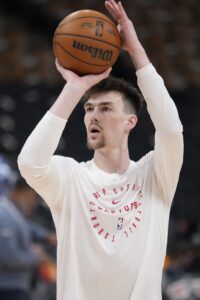 11:03 am: The Raptors are bringing back Colin Castleton on a second 10-day contract after his first 10-day deal expired overnight, league sources tell Michael Scotto of HoopsHype (Twitter link).
A 6’11” big man, Castleton has made five appearances thus far for Toronto, averaging 7.0 points, 8.6 rebounds, 2.4 assists and 1.0 block in 27.8 minutes per contest.
Castleton spent his rookie year on a two-way contract with the Lakers and was on a two-way deal with the Grizzlies for most of the first half of 2024/25. He was waived by Memphis in January.
Although Castleton didn’t have much of an NBA role for the Lakers or Grizzlies, he has been a productive player at the G League level since he went undrafted out of Florida in 2023. In addition to his time with L.A. and Memphis, the 24-year-old has also played for the Magic’s NBAGL affiliate in Osceola.
Toronto has an open spot on its 15-man roster, so no corresponding move will be necessary to make room for Castleton. His 10-day contract will pay him $107,027 and will carry an identical cap hit on the Raptors’ books.
Assuming the signing is completed prior to Sunday’s game at Portland, Castleton will be eligible to play five more games for the Raptors during his second 10-day contract, which will expire overnight on March 25. At that point, the Raptors will have to decide if they want to retain him for the rest of the season.
Warriors Notes: Kerr, Butler, Podziemski
Steve Kerr became the winningest coach in Warriors history following Saturday’s victory over New York, per Ohm Youngmisuk of ESPN.com. With his 558th regular season win, Kerr broke Al Attles‘ franchise record.
As Youngmisuk notes, Attles spent six-plus decades with the Warriors as a player, executive and coach. The Hall of Famer, who passed away in August, guided the club for 14 seasons, leading the team to its first championship in 1975. His family was on hand to present Kerr with the game ball after the victory.
“It was a great moment being awarded the game ball by the Attles family,” Kerr said. “It was really beautiful to be honored by their presence, and obviously Al Attles is Mr. Warrior forever. The record, it’s kind of surreal to even think that this could happen, but it’s a reflection of our organizational strength, stability and a talent level over the last 11 years since I’ve been here.
“I’m incredibly lucky to be part of this organization and part of this city and very humbled by the honor because of Al’s greatness and what he means to the franchise.”
Here’s more on the Warriors:
- Golden State is now 14-1 when Jimmy Butler is in the lineup. ESPN’s Brianna Williams takes a look Butler’s history of making an immediate impact with the teams he has played for.
- Butler has acted as more of a play-maker than a scorer since he joined the Warriors. His 11.0 field goal attempts per game with Golden State would be his lowest mark in 11 years, but he’s averaging 5.9 assists and only 1.4 turnovers per game, two of the best figures of his career. After Saturday’s victory, Butler suggested he’s been biding his time when it comes to scoring, as Anthony Slater of The Athletic relays (Twitter video link). “When it’s my time, you’ll know it’s my time,” Butler said. “Until then, I’m going to pass the ball to the open man, get my guys some jumpers, get them out in transition and we gonna keep winning.”
- Kerr said the Warriors are targeting Tuesday’s game vs. Milwaukee for Brandin Podziemski to return from the back issue that has cost him the past four games, Slater tweets. That means the second-year guard will miss his fifth straight contest on Monday against Denver.
Sixers Sign Chuma Okeke To Second 10-Day Contract
March 16: Okeke’s second 10-day contract with Philadelphia is now official, per the team.
March 15: Chuma Okeke, who played one game for the Sixers on a 10-day contract last month, will return to the team on another 10-day deal, sources tell NBA insider Marc Stein (Twitter link). Stein adds that Okeke will be available for Sunday afternoon’s game at Dallas.
The 26-year-old combo forward inked his first 10-day contract on February 7, but was waived after just six days when the team promoted two-way player Jared Butler to the 15-man roster. Okeke saw two minutes of action in his only appearance, finishing with no points and one rebound.
Apart from his brief NBA appearance, Okeke has spent the season with the Knicks’ G League affiliate in Westchester, averaging 18.0 points, 8.1 rebounds and 4.9 assists in 25 regular season games.
Okeke was mentioned as a potential addition for New York when the team became financially eligible to add a 15th player in late February. New York opted to sign P.J. Tucker to a 10-day deal instead.
The Sixers have a full roster, but they are able to make additions through 10-day deals under the hardship exception because they have several players who have missed at least three consecutive games and are expected to remain sidelined for at least two more weeks.
Free agent forward Oshae Brissett signed a 10-day hardship contract with the team on Friday. Assuming the Sixers don’t plan to release Brissett in order to sign Okeke, they’ll need to have at least five players who meet the hardship criteria in order to make a second 10-day signing. Joel Embiid, Eric Gordon, Jared McCain, Paul George, and Kyle Lowry may all fit the bill.
If Okeke’s deal becomes official on Sunday, he will be eligible to appear in six games before it expires on March 25. Players are limited to two 10-day contracts per team in a season, so the Sixers would have to give him a standard deal to keep him any longer.
Injury Notes: Washington, Ball, Thybulle, Kaminsky
Mavericks forward P.J. Washington is not listed on the injury report ahead of Sunday’s game vs. Philadelphia, so he appears on track to return after missing the past seven games with a right ankle sprain, tweets Christian Clark of The Athletic.
It’s certainly welcome news for Dallas, which has been absolutely devastated by injuries over the past several weeks. Even with Washington back, the Mavs will still be shorthanded, as Kyrie Irving (torn ACL), Olivier-Maxence Prosper (wrist surgery), Dante Exum (broken hand), Anthony Davis (left adductor strain), Dereck Lively (right ankle stress fracture) and Daniel Gafford (right knee sprain) are out.
Jaden Hardy is doubtful for Sunday’s game as he continues to deal with a right ankle sprain, while Kai Jones (left quad strain) and Caleb Martin (left hip strain) are questionable. Brandon Williams, who is on a two-way deal, is probable with left hamstring tightness, per the league’s official injury report.
Here are a few more injury notes from around the NBA:
- Bulls guard Lonzo Ball missed 15 games earlier in 2024/25 due to a right wrist injury. He reinjured the wrist at the end of February, causing him to miss the past seven games, and he’ll likely miss at least five more, as he didn’t travel with the team during its West Coast trip, writes Joe Cowley of The Chicago Sun-Times. “I haven’t heard anything about him being shut down,” head coach Billy Donovan said Saturday. “I think what he’s doing right now is just trying to get himself back to playing. Doctors aren’t saying, ‘Hey, listen, you gotta sit out.’ It’s just when he feels that he can do things on the court that he’s comfortable with. Like he can’t shoot right now, hasn’t been able to do that . . . passing and dribbling. Until that subsides, then he’ll be out, but I think he, in my conversations with him, it’s been everything to try to get back to playing. No one has said to me from above, ‘Hey, this goes on a little longer, we’re going to have him shut down.’ I have not heard that.”
- Trail Blazers wing Matisse Thybulle underwent a procedure in October, just before the start of the regular season, to address inflammation in his right knee. It wasn’t supposed to sideline him for a significant period, but he sustained a bad right ankle sprain in late November during his ramp-up process, which set back his recovery. “I’ve talked to so many people about it now, and the overarching sentiment is that with ankle sprains this bad, sometimes it’s better to just break it than to sprain it,” Thybulle said, per Sean Highkin of The Rose Garden Report (Substack link). “Because the recovery time with all the ligaments that were torn takes so long. With a bone, it can just heal back up and it’s just as strong. It was a whole process. And then to have it happen in conjunction with a different injury … You start with the knee, and then hurt the ankle as bad as I did, and have those things be married as one giant injury to be dealt with. It made it quite the process.” Thybulle was technically active for the first time this season on Wednesday vs. New York, but he didn’t end up playing. Head coach Chauncey Billups said the two-time All-Defensive member’s role is up in the air for the final 15 games of ’24/25, according to Highkin.
- Former NBA big man Frank Kaminsky, who spent training camp with Phoenix last fall before being cut, will miss the remainder of the NBA G League season, reports Blake Murphy of Sportsnet.ca (Twitter link). Kaminsky, who had been playing for the Raptors 905 until recently, is set to undergo arthroscopic surgery on his right knee.