
Injuries Slowing Down Jazz
- Early-season injuries have prevented the Jazz from showing how good they could be, contends Randy Hollis of The Deseret News. The team has played long stretches without George Hill, Gordon Hayward, Derrick Favors and Boris Diaw. In addition, Alec Burks hasn’t been on the court at all.
NBA D-League Assignments/Recalls: 11/22/16
Here are Tuesday’s D-League assignments and recalls from around the NBA:
- The Sixers have recalled Timothe Luwawu-Cabarrot from the D-League, according to a press release issued by the club. The first-round rookie helped the Delaware 87ers get past the Greensboro Swarm on Monday, contributing 14 points, six rebounds, and three steals.
- After sending him to the Salt Lake City Stars on Monday, the Jazz have recalled forward Joel Bolomboy from the D-League, the team announced today in a press release. Bolomboy scored nine points and grabbed 12 rebounds against the Oklahoma City Blue on Monday.
- The Nets have sent Chris McCullough back to the D-League, the team announced today. McCullough will get a chance to play for the Long Island Nets on Wednesday afternoon, then should be recalled to Brooklyn for the team’s Wednesday night game.
NBA D-League Assignments/Recalls: 11/21/16
Here are Monday’s D-League assignments and recalls from around the NBA:
6:00pm
- The Celtics assigned guard Demetrius Jackson to the Maine Red Claws, their D-League affiliate, the team announced. The 22-year-old has made just three appearances for Boston this season and is averaging 3.3 points and 1.0 rebound in 5.0 minutes per outing.
- The Sixers announced that they have assigned swingman Timothe Luwawu-Cabarrot to the Delaware 87ers, their D-League affiliate.
- Forward Danuel House was recalled by the Wizards from Delaware, where he was sent via the league’s flexible assignment rule, the team announced.
12:27pm
- The Rockets have recalled rookies Chinanu Onuaku and Kyle Wiltjer from the Rio Grande Valley Vipers, the team announced today (via Twitter). As Jonathan Feigen of The Houston Chronicle tweets, the duo likely won’t see any game action for Houston, but the Rockets’ D-League affiliate doesn’t play until Saturday, so it made sense to have them rejoin the NBA club.
- Rakeem Christmas has been recalled from the D-League, the Pacers announced today in a press release. Myles Turner and Kevin Seraphin are battling injuries, so Christmas could see some minutes for Indiana tonight against Golden State.
- The Jazz have assigned rookie forward Joel Bolomboy to the D-League, according to a team release. Bolomboy will suit up for the Salt Lake City Stars tonight in their game against the Oklahoma City Blue.
- Damian Jones has been assigned to Santa Cruz by the Warriors, according to Anthony Slater of The Bay Area News Group, who writes that the rookie center will continue his injury rehab in the D-League as he works toward his NBA debut.
- The Kings have sent first-round rookie Georgios Papagiannis back to the Reno Bighorns, tweets James Ham of CSNBayArea.com. Papagiannis has averaged 10.3 PPG, 6.7 RPG, and 2.3 BPG in three D-League contests so far this year.
NBA 2016/17 Dead Money: Northwest Division
The concept of “dead money” on a salary cap isn’t as common in the NBA as it is in the NFL, but it essentially functions the same way in both leagues. Dead money refers to the salary remaining on a team’s cap for players that are no longer on the roster.
For NFL teams, taking on a certain amount of dead money is a common practice, since signing bonuses affect cap hits differently, and big-money players are more likely to be released before playing out their entire contracts. That practice is less common in the NBA.
Still, with the NBA’s salary cap on the rise, teams may be a little more willing to part ways with players on guaranteed salaries, since that increased cap gives clubs more flexibility than they used to have. Within the last month, we’ve seen players like Ronnie Price and Greivis Vasquez, who each had $4-5MM in guaranteed money left on their contracts, waived in order to clear room for newcomers.
We’ve examined each of the NBA’s 30 teams, breaking them down by division, determining which teams are carrying the most dead money on the cap for 2016/17, and assessing what that might tell us about those teams. We’ve already examined the Central, Atlantic, Southeast, Southwest, and Pacific divisions. Today, we’ll turn our attention to the Northwest division to wrap things up.
Here are the 2016/17 dead money figures for the Northwest teams:
1. Minnesota Timberwolves
Total dead money: $9,360,305
Full salary cap breakdown
Only two NBA teams – the Sixers and Nets – are currently carrying more dead money on their 2016/17 salary cap than the Timberwolves. And like those other clubs, Minnesota remains below the salary floor, so those dead-money charges aren’t hurting the team too much. Kevin Garnett ($8MM) is responsible for most of the Wolves’ dead money, and if he had made his retirement decision earlier, the club could have stretched his cap hit across three years. Still, Minnesota may have chosen to apply the entire amount to this season’s cap anyway, since the club has excess cap room at the moment and won’t have to worry about KG’s charges after June. The rest of the Wolves’ 2016/17 dead money comes from Kevin Martin ($1.36MM).
2. Oklahoma City Thunder
Total dead money: $4,358,585
Full salary cap breakdown
The Thunder’s management of their cap has been interesting, as the team has been willing to waive players with guaranteed salaries, like Ronnie Price ($2.558MM) and Mitch McGary ($1.526MM). Oklahoma City was also fairly generous with its partial guarantees for camp invitees, such as Chris Wright ($100K), Kaleb Tarczewski ($75K), Alex Caruso ($50K), and Reggie Williams ($50K).
So it was a little surprising when the Thunder essentially dumped Ersan Ilyasova‘s $8.4MM salary in a trade with the Sixers earlier this month, opening up cap room and reducing their year-end salary bill, at the cost of a future conditional first-round pick. Perhaps Philadelphia simply coveted Ilyasova, but it’s worth keeping an eye on the Thunder the rest of the way to see if they do anything with that newfound cap room.
3. Portland Trail Blazers
Total dead money: $1,984,005
Full salary cap breakdown
Anderson Varejao‘s $1.984MM cap hit is the only dead money on the Trail Blazers’ books, and that contract was one worth taking on, since it landed Portland a future first-round pick. Still, the Blazers will likely do everything they can to avoid eating more salary this season. As it stands, the club is less than $500K from the tax line, so even replacing one minimum salary player with another could have major financial implications for the team.
4. Denver Nuggets
Total dead money: $1,380,431
Full salary cap breakdown
The Nuggets have several players contributing dead-money charges to their cap, ranging from Nick Johnson ($980K) to camp invitees like D.J. Kennedy ($50K) and Nate Wolters ($50K). Most recently, Denver waived Jarnell Stokes, who had a $150K guarantee, and the team likely won’t hesitate to continue rolling over its roster and eating salary if necessary — with only about $75MM in total salary on their books for 2016/17, the Nuggets currently sit well below the salary floor.
5. Utah Jazz
Total dead money: $275,000
Full salary cap breakdown
The Jazz have kept a very clean cap sheet for 2016/17, with their only dead-money charges coming in the form of partial guarantees for camp invitees — Marcus Paige ($125K), Quincy Ford ($75K), and Henry Sims ($75K). As a result, the team is more than $13MM under the cap, which come in handy, since George Hill and Derrick Favors are both eligible for extensions. With the ability to give either player a significant raise for ’16/17, the Jazz have a great opportunity to lock up one of those two players and keep them off the market, if they so choose.
Salary information from Basketball Insiders was used in the creation of this post.
Jazz Prioritizing Extension For Hill Over Favors?
Veteran contract extensions are rare, but when a team has cap room available to renegotiate a contract and give a player an immediate raise, they become much more viable. The Jazz are one team with the flexibility necessary to give an extension-eligible veteran a significant raise for 2016/17, and Utah has two candidates: Derrick Favors and George Hill. While Favors has been viewed as the more likely candidate to be extended this season, ESPN’s Marc Stein reports that Hill is believed to have emerged as the Jazz’s priority.
[RELATED: Five veteran extension candidates to watch]
Hill, acquired by the Jazz in a three-way trade with the Pacers and Hawks during the offseason, has only appeared in seven regular-season games for Utah so far, having been slowed by a right thumb injury. However, he has looked excellent in those seven games, averaging career highs in PPG (20.4), FG% (.541), 3PT% (.432), and several other categories.
According to Stein, the Jazz like Hill’s leadership qualities — the former Pacers point guard has more playoff experience than most of the other players on the team’s roster. The ESPN scribe also observes that, after locking up Rudy Gobert to a four-year extension last month, the Jazz may be focused on securing a key backcourt piece, rather than extending another big man like Favors. Additionally, Hill is in the final year of his deal, while Favors is under contract through 2017/18.
As our salary cap breakdown for the Jazz shows, Utah has in excess of $13MM in cap space available for 2016/17. The team could use that cap room to bump Hill’s $8MM salary up over $20MM, while tacking on additional years to his contract. While that may seem like an exorbitant price for the 30-year-old, he’s poised to be one of the best available point guards on the market next summer, particularly if Chris Paul, Stephen Curry, and Kyle Lowry all stay with their current teams, as is currently expected. A big year for Hill in 2016/17 would put him in line for a huge payday if the Jazz don’t extend him before then.
Teams can renegotiate veteran contracts up until February 28, so the Jazz have plenty of time to mull their decision. With Hill and Favors both dealing with injuries early in the season, it would be a surprise if the team rushed into a new agreement with either player. Of course, Utah could ultimately retain both players, but probably doesn’t have the cap flexibility to do more than one in-season extension.
Favors To Miss Time With Knee Injury
- Jazz power forward Derrick Favors will be sidelined “for a while,” coach Quin Snyder told Tony Jones of the Salt Lake Tribune (Twitter link). Favors was diagnosed with a bone contusion in his left knee on Wednesday. Trey Lyles will likely take Favors’ starting spot while he mends.
Derrick Favors Out Of Lineup
- Derrick Favors‘ MRI confirmed a bone contusion on his left knee and he won’t play for the Jazz in Thursday’s game, according to the team’s website. Utah didn’t provide a concrete timetable for Favors’ return.
Heat Notes: McRoberts, Williams, Joe Johnson
The Heat are moving to Plan B after a 2-6 start, with greater roles for Josh McRoberts and Derrick Williams, writes Ira Winderman of The Sun-Sentinel. McRoberts hadn’t played at all before Saturday, and Williams, one of the team’s many offseason additions, had seen just three minutes of action. Luke Babbitt, who has started every game, was benched early along with Dion Waiters. It’s likely that coach Erik Spoelstra will keep tinkering, as Miami fell to Utah even with the changes. “I really like these guys in the locker room we have, and we’re a hard-working group,” McRoberts said. “We’ll continue to figure it out. But it’s really hard to win an NBA game and we can’t forget that as we come together here early. I know it’s tough. I’m the last guy that wants to say that. I want to win every game. But I think we just have to continue to keep working and keep fighting together.”
There’s more news out of Miami:
- Spurs coach Gregg Popovich, whose team faces the Heat Monday night, offered some advice on how to rebuild after the losses of Dwyane Wade and Chris Bosh, Winderman relays in a separate story. San Antonio was in the same situation with an aging roster, but was able to stay competitive by trading for Kawhi Leonard and signing LaMarcus Aldridge. “We’ve had to do that over the years with Manu [Ginobili] and Tony [Parker], and then making the trade for Kawhi before LaMarcus, because we knew we had to have more size at that three position,” Popovich said. “So we were able to get that done. And then obviously LaMarcus and now Pau [Gasol]. It’s as much about the pieces that go around those guys as anything.”
- Jazz swingman Joe Johnson, who finished last season in Miami, told Manny Navarro of The Miami Herald that he would have been interested in staying if the organization hadn’t opted for a youth movement. “There was [interest on my part to come back], but nobody who was 30 and up was coming back,” Johnson said. “I saw that early in free agency. So, for me, there was nothing to talk about [with the Heat in free agency]. My stint here was very brief. I appreciated it, but I knew where they were trying to go once free agency started.”
- Free agent addition Wayne Ellington is getting closer to making his Heat debut, Navarro writes in the same piece. The shooting guard has been out of action since suffering a severe right bruise on his left quad in the team’s last preseason game. There’s still no timetable for him to come back, but he has started running in a pool and may be cleared to run on the court this week. “Everybody I talked to said it was the worst contusion they’ve ever seen,” Ellington said. “That came from a few doctors. I knew it was bad, and I knew it was going to take some time to get right. But they’re also telling me they’re surprised how fast I’m healing from it.”
Five Veteran Extension Candidates To Watch
As we discussed earlier this year when we identified the veteran players eligible for contract extensions, the limits imposed on veteran extensions by the NBA’s Collective Bargaining Agreement make such deals rare. Teams are afforded plenty of cap flexibility to finalize rookie-scale extensions for fourth-year players, but that same flexibility doesn’t exist for veteran extensions.
While the league’s new CBA is expected to reduce this figure, players currently have to wait for three full years after signing their contract to renegotiate and/or extend it. Most veteran NBA contracts don’t run for more than three years to begin with, which means the pool of players eligible to extend their deals are small.
Additionally, even players who are eligible for a veteran extension often choose to wait until free agency, since there is little incentive to complete an extension early. Over-the-cap teams can extend veteran contracts, but can’t accommodate significantly renegotiated salaries for the current season — a club must have the cap room necessary to give a player a big raise in 2016/17. Plus, veteran extensions can cover no more than three new seasons (four total).
So, for a player like Blake Griffin, who is extension-eligible in the final year of his contract, it doesn’t make sense for him to re-up now with the over-the-cap Clippers. Even if he wants to re-sign with Los Angeles, he would be eligible for more years and larger salaries if he waits until next July to work something out with the team.
In other words, for a player to be a realistic candidate for a veteran contract extension before next summer, he must meet one of the following criteria, in addition to having signed his current deal at least three years ago:
- His team has sufficient cap room to give him an immediate raise. This applies to guys like Russell Westbrook and James Harden, who added an extra year or two to their deals earlier this summer in exchange for getting a big pay bump in 2016/17.
- He won’t receive a major raise in free agency anyway. Given the rising salary cap, this doesn’t apply to many players in their prime, but guys nearing the tail end of their careers could be happy to settle for a small raise rather than rolling the dice on a bigger payday in free agency.
With those criteria in mind, let’s take a look at five players who are viable candidates for veteran extensions in 2016/17…
Derrick Favors (Jazz)
Contract: $11,050,000 salary in 2016/17; UFA in 2018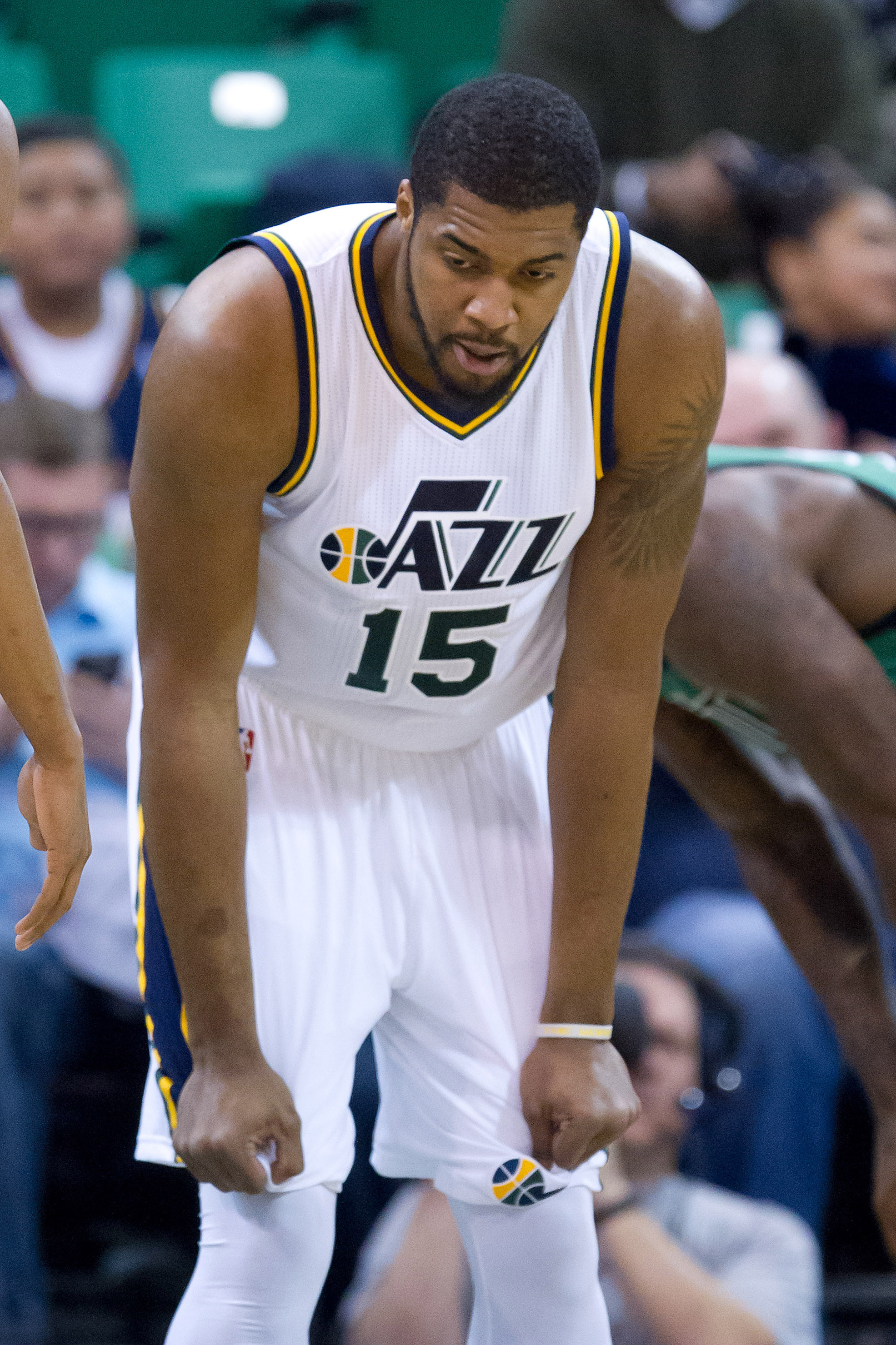
Favors is perhaps the most obvious extension candidate on our list. The Jazz are still below the salary floor, meaning the team has more than enough cap room to give him a raise all the way up to the maximum. Favors is also still two years away from free agency, so the opportunity to get significant pay increases for the next two years should make him very willing to add a couple more years of team control for Utah.
Still, this is no lock to happen. The Jazz won’t be overly motivated to simply hand Favors a maximum salary when there’s no pressure to do so quite yet, so he’d probably have to take a little less for the team to pull the trigger. If he wants a short-term raise, it makes sense to go for it. If he wants to wait another year, he’d be eligible for a higher max in 2017/18, and the Jazz might feel a little more pressure to get something done at that point, since it’d be a contract year for the big man.
George Hill (Jazz)
Contract: $8,000,000 salary in 2016/17; UFA in 2017
Of course, the Jazz’s talks with Favors are also complicated by the fact that the club has another strong candidate on its roster for a renegotiation and extension. Hill hasn’t been with the team for very long, but he’s made a great early impression. If Utah isn’t confident in handing the reins to Dante Exum next fall, reaching a new agreement with Hill would make a lot of sense.
As is the case with Favors, the Jazz have more than enough cap flexibility to offer Hill a big raise right away. However, the team’s current cap room (about $14MM) won’t be enough to accommodate significant renegotiations for both players. If each of them have interest in getting something done during the season, Utah would have a choice to make, and I imagine the team would lean toward Favors.
Paul George (Pacers)
Contract: $18,314,532 salary in 2016/17; Can opt out in 2018
I took a more extensive look at George’s situation back in September, so I won’t spend long re-hashing those points. As I explained at that time, the Pacers would be happy to get a max deal done sooner rather than later, but there are pros and cons for George, so it will come down to what he wants.
It certainly wouldn’t be a bad choice for George to sign a deal immediately if he wants to secure an immediate raise – which the Pacers have the cap room to give him – and shut down any speculation about a possible departure from Indiana. But there are reasons why it makes sense to wait too, and with the team off to a sluggish start, it seems that’s what he’ll do for now.
Derrick Rose (Knicks)
Contract: $21,323,252 salary in 2016/17; UFA in 2017
Rose is the first player on our list whose team is over the cap, meaning he wouldn’t get a raise this season if he were to work out a new deal with the Knicks. Still, he’s already on a maximum-salary contract, and even though he’ll be eligible for a much higher max next season (approximately $29MM based on current cap projections), there’s certainly no guarantee he’ll get those kind of offers on the open market.
The Knicks haven’t had a reliable, long-term starter at point guard for quite some time, so if things go well with Rose this year, they could make an effort to lock him up before he reaches free agency. The team could offer up to three additional years, with a 2017/18 starting salary worth up to nearly $23MM.
Ersan Ilyasova (Sixers)
Contract: $8,400,000 salary in 2016/17; UFA in 2017
It’s absolutely premature to consider Ilyasova an extension candidate in Philadelphia. The veteran power forward has been traded four times since signing his current contract, suggesting teams are more likely to move on from him than to want to lock him up.
Still, indications out of Philadelphia when the Sixers acquired Ilyasova last week were that they like how he fits on their roster, providing some much needed outside shooting and helping the club stretch the floor. In his first four games with the Sixers, he has averaged 12.8 PPG and shot 42.1% from three-point range — the sample size is minuscule, but those would be his best averages since 2012/13.
If Ilyasova continues to play well as a Sixer, a contract like the three-year, $30MM deal signed by Mirza Teletovic this summer looks like a reasonable goal for him, and Philadelphia could certainly afford something like that. It’s more likely that they’ll let him reach free agency, but if they like what they see this season from Ilyasova, the 76ers could at least explore what sort of deal it would take to keep him off the market.
Photo courtesy of USA Today Sports Images.
George Hill Will Leave Contract Talk To GM, Agent
George Hill was involved in one of the offseason’s biggest trades, a three-way deal that sent him to the Jazz in exchange for the 12th overall pick. So far, he’s thrived in what he describes as a great situation in Utah, telling Michael Scotto of Basketball Insiders that he has the ball in his hands much more than he did in Indiana.
“I have the coach’s green light to be aggressive and take shots,” said the Jazz’s starting point guard. “Not saying I didn’t have the green light in Indy, so no disrespect to the coach there, but it’s a little different. When I have the ball in my hands a lot more, I’m not in the corner a lot, just taking advantage of the opportunity that’s given to me.”
Hill is eligible for an extension this season, and for unrestricted free agency in 2017, but even with his stock seemingly on the rise, he tells Scotto that he’s not thinking about his next contract right now: “I’m going to let [Jazz GM] Dennis Lindsey and the front office handle that and my agents. My focus is just to play basketball and try to get us to the playoffs.”
- Former Jazz point guard Marcus Paige, who is one of just three 2016 draft picks who was waived by the team that selected them, admits that he wasn’t surprised about landing in the D-League and discusses his goals for his time with the Salt Lake City Stars (Twitter link via Aaron Falk of The Salt Lake Tribune).