
Draft Decisions: Amini, Ishchenko, Ferrari, Suigo
Iranian forward Mohammad Amini will keep his name in the 2026 NBA draft, agent Xavier Severin tells Jonathan Givony of DraftExpress (Twitter link). Saturday at 5:00 pm ET was the league’s official withdrawal deadline for international early entrants.
Amini, 21, has spent the past four seasons playing for Monaco and Nancy Basket in France’s top domestic league, the LNB Élite. He averaged 7.8 points, 4.1 rebounds, and 1.8 assists on .500/.265/.625 shooting splits in 27 games (22.6 minutes per contest) in 2025/26.
Here are a few more notes on international early entrants:
- Vsevolod Ishchenko is also staying in the draft, agent Alex Saratsis tells Givony (Twitter link). The Russian wing averaged 8.7 PPG, 4.6 RPG, 2.0 APG and 1.3 SPG on .506/.451/.781 shooting in 48 games (23.6 MPG) this past season for Lokomotiv Kuban. He’s ranked 60th on ESPN’s big board, making him a potential second-round pick.
- Italy’s Francesco Ferrari has withdrawn from the draft after gauging the interest from NBA teams ahead of Saturday’s deadline, according to BasketNews contributor Orazio Francesco Cauchi (Twitter link). Ferrarri, who reportedly interviewed with the Pistons, Hawks and Bucks, played for Virtus Bologna in the Lega Basket Serie A last season, averaging 4.4 PPG and 2.2 RPG in 11 games (10.2 MPG).
- Italian center Luigi Suigo, who withdrew from the draft and committed to playing for Villanova next season, discussed his decision in a recent interview with Sky Sport, as Iacopo De Santis of Pianeta Basket relays. “Unfortunately, two or three days before the draft combine, I sprained my ankle in practice. I couldn’t participate in the drills, which I believe would have significantly raised my draft stock,” Suigo said in part. “I did a few workouts; I trained with the Wizards, Spurs, and Celtics. They went well. My plan was to remain in the draft if I had a guarantee of being selected within the top 20 picks. I have a lot of confidence in myself. And now, the important thing is to work hard. Villanova will be a place where I can do that very well. [If I had stayed in the draft] I could have remained in the first round, possibly with Boston (No. 27). But I don’t want to rush things. I decided to get an extra year of development, and to declare again next year for a higher pick. The earlier you are drafted, the more a franchise is committed to your development.”
- As our early entrant tracker shows, Serbian center Pavle Backo is the only international prospect we haven’t seen an update on regarding whether he stayed in or withdrew from the draft. The NBA figures to reveal its official list of early entrants within the next few days.
2026 NBA Offseason Preview: Boston Celtics
After winning their 18th title two years ago, the Celtics decided to run back the same core roster to try to defend their title in 2024/25, operating over the restrictive second tax apron to do so. A mysterious ailment caused Kristaps Porzingis' significant issues in the second half of that campaign, but Boston still entered last year's playoffs with an excellent 61-21 record and the team was considered to be on a short list of legitimate contenders.
After beating Orlando in a physical first-round matchup, the Celtics were upset by the 51-31 Knicks in a six-game second-round series. Disaster struck in Game 4, when star forward Jayson Tatum tore his Achilles tendon in the fourth quarter of a game Boston ultimately lost to fall behind 3-1 in the series.
Boston's unwillingness to be further hamstrung by the second apron led to the moves president of basketball operations Brad Stevens made last summer, when he traded Jrue Holiday's long-term deal for the expiring salary of Anfernee Simons (we'll circle back to him shortly) and sent Porzingis to Atlanta in a deal that brought back Georges Niang, who was subsequently flipped to Utah.
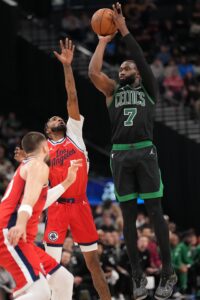 The cost-cutting maneuvers, combined with Tatum's injury, contributed to an outside perception that the Celtics wouldn't necessarily be upset if 2025/26 ended up being a "gap year." They were projected to win 42.5 games by sportsbooks, yet they wound up going 56-26, far exceeding external expectations and earning Joe Mazzulla a Coach of the Year award.
Boston's season was highlighted by the play of Jaylen Brown, who thrived as the primary offensive option with Tatum sidelined; the emergence of Neemias Queta as a starting-caliber center; another strong season from Payton Pritchard; the heady two-way play of Derrick White, who was named first-team All-Defense but struggled throughout 2025/26 with his outside shot (32.7% after converting 38.7% of his three-point looks in the three seasons prior); and the March return of Tatum, who looked healthy and capable of playing at or above his previous All-NBA level.
The Celtics also received positive contributions from their minimum-salary free agent additions (Luka Garza and Josh Minott, though Minott was later traded to Brooklyn); first-rounder Hugo Gonzalez was a pleasant surprise as a rookie; and young players like Jordan Walsh and Baylor Scheierman continued to improve and played rotation roles on the wing at different times.
Boston made another series of cost-cutting moves before the deadline to duck the luxury tax, including trading Simons to Chicago for Nikola Vucevic. Then Tatum came back, and suddenly the Celtics looked like contenders again.
However, after building a 3-1 lead in their first-round series against the Sixers, the Celtics collapsed, dropping the final three games to lose in seven. Tatum was reportedly dealing with some knee discomfort in Game 6 and wound up missing Game 7.
The Celtics' Offseason Plans
The Celtics have had a ton of success with Tatum and Brown as their top two players, making the Eastern Conference finals multiple times, advancing to the NBA Finals in 2022, and winning the championship in 2024. However, the team's heavy reliance on three-point shooting does lead to a considerable amount of offensive volatility. Boston doesn't put a lot of pressure on the rim or score much in the paint, which Stevens noted after the season; those comments subsequently led to speculation about a possible pursuit of Giannis Antetokounmpo.

Knicks Win First Championship Since 1973; Brunson Named MVP
For the first time in 53 years, New York has an NBA title to celebrate. The Knicks finished off a thrilling NBA Finals with a 94-90 win Saturday night in San Antonio.
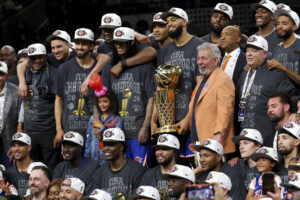
Jalen Brunson was named Finals MVP, wrapping up the series with 45 points in Game 5. He was overwhelmed by the moment in a post-game interview on ABC (Twitter video link), taking a long time to compose himself before calling it “everything I ever dreamed of.”
With a huge contingent of Knicks fans cheering them on after making the trip to San Antonio, Brunson said the championship is “the reason I came to New York” as he accepted the Bill Russell NBA Finals MVP Award.
Head coach Mike Brown thanked owner James Dolan and team president Leon Rose before giving a shout-out to New York fans for their support. Sources tell NBA insider Chris Haynes that the Knicks plan to fly back to New York City tonight to continue their celebration (Twitter link). Dolan implored New Yorkers to be safe and said the championship parade will be held on Thursday (Twitter link via Brett Siegel of ClutchPoints).
Saturday’s game followed a familiar pattern as San Antonio built a large early lead before the Knicks began to chip away. New York scored just 13 points in the first quarter as the Spurs flashed a dominant defense built around Victor Wembanyama patrolling the paint. San Antonio kept the lead for most of the game, but the Knicks put together another late rally led by Brunson, who finished 14-of-27 from the field and 4-of-7 from three-point range.
Mikal Bridges (14 points), Josh Hart (13) and OG Anunoby (11) were the only other Knicks players to hit double figures, but Brunson made plenty of big shots with the game in the balance. It was a difficult night for Karl-Anthony Towns, who was in foul trouble all game and finished with two points and 10 rebounds in less than 23 minutes.
Rookie guard Dylan Harper carried the offensive load for the Spurs, posting 25 points, five rebounds and four assists in 31 minutes off the bench. Wembanyama contributed 19 points, 14 rebounds and five blocks.
“We weren’t ready to win an NBA championship,” Spurs coach Mitch Johnson said after the loss, per Siegel (Twitter link). “The better team won. We did a lot of good things, and we didn’t finish the job. That’s what it is.”
Even though the series lasted just five games, it will go down as one of the most competitive in NBA Finals history, according to Mike Vorkunov of The Athletic (Twitter link). New York outscored San Antonio by just 12 total points, which is tied for the closest Finals ever that went five or fewer games.
The Knicks also set a record with the longest drought between championships, notes Law Murray of The Athletic (Twitter link), breaking the old mark of 50 years held by Milwaukee (1971-2021).
The long-awaited title is the result of several gutsy moves by Rose and the front office, states Kevin O’Connor of Yahoo Sports (Twitter link). Rose made the decision a year ago to fire head coach Tom Thibodeau, who had just taken the team to the conference finals, and replace him with Brown, who was dismissed by Sacramento in the middle of last season.
Rose’s transformation of the Knicks from a perennial loser to a title contender began with the 2022 signing of Brunson in free agency, but it also included ambitious trades that brought in Anunoby, Hart, Towns and Bridges, as well as smaller moves to pick up Landry Shamet and Jose Alvarado.
“I found a home in New York,” Hart said during the post-game celebration (Twitter link from James L. Edwards of The Athletic). “They embrace for who I am, and I’m not perfect.”
As always, the end of the NBA Finals marks the beginning of the league’s offseason. Starting Sunday, teams will be permitted to negotiate with their own free agents and extension-eligible players — contract agreements reached before the end of the month with those players can be officially finalized in July. Trade restrictions are also lifted, as all 30 teams are now able to make deals.
The major decision for New York in its quest to repeat will be how to handle Mitchell Robinson as he approaches unrestricted free agency. Robinson is the longest-tenured Knick and an indispensable part of the second unit, but the team already has a very expensive roster in place. Jordan Clarkson and Shamet will also be unrestricted free agents, while Alvarado holds a $4.5MM player option.
The Spurs’ roster is more stable as most of their rotation is on low-cost rookie deals. Wembanyama, Devin Vassell and Keldon Johnson will all be extension-eligible this summer, as will Julian Champagnie, whose contract includes a $3MM team option for next season. It will be interesting to see whether San Antonio decides to explore trade opportunities involving De’Aaron Fox, who suffered through a difficult Finals and has a four-year, maximum-salary extension that’s about to kick in. That contract is worth a projected $221.76MM.
The Spurs and Thunder are listed as the early co-favorites for next year’s title by DraftKings, relays Bill Speros of The Boston Herald (Twitter link).
Franz Wagner Hopes To Move Past Injury Issues
Magic forward Franz Wagner is coming off the most frustrating season of his NBA career, as a recurring left high ankle sprain caused him to miss 48 games. In an interview with Cyro Asseo of HoopsHype, Wagner talks about the difficulty of not being able to overcome the injury and admits it might have been a mistake for him to play when the team visited his native Germany on January 15.
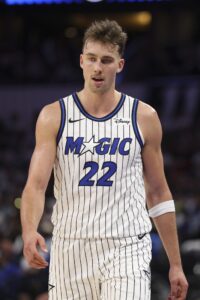 “It was very challenging. At the end of the day, if we’re not healthy as athletes, we can’t do our jobs, so that’s the most important thing,” Wagner said. “And so there’s always that pressure that you need to be out there and perform and help the team out. So not being able to do that and not seeing the results in rehab, too, when you’re going really hard, it was really frustrating for me. And basically, trying to rehab the same injury three times in a year was tough for me, always having the same kind of setback feeling.
“The way it went, I probably shouldn’t have played (in Germany). Everybody understands the situation that it was, and honestly, I hate to say it, but I don’t really regret the decision to play. It was that special of a moment for me, and for a lot of other people who were there. So, it just happened to be a bad moment in time, probably, but maybe some people hate me for this, but it was a really special moment for my family and me. So, I was happy that I got the chance to at least be out there.”
Wagner’s season got off to a promising start, as he averaged 23.4 points, 6.2 rebounds, and 3.8 assists in his first 23 games. He suffered the injury in the next contest and sat out 16 straight games before returning for a pair in Berlin and London. He was sidelined for another nine games after that, then came back on February 9 and 11 before experiencing another setback. He returned for six games in April, then played the first four games of a playoff series against Detroit before suffering a right calf strain.
Wagner addressed several more topics in the interview. Here are a few highlights:
Playing in front of the Berlin crowd a few months after capturing gold at EuroBasket:
“You gotta understand, basketball is a very much growing sport in Germany, and we have had great success with the national team these last couple of years. So in my mind, I’m trying to capitalize on the moment a little bit, and the game in Berlin was a big part of that. Like I said, we need as many people, as many kids starting the sport to play, and that’s kind of the whole goal of this, to grow the sport at home. And moments like that, I know I would have killed to be at an NBA game when I was a kid. So, I know how special it was for everybody who was there.”
His offseason approach to avoid more injuries:
“It’s rehabbing first of all, the injuries that I did have, and then sort of addressing some of the patterns, maybe why injuries keep coming up. That’s the goal: that you’re not hurt at all, and not just treating symptoms when they come up, but taking preventive measures. I have a great amount of time now in the summer to do some of that.”
The coaching change in Orlando, with Spurs top assistant Sean Sweeney replacing Jamahl Mosley:
“For sure, it’s very exciting for all of us. We’ve played pretty much the same core together for five years, and it’s gonna be a lot of change in the building next year. I haven’t met Sweeney yet in person, but just texting back and forth, you can feel the excitement from him too. And it speaks to his work ethic as well as character. Getting a job that young is not easy. It hasn’t been too much; he’s still in the Finals. I also want to respect that, but we’re all really excited for next year.”
Nikola Topic Undergoes Back Procedure, Expected To Be Ready For Training Camp
Nikola Topic has undergone a minimally invasive surgical procedure on his spine, the Thunder announced on Saturday. The second-year guard won’t be available for Summer League, but the team expects him to be healthy when training camp opens in late September.
Team medical personnel were present for the lumbar microdiscectomy, which was performed by Dr. Andrew Dossett in Dallas. It involves making small incisions to fix a bulging disk in the lower back, according to Jeff Patterson and Joe Mussatto of The Oklahoman.
The procedure is the latest in a string of health-related misfortunes for Topic, who was selected with the 12th pick in the 2024 draft. He suffered a torn ACL prior to the draft that forced him to miss his entire first season, then he received a testicular cancer diagnosis last fall that necessitated another operation followed by chemotherapy.
After recovering, Topic made his NBA debut on February 12 and played in 10 games during the regular season, averaging 5.2 points and 4.4 assists in 16 minutes per night. He also made brief appearances in nine playoff games.
Topic was a major star in Europe before deciding to come to the NBA and was viewed as a potential high lottery pick prior to the ACL injury. He could have a much larger role next season if he makes a full recovery and stays healthy, particularly if the Thunder make some cost-cutting roster moves this summer.
NBA Finals Notes: Game 5, Wembanyama, Dynasty, Kornet
After watching their team rally from a 29-point deficit and pull out an improbable victory in the closing seconds of Game 4, Knicks fans lingered inside Madison Square Garden on Wednesday and celebrated like they had just won the championship, writes Steve Popper of Newsday (subscription required). However, the players and coaches can’t afford to get caught up in that jubilation, as they still need one more victory to close out the series.
“It is hard. We’re all human,” coach Mike Brown said. “It was hard even in the series that we swept. You win two, three, four, five games in a row, there’s a tendency to relax a little bit. That’s just in life. In your job, you have success for 10 months straight, maybe you feel like, I got this, I know what I’m doing. You’re not as sharp then because everybody’s been patting you on your back and telling you how great you are. Trying to manufacture things to help guys lock in, trying to talk to guys individually so they can continue to talk to their teammates to lock in, all that stuff is huge.”
Popper notes that the coaching staff had plenty of video to review with the players over the past two days of the mistakes that enabled the Spurs to build that huge advantage. San Antonio has charged out of the gate faster in every game of the series, holding leads of eight, nine, 11 and 19 points after the first quarter.
“We know they come out with a lot of energy,” Josh Hart said. “They’ve been doing it all playoffs. We’ve been very up and down with that a lot this year. So we’ve got to make sure we come in focused with a great attention to detail and taking things a possession at a time.”
There’s more on the NBA Finals:
- The Knicks have been able to wear down Victor Wembanyama by forcing him to switch onto dangerous shooters and not letting him relax in the lane, observes Jared Weiss of The Athletic. A “veer” attack has caused Wembanyama to guard Jalen Brunson on 27.9 partial possessions throughout the series, which brings him away from the basket and causes the rest of the defense to rotate.
- New York fans are hoping for a potential dynasty, but Ryan Dunleavy of The New York Post cautions them to enjoy this year and not get caught up in the future. He points out that the Knicks don’t have the kind of transcendent superstar that dynasties are usually built around, and 17 teams currently have younger rosters. Dunleavy suggests the upstart Spurs are a better dynasty candidate.
- Spurs coach Mitch Johnson confirmed that backup center Luke Kornet has been cleared to play in Game 5 after being listed as questionable with an illness (Twitter video link from Spurs Nation). “I didn’t hear about it in Game 4,” Johnson said in his pregame press conference Saturday. “He’s been sick, but he’s getting better, and he’ll be available tonight.”
Rich Paul Says 10-12 Teams Have Inquired About LeBron James
Appearing Friday on The Pat McAfee Show (Twitter video link), LeBron James‘ agent revealed that there’s already significant interest in his client if he decides to leave the Lakers. Rich Paul of Klutch Sports said at least 10 teams have expressed an interest in signing James if he can’t work out a new contract with L.A. before the start of free agency on June 30.
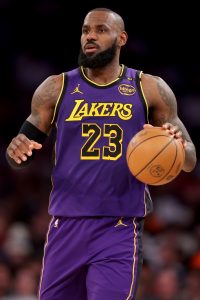 “There have been incoming calls from every team with the excitement of possibly him playing for them,” Paul said. “So, at 41 years of age, going on 42, that’s something to be extremely proud about, and it’s one of those things that’s like ‘Wow, even at 42 I’m still wanted.’ That’s admirable. Without naming names, I would say about 10, 12 teams.”
Although Paul didn’t identify any of the suitors, a couple of potential destinations have been widely reported. There has been repeated speculation that James might want to end his career playing alongside Stephen Curry with the Warriors after they joined forces to win a gold medal on Team USA in the 2024 Olympics. Steve Kerr coached that team, and James has a strong relationship with Draymond Green, so it may be a logical next step. However, Golden State’s offer would be limited to around $15MM through the mid-level exception unless there’s a sign-and-trade or a massive roster overhaul.
It’s also been suggested that James would like to return to Cleveland, where he was drafted in 2003 and delivered the city’s only NBA title in 2016. But the Cavaliers already have an expensive roster in place and wouldn’t be able to offer more than a veteran’s minimum deal without making significant roster changes.
Age hasn’t been a factor yet for James, who’s coming off his 22nd straight All-Star appearance and might have challenged for All-NBA honors if he had reached the 65-game minimum. He averaged 20.9 points, 6.1 rebounds and 7.2 assists per night in 60 games and helped the Lakers claim the fourth seed in the West. With Luka Doncic unavailable and Austin Reaves also dealing with an injury, James led L.A. past Houston in the first round of the playoffs before the club fell to Oklahoma City.
With the start of free agency a little more than two weeks away, leaguewide chatter regarding James’ next destination has already started to heat up. However, Paul told McAfee that none of the reports so far have any basis in fact, and he repeated that message on his Game Over podcast on the Ringer (Twitter video link).
“There’s nobody that knows anything about anything that pertains to LeBron,” Paul said. “All these reports, nobody knows. They’re just speculating. They put out salaries, nobody knows. There’s been zero conversations and there won’t be conversations until I have a conversation with the man himself.”
Spurs Notes: Wembanyama, D. Green, Bryant, Harper, M. Johnson
Warriors forward Draymond Green believes Spurs star Victor Wembanyama deserves to be suspended for his actions throughout the playoffs, relays Ryan Dunleavy of The New York Post. Green, who’s working as a studio analyst on ESPN’s coverage of the NBA Finals, made the remarks on the latest edition of his podcast (Twitter link).
“Listen, I’m not one that wants to see series decided by suspensions,” Green said. “That’s not good for anyone. It leaves a lot of questions, a lot of what-ifs. I don’t enjoy that. I will say, he’s been shown a lot of grace. He probably should be suspended at some point – or (should) have been already – but he’s been shown a lot of grace.”
Wembanyama is one flagrant foul point away from triggering an automatic suspension after being whistled for a flagrant 1 for elbowing Karl-Anthony Towns in the chin during Wednesday’s game. Wembanyama could have been assessed another flagrant 1 for shoving Jalen Brunson in the back of the head during Game 3, but the NBA opted not to impose a penalty.
Green, of course, has a long history of his own with league discipline, having been suspended six times during his career, including Game 5 of the NBA Finals in 2016. Even though he supports suspending Wembanyama, he understands that the league office doesn’t want to decide the series.
“I wish the NBA would just come out and say, ‘In most cases, this probably should be a suspension, but it’s not because we want our best in the NBA Finals and that’s the way it should be,’” Green added. “And I agree with that.”
There’s more from San Antonio:
- Wembanyama has been a huge influence on rookie Carter Bryant, Tom Orsborne of The San Antonio Express-News writes in a subscriber-only story. The French star has helped the 20-year-old forward adjust to NBA life, frequently offering advice during long flights. “Me and Vic sit next to each other on the plane, so we’ve had a ton of conversations, whether that was easy conversations, hard conversations, just me checking up on him, him checking up on me,” Bryant said. “Sometimes you need a brother to lean on, somebody to hug and somebody to spill out your emotions to and your words to. We’ve both been there for each other. I’m super grateful for Vic.”
- A larger role for Dylan Harper could help the Spurs salvage the series, suggests Steve Aschburner of NBA.com. The rookie guard is averaging 16.3 PPG off the bench during the Finals and has been outplaying De’Aaron Fox. However, coach Mitch Johnson still seems inclined to lean on Fox’s experience in crunch time.
- Johnson believes the Spurs lost their focus in the third quarter of Game 4, which planted the seeds for New York’s dramatic comeback, per Kelly Iko of Yahoo Sports. “There [were] a lot of things that we did, where it felt like we could have put our energy into the right spots in that third quarter,” San Antonio’s head coach said. “Some things that I could have done to help that, as well. I think that quarter probably was the most disappointing for me. There’s some learning things in every quarter, don’t get me wrong, some things we want to be sharper with, better at, finish games. We weren’t as connected and disciplined as we should have been.”
Draft Notes: Lendeborg, Warriors, Wilson, Suder, Kayil
Former Michigan forward/center Yaxel Lendeborg worked out for the Warriors on Thursday and believes he’d be a great fit with Golden State, writes Dalton Johnson of NBC Sports Bay Area. Lendeborg is a projected late lottery pick and the Warriors hold the 11th overall selection.
“I would say, like five assists a game maybe to start off,” Lendeborg said. “A lot of defense, fast-break opportunities for me. Depending on if I’m here or anywhere else, my role will be a lot different. But if I was here, I’ll be more like a secondary ball-handler. Whenever Steph [Curry] is taken out of the game, I’ll be there to assist, maybe provide a little more offense or instant offense.”
In addition to the Warriors and Thunder (Nos. 12 and 17), Lendeborg has also worked out for the Heat (No. 13), Bucks (No. 10), Hornets (Nos. 14 and 18), and Mavericks (No. 9), and has upcoming workouts with the Clippers (No. 5) and Hawks (No. 8), Johnson notes.
“In a way, it kind of makes me envision myself playing on a team like this, Charlotte, the Heat, all those teams that I’m getting mocked to,” Lendeborg said. “It kind of gives me something to get attached to. I can’t get too attached, though. If I don’t get drafted by any of them, I don’t want to be upset. Either way, it’s nice to see and it’s a blessing to be part of this.”
Here’s more on the 2026 NBA draft:
- While North Carolina’s Caleb Wilson is viewed as a less-polished offensive player compared to fellow top prospects Cameron Boozer, Darryn Peterson and AJ Dybantsa, he expressed confidence in his shooting and passing ability at last month’s combine, as Chase Hughes of Monumental Sports Network writes. “People don’t think I can really shoot, which is kind of funny to me. I really work on it and I can shoot,” Wilson told reporters. “I didn’t have the best numbers this year, but it was an interesting situation because that’s not what I was asked to do at the college I was at. I was just doing what I needed to do to help us win. People that say I can’t shoot, I feel like that’s interesting, but I’ll prove it over time. It doesn’t really matter.”
- Peter Suder was considered a relatively unheralded prospect when he was invited to the combine, but NBA teams have grown familiar his game over the last couple months, per Grant Afseth of Ballislife.com. “I’ve done 17 (pre-draft) workouts so far and have five more through June 20,” Suder told Afseth. “One of the main things I’ve learned is that it’s your job now. That’s how it’s treated at the next level. It’s not really like recruiting in college. You go in, show what you can do, and then move on to the next workout. The main thing I’m working on right now is movement shooting and different types of catch-and-shoot situations. I’m just trying to perfect that skill for the next level.” The former Miami Redhawk, a 6’5″ guard, was named MAC Player of the Year as a senior last season and is ranked 93rd on ESPN’s big board.
- German guard Jack Kayil is keeping his name in the draft, agent Milan Nikolic confirmed to Jonathan Givony of DraftExpress (Twitter link). Givony reported a month ago that the projected second-round pick planned to stay in the draft as an early entrant.
Cavs’ Riley Minix Reportedly Nearing Deal With ASVEL
Cavaliers forward Riley Minix is close to signing a contract with ASVEL in France, according to a report from Blazo Komnenic of Meridian Sport (hat tip to Eurohoops).
After going undrafted out of Morehead State in 2024, Minix initially signed an Exhibit 10 training camp contract with San Antonio and was promoted to a two-way deal shortly before the 2024/25 season began.
The 25-year-old only played seven minutes in one game as a rookie with the Spurs, but he was a steady contributor for the team’s G League affiliate in Austin, averaging 19.3 points, 6.6 rebounds, 2.1 assists, 1.2 steals and 1.2 blocks on .524/.414/.853 shooting in 19 games (31.6 minutes per contest).
Minix returned to the Spurs on a two-way contract last summer and appeared in three games with the club in 2025/26 before being waived in mid-December. He signed a two-year, two-way contract with Cleveland in February, making six appearances for the Cavs late in his second season.
In 34 NBAGL games (31.9 MPG) with the Austin Spurs and Cleveland Charge in 2025/26, Minix averaged 18.0 PPG, 6.6 RPG, 3.0 APG and 1.3 SPG on .519/.428/.800 shooting splits.
While Minix is technically under contract for 2026/27, his two-way deal is non-guaranteed, and it wouldn’t be surprising if the Cavaliers permit him to pursue an overseas opportunity. Signing with ASVEL would represent Minix’s first stint in Europe.